How to Groom a Cat at Home, Even One That Hates It
A vet-informed guide to grooming a cat at home: tools for different coats, a practical checking routine, gentle handling, and when to stop or seek professional help.

This article contains affiliate links. Webvet may earn a commission when you buy through them, at no extra cost to you.
Knowing how to groom a cat comes down to four decisions: which tools you actually need, how long a session should run, how to hold a cat that would rather not be held, and when to stop. Get those right and grooming becomes a short habit your cat tolerates.
This guide covers how to groom a cat at home from the first brush stroke to putting the tools away, including the cat that hisses, bolts, or bites. Nothing in it asks you to hold a cat down or finish a job the cat has told you to stop.
Cats do most of their own coat care. A cat's tongue is covered in backward-facing keratin spines that pull loose hair out of the coat, which is why so much of it ends up swallowed. Cats living together also groom each other, a social behavior called allogrooming that is mainly about bonding rather than cleaning.
 Sponsored
Want a vet's help with your cat's anxiety or behavior?
Talk to a licensed vet at Dutch over video, often the same day. They can recommend treatment and prescribe it when it's appropriate.
Use code Pets30
Plans start at $11/month · covers up to 5 pets
- Licensed vets in most states
- Rx for 150+ conditions
- 4.7 on Trustpilot
How to groom a cat at home, step by step
Your job is the part the tongue cannot reach. To groom a cat at home, run every session in the same order: settle the cat, brush with the coat, comb through to the skin, check ears, eyes and paws, then stop while the cat is still relaxed.

- 1Choose tools for the actual coat and handling tolerance.
- 2Long, silky, or curly coats commonly need daily attention; shorter coats may need less frequent grooming.
- 3Work in comfortable sections and stop if the comb catches or pulls skin.
- 4Use a loosely folded towel only if accepted. Never scruff, pin, or wrap a struggling cat to finish.
- 5Tail lashing, flattened ears, tension, or attempts to leave mean stop. Warning signs have no fixed order.
Use the table to plan grooming frequency, priority areas, and comfortable stopping points. The amount completed in one sitting depends on the individual cat; there is no validated minute target for every coat type.
| Coat or life stage | Checking routine | Focus | Session limit |
|---|---|---|---|
| Short-haired adult | Regular checks; often one or two grooming sessions weekly | Loose fur, skin, ears, and paws | Stop before irritation |
| Medium coat | Daily check; groom as needed | Ruff and friction areas | Comfortable sections |
| Long coat | Daily attention commonly needed | Brush and comb hidden areas | Split work when needed |
| Kitten | Frequent brief handling | Soft brush and gentle touch | A few accepted touches may be enough |
| Senior or arthritic | Daily check of missed areas | Comfortable positioning | Stop at discomfort |
| Overweight cat | Check hard-to-reach areas | Rump and hygiene | Avoid force |
| Hairless cat | Individual skin-care plan | Skin and nail beds | Stop at irritation |
| Heavier shedding | Check accumulating loose hair | Suitable tools | No automatic extra minutes |
VCA recommends daily brushing for long, silky, or curly coats. There is no universal timed session for every cat; comfort sets the limit.
None of them are rules. A cat that mats between sessions needs more than the table says, and one that stays sleek on a weekly comb-through does not need daily attention.
Senior cats with arthritis, overweight cats, and cats with other health problems may struggle to reach parts of their coat. Help gently with those areas, and arrange a veterinary check when self-grooming changes rather than assuming age or weight is the only cause.
Grooming routines by breed and coat type
Cats groom themselves for a large part of each waking day, and allogrooming between bonded cats focuses on the head and neck. Your sessions add to that work rather than replace it.
The same session order works for every coat. What changes by breed or coat type is the tool and how often you groom:
- British Shorthair: a dense, plush coat. To groom a British Shorthair cat, comb through to the skin weekly with a steel comb, and more often during seasonal shedding.
- Russian Blue: a short, fine double coat. To groom a Russian Blue cat, a rubber glove or soft brush once a week is usually enough.
- Selkirk Rex: a curly coat that can mat. Selkirk Rex cat grooming means gentle combing a few times a week, without brushing the curl flat.
- Double coated cats: line brush and comb to the skin so the undercoat is cleared, not just the top coat.
Which grooming jobs are yours, and which belong to a groomer or vet
Most of the routine is an owner job. The exceptions are the ones where a blade comes near skin, or where the cat has to be held still to get it done.
- Owner job: brushing, combing, deshedding, a flea comb pass, nail tips, toothbrushing, and the ear, eye, and paw check.
- Owner job with care: routine brushing, combing loose tangles only while the comb moves without pulling, and wiping away minor surface soiling. Leave sanitary haircuts and firm mats to a cat-experienced professional.
- Groomer or veterinary-team job: sanitary haircuts, full-body clips, lion cuts, and widespread matting. If handling is painful or the cat cannot stay comfortable, ask your veterinarian to plan the care rather than increasing restraint.
- Vet job: sedation of any kind, a sore or broken skin surface under a mat, a swollen or smelly ear, and a cat that has stopped grooming itself.
- Either professional: a cat that has bitten you, because the next attempt is a health risk to you as well as a welfare problem for the cat.
What a full session covers, in order
Run the same sequence every time. A cat that knows what comes next settles faster than one being surprised by a new tool each week.
- Pick your moment. A cat that has just eaten or just woken from a nap is far easier to handle than one mid-zoomies.
- Let the cat see and sniff the tools before anything touches it.
- Start where cats like being touched: cheeks, chin, along the shoulders, and down the back.
- Brush the body in the direction the coat grows, in short strokes, working front to back.
- Comb through in sections, parting the coat so the teeth reach the skin.
- Leave the sensitive zones until last: belly, armpits, back legs, and the base of the tail.
- Check ears, eyes, and paws while your hands are already on the cat.
- Stop before the cat asks you to, and finish with something it likes.
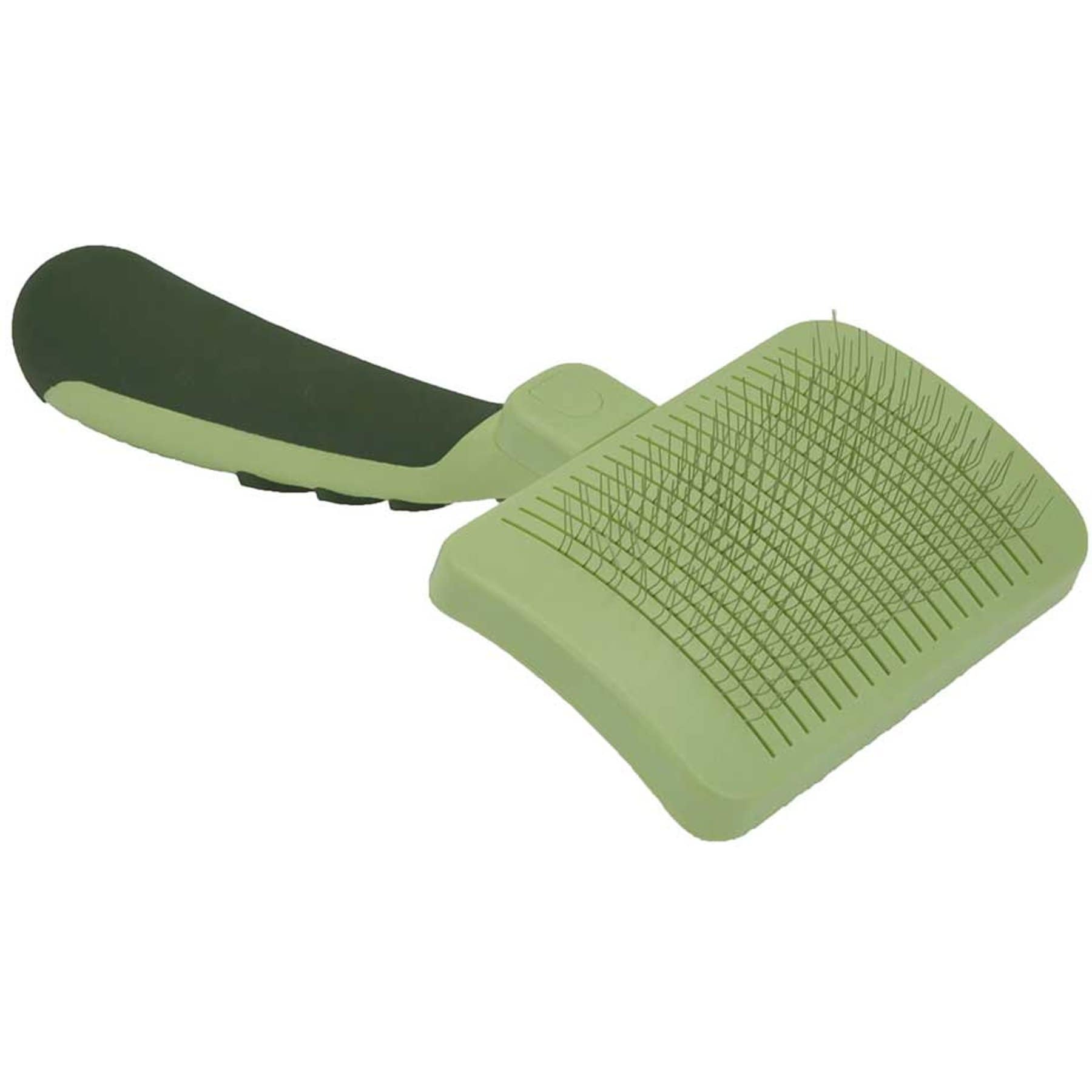
Coated pins and push-button cleanup for cats that tolerate gentle slicker grooming.
Webvet may earn a commission when you click through to Chewy, at no extra cost to you.
Line brushing: brush with the coat, then comb to the skin
Brush in the direction the hair grows. Backward strokes feel wrong to most cats, drag at the follicles, and are the fastest way to teach a cat that brushing is unpleasant.
A brush only manages the top coat. The comb is what tells you whether there is anything underneath, and on any cat with an undercoat, underneath is where mats begin.
Line brushing is the technique that gets you there, and it is the one thing most home routines are missing.
- Sit the cat with one flank facing you and work that side only.
- Part the coat horizontally, low on the flank, so a line of skin shows.
- Comb the hair below the parting outward from the skin in short strokes until it lifts cleanly.
- Move the parting up about a finger's width and repeat, working toward the spine.
- Change sides only if the cat is still relaxed. Otherwise leave the second flank for tomorrow.
Use a visible parting to check beneath the surface coat without scraping the skin. A smooth comb pass is useful; a snag means stop and inspect, not press harder.
When the comb stops on something, do not pull. Take your fingers to it first, and if it will not open, treat it as a mat rather than a tangle.
The ear, eye, and paw check that belongs in the same session
Grooming is also the only regular head-to-tail look you get at your cat. Folding the checks into the same few minutes is how you find problems while they are still small.
- Ears: look for a clean, pale pink canal. Dark crumbly debris, a yeasty smell, or head shaking is a vet visit, not a cleaning job. Never push a cotton bud into the canal.
- Eyes: a little clear discharge in the inner corner is normal, especially on flat-faced breeds. Colored discharge, squinting, or a cat rubbing at one eye is not.
- Paws: check between the toes for litter clumps, grass seeds, and cracked pads. Long-haired cats grow tufts between the pads that mat and make floors slippery.
- Skin: run your fingers against the coat over the spine, rump, and belly, feeling for scabs, lumps, flakes, and tangles you cannot see.
- Rear end: on a long coat, check the fur under the tail is clean. Trapped waste is uncomfortable and a common reason a cat starts avoiding the litter box.
- Mouth: lift a lip once a week. Red gum lines, brown build-up, and a sudden smell all matter.
Note anything you find and where it was. One flake means nothing. The same greasy patch over the rump three weeks running is worth a photograph and an appointment.
Which cats stop grooming themselves, and what that looks like
The pattern is specific. The head, chest, and front legs stay clean, because the cat can still reach them with its tongue and forepaws. The lower back, rump, and base of the tail go first.
This is the group least able to tolerate being held in position, so the sessions get shorter rather than longer. Dental pain does the same thing from the other end: a sore mouth makes grooming itself uncomfortable, and the whole coat dulls.
The grooming tools worth owning, and what each one does
Four tools cover almost every domestic cat: a slicker brush for the top coat, a stainless steel comb for everything underneath, a rubber glove or curry for short coats and nervous cats, and a fine-toothed flea comb. Everything after that is coat-specific.

The table below is the named kit in one place: each tool, the job it does, the coat it suits, and the damage it causes on the wrong one. The complaint that runs through owner forums is not that grooming fails, it is that the recommended tool hurt the cat.
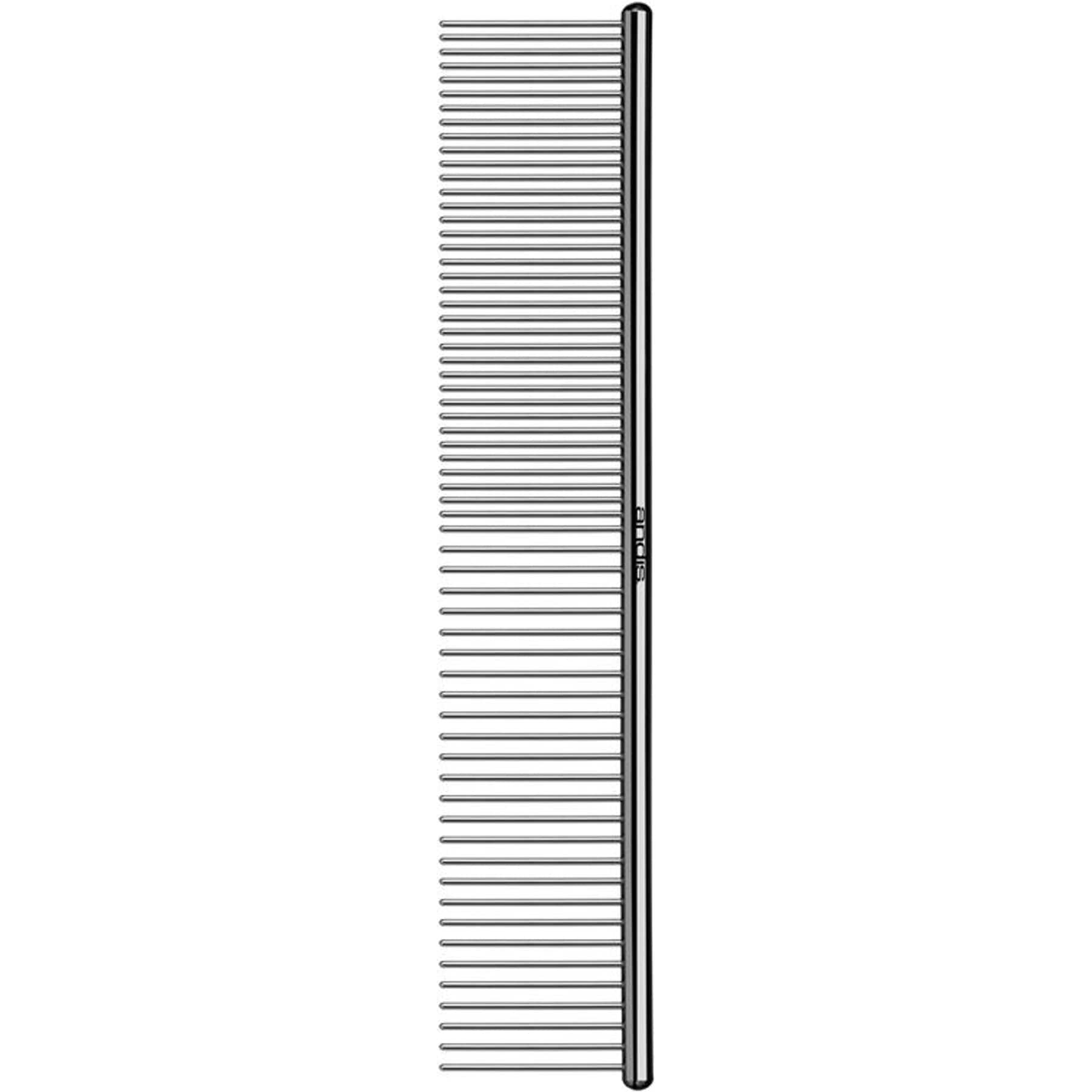
Two tooth spacings help check loose coat and minor tangles without pulling through snags.
Webvet may earn a commission when you click through to Chewy, at no extra cost to you.
| Tool | The job each tool does | Coat it suits | What goes wrong on the wrong coat |
|---|---|---|---|
| Slicker brush (fine bent wire pins) | Lifts loose hair and opens light tangles in the top coat | Medium to long coats, and short coats with a light hand | Pins scratch thin or sparsely covered skin, and pressure on a short coat leaves red, sore patches |
| Stainless steel comb, wide and fine teeth (greyhound comb) | Reaches the skin, finds mats before you can see them, finishes what the brush started | Every coat, and the only honest test of whether a coat is clear | Forced through a mat it pulls skin; work the mat with fingers first or stop |
| Grooming glove or rubber curry brush | Collects loose hair with a stroking motion that feels like being petted | Short coats, kittens, and cats that refuse a firmer tool | Barely touches a dense undercoat, so mats keep forming under a coat that looks fine |
| Fine-toothed flea comb | Pulls fleas, flea dirt, and grit out of the coat close to the skin | Every coat, worked over the rump, tail base, and neck | Snags and pulls in a long coat that has not been combed through first |
| Undercoat rake | Thins dense, packed undercoat during a seasonal coat blow | Thick double coats: Maine Coon, Siberian, Norwegian Forest type | Cuts guard hairs and thins a single-coated cat down to patchiness |
| Deshedding tool with a blade edge | Strips dead undercoat faster than a comb can | Heavy shedders during a coat blow, used sparingly | Repeat passes over one spot cut healthy coat and can catch skin over hips and shoulders |
| Mat splitter or bladed dematting comb | Cuts hair within a mat | Trained professional use on an assessed coat | Can cut skin; a gap beneath a mat does not establish safety |
| Professional pet clippers | Remove coat that cannot be combed comfortably | Individually assessed needs | Blade choice requires training; guards do not make mat removal safe |
| Cat nail clippers | Blunts the claw tips that make handling risky for both of you | Every cat | Human nail clippers crush rather than cut, and split the claw |
| Cat toothbrush and enzymatic paste | The part of grooming with the clearest long-term health payoff | Every cat | Human toothpaste is not made to be swallowed and should never be used on a cat |
The slicker brush
The slicker is the tool most owners buy first and the one most often used too hard. The pins are fine bent wire, and they work by lifting hair away from the coat rather than by scraping skin.
Look for coated pin tips and a self-cleaning head. The self-cleaning plate matters more than it sounds. A slicker that clogs after two strokes turns a three-minute session into a six-minute one, and the extra three minutes are exactly the ones your cat runs out of patience for.
A researched, vet-informed choice for most households is the Safari Cat Self-Cleaning Slicker Brush, which has a retracting pin plate so collected hair comes off in a single push.
- Hold the brush flat against the coat rather than tipped onto one edge of the pins.
- Let the weight of the tool do the work. Pressure is what causes brush burn, not the pins themselves.
- Stop the moment you see pink skin showing where you have been working.
The steel comb
If you own one tool, own this one. A stainless steel comb with a wide-toothed half and a fine-toothed half is the only way to know whether a coat is genuinely clear or merely smooth on top.
The JW Pet GripSoft Cat Comb is a widely sold handled steel comb for medium and long coats, with rounded tooth tips, and rounded tips matter on a cat that flinches.
Work the wide teeth first, then the fine teeth over the same area. Anything the fine teeth stop on is a tangle that needs your fingers before it needs metal.
The grooming glove or rubber curry
For a cat that treats a brush as an assault, a glove is the way in. It feels like being stroked, and it lifts a startling amount of loose hair off a short coat with no tool in sight.
Its limit is the undercoat. A glove will keep a short-haired cat and your sofa in decent condition, and it will do almost nothing about the packed layer under a long coat.
The flea comb
A flea comb is not only a parasite tool. The teeth sit close enough together to catch grit, dried skin, scabs, and the first stage of a tangle, which is why it belongs in the weekly routine rather than in a cupboard for emergencies.
The undercoat rake and coat blow season
Use a deshedding tool only on a suitable, dry coat after gently removing tangles. Follow the specific model's directions for frequency and pressure.
What you do not need
- A human hairbrush. The bristle spacing is designed for human hair, it skims the top coat without lifting undercoat, and un-rounded tips scratch.
- Scissors. There is no safe home use for scissors in a cat's coat, and cutting at a mat is the most common way owners cut a cat.
- Anything perfumed. Scented sprays, wipes, and colognes give a cat a strong reason to avoid the whole ritual.
- A restraint bag as a first resort. Grooming bags exist, but reaching for one in week two teaches a cat that grooming means being contained.
- Clippers for home mat removal. A guard comb does not protect skin folded into a mat; leave firm mats and close clipping to a cat-experienced professional.
How to groom a cat that hates being groomed
You do not win this with a better grip. You win it by making sessions so short that the cat never reaches the point of protest, and by ending on the first warning signal instead of the third.

Professional groomers are not stronger than you. They read the cat continuously, work in a fixed order, use a towel wrap rather than a grip, and stop when the cat says so. That last part is the one owners skip, and it is the one that decides everything after it.

Watch your cat throughout the session. Tension or avoidance can precede a bite, but signs vary and do not follow a reliable sequence. Stop at the first sign of discomfort rather than waiting for escalation.
| What you see | What it means | What to do right now |
|---|---|---|
| Tail tip flicking or repeated swishing | Possible irritation; interpret with the rest of the body | Pause and stop if tension continues |
| Skin rippling along the back, a sudden turn to look at the brush | The touch has crossed from pleasant into too much | Lift the tool off, pause, and either finish elsewhere or stop |
| Ears turning sideways or flattening back | Defensive. The cat is preparing to protect itself | Stop grooming and release any hold you have |
| Pupils widening, body going still and hard | A freeze response, which is fear rather than cooperation | End the session and give the cat space. A still cat is not a relaxed cat |
| Growl, hiss, or raised paw | Stop even if earlier warnings were absent | Release restraint safely and let the cat leave |
| Grabbing your hand with the front paws and kicking with the back legs | A full defensive response, and how most grooming injuries happen | Release, protect your forearms, and end the session |
| Rolling onto the back with the belly exposed | Rarely an invitation to groom the belly on a cat that is being handled | Treat it as a stop signal, not as permission |
| Purring that starts mid-struggle | Purring is not only contentment. Cats also purr when stressed or in pain | Judge by the ears, tail, and body tension rather than by the purr |
These are the same signals a cat uses everywhere else in the house. Our guide to cat body language covers them outside the grooming session, and the reading transfers directly.
Searching for a cat sedative for grooming is common, and the honest answer is short. Sedation for grooming is a prescription decision, made by a veterinarian who has examined your cat.
A veterinarian may prescribe medication such as gabapentin for stressful handling, with instructions for that individual cat. Do not estimate a dose or timing from a forum post.
- Shorten the session before you consider medicating the cat.
- Change the tool, because a lot of resistance is a slicker used too hard rather than grooming itself.
- Split the coat across several days so no single session runs long.
- Rule out pain first. A cat that objects to being touched in one specific place is often sore there.
- Ask your vet about a referral to a veterinary behaviorist if the fear is severe and generalized.
Do not use Benadryl or another human antihistamine to sedate a cat for grooming on your own. Drug choice, dose, and suitability are veterinary decisions. A product being available without a prescription does not make it an appropriate calming treatment.
The towel wrap: how to hold a cat without scruffing it
Scruffing is out. Gripping the loose skin at the back of an adult cat's neck does not trigger the calm it does in a kitten carried by its mother. In an adult it is a restraint, which is why Fear Free and cat-friendly handling guidance moved away from it years ago.
Offer a stable surface and gentle support, and let your cat leave. These steps may make handling easier, but they do not guarantee cooperation.
- Lay a large towel flat on your lap or on a non-slip surface.
- Set the cat on the towel facing away from you.
- Fold one side of the towel over the cat's back and tuck it lightly under the far side.
- Fold the other side across, leaving the head out and one shoulder or one hip exposed.
- Groom only the exposed area, then unwrap and stop, or re-wrap to expose the next area if the cat is genuinely still settled.
A loosely folded towel can provide support for some cats. It does not prevent bites or scratches and should not be used to overpower a cat or hide its signs of distress.
- Never wrap a cat's head.
- Never wrap tightly enough to press on the chest.
- Never hold a wrapped cat in place once it starts to struggle.
Counter-conditioning: build tolerance instead of winning the session
Counter-conditioning is the unglamorous answer and the one that lasts. You are changing what the brush predicts, from an ordeal into a snack.
- Leave the brush out where the cat lives, so it stops being an event.
- Touch the cat with the back of the brush, give a treat, and put it away. For the first few days, that is the entire session.
- Add one stroke at a time, always ending before the cat wants you to.
- Pair every session with something genuinely high value: a lickable treat, a spoon of wet food, or the exact spot the cat likes being scratched.
- Groom in the same place at the same time of day so the cat can predict it.
- If a session goes badly, drop back two steps rather than trying the same thing again tomorrow.
Progress varies and may take weeks or longer. If fear or resistance persists, ask your veterinary team to check for pain and help plan handling.
A cat that is frightened rather than impatient needs the fear addressed before the coat does. Our guide to calming a stressed cat is the better place to start with that cat.
When to stop and call a vet or a cat-experienced groomer
Painful mats, abnormal skin, and grooming that cannot be completed without distress need professional assessment. Tell the clinic or groomer what happened during previous attempts so they can plan appropriate handling. A different handler is not a guarantee that a frightened cat will tolerate the procedure.
Do not attempt to restrain and groom an unsocialized feral cat using this home routine. Ask a veterinarian experienced with community cats or a local trap-neuter-return group to arrange safe handling and coat care. Alley Cat Allies explains the specialized handling required for community cats. Any sedation must be planned and administered by the veterinary team.
- The cat has bitten or drawn blood in a previous session.
- The coat is matted to the skin over more than a small patch.
- The cat needs a full body clip rather than a trim.
- You cannot get near the rear end and the cat is soiling itself.
- The cat is elderly, arthritic, or unwell and cannot be positioned comfortably.
- You have become frightened of the cat, which changes how you handle it, and the cat can tell.
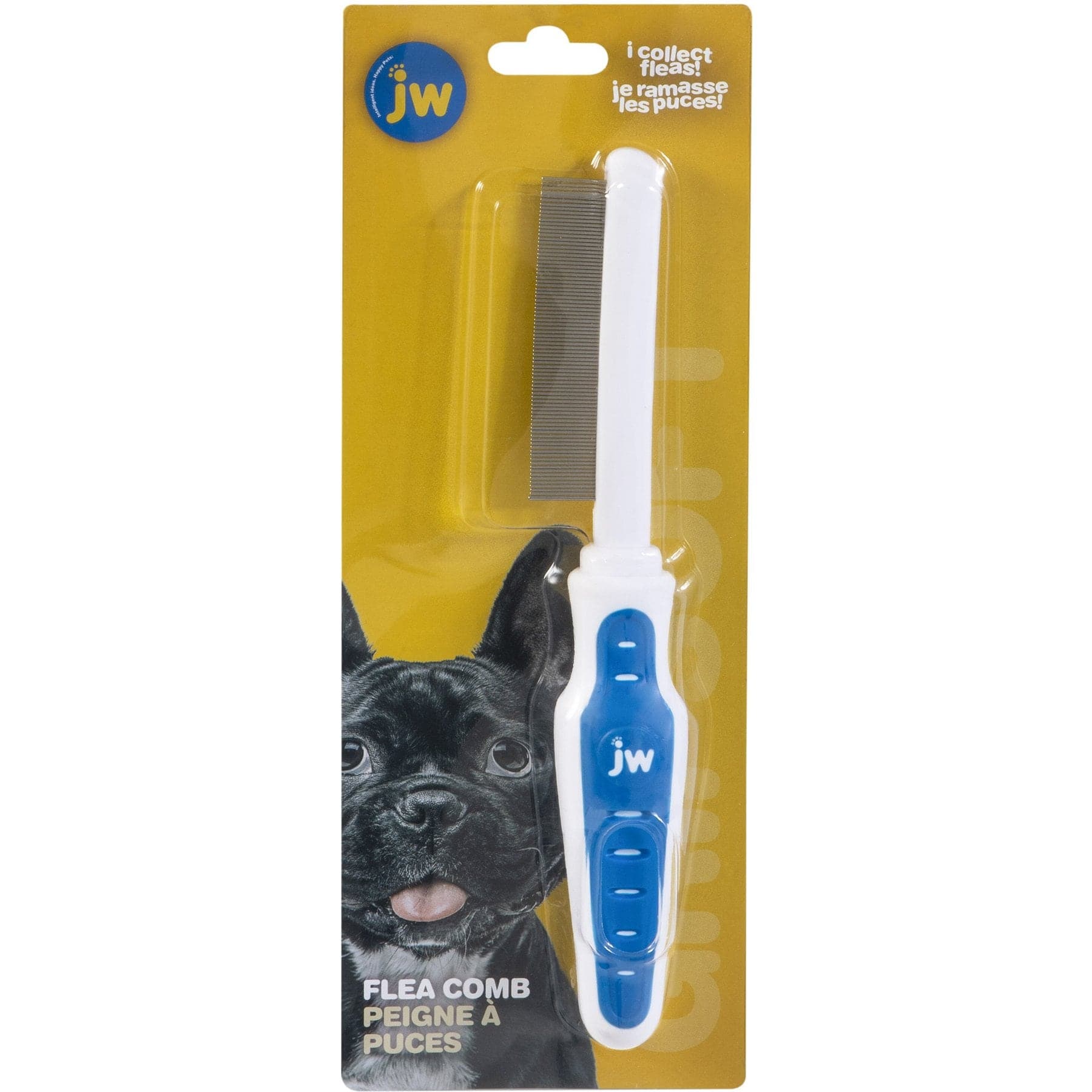
Fine teeth help inspect the coat for fleas or debris; a comb does not replace parasite treatment.
Webvet may earn a commission when you click through to Chewy, at no extra cost to you.
Ask for a groomer who works with cats specifically rather than a mixed salon, or ask your veterinary practice whether they do coat work. Many clinics will groom cats that cannot be handled anywhere else.
SponsoredVet care that's always there
Unlimited video calls and messaging with licensed vets for less than a typical vet visit. One membership covers up to five pets.
Use code Pets30
Plans start at $11/month · covers up to 5 pets
- Licensed vets in most states
- Rx for 150+ conditions
- 4.7 on Trustpilot
Common cat grooming mistakes
The most common cat grooming mistakes are not cosmetic ones. Some of them injure the cat outright. Others do something worse and turn a cat against grooming for good, which is far harder to undo than a cut and is measured in months of rebuilding rather than in one evening.
Most of them come from treating a cat like a small dog. Cats have thinner skin, far less tolerance for being held, and a much longer memory for a session that went wrong. Each common grooming mistake below is set against the correction that fixes it.
| The mistake | What each one costs | The correction: what to do instead |
|---|---|---|
| Scruffing to hold still | Can increase fear and defensive responses | Stable footing and gentle support; loose towel only if accepted |
| Brushing against the direction the coat grows | Drags at follicles, feels wrong, and teaches the cat that brushing hurts | Brush with the coat, front to back, in short strokes |
| Cutting a mat out with scissors | Skin tents up into the mat, so the blade finds skin. These wounds are common and often need stitches | Gently separate easy loose tangles; leave firm mats and clipping to a cat-experienced professional. |
| Using human shampoo, baby shampoo, or dish soap | Strips the coat, leaves skin dry and itchy, and drives more self-grooming and more swallowed hair | Use a shampoo formulated for cats, or skip the bath and use a damp cloth |
| Pushing through a session because it is nearly finished | One bad ending can undo weeks of tolerance and create a cat that hides from the brush | Stop at the first warning signal and do the other side tomorrow |
| Grooming only when the coat looks bad | Tangles can make handling painful | Regular comfortable checks; help before mats become firm |
| Pressing a slicker hard enough to redden the skin | Brush burn, a sore patch, and a cat that flinches at the sight of the tool | Hold the brush flat, let the pins do the work, and check the skin as you go |
| Trimming whiskers | Whiskers are sensory equipment, not decoration. A cat without them misjudges gaps and becomes disoriented | Leave every whisker alone, including those above the eyes and on the backs of the front legs |
| Cleaning inside the ear canal with cotton buds | Pushes debris deeper and can damage the canal or the eardrum | Look, do not poke. Visible debris or a smell is a vet appointment |
| Bathing a cat that does not need one | Removes coat oils, stresses the cat, and rarely improves anything | Bathe only for a specific reason: a substance on the coat, a hairless breed, or a medical instruction |
Cutting a mat with scissors
This is the one that ends in stitches. A mat does not sit on top of the coat. It contracts as it forms and pulls skin up into itself, so what looks like a clump of hair with a gap underneath is often skin tented into the base of the mat.
Cat skin is thin and mobile. By the time you feel resistance on the blade, the cut has already happened. Emergency clinics see these wounds routinely, and they almost always come from an owner trying to help.
Scruffing
This is the one that costs you the relationship. It appears to work because the cat goes still, but stillness in a handled cat is a fear response rather than consent, and the cat remembers it long after you have forgotten.
Human shampoo on a cat
This is the one that quietly makes everything worse. Human products, baby shampoo included, are formulated for human skin and a different oil balance. On a cat they strip the coat and leave skin dry and flaky.
An itchy cat grooms more. A cat that grooms more swallows more hair, and the coat you were trying to improve gets worse while the hairballs get more frequent.
Should you shave a cat? Clippers and lion cuts
Most cats should not be shaved. A coat is insulation against heat as well as cold and it shields skin from sun, so shaving a healthy cat to keep it cool in summer usually makes it less comfortable rather than more.
Coat regrowth after clipping varies with the individual cat, coat, season, and health. There is no fixed number of weeks, and not every patch grows back evenly. Ask the professional who performed the clip what to expect, and contact your veterinarian if the skin becomes irritated or regrowth seems abnormal.

Clipping earns its place for a specific reason: mats that cannot be combed out, a long-coated cat that can no longer keep its rear end clean, a medical instruction, or a coat that has become unmanageable because the cat has stopped grooming.
The line is drawn by how close the blade has to come to skin, and by whether the cat is holding still because it is relaxed or because it has frozen.
- Professional task: a sanitary haircut around the rear end. A guard does not remove the risks from moving skin, folds, or sudden movement.
- Professional task: trimming coat between the pads when it causes problems. Ask for an assessment rather than cutting close to toes at home.
- For any separate home coat-trimming task, get individual instruction from your veterinarian or cat-experienced groomer first. That instruction does not make firm-mat removal a home job.
- Not reasonable: any mat that lies flat against skin, because skin lifts into it and a blade finds skin first.
- Not reasonable: any job that needs the cat held down, because a moving cat and a running blade is how injuries happen.
- Not reasonable: the belly, armpits, and the folds behind the legs, where skin is thinnest and loosest.
- Professional task: a full lion cut. A veterinarian decides whether medication or monitored sedation is needed.
Maine Coons and home clippers
The same rule covers shaving a Maine Coon. When one is shaved, it is usually because of matting or a vet's advice for heat stress, not routine care, and that clip belongs with a professional groomer or veterinary team.
A small pet shaver or kitten clippers sold as cat grooming tools can tidy a little loose fur, but they do not make close shaving at home safe. Cat skin is thin and loose, so leave clipper work near the skin to a professional.
What a lion cut and a sanitary trim actually are
A lion cut is a full body clip that leaves the head, the lower legs, and the tip of the tail in coat. It is done for matting far more often than for looks, and on a heavily matted cat it is frequently the kindest option available.
A sanitary trim is much smaller. The fur around the anus and under the tail, sometimes with the belly, is trimmed short so waste cannot catch. On a long-haired or overweight cat it can solve a litter-box problem on its own.
A comb cut sits between the two, taking the whole coat down to a set length with a guard comb rather than to the skin.
What shaving costs you
Coat does not always come back the way it went. In color-pointed cats such as Siamese and Himalayans the pigment is temperature dependent, so hair regrowing over cooler shaved skin often comes back noticeably darker until the next full coat cycle.
Texture can change too, particularly in older cats and thick double coats, and regrowth can be slow and uneven. A shaved cat also loses its sun protection, which matters for white cats and pale ears.
None of that is a reason to leave a cat in discomfort under a matted coat. It is a reason not to shave a healthy cat because it looks hot.
Choosing a brush for your cat's coat
The right brush is decided by the coat, not by the cat's size or its breed name. A dense double coat needs a tool that reaches the layer under the guard hairs. A fine single coat needs one that does not.
- Short single coat: a rubber glove or curry brush, finished with a steel comb.
- Medium or semi-long coat: a slicker brush plus a steel comb.
- Long double coat: a slicker, a steel comb, and an undercoat rake kept for shedding season.
- Thin, fragile, or elderly coat: a soft pin brush or a glove, and nothing firmer.
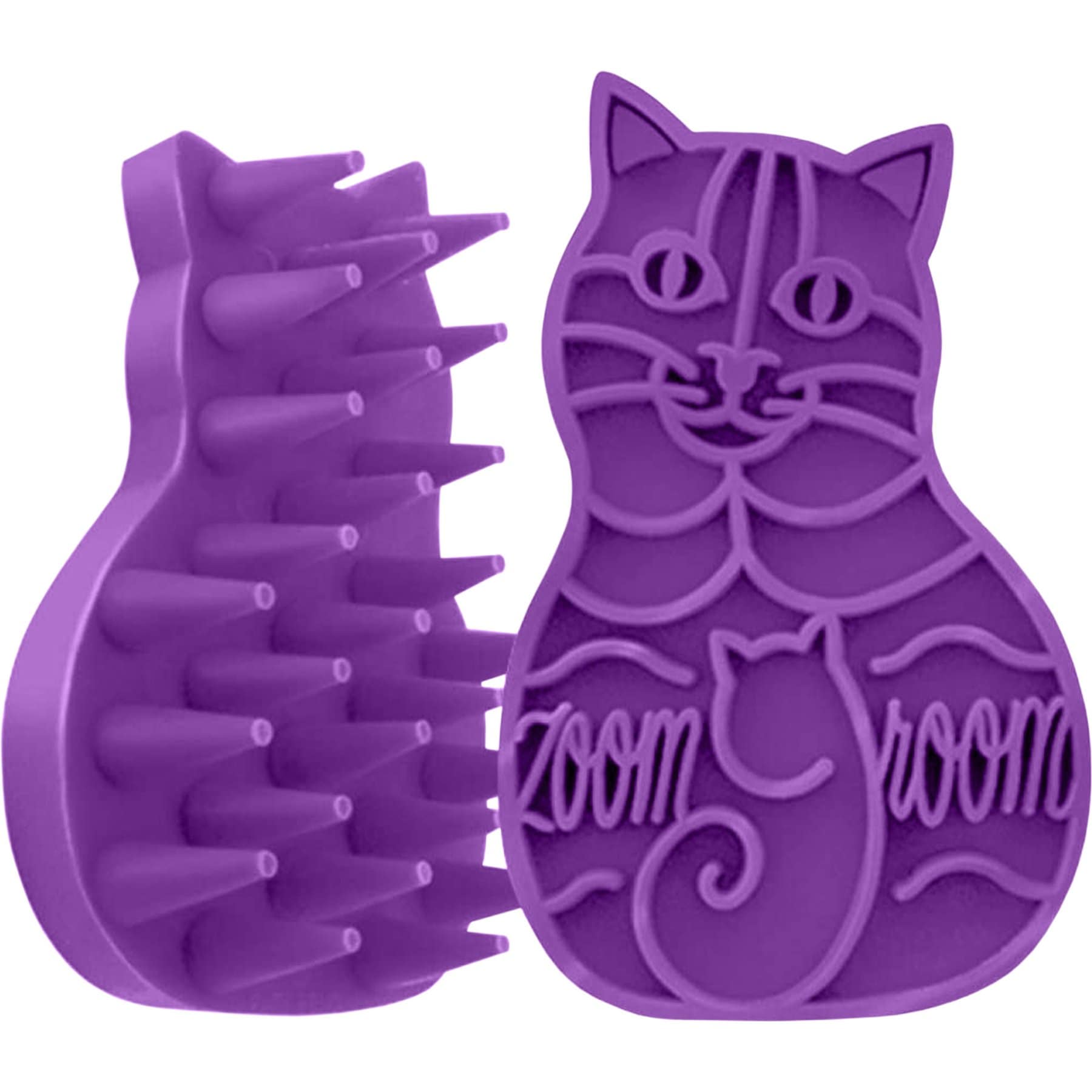
Flexible projections offer an alternative to wire pins for gentle surface grooming.
Webvet may earn a commission when you click through to Chewy, at no extra cost to you.
Pin brushes with ball tips are gentler than a slicker and much less effective at lifting undercoat, which makes them a fair trade on a cat that will not accept anything firmer at all.
Choose a brush your cat tolerates and check comfortable, detangled sections with a suitable comb. If the comb snags, stop rather than increasing brush pressure.
Coat type also changes across a single cat. Many medium-coated cats have short body hair with a long, dense ruff and britches, and those areas need the comb even when the back does not. For the full method and its limits, see choosing a cat brush.
- A kitten brush should be soft, with flexible bristles, because the goal at that age is getting the kitten used to handling.
- For semi-long coats, the best brushes for Ragdoll cats are a slicker plus a steel comb.
- A well-made comb such as the Chris Christensen cat comb is simply a quality version of that steel comb.
- A cat deshedder is a separate undercoat tool. The best deshedding brush for cats is one matched to coat length and used gently, as covered in the next section.
Cat dander vs dandruff, and how to reduce it
Brushing also moves dander, the tiny skin flakes that carry the main cat allergen. Dander is microscopic and invisible, while dandruff is the larger white flakes you can see in the coat. So cat dander vs dandruff comes down to size: dandruff is visible and often points to dry skin or a cat that cannot groom well.
There are no cats without dander. Hairless cats still have dander and still produce the allergen, and no breed is truly a low dander cat, though individual cats vary. To reduce cat dander in your home:
- Brush or comb the cat regularly, ideally done by someone without allergies.
- Wash bedding and vacuum often, and use a HEPA air filter.
- Ask your vet about a diet made to reduce cat dander allergen: one veterinary-studied food targets the main allergen in saliva, which may help some households.
Deshedding tools and shedding season
Every cat sheds. Cats with outdoor access shed hardest in spring and again in fall as day length changes, while cats living entirely under artificial light tend to shed at a steadier rate all year round.
A coat blow is not a health problem. It is the undercoat releasing in quantity over a few weeks, and the only thing you control is how much of it you take out before the cat swallows it.
- Domestic shorthair cats do shed, often steadily year round.
- British Shorthair cats shed a lot for a short coat because it is dense, especially in spring.
- Maine Coon shedding peaks seasonally and needs combing to keep the undercoat from matting.
- Kittens start shedding their kitten coat as the adult coat comes in over the first year.
- No breed is shed-free. The cat breeds that shed the least tend to have little or no undercoat, such as Rex breeds and hairless cats.
- It is normal for cats to shed whiskers occasionally; a new one grows back.
Undercoat color and long-coat deshedders
A black cat with a gray or brown undercoat is common, and a white undercoat under black tips is the smoke color. Many black cats have lighter undercoat hair beneath the black guard hairs, and sun exposure can turn a black coat brownish. A sudden color change with coat thinning is worth mentioning to your vet.
FURminator's long-hair version has a different edge; use it only on a long-haired cat whose coat is already combed through. The EquiGroomer, a blade-style deshedding brush first made for horses, is sold in a cat size and follows the same gentle, short-session rules.
The deshedding tool
Blade-edged deshedding tools, of which the FURminator Short Hair Cat Deshedding Tool is the best known, strip dead undercoat faster than a comb can.
Edged deshedding tools and bladed dematting tools are different. Neither should be forced through tangles; pressure and repeated passes can irritate skin.
Follow the tool's directions and your cat's comfort rather than a seasonal-only rule. Stop if the skin becomes irritated or the coat looks thinned.
- Use brief, gentle passes only as directed for that particular tool and coat. Stop at discomfort or skin irritation.
- No repeat work over the same patch in one session.
- Never on a coat that has not already been combed through.
- Never over a bony area such as the hips, shoulders, or spine of a thin cat.
No tool stops shedding, and any product that claims to should be read carefully. What brushing changes is where the hair ends up, in your hand rather than on the sofa, and out of the cat rather than swallowed. For the full method and its limits, see comparing cat deshedding tools.
Long-haired cats need a different routine
A long coat is not a short coat that takes longer. The whole session changes shape: it is worked in sections, it happens most days, and it is organized around the four places mats actually form.

- Behind and under the ears, where a cat's own grooming reaches least.
- The armpits and the folds behind the front legs, where movement rubs hair into knots.
- The britches and the base of the tail, especially on an older or overweight cat.
- The ruff around the neck, particularly on cats that wear a collar.
Line brushing is not optional on a long coat. Passing a slicker over the top produces a cat that looks groomed with a compacted layer underneath, and that layer is what becomes a mat.
Sanitary areas need watching. Long fur around the rear catches waste, and a cat that becomes uncomfortable back there sometimes stops using the litter box rather than showing you the problem.
Grooming removes some loose hair before a cat swallows it. Frequent vomiting or hairball-like retching still needs veterinary attention, regardless of coat length. For the full method and its limits, see the long-haired cat grooming routine.
Breed-by-breed long coat care
The routine is the same for every long-haired breed: a wide-tooth and a fine steel comb, a slicker brush, and short daily sessions. What differs is where the coat tangles:
- Persian and Himalayan: comb to the skin every day at home and wipe the face folds gently. A steel comb and a slicker are the core grooming tools for a Persian cat; the coat mats fast without them.
- Maine Coon: if you groom a Maine Coon cat yourself, focus on the ruff, britches, and belly. Maine Coon grooming tools are a steel comb, slicker, and undercoat rake for the seasonal shed, and most need combing a few times a week.
- Norwegian Forest cat: to groom a Norwegian Forest cat, comb a few times a week and more during the heavy spring shed.
- Ragdoll: to groom a Ragdoll cat at home, comb the armpits, ruff, and britches twice a week; the silky coat mats less than a Persian's.
- Turkish Angora and Turkish Van: grooming either breed is lighter work, because their single, silky coats lack a dense undercoat. A weekly comb-through usually keeps them tidy.
Maine Coons and other large long-haired breeds are heavy and slow to mature, so support the cat comfortably on a table or your lap during longer sessions.
Matted fur: what is safe to work out at home
Only small loose tangles that separate readily without pulling skin or upsetting your cat are suitable for home care. A dense core needs professional help, even if a finger fits beneath it.
Mats are not simply large tangles. They contract as they form, pulling on the skin beneath them, and the skin under a big mat is often sore, damp, and inflamed before anyone notices it.
- Support only loose fur without pinching skin. This may reduce tugging, but it does not make pulling safe; stop if the skin moves or the tangle resists.
- Tease the edges apart with your fingers first, working from the outside in.
- Use the wide teeth of the comb at the outer edge only, never driving the comb toward the skin.
- Work for a few seconds at a time and stop the instant the cat objects.
- If a loose tangle does not release readily, stop and arrange professional help rather than repeating a painful attempt on successive days.
Some mats are not a home job at all, and recognizing that early is the difference between a groomer's appointment and a wound.
- The tangle has a dense core or pulls the skin, even if a finger fits beneath it.
- There are several mats, or a plate of matting across the back or flanks.
- The skin under the mat is red, wet, or smells.
- The cat reacts sharply when you touch the area, which suggests it already hurts.
Never use scissors, and this is the one absolute in the whole guide. Skin lifts into the base of a mat, so the cut lands on the cat rather than on the hair.
Mats that keep returning are a signal in themselves. A cat that used to maintain its own coat and now cannot is worth a check-up rather than a firmer brush. For the full method and its limits, see handling matted cat fur safely.
- How to dematt a cat comes down to this: loose tangles at home with fingers and a comb, and anything tight against the skin with a groomer or vet.
- Kittens with matted eyes, where crust glues the lids together, are a different problem. Soften the crust with a clean cloth dampened with warm water, and see a vet promptly, because sticky, crusted eyes in kittens often mean an infection.
Bathing a cat without a fight
Most cats never need a bath. A healthy cat with a normal coat keeps itself clean, and a bath removes coat oils that took time to build up.
- Something is on the coat that must not be licked off, such as oil, paint, or a household chemical. Call your vet before you wash it, because some substances need specific handling.
- A hairless breed such as the Sphynx, where skin produces oils with no coat to distribute them.
- A medical instruction, such as a medicated shampoo prescribed for a skin condition.
- A cat that has stopped grooming and has become genuinely soiled.
- A long-haired cat with a soiled rear end that a damp cloth will not fix.
If you do bathe, the preparation decides the outcome. Comb the coat through first, because water turns an existing tangle into a solid mat, and put everything within arm's reach before the cat is wet.
Use a non-slip surface to help your cat keep its footing. Stop if your cat struggles or becomes frightened.
A jug of warm water is calmer than a running shower head, and the head is cleaned with a damp cloth rather than poured over. Dry with towels rather than a hairdryer unless your cat has already accepted one. For the full method and its limits, see safe cat bathing and drying.
How often to bathe a cat, and the best way to do it
Most healthy cats never need to be bathed; bathe only for the reasons above or as often as your vet directs for a skin condition or hairless breed. It is okay to give a cat a bath when there is a reason, done calmly.
The best way to bathe a cat is a few inches of warm water in a sink or a cat in the bathtub on a rubber mat, a second person, and a quick rinse. A mesh cat bathing bag can help some cats stay contained, but a cat that panics in one should not be bathed at home.
Cats that pee or poop in the bathtub
If your cat pees or poops in the bathtub, it is not a bathing issue. Cats that pee in the bathtub are often avoiding the litter box or have a urinary problem, so book a vet check before changing the box setup.
Choosing a cat shampoo and waterless options
The firm rule is the one owners break most often: never use human shampoo on a cat. Human products are built for human skin and a different oil balance, and on a cat they strip the coat and leave skin dry, flaky, and itchy.
That includes baby shampoo, which sounds gentle and is still a human product, and dish soap, which is a degreaser. A shampoo formulated for cats, fragrance-free where you can find it, is the baseline.
Anything medicated is your veterinarian's call, because a wash that treats one skin problem can inflame another.
- Waterless foams and sprays clean a section of coat without a bath, which suits a cat that cannot be bathed safely.
- Grooming wipes handle a dirty rear end, muddy paws, or a greasy patch on an older cat.
- A damp cloth and a comb solve most day-to-day dirt and cost nothing.
- Whatever the format, it has to be labeled for cats. Products made for dogs can contain ingredients that are unsafe on a cat.
Flea shampoo is a separate decision with its own safety rules. Our guide to flea shampoo for cats covers what is safe to put on a cat and what is not. For the full method and its limits, see choosing a cat shampoo.
Dander-reducing wipes, such as Burt's Bees for Cats dander reducing wipes, are grooming wipes labeled for cats. They can lift loose dander from the coat between brushing sessions, but they do not stop a cat producing allergen.
Nail trims as part of the grooming routine
Nails can be checked during a calm grooming session if your cat accepts paw handling. Gradual practice may help with later trims, but tolerance varies and should never be forced.
Cats may bite at their claws while grooming and shed the outer claw sheaths. Persistent chewing at one toe, limping, swelling, bleeding, or a claw growing into the pad needs veterinary attention. Do not pull off a damaged claw or try to treat an embedded claw during a routine trim.
- Press gently on the top of the toe to extend the claw, and look for the pink quick inside it.
- Take the sharp hook off the end and nothing more.
- Two claws is a complete session if two claws is all the cat will give you.
- Handle the back feet during grooming even in the weeks when you do not trim them.
Blunt claws also reduce the damage a defensive swipe does mid-session, which matters more than most owners expect once a cat has learned to protest.
Our guide to cat nail clippers covers the tools, the quick, and what to do if you cut one too short.
Dewclaws, claw sheaths, and when to see a vet
Are you supposed to clip cat nails? For most indoor cats, yes, about every 2 to 4 weeks. Do vets clip cat nails? Yes, a vet clinic or groomer can trim them if your cat will not accept it at home.
Do cats have dewclaws? Yes, on the inside of each front leg. The cat dewclaw never touches the ground, so it does not wear down and can curl into the pad. An ingrown dew claw in a cat, or an overgrown thick cat claw, needs a vet to trim it and treat the pad.
- Do cat claws fall out? What owners find is the outer sheath, not the claw. Cats pull old sheaths off, and nail biting is usually that sheath removal.
- A whole claw falling out, a cat nail ripped out or split in half, or bleeding is a vet visit.
- Black under a cat's nail can be normal pigment on dark paws, but new dark staining, swelling, or a smell at the nail bed needs a vet.
- A nail grinder suits some calm cats; the best cat nail grinder is a quiet one used only for a second or two per claw.
- Rubber caps for cat claws are soft vinyl caps glued over trimmed nails to blunt scratching; they fall off as the nail grows.
- For restraint during nail clipping, a loose towel wrap works for many cats. A cat that fights restraint should be trimmed by a vet team instead.
Brushing your cat's teeth
Dental care is the part of grooming with the clearest long-term payoff and the part most owners skip. Dental disease is among the most commonly diagnosed problems in adult cats, and it is largely invisible until it is advanced.

It is also the slowest thing to introduce, and the ladder is measured in weeks rather than days.
- A finger run along the outside of the lips, paired with something the cat likes.
- A finger along the gum line, a couple of teeth at a time.
- A taste of enzymatic cat toothpaste off your fingertip.
- The brush itself, on the outer surfaces only, a few teeth per session.
Never use human toothpaste. Cats cannot spit, and human formulations are not made to be swallowed.
Our guides to cat teeth cleaning and cat dental treats cover the routine itself and the products that support it between brushings. For the full method and its limits, see introducing cat tooth brushing.
Brushing, shedding, and hairballs
The strongest everyday reason to brush a cat is that whatever you take out is hair the cat does not swallow. A cat's tongue is built to pull loose hair out of the coat, and the only place that hair can go is down.
Most of it passes through without incident. Some collects in the stomach and comes back up, which is where hairballs come from, and long-coated cats and heavy shedders produce more of them.
Brushing is not a cure and it is not a treatment. It reduces the volume of hair going in, which is a sensible thing to do rather than a medical intervention.
- Our guide to preventing hairballs in cats covers diet, brushing, and the products that help.
- If you are not sure what you are looking at, hairball versus vomiting in cats explains the difference.
- A cat that retches repeatedly and produces nothing may have a blockage, and hairball blockage in cats sets out the emergency signs.
Repeated unproductive retching, going off food, or sudden lethargy is not an ordinary hairball. That cat needs a veterinarian rather than more brushing.
Is it normal for cats to throw up hairballs? An occasional hairball is normal. Frequent hairballs, or hairballs with weight loss, diarrhea, or poor appetite, are not, and need a vet.
A cat hairball can look like poop because passing up the esophagus makes it tube-shaped, and food and stomach fluids often darken it. Look closely and it is packed hair, often in fluid, not feces.
Flea combs and what they turn up
A flea comb run over the rump and the base of the tail is the cheapest parasite check there is, and a routine grooming session is the natural place to do it.
You are rarely looking for fleas themselves, which are fast and good at hiding. What turns up is flea dirt: dark specks that look like grit until you test them.
- Comb the base of the tail, the rump, and the back of the neck, close to the skin.
- Tap the debris off the comb onto a damp white tissue.
- Watch for specks that spread into a rusty red-brown halo. That is digested blood, which means fleas.
- Grit that stays black and does not run is ordinary dirt.
One positive result means the whole household needs treating, cats and dogs alike, along with the environment they live in. Treating the cat you found it on is not enough.
Never use a flea product labeled for dogs on a cat. Some canine spot-on treatments contain permethrin, which is highly toxic to cats and can be fatal.
Our guide to flea shampoo for cats covers which washes are safe on a cat and which products to avoid entirely.
Flea combs and flea baths
A fine toothed metal flea comb for cats is the right tool here: the teeth sit close enough to catch fleas and flea dirt. If you are deciding how to give a cat a flea bath, ask your vet first. A bath alone does not end an infestation, and a vet-recommended cat flea treatment usually does more.
When a cat over-grooms or stops grooming itself
Both directions matter. A cat that grooms one area bald and a cat that has stopped grooming altogether are each telling you something a brush cannot fix.
Over-grooming often looks tidy. The hair is broken off short rather than falling out, usually along the belly, the inner thighs, or one flank, and the skin underneath can look completely normal.
Groomers call it barbering. The common causes are itch and pain well before they are stress: fleas, allergy, and discomfort in a joint, the bladder, or the skin under the area the cat is licking.
- Bald or thinning patches, especially symmetrical ones.
- Hair that feels stubbly and broken rather than smooth at the tips.
- Scabs, crusts, or small bumps you feel before you see.
- Round patches of hair loss with flaky, crusted edges, which can be ringworm and is contagious to people.
- A coat that has gone greasy, clumped, or dandruffy across the back.
- A cat that has simply stopped grooming, which in an older cat often means pain.
Our guides to hair loss in cats and how vets diagnose cat skin problems cover the workup from there.
Ringworm in cats is the one finding that also changes how you handle your tools, and ringworm treatment covers what comes next.
Do not share brushes and combs between a cat with a skin problem and the other animals in the house. Wash tools in hot soapy water and let them dry completely between cats.
- A cat losing fur around the neck often has a collar rubbing, or is scratching at that area from fleas, mites, or allergy. Treat it like any other overgrooming: see a vet rather than changing the brush.
- A cat that grooms its owner is showing the same social bonding cats show each other.
- A cat arching its back into your hand during grooming is usually enjoying the contact.
Cat grooming questions owners ask
Frequently Asked Questions
Is it safe to sedate a cat for grooming?
Do not choose or give a sedative for grooming on your own. A veterinarian may prescribe medication for use at home or recommend monitored care at the clinic after assessing your cat's health and handling needs.
Follow your veterinarian's exact instructions, and do not substitute a human sleep aid, antihistamine, or another pet's prescription. Medication does not make forceful handling appropriate.
Can I use my own shampoo or hairbrush on my cat?
No on the shampoo, and probably not on the brush. Human shampoo, baby shampoo included, is formulated for the acidity of human skin and a different oil balance. On a cat it strips the coat and leaves skin dry, flaky, and itchy, and an itchy cat grooms more and swallows more hair. Dish soap is a degreaser and worse again. Use a product labeled for cats, or skip the bath and use a damp cloth.
A human hairbrush is less dangerous but not much use. The bristles are spaced for human hair, so a human hairbrush skims the top coat without lifting any undercoat, and un-rounded bristles scratch skin. A cat slicker and a stainless steel comb do the job properly for about the price of one decent hairbrush.
When should I start grooming a kitten?
Begin brief, pleasant grooming practice once your kitten is settled and comfortable with gentle handling. There is no required starting birthday or session length. Use a soft suitable tool and stop before distress.
Gradually introduce touching the feet, looking at the ears, and a brief lip lift, rewarding comfortable participation. Early practice can help later care, but it does not guarantee that an adult cat will tolerate every grooming task.
How long should a cat grooming session actually last?
There is no validated session length for every cat or coat. A few accepted strokes may be enough at first. Work in small sections while your cat remains comfortable and stop at tension, resistance, or an attempt to leave.
Regular, comfortable sessions are more useful than trying to finish an entire coat through a struggle. If you cannot maintain the coat without distress, ask a cat-experienced professional for help.
Do short-haired indoor cats need grooming at all?
Short-haired indoor cats benefit from regular coat checks and gentle grooming. They can develop mats, especially when illness, pain, or reduced mobility affects self-care. Brushing removes loose fur, but does not guarantee that hairballs will stop.
The bigger reason is the weekly health check that comes with it. Running your hands over a cat every week is how you find a lump, a scab, a flea, a sore tooth, or early weight loss, and indoor cats hide all of those exactly as well as outdoor ones do.
The routine above is built from published veterinary and cat-welfare guidance, including International Cat Care, the ASPCA cat care library, VCA Hospitals, and the American Association of Feline Practitioners. Anything that concerns your cat's skin, weight, or comfort belongs with your own veterinarian.
Further reading: VCA coat-care guidance

Editor
The Webvet Editorial Team is the in-house group of pet-care editors and writers behind Webvet, operated by Smart Pet Collective. The team researches, writes, and maintains Webvet's pet health, behavior, and medication content. Every article follows a defined editorial process: research from reputable veterinary and scientific sources, careful drafting, mandatory review of medical content by a credentialed veterinarian, and dated publication. Health and medication articles are medically reviewed by a licensed veterinary professional before they go live and are kept current over time.


