Cat Stress Relief: 5 Vet-Reviewed Ways to Calm a Cat
A vet-reviewed guide to cat stress relief that fixes the environment first: safe places, resource math for multi-cat homes, daily predatory play, scent protection, playbooks for moving and vet visits, and the signs that mean call a vet today.

BVMS MRCVS

This article contains affiliate links. Webvet may earn a commission when you buy through them, at no extra cost to you.
Real cat stress relief starts with the room your cat lives in, not with a product on a shelf. Cats are territorial animals that read safety off their surroundings, so the fastest way to bring a tense cat down is to fix the environment first: give it a safe place to retreat to, spread its key resources apart, build in daily predatory play, keep human contact predictable, and protect its scent. Calming products can support that work. They cannot replace it.
This guide follows the five environmental needs that the American Association of Feline Practitioners (AAFP) and the International Society of Feline Medicine (ISFM) set out for cats living in homes. It then adds the resource math almost every multi-cat household gets wrong, four playbooks for the life events that generate most feline stress, and a clear line for when this stops being a home project and becomes a veterinary one.
- 1Cat stress relief works best in a fixed order: correct the environment first, then add supports such as pheromones or supplements, then involve your veterinarian if nothing shifts.
- 2The five environmental needs are a safe place, multiple and separated key resources, opportunity for play and predatory behavior, positive and consistent human interaction, and an environment that respects the cat's sense of smell.
- 3In a multi-cat home you count resources rather than guessing, starting with one litter box per cat plus one, and you separate food, water, resting, and scratching stations by room or broken sightline instead of lining them up together.
- 4Never wash every bed, blanket, and cat tree cover at the same time, because your cat's own scent on those surfaces is what tells it the territory is still safe.
- 5Behavior that looks like stress is very often pain or illness, so a cat that suddenly hides, stops eating, avoids the litter box, or overgrooms needs a veterinary exam before you assume the cause is emotional.
- 6A cat straining in the litter box, passing little or no urine, or crying while urinating is an emergency, and a male cat that cannot urinate can die within a day or two without treatment.
- 7Change one thing at a time and judge it over two to four weeks, because stacking five interventions at once makes it impossible to tell which one helped.
Signs your cat is stressed
You know your cat is stressed when its normal patterns shrink. Stressed cats play less, hide more, eat differently, groom either too little or too much, and stop using parts of the home they used to move through freely. The change matters more than the behavior itself, so the useful question is not whether a cat hides but whether this cat hides more than it did a month ago.
Subtle early signs, the ones most owners miss:
- Playing less, or losing interest in a toy that reliably worked before.
- Sleeping in new places, especially high up, behind furniture, or under a bed.
- Rubbing its cheeks on doorways, chair legs, and your ankles less often than it used to.
- Eating more slowly, leaving food in the bowl, or only eating when the house goes quiet.
- Grooming less, so the coat starts to look flat, greasy, or dandruffy along the back.
- Sitting hunched with the tail wrapped tight, or facing into a corner or a wall.
Loud signs that are hard to miss:
- Overgrooming a strip of belly, flank, or inner thigh until the hair is thin or bald.
- Urinating or passing stool outside the litter box.
- Spraying small amounts of urine backward onto vertical surfaces.
- Hissing, growling, or swatting at people or housemates it previously tolerated.
- Hiding through the whole day and only moving around after the household goes to bed.
- Flattened ears, dilated pupils, and a low, fast tail flick that does not settle.
Those twelve signs rarely show up alone, and several of them are resource problems wearing a behavioral costume. A cat that starts sleeping on top of a bookcase or the refrigerator is usually telling you it wants height it does not have, and vertical space is the single most common gap in the homes of stressed indoor cats. A tall, stable, multi-level perch such as the Yaheetech Multi-Level 63-in Plush Cat Tree, Dark Gray gives a cat somewhere to sit above the traffic, watch the room, and step away from a housemate without a confrontation, which is exactly what the first environmental need is about.
Webvet may earn a commission when you click through to Chewy, at no extra cost to you.
| Sign | What it often points to | First thing to change |
|---|---|---|
| Sleeping somewhere new and high | No secure resting spot at ground level | Add an enclosed bed and a second elevated perch |
| Peeing just outside the box | Box location, litter, or competition | Add a box in a different room, uncovered, unscented litter |
| Overgrooming one patch | Chronic low-grade stress or an itch or pain source | Book a veterinary exam before treating it as behavioral |
| Hissing at a housemate cat | Resource competition at a pinch point | Duplicate the contested resource in a second location |
| Eating only at night | Feeling exposed at the bowl | Move the bowl out of traffic and away from the litter box |
| Less cheek rubbing on furniture | The scent map was disrupted | Stop scented cleaners on marked surfaces, stagger washing |
No single sign confirms stress on its own, and none rules it out either. If you are unsure whether what you are seeing is tension or something else, reading your cat's body language in context is more reliable than any one behavior, and knowing how much cats normally sleep makes it easier to tell a genuine change in resting patterns from an ordinary long nap.
The five environmental needs every cat has
To help with cat stress, work through the five environmental needs in order rather than reaching for a product. The AAFP and ISFM feline environmental needs guidance describes five things every pet cat requires: a safe place, multiple and separated key resources, opportunity for play and predatory behavior, positive and consistent human interaction, and an environment that respects the cat's sense of smell. Most household stress traces back to one or two of these being missing, and correcting them costs very little. Each one below has a concrete action you can take today.
1. A safe place
A safe place is a spot where a cat can get out of sight, is not cornered, and cannot be reached by a person, a dog, or another cat without warning. It needs to feel enclosed on most sides and it needs an exit. A cardboard box on its side, a covered bed on a shelf, the top of a wardrobe with a step up to it, or the inside of a carrier left open all qualify. Give every cat at least one that is genuinely theirs, and put one on an upper level if your home has stairs.
The test is simple. If your cat only retreats to places you can reach into, it does not have a safe place yet. Never pull a cat out of one, and teach children the same rule, because a retreat that gets invaded stops working within days.

2. Multiple and separated key resources
Key resources are food, water, litter boxes, resting places, scratching surfaces, and toys. Separated means in different rooms or with broken sightlines, not two bowls pushed side by side against the same wall. Two food bowls touching each other is one feeding station as far as a cat is concerned, and a cat that has to walk past a housemate to reach the only water bowl will simply drink less.
Scratching is a resource, not a bad habit. Cats scratch to stretch, to shed claw sheath, and to leave a visible and scented mark, and a stressed cat that has nowhere appropriate to do it will use the sofa. Put a surface in every room the cat actually spends time in, and include at least one vertical option: a wall-mounted board such as the Necoichi Premium Comfort Cat Scratcher Wall, Dark Cherry/Brown, Regular covers a corner that a floor post cannot, which matters in small apartments. If your cat ignores what you provide, the fix is usually placement rather than the post itself, and the reasons a cat won't use the scratching post are worth ruling out before you buy another one.
3. Opportunity for play and predatory behavior
Cats are built to hunt several small meals a day, and the sequence runs stalk, chase, pounce, catch, eat, groom, sleep. Play that never reaches a catch leaves a cat wound up rather than settled, which is why a laser pointer used on its own frustrates some cats. Finish every laser session by landing the dot on a physical toy the cat can actually grab.
Feeding is the other half of this need. Putting part of the daily ration into food puzzles and foraging feeders turns a thirty-second bowl meal into ten minutes of problem solving, and it is one of the cheapest stress interventions available. Start easy, because a puzzle that is too hard on day one gets abandoned.
4. Positive and consistent human interaction
Cats tolerate handling far better when they control it. Offer a still hand at the cat's nose height, wait, and let it close the distance. If it bumps your hand with its cheek or forehead it is both greeting you and marking you, which is a clear yes. If it holds still, leans away, or does nothing, that is a no, and pressing on teaches the cat that you are unpredictable.
Stick to the head, cheeks, and chin, which is where cats groom each other. Many cats dislike contact along the belly, the flanks, and the base of the tail, and petting-induced overstimulation is a genuine and well-documented reason a purring cat suddenly swats. That swat is not spite and it is not a discipline problem. Consistency matters just as much as technique: cats settle around predictable feeding times, predictable quiet hours, and predictable greetings, and households with rotating schedules see more stress behavior than households with dull ones. If your cat's tension shows up mainly when people come over, aggression toward visitors has its own management plan.

5. An environment that respects the cat's sense of smell
Cats build a scent map of their territory by rubbing their cheeks, chin, and flanks on furniture, doorframes, and people. That map is how a cat knows a space is safe, and humans wipe it out constantly without realizing. Strongly scented cleaners on marked surfaces, a new sofa, a deep clean before guests, and washing every soft item on the same day all reset the map at once.
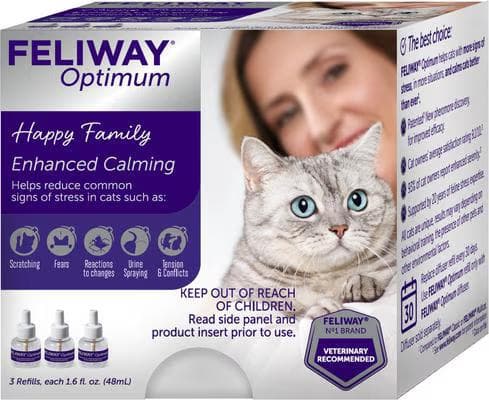
Practical rules: keep scented cleaners off the corners and edges your cat rubs, use warm water on those spots instead. When furniture moves or something new arrives, let the cat re-mark it in its own time rather than encouraging it. Carry a familiar-smelling blanket into a carrier, a car, or a new home so there is at least one thing that already smells right. Synthetic analogues of the facial pheromone cats deposit when they rub, sold as plug-in diffusers like the Feliway Classic 30 Day Starter Kit Calming Pheromone Diffuser for Cats, work on this same channel, and where they fit in a wider plan is covered below.
Webvet may earn a commission when you click through to Chewy, at no extra cost to you.
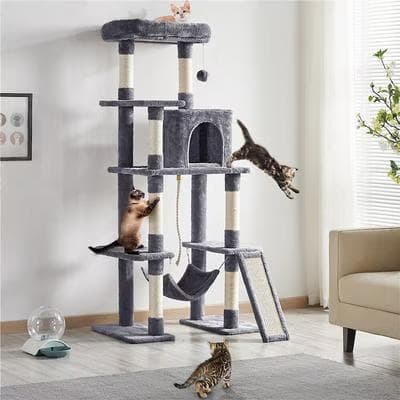
63-inch multi-level cat tree with plush perches, a condo, a hammock, sisal scratching posts, and a dangling toy. Dark gray.
Webvet may earn a commission when you click through to Chewy, at no extra cost to you.
Resource math for multi-cat homes
Most multi-cat conflict is a supply problem, not a personality problem. Two cats that hiss at each other across a hallway are usually competing over a pinch point: the only litter box, the only water bowl, the only sunny window seat. Counting resources removes the guesswork, and the numbers below are the starting point rather than a ceiling.
| Resource | 1 cat | 2 cats | 3 cats |
|---|---|---|---|
| Litter boxes | 2 | 3 | 4 |
| Feeding stations | 1 | 2 | 3 |
| Water stations | 2 | 3 | 4 |
| Resting places (at 2 or more heights) | 2 | 4 | 6 |
| Scratching surfaces | 2 | 3 | 4 |
| Enclosed hiding spots | 1 | 2 | 3 |
The rule behind the litter box row is one box per cat plus one, and it fails the moment all the boxes sit in a row in the same laundry room, because that is one location no matter how many boxes are in it. Spread them across floors and rooms. Keep food and water apart from each other, since many cats avoid drinking beside their food, and keep both well away from any litter box. Resting places should sit at different heights so a cat can choose elevation when it wants to withdraw without leaving the room.

Daily play is a stress outlet, not a luxury
Play is where a cat discharges the energy that otherwise turns into pacing, night vocalizing, or ambushing ankles. Two sessions of ten to fifteen minutes beat one long session, and the timing matters: a session in the early evening lines up with the natural activity peak and buys a quieter night.
Run the sequence properly. Drag a wand toy away from the cat and along the floor rather than dangling it overhead, let the cat stalk and miss a few times to build the chase, then let it win. End with a few pieces of kibble or a treat so the sequence completes at eat, groom, sleep. Rotate toys weekly and store the rest out of sight, because a toy that is always available stops registering as prey.

Toy choice is worth getting right rather than buying a bin of everything. Interactive wand toys are the workhorse for the predatory sequence, puzzle toys fill the solo hours, and for cats that spend long stretches alone there are dedicated options for enrichment for bored indoor cats. Understimulation and stress look almost identical from the outside, and in indoor cats they very often occur together.
Stress playbooks: moving, a new baby, construction, and the vet
General advice fails at the exact moments cats need help most. Each of the four events below has a before, during, and after that changes the outcome, and the common thread is that preparation starts earlier than most people expect.
Moving house
Before: set up a safe room in the old home two weeks out, containing a bed, a box, food, water, and a litter box, and feed your cat there so the room becomes valuable. Leave packing boxes out early so they stop being novel. During: shut the cat in that safe room on moving day with a note on the door, and move it last. After: recreate the identical safe room in the new home before the cat comes inside, keep it there for several days with the door shut, and only open the rest of the house one room at a time as the cat starts asking to explore. Bring at least one unwashed bed with you.
A new baby
Before: play recordings of infant crying at low volume during meals and play for several weeks, set up the nursery furniture early, and make any resource moves at least a month ahead so they are not linked to the baby. During: keep feeding, play, and litter cleaning on the same clock in the first weeks, since predictability matters more to a cat than attention. After: give the cat a route through the home that never passes the baby, and add a high perch in the room where the family spends time so it can be present without being reachable.
Construction and renovation noise
Before: move all of the cat's resources to the quietest room in the house, ideally on a different floor from the work, and tell contractors that room is off limits. During: leave a radio or a fan running in that room to blunt the sudden bangs, keep the door shut while crews come and go, and check the cat between rather than during noisy stretches. After: expect a settling period of a week or more, and re-introduce the worked-on rooms slowly, allowing the cat to re-mark new surfaces before you clean them.

A vet visit
Before: this is the one that changes everything. Leave the carrier out permanently as furniture rather than producing it on appointment day, put a familiar unwashed blanket inside, and feed meals and treats in it for weeks so the cat loads itself. During: cover the carrier with a towel in the waiting room, keep it off the floor, and ask the practice about low-stress handling or Cat Friendly Practice standards when you book. After: bring the carrier back into the house and leave it open rather than putting it away, and in a multi-cat home reintroduce the returning cat slowly, because it comes back smelling like the clinic and housemates may react to a familiar cat that suddenly smells foreign.

Probiotic supplement with Bifidobacterium longum BL999 that supports cats in maintaining calm behavior plus digestive and immune health. One daily sachet.
Webvet may earn a commission when you click through to Chewy, at no extra cost to you.
At-home cat stress relief that actually works
If you are asking what helps anxiety in cats naturally, start with the environment. The best cat stress relief at home is mostly time, structure, and opportunity rather than a substance. The highest-yield changes cost nothing: an added litter box in a second room, a covered bed and an elevated perch, part of the daily ration served in a puzzle, predictable meal and quiet times, and a window seat with something worth watching. Those changes move more cats than anything sold in a bottle, and they are the ones to exhaust first.
A few consumables are reasonable to trial once the environment is right. Catnip and silvervine give many cats a short burst of play followed by a calm period, and rotating catnip toys in and out of circulation keeps the response from fading. Some cats respond to a probiotic supplement fed daily with food, such as Purina Pro Plan Veterinary Diets Calming Care Cat Supplement, 30 Count, which is designed to be given every day over several weeks rather than as a one-off dose before a stressful event. Treat any supplement as a support for a corrected environment, not as a treatment for a medical or behavioral condition, and clear it with your veterinarian first if your cat takes medication or has a diagnosed illness.
Be careful with anything marketed as a natural remedy for people. Many essential oils, including tea tree, citrus, pine, eucalyptus, and wintergreen, are toxic to cats whether they are licked, applied to the coat, or diffused into a shared airspace, and cats lack some of the liver enzymes that let humans process them safely. Never give a cat a human anxiety medication, a sedative, or an herbal preparation intended for people without veterinary direction.
Where pheromone diffusers fit in a stress plan
A cat stress relief spray suits a carrier, while a cat stress relief plug-in diffuser suits a room; that distinction matters more than star ratings in cat calming diffuser reviews. The idea is to make a space smell already claimed and therefore safe. They sit on top of a corrected environment, never in place of one, and a diffuser plugged into a home with one litter box for three cats will not fix anything.
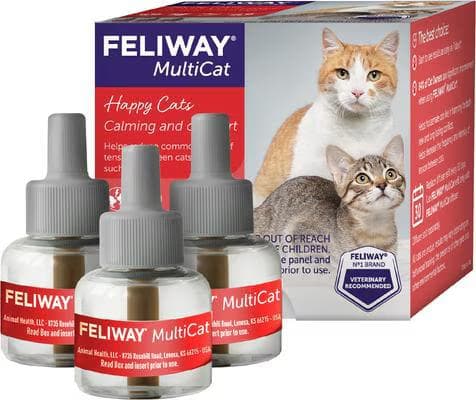
Set expectations honestly. Evidence quality varies by product and by claim, response is individual, and a diffuser that transforms one cat does nothing visible for another. Give any diffuser about four weeks in the room the cat actually uses, not a hallway, and keep it away from doors and windows where airflow scatters it. Different formulations target different problems, and the multi-cat versions such as Feliway MultiCat are aimed at tension between housemates rather than general anxiety. For which unit to buy and how the formulations compare, see our guide to pheromone diffusers for cats, and if you have people or other pets in the house, it is worth reading whether pheromone diffusers are safe before you plug one in. If that formula helps during the first cycle, Feliway MultiCat 3-count refills are the matching bulk refill option.
Calming products: what to consider once the environment is right
Beyond diffusers, the shelf holds four broad categories: calming collars that release pheromone against the cat's body, sprays for carriers and bedding, calming treats and chews, and daily supplements or therapeutic diets built around ingredients such as alpha-casozepine and L-theanine. A cat calming spray for travel is the most useful format, since a carrier or blanket sprayed ten to fifteen minutes before the cat goes in avoids the wet surface a cat will otherwise avoid.
Three rules keep this honest. First, none of these products treat a disease, and any product advertised as doing so deserves suspicion. Second, run one product at a time for a defined trial period so you can attribute any improvement. Third, tell your veterinarian what your cat is taking, including chews and supplements, because interactions with prescribed medication are real. For a category by category comparison, see our roundup of cat calming products.
When cat stress relief needs a veterinarian
If you are wondering what you can give your cat for anxiety, the accurate answer is that nothing should go into your cat without your veterinarian's input. There is no safe over-the-counter anxiety medication for cats, human anxiety drugs can be dangerous or fatal to them, and prescription anxiolytics do exist but require an exam, a diagnosis, and often bloodwork first because the same drug can be inappropriate for a cat with kidney or heart disease. Behavior changes also need medical causes ruled out before anyone calls them anxiety, which is why the exam comes before the prescription. Our guide to diagnosed anxiety in cats covers the workup, the treatment pathway, and the medication options your veterinarian may discuss.
Book a veterinary appointment if your cat shows any of the following: a sudden change in behavior with no obvious trigger, not eating for more than 24 hours, overgrooming that reaches bare skin, hiding that lasts more than a day or two, weight loss, increased thirst or urination, new night vocalizing in a cat over ten, or aggression that is genuinely new.
Behavior blamed on stress is frequently pain or disease wearing the same clothes. The table below maps the common presentations to the conditions that mimic them. It is there to sharpen what you tell your veterinarian, not to let you diagnose at home.
| What you see | Conditions that can mimic stress | Red flag that makes it urgent |
|---|---|---|
| Litter box avoidance or straining | Feline idiopathic cystitis, FLUTD, bladder stones, urinary infection | Straining with little or no urine, crying, repeated trips |
| Hiding or moving less | Osteoarthritis, chronic pain, systemic illness | Hiding beyond a day or two, refusing food for 24 hours |
| New irritability or aggression | Dental disease, arthritis, hyperthyroidism | Aggression appearing suddenly in a tolerant cat |
| Overgrooming to bare skin | Skin allergy, fleas or mites, referred pain | Broken skin, scabs, or a patch that keeps spreading |
| Appetite change or weight loss | Hyperthyroidism, kidney disease, dental pain | Weight loss with a normal or increased appetite |
| Night howling in an older cat | Hyperthyroidism, high blood pressure, cognitive decline | Any new night vocalizing in a cat over ten |
Feline idiopathic cystitis deserves a specific mention because it is the clearest link between stress and physical illness in cats. Affected cats develop painful bladder inflammation with no infection or stone to explain it, flares track closely with household stress, and the long-term management is environmental enrichment alongside veterinary care. It is the reason litter box problems should never be treated as a purely behavioral issue.
Give one change two to four weeks before you judge it
The most common mistake after reading a guide like this is doing everything at once. Stack five interventions in a weekend and you will never know which one worked, and if the cat gets worse you will not know what to undo.
Work it like this instead:
- Pick the single biggest gap, which is usually litter box count or the absence of a safe elevated retreat.
- Change that one thing and leave the rest alone.
- Keep a two-line daily note on one specific behavior, such as the number of accidents outside the box or how many hours the cat spent out of hiding.
- Judge it at two to four weeks, since environmental change works gradually rather than overnight.
- If nothing has shifted, go back to your veterinarian rather than adding a sixth product.
Frequently Asked Questions
How do I know if my cat is stressed?
Look for a change from your cat's own baseline rather than a single behavior. Stressed cats typically play less, sleep in new or higher places, rub their cheeks on furniture less often, eat more slowly or only when the house is quiet, and either groom less or overgroom one patch. Louder signs include urinating outside the litter box, hiding all day, hissing at a housemate it used to tolerate, and flattened ears with dilated pupils. Two or three of these appearing together over a couple of weeks is a stronger signal than any one on its own.
What are 10 signs that my cat is stressed?
The ten most useful signs are reduced play, sleeping in new hiding spots, less facial rubbing on furniture, slower or reduced eating, a flat or unkempt coat from under-grooming, overgrooming to thin or bald skin, urinating or passing stool outside the litter box, urine spraying on vertical surfaces, hissing or swatting at familiar people and pets, and hiding through the day with activity only at night. Flattened ears with dilated pupils and a hunched posture with a tucked tail round out the picture. Any of these that persist for more than a few days deserve a veterinary exam first.
How to help with cat stress?
Work through the five environmental needs in order before you buy anything. Give your cat an enclosed safe place it can retreat to that no one reaches into, spread food, water, litter boxes, resting places, and scratching surfaces into separate rooms, run two short wand play sessions a day that end in a catch and a food reward, let the cat initiate contact and keep petting to the head, cheeks, and chin, and protect its scent by not washing every soft item at once. Then change one thing at a time and give it two to four weeks.
What can I give my cat for stress at home?
Structure and opportunity help more than any substance. Add a litter box in a different room, put part of the daily food into a puzzle feeder, add an elevated perch and an enclosed bed, and hold meal and play times to a predictable clock. Catnip or silvervine gives many cats a burst of play followed by a calm period. A daily probiotic or a calming supplement is reasonable to trial once the environment is right, but clear it with your veterinarian first. Never give a cat human anxiety medication or herbal remedies intended for people.
What can I give my cat for anxiety?
Nothing without veterinary input. There is no safe over-the-counter anxiety medication for cats, human anxiety drugs can be dangerous or fatal to them, and many essential oils marketed as natural calming aids, including tea tree, citrus, pine, and eucalyptus, are toxic to cats. Prescription anti-anxiety medication for cats does exist, but it requires an exam and often bloodwork first, because the right drug depends on the cat's kidney, liver, and heart health. Your veterinarian will also want to rule out pain or illness before treating the problem as behavioral.
Do cat stress relief home remedies actually work?
The environmental ones work well and are the best-supported intervention available: more litter boxes, separated resources, vertical space, enclosed hiding spots, daily predatory play, and a protected scent profile all have real behavioral evidence behind them. Ingestible home remedies are a different story. Catnip and silvervine are safe and genuinely useful for many cats, but human herbal preparations, essential oils, and CBD products sold for pets range from unproven to actively dangerous. Ask your veterinarian before anything goes into your cat.
How long does cat stress relief take to work?
Give any single change two to four weeks before you judge it. Some interventions show up faster, such as an added litter box resolving accidents within days, while pheromone diffusers and daily supplements are usually assessed over four weeks or more. The key is to change one thing at a time and to track one specific behavior in a short daily note, because stacking several changes at once makes improvement impossible to attribute. If four weeks pass with no movement at all, that is the point to return to your veterinarian rather than adding another product.
Sources

Editor
The Webvet Editorial Team is the in-house group of pet-care editors and writers behind Webvet, operated by Smart Pet Collective. The team researches, writes, and maintains Webvet's pet health, behavior, and medication content. Every article follows a defined editorial process: research from reputable veterinary and scientific sources, careful drafting, mandatory review of medical content by a credentialed veterinarian, and dated publication. Health and medication articles are medically reviewed by a licensed veterinary professional before they go live and are kept current over time.
Veterinarian · BVMS MRCVS
Dr. Pippa Elliott, BVMS, MRCVS, is a veterinarian with nearly 30 years of experience in companion animal practice. Dr. Elliott earned her Bachelor of Veterinary Medicine and Surgery from the University of Glasgow. She was also designated a Member of the Royal College of Veterinary Surgeons. Married with 2 grown-up kids, Dr. Elliott has a naughty Puggle named Poggle, 3 cats and a bearded dragon.


