Cat Puzzle Feeder Guide: Science, Types, and Best Picks
Puzzle feeders and slow feeders put your cat's foraging instinct back to work. This guide covers the enrichment science, the problems each feeder type solves, DIY options, a staged introduction protocol, and the few products we genuinely recommend.

This article contains affiliate links. Webvet may earn a commission when you buy through them, at no extra cost to you.
WebVet may earn a commission from qualifying purchases made through links on this page, at no additional cost to you.
A cat puzzle feeder turns the dullest 90 seconds of your cat's day, inhaling kibble from an open bowl, into the mental and physical workout she was built for. It is one of the cheapest, most effective enrichment upgrades an indoor cat can get, and the science behind it is surprisingly deep.

A cat puzzle feeder is any food-dispensing device that makes a cat work for meals by pawing, nosing, rolling, or hunting for food instead of eating from an open bowl. Puzzle feeders slow eating, reduce vomiting after meals, help with weight control, and ease boredom by engaging a cat's natural foraging instinct.
If you are unsure whether boredom explains the behavior you are seeing, start with signs your indoor cat is bored before choosing another feeder.
Puzzle feeders pair well with the movement ideas in our guide to cat exercises.
This guide is an explainer and a roundup in one. Here is what we cover:
- The foraging science: why working for food is normal for cats, not cruel
- The four problems puzzle feeders solve: scarf-and-barf, obesity, boredom, and night waking
- Every feeder type: stationary puzzles, ball feeders, slow-feed bowls, and hunting-style feeders
- DIY and homemade puzzle feeders you can build tonight
- A staged introduction protocol so your cat actually uses the thing
- The few products we genuinely recommend, and the ones we cover without links
If you just want the short version: buy a ceramic slow feeder if your cat vomits after eating, a ball feeder if she is overweight, a hunting-style feeder if she wakes you at night, and introduce whatever you buy gradually. The rest of this guide explains why, and how.
Free-fed bowl meals ask nothing of a predator built to hunt 10 or more times a day. A cat puzzle feeder restores that work-for-food loop, which is why behaviorists treat food puzzles as core environmental enrichment for indoor cats, not a gimmick.
What is a cat puzzle feeder? The foraging science and benefits

If you keep one passage from this guide, make it this definition: a cat puzzle feeder is any object that makes your cat work for food instead of eating it freely from a bowl, recreating the hunt-catch-eat sequence cats are wired for and slowing every meal in the process.

Your cat's wild ancestors did not eat two large meals a day. They hunted small prey, mostly mice and other rodents, in many short episodes around dawn and dusk. Each successful meal came after a sequence of searching, stalking, pouncing, and manipulating prey with paws and mouth.
Domestication barely touched that wiring. Behaviorists call it the foraging instinct: the drive to seek, work for, and earn food. An open bowl short-circuits the entire sequence. The cat gets the calories but loses the searching, the pawing, and the problem-solving that fill a predator's day.
That mismatch matters most for indoor cats. Indoor life is safer, but it removes nearly all natural foraging opportunities. International Cat Care's guide to puzzle feeders frames food puzzles as the direct answer: restoring control, choice, and work in an environment that otherwise hands cats everything.
Specifically, bowl feeding deletes four things a hunting cat gets for free:
- Seeking: no territory to patrol or food sources to check
- Working: no pawing, scooping, or extracting before the first bite
- Pacing: two large meals instead of many small, earned ones
- Choice: no control over when or where the next meal happens
The veterinary literature backs the practice. A widely cited 2016 review in the Journal of Feline Medicine and Surgery, by veterinary behaviorists including Mikel Delgado and Tony Buffington, documented food puzzles improving weight management, reducing stress signs, and easing problem behaviors. That paper moved food puzzles from niche trick to mainstream veterinary recommendation.
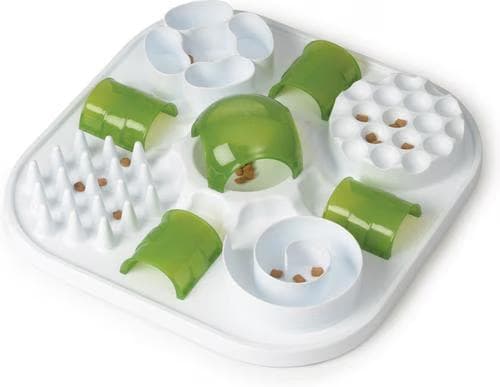
Webvet may earn a commission when you click through to Chewy, at no extra cost to you.
One honest wrinkle: cats are not automatic puzzle enthusiasts. Later work by Delgado's group found many cats will eat freely available food before working for it. That does not undermine food puzzles. It explains why introduction technique matters, and why the benefits appear once a cat has actually learned the game.
Think of it the way trainers do. The complete predatory sequence, search, stalk, pounce, manipulate, consume, is self-reinforcing once each link is learned. A puzzle feeder rebuilds the manipulate-and-consume links every mealtime. Play with a wand toy covers stalk and pounce. Together they give an indoor cat the whole loop.
The four problems puzzle feeders solve
Puzzle feeders and slow feeders are not just entertainment. Each maps to a specific, common problem:
- Scarf-and-barf. Cats that bolt food from an open bowl often regurgitate it minutes later. Slowing intake is the fix, and it is the single most common reason owners buy a slow feeder.
- Indoor cat obesity. Bowl feeding uncouples calories from effort. Making a cat forage for the same portion adds movement, slows consumption, and gives the fullness signal time to register.
- Boredom and destructive behavior. An under-stimulated cat invents jobs: dawn zoomies, counter surfing, blind-cord attacks. Foraging is a job you assign instead.
- Night waking. Cats that wake you at 4 a.m. for food are running on a natural crepuscular schedule. Hunting-style and timed feeders let them earn a meal without involving you.
The obesity point deserves emphasis. Excess weight is among the most common health problems vets see in indoor cats, and it drags diabetes, arthritis, and grooming trouble behind it. Feeding method is one of the few risk factors an owner fully controls, which is why enrichment feeding appears in so many weight-management plans.
There is a fifth benefit: stress reduction. Environmental enrichment, of which foraging is a pillar, is a first-line recommendation for stress-linked problems like overgrooming and inter-cat tension. The Cornell Feline Health Center treats enrichment and weight management as core levers owners control for indoor cat health.
The four types of cat puzzle feeders
Every commercial feeder, and every DIY build, falls into one of four families. Knowing the families matters more than knowing brand names, because the right type depends on which problem you are solving.
Stationary puzzles
Stationary puzzles are fixed boards, mazes, or towers the cat manipulates in place. The cat fishes kibble out of cups, tunnels, or pegs with a paw. The Catit Senses food tree is the best-known example: a clear tower with side openings the cat reaches into, dropping kibble down level by level.
Stationary puzzles suit cats that like to sit and work a problem, older cats with limited mobility, and multi-cat homes where a rolling toy would start a chase. They are the easiest type to level up, since most boards offer several difficulty settings in one unit.
A subtype worth knowing: sequence puzzles, boards where sliding one piece exposes the next well. They are the hardest commercial class, best saved for cats that have mastered everything else, and the closest thing to a crossword your cat will ever do.
Mobile and ball feeders
Ball feeders are hollow spheres or eggs with an adjustable hole. The cat bats the ball around and kibble drops out as it rolls. They add the most physical activity of any type, which makes them the strongest pick for weight loss and for young, play-driven cats.
The tradeoffs: kibble ends up under the couch, they only work with dry food, and noise-sensitive cats can be startled by a rattling ball on hard floors. Start with the dispensing hole wide open so food falls easily, then tighten it as your cat gets skilled.
Sizing matters more with balls than any other type. A ball made for dogs is too heavy for a cat to move, so confirm the product is cat-specific, roughly tennis-ball sized or smaller, and light enough to roll with a soft paw swipe.
Slow-feed bowls
Slow-feed bowls are not puzzles in the strict sense. They are bowls with ridges, mazes, or petal walls that force a cat to eat around obstacles, slowing intake dramatically. They demand no learning curve, which makes them the right first step for fast eaters. The next section covers them in depth.
Hunting-style feeders
Hunting-style feeders split a meal across several prey-shaped dispensers you hide around the house. The cat must locate each one, then work the kibble out. Doc & Phoebe's Indoor Hunting Feeder, three mouse-shaped skins with dispensing bodies, is the category-defining product. We cover it editorially because it is a good design.
This is the only type that recreates the full hunt: search, find, manipulate, eat, repeat. It is the strongest tool for night waking, because you can hide the mice at bedtime and your cat hunts breakfast instead of hunting you.
How much foraging? Building a daily routine
Small cats in the wild eat many small prey meals spread across the day and night rather than one or two large sittings. You do not need to replicate that exactly, but the closer your routine gets to small, frequent, earned meals, the more of the behavioral benefit you capture.
A practical starting routine for a typical adult indoor cat looks like this:
- Weigh or measure the full daily ration once, in the morning, so puzzles never add calories on top of meals
- Serve breakfast and dinner from a slow bowl or stationary puzzle
- Load a ball feeder or hunting mice with a midday portion before you leave for work
- Hold back a small portion to hide at bedtime, which buys you the quiet 4 a.m. described earlier
- Move feeder locations every few days so the search stays part of the job
The non-negotiable in that list is the first line. Every kibble that goes into a puzzle comes out of the measured daily ration. Foraging devices loaded with bonus food are how enrichment programs accidentally create the indoor cat obesity they were meant to prevent.
Location is a free difficulty dial. A feeder on a low shelf adds a jump. A hunting mouse behind a door adds a search. Cats also value predictable safe eating spots, so change one variable at a time and keep at least one station in a quiet, familiar place.
One more multiplier: a five-minute wand-toy session before a puzzle meal completes the hunt-then-eat sequence cats are wired for. Play stands in for the stalk and pounce, the feeder supplies the working meal, and the post-play meal is often when reluctant cats finally commit to a new feeder.
Puzzle feeders for kittens and seniors
Kittens are the easiest converts. A kitten raised on food puzzles treats working for food as simply how meals happen, with no retraining ever needed. Use kitten-sized portions, openings sized to small kibble, and supervise anything with parts a teething kitten could chew off.
Seniors benefit just as much, with adjustments. Arthritic cats need stationary, floor-level designs with shallow wells rather than rolling toys. An elevated slow bowl eases neck and elbow strain. And a senior whose interest in food puzzles suddenly drops deserves a vet visit, since appetite changes in old cats are never just quirks.
Match the type to the problem: slow-feed bowls for scarf-and-barf, ball feeders for weight and energy, stationary puzzles for brain work and seniors, hunting-style feeders for night waking and the full predatory sequence.
Frequently Asked Questions
Are puzzle feeders good for cats?
Yes. Puzzle feeders engage a cat's natural foraging instinct, slow down fast eaters, add activity that helps prevent indoor cat obesity, and reduce boredom-driven behavior problems. Veterinary behaviorists recommend them as core environmental enrichment for indoor cats, and organizations like International Cat Care publish guidance on using them for everyday feeding, not just treats. The one qualifier: benefits depend on a gradual introduction, since a puzzle that frustrates a cat delivers none of them.
Slow feeder bowls for cats: fixing scarf-and-barf

Scarf-and-barf is the pattern every multi-cat household knows: the cat bolts a meal in under a minute, walks three steps, and regurgitates barely digested food. It looks alarming, but in an otherwise healthy cat it is usually mechanical. Food hits a stretched stomach too fast and comes straight back up.
Why do cats eat that fast in the first place?
- Competition. In multi-cat homes, slow eaters lose food to bold ones, so everyone learns to rush.
- Meal scheduling. Two large meals a day concentrate a naturally grazing eater's hunger into two frantic windows.
- History. Strays, shelter cats, and former bottle babies often carry food insecurity for life.
- Plain enthusiasm. Some cats just love food and have never been given a reason to slow down.
A slow feeder bowl attacks the mechanics directly. Ridges, spirals, or petal walls stand between the cat and the food, so she takes small bites around obstacles instead of gulping mouthfuls. Most owners see eating time stretch from under a minute to five minutes or more, and regurgitation episodes drop with it.
A caveat first: frequent vomiting is not always scarf-and-barf. If your cat vomits repeatedly, loses weight, seems lethargic, or the vomit contains bile or hair rather than intact food, rule out medical causes first. Our guide to why a cat stops eating covers the appetite red flags that warrant a workup.
Do slow feeders actually work, and what do vets say?
For the specific problem of eating too fast, yes, they work, and the mechanism is not mysterious: physical obstacles cap bite size and pace. Veterinarians routinely recommend slow feeders for cats that regurgitate after meals, and the veterinary behavior literature endorses food puzzles broadly for enrichment and weight management.
What a slow feeder will not do is fix a medical problem, resolve food-guarding between cats on its own, or make an overweight cat lose weight without portion control. It changes how food is eaten, not how much. Pair it with measured meals and separate feeding stations in multi-cat homes.
The honest cons of slow feeders
Slow feeders have real drawbacks, and it is worth knowing them before you buy:
- Frustration in some cats. A very hungry or impatient cat may paw food out onto the floor or walk away. Start with a shallow, easy pattern.
- Whisker stress. Deep, narrow channels press on whiskers. Cats with whisker sensitivity do better with wide, shallow designs.
- Cleaning effort. Mazes trap food residue. Anything you buy should be dishwasher safe, because you will not hand-scrub 40 grooves daily forever.
- Cheap plastic concerns. Scratched plastic harbors bacteria and can contribute to feline chin acne. Ceramic and stainless steel sidestep this.
- Not a portion tool. A slow bowl slows eating. It does not measure food, and it will not stop a determined cat from finishing everything eventually.
How to choose a slow feeder bowl
Material and geometry decide whether a slow feeder gets used or abandoned. Look for:
- Ceramic or stainless steel over plastic: heavier, more hygienic, and kinder to acne-prone chins
- Wide, shallow patterns that slow eating without punishing whiskers
- An elevated or raised base, which helps older cats and deep-chested eaters maintain a comfortable neck posture and can further reduce regurgitation
- A non-slip base or enough weight that the bowl does not skate across the floor
- Dishwasher-safe construction, non-negotiable for daily use
Two design details are easy to miss when shopping online. Check channel depth against your cat's face shape, since flat-faced breeds like Persians struggle with anything deep. And check listed dimensions: several popular slow feeders are dog products photographed with cats, with grooves too wide to slow a cat at all.
Our slow feeder pick: PawsPik Raised Ceramic Slow Feeder
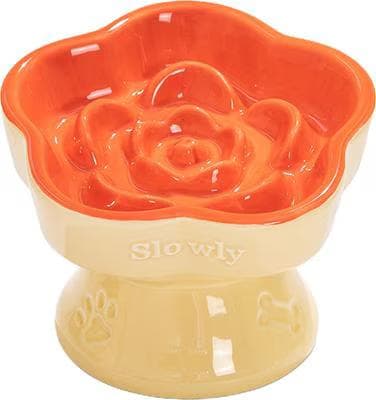
Webvet may earn a commission when you click through to Chewy, at no extra cost to you.

The PawsPik Raised Ceramic Slow Feeder ($22.99, rated 4.6 stars) checks every box above. It is heavy glazed ceramic rather than plastic, the flower-maze pattern is wide and shallow enough for whisker comfort while still forcing small bites, and the raised base gives adult cats and seniors a natural eating posture.
It also handles both dry and wet food, which most slow feeders cannot claim, and the glazed surface rinses clean or goes in the dishwasher. For the single most common problem that brings owners to this page, a cat that eats too fast and throws up, this is the first product we would hand them.
The problem-to-feeder matrix
The ranking roundups list products; the vet explainers list benefits. What owners actually need is the mapping between them. This problem-to-feeder matrix matches the four big problems to the feeder type that fixes each, so you buy one right thing instead of three wrong ones.
| Problem | Best feeder type | Why it works | Where to start |
|---|---|---|---|
| Scarf-and-barf (eats fast, regurgitates) | Slow-feed bowl | Ridges cap bite size and pace with zero learning curve | PawsPik Raised Ceramic Slow Feeder |
| Indoor cat obesity / weight gain | Ball or mobile feeder plus measured portions | Adds movement to every meal and slows intake so fullness registers | Any adjustable treat ball, hole set wide at first |
| Boredom, destructive behavior | Stationary puzzle | Sustained problem-solving occupies the brain, not the curtains | Multi-station puzzle board or the Catit Senses food tree |
| Night waking for food | Hunting-style feeder or timed feeder | Cat earns pre-dawn meals herself instead of waking you | Doc & Phoebe's Indoor Hunting Feeder, or a timed feeder for scheduled portions |
| Multi-cat food competition | Separate stations plus slow bowls | Distance removes the race; obstacles slow the winner | One slow feeder per cat, in different rooms |
Making the switch stick: what improvement looks like
Because scarf-and-barf is a frequency problem, measure it like one. Before the new bowl arrives, note two numbers for a few days: how long a meal takes, and how many regurgitation episodes happen per week. Those baselines turn a vague feeling of better into evidence.
Here is the trajectory most households see with a well-chosen slow feeder:
- Days 1-3: meals stretch from under a minute to several minutes; some cats paw food onto the floor while they learn the geometry
- Week 1: eating pace settles, floor spillage drops, and post-meal regurgitation episodes become noticeably rarer
- Weeks 2-4: episodes should approach zero for true speed-eaters; the cat eats calmly around the maze without frustration
- Beyond a month: if vomiting persists at all despite visibly slower eating, stop attributing it to speed and book a vet visit
Pair the bowl with meal frequency changes and the effect compounds. Splitting the same daily ration into three or four smaller servings means the stomach never gets the giant bolus that comes back up. A slow feeder plus smaller, more frequent meals resolves most mechanical regurgitation outright.
In multi-cat homes, layout does as much work as the bowl. Give each cat a station in a separate room or out of the others' sight lines, feed the fastest eater first behind a closed door, and keep the slow feeder with the cat who needs it. No bowl design can slow a race.
Keep the old bowl, though. If your cat is ever sick, post-surgical, or simply worn out, effort-free meals are appropriate, and a familiar bowl makes those days easier. Enrichment feeding is a routine, not an ideology.
Frequently Asked Questions
Do slow feeders actually work for cats?
Yes, for the problem they are designed to solve. The ridges and mazes physically cap how much a cat can take per bite, which typically stretches a sub-minute meal to five minutes or more and reduces regurgitation from eating too fast. They do not control portions or fix medical causes of vomiting, so pair them with measured meals and see a vet if vomiting persists.
Do vets recommend slow feeders?
Commonly, yes. Slowing intake is the standard first recommendation for cats that regurgitate intact food right after eating, and veterinary behaviorists endorse food puzzles more broadly for enrichment and weight management. Vets also caution that repeated vomiting, weight loss, or lethargy needs a medical workup before you treat it as a behavior problem.
What are the cons of slow feeders?
The main drawbacks are frustration in impatient cats, whisker stress from deep narrow channels, harder cleaning than a plain bowl, and hygiene concerns with scratched cheap plastic. Choosing a wide, shallow, dishwasher-safe ceramic or stainless design and starting with an easy pattern avoids most of them. A slow feeder also does not measure portions, so it is not a weight-loss tool by itself.
The payoff reaches beyond scarf-and-barf. Slower meals support weight control in cats prone to obesity, and the added work fights the boredom that drives overeating in indoor cats. Both effects compound: a cat that eats slowly and works for meals takes in fewer calories and spends more of the day occupied.
Using wet food in puzzle feeders and slow feeders
Most puzzle feeder content quietly assumes kibble, which leaves wet-food households wondering if enrichment feeding is even available to them. It is. You just need the right hardware, because a treat ball full of pate is a crime scene, not a puzzle.
Wet food works in any feeder built around open, reachable surfaces rather than internal chambers. Rolling and tumbling feeders are out. Everything else is fair game:
- Slow-feed bowls. Smear pate into the maze channels. The cat licks and tongue-works food out of the grooves, which slows a wet meal just as effectively as ridges slow kibble.
- Lick mats. Textured silicone mats made for spreadable food. Freezing a loaded mat extends a two-minute meal to fifteen.
- Open puzzle trays. Boards with shallow cups and channels accept wet food directly, and most are top-rack dishwasher safe.
- Silicone molds and ice cube trays. A free DIY version: drop a teaspoon of wet food in each cavity and let the cat work cup to cup.
Hygiene is the one place wet-food puzzling demands more discipline than kibble. Wet food dries into concrete and spoils fast at room temperature. Wash the feeder after every single meal, and do not leave wet food sitting out beyond roughly 30 to 60 minutes, less in a warm house.
Material matters even more here than with dry food. Glazed ceramic, stainless steel, and food-grade silicone clean up completely. Scratched plastic mazes hold residue and bacteria no sponge reaches. This is another point in favor of a ceramic slow feeder like our pick above if wet food is on the menu.
Three techniques that make wet food puzzling work better
- Freeze it. Load a lick mat or silicone mold and freeze it for an hour before serving. Frozen pate takes several times longer to finish, and in summer it doubles as a cooling treat.
- Thin it. A spoonful of warm water or plain, onion-free broth mashed into pate makes it spread deeper into maze channels and adds hydration, which matters for cats prone to urinary issues.
- Layer it. Smear wet food into the grooves and press a few kibble pieces on top. The cat works through two textures, and picky eaters often accept a feeder faster when the surface layer is their favorite.
- Warm it. Ten seconds of warm water stirred into refrigerated wet food releases aroma, and smell drives feline appetite far more than taste. A warmed, fragrant puzzle meal recruits cats that ignored the same food served cold.
Texture-fussy cats deserve one warning: some cats refuse wet food that has been smeared thin because it dries at the edges within minutes. If your cat abandons a loaded lick mat, serve smaller amounts more often, keep the layer thick in the center, and skip the freezing until she is committed to the game.
If your cat eats both textures, an easy pattern is kibble in the working feeders, wet food on a lick mat or slow bowl. You keep the activity benefits of dry-food foraging and the hydration benefits of wet food without asking one device to do everything.
For wet-food households that also need scheduled meals, refrigerated compartment feeders exist, but they are a different tool with different tradeoffs. We cover chilled and wet-capable options in the automatic feeder guide linked later in this article.
Frequently Asked Questions
Can you put wet food in a puzzle feeder?
Yes, in feeders with open, lickable surfaces: slow-feed bowls, lick mats, open puzzle trays, and silicone molds. Skip rolling ball feeders and enclosed chambers, which wet food clogs. Wash the feeder after every wet meal and do not leave wet food out beyond about an hour, since it spoils quickly at room temperature. Freezing a loaded lick mat is the easiest way to extend a wet-food puzzle meal safely.
Wet food works in any feeder with open, lickable surfaces: slow bowls, lick mats, trays, and molds. Keep servings under an hour at room temperature, wash after every meal, and choose ceramic, stainless, or silicone over scratchable plastic.
DIY and homemade cat puzzle feeders

Whatever you build, treat it as disposable: cardboard and paper feeders cannot be washed, so replace them after a few uses, and wash plastic bottle feeders with hot soapy water the way you would a food bowl. Skip anything with sharp cut edges or pieces small enough to swallow.
You do not need to buy anything to find out whether your cat enjoys foraging. Some of the most effective puzzle feeders in behavior programs are built from recycling-bin material in five minutes. DIY is also the cheapest way to add variety, which matters because novelty itself is enriching.
Ground rules before the fun part:
- Remove staples, tape, plastic rings, and any strings a cat could swallow
- Sand or tape any cut plastic edges smooth
- Use only clean containers that never held chemicals, medications, or anything toxic
- Make openings generous at first, at least half again wider than a kibble piece
- Supervise the first few sessions and retire anything your cat starts shredding and eating
- Skip DIY entirely for cats that eat cardboard or plastic; pica-prone cats need commercial feeders with nothing shreddable
Seven homemade puzzle feeders, easiest first
- Muffin tin scatter. Drop kibble into a muffin tin's cups. That alone slows a fast eater. Cover some cups loosely with balled paper or toy balls to add a lift-and-find step. Difficulty: trivially easy, perfect first exposure.
- Egg carton buffet. A cardboard egg carton with kibble in the cells makes cats scoop with a paw instead of gulping. Cut varying holes in the closed lid to level it up.
- Toilet-roll pyramid. Glue toilet paper tubes into a pyramid on a cardboard base, kibble in random tubes. The cat fishes pieces out with a paw. This is the classic DIY stationary puzzle.
- Bottle roller. Cut two or three kibble-plus-sized holes in a clean plastic bottle, sand the edges, drop in a meal, cap it. A free ball feeder, and the crinkle noise is a feature for confident cats and a bug for shy ones.
- Paper wrap surprise. Wrap small kibble portions loosely in plain paper balls and scatter them for a search-and-destroy hunt. The closest DIY analog to hunting-style feeders.
- Box forage station. Cut paw-sized holes in the sides of a shallow cardboard box, tape the lid shut, and drop kibble inside. The cat reaches through the holes and hooks pieces out, a free version of a commercial puzzle box.
- Towel roll-up. Sprinkle kibble along a towel and roll it loosely. The cat noses and paws the roll open, a gentle snuffle-mat substitute that works well for shy cats because it makes no noise.
Sequence matters more than construction quality. Start with the muffin tin, where all food is visible and reachable, and only move to enclosed builds like the bottle roller after your cat is confidently clearing open designs. Jumping straight to a hard puzzle teaches a cat that feeders mean frustration.
DIY has an underrated diagnostic role, too. A week of homemade puzzles tells you which style your cat prefers, pawing at stationary targets or chasing rolling ones, before you spend money. Buy the commercial version of whatever your cat already loves.
Run a free DIY week before buying anything. The muffin tin and egg carton reveal whether your cat is a patient paw-worker or a chase-and-bat forager, and that preference should drive which commercial feeder you buy.
Where store-bought wins: durability, dishwasher-safe hygiene (cardboard cannot be washed, so it must be replaced), wet food compatibility, and adjustable difficulty. Most enriched households land on a mix: one or two quality commercial feeders in the daily rotation, plus disposable DIY builds for variety.
Cost tells the same story. A month of DIY builds costs nothing but tape and cardboard, a quality ceramic slow feeder runs about $20 to $25, and even the timed feeders in this guide stay under $50. Relative to how much behavior it changes, foraging enrichment is among the cheapest interventions in cat care.
Frequently Asked Questions
How do you make homemade puzzle feeders for cats?
The easiest builds: scatter kibble in a muffin tin or egg carton, glue toilet paper tubes into a pyramid the cat fishes kibble from, or cut smooth-edged holes in a clean plastic bottle to make a rolling dispenser. Remove staples and strings, keep openings generous at first, supervise early sessions, and replace cardboard builds regularly since they cannot be washed. Start with an open design like the muffin tin before any enclosed build, so your cat learns the game with visible food.
How to introduce a puzzle feeder to your cat

More puzzle feeders are abandoned in closets than are worn out by cats, and the failure is almost never the cat. It is the introduction. A cat presented with a hard puzzle at dinnertime, hungry and confused, learns exactly one thing: this object stands between me and food, and I hate it.
The fix is a staged introduction: start easier than seems necessary, and only raise difficulty after your cat is winning consistently. Behavior organizations that teach food-puzzle programs, including International Cat Care, are unanimous on this progression logic. Here is the protocol we recommend.
The staged introduction protocol
- Stage 1: free wins. Put the new feeder next to the regular bowl with a few pieces of a high-value treat sitting on top or in the easiest, most exposed position. No work required. Goal: the feeder predicts good things. One to three days.
- Stage 2: visible food, trivial work. Load the feeder on its easiest setting, openings wide, food visible. Transparent feeders shine here, because the cat can see the payoff while learning the mechanism. Keep the regular bowl available with a reduced portion.
- Stage 3: the feeder earns a meal. Once your cat empties the easy setup without hesitation, serve a full meal portion in the feeder and shrink the backup bowl further. Most cats reach this stage inside a week.
- Stage 4: level up and retire the bowl. Tighten openings, add harder stations, or split meals across multiple feeders in different spots. Raise difficulty one notch at a time, and only after several confident, complete wins at the current level.
Two accelerators help almost any cat. Rub a soft cloth on your cat's cheeks and wipe it on the new feeder, transferring her own scent so the object smells familiar. And lay a short trail of three or four treats leading to the feeder for the first sessions, so approaching it pays off immediately.
Frustration signs: when to make it easier
The protocol only works if you watch for frustration signs and respond by dropping difficulty, not by coaxing. Watch for:
- Walking away from the feeder with food still inside
- Sitting and staring at the feeder or at you instead of working it
- Batting or biting the feeder aggressively rather than manipulating it
- Vocalizing at mealtimes more than usual
- Eating noticeably less across a full day
Any of these means the current level is too hard. Go back one stage, make the win easier, and rebuild confidence. There is no timetable prize. A cat that spends three weeks at stage 2 and ends up a happy lifelong forager beats a cat rushed to stage 4 in five days who quits.
Two hard rules while transitioning. First, never let a cat skip meals to force puzzle use. If your cat is refusing food, drop the puzzle immediately and see our guide on how to get a cat to eat.
Second, in multi-cat homes, introduce feeders separately. A confident cat will strip every station while a timid one watches, and the timid cat learns feeders are contested territory. Run introductions in separate rooms, and keep at least one feeding station per cat permanently.
Troubleshooting the common sticking points
- She eats half and quits. The portion-to-effort ratio is off. Make the remaining food easier to reach, or split the meal across two easier stations.
- He flips the feeder and vacuums the spill. Clever, not cheating. Weight it down or switch to a heavier ceramic or weighted design, and count it as proof he is motivated.
- She only uses it when you watch. Some cats treat novel objects as safer with a trusted human nearby. Sit with her for a few sessions, then drift farther away each meal.
- One cat empties every station. Feed the puzzle-skilled cat first in a closed room, or use a microchip-gated station for the slower cat's share.
- He cries at the old bowl spot. Leave the empty bowl down for a week during transition, then remove it once feeder meals are routine. Ritual matters to cats.
- She dumps the ball feeder against a wall. Hard floors plus hollow plastic equals noise. Confine ball-feeder meals to a rug or carpeted room, and shy cats usually re-engage.
Expect the full transition, from first sniff to all meals as foraging, to take two to six weeks for a typical adult cat. Confident cats compress that to days; cautious or senior cats stretch it longer, and that is fine. The routine will run for years, so the on-ramp pace is irrelevant.
Introduce a puzzle feeder easier than seems necessary: free wins first, visible food second, full meals third, difficulty last. Retreat a stage at the first frustration signs, and never let a cat miss meals to force the transition.
Frequently Asked Questions
How do you get your cat to use a puzzle feeder?
Use a staged introduction. Start with treats sitting on the feeder so it predicts good things, then load it on the easiest setting with food visible, keeping the normal bowl available. Once your cat empties it confidently, move full meals into the feeder and phase out the bowl, raising difficulty one notch at a time. If your cat walks away, stares, or swats at the feeder, drop back a stage. Never let a cat skip meals during the transition.
Take photos of each session during the first week. Comparing photos day by day makes slow progress visible, shows you which feeder your cat actually engages with, and gives your vet something concrete if frustration signs persist.
Timed and automatic feeders for small, frequent meals

One honest limitation of puzzle feeders: they control how a cat eats, not when. If your core problem is scheduling, a cat that needs many small meals, a 4 a.m. breakfast alarmist, or a household that works long shifts, the complementary tool is a timed automatic feeder.
To be clear about what we are recommending: a timed feeder is not a puzzle and provides no foraging enrichment by itself. It solves the scheduling half of natural feline feeding, many small meals across the day and night, while puzzles solve the working-for-food half.
The strongest setups use both. A timed feeder dispenses small portions on a hunting-like schedule, and a puzzle or slow bowl makes the cat work for part of the ration. Framed that way, the two products below are the honest timed-feeding complement to everything above, not puzzles in disguise.
Petlibro Air Automatic Feeder
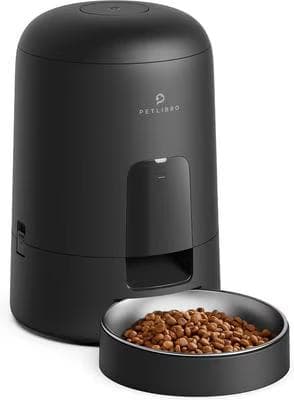
Webvet may earn a commission when you click through to Chewy, at no extra cost to you.
The Petlibro Air ($49.99, rated 4.2 stars) is the compact option: a slim, battery-operated dry-food feeder that schedules multiple small meals a day with portions small enough to mimic prey-sized feedings. Its footprint fits where bulky hopper feeders will not, and battery power frees placement from outlets.
OneIsAll PF05 Automatic Feeder
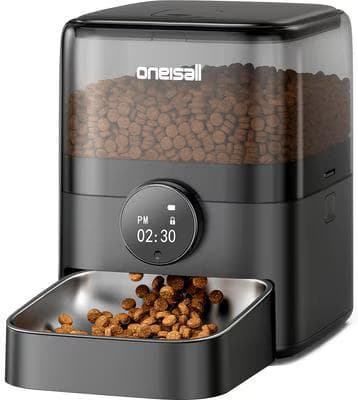
Webvet may earn a commission when you click through to Chewy, at no extra cost to you.
The OneIsAll PF05 ($39.99, rated 4.6 stars) trades the slim profile for capacity: a 12-cup hopper covering a week or more of scheduled small meals for one cat. For breaking the 4 a.m. wake-up cycle, an early portion from a machine retrains the habit fast. The cat stops associating your bed with breakfast.
What to look for in a timed feeder

- Fine portion control. The whole point is many small meals, so the feeder must dispense portions small enough to schedule four to six feedings without overfeeding
- Battery backup or battery power, so a tripped breaker does not mean a hungry cat and a broken routine
- A removable, washable hopper and bowl, for the same chin-acne and hygiene reasons as any other feeder
- A locking or cat-proof lid. Motivated cats defeat flimsy hoppers within a week
- Quiet dispensing, since a grinding motor can scare a shy cat off the feeder entirely
Multi-cat households should also know microchip feeders exist: bowls that open only for a registered cat's chip or collar tag. They are the definitive fix when one cat steals another's slow-fed meals, or when one cat eats a prescription diet the others must not touch.
The best pairing routine we know: schedule the timed feeder for the hours you are away, early morning and midday, and serve the meals you are home for as puzzle or slow-bowl feedings. The machine handles the clock, the puzzles handle the enrichment, and the day fills with small, earned meals.
A common follow-up question: does an automatic feeder mean you can leave a cat alone for several days? Short answer, food is the smallest part of that problem. Water supply, litter, illness monitoring, and loneliness all fail before the feeder does. Most vets cap unattended time around 24 to 48 hours even with equipment.
Our full guide to the best automatic cat feeders covers time-away safety, backup power, and wet-food-capable models in depth. Meanwhile, here is every product we genuinely recommend in this guide, at a glance:
| Product | Type | Price | Rating | Best for |
|---|---|---|---|---|
| PawsPik Raised Ceramic Slow Feeder | Slow-feed bowl (wet or dry) | $22.99 | 4.6 | Scarf-and-barf, whisker-friendly slow eating |
| Petlibro Air Automatic Feeder | Timed feeder, compact | $49.99 | 4.2 | Small frequent meals in tight spaces |
| OneIsAll PF05 Automatic Feeder | Timed feeder, 12-cup hopper | $39.99 | 4.6 | Night-waking retraining, longer refill intervals |
The list is short on purpose. The market is crowded with near-identical plastic mazes, and we only link products we would use ourselves. The excellent options covered above, Doc & Phoebe's Indoor Hunting Feeder and the Catit Senses food tree, earn their mentions on merit; we simply do not carry links for them.
Need a slow feeder for a dog instead?
Everything in this guide is cat-specific: portion scale, whisker-safe geometry, and prey-sized meal logic do not transfer to a Labrador who can swallow a cat slow feeder whole. Dogs bolt food too, and fast eating in deep-chested breeds carries a bloat risk that makes slowing intake a genuine safety issue.
If the fast eater in your house barks rather than meows, our guide to the best slow feeder dog bowls covers dog-scale maze bowls, DIY dog puzzle options, and wet-food-friendly designs, with sizing guidance by breed.
Wherever you start, start small. A muffin tin tonight, a ceramic slow bowl this week, a hidden hunting mouse before bed. Each one hands your cat back a piece of the job she was built to do.
The whole playbook in one line: match the feeder type to your cat's actual problem, introduce it easier than seems necessary, keep every calorie inside the measured daily ration, and let a timed feeder cover the hours you cannot.
The payoff compounds quietly. Meals stop coming back up, the scale stops creeping, the pre-dawn yowling fades, and the long indoor afternoons gain a purpose. A cat with a job is calmer, leaner, and a far better roommate at 4 a.m., and the job costs less than a bag of treats.

Editor
The Webvet Editorial Team is the in-house group of pet-care editors and writers behind Webvet, operated by Smart Pet Collective. The team researches, writes, and maintains Webvet's pet health, behavior, and medication content. Every article follows a defined editorial process: research from reputable veterinary and scientific sources, careful drafting, mandatory review of medical content by a credentialed veterinarian, and dated publication. Health and medication articles are medically reviewed by a licensed veterinary professional before they go live and are kept current over time.
Related reading

Best Dog Advent Calendars and Cat Advent Calendars for 2026: Vet-Reviewed Picks

How to Help a Cat Lose Weight: A Safe Weight Loss Plan

When Can Puppies Eat Solid Food? Weaning Timeline and Tips
