How to Help a Cat Lose Weight: A Safe Weight Loss Plan
To help a cat lose weight, set a calorie target with your vet, feed measured meals of a weight-loss food, add puzzle feeders and play, and lose slowly, because crash diets can trigger fatty liver disease. Here is a step-by-step plan.

BVMS MRCVS

This article contains affiliate links. Webvet may earn a commission when you buy through them, at no extra cost to you.
How to help a cat lose weight comes down to a calorie target your vet sets for the cat's ideal weight, measured meals of a weight loss food, daily play, and slow, steady loss of about 0.5% to 2% of body weight per week.
Going faster is the danger. VCA Animal Hospitals warns that obese cats who stop eating are at significant risk of hepatic lipidosis, a potentially life-threatening liver condition, so any plan to help a cat lose weight should be gradual and supervised by your vet.
The need is common. In a 2022 clinic survey by the Association for Pet Obesity Prevention (APOP), veterinary teams assessed 61% of cats as overweight or obese: 28% overweight and 33% obese.
- 1To tell if a cat is overweight, use a body condition score: 5 out of 9 is ideal, and at 7 out of 9 the ribs need finger pressure to feel and the waist is gone.
- 2Indoor cats and spayed or neutered cats gain weight more easily, because indoor cats burn fewer calories and neutered cats are more than three times as likely to be overweight as intact cats.
- 3A safe rate of cat weight loss is about 0.5% to 2% of body weight per week, checked with a weigh-in at least every other week until the cat reaches its goal weight.
- 4A cat's weight loss calorie target is based on its ideal weight, and Cornell's rule of thumb is 70% of the maintenance calories for that ideal weight.
- 5Crash diets are dangerous for cats because they can trigger hepatic lipidosis: never let a cat go longer than 24 hours without eating any meals, and see a vet immediately if it seems depressed or dehydrated, vomits, drools, or has yellow-tinted eyes or skin.
How to Help a Cat Lose Weight
To help a cat lose weight, work with your vet to set a calorie target for the cat's ideal weight, feed measured meals of a weight loss food, add daily play, and let the weight come off slowly.
The Merck Veterinary Manual says the most successful weight loss programs combine calorie restriction with exercise. Supervision matters too: VCA says never to put an obese cat on a diet without veterinary supervision, because weight loss that is too rapid, or done with the wrong food, can be quite dangerous.
A 2014 review by Hoelmkjaer and Bjornvad in Veterinary Medicine: Research and Reports sets out five steps for a cat weight loss program, following the 2014 American Animal Hospital Association (AAHA) weight-management guidelines:
- Target weight: estimate the cat's ideal or target body weight.
- Calories: work out how far to restrict daily energy intake.
- Diet: choose the food.
- Feeding and activity: plan how meals are served and how the cat will move more.
- Follow-up: schedule rechecks to weigh the cat and adjust the plan.
For the diet step, the Merck Veterinary Manual says maintenance diets are generally not recommended for weight loss, because they are formulated to meet the needs of moderately active adults. The alternative is a therapeutic weight loss diet chosen with your vet.
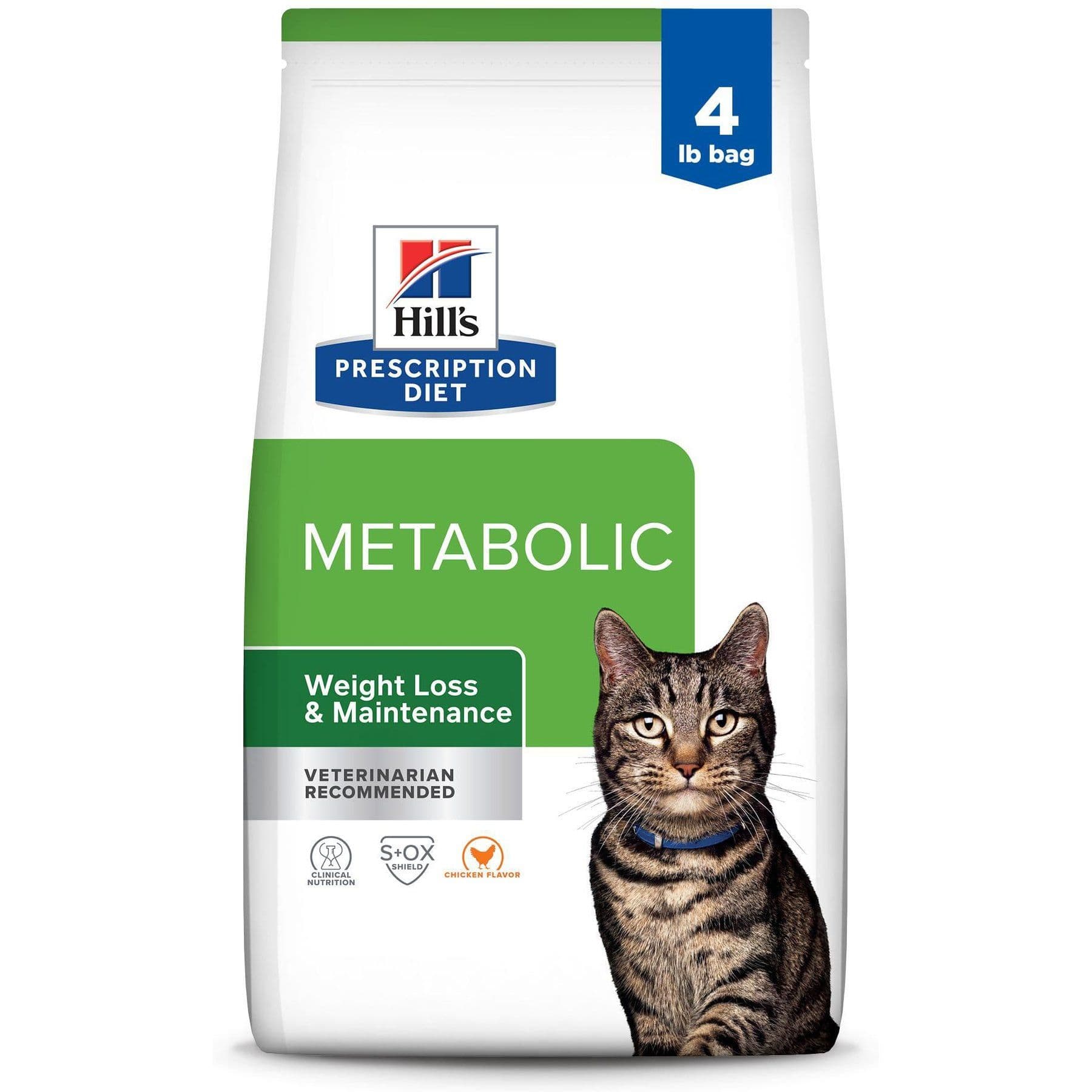
Hill's Prescription Diet Metabolic Weight Solution is a dry weight management cat food sold only with a veterinarian's prescription.
Webvet may earn a commission when you click through to Chewy, at no extra cost to you.
Feline weight loss takes longer than many owners expect. In APOP's 2022 survey, only 19% of cat owners who tried to help their cat lose weight reported success, compared with 34% of dog owners, so expect the plan to take patience and regular rechecks.
Extra pounds are not harmless: the Merck Veterinary Manual links obesity in cats to diabetes mellitus, arthritis, and hepatic lipidosis, along with decreased life expectancy.
A few cats need the plan adjusted from the start:
- Senior or less active cats: start gently, with short play sessions and food puzzles, and let your vet set a goal weight that suits the cat's age and health.
- Cats that have lost a lot of weight without a diet: book a vet exam before starting any plan, because weight loss you did not plan is a medical question, not progress.
- Morbidly obese cats: VCA suggests a slower target, closer to 0.5% of body weight per week, rather than 1% to 2%.
Treat any calculator or feeding chart as a first estimate. The Merck Veterinary Manual says a calculated calorie intake is only a starting point, and that the cat's weight should be monitored every 2 weeks so the program can be modified based on its response.
For the feeding and activity step, the 2014 review recommends raising daily activity by making the cat work for its food: move the food bowl, put food in hard-to-reach places, or feed with an activity toy. A slow feeder that the cat has to paw food out of is one kind of activity toy.

Catit Senses 2.0 Food Tree is an interactive, tree-shaped slow feeder with multiple openings.
Webvet may earn a commission when you click through to Chewy, at no extra cost to you.
Is My Cat Overweight?
A cat is overweight when it weighs 10% to 20% above its ideal body weight and obese when it weighs more than 20% above, according to VCA.
The practical way to tell if a cat is overweight is a body condition score, a hands-on check of ribs, waist, and belly. Tufts says most cats should weigh about 7 to 12 lb, but ideal weight depends on frame size, so the body condition score matters more than the scale alone.
VCA's body condition guide describes the signs to check at home:
- Ribs: at an ideal weight, the ribs feel like your knuckles when your hand rests flat on a surface; in an overweight cat, they feel like the knuckles on the palm side of your hand.
- Fat cover: at a score of 7 out of 9, a heavy fat layer covers the ribs, so feeling them takes finger pressure, and the backbone and pelvis are hard to feel.
- Waist: at 7 out of 9, the waistline is not apparent.
- Belly: at 7 out of 9, the cat has a moderate abdominal fat pad, although the tummy tuck is still slightly visible.

Scales differ slightly. On the Merck Veterinary Manual scales, ideal is 5 out of 9 (or 3 out of 5) and obese is the fattest end, 9 out of 9 (or 5 out of 5). APOP's 2022 survey, by contrast, counted scores of 6 to 7 as overweight and 8 to 9 as obese.
Is 20 pounds for a cat obese?
For most cats, yes, although frame size matters. A 20 lb cat is well above the 7 to 12 lb that Tufts gives for most cats.
VCA's diabetes guide counts a cat 3 lb over its ideal weight as obese and says an average domestic cat at 13 lb or more is at high risk of type 2 diabetes mellitus.
Frame size varies from cat to cat and breed to breed, and a large-framed cat has a higher ideal weight, so confirm the answer with a body condition score at your vet's office.
How chubby is too chubby for a cat?
A body condition score of 7 out of 9 is too chubby: at that score, VCA describes ribs under a heavy fat layer, no apparent waistline, and a moderate fat pad on the belly.
A mildly overweight cat at 6 out of 9 sits in a gray zone, because the WSAVA body condition chart notes that a score of 6 may be acceptable in some cats, especially older cats.
Why Cats Gain Weight
Cats gain weight when indoor living, spaying or neutering, or free feeding tips their calorie balance toward taking in more than they burn.
Indoor, spayed, or neutered cats gain weight more easily because they need fewer calories. The Cornell Feline Health Center explains that cats fed from a bowl burn fewer calories each day than feral cats, which must hunt for their meals, and strictly indoor cats burn fewer than cats that go outdoors.
Spaying or neutering has a large effect, and the 2014 review and Tufts put different numbers on the food cut needed afterward:
- 2014 review: neutered cats are more than three times as likely to be overweight as intact cats, and a 30% to 40% cut in daily calories is needed to prevent weight gain after neutering.
- Tufts: routinely recommends cutting food by 20% to 30% after a spay or neuter and watching body condition closely, while keeping a kitten on a diet for growing cats until it is at least 1 year old.
Free feeding is the other big driver. A Cornell clinician names free feeding, leaving a bowl of dry food out all day, as a major factor in feline obesity. Scheduled, measured meals remove that factor, and the AAFP notes that automatic feeders can help, although they do not typically provide for foraging.
What causes a cat to gain weight quickly?
Look for a recent change when a cat gains weight quickly:
- A spay or neuter
- A switch to free feeding
- Less exercise
- A new medicine
The Merck Veterinary Manual lists lack of exercise, breed, age, neutering, certain endocrine disorders, and certain drugs, such as corticosteroids and phenobarbital, among the risk factors for obesity.
If a cat gained weight fast with no clear cause, have it checked. VCA says the vet will examine the cat and likely recommend diagnostic tests to make sure no underlying disease will get in the way of weight loss.
Why is my cat gaining weight but not eating a lot?
Hidden calories and a low calorie burn are the first things to check. VCA suggests keeping a food diary, a written log of everything that goes into your cat's mouth for several days, to show how much it really eats, treats included.
The opposite problem, a cat that is eating but not gaining weight or is losing weight without a diet, needs a vet exam rather than a diet change. WebVet's guide to hyperthyroidism in cats covers one condition your vet may want to rule out.
How Fast Should a Cat Lose Weight?
A safe rate of weight loss for a cat is about 0.5% to 2% of its body weight per week, according to Tufts. VCA aims for 1% to 2% of initial body weight per week, and closer to 0.5% for morbidly obese cats.
Tufts gives the example of a 20 lb cat losing 0.2 to 0.4 lb, or about 4 oz, per week, and says a slower pace is acceptable but takes longer.
The cat weight loss plan table below lists each step, what to do, how often, and the warning sign to stop. It sets the calorie approach, the weigh-in schedule, and the safe weekly rate, and it shows what to change if the cat stalls or loses weight too fast.
| Cat weight loss plan step | What to do | How often | Warning sign to stop and call your vet |
|---|---|---|---|
| 1. Vet exam and target weight | Your vet sets the ideal weight and checks blood and urine for medical problems | Once, before the diet starts | Weight loss you did not plan |
| 2. Calorie approach | Feed a vet-set daily amount in grams, for example 70% of the maintenance calories for the ideal weight (Cornell) | Set at the start, then adjusted at rechecks | The cat skips meals; never let it go longer than 24 hours without eating any meals |
| 3. Food switch | Mix the new food into the old in four steps: 25%, 50%, 75%, then 100% new | One step at a time | The cat refuses the new diet |
| 4. First weigh-in | Reassess feeding amounts within 1 to 2 weeks of finishing the food switch | Once | Loss faster than 2% of body weight in a week |
| 5. Regular weigh-in | Weigh the cat and record the result | At least every other week until the goal weight | Weight stops dropping, or drops faster than 2% a week |
| 6. Progress stalls | Recheck the food diary and portions first; if feeding is on track, lower the allowance by about 10% | At the next recheck | Any cut that makes the cat stop eating |
| 7. Loss runs too fast | Raise the food allowance by about 10% | At the next recheck | Depression, dehydration, vomiting, drooling, or yellow eyes or skin: possible signs of hepatic lipidosis that need a vet immediately |
Real-world progress can be slower than the target. In a six-month trial funded by Hill's, 83% of cats lost weight, at an average of 0.45% of body weight per week and 11.0% over six months, according to the Journal of Feline Medicine and Surgery.
Faster is not better. A UK referral weight loss program treated loss of more than 2% per week as too quick and increased the food again (German et al. 2008), and VCA says rapid weight loss can cost lean muscle and put a cat at risk of severe liver disease.
When a cat is sick, weight can drop quickly. The Merck Veterinary Manual lists dramatic weight loss of more than 25% among the usual signs of hepatic lipidosis, so unplanned or rapid loss calls for a vet exam, not a diet.
How long does it take a cat to lose 3 lbs?
Usually a few months to most of a year. At 0.5% to 2% of initial body weight per week, a 15 lb cat would lose about 0.075 to 0.3 lb a week, so 3 lb takes roughly 10 to 40 weeks. That is arithmetic, not a schedule.
VCA says the time to goal depends on how quickly the cat accepts the new diet, the rate of loss (losing 1% a week takes twice as many weeks as losing 2%), and the total amount to lose.
One worked example comes from the 2014 review: at 0.5% to 2% of initial body weight per week, a cat that needs to lose 3 kg (about 6.6 lb) can expect 24 to 60 weeks to reach its target weight.

Petlibro Air Automatic Cat Feeder is an automatic dry food dispenser that runs on plug-in power with battery backup.
Webvet may earn a commission when you click through to Chewy, at no extra cost to you.
How Many Calories for Cat Weight Loss
A common starting point for weight loss is 70% of the maintenance calories for the cat's ideal weight. Using the Cornell Feline Health Center formula, a cat with an ideal weight of 5 kg (about 11 lb) needs 220 kcal a day to maintain, so its weight loss starting point is 154 kcal a day.
To turn the target into food, VCA says your vet should ideally give you an amount in grams per day rather than cups or cans, because measuring cups make it very easy to over- or under-feed. For general portion guidance, see how much to feed a cat.
Calorie targets are based on ideal weight and set with a vet, who estimates the target weight first and then decides how far to restrict energy, the first two steps in the 2014 review's plan. Veterinary formulas for the starting point differ:
- Cornell Feline Health Center: maintenance is 30 times the ideal weight in kg, plus 70; offer 70% of that for weight loss.
- Merck Veterinary Manual: 70% of maintenance energy requirement for cats (60% for dogs) is one way to set the starting intake.
- AAHA, as cited in the 2014 review: 80% of resting energy requirement, about 37.5 kcal per kg of target weight per day for a 5 kg cat and 39.5 for a 4 kg cat.
For comparison, the WSAVA calorie chart for healthy adult cats at an ideal weight lists 215 to 230 kcal a day at 3.5 kg (7.7 lb), 225 to 250 at 4.0 kg (8.8 lb), and 240 to 270 at 4.5 kg (9.9 lb). These are maintenance figures, not weight loss targets.

Iams Proactive Health Indoor Weight & Hairball Care is a dry adult cat food that is complete and balanced for maintenance.
Webvet may earn a commission when you click through to Chewy, at no extra cost to you.
A low-calorie food helps only when the portion is measured, since Tufts says there is no food that every cat can eat as much as it wants and still lose weight.
Is 1 cup of food a day enough for a cat?
It depends on the food and the cat's calorie target, and a cup is too rough a measure for a diet. The 2014 review found that measuring cups ranged from an 18% underestimate to an 80% overestimate of the intended portion.
Labels show how much the answer varies. The IAMS feeding chart for its Indoor Weight and Hairball Care food lists 1 cup a day as the maintenance amount for a 16 lb cat and 3/4 cup for weight loss, and 2/3 cup versus 1/2 cup for an 8 lb cat.
VCA cautions that store foods with a weight claim are still maintenance diets that should not be fed calorie restricted, so follow your vet's target rather than the weight loss line on a bag.
Choosing a Weight Loss Food
When choosing a weight loss food for a cat, start with your vet and a therapeutic weight loss diet.
VCA says there is no over-the-counter weight loss cat food: store foods labeled for weight control or weight management are adult maintenance diets, and feeding them in calorie-restricted amounts could lead to nutrient deficiencies. Any food still needs portion control rather than free feeding.

Therapeutic diets are built for eating less. VCA says they are higher in protein, to preserve lean muscle and meet protein needs on fewer calories, and higher in fiber, to add bulk that helps with satiety. Prescription options such as Hill's Prescription Diet Metabolic Weight Solution require a veterinarian's prescription to buy.
Wet or dry is a closer call. A Cornell clinician advises canned food for overweight cats, since it typically has more protein and fewer carbohydrates than kibble and is 90% water, which raises fluid intake. Tufts says several studies show calorie intake matters more than the type of food.
VCA sets out four steps for switching to the new food:
- Mix 25% new food with 75% old food.
- Mix 50% new food with 50% old food.
- Mix 75% new food with 25% old food.
- Feed 100% new food.
If your cat refuses the new food, contact your vet rather than waiting it out. The Merck Veterinary Manual says that if a cat does not like the weight loss diet chosen, an alternative should be found.
Feeding Tricks: Puzzle Feeders, Meals, and Measuring
Three feeding tricks make a calorie target easier to keep: measured meals, puzzle feeders, and separate feeding in multi-cat homes. Each one replaces free feeding, which Tufts calls challenging because you cannot know how many calories the cat is eating.

These habits put the tricks into practice:
- Split the daily allowance into multiple small meals fed across the 24-hour day, using puzzle feeders when possible, as the AAFP consensus statement on feeding cats recommends.
- Fill a food puzzle, snuffle mat, or other dispensing toy with a measured amount of dry food so the cat has to work to get it out (VCA).
- Keep the total daily amount consistent, since VCA says research on whether smaller, more frequent meals or fewer, larger meals keep cats more satisfied is not conclusive.
- Count treats: VCA's rule is 10% of daily calories from treats, or 20 calories in a 200-calorie day, and typical cat treats have 1 to 3 calories each, though some have much more. The Cornell Feline Health Center allows up to 10% to 15%.
- In a multi-cat home, feed the overweight cat in a separate room for a set time, generally 15 to 30 minutes, then remove any uneaten food until the next meal (VCA).
Food puzzles have some case-report support. A 2016 review in the Journal of Feline Medicine and Surgery describes a cat that lost 32% of its weight over 18 months after stationary food puzzles were introduced; it is one case from the authors' practices, not a controlled trial.
Tiered slow feeders such as the Catit Senses 2.0 Food Tree are one style of food puzzle, and WebVet's guide to cat puzzle feeders covers more options.
An automatic feeder can serve measured portions on a schedule. WebVet explains whether automatic feeders are good for cats and compares the best automatic cat feeders.
Exercise and Play for Overweight Cats
Exercise through play is the activity half of a cat weight loss plan. VCA recommends scheduled active play for about ten minutes, twice a day, with feather toys, laser pointers, paper or foil balls, or anything else your cat likes to chase.
Every bit counts: VCA's exercise guide says any increase in exercise raises calorie expenditure and promotes weight loss. Expect short bursts, since VCA notes that most wild cats chase prey at top speed for less than a minute and then need hours to recover.
The best toys for cats that need to lose weight are the ones your cat will chase. Tufts says feather toys and shoelaces can be useful but must be used with supervision, so your cat does not swallow them in its enthusiasm.

Daily routines can add movement, too:
- Move the food bowl upstairs or downstairs and change its location often, so the cat always has to walk to eat (VCA).
- Hide portions of the meal around the house, such as behind the sofa or on stairs, chairs, and window ledges, so your cat hunts for its food (VCA).
For more ideas, see WebVet's guide to cat exercises.
How can I get my indoor cat to lose weight?
Pair fewer calories with more movement, because the Cornell Feline Health Center says strictly indoor cats burn fewer calories than cats that go outdoors.
Feed a vet-set amount as measured meals, put part of it in a puzzle feeder, play for about ten minutes twice a day, and move the food bowl often so your cat walks to eat (VCA).
Health Risks of Obesity in Cats
The health risks of obesity in cats include diabetes, arthritis, and liver disease, along with a shorter life. The Merck Veterinary Manual lists decreased life expectancy, joint problems such as arthritis, diabetes mellitus, hepatic lipidosis, and greater risk during and after anesthesia among the problems linked to obesity in cats.
Studies put numbers on several of these risks:
- Diabetes: VCA says an obese cat is three times more likely to develop type 2 diabetes than a cat of normal weight, and the 2014 review estimates that 13% to 18% of feline diabetes cases could be eliminated if overweight and obese cats reached a normal weight. Read more about diabetes in cats.
- Diabetes control: Tufts says obesity makes diabetes harder to control, and losing the extra weight may even lead to remission in some cases.
- Lameness: Tufts reports that overweight cats are almost five times as likely as lean cats to develop lameness that needs a vet visit.
- Anesthesia and medicines: Tufts says obese cats have higher anesthesia risks and medical costs, and need special care when vets choose medication doses.
- Fatty liver: VCA warns that obese cats who stop eating are at significant risk of hepatic lipidosis, a potentially life-threatening liver condition.
Obesity can also shorten how long a cat lives. VCA reports a 2.8-fold increase in mortality in obese cats aged 8 to 12 compared with lean cats.
In a Sydney study of 2,609 cats, those whose highest recorded body condition score was 9 had a higher hazard of death than cats whose highest score was 6 (hazard ratio 1.80), and so did cats whose highest score was 3, 4, or 5, according to the Journal of Feline Medicine and Surgery.
Why Crash Diets Are Dangerous for Cats
Crash diets risk hepatic lipidosis, also called fatty liver disease, which is why cat weight loss must be slow. Tufts explains that when a cat loses too much weight too quickly, its body breaks down fat faster than the liver can process it.
The Merck Veterinary Manual says obese cats undergoing weight loss are at increased risk of hepatic lipidosis and must keep eating adequate calories and nutrients, and that starvation is never a safe or humane way to cause weight loss.
Missed meals add up fast. The Cornell Feline Health Center says a loss of appetite can severely affect a mature cat's health if it lasts as little as 24 hours, and a Cornell clinician warns that a sudden starvation diet puts a cat at risk of serious problems such as hepatic lipidosis.
Even supervised plans need follow-up visits. The 2014 review notes that cutting energy to 50% of metabolic energy requirement has been estimated as safe in cats, yet in one study of client-owned cats fed 60% of that requirement (30 kcal per kg of target weight per day), one cat developed hepatic lipidosis.
Merck's chapter on feline hepatic lipidosis lists forced weight loss with unacceptable food substitutions among the less common causes of the appetite loss behind it. With customized critical care, about 75% to 80% of severely affected cats survived at the author's hospital, versus 50% given nutritional support alone.
When to Talk to Your Vet
Talk to a vet before you start any diet and whenever the plan goes off track. Tufts says the vet will determine your cat's optimal weight, test for medical issues that predispose it to obesity, and assess overall health with blood and urine testing.
Contact your vet in these situations, starting with the most urgent:
- Immediately: your cat seems depressed or dehydrated, vomits, drools, or has yellow-tinted eyes or skin, which Tufts lists among the signs of hepatic lipidosis.
- Before 24 hours pass without food: VCA warns that obese cats who stop eating are at significant risk of hepatic lipidosis, and Tufts says not to let a cat go longer than 24 hours without eating any meals.
- When your cat refuses food and is losing weight: the Cornell Feline Health Center says a veterinarian should examine any such cat. WebVet's guide to a cat not eating has more on appetite loss.
- During the food switch: your cat refuses the new diet, or anything concerns you; VCA says not to hesitate to contact the clinic.
- At weigh-ins: weight drops faster than 2% of body weight a week, or stops dropping, so the vet can adjust the food allowance.
Cat Weight Loss FAQs
Frequently Asked Questions
Can I put my cat on a diet at home?
Yes, the feeding happens at home, but the plan should come from your vet. The Cornell Feline Health Center says any feline weight-reduction program should be carried out under a veterinarian's direction.
Keep the loss gradual: VCA warns that rapid weight loss can cost lean muscle and put a cat at risk of severe liver disease.
What do you feed a cat that is always hungry?
Feed the same vet-set daily amount, split into more frequent, smaller meals, as Tufts suggests, and serve part of it in a puzzle feeder so your cat works for it.
Cats like to eat at night, so Tufts suggests a feeding right before bedtime and an automatic timed feeder overnight. VCA notes that attention-seeking can look like food begging, so offer pats, brushing, or play instead of extra food.
Does dry food keep cats full longer?
Not necessarily, and wet food may have the edge: in a 2011 trial in the American Journal of Veterinary Research, cats ate fewer calories and lost weight when the same food was served with its water rather than freeze-dried.
The authors concluded that the effect of water on energy density and food intake may help promote weight loss in cats.
How long do overweight cats live?
Overweight cats tend to live shorter lives, and obesity raises the risk of an earlier death.
In a Sydney study of 2,609 cats published in the Journal of Feline Medicine and Surgery, median lifespan across all cats was 15.8 years, and cats whose body condition score reached 9 between the ages of 3 and 11 had shorter lifespans (hazard ratio 2.27), as did cats that reached a score of 3.

Editor
The Webvet Editorial Team is the in-house group of pet-care editors and writers behind Webvet, operated by Smart Pet Collective. The team researches, writes, and maintains Webvet's pet health, behavior, and medication content. Every article follows a defined editorial process: research from reputable veterinary and scientific sources, careful drafting, mandatory review of medical content by a credentialed veterinarian, and dated publication. Health and medication articles are medically reviewed by a licensed veterinary professional before they go live and are kept current over time.
Veterinarian · BVMS MRCVS
Dr. Pippa Elliott, BVMS, MRCVS, is a veterinarian with nearly 30 years of experience in companion animal practice. Dr. Elliott earned her Bachelor of Veterinary Medicine and Surgery from the University of Glasgow. She was also designated a Member of the Royal College of Veterinary Surgeons. Married with 2 grown-up kids, Dr. Elliott has a naughty Puggle named Poggle, 3 cats and a bearded dragon.


