Are Automatic Feeders Good for Cats? A Vet-Reviewed Answer
Are automatic feeders good for cats? For most healthy adults, yes: measured meals on a schedule support portion control and weight management. But they are the wrong tool for some cats, and they are never a cat sitter.

BVMS MRCVS

This article contains affiliate links. Webvet may earn a commission when you buy through them, at no extra cost to you.
Are automatic feeders good for cats? For most healthy adult cats, yes. A programmable automatic feeder dispenses measured portions on a consistent schedule, which supports portion control, weight management, and a stable feeding routine. Monitored daily, automatic feeders are not bad for cats, but they never replace owner supervision or a cat sitter.

That verdict comes with real caveats. The wrong feeder in the wrong household can hide a sick cat's fading appetite, spark food competition between cats, or serve spoiled wet food. This vet-reviewed explainer covers which cats benefit, which cats should not use one, and how to transition safely.
Below you will find the benefits vets actually cite, the risks they warn about, a comparison of timed, gravity, and microchip-selective feeders, and clear travel guidance. If you already know you want one and just need model picks, start with our roundup of the best automatic cat feeders.
Automatic feeders are good for most healthy adult cats when they dispense measured meals on a schedule and you still check food intake every day. They are the wrong tool for cats whose appetite must be watched as an illness signal, and they are never a substitute for a cat sitter.
Are automatic feeders good for cats? The vet verdict (benefits: portion control, routine, weight management + what vets actually say)
Are automatic feeders good for cats? For most healthy adult cats, yes. Vets recommend them for portion control, a consistent routine, and weight management, provided you still check food and water daily. Owner threads on Reddit reach the same conclusion: the feeder helps when portions are measured and someone is monitoring.
Feline vets frame this question around two facts. First, cats do best eating multiple small meals on a predictable routine, per the Cornell Feline Health Center's feeding guidance. Second, obesity is one of the most common nutritional problems vets see in cats, per Cornell's obesity page.
A timed automatic feeder addresses both facts at once. It converts feeding from an act of memory and generosity into a repeatable system: the same measured amount, at the same times, every day, whether you are home, asleep, or stuck in traffic.
That system matters because portion creep is how most indoor cats get fat. A rounded scoop here, a sympathy top-up there, a second family member who did not know the cat was already fed: none of it looks like overfeeding in the moment, and all of it compounds into extra weight over a year.
Webvet may earn a commission when you click through to Chewy, at no extra cost to you.
The stakes are not cosmetic. Excess weight in cats is linked to diabetes, arthritis, urinary problems, and shorter lifespans, which is why vets push portion control so hard. A machine that dispenses exactly what was programmed, and nothing more, removes the human variability from the single biggest lever in feline weight management.
The benefits: portion control, routine, and weight management
A quality automatic feeder does several jobs that a hand-scooped bowl often does poorly:
- Portion control: the feeder dispenses a pre-measured amount per meal, so calories stop creeping upward with generous scoops and second helpings.
- Routine: meals arrive at the same times daily, which reduces begging, dawn wake-up calls, and mealtime anxiety.
- Weight management: measured, scheduled meals are the foundation of nearly every vet-directed weight-loss plan for an overweight cat, and the most practical defense against feline obesity.
- Small, frequent meals: many units split the daily ration into four to six small meals, far closer to how cats naturally eat than one or two large bowls.
- Consistency when life is not consistent: shift work, travel days, and late meetings no longer knock your cat's schedule sideways.
Routine matters more to cats than most owners realize. Cats are creatures of pattern: an unpredictable feeding schedule is a genuine stressor, and food-related stress shows up as begging, gorging, vomiting, and tension between housemates. A feeder removes the variability without removing the food.
An automatic feeder only helps if the portion is right. Our how much to feed a cat guide shows daily calories and wet and dry amounts by weight.
In practice, the cats that benefit most from an automatic feeder are a specific group. This is the part of the decision most articles skip, so here is the first half of the framework, which cats benefit:
- Overweight or formerly free-fed cats that need strict portion control to lose weight safely.
- Early-morning beggars that have trained their owners into 5 a.m. feedings; the feeder breaks the association between you and the food.
- Cats whose veterinarian has prescribed timed meals, such as cats on a weight-loss plan or a medically managed feeding schedule.
- Multi-cat homes using microchip-selective feeders so each cat eats only its own diet.
- Fast eaters that do better with the daily ration spread across many small portions.
What vets actually say about automatic feeders
Do vets recommend automatic cat feeders? Broadly yes, as a portion-control and routine tool rather than a convenience gadget. The AAHA 2021 Nutrition and Weight Management Guidelines are built around measured feeding, calorie targets, and ongoing body-condition monitoring, exactly the feeding pattern a well-programmed feeder enforces.
No veterinary body endorses a specific gadget. What organizations like AAHA and the AAFP endorse is the pattern: fixed portions, predictable timing, reduced mealtime stress, and, in multi-cat homes, separate feeding stations so every cat eats its own food at its own pace.
The consistent caveat vets attach is just as important as the endorsement. The machine feeds the cat, but it cannot watch the cat. You remain responsible for confirming your cat actually ate, keeping water fresh, and noticing appetite changes early, because appetite is one of the first things illness takes.
Webvet may earn a commission when you click through to Chewy, at no extra cost to you.
It is also worth noting what feline practitioners recommend alongside scheduled meals: food puzzles, foraging opportunities, and feeding locations where a cat feels safe. An automatic feeder covers the timing and portion half of healthy feeding; enrichment and placement cover the behavioral half. The two work best together, not as substitutes.
Vets are also asked what the healthiest way to feed a cat is. The most common answer: several small, measured meals spread through the day, which is exactly the schedule a good automatic feeder automates.
The risks and pitfalls of automatic feeders

What are the disadvantages of automatic feeders for cats? The Merck Veterinary Manual's small-animal nutrition overview is a useful backdrop here: nutrition-related problems develop quietly and cause outsized harm. Automatic feeders add their own quiet failure modes to that list.
- Multi-cat competition: with an open-bowl feeder, the boldest cat learns the dispense times, camps the machine, and eats first and most. Shy cats get squeezed out, and diet cats raid each other's meals.
- Wet food spoilage: standard hopper feeders handle dry kibble only. Wet food left at room temperature spoils within hours, and ice-pack trays only stretch that to about a day, not a weekend.
- Overreliance: a hopper that quietly refills the bowl makes it easy to stop noticing whether food is actually being eaten.
- Jams and failures: hoppers clog, batteries die, Wi-Fi drops, and motors stall. A single machine standing between your cat and every meal is a real point of failure.
- Overeating loopholes: determined cats learn to fish kibble out of chutes, tip units over, or headbutt lids open, defeating the portion control you bought the feeder for.
The most serious pitfall is medical, not mechanical. A drop in appetite is often the first sign of feline illness, from dental pain to kidney disease, so vets treat appetite as an illness signal. If the feeder keeps a bowl topped up that your cat stopped touching, you can lose days of early-warning time.
Those lost days matter. A cat that stops eating for even a few days risks serious liver complications, and the underlying illness keeps progressing while the hopper stays full. If your cat's intake drops, our guide to a cat not eating explains when it becomes an emergency.
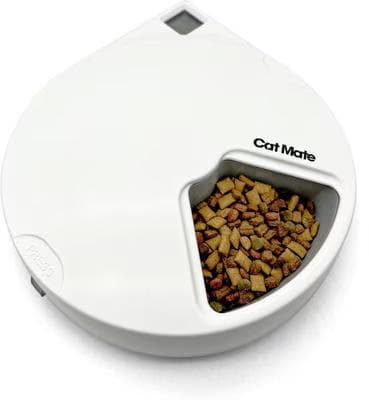
If your cat eats wet food, choose hardware designed for it. Units like the Cat Mate C500 use sealed compartments with ice packs to keep meals cool for same-day feeding, not multi-day coverage. For anything longer, dry food plus a human check-in is the safer plan.
Webvet may earn a commission when you click through to Chewy, at no extra cost to you.
That brings us to the second half of the vet decision framework, which cats should not use one, at least not without extra safeguards:
- Cats recovering from illness, or living with chronic disease, whose daily appetite is itself the monitoring tool.
- Wet-food-only cats in homes without a refrigerated or ice-pack unit and a same-day serving plan.
- Food-aggressive or resource-guarding multi-cat households relying on open-bowl feeders.
- Kittens, who need frequent meals, close supervision, and rapid response if they stop eating.
- Any cat whose owner plans multi-day absences around the machine. An automatic feeder is not a cat sitter.
Most of the mechanical risks have practical mitigations, and they are worth building into your routine from day one:
- Choose a unit with battery backup so a power flicker does not cancel dinner.
- Weigh or eyeball the bowl daily; a feeder with a camera or dispense log makes this a ten-second check.
- Keep a small amount of food accessible as a failsafe during absences, even if it costs some portion precision.
- Clean the hopper and chute weekly, since kibble dust and oils are the usual cause of jams.
- Test every schedule change by watching the next dispense happen before you walk away.
None of these pitfalls outweighs the upside for every household; it is a benefits-versus-risks call that depends on your cat, your schedule, and how much monitoring you can commit to.
Automatic feeders vs gravity feeders
Are gravity feeders good for cats? For most cats, no. A gravity feeder simply refills the bowl as your cat empties it. That is free-feeding with extra steps, and free-choice access to dry food is one of the classic routes to feline obesity.
Gravity feeders suit only a narrow slice of cats: healthy-weight self-regulators eating dry food, with an owner around to notice problems. If your cat is overweight, food-obsessed, or sharing the house with other cats, a timed or microchip-selective feeder is the better tool in every column that matters.
| Feeder type | Portion control | Multi-cat fit | Wet food fit | Main failure mode |
|---|---|---|---|---|
| Gravity feeder | None: refills as the bowl empties | Poor: one cat can dominate and overeat | Dry food only | Encourages overeating and weight gain |
| Timed automatic feeder | Good: pre-measured meals on a schedule | Fair: open bowls still allow stealing | Mostly dry; some ice-pack wet models | Jams, dead batteries, tipping |
| Microchip-selective feeder | Good: opens only for the registered cat | Best: separates diets and stops stealing | Yes: sealed bowl keeps wet food fresher | Higher cost; cats tailgating each other |
One nuance worth naming: a gravity feeder can serve as a short-term backup food failsafe alongside a timed unit, since it has no motor or battery to fail. As the primary feeding method for an average indoor cat, though, it works against every weight goal your vet will set.
If you are searching for the best gravity feeder for cats, first ask whether your cat is genuinely a self-regulator: stable weight over months, food left in the bowl between meals, no gorging. Cats that fail any part of that test will do better, and often lose needed weight, on a timed unit instead.
Automatic feeders in multi-cat homes

Multi-cat households are where standard automatic feeders fail most often. Scheduled meals from an open bowl create a race: the dominant cat learns the dispense times and camps the feeder, while timid cats hang back, stress, or quietly go short. Owners discover the problem only when one cat gains weight and another loses it.
Webvet may earn a commission when you click through to Chewy, at no extra cost to you.
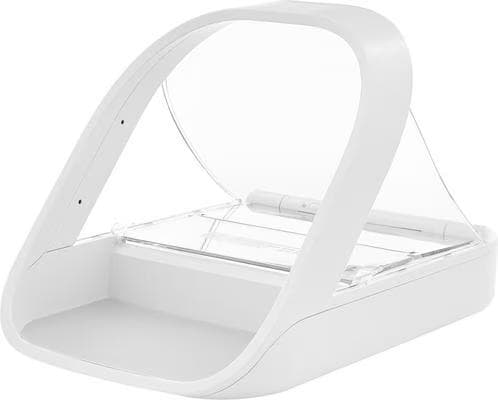
Microchip-selective feeders solve the competition problem directly. The unit reads each cat's implanted microchip or collar tag and opens only for the registered cat. The SureFeed Microchip Feeder is the standard example: it lets a prescription-diet cat, a cat on a weight plan, or a slow eater keep food the others cannot reach.
Microchip feeders are not foolproof. A determined housemate can learn to tailgate, darting in as the door opens for the registered cat, and some cats need a slow, treat-based introduction before they will put their head inside the arch. Budget a week or two of supervised training rather than expecting plug-and-play separation.
If you run feeders for more than one cat, plan one feeding station per cat, spaced apart and ideally out of each other's sight lines. Separate stations lower mealtime stress and make it obvious whose bowl is going untouched. For specific models and configurations, see our roundup of the best automatic feeders for multiple cats.
Can you leave your cat alone with an automatic feeder?
Can I leave my cat alone for 4 days with an automatic feeder? Most vets advise firmly against it. An automatic feeder is not a cat sitter. For a healthy adult cat, one overnight alone is a reasonable maximum, and 24-48 hours is the outer limit, and only with someone scheduled to check in.
The feeder solves exactly one problem, dispensing food on time. Everything else that can go wrong over four days stays unsolved:
- Water fountains run dry, foul, or unplug, and dehydration harms a cat faster than hunger does.
- A jammed hopper or dead battery means missed meals that nobody notices.
- A cat that stops eating or falls ill can deteriorate quickly, and a few days of not eating risks dangerous liver complications.
- Litter boxes overflow, which drives stress and house-soiling.
- Vomiting, injury, or escape happens with no one there to respond.
The limits are tighter for some cats. Kittens need frequent meals and supervision measured in hours, not days. Seniors and cats with chronic conditions like kidney disease or diabetes should not be left overnight without a plan. Even for healthy adults, leaving two cats together does not halve the risk.
For any absence beyond one night, book a pet sitter or a daily check-in visit. The feeder then becomes what it should be: a backup that keeps mealtimes exact between human visits, not the only thing standing between your cat and an empty bowl.
How automatic cat feeders work and vet guidance on transitioning

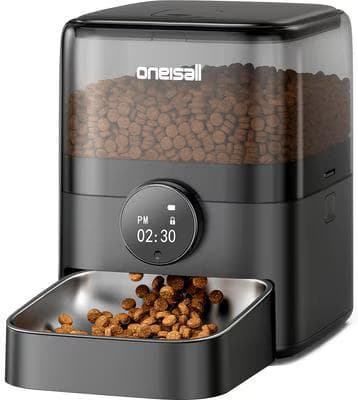
How do automatic cat feeders work? Most pair a dry-kibble hopper with a motorized portion wheel or auger and a timer. At each programmed mealtime, the unit dispenses a set portion into the bowl. Higher-end models add Wi-Fi apps, cameras, voice recordings, and low-food alerts; microchip units add an access door.
Wet-food designs work differently: instead of a hopper, they rotate sealed, often ice-pack-cooled compartments open on a timer. Whatever the mechanism, run any new feeder for several days at home, watching it dispense, before you depend on it. Reliability is a per-unit fact you verify, not a spec you trust.
Camera and app-connected models deserve a specific caution. A phone notification that food dispensed is not proof that your cat ate it, and a live camera you rarely open is not monitoring. Treat the app as a convenience layer on top of daily in-person checks, not as the checks themselves.
Vet guidance: transitioning your cat to an automatic feeder
What is the healthiest way to feed a cat? The AAFP's How to Feed a Cat consensus statement recommends multiple small meals per day, a consistent routine, and separate, low-stress feeding for cats in multi-cat homes. A well-programmed automatic feeder can deliver exactly that pattern; the transition just needs to be gradual.
- Keep the same food. Change one variable at a time; a new machine and a new diet together invite refusal.
- Run the feeder beside the old bowl for several days so your cat links the machine with meals before it becomes the only source.
- Start with a mealtime your cat already expects, then add the remaining meals over a week.
- Place it in a quiet, low-traffic spot away from litter boxes, loud appliances, and busy doorways.
- Split the vet-calculated daily ration into three to five small meals rather than one or two large ones.
- Watch intake and weight for the first two weeks, and keep at least one hand-served interaction daily so you still see your cat eat.
If your cat snubs the feeder, do not wait it out. Cats that refuse food need prompt attention, and gentle, appetite-friendly tactics beat standoffs every time. Our guide on how to get a cat to eat covers safe encouragement techniques and the warning signs that mean it is time to call the vet.
Which automatic feeder fits your cat
The decision framework vets would apply is simpler than the marketing suggests. Match the machine to the cat in front of you, not to the longest feature list:
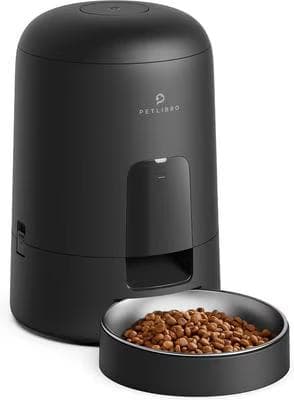
- Overweight, formerly free-fed, or begging cat in a single-cat home: a basic timed feeder with measured portions, such as the Petlibro Air, covers everything that matters.
- Multi-cat home, or any cat on a special diet: microchip-selective feeders, one station per cat.
- Wet-food cat: an ice-pack wet feeder for same-day coverage only, never multi-day.
- Senior cat or a cat with a chronic condition: talk to your vet first, and keep daily hand-feeding checks so appetite changes are caught early.
- Frequent multi-day traveler: a sitter plus a feeder, never a feeder alone.
Once you know which category fits your household, model choice is the easy part. Our vet-informed roundup of the best automatic cat feeders compares capacity, portion precision, power backup, jam resistance, and app reliability across the current field, so you are choosing between good options rather than gambling.
So, are automatic feeders bad for cats? No. Used correctly, they are a genuinely useful portion-control and routine tool that vets are happy to see in the home. They earn their bad reputation only when owners treat them as a replacement for daily attention, a cat sitter, or a vet-guided feeding plan.
Frequently asked questions
Do vets recommend automatic cat feeders?
Generally yes, as a portion-control and routine tool. Veterinary nutrition guidance from AAHA and the AAFP centers on measured portions, consistent mealtimes, and low-stress feeding, which is exactly the pattern a well-programmed feeder enforces. Vets add one firm caveat: the feeder cannot monitor your cat, so you must still confirm daily that food is being eaten.
What are the disadvantages of automatic feeders for cats?
The main disadvantages are multi-cat competition at open bowls, wet food spoilage in non-refrigerated units, mechanical failures like jams and dead batteries, and overreliance: a self-refilling bowl can hide the drop in appetite that is often the first sign of illness. Cats whose appetite must be monitored, and households planning multi-day absences, should not depend on one.
Can I leave my cat alone for 4 days with an automatic feeder?
No. An automatic feeder is not a cat sitter. Most vets cap alone time for a healthy adult cat at roughly 24-48 hours, and only with a check-in arranged. Over four days, water can run out, the feeder can jam, litter boxes overflow, and a cat that stops eating or falls ill can deteriorate seriously with nobody there to notice. Book a sitter or daily visits for any longer absence.
What is the healthiest way to feed a cat?
Feline practice guidelines recommend feeding measured portions as multiple small meals per day on a consistent schedule, with each cat in a multi-cat home fed separately to reduce stress. Your vet should set the daily calorie amount based on your cat's body condition. An automatic feeder can deliver this pattern reliably, provided you still observe your cat eating every day.

Editor
The Webvet Editorial Team is the in-house group of pet-care editors and writers behind Webvet, operated by Smart Pet Collective. The team researches, writes, and maintains Webvet's pet health, behavior, and medication content. Every article follows a defined editorial process: research from reputable veterinary and scientific sources, careful drafting, mandatory review of medical content by a credentialed veterinarian, and dated publication. Health and medication articles are medically reviewed by a licensed veterinary professional before they go live and are kept current over time.
Veterinarian · BVMS MRCVS
Dr. Pippa Elliott, BVMS, MRCVS, is a veterinarian with nearly 30 years of experience in companion animal practice. Dr. Elliott earned her Bachelor of Veterinary Medicine and Surgery from the University of Glasgow. She was also designated a Member of the Royal College of Veterinary Surgeons. Married with 2 grown-up kids, Dr. Elliott has a naughty Puggle named Poggle, 3 cats and a bearded dragon.
Related reading

Best Dog Advent Calendars and Cat Advent Calendars for 2026: Vet-Reviewed Picks

How to Help a Cat Lose Weight: A Safe Weight Loss Plan

When Can Puppies Eat Solid Food? Weaning Timeline and Tips
