Best Automatic Cat Feeder for Two Cats (or More): Vet Picks
Dual-bowl or microchip? We match every multi-cat feeding problem (food stealing, different diets, separate schedules, one cat overeating) to the feeder that actually solves it, with real prices and honest limitations.

This article contains affiliate links. Webvet may earn a commission when you buy through them, at no extra cost to you.
WebVet may earn a commission from qualifying purchases made through links on this page, at no additional cost to you.
The best automatic cat feeder for two cats is a dual-bowl unit that splits portions into two bowls at once: the OneIsAll Stainless Steel Two-Bowl Feeder ($49.99) for cats on the same diet, the SureFeed Microchip Feeder ($183.59) when diets differ, and the Vacqueen 3-Cat Feeder ($69.99) for three or more cats.

That answer changes with the problem you are solving. Food stealing calls for different hardware than uneven portions, separate schedules, or one cat that inhales everything in sight. A feeder that works beautifully for two easygoing littermates can fail completely in a household with a determined food bully.
So this guide is organized by problem, not by product. We start with a decision framework that matches each multi-cat feeding issue to the right feeder type, then review the dual-bowl, three-bowl, microchip, and camera options we recommend, with real prices, real ratings, and honest limitations.
For two cats on the same diet, a dual-bowl feeder like the OneIsAll Two-Bowl ($49.99) splits portions fairly from one hopper. For different diets or a food-stealing cat, a microchip feeder such as the SureFeed ($183.59) is the only hardware that truly controls who eats what.
Matching the Feeder to Your Multi-Cat Problem
Do automatic cat feeders work for multiple cats? Yes, with one condition: the feeder type has to match the problem. Dual-bowl feeders work for multiple cats sharing one diet and one schedule. They fail when a dominant cat guards both bowls, or when cats eat different foods, jobs only a microchip feeder handles.
Before comparing models, name your household's actual problem. Across multi-cat setups, the feeder that disappoints is almost always the right machine bought for the wrong job. This table is the whole decision in four rows.
| Your problem | What actually fixes it | Our pick |
|---|---|---|
| One cat steals the other's food | A microchip feeder that opens only for the registered cat | SureFeed Microchip Feeder ($183.59) |
| Same diet, but portions need to be fair | A dual-bowl feeder that splits each meal into two bowls | OneIsAll Two-Bowl Feeder ($49.99) |
| Three or more cats on one schedule | A three-bowl feeder, or multiple single feeders in separate rooms | Vacqueen 3-Cat Feeder ($69.99) |
| One cat overeats or gulps its food | A portion-controlled selective feeder, plus a vet check | Closer Pets MiBowl ($129.99) |
Do I Need Two Automatic Feeders for Two Cats?
Not always. If both cats eat the same food and tolerate eating side by side, one dual-bowl feeder is cheaper, easier to program, and takes less floor space than two machines. It fills two bowls simultaneously from a single hopper, so neither cat waits while the other eats.
Two separate feeders make more sense in three situations:
- Your cats already eat in different rooms because one bullies the other at mealtime, and you want to keep that peace.
- Each cat needs a different portion size. Most dual-bowl units, including the OneIsAll Two-Bowl, split each meal evenly rather than customizing per bowl.
- Your cats eat different diets. In that case each feeder should be a microchip unit, because an open bowl of the wrong food is an invitation, not a boundary.
The honest math: one dual-bowl unit solves the fairness problem for around $50, while two microchip units solve the access problem for over $250. Buy the cheaper hardware only if your problem is genuinely the cheaper problem.
There is also a middle path worth naming: one standard feeder for the easygoing cat plus one microchip unit protecting the cat that needs it. Plenty of two-cat homes only have one cat with a special diet, and protecting just that bowl halves the cost.
The Best Way to Feed Multiple Cats in a Home
The best way to feed multiple cats is separate, predictable feeding stations: each cat gets its own bowl, in its own spot, on a consistent schedule. Cats are naturally solitary eaters, and forced communal feeding creates exactly the stealing and guarding behavior automatic feeders are supposed to solve.
The Cornell Feline Health Center treats feeding management as part of feline health for good reason: mealtime stress shows up as behavior problems first and medical problems second. A few setup rules prevent most of it:
- Place stations out of each other's line of sight, ideally in separate rooms, so a nervous cat can eat without being watched.
- Use height when rooms are scarce. A feeder on a stable counter for the agile eater and one at floor level for the senior creates real separation in a small home.
- Schedule simultaneous dispensing so both cats are anchored to their own bowls during the most competitive first minutes of a meal.
- Keep schedules identical day to day. Cats that trust the routine stop loitering at the machine and stop shoving each other out of the way.
Separate Schedules: When Your Cats Should Not Eat at the Same Time
Some households need different timing, not just different bowls. A senior cat on four small meals, a kitten eating more frequently than an adult, or a diabetic cat whose meals anchor insulin timing all need a schedule the other cat does not share.
No multi-bowl feeder in this lineup runs independent schedules per bowl: the OneIsAll and Vacqueen dispense to every bowl on one timetable. That is worth knowing before you buy, because it is the spec sheet detail most shoppers discover after unboxing.
For genuinely separate schedules you have two workable setups:
- Two single feeders, independently programmed, placed in different rooms so the off-schedule cat is not drawn to the sound of the other machine dispensing.
- A microchip feeder for the special-schedule cat, which protects its food between its own mealtimes while the housemate eats from a standard timed feeder.
The dispensing sound is the underrated complication. Cats learn the motor noise within days, and every scheduled drop becomes a dinner bell for both cats. Rooms and doors solve what programming cannot.
The Dual-Bowl Failure Mode Nobody Puts in the Product Description
Read the top-ranking Reddit threads on two-cat feeders and one complaint dominates: bowl guarding. A dominant cat parks in front of the machine, finishes its own portion, then shoulders the other cat away from the second bowl. Twelve inches of bowl separation means nothing to a committed food bully.
Owner reviews of dual-bowl feeders describe this behavior repeatedly, and it is one of the most common complaints in multi-cat households. No editorial roundup we benchmarked even mentions it. The fix is an escalation ladder, not a return label:
- Distance and placement first. Angle the feeder so the cats approach from different sides, and give the timid cat a clear exit route.
- Simultaneous dispensing. Both bowls filling at once keeps each cat occupied with its own food instead of racing to a single drop point.
- Separate rooms. Two single feeders behind different doors end the contest entirely, at roughly the price of one premium unit.
- The microchip upgrade path. If guarding persists, a SureFeed or MiBowl is the definitive fix, because the bowl physically will not open for the bully.
When the Feeding Problem Is Medical, Not Mechanical
Food stealing and overeating are not just etiquette problems. Feline obesity is among the most common conditions veterinarians manage, per the Cornell Feline Health Center, and a feeder arrangement that lets one cat eat double rations feeds that condition directly.
Prescription diet contamination is the quieter risk. If one cat eats a renal, urinary, or hypoallergenic prescription diet, even occasional theft of the housemate's regular food can undermine the treatment. This is the single strongest case for microchip feeders, and it is why we treat them as medical equipment, not gadgets.
Ask your veterinarian before assuming hardware will fix a behavior change. Sudden gulping, new food stealing, or constant begging can signal a medical appetite driver such as hyperthyroidism or diabetes, and a smarter feeder will only hide the symptom.
Two related problems have their own guides: a cat that eats too fast and then vomits needs portion pacing, covered in our guide to a cat throwing up after eating, and a cat losing weight because a housemate intercepts its meals is a core scenario in how to get a cat to eat.
Best Automatic Cat Feeders for Two Cats

For two cats, a dual-bowl automatic feeder is the default choice: one hopper, one schedule, and two bowls filled at the same time with split portions. The OneIsAll Two-Bowl Feeder ($49.99) is our overall pick, the FrienHund Camera Feeder ($99.99) adds remote monitoring, and the SureFeed Microchip Feeder ($183.59) covers different diets.
What to Look For in an Automatic Cat Feeder for Two Cats
Two-cat feeders live or die on a handful of specs that single-cat roundups barely mention. Before comparing models, screen every candidate against these:
- Simultaneous dispensing into two bowls. Sequential dispensing turns every meal into a race won by the pushier cat.
- Hopper capacity of 15 cups or more. Two cats empty a small hopper in days, and an empty feeder mid-trip is the failure you bought the machine to prevent.
- Stainless steel bowls for chin health and honest cleaning, ideally dishwasher safe.
- Bowl spacing and approach angles wide enough that the cats are not cheek to cheek while eating.
- Power redundancy. Look for a battery backup option on the listing, since a power blip that wipes the schedule feeds nobody.
- Portion granularity. Smaller minimum portions let you run more frequent, smaller meals, which takes the drama out of mealtime.
Notice what is not on the list: apps, cameras, and voice recordings. They are nice, but no smart feature rescues a machine that dispenses unevenly or runs out early. Mechanics first, software second.
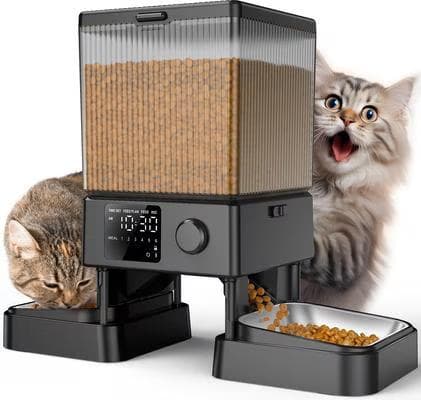
OneIsAll Stainless Steel Two-Bowl Feeder: Best Overall for Two Cats
Webvet may earn a commission when you click through to Chewy, at no extra cost to you.

What is the best automatic cat feeder for 2 cats? For most two-cat homes it is this one. The OneIsAll splits every scheduled meal evenly into two stainless steel bowls from a single 20-cup hopper, so both cats eat at the same moment and neither can claim a head start.
The 20-cup hopper capacity is the practical win. For two average adult cats on dry food, that is well over a week of meals between refills. Stainless bowls also matter: plastic feeding bowls are a known contributor to feline chin acne, and stainless cleans up properly.
- Cats served: two, on the same diet
- Bowls: two, stainless steel
- Hopper capacity: 20 cups of dry food
- Per-cat control: no; each meal splits evenly between the bowls
- Chewy rating: 4.6 stars
- Price: $49.99
The honest limitation follows from the design: an even split is fairness, not customization. If one cat needs 40 grams a day and the other needs 60, or if either cat eats a prescription diet, this is the wrong machine no matter how good the rating is. That job belongs to the microchip feeders below.
FrienHund Two-Cat Camera Feeder: Best for Watching Who Actually Eats
Webvet may earn a commission when you click through to Chewy, at no extra cost to you.

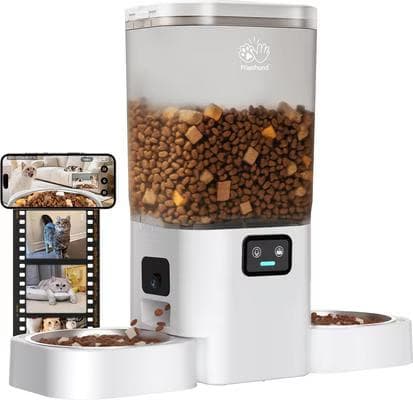
In a two-cat home, the camera is not a gimmick. It answers the question every dual-bowl owner eventually asks: did both cats eat, or did one eat twice? Meal-time footage is how you catch bowl swapping and stealing that happens the moment you leave the room.
The FrienHund pairs two-bowl split dispensing with a built-in camera aimed at the bowls, so each scheduled meal doubles as a check-in. For travelers, that is the difference between hoping the shy cat ate and knowing she did.
- Cats served: two, on the same diet
- Bowls: two
- Camera: built in, aimed at the feeding area
- Per-cat control: no; portions split between bowls
- Chewy rating: not yet rated (newer listing with too few reviews for a score)
- Price: $99.99
Fair warning on that missing rating: this is a newer product without the review history of the OneIsAll, so check the current Chewy listing for hopper size and app details before buying. It earns its place here on the strength of the two-cat camera concept, which no other pick in this lineup offers.
Is there a smart cat feeder for two cats? Yes, in two flavors. App-connected models like the FrienHund add remote feeding and a live camera view, and the Vacqueen below brings smart scheduling to three bowls. The smartest per-cat control, though, is a microchip feeder: it decides who eats, not just when.
Also consider: Petlibro's Granary two-cat variant is the dual-bowl model that Google's AI Overview and several large roundups anchor on, and it is a credible option in this category. It is not in our vetted lineup, so it is not one of our linked picks here.
Here is the full price comparison across every feeder in this guide, scoped to what actually matters in a multi-cat home: cats served, bowls, hopper capacity, and per-cat control. These are real prices at the time of writing, not manufacturer list prices.
| Feeder | Cats served | Bowls | Capacity | Per-cat control | Price |
|---|---|---|---|---|---|
| OneIsAll Two-Bowl Feeder | 2 (same diet) | 2 stainless | 20 cups | No (even split) | $49.99 |
| Vacqueen 3-Cat Feeder | 3 (same diet) | 3 | 25 cups | No (split portions) | $69.99 |
| FrienHund Camera Feeder | 2 (same diet) | 2 | See listing | No (split portions) | $99.99 |
| Closer Pets MiBowl | 1 per unit | 1 covered bowl | Bowl only (no hopper) | Yes (microchip/RFID) | $129.99 |
| SureFeed Microchip Feeder | 1 per unit | 1 sealed bowl | Bowl only (no hopper) | Yes (microchip/RFID) | $183.59 |
Read the table by the per-cat control column. Everything above the line is portion fairness for cats that can share; everything below it is access control for cats that cannot. Mixing up those two categories is how multi-cat feeders end up in the returns pile.
Price tracks control, not quality. The $49.99 OneIsAll is excellent at fair portions, and the $183.59 SureFeed is excellent at deciding who eats. Neither does the other's job, so let your household's problem, not the price tag, pick the category.
Best Automatic Feeders for Three or More Cats

Is there an automatic feeder for 3 cats? Yes. Purpose-built three-bowl units exist, and the Vacqueen Smart Automatic 3-Cat Feeder ($69.99) is the one in our lineup: one 25-cup hopper feeding three bowls on a shared schedule. Past three cats, multiple separate feeders almost always beat one bigger machine.
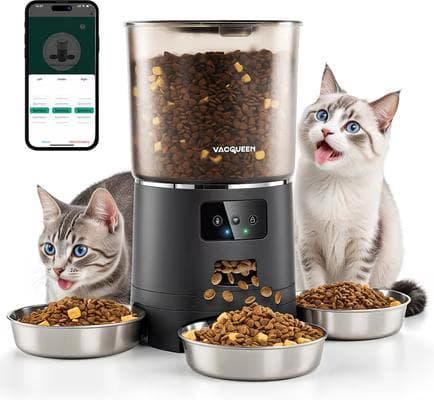
Vacqueen Smart Automatic 3-Cat Feeder: Best for Three Cats
Webvet may earn a commission when you click through to Chewy, at no extra cost to you.

The Vacqueen is the rare feeder built for a three-cat household from the start: three bowls, split portions from a single 25-cup hopper, and smart scheduling so the whole trio eats at once. One machine, one refill, one schedule instead of juggling three.
- Cats served: three, on the same diet
- Bowls: three
- Hopper capacity: 25 cups of dry food
- Per-cat control: no; meals split across the bowls
- Chewy rating: 3.9 stars
- Price: $69.99
Be clear-eyed about the 3.9 rating: it signals mixed experiences, not a defective product. Three-bowl feeders concentrate the same guarding risk a dual-bowl carries, with one more cat in the scrum. In a harmonious trio it is a genuine bargain; with a bowl guard, it inherits every limitation above.
Placement helps this machine succeed. Give it a corner with open approaches from at least two sides so all three cats can reach a bowl without crossing each other, and put it far from doorways where an ambush-minded cat likes to lurk.
How to Feed Three Cats at Once
Feeding three cats at once comes down to simultaneous stations: three bowls filling at the same moment, far enough apart that no cat can police them all. You can get there three ways, in rising order of cost and control:
- One three-bowl unit like the Vacqueen for three cats that share a diet and get along at mealtime.
- Multiple single feeders in separate rooms when personalities clash, portions differ, or you want each station on its own schedule.
- A microchip feeder per cat when diets differ or one cat steals, which is the only setup that enforces who eats what with zero supervision.
When do multiple single feeders beat one multi-bowl unit? Whenever the cats need anything individualized: different portion sizes, different foods, different rooms, or protection from a dominant cat. A multi-bowl machine buys convenience for you; separate machines buy peace for the cats. Choose based on whose problem you are solving.
Whichever route you take, refill math scales faster than people expect. Three adult cats can move through 25 cups of dry food in under two weeks, so treat the hopper as a several-day buffer, not a monthly one, and check food levels every few days.
Placement does as much work as the hardware. Set the three stations in a triangle across the room, or in separate rooms entirely, so no single cat can guard two bowls at once.
Keep each station against a wall with clear sightlines, because cats eat more calmly when they can watch the room. If one cat still hovers, stagger the schedules a few minutes apart so the guarder is busy at its own bowl while the others start eating.
Microchip Feeders: When Your Cats Eat Different Diets

A microchip feeder reads your cat's implanted microchip, or an RFID collar tag, and opens its lid only for the registered cat. It is the one feeder category that solves food stealing and different diets outright, because the wrong cat is physically locked out rather than merely discouraged.
That precision changes what the hardware is for. A dual-bowl feeder manages a schedule; a microchip feeder enforces a prescription. If one of your cats eats a renal, urinary, weight-management, or hypoallergenic diet, this category is not optional, it is the treatment plan's lock and key.
SureFeed Microchip Feeder: The Different-Diets Standard
Webvet may earn a commission when you click through to Chewy, at no extra cost to you.

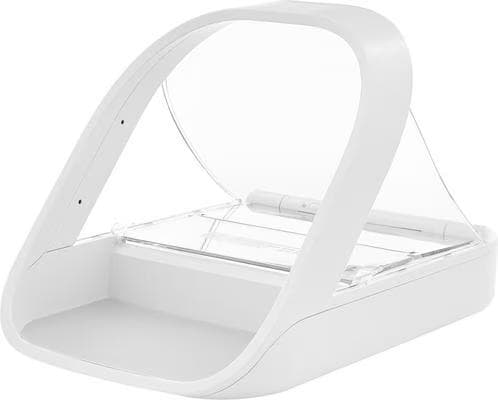
The SureFeed is the reference microchip feeder for a reason: a motorized lid that opens only for the registered cat, a sealed bowl that keeps wet food fresher between meals, and compatibility with both implanted microchips and RFID collar tags for cats that are not chipped.
- Access control: implanted microchip or included RFID collar tag
- Bowls: one sealed bowl per unit, one cat per unit
- Food type: wet or dry
- Scheduling: access control rather than timed hopper dispensing; check the listing for the exact version's features
- Chewy rating: 4.3 stars
- Price: $183.59
Understand the model before buying: this is one protected bowl, not a hopper feeder. It guards the food rather than portioning a reservoir of it, so a two-cat, two-diet home needs two units. That is real money, and for prescription-diet households it is cheaper than the vet bills contamination causes.
The sealed bowl is the underrated feature for wet food homes. Multi-cat households often avoid wet food with feeders because it dries out or gets raided; a lid that closes between visits solves both problems in one mechanism.
Closer Pets MiBowl: Microchip Control for Less
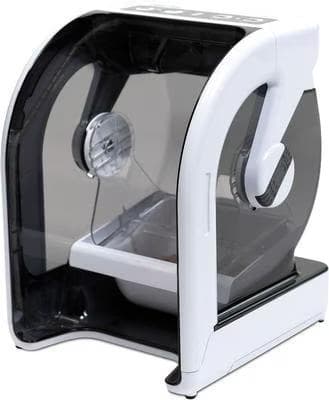
Webvet may earn a commission when you click through to Chewy, at no extra cost to you.

The Closer Pets MiBowl delivers the same core promise at a lower price: a covered bowl that opens for one registered cat, triggered by an implanted microchip or an RFID collar disc. For homes that need selective access without the SureFeed's price, it is the value play in the category.
- Access control: implanted microchip or RFID collar disc
- Bowls: one covered bowl per unit, one cat per unit
- Food type: suits wet or dry; confirm details on the current listing
- Chewy rating: 4.1 stars
- Price: $129.99
Between the two, the SureFeed's 4.3 rating and longer track record justify its premium for a medically critical diet, while the MiBowl covers straightforward food stealing for about $54 less. Either way, budget one unit per protected cat, not one per household.
Microchip feeders are a deep category of their own, with meaningful differences in lid speed, training curves, bowl sealing, and multi-pet management that go beyond this roundup's scope. For the full breakdown, see our guide to the best microchip pet feeders.
Training Your Cats to Accept a Microchip Feeder
The one real friction with microchip feeders is the introduction period. A lid that moves near a cat's face is alarming at first, and a rushed setup teaches the cat to avoid the machine that guards its only food source.
Both the SureFeed and MiBowl ship with training modes that open the lid gradually over days. The rollout that works in real-world homes:
- Start with the lid fully open so the feeder is just a new bowl in a familiar spot.
- Advance the training stage every day or two, letting the lid close a little more only after the cat eats calmly at the current stage.
- Feed the non-registered cat elsewhere during training so it does not learn to dart in while the lid is still closing slowly.
- Expect one to two weeks for a confident cat and longer for a nervous one, and never skip stages to speed it up.
Registration itself is the easy part: the feeder learns the cat's implanted chip the first time it eats in learn mode, or you snap the included RFID tag on a collar for an unchipped cat. Patience goes into the lid, not the pairing.
Plan the training window before you need it. Start the learn-mode introduction two to three weeks ahead of any trip or schedule change, not the night before, so the lid is fully closing while you are still home to supervise.
Keep the old bowls available during the transition, then remove them only once every cat eats confidently from its own feeder. A calm rollout now prevents a hunger strike later, and it protects the shy cat's confidence most of all.
Should You Get a Camera Feeder?
A camera earns its cost in a multi-cat home when you cannot personally verify meals. It shows you which cat ate, whether the shy one got shouldered aside, and whether the machine actually dispensed while you were away. That is monitoring a bowl-side glance at an empty dish can never give you.
In a two-cat home specifically, footage answers three questions no other feeder feature can:
- Who ate the meal, which is the only way to catch a bowl swap that happens the moment you leave for work.
- Whether appetite changed, since a cat that stops showing up at its scheduled meal is often flagging illness before any other sign.
- Whether the hardware fired, because an empty pair of bowls at 6 p.m. does not tell you if the cats ate or the feeder failed.
Skip the camera if you are home for most meals or already run a pet camera in the feeding area. The money is better spent moving up this list: a second feeder or a microchip unit changes feeding outcomes, while a camera only observes them.
One caution for multi-cat buyers: a camera cannot tell the machine to do anything differently. If footage shows one cat eating both portions night after night, you have documented the problem, not solved it, and the answer is still the microchip section above.
In this lineup, the FrienHund is the two-cat camera option. Camera feeders as a category, single-bowl models included, have their own dedicated roundup: see our guide to the best pet feeders with cameras for the full field.
How These Picks Fit the Full Feeder Lineup
This guide covers one specific job: feeders for households with two or more cats. If you are shopping for a single cat, want wet-food-specific hardware, or just want the strongest all-around models regardless of cat count, start with our pillar guide to the best automatic cat feeders overall.
And if you are still deciding whether an automatic feeder belongs in your home at all, our companion guide on whether automatic feeders are good for cats covers suitability, vet perspective, and how long a feeder can safely cover for you. The short version of its answers:
- Vets are broadly supportive of automatic feeders for portion control and schedule consistency, with the caveat that they supplement care rather than replace it.
- Two days away is generally the outer edge of what a feeder plus ample water can responsibly cover for a healthy adult cat, and a check-in visit is still smart.
- Four days or more always needs a sitter or boarding, because litter, water, monitoring, and emergencies are not problems a hopper solves.
Buy in this order: match the feeder type to your household's problem, then pick the model. The problem-first table at the top of this guide will point most two-cat homes at the OneIsAll, most different-diet homes at the SureFeed, and most trios at the Vacqueen. Everything else is detail.
Frequently Asked Questions
Can I leave my cat alone for 2 days with an automatic feeder?
For a healthy adult cat, a reliable feeder with a large hopper plus plenty of fresh water can cover a two-day absence, though a mid-trip check-in from a friend or sitter is still the safer plan. Feeders handle food only, not water, litter, or emergencies. Our guide to whether automatic feeders are good for cats covers absence planning in full.
Can I leave my cat alone for 4 days with an automatic feeder?
No. Four days is sitter or boarding territory regardless of how good the feeder is. A machine cannot refresh water, scoop litter, notice illness, or respond to a jam, and multi-cat homes add the risk of one cat monopolizing whatever does dispense. See the full breakdown in are automatic feeders good for cats.
Do vets recommend automatic cat feeders?
Generally yes, for the things feeders do well: consistent schedules, measured portions, and slowing down weight gain from free-feeding. The caveats are real too, especially in multi-cat homes where the wrong feeder type can worsen stealing. We cover the vet perspective in depth in are automatic feeders good for cats.
Do dual-bowl feeders stop food stealing?
Not reliably. A dual-bowl feeder makes portions fair, but nothing stops a dominant cat from finishing its bowl and taking the second one. If stealing is your core problem, a microchip feeder like the SureFeed or MiBowl is the only hardware that physically locks the thief out.
Do automatic feeders help an overweight cat in a multi-cat home?
They help when the hardware controls access, not just timing. Feline obesity management fails if the dieting cat can raid a housemate's bowl, so pair measured portions with a microchip feeder that locks the overeater out of everyone else's food. Ask your veterinarian to set the calorie target first; the feeder only enforces the plan.
Is one automatic feeder enough for two cats?
One dual-bowl feeder is enough when both cats eat the same food, need similar portions, and tolerate eating near each other. Go to two machines, or two microchip units, when diets differ, portions differ, or one cat guards the feeder. The decision table at the top of this guide maps each case.

Editor
The Webvet Editorial Team is the in-house group of pet-care editors and writers behind Webvet, operated by Smart Pet Collective. The team researches, writes, and maintains Webvet's pet health, behavior, and medication content. Every article follows a defined editorial process: research from reputable veterinary and scientific sources, careful drafting, mandatory review of medical content by a credentialed veterinarian, and dated publication. Health and medication articles are medically reviewed by a licensed veterinary professional before they go live and are kept current over time.
Related reading

Best Dog Advent Calendars and Cat Advent Calendars for 2026: Vet-Reviewed Picks

How to Help a Cat Lose Weight: A Safe Weight Loss Plan

When Can Puppies Eat Solid Food? Weaning Timeline and Tips
