Best Microchip Cat Feeder: Top 3 Picks for Multi-Pet Homes
SureFeed vs PawsPik RFID vs Closer Pets MiBowl: we compared the three leading microchip feeders head to head on chip compatibility, capacity, battery life, and price to find the best pick for multi-pet homes and prescription diets.

This article contains affiliate links. Webvet may earn a commission when you buy through them, at no extra cost to you.
WebVet may earn a commission from qualifying purchases made through links on this page, at no additional cost to you.
What Is a Microchip Cat Feeder?
A microchip cat feeder is a selective-access bowl that reads your pet's implanted ISO 11784/11785 microchip, or an included RFID collar tag, and opens only for the registered animal. The SureFeed Microchip Pet Feeder, PawsPik RFID feeder, and Closer Pets MiBowl are the leading options for multi-pet homes and prescription diet separation.

We put the three feeders that dominate this category head to head: the SureFeed Microchip Small Dog and Cat Feeder at $183.59, the PawsPik Automatic Microchip RFID Cat Feeder at $249.99, and the Closer Pets MiBowl at $129.99. Each solves the same problem a different way, and the right pick depends on your household.
A selective feeder earns its price in three situations:
- Prescription diet separation. One pet eats a therapeutic food (renal, urinary, hypoallergenic) that housemates must not touch.
- Food stealing and weight management. A fast eater keeps raiding a slower pet's bowl, so one cat gains weight while the other loses it.
- Medication in meals. You need certainty about which pet actually ate the dosed food.
Quick verdict: The SureFeed Microchip Pet Feeder is the best microchip cat feeder for most homes thanks to its sealed bowl and reliable chip reading. Pick the PawsPik RFID if you also need a 16-cup hopper with scheduled meals, or the Closer Pets MiBowl to spend under $130.
Top picks: SureFeed vs PawsPik RFID vs Closer Pets MiBowl (per-feeder reviews + comparison table)

What is the best cat feeder for microchips? For most multi-pet homes it is the SureFeed Microchip Small Dog and Cat Feeder. It reads implanted chips more reliably than any rival we compared, its sealed lid keeps wet food usable between visits, and Sure Petcare backs it with the deepest accessory ecosystem in the category.
Here is the field at a glance:
- Best overall: SureFeed Microchip Small Dog and Cat Feeder, $183.59, 4.3-star Chewy average
- Best for scheduled meals: PawsPik Automatic Microchip RFID Cat Feeder, $249.99, 4.2 stars
- Best budget pick: Closer Pets MiBowl Microchip Feeder, $129.99, 4.1 stars
How we compared
We compared list price, chip and tag compatibility, capacity, power, bowl sealing, and app support using manufacturer-published specs and current Chewy listings. Where a maker does not publish a number, we say so instead of estimating. Star ratings reflect Chewy shopper averages at the time of writing.
We also weighted the jobs owners actually buy these feeders for: prescription diet separation, food-stealing control, and unattended feeding. A feeder that nails the one job your household needs beats a feeder that is mediocre at all three.
SureFeed Microchip Pet Feeder review
Webvet may earn a commission when you click through to Chewy, at no extra cost to you.

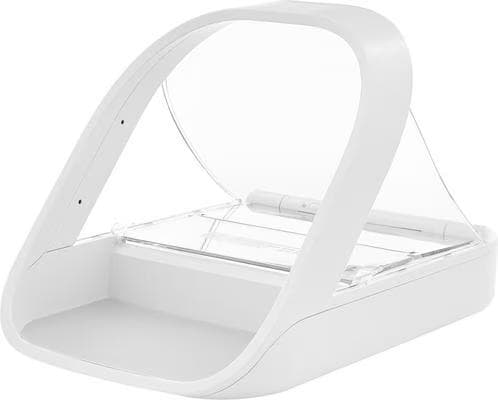
If you have ever wondered what the automatic cat feeder that opens with microchip is called, this is the product people mean. The SureFeed reads your cat's implanted chip on approach, arcs its lid open, then seals shut again once the cat walks away.
That seal matters. A neoprene lip closes over the bowl, which slows wet food from drying out and keeps flies off between meals. A split-bowl option lets you serve wet and dry together, and a collar tag for unchipped pets ships in the box, so a chip-free cat can start day one.
Compatibility is the other reason it wins. It reads 9, 10, and 15 digit implanted chips, including the ISO 11784/11785 standard common across the US and Europe, and Sure Petcare says one feeder can store up to 32 pet identities, so multiple cats on the same diet can share a unit.
Strengths:
- Sealed bowl keeps wet food fresher between visits
- Reads 9, 10, and 15 digit chips plus the included RFID collar tag
- Quiet, slow-arcing lid most cats accept after training
Tradeoffs:
- Holds one meal at a time, with no hopper or scheduling
- 4 C batteries are not included
- App features require the pricier Connect version
Want app data? The SureFeed Connect variant (sold with a hub) adds feeding logs plus an intruder mode that closes the lid faster when a non-registered pet approaches. We treat it as context here: the standard feeder is the better value for most homes, and it is the unit we compared.
Living with it is undramatic, which is the point. Owners mostly report a short adjustment week, then years of quiet operation: the lid cycles a few thousand times per set of batteries, the bowl and mat lift out for washing, and replacement bowls, mats, and tags are easy to buy separately.
Who should buy it: any home where one cat eats wet food, a prescription diet, or medicated meals and another pet keeps interfering. It is not the pick if you need unattended scheduled feeding, because it holds a single meal and relies on you to refill it.
PawsPik Automatic Microchip RFID Cat Feeder review
Webvet may earn a commission when you click through to Chewy, at no extra cost to you.

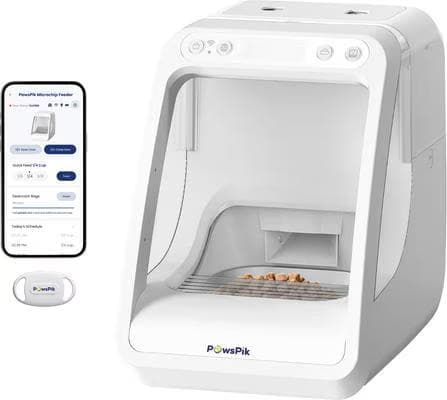
The PawsPik is the only pick that combines selective access with true automation. The PawsPik RFID 16-cup hopper stores dry kibble and dispenses portioned meals on a schedule, then opens its feeding door only for the registered pet.
No ranking competitor guide we benchmarked even compares PawsPik against SureFeed or Closer Pets, which is the gap this comparison closes. It is the strongest fit for multi-cat dry-food homes where nobody is around at mealtimes: grazers and staggered work schedules get timed portions and diet separation from one machine.
Two things to verify. It ships with an RFID collar tag, and RFID feeders vary in which implanted chip formats they read, so confirm chip support on the current listing if you want a collar-free setup. It is also a dry-kibble feeder, so wet-food homes should choose the SureFeed or MiBowl.
Strengths:
- Only pick with a 16-cup hopper and scheduled, portioned meals
- Selective access and automation in a single machine
- Best choice when nobody is home at mealtimes
Tradeoffs:
- Dry kibble only
- Highest price of the three at $249.99
- Largest footprint, and chip support should be confirmed on the listing
Setup is a one-time job: register each cat's tag or chip at the feeder, program meal times and portion sizes, and fill the hopper. From there the machine handles the routine, and you handle the exceptions, like topping up kibble and confirming the schedule survived a battery change.
Closer Pets MiBowl Microchip Feeder review
Webvet may earn a commission when you click through to Chewy, at no extra cost to you.

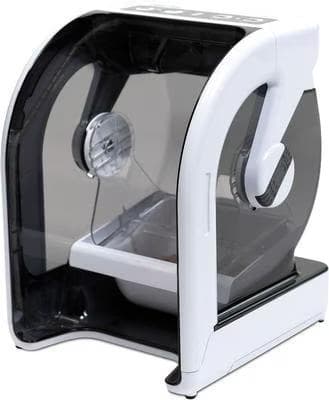
Closer Pets (the UK brand formerly known as Pet Mate) built the MiBowl as the value play: a sealed, selective-access bowl at $129.99, roughly $54 less than the SureFeed. It reads implanted microchips, works with the brand's RFID collar tags, and its covered bowl handles wet or dry food.
In daily use it does the one job well. The cover opens for the registered cat and closes when the cat leaves, which is all many households need to stop a food thief or protect a prescription diet.
The tradeoff is ecosystem depth. There is no app pathway, fewer replacement accessories, and a 4.1-star Chewy average that trails the SureFeed's 4.3. If budget decides, it is a solid buy; if reliability headroom matters more, spend up.
Strengths:
- Lowest price of the three at $129.99
- Sealed cover works with wet or dry food
- Reads implanted chips and Closer Pets RFID collar tags
Tradeoffs:
- No app option at any price
- Smaller accessory ecosystem than Sure Petcare's
- Slightly lower shopper rating at 4.1 stars
Who should buy it: two-cat homes where one cat simply needs to stay out of the other's bowl, and price is the deciding factor. Closer Pets has made microchip feeders for years under the Pet Mate name, so the low price reflects a leaner feature set, not an unknown brand.
Battery life & specs comparison table
How long do SureFeed batteries last? Sure Petcare rates the SureFeed at up to 6 months of typical use on 4 C batteries, with a low-battery indicator that warns you before the lid stops cycling. The MiBowl is also battery powered, while PawsPik's power spec is best confirmed on its current listing.
| Feeder | Price | Capacity | Power | Sealed bowl / App | Best for |
|---|---|---|---|---|---|
| SureFeed Microchip Small Dog & Cat Feeder | $183.59 | Single meal, split-bowl option | 4 C batteries (up to 6 months) | Yes, neoprene-lipped lid; No (Connect model adds app) | Wet food, prescription diets, food stealers |
| PawsPik Automatic Microchip RFID Cat Feeder | $249.99 | 16-cup dry-food hopper, portioned meals | See current listing | Covered feeding area; No | Multi-cat dry-food homes that need scheduling |
| Closer Pets MiBowl Microchip Feeder | $129.99 | Single sealed bowl | Battery powered | Yes; No | Budget homes, wet or dry food |
We only list specs the manufacturers publish. Where a number is not public, the table says so rather than guessing, because a wrong battery or capacity claim is exactly the kind of error that gets a pet fed late.
| Feeder | Battery life | Chip and tag compatibility |
|---|---|---|
| SureFeed | 4 C batteries, up to 6 months of typical use | 9, 10, and 15 digit implanted chips (including ISO 11784/11785 FDX-B), plus the included RFID collar tag |
| PawsPik RFID | Not published; check the current Chewy listing | Ships with an RFID collar tag; confirm implanted-chip support on the listing |
| Closer Pets MiBowl | Battery powered; no fixed runtime published | Implanted microchips and Closer Pets RFID collar tags |
Care, cleaning, and running costs
Budget past the sticker price. All three feeders have modest running costs, but they are not zero, and skipping them is how a selective feeder quietly stops being selective:
- Batteries: a set of C cells once or twice a year for the SureFeed, on a similar cadence for the MiBowl
- Bowls and mats: wet food demands daily bowl washing, so a second bowl set pays for itself fast
- Tags: replacement RFID collar tags for unchipped pets, since collars get lost
- Kibble hygiene: for the PawsPik, empty and wipe the hopper between bag changes to keep oils from going rancid
None of these feeders is dishwasher-proof as a whole unit, so plan on hand-washing the removable bowls. A feeder that smells of old food also invites more interest from the wrong pets, which works against the entire selective-access idea.
Top Picks: Verdict
The best cat feeder for microchips is the SureFeed Microchip Pet Feeder: it reads implanted ISO chips directly, its sealed bowl handles wet food and prescription diets, and it has the longest reliability track record of the three.
Match the feeder to the problem you are solving:
- Wet food, a prescription diet, or a food thief: the SureFeed, the best microchip cat feeder overall
- Nobody home at mealtimes, dry kibble, multiple cats: the PawsPik RFID
- The same core job under $130: the Closer Pets MiBowl
- A small dog raiding the cat's bowl: the SureFeed small dog version doubles as a microchip dog feeder for toy and small breeds
How microchip recognition works & safety
Every microchip feeder and RFID cat feeder works on the same physics. Your pet's implanted chip is a passive transponder with no battery: the feeder's antenna briefly energizes it at close range, the chip echoes back its unique number, and the feeder checks that number against its registered list before opening.
Most implanted chips in North America and Europe follow the ISO 11784/11785 standard, known as FDX-B, which is why the AVMA encourages ISO-compliant chips for universal readability. All three feeders in this guide either read ISO chips directly or pair with an RFID collar tag.
That also answers the microchip cat feeder no collar question: if your cat is chipped, nothing needs to hang from the collar at all. The included tag is a fallback, a collar tag for unchipped pets or for a chip format a specific feeder cannot read.
Key point: The chip never transmits on its own and carries no battery. The feeder does all the work, reading the chip only at bowl range, which is why a microchip feeder adds no exposure beyond what a routine vet scan already involves.
Are microchip feeders safe for cats? Yes. The feeder reads the chip the same way a vet's handheld scanner does, with a short-range passive read, and it sends no power or signal into your cat beyond that moment. The moving lids are low-force and designed to stop against a head or paw.
Feeder registration is not chip registration
One point confuses many buyers: registering a chip to a feeder has nothing to do with the national recovery databases that reunite lost pets with owners. The feeder just memorizes the chip's number locally. Your contact details in the recovery registry stay exactly as they were.
That independence cuts both ways. A feeder cannot tell you whether the chip's recovery registration is current, so while you are scanning chips anyway, it is a good moment to confirm your address and phone number are up to date in the registry your vet or shelter used.
Placement and read reliability
Read failures are usually placement problems, not hardware failures. The antenna reads near the bowl rim, so a cat hovering at the edge may not trigger it. Set the feeder against a wall so pets approach head-on, and keep two feeders several feet apart so each reads only its own visitor.
Metal surfaces and dense electronics can interfere with RFID antennas, so avoid parking a feeder on a metal shelf or beside a running appliance. If a registered pet suddenly stops triggering the lid, re-register the chip and test with the collar tag before assuming the unit is faulty.
Power management matters for read reliability too. SureFeed batteries last up to six months of typical use, and the low-battery indicator warns you well before the lid stops cycling, so pair chip registration with a standing monthly battery check.
Multi-pet setups, wet food, and prescription diets

Vet rationale for separated feeding
Do vets recommend using cat feeders? Broadly yes, as a management tool. Controlled, separated feeding is one of the few practical ways to run different diets under one roof, and the Cornell Feline Health Center treats portion control as a cornerstone of feline weight management.
Prescription diet separation is the clearest case. Renal, urinary, and hypoallergenic foods only work when the patient eats them consistently and housemates stay out. Cross-contamination can quietly undo months of a therapeutic plan your vet is tracking.
The Merck Veterinary Manual's cat owner section outlines why diet adherence matters in managing chronic disease. A feeder that physically enforces who eats what removes the weakest link in that plan: the humans trying to referee bowls by hand.
Food stealing is the second case. When a gulper raids a slow eater's bowl, you get one overweight cat, one anxious underfed cat, and no idea who actually ate a medicated meal. A selective feeder turns that guesswork into certainty.
When the food thief is the dog
Mixed cat-and-dog homes are where these feeders quietly shine. A cat feeder on the counter is the traditional fix, but senior cats, arthritic cats, and big determined dogs all defeat it eventually. A microchip feeder puts the cat's food back on the floor while keeping the dog out of it.
The reverse works too: the SureFeed small dog and cat version protects a small dog's meals from a food-obsessed housemate. For large dogs, no selective feeder here fits the muzzle, so manage those meals with scheduling and separate rooms instead.
Wet food, freshness, and sealed bowls
For a microchip cat feeder for wet food, the sealed-bowl designs win. The SureFeed's neoprene-lipped lid and the MiBowl's cover both slow drying and deter flies. Neither refrigerates, though: in a warm house, wet food still should not sit out longer than a few hours.
Two cats, three cats, or a whole crew
A microchip cat feeder for 2 cats usually means two feeders, one registered to each cat, placed a few feet apart. Cats prefer separated feeding stations anyway, and a single feeder cannot serve two different diets.
For a microchip cat feeder multiple cats setup, the same rule scales: one feeder per diet, not necessarily per cat. Cats eating the same food can share one SureFeed, since it stores up to 32 pet identities, while the pet on the therapeutic diet gets its own dedicated unit.
Think of a multi-cat feeder setup as a network of single selective stations rather than one machine with several bowls. Budget for one unit per diet from the start, because retrofitting a shared bowl later usually means retraining every cat in the house.
If nobody in the house needs diet separation and you mainly want scheduled meals for a crowd, selective access may be overkill. Our guide to the best automatic feeder for multiple cats covers non-selective options that cost far less per feeding station.
Training your pet to use a microchip feeder

Most searches about teaching a cat to use a microchip feeder happen about a week after purchase, and usually for the same reason: the owner skipped the gradual introduction. Cats distrust anything that moves near their food, so the lid has to become boring before it can become normal.
This is exactly what SureFeed training mode exists for. The mode holds the lid progressively less open across stages, so your cat first eats with the bowl fully exposed, then with the cover creeping further closed each day, until full open-and-shut operation feels routine.
A four-phase plan that works on all three feeders:
- Phase 1 (days 1-2): Run the feeder with the lid locked fully open. Let your cat eat normally and ignore the hardware.
- Phase 2 (days 3-5): Enable SureFeed training mode, or the closest equivalent stage on your model, so the cover sits partly open and moves gently on approach.
- Phase 3 (days 6-8): Allow the lid to open and close fully, staying nearby during meals and rewarding calm approaches.
- Phase 4 (day 9 onward): Normal operation. Register any additional pets and confirm the wrong cat is actually locked out.
If your cat treats the new hardware as a puzzle rather than a threat, lean into that instinct. Food-motivated cats often enjoy cat puzzle feeders too, and the same slow-introduction principle applies to both kinds of gear.
Troubleshooting a reluctant cat
A cat that stalls mid-training is usually reacting to one of three things: the lid's movement, the lid's sound, or the feeder's location. Work through them in that order before concluding your cat hates the feeder.
Common fixes that rescue a stalled training run:
- Back up a phase. Return to the last lid position your cat accepted and hold it for three extra days.
- Move the feeder. A quiet, low-traffic corner beats a busy kitchen for nervous cats.
- Use higher-value food. Warm wet food or a favorite topper makes the moving lid worth tolerating.
- Feed the confident cat first. In multi-cat homes, a bold cat modeling calm use teaches faster than any human can.
Most cats cross the line within two weeks. If yours refuses beyond that while eating normally from an open bowl, the feeder may simply be a poor fit for that cat's temperament, and a scheduling feeder plus separate feeding rooms is the humane fallback.
When a regular automatic feeder is enough (link to pillar)
Selective access solves one specific problem: the wrong mouth in the wrong bowl. If every pet in your home eats the same food and your real need is scheduling, portioning, or a camera, a standard automatic feeder does that for less. Our pillar guide to the best automatic cat feeders ranks those options.
The weekend question comes up constantly, so here is the one-line answer: a feeder can dispense meals overnight, but most vets still want a human checking in at least once a day. We cover that in full in are automatic feeders good for cats.
Dog homes face the same fork in the road. The SureFeed small dog version works as a microchip dog feeder for toy and small breeds, while larger dogs and simple scheduling needs are better served by the picks in our best automatic dog feeders guide.
Bottom line: Buy the SureFeed if a prescription diet or a food thief is the problem, the PawsPik RFID if you need a 16-cup hopper with scheduled meals, and the Closer Pets MiBowl if you want microchip control under $130. All three beat trying to referee a shared bowl by hand.
Frequently Asked Questions
What is the best cat feeder for microchips?
For most homes it is the SureFeed Microchip Small Dog and Cat Feeder ($183.59). It reads 9, 10, and 15 digit implanted chips, seals wet food under a neoprene-lipped lid, and stores up to 32 pet identities. Choose the PawsPik RFID for scheduled hopper feeding, or the Closer Pets MiBowl on a budget.
Are microchip feeders safe for cats?
Yes. The feeder energizes your cat's passive chip at close range, exactly like a vet's handheld scanner, and sends nothing into the cat beyond that momentary read. The lids are low-force and designed to stop against a head or paw. The main practical risk is management, not hardware: keep batteries fresh so meals are never missed.
What is a microchip cat feeder?
A microchip cat feeder is a selective-access food bowl that opens only for a registered pet. It identifies the pet by reading an implanted ISO 11784/11785 microchip or an included RFID collar tag, then closes again when the pet walks away. Households use them to separate prescription diets, stop food stealing, and confirm who ate a medicated meal.
What is the automatic cat feeder that opens with microchip?
That is almost always the SureFeed Microchip Pet Feeder, the best-known product in the category. It arcs its lid open when it reads the registered cat's chip and seals shut afterward. The Closer Pets MiBowl works the same way at a lower price, and the PawsPik adds a scheduled 16-cup hopper on top of selective access.
How long do SureFeed batteries last?
Sure Petcare rates the SureFeed at up to 6 months of typical use on 4 C batteries. Heavy traffic from several registered pets shortens that, and a low-battery indicator warns you before the lid stops cycling. Batteries are not included in the box, so order a set alongside the feeder.
Do vets recommend using cat feeders?
Many do, as a management tool rather than a substitute for observation. Separated, portioned feeding supports weight control and keeps therapeutic diets uncontaminated, which is why resources like the Cornell Feline Health Center emphasize controlled feeding. Vets caution against letting any feeder mask appetite changes, since eating less is often an early illness signal.
Can I use a microchip cat feeder for wet food?
Yes, if you pick a sealed-bowl design. The SureFeed and the Closer Pets MiBowl both cover the bowl between visits, which slows drying and keeps flies off. Neither refrigerates, so replace wet food within a few hours in warm weather. The PawsPik is a dry-kibble feeder and is not the wet-food pick.
Does a microchip cat feeder work with no collar?
Yes. If your cat has an implanted microchip, the feeder reads it directly and nothing needs to hang from the collar at all. The RFID collar tag that ships with the SureFeed, and works with the MiBowl, is only a fallback: a collar tag for unchipped pets or for chip formats a specific feeder cannot read.

Editor
The Webvet Editorial Team is the in-house group of pet-care editors and writers behind Webvet, operated by Smart Pet Collective. The team researches, writes, and maintains Webvet's pet health, behavior, and medication content. Every article follows a defined editorial process: research from reputable veterinary and scientific sources, careful drafting, mandatory review of medical content by a credentialed veterinarian, and dated publication. Health and medication articles are medically reviewed by a licensed veterinary professional before they go live and are kept current over time.


