The Best Automatic Cat Feeder for Every Budget (2026 Picks)
Our vet-informed roundup ranks the best automatic cat feeders across budget, mid-range, and premium tiers, from the $29.99 Cat Mate C200 to the SureFeed Microchip Feeder.

This article contains affiliate links. Webvet may earn a commission when you buy through them, at no extra cost to you.
WebVet may earn a commission from qualifying purchases made through links on this page, at no additional cost to you.
The best automatic cat feeder for most homes is the Petlibro Air ($49.99): accurate portions, simple scheduling, and quiet dispensing at a mid-range price. Budget shoppers should look at the Cat Mate C200 ($29.99), and premium households with a food-stealing cat should consider the SureFeed Microchip Feeder ($183.59).

That is the short, extractable verdict. The longer answer depends on your cat, your schedule, and your price tier. A feeder that thrills a single-cat apartment can fail badly in a two-cat household, and a wet-food loyalist needs completely different hardware than a kibble household.
This guide is a vet-informed roundup, not a sponsored list. We ranked eight feeders across budget, mid-range, and premium tiers using the criteria veterinary nutrition guidance actually cares about:
- Portion accuracy: does the feeder dispense what you programmed, every time?
- Meal frequency: can it split the day into multiple small meals?
- Reliability and failure modes: battery backup, hopper jam resistance, and what happens when Wi-Fi drops
- Cleanability: removable, dishwasher-safe food-contact parts
- Honest value: what each price tier really buys you
A note on method, since most competing roundups lead with "we tested." Testing matters, and shopper ratings on Chewy aggregate thousands of real-world tests. What tested roundups usually skip is the veterinary layer: whether a feeder's portioning hardware can actually execute a calorie-controlled feeding plan. That layer is where this guide spends its energy.
We also kept the product facts honest. Prices and ratings are pulled from Chewy listings; capacities come from the products' own names (12-cup, 5-liter, 5-meal). Where a spec commonly varies between production runs, such as power options, we flag it instead of asserting it.
For most cat owners, the best automatic cat feeder is the mid-range Petlibro Air: reliable portioning without app bloat. Spend less (Cat Mate C200) if you only need meal coverage for a workday, and spend more (SureFeed Microchip) only when multi-pet food stealing is a real problem.
At a glance: our top picks by price tier
What is the best automatic cat feeder? For most households it is the Petlibro Air: it hits the sweet spot of portion accuracy, capacity, and price, and it does not force you into an app ecosystem to feed your cat breakfast. Every pick below earned its slot in a specific role.
- Best overall (mid-range): Petlibro Air Automatic Feeder, $49.99, 4.2 stars
- Best budget pick: Cat Mate C200 2-Bowl, $29.99, 4.0 stars
- Best value hopper: OneIsAll PF05 12-cup, $39.99, 4.6 stars
- Best simple timed feeder: PetSafe Eatwell 5-Meal, $59.95, 4.2 stars
- Best for wet food: Casfuy F13 6-Meal with Ice Packs, $79.99, 4.3 stars
- Best budget wet-food option: Cat Mate C500 Digital 5-Meal, $45.99, 4.0 stars
- Best with a camera (premium): Petlibro Granary WiFi Camera Feeder 5-L, $129.99, 4.2 stars
- Best for multi-pet homes (premium): SureFeed Microchip Feeder, $183.59, 4.3 stars
Three tiers structure everything that follows. Budget (under $50) covers timed feeding with hand-portioned accuracy. Mid-range ($50-$100) adds refined hardware and scheduling depth, and it is where most readers should land. Premium ($100+) exists for two specific problems: remote monitoring and per-cat access control.
Which pick fits your situation?
If you recognize yourself in one of these lines, your decision is already made:
- "I just need lunch covered on workdays": Cat Mate C200, and stop reading
- "One kibble cat, I want set-and-forget": Petlibro Air
- "I refill feeders constantly and hate it": OneIsAll PF05 and its 12-cup hopper
- "My cat eats wet food, period": Casfuy F13, with the C500 as the cheaper fallback
- "I travel and worry": Petlibro Granary, so you can see the meal happen
- "My other pet steals the food": SureFeed Microchip, nothing else fixes this
- "My vet put my cat on a diet": Petlibro Air or a tray feeder, portioned to the vet's calorie target
If you want the fastest possible decision, use the comparison table below, then jump to the full write-up for the one or two models that fit your situation. Prices reflect Chewy listings at the time of writing and can change.
| Feeder | Price | Rating | Capacity | Power | Best for |
|---|---|---|---|---|---|
| Petlibro Air | $49.99 | 4.2 | Compact dry-food hopper | Battery-first design (check listing) | Best overall: single-cat kibble homes |
| Cat Mate C200 2-Bowl | $29.99 | 4.0 | 2 covered bowls | Battery | Budget workday coverage, wet or dry |
| OneIsAll PF05 | $39.99 | 4.6 | 12-cup hopper | Dual power (check listing) | High-capacity kibble value |
| Cat Mate C500 Digital | $45.99 | 4.0 | 5 meal trays | Battery | Budget wet-food scheduling |
| PetSafe Eatwell 5-Meal | $59.95 | 4.2 | 5 meal compartments | Battery | Simple, reliable timed meals |
| Casfuy F13 6-Meal | $79.99 | 4.3 | 6 meal trays + ice packs | Battery (check listing) | Wet food kept cool longer |
| Petlibro Granary Camera 5-L | $129.99 | 4.2 | 5 L hopper | Plug-in with backup (check listing) | Camera monitoring + big capacity |
| SureFeed Microchip | $183.59 | 4.3 | Single sealed bowl | Battery | Multi-pet homes, food stealing |
The best automatic cat feeders by price tier
Our verdict in one paragraph: the Petlibro Air is the best automatic cat feeder for most homes, the Cat Mate C200 owns the budget tier, and the SureFeed Microchip is worth its premium only in multi-pet households. Every pick below earned its slot on portion accuracy, reliability, and ease of cleaning.

We organized the full roundup by price tier rather than by an arbitrary numbered ranking, because that is how people actually shop. Budget picks live under $50, mid-range covers $50 to $100, and premium runs above $100. Within each tier, feeders are ordered by how broadly useful they are.
Every product fact below comes from the manufacturer's own naming and listing data or from neutral category knowledge. Where a spec varies by production run (power options are the usual culprit), we say so and tell you to check the current listing rather than guessing.
First, know the three feeder designs
Every automatic cat feeder on the market is one of three machines, and the design decides what it can and cannot do before any feature list matters:
- Hopper feeders (Petlibro Air, OneIsAll PF05, Petlibro Granary): a kibble reservoir dispenses measured amounts on schedule; the highest capacity, dry food only
- Tray and bowl feeders (Cat Mate C200 and C500, PetSafe Eatwell, Casfuy F13): you hand-portion compartments that open on a timer; wet-food capable, perfect portions, limited meals
- Access-control feeders (SureFeed Microchip): a sealed bowl that opens only for a registered cat; controls who eats rather than when
Gravity feeders are deliberately excluded from that list and from this roundup. A tube that refills a bowl is not automation, it is unlimited food, and the health case against it is covered in the vet section below.
Design also predicts failure behavior. Hoppers can jam but hold huge reserves; trays cannot jam but run out fast; access-control bowls do neither but require chip or tag registration. Keep that triangle in mind as you read the picks, because the right corner of it depends entirely on your household.
How we scored the picks
Each feeder was evaluated against five weighted questions, in this order of importance:
- Does it portion accurately? A feeder that cannot execute a diet plan fails its core job
- Can it run proper meal frequency? Two meals minimum, more preferred
- How does it fail? Fewer failure modes and graceful degradation score higher
- Is it cleanable? Food-contact parts must come apart and wash easily
- Is the price honest for its tier? Features must solve real problems, not pad listings
Budget tier (under $50): coverage without the frills
Budget feeders solve one problem: your cat gets fed on time when you are not standing in the kitchen. They skip Wi-Fi, cameras, and voice recordings. For many households, especially those testing whether an automatic feeder suits their cat at all, this tier is the smart entry point.
There is a hidden advantage down here as well. Because budget tray and bowl designs are hand-portioned, they sidestep the portioning drift that plagues cheap augers. In other words, the least expensive feeders in this guide are, in one specific dimension, the most accurate machines in it.
Cat Mate C200 2-Bowl: best budget pick ($29.99)
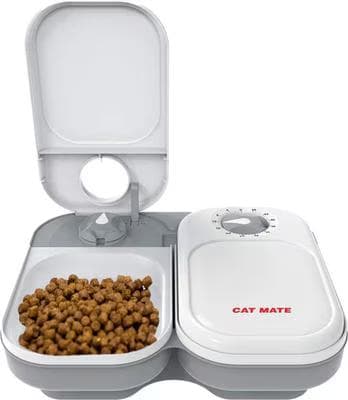
Webvet may earn a commission when you click through to Chewy, at no extra cost to you.

The Cat Mate C200 is the simplest machine in this roundup: two covered bowls, a timer, and lids that pop open when mealtime arrives. There is no hopper, no motor-driven auger, and no app. That simplicity is exactly why it earns the budget slot.
Because you pre-load each bowl yourself, portion accuracy is perfect by definition: the cat gets exactly what you spooned in. That also means it handles wet food for a single mealtime stretch, something hopper feeders cannot do at all.
Where it fits, and where it does not:
- Great for: covering a workday, feeding a second scheduled meal, wet or dry food
- Great for: cats on measured meals where a scoop-it-yourself portion beats any auger
- Not for: multi-day trips, since two bowls cover roughly one day of meals
- Not for: tech lovers, as there is no app, camera, or feeding log
Living with the C200 is refreshingly boring. Load two bowls in the morning, set the timer dials, and forget it. The covered lids also matter more than they look: they keep the second meal fresher and stop an impatient cat from clawing an early lunch out of an open dish.
Cleaning is another quiet win for the bowl format. The food-contact bowls lift out and wash like any dish, with no auger tunnels or hopper corners to trap crumbs. For wet food users, that easy wash-up is the difference between a feeder you sanitize and one you eventually distrust.
At $29.99 with a 4.0-star Chewy average, the C200 is the cheapest legitimate answer to "I need my cat fed at noon." Just accept its ceiling: it is a one-day machine, not a vacation machine.
OneIsAll PF05 12-cup: best value hopper ($39.99)
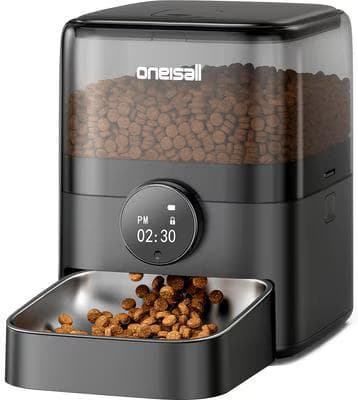
Webvet may earn a commission when you click through to Chewy, at no extra cost to you.

The OneIsAll PF05 carries the highest shopper rating in this entire roundup: 4.6 stars. That matters, because hopper feeders live or die on reliability, and a large base of satisfied reviewers is the best low-cost signal you can get without a lab.
The 12-cup hopper is the headline. For a typical adult cat eating measured kibble meals, that is well over a week of dry-food capacity, which means fewer refills and less chance you discover an empty hopper on a busy morning.
Why it beats other budget hoppers:
- Capacity: 12 cups of kibble dwarfs most compact feeders in this price range
- Scheduling: multiple small meals per day, which supports healthy meal frequency
- Value: at $39.99 it undercuts mid-range hoppers while doing the same core job
- Trade-off: dry food only, like every hopper design; wet food needs a tray feeder
Practical notes from the hopper-feeder category apply here in full. Kibble size is the make-or-break variable: small, roundish pieces flow through dispensing mechanisms cleanly, while large dental-diet kibble or soft, oily formulas are the classic jam recipe. Match your food to the listing's kibble-size guidance before you rely on any hopper.
The scheduling side is where a 12-cup hopper earns its keep for weight management. Because the machine does the measuring, you can split the same daily ration into three or four small meals without adding any work to your day. That schedule keeps a hungry cat occupied and stops the 5 a.m. wake-up campaign.
If your cat eats kibble and you want the most feeder for the least money, this is the pick. Confirm power options on the current listing; many owners run hopper feeders on mains power with batteries installed as a battery backup against outages.
Cat Mate C500 Digital 5-Meal: best budget wet-food option ($45.99)
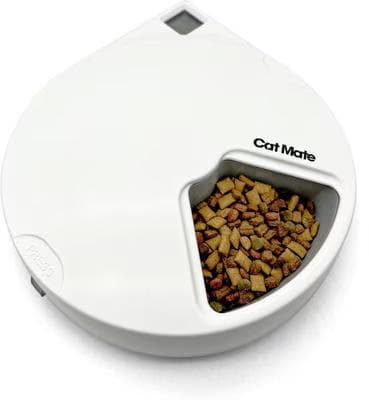
Webvet may earn a commission when you click through to Chewy, at no extra cost to you.

The Cat Mate C500 rotates five covered meal trays on a programmable carousel. Like the C200, you portion each tray yourself, so portion accuracy is whatever your measuring spoon says. Unlike the C200, it stretches to five scheduled meals, which can cover a weekend for a dry-fed cat.
Tray feeders are the budget path to scheduled wet food. Cooling accessories such as ice packs help wet food stay fresher for a few extra hours, but no unrefrigerated tray keeps wet food safe for days; we cover safe time limits in the wet-food section below.
Strengths and limits at a glance:
- Five meals, each hand-portioned: ideal for weight-management feeding plans
- Wet or dry: trays do not care what you put in them
- Battery-powered: no outlet needed, no outage worries, but keep spare batteries
- Limit: once the fifth tray opens, the machine is done until you reload
The carousel format has a subtle behavioral benefit too. Because the machine, not you, reveals each meal, cats stop associating their human with food delivery. Owners of dawn-patrol cats consistently report that a week of carousel feeding retrains the cat to stare at the feeder instead of standing on your chest at 5 a.m.
Setup takes minutes: portion five meals, set the interval timers, snap the lid. The habit worth building is a load-and-wash rotation, where trays go straight to the sink at each reload. Tray feeders reward that small discipline with years of unglamorous, jam-free service.
At $45.99 and 4.0 stars, the C500 is the bridge between budget simplicity and genuine multi-meal scheduling. It is also the feeder we point to for cats who need small, frequent meals on a vet-directed plan.
Mid-range tier ($50-$100): where most cat owners should shop
Mid-range is the value center of this category. You gain better build quality, better scheduling, and better portioning hardware, without paying for cameras or microchip sensors you may never use. Both of our overall favorites live here.
It is also the tier where the two design philosophies compete head to head: the Petlibro Air represents the refined hopper, and the PetSafe Eatwell represents the bulletproof tray. Reading those two picks together is the fastest way to understand which design your household actually needs.
Petlibro Air Automatic Feeder: best overall ($49.99)
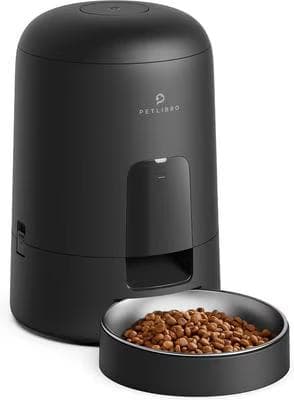
Webvet may earn a commission when you click through to Chewy, at no extra cost to you.

The Petlibro Air sits right at the tier boundary and delivers the best all-around package in this roundup. It is a slim, quiet, kibble-focused feeder that does the fundamentals with unusual polish: consistent portions, easy scheduling, and a footprint small enough for apartment kitchens.
What earns it the top slot is balance. Cheaper feeders make you accept a compromise (one-day capacity, or bare-bones scheduling), while premium feeders charge for features that are situational. The Air simply feeds your cat the right amount at the right time, repeatedly.
Why it is our best overall:
- Portion control: small dispensing increments make it easy to match your cat's caloric needs
- Meal frequency: schedule several small meals a day, the pattern cats naturally prefer
- Compact, stable body: harder for a determined cat to tip or raid
- No app dependency: program it on the device and it just runs
In daily use, two details separate the Air from cheaper hoppers. Dispensing is quiet and quick, which matters for sound-sensitive cats who bolt from clattering machines. And the sealed food path keeps kibble noticeably fresher at the bottom of the hopper than open-bin designs, so the last meals smell like the first ones.
The honest limitations: it is a dry-food machine with a deliberately compact hopper, so a multi-week capacity is not the goal here. Households wanting maximum unattended runtime should look at the OneIsAll's 12 cups or the Granary's 5 liters instead, and wet-food homes should skip to the Casfuy section.
At $49.99 with a 4.2-star average, it is also the rare "best overall" that costs less than the category's mid-point. If you feed dry food to one cat and want a feeder you can trust and forget, buy this one.
PetSafe Eatwell 5-Meal: best simple timed feeder ($59.95)
Webvet may earn a commission when you click through to Chewy, at no extra cost to you.

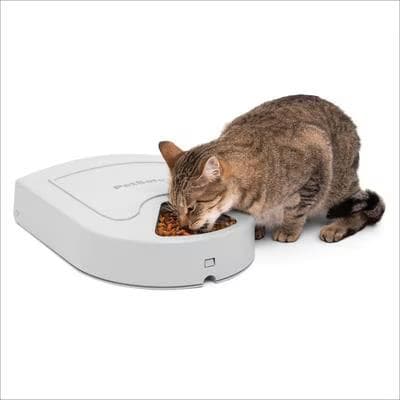
The PetSafe Eatwell 5-Meal is the mid-range answer for owners who want scheduled meals with the fewest possible points of failure. Five compartments rotate under a locked lid on a timer. No hopper, no auger, no Wi-Fi, nothing to jam.
PetSafe is one of the most established brands in pet containment and feeding hardware, and the Eatwell's design has been refined over many years. Its 4.2-star Chewy average reflects that maturity.
Where the Eatwell earns its price over the similar Cat Mate C500:
- Larger compartments: roomier meals suit bigger cats or shared households
- Sturdier carousel build: the lid and base resist prying paws well
- Same hand-portioned accuracy: you control every meal to the gram
- Battery operation: immune to power outages by design
The Eatwell also handles an underrated scenario: the semi-moist or fresh-food diet. Because compartments are open trays rather than an auger path, any food consistency works for a same-day schedule. Owners feeding refrigerated fresh diets can run a morning-to-evening schedule that no hopper feeder can attempt.
One behavioral caveat applies to every carousel design, this one included: a clever, food-obsessed cat will study the rotating lid. The Eatwell's construction resists prying better than most, but if your cat is a known safecracker, place the unit against a wall and watch the first week closely.
At $59.95 it costs more than the C500 for the same core concept, so choose it when build quality and compartment size matter more than saving $14. It is also our reliability favorite, for reasons covered in the failure-modes section below.
Premium tier ($100+): pay for a specific problem, not for prestige
Premium feeders are not "better budget feeders." They are specialized tools. A camera feeder solves an anxiety and monitoring problem; a microchip feeder solves a multi-pet access problem. If you do not have that problem, the mid-range tier feeds your cat just as well.
Petlibro Granary WiFi Camera Feeder 5-L: best premium camera feeder ($129.99)
Webvet may earn a commission when you click through to Chewy, at no extra cost to you.

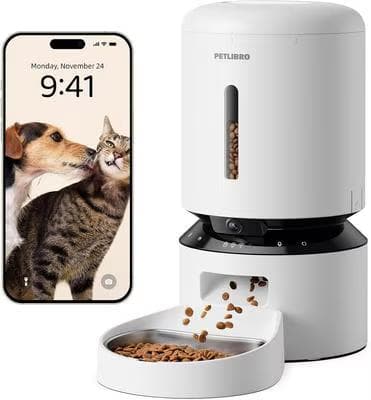
The Petlibro Granary pairs a generous 5-liter kibble hopper with Wi-Fi scheduling and a built-in camera, so you can watch meals happen from your phone. For owners who travel, or who manage a cat's weight remotely, that visibility is the whole point.
The 5-liter hopper is the other half of the value story. For one cat on measured meals, that is well over a week of capacity, and app scheduling makes it painless to run several small meals a day without touching the machine.
What you are paying for at $129.99:
- Camera verification: see that the meal dispensed and that your cat ate it
- App scheduling and logs: adjust portions from anywhere, review feeding history
- 5 L capacity: fewer refills, better for trips (with a human checking in)
- Trade-off: Wi-Fi features need Wi-Fi; scheduled feeds should still run locally, but confirm behavior on the current listing
The app layer changes how you manage a diet plan, not just how you fill a bowl. A vet's mid-plan calorie change takes effect at the next meal, not the next weekend. Feeding logs also give appointments an objective record, replacing "I think she eats around a cup."
Smart-feeder shopping has one rule: the machine must feed the cat even when the smart part fails. Look for stored on-device schedules and treat the app as a remote control, not a life-support system. That is the standard we hold the whole camera category to in the dedicated section below.
Its 4.2-star average matches the simpler Petlibro Air, which tells you the smart-feeder experience has matured. Buy the Granary when remote eyes on the bowl are worth $80 over our best overall; we break down the camera question fully in its own section below.
SureFeed Microchip Feeder: best for multi-pet homes ($183.59)
Webvet may earn a commission when you click through to Chewy, at no extra cost to you.

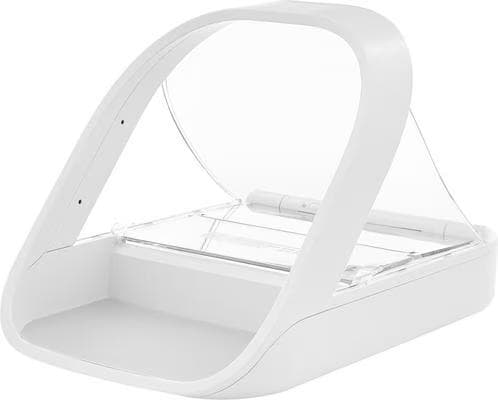
The SureFeed Microchip Feeder is the most expensive pick in this roundup and the only one that controls who eats, not just when. Its lid stays closed until it reads your cat's implanted microchip (or a collar tag), then opens for that cat alone.
That single trick solves problems nothing else here can touch:
- Prescription diets: the medicated cat eats the medicated food, and nobody else does
- Weight management: the dieting cat cannot raid the other cat's bowl
- Dog-proofing: a kibble-vacuuming dog cannot get into the cat's food
- Wet food: the sealed bowl slows drying, keeping wet meals fresher between visits
Understand what it is not: the standard SureFeed is a sealed smart bowl, not a scheduled dispenser. You still portion the food; the machine controls access. Many multi-pet homes pair it with a scheduled feeder, or step up SureFeed's own scheduling variants.
Plan for a training period. Most cats accept the motorized lid within days using the feeder's staged training mode, which opens the lid progressively less until the cat is comfortable eating from the enclosed bowl. Skipping that ramp-up is the main source of "my cat is scared of it" returns in this category.
At $183.59 with 4.3 stars, it is a targeted investment. If food stealing, diet separation, or a chip-verified feeding record is your actual problem, nothing cheaper solves it properly. Our full microchip pet feeder guide compares every variant in depth.
Budget vs. premium: what each price tier actually buys you
The comparison table in the at-a-glance section above pairs every pick with its price tier; this section explains what moving up a tier actually buys you, and when it does not.

"Spend more, get more" is only half true in this category. Each price tier buys a specific bundle of capabilities, and the jump between tiers is about which problems get solved, not about raw quality. Here is the honest breakdown, tier by tier.
The pricing spread in this roundup makes the point by itself: our picks run from $29.99 to $183.59, a six-fold range, yet the cheapest and the most expensive both hold 4.0-plus star ratings. Owners are not happier at higher prices; they are happier when the machine matches the problem.
What the budget tier (under $50) buys you
Under $50, you get timed feeding, full stop. The best cat feeder in this tier is one that opens or dispenses on schedule and does nothing else. Bowl and tray designs (Cat Mate C200, C500) even give you perfect hand-measured portions, which cheap augers cannot promise.
What you give up is convenience and margin for error:
- Capacity: one to five meals for tray designs; refill days come fast
- No connectivity: no logs, no remote portion changes, no alerts
- Basic portioning on hoppers: cheap augers can be less precise per dispense
- Fewer safeguards: minimal anti-jam engineering and no camera to verify a meal happened
What the mid-range ($50-$100) buys you
This tier buys reliability engineering. A timed cat feeder like the PetSafe Eatwell or a polished compact hopper like the Petlibro Air gives you better motors, better seals, more scheduling flexibility, and designs refined against real-world cat sabotage: prying paws, tipping, and nose-first raids.
For most readers, this is the correct amount of feeder. The OneIsAll PF05 even drags mid-range capacity down into budget pricing, which is why its 4.6-star rating leads the roundup.
What the premium tier ($100+) buys you
Above $100 you are buying one of two specific superpowers:
- Information: cameras, apps, feeding logs, alerts (Petlibro Granary)
- Access control: microchip-verified, per-cat feeding (SureFeed)
- Bigger everything: larger hoppers and better batteries usually ride along
- Better failure handling: dual power designs with a genuine battery backup are more common here
Neither superpower makes kibble land in the bowl more reliably than a good mid-range machine. That is the core buying insight of this entire guide: match the tier to your problem. The best automatic pet feeder for your home is the cheapest one that solves your actual failure scenario.
The real cost of ownership, tier by tier
Sticker price is not the whole bill. Over a feeder's life, plan for:
- Batteries: battery-only designs need fresh cells every few months; buy quality alkalines and change them on a calendar, not when the display dies
- Ice packs: wet-food feeders consume freezer space and eventually replacement packs
- App accounts: current picks here do not require subscriptions for core feeding, but some smart-feeder brands paywall cloud video history; read the listing before assuming
- Replacement parts: bowls, lids, and seals wear; established brands (PetSafe, Cat Mate, SureFeed, Petlibro) keep spares available, which is a quiet argument against no-name imports
When upgrading a tier is actually justified
Upgrade when a cheaper feeder is failing at its job, not when a feature list tempts you. The legitimate triggers:
- You stopped trusting it: repeat jams or missed meals mean the machine is costing you the consistency you bought it for
- Your household changed: a new cat, a new dog, or a new prescription diet creates the access-control problem premium tiers solve
- Your schedule changed: regular travel converts a camera from gimmick to genuine monitoring tool
- Your cat's health changed: weight-loss plans and appetite monitoring both benefit from logs and finer portion control
If none of those describe you, the money is better spent on high-quality food. A $50 feeder executing a good feeding plan beats a $200 feeder executing a bad one, every single time.
| What you get | Budget (under $50) | Mid-range ($50-$100) | Premium ($100+) |
| Scheduled meals | Yes (1-5 meals) | Yes (multiple daily) | Yes (multiple daily) |
| Capacity | Low (bowls/trays) to 12 cups | Compact to large hoppers | Large hoppers (5 L class) |
| Wet food | Yes on tray/bowl designs | Rare | Sealed-bowl designs only |
| App / camera | No | Sometimes app-optional | Common (camera, logs, alerts) |
| Access control | No | No | Microchip / RFID options |
| Power resilience | Battery-only designs | Mixed (check listing) | Dual power with battery backup more common |
Budget buys a schedule, mid-range buys reliability, premium buys either information (camera and app) or access control (microchip). If you cannot name the premium problem you are solving, buy mid-range and bank the difference.
Best automatic feeders for wet food

Searches for an automatic cat feeder wet food setup outnumber almost every other refinement of this category, and for good reason: wet food supports hydration, many cats simply prefer it, and some medical conditions call for it. Yet most automatic feeders are built for kibble only.
The physics are the problem. Hoppers and augers need dry, flowable food. Wet food must be portioned into open compartments, and once opened, the clock starts: at room temperature, canned food should not sit out more than a few hours before it dries, oxidizes, and grows bacteria.
It is worth solving anyway, because wet food is not a mere preference for many cats:
- Hydration: higher moisture intake supports urinary tract health
- Weight plans: water adds satiety without calories, which helps some diets
- Seniors and dental patients: cats with mouth pain or fading smell often accept wet food when they refuse kibble
- Medical diets: many urinary and kidney prescriptions come wet-first
Owners of cats on vet-directed wet diets, including many urinary and kidney patients, should treat feeder choice as part of the treatment plan and confirm the schedule with their veterinarian. Getting scheduled wet meals right is harder than kibble automation, but the health payoff is real.
That reality shapes what "good" looks like in this niche:
- Tray or bowl designs only: Cat Mate C200/C500, PetSafe Eatwell, Casfuy F13
- Cooling matters: an ice pack tray under the food buys extra freshness, not days
- Short horizons: plan wet-food automation in hours, not week-long stretches
- Sealed access helps: the SureFeed's closing lid slows drying between nibbles
Casfuy F13 6-Meal Wet Food Feeder with Ice Packs: best for wet food ($79.99)
Webvet may earn a commission when you click through to Chewy, at no extra cost to you.

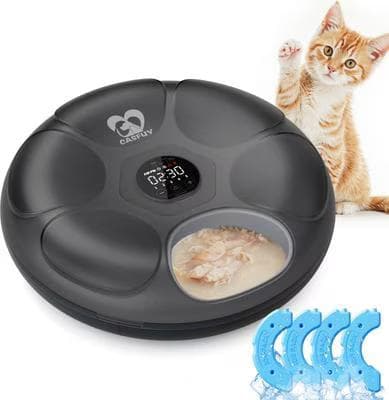
The Casfuy F13 is purpose-built for this job: six rotating meal compartments over included ice packs. Load the packs frozen, portion wet food into the trays, and the chilled base keeps meals cooler and fresher through the day than any open-air tray can.
Six compartments is also the most in this roundup, which matters for wet-food cats specifically. Smaller, more frequent wet meals stay fresher than one big serving, and the F13 can run a genuinely cat-like schedule of small meals across a workday and evening.
Why it wins the wet-food slot at $79.99 (4.3 stars):
- Ice packs included: cooling is designed in, not improvised
- Six meals: the most scheduling room of any tray feeder here
- Hand-portioned accuracy: you control every gram, ideal for measured diets
- Trade-off: like all tray feeders, when the last tray opens, it is empty
A safe wet-food automation routine
Here is the daily pattern that makes wet-food automation work in practice:
- Morning: wash trays, load fresh portions over frozen ice packs, set the day's schedule
- Daytime: meals open on schedule; ice packs keep food cool through the workday window
- Evening: serve the last wet meal by hand if you are home, and pull any uneaten leftovers
- Night: trays to the sink, packs to the freezer, so tomorrow's reload takes two minutes
Two refinements help picky cats. Cold food carries less aroma, and aroma drives feline appetite, so schedule the first tray to open within a couple of hours of loading while it is freshest. And keep portions modest: a small meal eaten immediately beats a large one that sits.
What about a 7-day wet food feeder or a truly refrigerated feeder?
Two searches deserve straight answers. First, "automatic cat feeder wet food 7 days": no ice-pack tray feeder keeps wet food safe for seven days. Ice packs melt within hours, not days. A 7-day wet-food plan without a human visit is a food-safety plan for making your cat sick.
Second, "automatic cat feeder wet food refrigerated": genuinely refrigerated (actively powered, compressor or thermoelectric) cat feeders are vanishingly rare as mainstream products. The practical ceiling today is chilled, not refrigerated: frozen packs under sealed trays, replaced at each reload.
If you need multi-day coverage, the vet-safe patterns are:
- Switch to dry food in a hopper feeder for the trip, transitioning gradually beforehand
- Book a sitter visit every 24 hours who reloads chilled trays and checks water
- Split the difference: dry food automated, wet food only when a human serves it
- For grazers on wet food: a sealed-bowl feeder like the SureFeed slows drying between visits
Running wet food for multiple cats at once, or wanting a camera view or a microchip-locked bowl on top of it, is covered in the dedicated sections below.
The most reliable automatic cat feeders (reliability and failure modes)
What is the most reliable automatic cat feeder? In this lineup, the PetSafe Eatwell 5-Meal and the Cat Mate tray feeders: they have the fewest failure points, with no hopper to jam, no Wi-Fi to drop, and battery power that shrugs off outages. Among hoppers, the OneIsAll PF05's 4.6-star average is the strongest reliability signal.
Reliability is not an abstract spec. An automatic feeder is a machine you are trusting with an animal's food supply, sometimes while you are hundreds of miles away. So the right question is not "is it reliable?" but "how exactly does it fail, and what happens to my cat when it does?"
This is also where marketing and engineering part ways. Listings advertise features; failure behavior lives in the fine print and the one-star reviews. The framework below is how we read this category, and it transfers to any feeder you evaluate, including models released after this guide.
The four failure modes that actually matter
Nearly every automatic-feeder horror story reduces to one of four events:
- Power outage: mains-powered feeders stop dead unless they have a battery backup
- Hopper jam: odd-shaped, oily, or oversized kibble bridges over the auger and blocks dispensing
- Wi-Fi drop: app-dependent feeders can miss schedule changes; well-designed ones keep feeding on the last stored schedule
- Empty hopper: the silent failure; the machine works perfectly and dispenses nothing
| Failure mode | Which feeders are exposed | What happens | How to mitigate |
| Power outage | Plug-in hoppers without batteries | No meals until power returns | Choose dual power; keep charged batteries installed as backup |
| Hopper jam | All auger/hopper feeders | Partial or missed portions | Use small round kibble; keep hopper above one-quarter full; clean oily residue monthly |
| Wi-Fi drop | App-first smart feeders | Remote changes fail; local schedule should continue | Confirm offline behavior before relying on it; keep a stored schedule |
| Empty hopper | Every feeder | Perfect machine, zero food | Check food level on a calendar; camera feeders let you verify visually |
Power: the boring spec that decides everything
Power design is the single best predictor of how a feeder behaves in a crisis, and it splits the market three ways:
- Battery-only (PetSafe Eatwell, Cat Mate C200 and C500): immune to outages, but batteries deplete silently; change them on a schedule
- Plug-in only: the worst configuration for unattended use; one tripped breaker ends feeding
- Dual power: mains for daily life, installed batteries as a battery backup that takes over seamlessly; the configuration to prefer in any hopper feeder
Battery discipline is simple but non-negotiable. Use quality alkaline cells, note the install date somewhere visible, and replace them proactively every few months rather than waiting for a low-battery icon you might not see. A dead feeder and a dead battery indicator look identical from an airport.
The pre-trip test protocol
Before any feeder covers real absences, run this one-week test while you are home:
- Days 1-2: run your normal schedule and confirm every dispense fires on time
- Days 3-4: weigh two dispensed portions on a kitchen scale to confirm portion accuracy
- Day 5: unplug it (or pull one battery) and verify the outage behavior matches the listing's promise
- Days 6-7: hands off entirely; check food level and schedule integrity only at day's end
Any machine that passes all four stages has earned a weekend. Any machine that fails one has told you exactly what to fix, at a cost of zero missed meals.
How each pick handles failure
Tray and bowl feeders (Eatwell, C500, C200, Casfuy) are structurally immune to two of the four failure modes: they cannot suffer a hopper jam because there is no hopper, and they cannot lose Wi-Fi because they never had it. Batteries cover the outage case; only the empty-reload case remains.
Hopper feeders trade that purity for capacity. The mitigation stack is simple and worth writing down:
- Kibble shape: small, uniform, round kibble flows; large or oily pieces bridge and jam
- Fill discipline: keep hoppers above roughly a quarter full so gravity keeps food feeding the auger
- Monthly cleaning: kibble oils build up on augers and chutes; residue is a jam accelerant
- Test runs: after any food change, watch two full dispense cycles before trusting it
Smart feeders add the connectivity question. The PetSafe Eatwell never has to answer it; the Petlibro Granary answers it with stored schedules plus a camera that lets you verify the meal actually landed. Verification, not connectivity, is the real reliability feature of camera feeders.
Reading shopper ratings like an engineer
Star averages hide the information you actually need, which lives in the failure stories. When you evaluate any feeder listing, including our picks, read the one-star and two-star reviews and sort them into the four failure modes above. A hundred complaints about a confusing app matter less than ten about missed meals.
Two more signals worth weighing. Review recency matters, because manufacturers revise internals without renaming products, so a jam complaint from years ago may describe hardware that no longer exists. And review volume matters: the OneIsAll's 4.6 stars means more across a large reviewer base than a 5.0 from a dozen buyers.
The setup mistakes that cause most 'broken feeder' complaints
Support forums suggest a large share of feeder failures are installation problems wearing a disguise:
- Wrong kibble for the mechanism: oversized or oily pieces in a small-kibble auger
- Feeder on carpet: soft, uneven surfaces let vibration walk the unit and misalign trays
- Hopper run to empty: the last few meals dispense light as gravity feed weakens
- Ice packs loaded unfrozen: a cool pack is not a cold pack; freeze overnight
- No portion verification: the machine was never weighed against the diet plan, so "it overfeeds" was really "it was never calibrated"
The most reliable designs are the simplest ones: battery-powered tray feeders with no hopper and no Wi-Fi. Every added convenience adds a failure mode, so buy the mitigation (battery backup, jam-resistant kibble, a camera to verify) along with the feature.
Do vets recommend automatic cat feeders? (vet-informed criteria + FAQ)
Do vets recommend automatic cat feeders? Broadly, yes, with conditions. Used well, an automatic feeder enforces exactly what veterinary guidance keeps asking owners to do: feed measured portions, on a consistent schedule, split into multiple small meals. Used badly (as a set-and-forget vacation substitute), the same machine becomes a liability.
The nutrition logic is straightforward. Feline obesity is one of the most common problems veterinarians see, and free-choice feeding is a major driver. Resources from the Cornell Feline Health Center and the American Animal Hospital Association consistently emphasize portion-controlled, scheduled feeding over leaving food out all day.
Cats are also natural nibblers. Left to their own instincts, cats eat many small meals across a day rather than one or two large ones. A feeder that dispenses several small, measured meals mimics that pattern far better than a human with a 9-to-5 can.
Meal frequency carries behavioral weight too. Predictable, machine-delivered meals reduce food anxiety, and spreading the ration across the day helps with:
- Dawn waking: the feeder, not you, becomes the breakfast source
- Food aggression between housemates: full cats patrol less
- Stress gorging and vomiting: smaller meals, eaten calmer
- Begging cycles: a schedule the cat can predict ends the lobbying
The honest counterweight: a feeder automates delivery, not judgment. It cannot see a cat leaving food, favoring one side of the mouth, or drinking more than usual. Vets recommend feeders as an execution tool inside a plan a human is still monitoring, which is exactly how this guide treats them.
The vet-informed buying criteria behind this roundup
These are the criteria this vet-informed roundup actually scored against, and they are worth using on any feeder we did not cover:
- Portion accuracy first: a feeder must dispense the amount you set, consistently; drifting portions quietly break a diet plan
- Small increments: a typical adult cat needs roughly 200 kcal a day (your vet sets the real number), so a feeder should adjust portions in small steps to match caloric needs precisely
- Meal frequency: at least two scheduled meals daily; more, smaller meals are generally better for cats
- No free-for-all: scheduled portions beat open troughs; that is the entire case against gravity feeders
- Cleanable food path: bowls, trays, and hoppers you can actually wash, since biofilm and kibble oils cause both hygiene and jamming problems
The gravity feeder problem
A gravity feeder is not an automatic feeder; it is an open buffet with a roof. Food falls whenever the bowl empties, so the cat, not the schedule, decides intake. The gravity feeder risk is twofold: unlimited calories for food-motivated cats, and zero signal when a cat stops eating.
That second point deserves emphasis. In cats, a fading appetite is an early warning sign for many illnesses, and a cat that stops eating entirely can develop serious liver complications within days, a pattern documented in references like the Merck Veterinary Manual. A portioned feeder shows you missed meals; a gravity feeder hides them.
When a vet would tell you not to automate
There are real cases where automation is the wrong tool:
- Cats on multiple daily medications mixed into food, where a human must verify each dose is eaten
- New medical diagnoses where intake itself is the thing being monitored hour to hour
- Cats in multi-pet homes without access control, where the wrong animal eats the portion (a microchip feeder fixes this specific case)
- Kittens under vet-directed feeding plans, which change too fast for static schedules
For everyone else, the vet-informed verdict is positive: an automatic feeder is one of the cheapest pieces of preventive-health hardware you can buy, because it makes measured feeding effortless enough that you actually keep doing it.
Signs the feeder is actually improving your cat's health
Give a new feeding routine four to six weeks, then look for these markers:
- Stable or vet-planned weight change, confirmed on a scale rather than by eye
- Calmer mealtimes: less begging, less counter-surfing, no more dawn wake-ups
- Visible intake: you can say with confidence how much your cat ate yesterday
- Steadier litter box output, which tracks consistent portions and schedules
- Faster illness detection: an untouched scheduled meal now gets noticed the same day
That last point is the quiet payoff of the whole category. Scheduled, portioned feeding converts appetite from something you vaguely sense into data you actually have, and appetite is one of the earliest health signals cats give us.
How to calibrate portions to your cat's caloric needs
A feeder dispenses volume; your vet prescribes calories. Bridging those two units is a ten-minute job that most owners skip, and it is the difference between a feeder that manages weight and one that quietly overfeeds:
- Get the daily calorie target from your vet, not a bag chart; targets vary widely with age, weight, and body condition
- Find your food's kcal per cup on the label, and convert the target into cups or grams per day
- Divide across meals: a 200 kcal day at three meals is roughly 67 kcal per meal
- Weigh what the feeder dispenses on a kitchen scale for the first few days, because "one portion" settings differ between machines
- Recheck monthly: weigh the cat, and adjust the schedule, not the treats
Tray feeders make this trivial (you weigh each meal as you load it), which is one reason vet-directed weight plans and carousel feeders pair so well. Hopper feeders need that initial scale check, after which their consistency becomes an asset.
Remember to subtract treats from the daily budget rather than stacking them on top. Treats routinely add a meaningful slice of a small cat's caloric needs, and they are the usual reason a perfectly calibrated feeder still produces a slowly expanding cat.
Transitioning your cat to an automatic feeder
Cats distrust new objects that make motor noises near their food. A gradual transition prevents the most common failure, a cat that refuses the machine entirely:
- Days 1-2: run the feeder unplugged next to the old bowl so it becomes furniture
- Days 3-4: serve part of each meal in the feeder's bowl by hand
- Days 5-6: trigger a dispense while you are in the room, so the sound predicts food
- Day 7 on: shift fully to scheduled meals, keeping times close to the old routine at first
Skittish cats may need each stage doubled. Whatever the pace, do not switch food and feeder in the same week; change one variable at a time so you can read your cat's reaction accurately.
Frequently Asked Questions
How many meals a day should an automatic feeder dispense?
At least two, and many cats do better with three to five small meals. Cats are natural nibblers, and splitting the same daily portion into more scheduled meals supports steadier energy and less begging. Keep total daily calories constant; increase meal frequency, not food volume.
Can an automatic feeder help my cat lose weight?
Yes, and it is one of the best tools for the job. Weight loss in cats depends on consistent portion accuracy against a calorie target your veterinarian sets. A feeder removes the human failure points: eyeballed scoops, second breakfasts, and giving in to begging. Pair it with a measured-in-grams food plan from your vet.
Will an automatic feeder work during a power outage?
Battery-powered feeders (PetSafe Eatwell, Cat Mate C200 and C500) keep working through any outage. Plug-in hoppers stop unless they have a battery backup, so if you buy a plug-in model, install fresh backup batteries the day it arrives and replace them on a schedule.
Can I put wet food in an automatic feeder overnight?
Overnight is the practical maximum, and only in a tray feeder with frozen ice packs, like the Casfuy F13, or a sealed-bowl design. Wet food left out unrefrigerated spoils within hours at room temperature. Never schedule wet food more than about a day ahead, even chilled.
Are gravity feeders the same as automatic feeders?
No. A gravity feeder refills the bowl whenever the cat empties it, so the cat controls intake and overeating is common. An automatic feeder dispenses measured portions on a schedule you control. For weight, health monitoring, and meal structure, scheduled portioning is the version veterinary guidance supports.
How often should I clean an automatic cat feeder?
Wash bowls and trays after every wet-food use and at least weekly for dry food. Empty and wipe hoppers, augers, and chutes monthly, since kibble oils build residue that harbors bacteria and encourages hopper jams. Always dry components fully before refilling, because moisture clumps kibble and blocks dispensing.
Can kittens use an automatic feeder?
Generally not as the primary feeding method. Kittens need frequent meals on a plan that changes as they grow, and their intake needs closer monitoring than a static schedule provides. Feeders work well for kittens as a supplemental scheduled meal once your veterinarian approves, typically later in their first year.
Why is my cat scared of the automatic feeder?
Usually the motor noise, which arrived without warning next to their food. Fix it with a slow transition: let the unit sit unpowered for days, hand-feed from its bowl, then trigger dispenses while you are present so the sound predicts food. Quiet-dispensing models and placing the feeder against a wall both help.
How long do batteries last in an automatic cat feeder?
It varies by model, dispensing frequency, and battery quality, so treat any specific claim skeptically. The safe practice matters more than the number: use quality alkaline batteries, write the install date on painter's tape on the base, and replace them proactively every few months instead of trusting a low-battery icon.
Microchip and RFID feeders for selective feeding
A microchip cat feeder reads your cat's implanted ID chip (or an RFID collar tag) and opens only for that animal. It is the only feeder category that controls access rather than timing, which makes it the definitive fix for multi-pet food problems.
The short version of when an RFID cat feeder earns its price:
- One cat on a prescription diet while housemates eat regular food
- One overweight cat raiding a slim cat's portions
- A dog that treats the cat bowl as a snack station
- Feeding records per cat, since only the registered cat triggers the bowl
In this roundup, the SureFeed Microchip Feeder ($183.59, 4.3 stars) represents the category. Note that a chip reader plus a collar sensor option covers unchipped cats too, and that sealed bowls double as wet-food freshness protection.
Cost math favors these feeders more than the sticker suggests. A single prevented pattern (a dog eating a cat's prescription diet, or a dieting cat undoing months of progress) can outweigh the price gap in wasted therapeutic food alone, before counting the vet visits the problem was causing.
Selective feeding is a deep topic (chip compatibility, training a wary cat onto a motorized lid, collar-tag fallbacks), so we built it a dedicated guide. Read the full comparison in our best microchip pet feeders roundup before spending in this tier.
Feeding multiple cats with automatic feeders

An automatic cat feeder for 2 cats is not simply a bigger feeder. Cats compete for food quietly: the confident cat drifts toward the dispenser at mealtime, the timid one waits, and your carefully measured portions land in one stomach. Automation can hide that dynamic instead of fixing it.
The working rules for multi-cat automation:
- One feeder per cat, placed in separate rooms or at least out of sight lines
- Same schedule, different stations, so neither cat finishes early and patrols the other bowl
- Access control where stakes are high: prescription or weight-loss diets call for a microchip feeder
- Watch the quiet cat: portioned stations make missed meals visible, but only if each cat has their own
- Slow the fast eater: pairing a feeder with puzzle feeders adds time and enrichment to gulped meals
Budget for the real number of machines from the start. Two cats fed from one feeder is the most common multi-cat mistake, and it fails in a way you cannot see: both bowls empty on schedule, both cats present at mealtimes, one cat slowly gaining what the other is losing.
Two of our picks scale well to this setup: a pair of Petlibro Air units keeps costs sane, and tray feeders work as second stations. For placement maps, feeder pairings, and peace-keeping tactics, see the full guide to the best automatic feeders for multiple cats.
Feeders with cameras: when they are worth it
An automatic cat feeder with camera answers the question every traveler asks the pet sitter: did she actually eat? Instead of trusting that a dispense cycle ran, you watch the meal happen, check the food level, and review history in the app.
A camera feeder is genuinely worth the premium when:
- You travel regularly and want visual proof of eating, not just a dispense log
- You are managing appetite, where a skipped meal is medical information
- Your feeder sits out of sight, in a laundry room or basement
- You share care, and multiple people need to see feeding status remotely
It is not worth it when someone is home most days, because your own eyes are a better camera. In this roundup the Petlibro Granary WiFi Camera Feeder ($129.99) is the category representative: big 5 L hopper, app scheduling, meal-time video.
One vet-informed use case elevates the category beyond convenience: appetite is an early illness signal in cats, and a camera plus feeding log turns "I think she has been eating less" into dated, reviewable evidence. For cats with chronic conditions, that record can meaningfully sharpen a vet visit.
Camera placement, resolution trade-offs, and which apps age well are their own buying problem, so the deep dive lives in our dedicated guide to the best pet feeders with cameras.
Need one for a dog instead?
The best automatic dog feeder is not just a scaled-up cat feeder. Dogs eat larger portions, empty hoppers dramatically faster, and apply far more brute force to anything that stands between them and kibble. Latch strength and hopper security move from nice-to-have to mandatory.
The dog-specific differences that change the buying math:
- Portion scale: a 60-pound dog can eat in a day what a cat eats in four
- Raid resistance: locking lids and heavy bases are the spec that matters
- Gulping: many dogs inhale dispensed meals; slow feeder bowls and the fixes in our guide to why dogs eat so fast pair naturally with automation
- Ergonomics: large breeds may eat more comfortably with setups like elevated bowls, which vets recommend only for specific cases
Some hardware does cross over. Compact hoppers like the Petlibro Air suit small dogs on kibble diets, and the reliability framework in this guide (failure modes, battery backup, portion verification) applies to dog feeders unchanged. What does not transfer is capacity planning or chew-resistance, which dog-specific models are built around.
If your household runs both species, a microchip feeder protects the cat's bowl from the dog, and the dog gets a dedicated machine. Our full roundup of the best automatic dog feeders covers capacity classes, chew-proofing, and multi-dog scheduling.
Automatic feeder safety and time-away limits
Are automatic feeders good for cats? Used as a scheduling tool for a cat who still sees humans daily: yes, clearly. They enforce portions, stabilize routine, and make missed meals visible. Used as a substitute for human care over multiple days, they turn risky fast.
Can you leave a cat alone for 2 days with an automatic feeder? The vet-safe answer: the feeder handles the food, but the cat still needs a human check every 24 hours. Feeders do not refill failed water fountains, notice vomiting or lethargy, or fix their own jams.
The safety checklist for any time away:
- Test the full schedule for a week while you are home
- Redundancy: two water sources, and ideally a second loaded feeder
- A human every 24 hours, even for "just" a weekend
- Verify remotely if you can: a camera feeder exists for exactly this
- Leave the sitter your vet's number and your cat's normal eating pattern
Time away also has a behavioral dimension that food delivery cannot touch. Cats are more socially attached to their routines and people than their reputation suggests, and multi-day solitude produces stress behaviors in plenty of them: overgrooming, litter box protests, and clingy or aloof spells after you return.
Risk profiles differ by cat: kittens, seniors, diabetics, and cats on daily medication should not be left on feeder-only care at all. The full risk-benefit breakdown, including separation stress and how long is genuinely safe, lives in our guide to whether automatic feeders are good for cats.
A closing thought on what all eight picks share: none of them is the point. The point is the feeding plan (measured portions, multiple daily meals, a human who notices changes) and a machine that makes you stick to it. Fit the feeder to your problem; the plan does the rest.
Our final word: the top rated automatic cat feeder for most homes remains the Petlibro Air, with the Cat Mate C200 as the budget gateway and the SureFeed Microchip as the premium problem-solver. Buy for your cat's actual failure scenario, portion to your vet's calorie target, and let the machine handle the discipline.
Match the feeder to the problem: Petlibro Air for everyday portion control, Casfuy F13 for wet food, OneIsAll PF05 for capacity on a budget, SureFeed Microchip for multi-pet peace. Whatever you choose, schedule at least two measured meals a day and keep a human in the loop every 24 hours.

Editor
The Webvet Editorial Team is the in-house group of pet-care editors and writers behind Webvet, operated by Smart Pet Collective. The team researches, writes, and maintains Webvet's pet health, behavior, and medication content. Every article follows a defined editorial process: research from reputable veterinary and scientific sources, careful drafting, mandatory review of medical content by a credentialed veterinarian, and dated publication. Health and medication articles are medically reviewed by a licensed veterinary professional before they go live and are kept current over time.
Related reading

Best Dog Advent Calendars and Cat Advent Calendars for 2026: Vet-Reviewed Picks

How to Help a Cat Lose Weight: A Safe Weight Loss Plan

When Can Puppies Eat Solid Food? Weaning Timeline and Tips
