How Much to Feed a Puppy: Chart by Age and Weight
How much to feed a puppy depends on its age, its expected adult size, and the calories in its food. Here is a puppy feeding chart by age, how many meals a day to feed, small versus large breeds, and how to tell if your puppy is eating enough.

BVMS MRCVS

This article contains affiliate links. Webvet may earn a commission when you buy through them, at no extra cost to you.
How much to feed a puppy depends on its age, its expected adult size, and the calories in its food, starting from the feeding guide on the puppy food label. Puppies need more calories per pound than adult dogs, so they eat several measured meals a day, fewer as they grow.
Label amounts are only estimates, so you check them against your puppy's body condition and weekly weight, adjust as it grows, and switch to adult food once its skeleton is mature. The Merck Veterinary Manual advises weighing growing puppies weekly so they gain a small amount each week.
- 1The starting point for how much to feed a puppy is the feeding guide on the puppy food label, adjusted to the puppy, since VCA says some puppies need a little less or a little more.
- 2Read a puppy feeding chart by age plus expected adult size: a retailer's copy of one Pro Plan puppy guide lists daily cups by the weight a dog will reach at maturity.
- 3Puppy meals per day drop with age: Merck recommends three meals a day from weaning to 6 months and two from 6 to 12 months, while a VCA handout gives four at 5 to 12 weeks.
- 4Body condition score is the check on a puppy's food amount: at an ideal weight, VCA says, the ribs are easy to feel under a thin layer of fat but not easy to see.
- 5Puppies stay on growth food until fully grown: VCA gives 6 to 9 months for toy breeds, 8 to 10 months for small breeds, around 12 months for medium breeds, about 18 months for large breeds, and 24 months for giant breeds.
How Much Should I Feed My Puppy?
Feed your puppy the daily amount on its food label for its age and expected adult size, split into several meals, then adjust by body condition. A puppy needs more calories per pound than an adult dog, and the puppy feeding chart below shows how the amount changes by age.
The starting point is the feeding guide on the puppy food label, adjusted to the puppy. VCA Animal Hospitals calls the package guidelines a good starting point, then leaves it to you and your veterinary team to watch how your puppy does, because some puppies need a little less or a little more.
Four things decide how much food your puppy needs per day:
- Age: The Merck Veterinary Manual puts healthy puppies under 4 months at 3 times their resting energy requirement and older puppies at 2 times.
- Expected adult size: A feeding guide can list amounts by the weight a dog will reach at maturity, not the weight it is today, as the Pro Plan puppy guide reproduced by the retailer 1800PetMeds does.
- The food's calories: Tufts says dry, over-the-counter dog foods range from about 300 to over 700 calories per cup, so a cup of one kibble is not a cup of another.
- The individual puppy: The WSAVA Global Nutrition Committee, writing about dogs and cats in general, says individual pets can need up to 50 percent more or less than the starting estimate.
Label directions are not exact for every dog. Nutrition faculty at Tufts Cummings School of Veterinary Medicine warn that the accuracy of feeding directions varies between manufacturers. WSAVA advises adjusting the amount every 2 weeks at first, until your pet reaches and holds an ideal weight and body condition score.
A retailer's copy of the feeding guide for Purina Pro Plan Focus Puppy Chicken & Rice Dry Dog Food lists daily cups by age and expected adult weight. Retailers also list this chicken and rice formula under Purina's Pro Plan Development and High Protein names, so read the guide on the bag you buy.
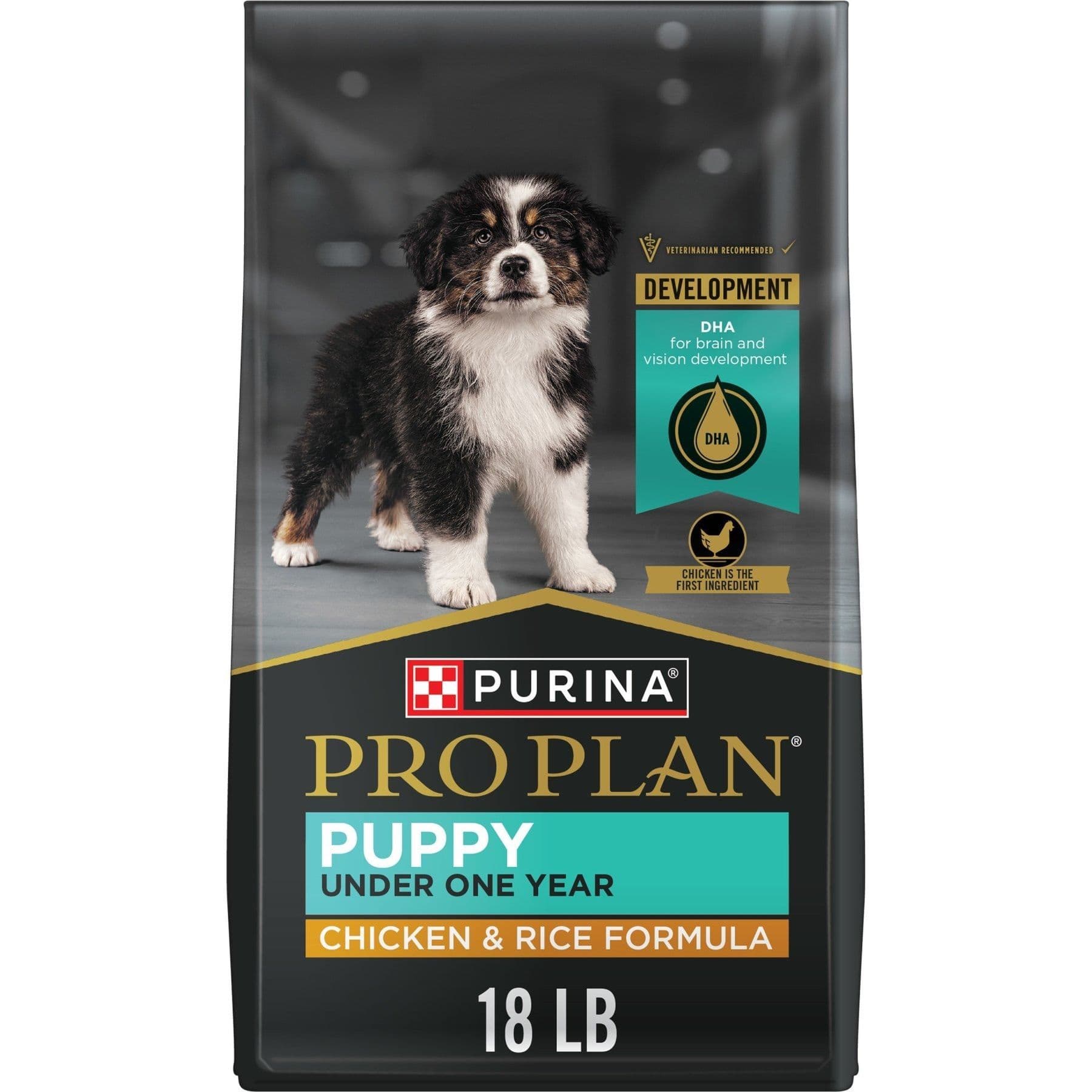
Purina Pro Plan Focus Puppy Chicken and Rice is a dry puppy food that retailers also list as Pro Plan Development.
Webvet may earn a commission when you click through to Chewy, at no extra cost to you.
Choose a food made for growth before you measure anything. VCA says to look for an AAFCO statement that the food provides complete and balanced nutrition for growing puppies or for all life stages. Puppies expected to reach 70 pounds or more need the large-size growth wording covered in the breed-size section.
Wet and canned puppy foods work the same way. The WSAVA guide to reading pet food labels says the calorie statement must give calories per kilogram and per household measure, such as a cup or a can, so you can compare a wet food with a dry one by calories rather than by volume.
Training rewards come out of the same daily amount. If your new puppy works for its own kibble in training games, measure those pieces from the day's portion; the treats section below covers how much room treats get.
Puppy Feeding Chart by Age
A puppy feeding chart by age shows meals per day falling from three or four to two, and daily amounts rising with expected adult size, as growth slows after about 6 months.

Puppies grow rapidly for their first 5 months. The Merck Veterinary Manual says they gain an average of 2 to 4 grams a day for every kilogram of their expected adult weight, so a puppy expected to reach 30 kg (about 66 lb) gains roughly 60 to 120 grams a day.
Growth then slows. Merck says growth begins to plateau after 6 months, with skeletal maturity by 8 to 12 months in small and medium breeds but not until 10 to 16 months in large and giant breeds. VCA adds that puppies are about 75 percent of adult size by six months, when energy needs drop.
This puppy feeding chart by age pairs meals per day with the expected adult size, so owners can match the label amount to the right growth stage. It sets age, meals per day, and what changes for small and large breeds side by side; medium-size puppies follow the general columns.
| Age | Meals per day | Energy and growth | Small-breed puppies (adult weight up to 20 lb) | Large-breed puppies (adult weight 70 lb or more) |
|---|---|---|---|---|
| 5 to 12 weeks | 4 measured meals (VCA new-owner handout); 3 meals from weaning (Merck) | About 3 times resting energy requirement (Merck); rapid growth of 2 to 4 g per day per kg of expected adult weight (Merck) | At least 3 small meals (VCA); Merck says small breeds may need more than 3 | At least 4 small meals (VCA large-breed handout); large-breed puppy food |
| 3 to 4 months | 3 meals (Merck); VCA says puppies on 4 meals usually drop one by 3 to 4 months | About 3 times resting energy requirement until 4 months (Merck) | At least 3 small meals until 4 months (VCA) | At least 4 small meals (VCA) |
| 4 to 6 months | 3 meals (Merck) | About 2 times resting energy requirement after 4 months (Merck); about 75% of adult size by 6 months (VCA) | Body condition score of 4 out of 9 to prevent overweight (VCA) | Portion-controlled meals for slow weight gain (WSAVA); body condition score of 4 out of 9 (VCA) |
| 6 to 12 months | 2 meals (Merck) | Growth plateaus after 6 months; small and medium skeletons mature by 8 to 12 months (Merck) | Adult food at 6 to 9 months for toy breeds and 8 to 10 months for small breeds (VCA) | Still growing; stay on large-breed puppy food with at least 4 small meals (VCA) |
| 12 to 24 months | At least 2 meals for adult dogs; at least 3 for large adults (VCA) | Adult needs of 1.4 to 1.8 times resting energy requirement once growth ends (Merck) | Adult food; toy and small breeds have switched by this age (VCA) | Growth food until about 18 months, or 24 months for giant breeds (VCA); Merck puts maturity at 10 to 16 months |
Puppies headed for a small adult size have their own formulas. PetSmart lists Purina Pro Plan Focus Puppy Small Breed Dry Dog Food as formulated for puppies under 20 pounds at maturity, and its listed calories per cup are higher than the standard formula's, so follow its own bag's guide.
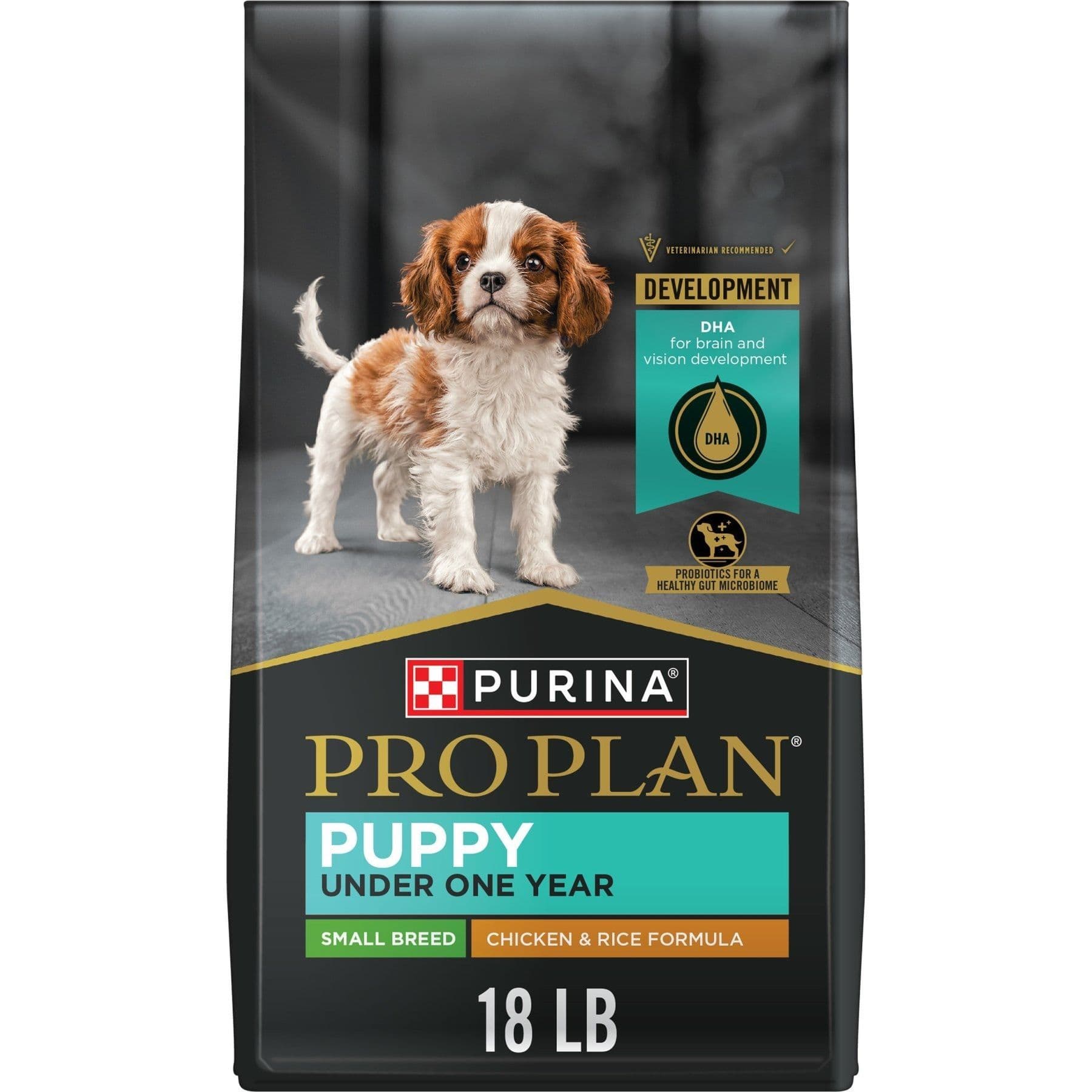
Purina Pro Plan Focus Puppy Small Breed is a dry puppy food formulated for puppies under 20 pounds at maturity.
Webvet may earn a commission when you click through to Chewy, at no extra cost to you.
To turn the chart into cups, read your food's feeding guide by expected adult weight. The pet retailer 1800PetMeds reproduces the guide for the standard Pro Plan puppy chicken and rice formula, with these daily amounts:
- Expected adult weight of 3 to 12 lb: 1/2 to 2/3 cup a day at 1 1/2 to 3 months, 2/3 to 1 cup at 4 to 5 months, and 1/2 to 1 1/4 cups at 6 to 8 months, with adult food from 9 months.
- 13 to 20 lb: 1/2 to 1 cup at 1 1/2 to 3 months, 1 1/4 to 1 1/2 cups at 4 to 5 months, 3/4 to 1 cup at 6 to 8 months, and 1 to 1 1/4 cups at 9 to 11 months.
- 21 to 50 lb: 1/2 to 1 cup at 1 1/2 to 3 months, 1 1/2 to 2 cups at 4 to 5 months, 1 1/4 to 2 cups at 6 to 8 months, and 2 to 2 1/4 cups at 9 to 11 months.
- 51 to 75 lb: 1/2 to 1 3/4 cups at 1 1/2 to 3 months, 1 1/2 to 3 cups at 4 to 5 months, 1 1/3 to 3 cups at 6 to 8 months, 2 1/2 to 3 1/2 cups at 9 to 11 months, and 2 3/4 to 4 2/3 cups at 1 to 2 years.
- 76 to 100 lb: 1 to 2 cups at 1 1/2 to 3 months, 2 to 3 cups at 4 to 5 months, 3 to 4 3/4 cups at 6 to 8 months, 4 to 5 1/4 cups at 9 to 11 months, and 5 3/4 to 8 1/4 cups at 1 to 2 years.
These are daily totals for that one food, not a rule for every puppy. A retailer's copy may not match the bag on your shelf, so check the printed guide, and for a puppy expected to reach 70 pounds or more, check that the bag also carries the AAFCO growth wording for large size dogs.
Current weight is not the row to use. A 4-month-old puppy that weighs 20 pounds today but will reach 60 pounds as an adult belongs in the 51 to 75 lb row, not the 13 to 20 lb row. If you are unsure of your puppy's adult weight, ask your vet to estimate it.
For nursing puppies and the move to a first solid diet, see when puppies can eat solid food. If your food has no chart for your puppy's expected size, use the calorie method in the next section.
How Many Calories Does a Puppy Need?
A healthy puppy needs about 3 times its resting energy requirement (RER) a day until 4 months of age and about 2 times its RER after that, according to the Merck Veterinary Manual. Healthy adult dogs need less: 1.8 times RER if intact, 1.6 times if neutered, and 1.4 times if prone to obesity.
Puppies need more calories per pound than adult dogs because they are growing. VCA says puppies have a high energy requirement in their first few months because they are growing rapidly, and their small stomachs mean they usually need several small meals a day to take in enough calories.
Merck gives two ways to work out RER from body weight in kilograms:
- Exponential formula: RER = 70 × (body weight in kg) to the power of 0.75, which can be used at any body weight.
- Linear formula: RER = 30 × (body weight in kg) + 70, which is limited to animals over 2 kg and under 45 kg.
Here is how that works for a 5-month-old puppy that weighs 10 kg (22 lb). The linear formula gives an RER of 370 kilocalories (kcal), and the exponential formula gives about 394 kcal. At 2 times RER, that puppy's daily estimate is about 740 to 790 kcal.
To turn calories into cups, divide by the kcal per cup printed in your food's calorie statement. At an illustrative 400 kcal per cup, an example figure rather than any product's, 740 to 790 kcal comes to a little under 2 cups a day.

Our feeding calculator runs the same math, using the exponential RER formula with a factor of 3 for puppies under 4 months and 2 for older puppies, and it converts calories to cups when you enter your food's kcal per cup.
Treat any formula result as a first guess, because veterinary references give no single calories-per-pound figure that fits every puppy.
In a 2017 Journal of Nutritional Science study of 22 Yorkshire terrier puppies, the 2006 National Research Council puppy energy equation overestimated their needs between 10 and 20 weeks of age, and the authors called for breed-specific feeding guides to avoid overfeeding.
How Many Times a Day Should a Puppy Eat?
Most puppies eat three or four meals a day when young and two meals a day by 6 to 12 months of age, but the Merck Veterinary Manual and VCA set the cut-off points differently, and breed size changes them again.
Merck's general recommendation is three meals a day from weaning to 6 months and two meals a day from 6 to 12 months. VCA's new-owner handout instead offers a measured amount four times a day to puppies 5 to 12 weeks old.
This puppy feeding schedule by age and size follows those two references and VCA's breed-size handouts:
- 5 to 12 weeks: four measured meals a day in VCA's handout, or three a day from weaning in Merck's schedule
- 3 to 6 months: three meals a day (Merck)
- 6 to 12 months: two meals a day (Merck)
- Toy and small breeds: at least 3 small meals a day until 4 months (VCA), and Merck says small-breed puppies may need more than three
- Large and giant breeds: at least 4 small meals a day for puppies (VCA's large-breed handout)
To work out how much to feed a puppy per meal, divide the daily amount by the number of meals. A puppy whose label amount is 1 1/2 cups a day and who eats three meals gets 1/2 cup at each meal, measured the same way every time.
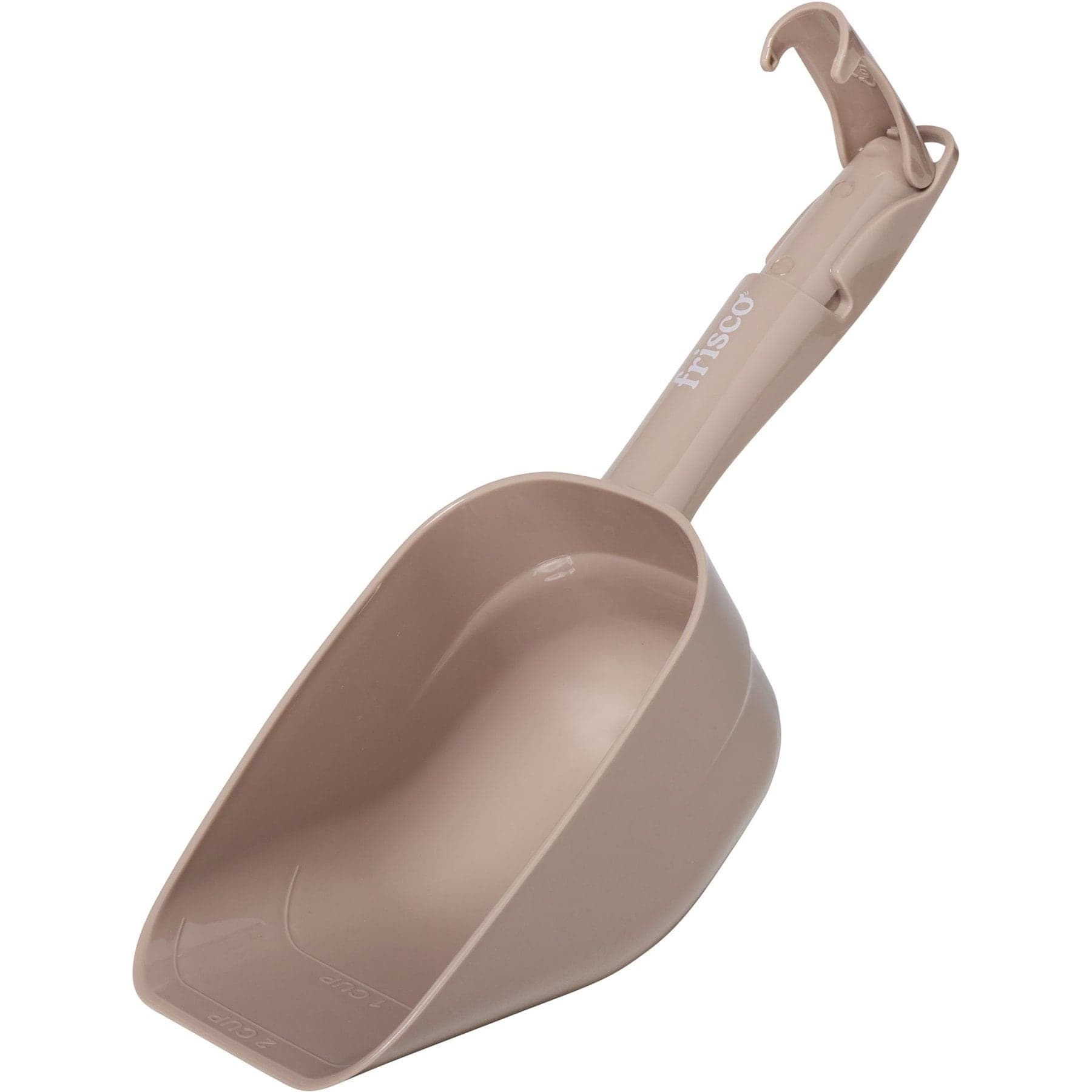
The Frisco Dog and Cat Food Scoop is a pet food scoop for portioning kibble from the bag.
Webvet may earn a commission when you click through to Chewy, at no extra cost to you.
Feeding a puppy once a day falls short of every schedule above. Even for adult dogs, VCA recommends at least two meals a day, because after 8 to 10 hours an empty stomach starts sending hunger signals to the brain.

Keep meal times regular as the number of meals drops, so the day's last meal and first meal stay predictable. For the routine after puppyhood, see our dog feeding schedule.
Can a puppy go 12 hours without food at night?
Not when it is young. VCA says puppies should not go for extended periods without food, especially when they are young, and veterinary references do not set a safe number of overnight hours. Ask your vet before stretching the gap between the evening meal and breakfast.
VCA adds that changes in appetite can signal a health problem.
Toy breeds need extra care: Merck says toy-breed puppies can develop low blood sugar in their first 6 months, a problem usually managed with frequent meals of a commercial puppy food. For setting up the bedtime routine itself, see how to crate train a puppy.
Feeding Small-Breed vs Large-Breed Puppies
Small-breed puppies need more calories per pound and more frequent meals, while large-breed puppies need fewer calories per pound, a large-breed puppy food, and careful portions that keep growth slow.
Small-breed versus large-breed puppy needs start with VCA's size definitions: toy and small dogs reach up to 20 pounds (9 kg) as adults, and large and giant dogs reach 70 pounds or more. Small dogs need more energy per pound of body weight; large dogs need more each day but fewer calories per pound.

Large and giant puppies get more, smaller meals. VCA's large and giant breed handout recommends at least 4 small meals a day for puppies, as part of its advice to help reduce bloat risk.
The same handout suggests feeding from the ground with a puzzle feeder or slow-down bowl. The JW Pet Skid Stop Non-Skid Plastic Slow Feeder Dog Bowl is one design; its retailer lists large interior indentations and a rubbery base that keeps it in place. Compare more in our best slow feeder dog bowls guide.
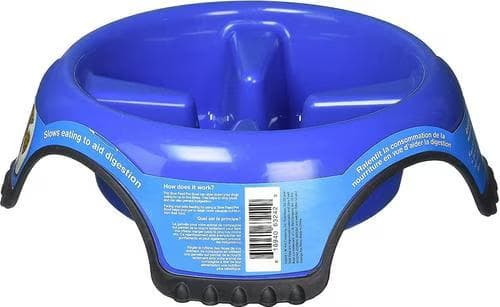
The JW Pet Skid Stop Slow Feeder Dog Bowl is a plastic slow-feeder bowl with a rubbery non-skid base.
Webvet may earn a commission when you click through to Chewy, at no extra cost to you.
Medium-size puppies have more choice of food. Merck says small- and medium-breed puppies can eat a growth or all-life-stage diet that does not meet the criteria for growth of large-size dogs.
Toy and small puppies need closer attention to meal timing, and VCA's toy and small breed handout and Merck set out these needs:
- At least 3 small meals a day before 4 months (VCA), and possibly more than three (Merck)
- Frequent meals of a commercial puppy food for toy breeds, which Merck says usually manages puppy hypoglycemia, or low blood sugar, in the first 6 months
- A body condition score of 4 out of 9 to prevent overweight (VCA)
Tufts says that since 2016, AAFCO has required growth foods to state whether they meet extra guidelines for large- and giant-breed puppies. VCA says to look for wording that the food meets AAFCO nutrient profiles for growth, including the growth of large size dogs (70 lb or more as an adult).
Much of the difference is calcium. AAFCO's 2015 Pet Food Committee report, which preceded the 2016 change, set lower calcium maximums for foods that may be fed to large-size puppies:
- Per 1,000 kcal: a maximum of 4.5 g of calcium for large-size puppy foods, versus 6.25 g for other life stages, including non-large-breed growth formulas
- On a dry-matter basis: a maximum of 1.8 percent calcium, versus 2.5 percent
Calories matter as much as minerals. A UC Davis-authored review says overnutrition in large-breed puppies leads to heavier body weight and also to faster bone growth with abnormal bone remodeling.
In a 1992 JAVMA study of 48 Labrador retrievers, one group was fed 25 percent less than a free-fed group until age 2, and fewer of the limit-fed dogs developed hip dysplasia:
- OFA method: 7 of 24 limit-fed dogs versus 16 of 24 free-fed dogs
- Swedish method: 5 of 24 limit-fed dogs versus 18 of 24 free-fed dogs
The authors worked at Ralston Purina and studied only Labradors. VCA's large-breed handout sets a related target: keep large and giant puppies at a body condition score of 4 out of 9 to prevent fast growth.
How to Measure Puppy Food
Measure puppy food by weight on a digital kitchen scale for the most consistent portions, or with a level measuring cup or scoop used the same way at every meal.
Weighing food on a kitchen scale keeps the daily amount from drifting. VCA's toy and small breed handout says to measure ideally with a digital kitchen scale, because cups are not precise even when the same person feeds each time, and its large and giant breed handout gives the same advice.

In a 2019 Veterinary Record study, 100 dog owners measured 1/4, 1/2, and 1 cup of dry food with a one-cup dry measuring cup, a two-cup liquid measuring cup, or a two-cup food scoop. Individual errors ran from about 48 percent under to 152 percent over the target. The authors disclosed ties to Royal Canin.
If you portion with a scoop such as the Frisco Dog & Cat Food Scoop, fill it level and weigh one scoopful before relying on it, since the two-cup food scoop in that study was one of the devices owners used with wide errors.
These steps keep portions consistent from meal to meal:
- Find the calorie statement on the bag, which WSAVA says must list kcal per kilogram and per household measure such as a cup.
- Work out the daily amount in grams, weigh it on a kitchen scale, and split it across the day's meals.
- If you use a cup or scoop, fill it level and use the same one every time.
- Weigh one level scoopful once, so you know how many grams your scoop really holds.
For example, a food listing 4,000 kcal per kg and 400 kcal per cup, illustrative figures rather than any product's, puts about 100 grams in a cup. A puppy that needs 740 kcal a day would then get about 185 grams of that food.
Is 2 cups of food enough for a puppy?
Two cups can be too much, about right, or too little, depending on the food's calories and your puppy's age and expected adult size. Tufts says dry dog foods range from about 300 to over 700 calories per cup, so 2 cups can supply roughly 600 to more than 1,400 calories.
On the Pro Plan feeding guide that 1800PetMeds reproduces, 2 cups a day is the top of the range for a puppy of 4 to 5 months expected to weigh 21 to 50 pounds.
It is also more than any daily amount the guide lists for dogs expected to weigh 3 to 12 pounds, and below the range for a puppy of 6 to 8 months headed for 76 to 100 pounds.
How to Tell If You Are Feeding Your Puppy Enough
You can tell you are feeding your puppy enough by two checks: a small weight gain each week and an ideal body condition, with ribs you can feel easily but not see.
Checking the amount with body condition score needs no equipment. On the WSAVA 9-point body condition chart, scores of 4 and 5 are ideal: ribs easy to feel without excess fat covering, a waist visible behind the ribs from above, and a belly tucked up when you look from the side.

VCA describes the ideal by touch. Your puppy's ribs should not be easily seen, but you should feel them easily, under a thin layer of fat, as you run your fingers across the rib cage without pressing.
Overfeeding a puppy shows up as the opposite of those ideal signs:
- You have to press to feel the ribs, or you cannot feel them at all
- The waist behind the ribs is hard to see from above
- The belly no longer tucks up when you look from the side
- Weekly weigh-ins show more than the small weekly gain Merck describes
- A large-breed puppy scores above the 4 out of 9 that VCA advises for keeping growth slow
The Merck Veterinary Manual advises weighing growing puppies weekly and adjusting the amount so your puppy gains a small amount each week. Write each weight down so you can see the trend rather than relying on how your puppy looks from day to day.
How do I know if I'm feeding my puppy enough?
Your puppy is getting enough if it gains a little weight every week, its ribs are easy to feel but not easy to see, and it keeps a visible waist. VCA's new-owner handout adds a bowl test: if a measured meal disappears within three to four minutes, the quantity is probably not enough.
If your puppy finishes fast but is also gaining more than a small amount each week, talk to your vet before adding food. The weekly weight and body condition score settle the question better than the empty bowl alone.
Do puppies stop eating when full?
Not reliably. Veterinary feeding advice relies on measured meals rather than appetite, and appetite differs between dogs: a 2016 Cell Metabolism study found a gene deletion in some Labrador retrievers linked to greater food motivation, higher body weight, and more body fat.
Offer each meal in a measured amount and take away what is not eaten within thirty minutes, as VCA's new-owner handout advises.
Treats and Training Rewards
Treats should make up no more than 10 percent of your puppy's daily calories, according to both VCA and the WSAVA Global Nutrition Committee.
Keeping treats to a small share of daily calories protects the diet. VCA says no more than 10 percent of a puppy's total daily calories should come from treats or snacks, keeping the diet complete and balanced. For the 740 to 790 kcal puppy above, that is about 74 to 79 kcal.
VCA's toy and small breed and large and giant breed handouts are stricter. They advise avoiding treats and other foods while puppies are growing and allow up to 10 percent only once dogs are adults, so ask your vet which limit fits your puppy.

These habits keep training rewards inside the limit:
- Use part of the day's measured kibble as rewards, which VCA's puppy treats page suggests for a puppy that loves its normal food.
- Choose low-calorie treats for most occasions, as VCA recommends; our guide to low calorie dog treats compares options.
- Check treat calories on the label or the maker's website, and call the company if they are not listed, as WSAVA suggests.
When to Switch From Puppy Food to Adult Food
Switch from puppy food to adult food when your puppy's skeleton has finished growing; VCA's guidance ranges from 6 to 9 months for toy breeds to 24 months for giant breeds.
When to switch to adult food depends on adult size, not one birthday. Merck says to keep feeding a complete and balanced growth diet until skeletal maturity, not only until obvious growth has stopped, and to move to a less nutrient-dense diet once a dog reaches about 90 percent of its expected adult weight.
VCA's handouts give these switch points by size:
- Toy breeds: 6 to 9 months
- Small breeds: 8 to 10 months
- Medium breeds: typically around 12 months, with adult food introduced slowly from about 10 months (VCA's general feeding page)
- Large breeds: around 18 months on a growth formula
- Giant breeds: 24 months on a puppy formula
Merck gives shorter ages for large and giant breeds, with skeletal maturity at 10 to 16 months, so ask your vet to set the switch date for a large puppy.
Change foods gradually. WSAVA says healthy pets should switch with a slow transition over at least 3 days, and the Pro Plan label text that 1800PetMeds reproduces advises allowing 7 to 10 days. See our guides to transitioning dog food for the switch itself and how much to feed a dog for adult portions.
When to Call Your Vet
Call your vet when your puppy leaves food behind, stops eating, or shows signs of illness alongside a change in appetite; how quickly depends on what you see.
A regular routine makes changes easy to spot. VCA says that if food is left, whether all or part of a meal, it is an important signal that something is wrong and time to schedule a veterinary appointment.
Tufts nutrition faculty list these reasons to talk to your vet about eating:
- Eating less or being picky about food is new behavior for your puppy
- You recently changed foods or opened a new bag, can, or batch of food
- Your puppy shows other signs of illness, such as lethargy, weakness, or slowing down on walks
Bring feeding questions to every checkup. The visits on our puppy vaccine schedule are a natural time to review the amount and body condition score with your vet, and our guide to puppy diarrhea covers loose stools.
Toy-breed puppies need prompt attention. VCA lists weakness, collapse, disorientation, tremors, and sometimes seizures as typical signs of low blood sugar, and names inadequate nutrition in toy-breed puppies among its causes. A puppy showing any of these signs needs a vet right away.
Cornell University's College of Veterinary Medicine lists these as the most common signs of bloat, or gastric dilatation-volvulus (GDV):
- Retching or trying to vomit without bringing anything up
- Excessive drooling or panting
- A bloated or painful belly
- Restlessness or pacing
- Pale gums
- Weakness or collapse
Do not wait to see whether these signs pass; contact a vet right away.
How Much to Feed a Puppy FAQs
Frequently Asked Questions
When can I stop feeding my puppy lunch?
On the Merck Veterinary Manual's schedule, you can stop the midday meal at around 6 months, when puppies move from three meals a day to two. VCA, which starts young puppies on four meals, says they generally cut back one meal by 3 to 4 months of age and perhaps another later.
VCA's sign that a meal can go is a puppy that seems less hungry at that meal for several days in a row. Its large-breed handout, though, recommends at least 4 small meals a day for large and giant puppies, so check with your vet before cutting one.
Should I let my puppy eat as much as it wants?
No. VCA does not recommend free-choice feeding, also called free-feeding, for puppies, because it can create juvenile obesity, encourage binge-eating, and lead to orthopedic problems and diabetes.
Large-breed puppies need the most care. WSAVA says free feeding should not be used for large-breed growing puppies, which need portion-controlled meals for a slow rate of weight gain and a body condition score of 4 out of 9, to avoid joint and skeletal problems linked to fast growth.
Long-term data point the same way. In a 2002 JAVMA study of 48 Labrador retrievers, dogs fed 25 percent less than paired control dogs from 8 weeks of age weighed less, carried less body fat, and had a significantly longer median life span. The authors worked at Nestle Purina.
What time of day should you feed a puppy?
Feed your puppy at the same times every day. Veterinary references do not set clock times for puppy meals, so build a schedule around your household and your puppy's number of meals, and ask your vet to help set an individual plan.
Pair every meal with a potty break. VCA says a regular feeding schedule helps with house training puppies, and that puppies generally need to relieve themselves within 10 to 15 minutes of eating a meal.
Is 1 cup of food too much for a puppy?
It can be, depending on the calories in the food and your puppy's age and expected adult size. One cup can be more than a very small puppy's label amount and well short of a large puppy's.
On the Pro Plan feeding guide that 1800PetMeds reproduces, 1 cup a day is above the 1/2 to 2/3 cup listed at 1 1/2 to 3 months for a puppy expected to weigh 3 to 12 pounds.
By 4 to 5 months, a puppy expected to weigh 76 to 100 pounds is listed at 2 to 3 cups a day, so 1 cup would fall well short. Check the calories per cup on your own bag before comparing.
Can I give my puppy homemade food?
VCA does not recommend homemade, home-cooked diets for puppies, because puppies have very specific nutritional needs and an unbalanced diet could harm their growth and development. If you want to cook, VCA says the diet must be designed with a veterinary nutritionist.
Tufts nutrition faculty list young, growing animals among the cases where a home-cooked diet should definitely be avoided: under 12 months for most dogs and under 18 months for giant breeds.
A Cornell nutrition faculty member says calcium is usually the most serious deficiency in home-prepared diets and can lead to fractures in puppies, so a complete and balanced growth food is the safer default.
Is 2 meals a day enough for a puppy?
Two meals a day suits many puppies from about 6 months of age, but not younger puppies. The Merck Veterinary Manual recommends two meals a day from 6 to 12 months and three meals a day before that.
Size changes the answer. VCA says toy and small puppies under 4 months need at least 3 small meals a day and large and giant puppies at least 4. For dogs in general, Cornell's bloat guidance advises two or more meals a day.

Editor
The Webvet Editorial Team is the in-house group of pet-care editors and writers behind Webvet, operated by Smart Pet Collective. The team researches, writes, and maintains Webvet's pet health, behavior, and medication content. Every article follows a defined editorial process: research from reputable veterinary and scientific sources, careful drafting, mandatory review of medical content by a credentialed veterinarian, and dated publication. Health and medication articles are medically reviewed by a licensed veterinary professional before they go live and are kept current over time.
Veterinarian · BVMS MRCVS
Dr. Pippa Elliott, BVMS, MRCVS, is a veterinarian with nearly 30 years of experience in companion animal practice. Dr. Elliott earned her Bachelor of Veterinary Medicine and Surgery from the University of Glasgow. She was also designated a Member of the Royal College of Veterinary Surgeons. Married with 2 grown-up kids, Dr. Elliott has a naughty Puggle named Poggle, 3 cats and a bearded dragon.


