Dog Feeding Schedule: Why Meal Timing and Consistency Matter for Canine Health
A consistent dog feeding schedule supports digestion, weight management, and behavior. See how often to feed by age, portion control basics, and routine tips.

This article contains affiliate links. Webvet may earn a commission when you buy through them, at no extra cost to you.
While many dog parents understand the importance of what they feed their dog, they often overlook the importance of when and how they feed. Dogs thrive on routine, including a consistent feeding schedule that determines when, where, and how often they eat each day.
Here, we'll cover the importance of regular feeding habits, the best feeding schedule for dogs, and how to maintain a consistent feeding schedule across different diets.
- 1A consistent dog feeding schedule supports digestion, stable metabolism, predictable bathroom habits, and reduced anxiety.
- 2Puppies need more frequent meals: 4 per day under 3 months, 3 per day from 3 to 6 months, then 2 per day from 6 months on.
- 3Most adult dogs do well with 2 meals per day at consistent times.
- 4Portion control matters as much as timing. Measure meals and count treats in the daily calorie target.
- 5Switch feeding schedules gradually over at least 7 days to avoid GI upset.
Why a Dog Feeding Schedule Matters
A consistent dog feeding schedule is important for your dog's physical and mental well-being. In anticipation of food, your dog's body releases stomach acids and digestive enzymes pre-emptively, which leads to more efficient digestion and absorption. Dogs fed regular meals at regular intervals predictably have fewer episodes of digestive distress. Regular feeding aids glycemic control and stable breakdown of nutrients for energy. Irregular feeding schedules can also disrupt your dog's circadian rhythm. Predictable elimination after meals is a useful tool for housebreaking puppies, and pairing set meal times with steady access to water makes it easier to track how much water your dog drinks each day. And unpredictability in feeding, enrichment, and exercise routines can contribute to canine anxiety, so regular feeding helps your pet know what to expect and when to expect it.
Vet-formulated fresh meals delivered to your door. Custom portions tailored to your dog. No fillers, no by-products.
- 50% off your first box
- Custom portion plans tailored to your dog
- Vet-formulated fresh meals made
Trusted by hundreds of thousands of dog parents
Webvet may earn a commission when you click through to Farmers Dog, at no extra cost to you.
How Often Should Dogs Eat?
A general baseline for how often to feed your dog: weaning to 3 months of age, 4 meals per day; 3 to 6 months, 3 meals per day; 6 months and older, 2 meals per day. Most adult dogs do well with 2 meals per day throughout adulthood. Some dogs may have health issues (diabetes, GI conditions) that require more frequent feeding. Follow your veterinarian's instructions when individual conditions apply.
Feeding Frequency by Age
| Age | Meals per Day | Why |
|---|---|---|
| Weaning to 3 months | 4 meals | Small stomach capacity, rapid growth, frequent calorie need |
| 3 to 6 months | 3 meals | Stomach capacity grows, calorie need stays high |
| 6 months to adult | 2 meals | Body matures to handle larger portions twice daily |
| Adult (1 year and older) | 2 meals | Standard maintenance pattern; supports metabolism and routine |
| Senior (7+ years) | 2 meals (sometimes 3 smaller) | May benefit from smaller meals if digestion has slowed |
Puppy Feeding Schedule by Age
Younger puppies need frequent small meals because their stomachs are small and they burn calories quickly. From weaning through about 3 months, plan on 4 meals per day spaced roughly every 4 to 5 hours during waking hours. From 3 to 6 months, drop to 3 meals per day. At 6 months, most puppies transition to the adult pattern of 2 meals per day. Adjust based on body condition, energy, and your veterinarian's guidance, especially for large or giant breeds whose feeding plans differ from small breeds.
Is Feeding Your Dog Once a Day Cruel? What Vets Actually Say
One-meal-a-day (OMAD) feeding for dogs is debated in veterinary nutrition. The 2022 Dog Aging Project found an association between once-daily feeding and lower rates of certain age-related conditions in companion dogs, but the study was observational, could not establish causation, and several confounding variables remain. Most veterinarians still recommend twice-daily feeding for adult dogs as the safer default. Twice-daily feeding supports stable digestion, lower bloat risk in deep-chested breeds, predictable behavior, and easier housetraining. The Dog Aging Project finding is a research association worth watching rather than a recommendation to change feeding patterns.
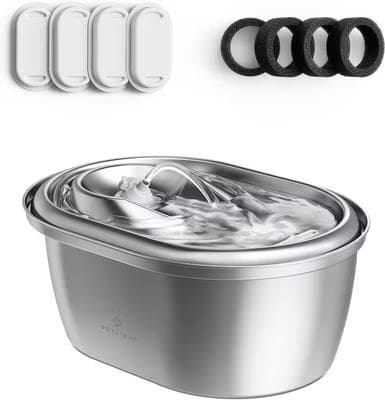
304 food-grade stainless steel pet water fountain, 101 oz. The circulating, filtered water encourages cats to drink more, which supports urinary tract and kidney health.
Webvet may earn a commission when you click through to Chewy, at no extra cost to you.
If you're considering once-daily feeding, do it under veterinary guidance. Once-daily feeding is generally NOT appropriate for puppies under 12 months, dogs prone to bloat (Great Danes, Standard Poodles, Weimaraners, large deep-chested breeds), diabetic dogs (need frequent meals to stabilize blood sugar), dogs with reflux or vomiting tendencies, or anxious dogs who do better with predictable meal timing. For most adult dogs, twice-daily feeding remains the safest default. Once-daily isn't cruel, but it isn't right for every dog.
The Role of Portion Control in Feeding Schedules
No matter what type of food you feed your dog, kibble, canned, fresh, or home-cooked, portion control is an important component of a healthy dog feeding schedule. Feeding the right amount helps prevent overeating that leads to vomiting or regurgitation, gradual weight gain and potential obesity, digestive upset including diarrhea or gassiness, and health conditions tied to obesity like diabetes and arthritis.
Pre-portioned meals can simplify your pet's feeding routine. For kibble or canned, measure with a cup or kitchen scale. The package gives a starting point, but your veterinarian can calculate a more accurate calorie target for your individual dog. Fresh dog food services like The Farmer's Dog provide pre-portioned meals tailored to your dog's age, weight, and activity. With these, you split the day's total into your chosen number of meals rather than measuring at every feeding.
Feeding Amount by Weight: How Much Food Per Pound
Feeding amounts vary significantly by food type (kibble vs canned vs fresh) and brand (calories per cup range from 300 to 500+). The table below uses general daily calorie targets, then translates them to typical kibble cup measurements based on a mid-range 380 calories per cup. Always check your specific food's calorie density on the bag and adjust. These are starting points; body condition score over weeks tells you whether to adjust up or down.
Compare coverage choices for your pet, then request a quote directly on Lemonade.
- Check a price for your pet
- Review available coverage choices
- See the terms before you decide
Eligibility, waiting periods, limits and exclusions apply.
Webvet may earn a commission when you click through to Lemonade, at no extra cost to you.
Daily Feeding Amount by Body Weight (Adult Dogs)
| Body Weight | Daily Calories (Sedentary to Active) | Approx Cups (380 cal/cup kibble) | Recommended Meals/Day |
|---|---|---|---|
| 5 lbs | 200 to 280 cal | 1/2 to 3/4 cup | 2 to 3 |
| 10 lbs | 330 to 460 cal | 3/4 to 1 1/4 cups | 2 |
| 20 lbs | 560 to 780 cal | 1 1/2 to 2 cups | 2 |
| 40 lbs | 920 to 1,290 cal | 2 1/2 to 3 1/2 cups | 2 |
| 60 lbs | 1,250 to 1,750 cal | 3 1/4 to 4 1/2 cups | 2 |
| 80 lbs | 1,560 to 2,180 cal | 4 to 5 3/4 cups | 2 (split if at risk for bloat) |
| 100 lbs | 1,860 to 2,600 cal | 5 to 7 cups | 2 to 3 (split for large breeds) |

Vet-formulated fresh meals delivered to your door. Custom portions tailored to your dog. No fillers, no by-products.
- 50% off your first box
- Custom portion plans tailored to your dog
- Vet-formulated fresh meals made
Trusted by hundreds of thousands of dog parents
Webvet may earn a commission when you click through to Farmers Dog, at no extra cost to you.
Why Consistency Supports Digestive Health
Feeding your dog at consistent times each day supports digestive stability. Your dog learns to predict mealtime, which influences their circadian rhythm. Regular feeding routines help regulate stomach acid and enzyme production, support regular nutrient absorption and metabolism, encourage predictable elimination schedules, and reduce digestive upset. That predictability is also one of the simplest ways to improve your dog's appetite at mealtime.
Sudden changes to your dog's feeding schedule may result in gastrointestinal upset, so it's always a good idea to make changes slowly. Plan transitions over 7 to 10 days when possible, shifting feeding times by 15 to 30 minutes per day rather than jumping to a new schedule overnight.
Best Time to Feed Dogs Daily
The single best time to feed your dog is the time you can be consistent. For most adult dogs on 2 meals per day, breakfast 7 to 8 AM and dinner 6 to 7 PM works well because it aligns with most owners' routines and gives the dog time to digest and eliminate before bed. Active or working dogs benefit from a small meal at least 1 hour before exercise. Large-breed dogs that are prone to bloat should not exercise hard within 1 hour of eating. Whatever times you choose, stick to them within a 30-minute window each day.
Fresh Food Diets and Feeding Routines
For some pet parents, a fresh food diet is appealing. These diets often contain minimally processed ingredients and are designed to support balanced nutrition. If you're considering one, make sure it carries an AAFCO nutritional adequacy statement appropriate to your dog's life stage, aligns with WSAVA Global Nutrition Committee selection guidelines (named manufacturer, board-certified veterinary nutritionist on staff, evidence-based formulation), and is appropriate for your individual dog.
You should not develop your own fresh-food diet without help from a veterinary nutritionist. Home-cooked diets prepared without nutritionist consultation are likely to be nutrient-deficient. A commercial fresh-food diet that includes pre-portioned meals based on your dog's age, weight, and activity (like The Farmer's Dog) makes it easier to maintain a consistent feeding schedule while meeting individual nutritional needs.
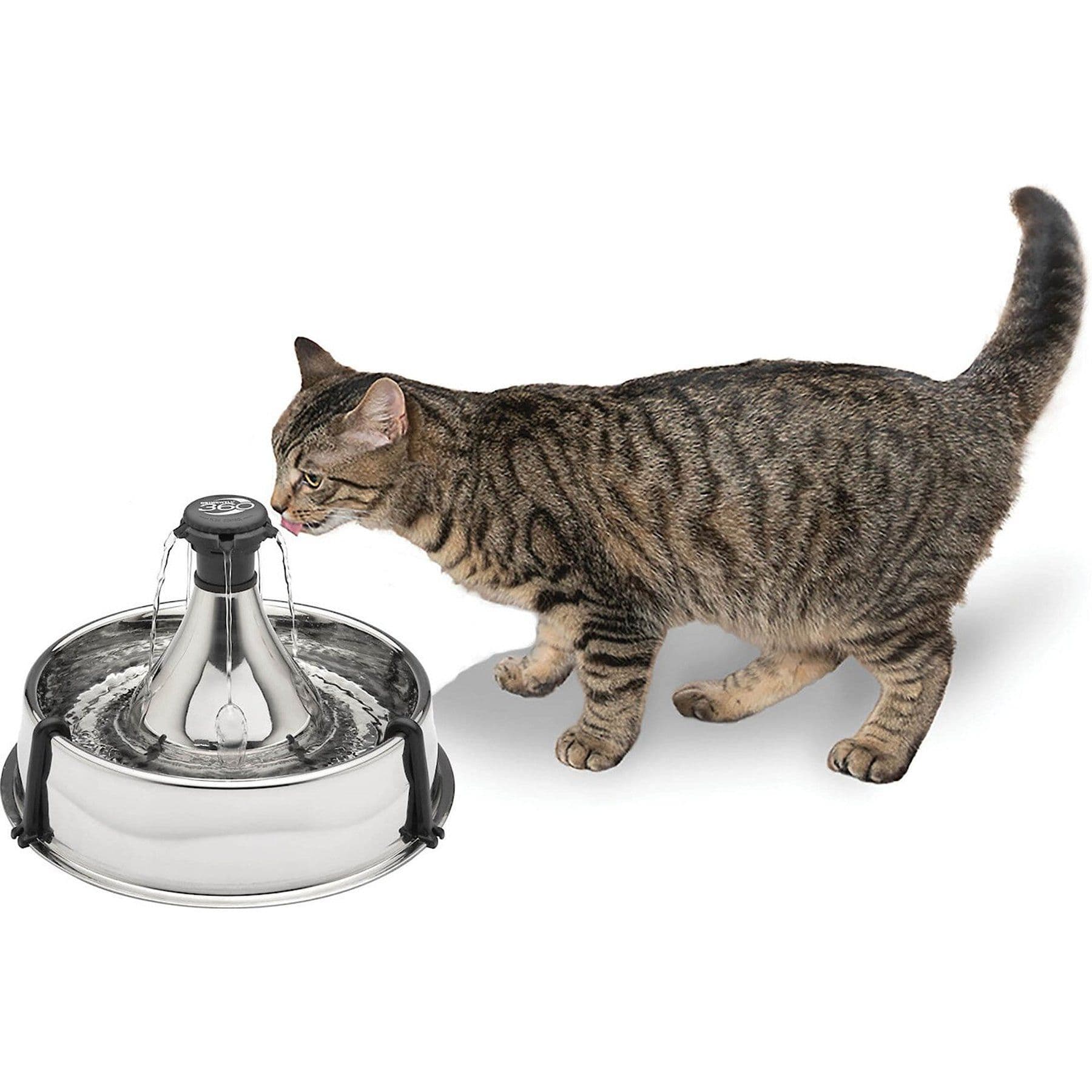
Webvet may earn a commission when you click through to Chewy, at no extra cost to you.
The 80/10/10 Rule for Dog Diets
The 80/10/10 rule comes from the raw feeding (PMR or BARF) community and refers to the proportional makeup of a prey-model raw diet: 80 percent muscle meat, 10 percent edible bone, and 10 percent organ meat (with that 10 percent organ split as 5 percent liver and 5 percent other secreting organ like kidney or spleen). The rule mimics the rough composition of whole prey animals and aims to balance protein, calcium-to-phosphorus ratio, and micronutrients without supplementation.
The 80/10/10 framework is contested in veterinary nutrition. Proponents argue it produces a biologically appropriate diet with strong palatability and digestibility. Critics point out that prey-model raw diets often fail to meet AAFCO requirements for trace minerals, vitamin D, iodine, and certain B vitamins, and that bacterial contamination risk (Salmonella, E. coli, Listeria) creates household hazards. If you're considering raw feeding using the 80/10/10 framework, work with a board-certified veterinary nutritionist to verify completeness and discuss safe handling practices.

Tips for Creating a Consistent Dog Feeding Schedule
Feed your dog at the same times and in the same place each day. Plan bathroom breaks for shortly after each feeding. Measure or portion food carefully based on calorie requirements. Make changes to the feeding schedule slowly over at least 7 days. Include a daily treat allotment in the total calorie count (treats should stay under 10 percent of daily intake). Ask your veterinarian about your dog's calorie requirement, individual dietary needs, and ideal feeding schedule. Consistency in timing is one of the most important factors in maintaining a healthy feeding routine.
Vet-formulated fresh meals delivered to your door. Custom portions tailored to your dog. No fillers, no by-products.
- 50% off your first box
- Custom portion plans tailored to your dog
- Vet-formulated fresh meals made
Trusted by hundreds of thousands of dog parents
Webvet may earn a commission when you click through to Farmers Dog, at no extra cost to you.
Frequently Asked Questions
What is the best dog feeding schedule?
The best dog feeding schedule is age-appropriate and consistent. Puppies usually do best with 3 to 4 meals per day, while adults generally need only 2. Your veterinarian is the best source for individual recommendations.
How often should puppies eat?
A weaned puppy generally needs 4 meals per day under 3 months, dropping to 3 meals per day from 3 to 6 months. From 6 months on, twice-daily feeding is usually sufficient.
Is it bad to change my dog's feeding schedule frequently?
Yes. Frequent schedule changes can cause gastrointestinal upset and anxiety. Make changes slowly over the course of a week or more.
Can portion-controlled meals help maintain a feeding schedule?
Yes. Portion-controlled meals tell you exactly how much to feed and how often. Pair them with consistent meal times for the strongest routine.
Do fresh dog food diets affect feeding routines?
Slightly. Pay attention to refrigeration instructions and how long the food is good after opening. Consider thawing times, whether the food needs to be warmed, and time-out-of-fridge guidelines. Some fresh diets, like The Farmer's Dog, are ready-to-serve.
Should I ever skip a meal as part of a feeding schedule?
Most adult dogs handle a single skipped meal without issue, but intentional fasting is rarely needed and can cause GI upset, anxiety, or behavioral changes in food-motivated dogs. Don't use meal-skipping for weight management; reduce portions instead.
Can I feed my dog once a day?
Twice-daily feeding is the standard recommendation for most adult dogs because it supports stable blood sugar, digestion, and behavior. Once-daily feeding is sometimes appropriate for certain dogs under veterinary guidance, but it isn't a default.
How much should I feed my dog per pound of body weight?
A general starting point is 1 cup of typical kibble per 20 lbs of body weight per day, split across 2 meals. A 40-lb adult dog might eat 2 to 3 cups daily, a 60-lb dog 3 to 4 cups, and a 100-lb dog 5 to 7 cups. Adjust based on your specific food's calorie density (300 to 500+ cal/cup varies widely) and your dog's body condition over weeks.
What is the 80/10/10 rule for dog food?
The 80/10/10 rule comes from raw feeding and refers to a prey-model diet: 80 percent muscle meat, 10 percent edible bone, 10 percent organ (split as 5 percent liver, 5 percent other organ). It aims to mimic whole-prey nutrition. Critics note this framework alone often falls short on trace minerals; veterinary nutritionist input is recommended for long-term raw feeding.
Final Thoughts on Dog Feeding Schedules
Providing a consistent dog feeding schedule supports digestive health, reduces anxiety, and supports your dog's overall well-being. When designing the routine, consider both how often you feed and the portion size.
For pet parents interested in fresh, pre-portioned meal options like The Farmer's Dog, the structure can make maintaining a consistent and balanced feeding routine easier across busy weeks.

Veterinarian · DVM
Athena Gaffud, DVM, is a licensed veterinarian and writer based in the Cagayan Valley of the northern Philippines. She runs the website countryvetmom.com. Dr. Gaffud earned her Doctor of Veterinary Medicine degree from the University of the Philippines Los Baños in 2011, ranking in the top 10 and receiving the Best Undergraduate Thesis Award in Large Animals. With over a decade of experience, she has worked as a researcher, a practitioner for small and large animals, and in veterinary technical sales, marketing, and pet insurance. A published author, Dr. Gaffud promotes responsible pet ownership and combats misinformation on animal care through her platforms, including the DocAthena Facebook Page and DocAthena YouTube channel. She is a writer and editor for various pet-related websites such as Total Vet, Honest Paws, PangoVet, Dogster, Catster, My Best PH, Paw Origins, Bully Max, Not a Bully, Paws and Claws CBD, many others. She was also cited in different pet-related media articles such as The Dog People, USA Today, Newsweek, New York Post, Reader’s Digest, Smithsonian Magazine, Woman’s World, Dog Time, Patch, Kinship, Martha Stewart, and many others. Moreover, she is also a published fiction author on Kindle.
Related reading

Low Calorie Dog Treats: Calories and Portion Guide

Minimally Processed Dog Food: What It Means and Why It Matters

Best Soft Dog Food for Senior Dogs: Gentle, Nutrient-Dense Options
