How Much to Feed a Cat: Dry and Wet Food Chart
How much to feed a cat comes down to the calories it needs for its ideal weight, then the wet or dry amount that delivers them. Here is a feeding chart by weight, how to split wet and dry food, how often to feed, and how to check the amount.

BVMS MRCVS

This article contains affiliate links. Webvet may earn a commission when you buy through them, at no extra cost to you.
How much to feed a cat comes down to calories: a healthy adult of about 10 pounds needs roughly 240 to 270 kilocalories a day to hold its ideal weight, according to the WSAVA Global Nutrition Committee.
At FDA reference densities, that is under 1 cup of dry food or roughly 1.5 small cans of wet food a day.
- 1The starting point for how much to feed a cat is the feeding guide on the food label, adjusted to the cat's ideal weight and body condition.
- 2A feeding chart by body weight from WSAVA lists about 240 to 270 kilocalories a day for a healthy 9.9-pound adult cat.
- 3Cornell considers feeding once or twice a day appropriate for most adult cats.
- 4A cat that refuses to eat for more than a day should go to the vet right away, Merck advises.
How Much Should I Feed My Cat?
How much to feed a cat each day comes down to the calories it needs for its ideal weight, starting from the food label and adjusting by body condition; the chart below converts those calories into cans or cups.
The starting point is the feeding guide on the food label, adjusted to the cat. The Merck Veterinary Manual calls label guidelines general recommendations at best and says body weight and condition must be monitored to prevent overfeeding or underfeeding.
To turn calories into food, find the Calorie Content statement. AAFCO, the non-profit that sets pet food standards in the United States, requires it in kilocalories per kilogram and per familiar unit, such as per can or per cup.
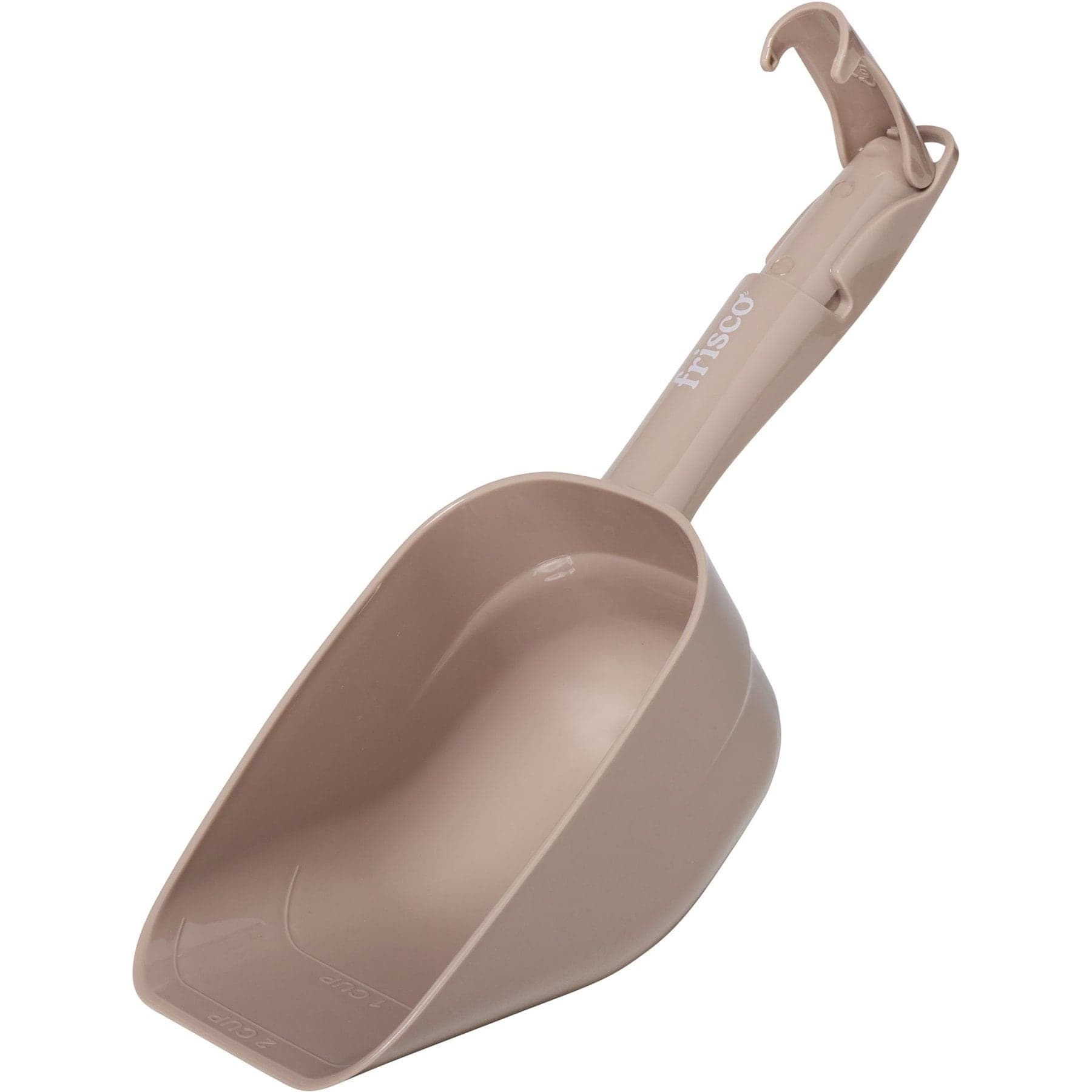
The Frisco Dog & Cat Food Scoop is a pet food scoop for portioning meals from the bag.
Webvet may earn a commission when you click through to Chewy, at no extra cost to you.
Cat Feeding Chart by Weight
A cat feeding chart by weight gives daily calories plus the wet and dry amounts that equal them at stated calorie densities. This one uses WSAVA's calorie ranges, wet food at 175 kcal per 175-gram can, and dry food at 360 kcal per cup, both drawn from FDA examples.
| Cat's ideal body weight | Daily calories (WSAVA chart) | Wet food at 175 kcal per 175 g can | Dry food at 360 kcal per cup |
|---|---|---|---|
| 4.4 lb (2.0 kg) | 160–170 kcal | 0.9–1.0 can | 0.44–0.47 cup |
| 5.5 lb (2.5 kg) | 180–190 kcal | 1.0–1.1 cans | 0.50–0.53 cup |
| 6.6 lb (3.0 kg) | 200–210 kcal | 1.1–1.2 cans | 0.56–0.58 cup |
| 7.7 lb (3.5 kg) | 215–230 kcal | 1.2–1.3 cans | 0.60–0.64 cup |
| 8.8 lb (4.0 kg) | 225–250 kcal | 1.3–1.4 cans | 0.63–0.69 cup |
| 9.9 lb (4.5 kg) | 240–270 kcal | 1.4–1.5 cans | 0.67–0.75 cup |
| 11.0 lb (5.0 kg) | 250–290 kcal | 1.4–1.7 cans | 0.69–0.81 cup |
| 12.1 lb (5.5 kg) | 260–310 kcal | 1.5–1.8 cans | 0.72–0.86 cup |
| 13.2 lb (6.0 kg) | 265–330 kcal | 1.5–1.9 cans | 0.74–0.92 cup |
| 14.3 lb (6.5 kg) | 275–350 kcal | 1.6–2.0 cans | 0.76–0.97 cup |
| 15.4 lb (7.0 kg) | 280–370 kcal | 1.6–2.1 cans | 0.78–1.03 cups |
The calorie ranges come from the WSAVA Global Nutrition Committee chart for healthy adult cats in ideal body condition, built from 2006 National Research Council (NRC) formulas for lean and obese-prone adults. WSAVA calls the chart guidance only: some cats need more or less to stay trim.
Keep these limits in mind when you read the chart:
- The wet and dry columns are estimates that vary by product, so use the calorie number printed on your cat's own food. At 425 kcal per cup, the top of the FDA's dry-food range, each cup amount drops by about 15 percent.
- Use ideal weight, not current weight. Tufts notes that ideal weight depends on frame size, so body condition confirms the right row.
- The chart ends at 15.4 pounds. For a heavier cat, ask your vet to confirm its ideal weight and set a target.
How Many Calories Does a Cat Need?
Daily calorie needs for an average adult pet cat of 10 pounds come to about 276 kilocalories, the FDA Center for Veterinary Medicine says, citing the 2006 NRC lean-adult equation, the same formula behind the top of WSAVA's range for cats this size.
Brand label amounts do not always match these estimates. The Iams Proactive Health Indoor Weight & Hairball Care dry food label lists 302 kcal per cup and suggests 2/3 cup a day for an 8-pound cat at maintenance, about 201 kcal, a little below WSAVA's range for that size.

Iams Proactive Health Indoor Weight & Hairball Care is a dry adult cat food in a chicken and turkey recipe.
Webvet may earn a commission when you click through to Chewy, at no extra cost to you.
Merck builds its estimate on the resting energy requirement (RER), the energy a healthy, fed animal uses at rest in a comfortable temperature. Merck calls any calculation a starting point; you can work out your cat's number in three steps:
- Divide your cat's ideal weight in pounds by 2.2 to get kilograms.
- Calculate RER as 70 × (body weight in kg)^0.75.
- Multiply RER by the factor for your cat's status, which Merck sets at 1.2 for a typical neutered adult.
How many calories should a 14-pound cat eat?
A 14-pound cat at its ideal weight needs roughly 275 to 350 kilocalories a day, based on the WSAVA row for 14.3 pounds. As a worked example, not a feeding rule, Merck's formula gives an RER of about 280 kcal (70 × 6.36^0.75) and about 337 kcal a day for a neutered adult.
If 14 pounds is above your cat's ideal weight, ask your vet for a target based on its ideal weight.
How Much Wet Food to Feed a Cat
The amount of wet food to feed a cat, in cans or ounces, equals its daily calories divided by the calories per can on the label.

Wet foods typically carry about 1 kcal per gram, the FDA says, so a 10-pound cat needing about 276 kcal eats roughly 276 grams of wet food a day, or about 9.7 ounces.
One small can is usually not a full day. In the FDA's worked example, a 10-pound cat eating one 175-gram can (about 6 ounces) of a 1 kcal per gram food gets just under two thirds of its daily calories, about 63 percent.
To work out cans or ounces for your cat's food, follow these steps:
- Find the kcal per can or per pouch on the Calorie Content line.
- Divide your cat's daily calories by that number to get cans per day.
- For ounces, divide your cat's daily calories by about 28, since a food at about 1 kcal per gram carries roughly 28 kcal per ounce.
- Split the daily amount across your cat's meals, usually two.
Wet portions look large because canned food is mostly water. Merck puts canned foods at 68 to 78 percent water and Cornell says at least 75 percent. VCA Animal Hospitals explains that the moisture lowers calories per gram, so a cat eats a bigger portion for the same calories as kibble.
Wet-only and dry-only plans can both work. Tufts nutritionists say that outside cats with kidney or urinary tract disease, there is no good evidence that the type of diet makes a difference in overall health. The amount is what has to be right.
Cornell describes cats as obligate carnivores that rely on nutrients found only in animal products. Ask your vet before adding any human food, and count every extra toward the daily calories. If your cat needs to gain weight, ask your vet for a calorie target.
How Much Dry Food to Feed a Cat
The amount of dry food to feed a cat, in cups or grams, equals its daily calories divided by the calories per cup. The FDA says dry cat foods that are not calorie-restricted generally contain 360 to 425 kcal per cup, so a 10-pound cat eats roughly 2/3 to 3/4 cup of kibble a day.

Grams are more exact than cups. In the FDA's example, a 360-kcal cup that weighs 100 grams means about 77 grams a day for a 10-pound cat, close to the 50 to 75 grams of dry food the FDA says cats typically need. Cup weights vary by kibble, so 100 grams is only an example.
Tufts Cummings School of Veterinary Medicine nutritionists recommend being very precise when measuring food, and note that many owners use a gram scale at home because measuring cups can be tricky to get exact.
Calorie density changes the answer. A weight-control dry food can sit below the FDA's range: Iams Proactive Health Indoor Weight & Hairball Care Chicken & Turkey Recipe Dry Cat Food lists 302 kcal per cup, so a cup of one kibble can carry roughly 60 to 120 fewer kcal than a cup of another.
Is 1 cup of cat food too much?
For an average 10-pound adult cat, yes. The FDA says a 10-pound adult eating 1 cup of dry cat food a day is consuming at least 1.25 times its daily requirement.
A larger cat or a lower-calorie food changes the math: the Iams weight-care label, at 302 kcal per cup, lists 1 cup a day for a 16-pound cat at maintenance.
Whatever the measured amount, you can serve it from a puzzle feeder, which makes your cat work for each piece instead of eating from a bowl. See cat puzzle feeders for how they work.
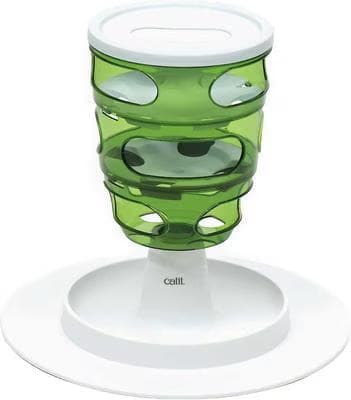
The Catit Senses 2.0 Food Tree is a puzzle feeder where food drops through side openings into a base bowl.
Webvet may earn a commission when you click through to Chewy, at no extra cost to you.
Feeding Wet and Dry Food Together
Splitting calories when feeding wet with dry food means dividing one daily calorie total between the two, not serving a full portion of each. Veterinary references do not set a standard wet-to-dry ratio, and VCA advises working with your veterinary team to set the portion of each type of food.
Here is how the split works for a cat whose daily target is 250 kcal:
- Set aside treats first. WSAVA's treat guide says treats should make up no more than 10 percent of daily calories, which is 25 kcal here, leaving 225 kcal.
- Choose the wet portion. One 175-gram can at about 1 kcal per gram supplies about 175 kcal, leaving 50 kcal.
- Cover the rest with dry food. At 360 kcal per cup, 50 kcal is a little over 1/8 cup, or about 14 grams at 100 grams per cup.
Cornell's rule of thumb on treats is a little looser, at 10 to 15 percent of daily calories. Either way, treats come out of the same daily budget as the wet and dry food.
Use your own foods' label figures in place of these typical ones, and recheck the split whenever you change foods or can sizes. If the mix gets complicated, your vet team can set the portion of each.
How Often Should You Feed a Cat?
Feeding once or twice a day is appropriate for most adult cats, according to the Cornell Feline Health Center. Merck adds that cats generally prefer small, frequent meals and that most cats can be fed twice a day and kept at a good weight.
Cornell sets the number of meals by age:
- Kittens under six months usually do best on three meals a day.
- From six months to one year, twice-daily feeding is generally best.
- For adult cats from about one year, once or twice a day is appropriate in most cases.
- Senior cats, 10 years and older, keep the same regimen unless your vet advises otherwise.
VCA recommends at least two meals a day because after 8 to 10 hours, an empty stomach starts sending hunger signals to the brain. Veterinary guidance does not name exact clock times, so choose meal times you can keep every day.
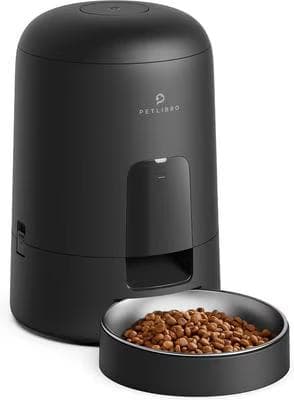
The Petlibro Air Automatic Cat Feeder is an automatic feeder that dispenses dry food at scheduled meal times.
Webvet may earn a commission when you click through to Chewy, at no extra cost to you.
More meals do not have to mean more food. In a 2022 study in the Journal of Feline Medicine and Surgery, feeding obese cats on a weight-loss plan six meals a day from an automatic feeder, instead of two, did not require more calories or speed weight loss.
The portioned feeder meals did make the weight-loss plan easier and reduced food-seeking behavior. If a feeder would help your schedule, read whether automatic feeders are good for cats and compare the best automatic cat feeders.

Can cats survive off one meal a day?
Yes, many healthy adult cats can. Cornell lists once or twice a day as appropriate for most adults, and VCA says some cats that are less food motivated do fine on one meal a day.
VCA still considers at least two meals ideal, and says three to four meals can help cats that beg between meals or eat only a little at a time. Kittens need more frequent meals, as the Cornell schedule above shows.
Adjusting for Age, Activity, and Spay or Neuter
Adjusting for age, activity, and spay or neuter status matters because each one shifts how many calories a cat needs. Merck's maintenance factors show the size of each shift:
- Intact adult: 1.4 times RER.
- Neutered adult: 1.2 times RER.
- Obesity-prone adult: 1.0 times RER.
- Growing kitten: 2.5 times RER.
Calories should drop at spay or neuter surgery. Tufts nutritionists advise cutting calories by 20 to 30 percent at that time. In a study of 22 spayed cats in the British Journal of Nutrition, energy needs after spaying were 25 percent below the NRC recommendation and lower than before surgery.
Kittens stay on a growth diet even after neutering. VCA says most cats are neutered by 5 to 6 months and should eat kitten food until 10 to 12 months, with daily calories carefully controlled. Merck notes kittens can also be fed free choice. For kittens still moving off milk, see weaning kittens.
Senior cats can go either way:
- Merck says middle-aged cats are at increased risk of obesity, while older cats often have a difficult time keeping weight on.
- Tufts notes that many cats in their teens lose weight, so the higher calories in senior diets for cats 11 and older would likely benefit them.
Activity counts as well. VCA says indoor cats face a greater risk of becoming overweight because they often lead more sedentary lives, and spayed or neutered cats carry a greater risk than intact cats. For ways to get an indoor cat moving, see these cat exercises.
Pregnant and nursing cats fall outside these adult formulas. Merck's factors cover healthy adults and kittens and the WSAVA chart covers healthy adults; neither covers a pregnant or nursing mother cat, so ask your vet how much she needs.
How to Tell If Your Cat Is Eating the Right Amount
Checking the amount with body condition score is the final step: a cat that holds an ideal body condition score and a steady weight is eating the right amount.
On the WSAVA 9-point body condition score chart, an ideal score of 5 looks like this:
- The body is well proportioned.
- You can feel the ribs under a slight covering of fat.
- A waist is visible behind the ribs, but it is not pronounced.
WSAVA adds that a score of 6 out of 9 may be acceptable in some cats, especially older cats. Tufts offers a home check: the ribs should feel no more padded than the back of your hand. Tufts defines overweight as 10 percent above ideal weight and obese as more than 20 percent above.

Track your cat's weight. After your vet sets a calorie target, VCA advises weighing your cat every 3 to 4 weeks and having the vet assess weight and body condition several times a year. Merck says a cat may need as much as 30 percent more or fewer calories than another of the same weight.
The UC Davis Nutrition Support Service goes further, saying an equation can miss a pet's real energy needs by as much as 50 percent. In a study of 2,609 cats at one Sydney practice, body condition scores below 5 and a score of 9 were linked to shorter survival and lifespan.
For an overweight cat, get the weight-loss target from your vet. The Pet Nutrition Alliance calculator advises a vet-guided plan at a body condition score of 7 out of 9 or higher, and Merck says food deprivation sets the stage for fatty liver disease in overconditioned cats; see how to help a cat lose weight.
How can I tell if my cat is hungry?
Appetite alone is a poor guide to how much your cat needs. Tufts notes that house cats with free access to food often eat more calories than they burn. Feed measured meals on a schedule and judge the amount by body condition and weight trend.
VCA adds that cats that beg between meals may do better on three to four smaller meals.
Will a cat stop eating when full?
Some cats do and some do not. Cornell notes that some cats eat too much when food is always available, while VCA says an overweight cat that seems picky may simply be overfed and full, so leftover food can mean the portion is too big.
A cat that refuses food for more than a day is different: Merck says to take it to the vet right away.
When to Talk to Your Vet
Talk to your vet whenever your cat stops eating, loses weight while eating more, or needs to lose or gain weight, because those are health questions rather than portion questions.
Call your vet about these feeding changes, too:
- Your cat eats more but loses weight. Cornell lists weight loss, increased appetite, and increased thirst and urination as the most common signs of hyperthyroidism in cats.
- Your cat is overweight and you want to cut its food. Tufts warns that cats can develop hepatic lipidosis, a serious liver disease also called fatty liver, if they stop eating for more than a few days, and it is most common in overweight cats.
- Your cat is thin or keeps losing weight, especially if it is a senior.
- Your cat eats less than usual or skips meals; read more about a cat not eating.
How Much to Feed a Cat FAQs
Frequently Asked Questions
Should I leave food out all day for my cat?
For most cats, no. Cornell says free-feeding dry food may be acceptable for some cats, but for others it results in overeating and inappropriate weight gain. A Cornell clinician names free feeding as a major factor in feline obesity, and Merck advises against leaving food out all the time because it can lead to overeating.
Is 2 cans of wet food a day enough for a cat?
It depends on the calories per can. At the FDA's typical 1 kcal per gram, two 175-gram cans supply about 350 kcal, more than the roughly 276 kcal an average 10-pound adult needs and within the WSAVA range for a 15.4-pound cat.
Can sizes vary, so divide your cat's daily calories by the calories per can listed under Calorie Content on the label.
How much should a 10-month-old cat eat?
Most guidance still feeds a 10-month-old cat as a kitten. Merck says kittens should keep eating kitten food until adulthood at about 9 to 12 months, and Tufts advises not switching to adult food until at least one year.
Feed kitten food split into two meals at this age, as Cornell suggests. If your cat has already been spayed or neutered, Tufts advises cutting calories by 20 to 30 percent at that time, so check body condition often as it grows.
Is it bad to give cats wet food every day?
No. Feeding wet food daily is fine as long as the total calories match your cat's needs. Merck notes that canned food can help a cat get enough water, which is one reason many veterinarians recommend wet food over dry food.
Is there a calculator for how much to feed my cat?
Yes. WebVet's feeding calculator estimates a dog or cat's daily calories and portion size from weight, life stage, and activity level, and Tufts recommends the Pet Nutrition Alliance Calorie Calculator. If you also have a dog, see how much to feed a dog.
Any calculator gives a starting point only. Tufts says the calories your cat actually eats, plus its weight and body condition score, are a better indicator of what it needs.

Editor
The Webvet Editorial Team is the in-house group of pet-care editors and writers behind Webvet, operated by Smart Pet Collective. The team researches, writes, and maintains Webvet's pet health, behavior, and medication content. Every article follows a defined editorial process: research from reputable veterinary and scientific sources, careful drafting, mandatory review of medical content by a credentialed veterinarian, and dated publication. Health and medication articles are medically reviewed by a licensed veterinary professional before they go live and are kept current over time.
Veterinarian · BVMS MRCVS
Dr. Pippa Elliott, BVMS, MRCVS, is a veterinarian with nearly 30 years of experience in companion animal practice. Dr. Elliott earned her Bachelor of Veterinary Medicine and Surgery from the University of Glasgow. She was also designated a Member of the Royal College of Veterinary Surgeons. Married with 2 grown-up kids, Dr. Elliott has a naughty Puggle named Poggle, 3 cats and a bearded dragon.


