Cat Not Eating? Causes, Warning Signs, and Exactly When to Worry
A cat not eating for 24 to 72 hours is a genuine emergency because of fatty liver disease. Here is how long is too long, the red flags to watch, why cats stop eating, and when to call the vet.

BVMS MRCVS
Medically reviewed by Dr. Pippa Elliott, BVMS MRCVS · Last reviewed

This article contains affiliate links. Webvet may earn a commission when you buy through them, at no extra cost to you.
A cat not eating is one of the most urgent warning signs in feline health, and it is easy to underestimate. Unlike dogs, cats cannot safely skip meals for long. A cat that has stopped eating entirely for 24 to 72 hours is a medical emergency, not a wait-and-see situation, because a life-threatening condition called feline hepatic lipidosis (fatty liver disease) can develop rapidly once a cat stops eating. This guide covers how long is too long, the red-flag symptoms that mean go now, the most common reasons a cat refuses food, how to safely encourage eating at home while you get veterinary help, and exactly what to expect at the vet.

How long can a cat safely go without eating? (the hepatic lipidosis emergency clock)

A healthy adult cat should not go more than about 24 hours without eating before you take action, and total food refusal beyond 48 to 72 hours is an emergency. The danger is not simple hunger. It is a metabolic trap unique to cats.
Cats are obligate carnivores whose bodies are built for a steady, protein-rich intake, and a period of poor appetite is exactly what sets off the danger. When a cat stops eating, its body starts mobilizing fat for energy, and in cats that fat can flood and overwhelm the liver. The result is feline hepatic lipidosis (fatty liver disease), which the Merck Veterinary Manual describes as the most common cause of liver disease in cats: an excessive accumulation of fat (triglycerides) inside the liver that leads to liver failure, associated with a period of poor appetite lasting anywhere from a few days to several weeks, especially in obese cats. Because appetite stimulants are often ineffective once it takes hold, placement of a feeding tube for nutritional support is frequently necessary to reverse it (Merck Veterinary Manual, liver disorders in cats).
This is why "my cat is not eating for 3 days" is never a normal situation. Overweight cats are at the highest risk because they have more fat to mobilize, but any cat can develop fatty liver. It is worth understanding the mechanism, because it explains why the usual "wait and see" advice that works for other symptoms is dangerous here. A dog can fast for a day or two and come to little harm. A cat's liver is not built to process a sudden, large fat load, so the very act of surviving on body reserves becomes the illness. Once fatty liver takes hold, the cat feels nauseous and refuses food even more, which deepens the cycle. Breaking that loop early, before the liver is overwhelmed, is far easier than reversing it once it is established.
The 24 to 72 hour timeline: what to do and when
| Time since last full meal | Risk level | What to do |
|---|---|---|
| 0 to 12 hours | Low, but watch | Monitor closely. Offer a favorite food. One skipped meal after a stressful day can be normal. |
| 12 to 24 hours | Rising | Try warmed, strong-smelling wet food. Note any other symptoms. Call the vet if a kitten, senior, or already-ill cat. |
| 24 to 48 hours | Serious | Call your veterinarian for same-day advice. Do not keep waiting to "see if it passes." |
| 48 to 72+ hours | Emergency | Seek veterinary care now. Fatty liver risk climbs sharply. Kittens and seniors may already be in danger. |
When should you worry about your cat not eating? Worry, and act, the moment food refusal passes 24 hours in an otherwise healthy adult, and immediately if a kitten, a senior cat, or a cat with a known illness (like kidney disease or diabetes) skips meals, or if not eating comes bundled with any red-flag symptom below. Kittens and senior cats deteriorate far faster and should not go even a full day without eating.
One more nuance that trips owners up: eating a little is not the same as eating enough. A cat that nibbles a few bites but takes in far less than usual can still slide toward fatty liver, because its calorie intake is well below what its body burns. Partial appetite loss that drags on for several days deserves the same seriousness as total refusal. If your cat is not eating much but has not stopped entirely, weigh it if you can, watch for weight loss, and use the same 24-to-48-hour window to call the vet rather than assuming the small amount is enough.

A soupy, lickable bisque treat that tempts a cat who has gone off solid food. The high-moisture, aromatic texture is easy to lap up and hard for a picky or recovering cat to resist, and it sneaks in extra hydration.
Webvet may earn a commission when you click through to Chewy, at no extra cost to you.
When a cat not eating is an emergency: red-flag symptoms

Not eating is worrying on its own. Combined with any of the signs below, it becomes a same-day emergency. Call a veterinarian immediately if your cat is not eating and also shows:
- Lethargy or extreme weakness, sleeping far more than usual, or not responding normally
- Hiding in unusual spots, which is how cats mask serious pain or illness
- Vomiting or retching, especially repeatedly (see the vomiting note below)
- Jaundice: yellow tint to the gums, the whites of the eyes, or the skin inside the ears, a classic sign of liver trouble
- Pale or bluish gums, or gums that are tacky and dry from dehydration
- Labored or open-mouth breathing
- Straining in the litter box with little or no urine, which is a life-threatening emergency in male cats
- Collapse, staggering, or unresponsiveness
- A distended or painful belly, or crying when picked up or touched around the abdomen
- Drooling, pawing at the mouth, or bad breath, which point to oral pain or nausea
A cat that is not eating and lethargic is a particularly ominous pairing. Lethargy plus inappetence suggests the cat is genuinely sick rather than merely picky, and it moves the timeline forward. The same is true of a cat that is not eating and sleeping a lot or seems to sleep all day: healthy cats sleep a great deal, but a sudden jump in sleep combined with a closed mouth at mealtime is a body conserving energy because something is wrong. For the full workup on that specific combination, see our dedicated guide on a cat not eating and lethargic.
How to check your cat's gums at home
Gum color is one of the fastest at-home checks, and it feeds directly into the red-flag list. Gently lift your cat's lip and look at the gums above the teeth. Healthy gums are bubble-gum pink and moist. Press a fingertip against the gum until it blanches white, then release: color should return in under two seconds. Warning colors are yellow (possible jaundice and liver involvement), white or very pale (anemia or shock), blue or gray (an oxygen emergency), and bright brick red (possible sepsis or toxin). Any of these, paired with a cat that will not eat, is a reason to head to the clinic without delay.
The "silent killer" and end-of-life signs
The "silent killer" of cats most often refers to chronic kidney disease, which is common in cats and quietly progresses for months or years while showing few obvious signs until it is advanced. Reduced appetite, weight loss, increased thirst, and lethargy are recognized clinical signs that should prompt a veterinary workup (Merck Veterinary Manual, renal dysfunction in cats). Other "silent" threats include hyperthyroidism, heart disease, and cancer, all of which can present first as a cat that simply stops eating well. The common thread is that cats are experts at masking illness, an evolutionary holdover from life as both predator and prey, so by the time appetite visibly drops, the underlying disease may have been building for a while. That is the real argument for acting early rather than waiting for more dramatic signs.
Signs that a cat may be near the end of life include profound and lasting loss of appetite, marked weakness, hiding away, a drop in body temperature, labored breathing, and disinterest in surroundings. These signs overlap heavily with treatable emergencies, so they are a reason to see a vet now, not to assume the worst at home. Many cats showing these signs are suffering from a condition that can still be treated or humanely managed once diagnosed. Only a veterinarian can tell the difference between a cat that is dying and a cat that is very sick but recoverable, and that distinction is exactly why a hands-on exam matters so much.
Why is my cat not eating? The most common reasons
Cats refuse food for reasons that range from harmless pickiness to serious disease. Loss of appetite (anorexia) is a clinical sign of many underlying disorders, from dental and digestive problems to kidney and liver disease. In cats specifically, the inappetence itself is not harmless: a period of poor appetite is the trigger for hepatic lipidosis, the accumulation of fat in the liver that can progress to liver failure, which is why a cat that will not eat warrants veterinary evaluation rather than a wait-and-see approach (Merck Veterinary Manual, liver disorders in cats).
Broadly, the reasons a cat is suddenly not eating or not eating much fall into four buckets:
- Medical illness or pain: dental disease, nausea, kidney disease, pancreatitis, infection, and more.
- Stress and environment: moves, new pets, schedule changes, or an owner being away.
- Food-related issues: a new food, an off texture, an unclean or off-putting bowl, or a treats-only habit.
- Recent procedures: vaccines, surgery such as a spay or neuter, or a stressful vet visit.
A cat refusing to eat is telling you something. The job is to figure out which bucket you are in and whether the clock has started. A useful rule of thumb: the more suddenly the change came on, and the more it is paired with other symptoms, the more likely it is medical. A cat that has slowly become fussier over months in a calm, unchanged home is a different story from a cat that ate breakfast happily yesterday and refuses everything today. When in doubt, assume medical and call the vet, because the cost of waiting on a truly sick cat is very high, while the cost of a "false alarm" vet visit is small.

Single-ingredient freeze-dried raw salmon treats with an intense aroma that can tempt a cat who has gone off her food to start eating again.
Webvet may earn a commission when you click through to Chewy, at no extra cost to you.
 $65 · no membership
Have a health question about your cat?
A licensed vet can assess your cat over video and prescribe online when it's appropriate.
 Talk to a vet
- Licensed vets
- All 50 states
- same-day Rx
Webvet may earn a commission if you book.
Medical causes: illness, dental pain, kidney disease, and nausea
Medical problems are the reasons you cannot afford to miss. Anorexia accompanies a long list of feline diseases, and in cats a stretch of poor appetite is itself what precipitates hepatic lipidosis, so identifying and treating the underlying cause quickly matters twice over (Merck Veterinary Manual, liver disorders in cats).
- Dental and mouth pain: fractured teeth, resorptive lesions, gum disease, and mouth ulcers make chewing hurt. A cat sniffing food but not eating, or one that approaches the bowl then backs off, often has oral pain. It may show interest, start to eat, then flinch and walk away, or chew on only one side. Drooling and dropping food point the same direction.
- Nausea and GI disease: inflammatory bowel disease, foreign bodies, constipation, and infections cause a cat not eating with diarrhea or a queasy cat that turns away from food. A cat that swallows a string, hair tie, or piece of a toy can develop a blockage that shuts down appetite fast, and that is a surgical emergency.
- Kidney disease: a cat not eating with kidney disease is common because toxins that build up when kidneys fail cause nausea and mouth ulcers. Weight loss, increased thirst, and increased urination often ride along (Merck Veterinary Manual, renal dysfunction). A cat not eating with kidney failure that is also vomiting or hiding needs urgent care.
- Diabetes: a cat with diabetes not eating is a warning sign, especially in a known diabetic, because it can signal a dangerous complication and it disrupts insulin timing. Never give a full insulin dose to a diabetic cat that has not eaten without talking to your vet first, and call the same day.
- Pancreatitis: inflammation of the pancreas is common in cats and often presents mainly as appetite loss, lethargy, and sometimes vomiting. It can be subtle and is easy to miss without bloodwork.
- A cat not eating and drooling: drooling plus food refusal suggests nausea, oral pain, or a toxin exposure and deserves prompt evaluation.
- A cat not eating and losing weight: any noticeable weight loss alongside reduced appetite is a red flag for hyperthyroidism, kidney disease, cancer, or diabetes and should be worked up. Weight loss means the calorie deficit has been running long enough to burn through reserves, which raises the fatty-liver stakes.
A quick word on vomiting: a cat not eating and throwing up (bile, white foam, or clear liquid) can dehydrate quickly and is often more urgent than either sign alone. Repeated vomiting plus food refusal is a same-day vet visit. We cover the vomiting side of this in depth in our dedicated cat vomiting guide rather than here, because the causes and workup for chronic vomiting deserve their own full treatment.
Stress, environment, and routine changes that stop a cat eating
Cats are creatures of habit, and stress alone can suppress appetite. Common triggers for a cat not eating for behavioral reasons:
One caution: an automatic feeder can keep meals on schedule during routine changes, but it can also hide a shrinking appetite unless you check the bowl daily.
- A cat not eating after a move: new sights, smells, and territory can put a cat off food for a day or two while it adjusts. Set up familiar bedding, bowls, and a litter box in a quiet room to speed the transition.
- A new cat not eating: a new cat hiding and not eating is extremely common in the first days in a home. Give it a quiet safe room, but still respect the 24 hour clock.
- A cat not eating when owners are away: some cats eat less during boarding, with a new sitter, or after a change in the person who feeds them. Leaving a worn t-shirt with your scent and keeping the feeding routine identical can help.
- New pets, a new baby, construction, or a rearranged home: any change to the resident environment can matter, and tension between cats in a multi-cat home is a frequently missed cause. A bullied cat may be too anxious to eat at a shared bowl.
- Bowl and location stress: a bowl next to a noisy appliance, near the litter box, or a whisker-crowding deep dish can deter a sensitive cat. Whisker fatigue, the discomfort of whiskers repeatedly brushing bowl sides, is a real reason some cats prefer wide, shallow dishes.
Here is the honest caveat that the internet often gets wrong: a cat that is not eating but acting normal, or still drinking, has NOT cleared the fatty-liver clock. Reduced eating can look mild on the surface while damage builds underneath. If appetite does not bounce back within 24 hours, treat it as medical no matter how normal the cat seems otherwise. For the specific "seems fine otherwise" scenario, see cat not eating but acting normal. And because water intake changes the picture, we split those out too: read cat not eating but drinking water and cat not eating and not drinking water for those exact situations.
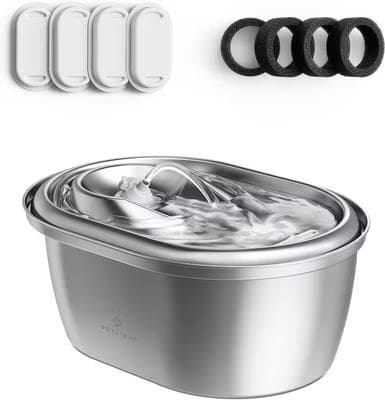
304 food-grade stainless steel pet water fountain, 101 oz. The circulating, filtered water encourages cats to drink more, which supports urinary tract and kidney health.
Webvet may earn a commission when you click through to Chewy, at no extra cost to you.
Quick guide: which scenario matches your cat?
Because "not eating" shows up in several combinations, this table maps the common ones to how urgent they are and where to read more. It is a triage aid, not a diagnosis.
| Scenario | How urgent | Where to go deeper |
|---|---|---|
| Not eating but drinking water | Still on the fatty-liver clock; call the vet by 24 hours | cat not eating but drinking water (https://www.webvet.com/cat-not-eating-but-drinking-water/) |
| Not eating and not drinking | More urgent; dehydration adds up fast | cat not eating and not drinking water (https://www.webvet.com/cat-not-eating-not-drinking-water/) |
| Not eating but acting normal | Do not be reassured; 24-hour rule still applies | cat not eating but acting normal (https://www.webvet.com/cat-not-eating-but-acting-normal/) |
| Not eating and lethargic | High; likely genuinely ill, act same day | cat not eating and lethargic (https://www.webvet.com/cat-not-eating-and-lethargic/) |
| Old or senior cat not eating | High; no grace period, underlying disease likely | old cat not eating (https://www.webvet.com/old-cat-not-eating/) |
| Well cat you want to tempt to eat | Low if within window; use gentle techniques | how to get a cat to eat (https://www.webvet.com/how-to-get-a-cat-to-eat/) |
Food-related reasons: new food, texture, and treats-only eaters
Sometimes the problem really is the food, not the cat. Rule these out only after you are confident the cat is otherwise well and within the safe window, because a "picky" label is dangerous if it is actually masking illness.
Bored, treats-only eaters sometimes re-engage when food becomes a hunt. Cat puzzle feeders add that foraging challenge back to meals.
- A cat not eating new food: cats can be neophobic and form strong texture and flavor preferences early in life. An abrupt switch to a new food can trigger a hunger strike. Transition foods gradually over 7 to 10 days, mixing an increasing amount of the new food into the old.
- A cat not eating wet food or not eating dry food: a cat that suddenly rejects one texture may be signaling dental pain (hard food hurts) or nausea. A cat not eating hard food in particular often has a sore mouth. It is not always simple preference, so do not just switch and move on if the change was sudden.
- A cat not eating food but eating treats: a cat eating treats but not food is a classic pattern. It can mean the cat feels too unwell to eat a full meal but will still take a tiny, high-value morsel, or that it has learned that holding out produces treats. Either way, a treats-only cat is not eating a balanced diet and needs evaluation if it lasts beyond a day. The fact that a sick cat will still take treats is also why treats are not proof your cat is fine.
- A cat not eating cat food but begging for people food: often a learned behavior reinforced by table scraps, but persistent refusal of its own food still warrants a vet check, and people food should never become the main diet.
- Stale food or a dirty bowl: cats have a keen sense of smell. Oxidized dry food that has been open too long, or a bowl with lingering residue or soap smell, can be an instant turn-off. Store dry food sealed, wash bowls daily, and check the "best by" date.
After vaccines, surgery (spay or neuter), or a vet visit
A short dip in appetite after a stressful or medical event is common, but there are limits, and knowing the limits keeps you from either panicking too early or waiting too long.
- A cat not eating after a vaccine or vaccination: mild lethargy and a smaller appetite for 12 to 24 hours can be a normal reaction as the immune system responds. Full food refusal beyond 24 hours, facial swelling, hives, repeated vomiting, or trouble breathing is not normal and needs a vet now, as those can signal an allergic reaction.
- A cat not eating after a neuter or spay: grogginess from anesthesia can dull appetite the day of surgery. Most cats eat a small amount that evening or by the next morning, and vets often recommend offering a smaller-than-usual portion the first night. If your cat has eaten nothing 24 hours after surgery, or seems painful, has a swollen, red, or oozing incision, or is vomiting, call the surgical clinic.
- A cat not eating after a vet visit: stress from handling, other animals, and car travel can suppress appetite briefly. It should recover within a day; if it does not, the visit may have uncovered or coincided with a developing problem.
The theme is consistent: a mild, brief dip can be expected, but the same 24 hour rule and red-flag list still apply. A recent procedure explains a quiet appetite; it does not excuse a cat that has eaten nothing for a full day.

Lickable cat treats with real chicken, made to support comfort and tranquility. 12 single-serve 0.5-oz tubes.
Webvet may earn a commission when you click through to Chewy, at no extra cost to you.
Special cases: kittens, senior cats, and cats still not eating on mirtazapine
Some cats are on a shorter fuse than the standard timeline, and some situations have their own dedicated guides.
Kittens have almost no energy reserves and can crash into low blood sugar (hypoglycemia) and dehydration in hours, not days. A kitten not eating and sleeping a lot is an urgent problem, not a minor one. Do not apply the 24 hour adult window to a kitten. A very young or bottle-fed kitten that misses feedings can decline within a matter of hours, so call the vet the same day, and sooner if the kitten is limp, cold, or unresponsive.
Senior and elderly cats also deteriorate faster and are far more likely to have an underlying disease driving the appetite loss, such as kidney disease, hyperthyroidism, dental disease, or cancer. An old cat not eating, an elderly cat not eating, or an older cat not eating as much should be seen promptly rather than watched for days. Age itself is not a reason a cat stops eating; there is almost always a treatable cause worth finding. We go deep on the age-specific angle in old cat not eating.
Cats already on an appetite stimulant: if your cat is still not eating on mirtazapine or another prescribed appetite stimulant, that is a signal the underlying illness is not controlled, or that the dose, timing, or route needs adjusting. Do not increase the dose on your own, and do not double up if you think a dose was missed. Call the prescribing vet, because a cat that will not eat despite medication usually needs re-evaluation, anti-nausea support, or more intensive nutritional care.
How to get a cat to eat again at home (while you get help)

If your cat is within the safe window and otherwise well, a few gentle tricks can restart eating. These are for short-term encouragement only, never a replacement for care in a cat that is truly refusing food.
- Warm the food. Heating wet food to just below body temperature releases aroma and often wins over a queasy cat. Stir it well and check the temperature so it is warm, not hot.
- Offer strong-smelling favorites. A small amount of a high-value canned food, a lickable treat, or a spoon of plain meat baby food (with no onion or garlic in the ingredients) can prime the pump.
- Serve small, fresh portions in a clean, shallow, wide bowl away from the litter box and noisy appliances. Refresh the plate often, since cats dislike food that has sat out and gone stale.
- Reduce stress. Give a nervous or new cat a quiet room with no other pets while it eats, and sit quietly nearby if your presence reassures it.
- Try texture and format changes. Some cats respond to a switch from pate to shreds, a different protein, or food offered on a flat plate rather than a bowl.
- Hand-offer, do not force. Placing a dab of food on a paw so the cat licks it off, or offering it by hand, can help. Do not push food into the mouth.
For the full toolkit of vet-approved tempting techniques and best foods to offer, see our step-by-step guide on how to get a cat to eat. If none of these work within a few hours, or your cat is already past 24 hours, stop experimenting and call the vet. Home tricks are a bridge to care, not a substitute for it.
What NOT to do: never force-feed, the 3-3-3 rule, and the one meat to avoid
Some well-meant moves make things worse. Avoid these.
Never force-feed a cat that is refusing food. Forcing food or water into the mouth with a syringe or your fingers risks aspiration (food entering the lungs, which can cause pneumonia) and adds stress that further suppresses appetite and can make a cat associate food with fear. If a cat needs assisted feeding, that is a veterinary decision involving safe techniques, anti-nausea medication, appetite stimulants, or a feeding tube, not something to improvise at home.
Never offer toxic human foods to tempt a sick cat. Onions, garlic, chives, leeks, and other allium-containing foods are toxic to cats and can damage red blood cells, so they must never be used to encourage eating. Any broth you offer must be plain and completely onion and garlic free, because many store-bought and low-sodium broths contain both, often listed as "natural flavors" (ASPCA Animal Poison Control, people foods to avoid). When in doubt, offer the cat's normal food rather than a human product.
What is the one meat to never feed a cat? There is no single "forbidden meat," but the food most vets warn against is raw or undercooked meat and fish. Raw meat can contain harmful bacteria such as Salmonella and E. coli that are dangerous to pets and people alike (ASPCA Animal Poison Control). Raw fish carries a separate problem: raw freshwater fish contains thiaminase, an enzyme that rapidly destroys dietary thiamine (vitamin B1), and a thiamine deficiency in cats can cause anorexia, neurologic dysfunction, seizures, and muscle weakness (Merck Veterinary Manual, nutritional requirements of small animals). Cured, seasoned, or heavily processed meats, and anything seasoned with onion or garlic powder, are also off-limits. When tempting a sick cat, stick to its normal food or a plain, cooked, unseasoned protein such as boiled chicken.
What is the 3-3-3 rule for cats? The 3-3-3 rule is a behavior and adjustment guideline for a newly adopted cat, not a medical feeding rule: roughly 3 days to decompress and hide, 3 weeks to settle into a routine, and 3 months to feel fully at home. It helps set expectations that a new cat may eat lightly and hide at first. Important caveat: the 3-3-3 rule does not override the hepatic-lipidosis clock. Even a brand-new, stressed cat should not go more than about 24 hours without eating anything before you seek advice, and a kitten far less.
What to do when a cat will not eat: a quick action list
| Situation | Do this |
|---|---|
| Skipped one meal, otherwise fine | Offer a favorite food, monitor closely |
| No food for 12 to 24 hours | Warm strong-smelling wet food, reduce stress, note other signs |
| No food for 24+ hours (adult) | Call the vet for same-day advice |
| Any red-flag symptom | Emergency vet visit now |
| Kitten or senior skipping meals | Call the vet today, do not wait |
| Tempted to force-feed or use broth | Stop. Never force-feed. Only plain, onion and garlic free broth |
| Diabetic cat that has not eaten | Call the vet before giving insulin |
When to call the vet and what to expect (diagnostics and treatment)

Call your veterinarian any time a cat has refused food for more than 24 hours, or shows appetite loss plus any red flag. For a cat not eating, the vet's goals are to find the cause and to stop the fatty-liver cascade before it starts. It helps to arrive prepared: note when your cat last ate normally, any change in food or environment, and any other symptoms you have seen, since that history often points the vet toward the cause quickly.
A typical workup for cat not eating treatment may include:
- A full physical and oral exam to check for pain, dental disease, dehydration, a distended abdomen, and jaundice.
- Bloodwork and urinalysis to screen for kidney disease, liver values, diabetes, thyroid issues, pancreatitis, and infection.
- Imaging (X-rays or ultrasound) to look for obstructions, foreign bodies, masses, or an enlarged fatty liver.
- Nutritional support, which may include anti-nausea medication, prescription appetite stimulants, intravenous or subcutaneous fluids, and, in cats with established hepatic lipidosis, a temporary feeding tube to deliver the aggressive nutritional support the condition requires (Merck Veterinary Manual, liver disorders in cats).
A feeding tube sounds alarming to many owners, but for a cat with fatty liver it is often the single most effective and humane tool available. It lets the cat receive complete nutrition without the stress of force-feeding, and many cats tolerate it well and start feeling better within days as the liver recovers.
The reassuring part: caught early, most causes of a cat not eating are treatable, and even hepatic lipidosis has a good outlook when nutritional support starts promptly. The dangerous part is delay. Because cats hide illness so well and the fatty-liver clock runs fast, a cat that will not eat is one of the few symptoms where erring toward an early vet visit is almost always the right call.
Key takeaway
- 1A cat not eating is a symptom to act on, not to sleep on. Monitor a healthy adult for up to 24 hours, call the vet by 24 to 48 hours, and treat 48 to 72 hours or any red-flag symptom as an emergency.
- 2Kittens, seniors, and already-ill cats get no grace period.
- 3Eating a little is not the same as eating enough, and "still drinking" or "acting normal" does not stop the fatty-liver clock.
- 4Never force-feed, never offer onion or garlic, and when in doubt, call your veterinarian, because with this particular symptom, acting early is almost always the safer choice.
A cat not eating is a symptom to act on, not to sleep on. Use the clock: monitor a healthy adult for up to 24 hours, call the vet by 24 to 48 hours, and treat 48 to 72 hours or any red-flag symptom as an emergency. Kittens, seniors, and already-ill cats get no grace period. Eating a little is not the same as eating enough, and "still drinking" or "acting normal" does not stop the fatty-liver clock. Never force-feed, never offer onion or garlic, and when in doubt, call your veterinarian, because with this particular symptom, acting early is almost always the safer choice.
Frequently Asked Questions
When should I worry about my cat not eating?
Worry and take action once a healthy adult cat has refused all food for more than 24 hours, and act immediately if the cat is also lethargic, hiding, vomiting, jaundiced (yellow gums or eyes), or straining to urinate. Food refusal beyond 48 to 72 hours is a medical emergency because of the risk of feline hepatic lipidosis (fatty liver disease). Kittens, senior cats, and cats with known illnesses like kidney disease or diabetes should be seen the same day they skip meals, with no 24 hour grace period.
What is the 3 3 3 rule for cats?
The 3-3-3 rule is an adjustment guideline for a newly adopted cat, not a medical feeding rule. It suggests roughly 3 days to decompress and hide, 3 weeks to settle into a routine, and 3 months to feel fully at home. It sets expectations that a new cat may eat lightly and hide at first, but it does not override the fatty-liver clock: even a stressed new cat should not go more than about 24 hours without eating anything before you seek veterinary advice.
What to do when a cat won't eat?
First, offer warmed, strong-smelling wet food in a clean, quiet spot, and check for other symptoms like lethargy, vomiting, or hiding. If your cat is otherwise well and within 24 hours of its last meal, gentle tempting is reasonable. If it has not eaten for more than 24 hours, or shows any red-flag symptom, call your veterinarian for same-day care. Never force-feed and never use onion or garlic containing broth to tempt a sick cat.
What are the signs that a cat is about to pass away?
Signs a cat may be near the end of life include a profound and lasting loss of appetite, marked weakness, hiding away, a drop in body temperature, labored breathing, and disinterest in its surroundings. Crucially, these signs overlap heavily with treatable emergencies, so they are a reason to see a veterinarian now rather than to assume the worst at home. Many cats showing these signs have a condition that can still be treated or humanely managed once diagnosed.
What is the silent killer of cats?
The phrase most often refers to chronic kidney disease, which is common in cats and progresses quietly for months or years with few obvious signs until it is advanced. Reduced appetite, weight loss, increased thirst, and lethargy are recognized clinical signs that should prompt a veterinary workup. Other quiet threats include hyperthyroidism, heart disease, and cancer, all of which can first appear as a cat that simply stops eating well.
What is the one meat to never feed a cat?
There is no single forbidden meat, but the food vets most consistently warn against is raw or undercooked meat and fish. Raw meat can harbor harmful bacteria such as Salmonella and E. coli, and raw freshwater fish contains thiaminase, an enzyme that destroys thiamine (vitamin B1) and can lead to a deficiency that causes anorexia, neurologic signs, and weakness in cats. Cured, seasoned, or processed meats containing onion or garlic powder are also off-limits, since alliums are toxic to cats. When tempting a sick cat, stick to its normal food or a plain, cooked, unseasoned protein.
$65 · no membershipHave a health question about your cat?
A licensed vet can assess your cat over video and prescribe online when it's appropriate.
Talk to a vet- Licensed vets
- All 50 states
- same-day Rx
Webvet may earn a commission if you book.

Editor
The Webvet Editorial Team is the in-house group of pet-care editors and writers behind Webvet, operated by Smart Pet Collective. The team researches, writes, and maintains Webvet's pet health, behavior, and medication content. Every article follows a defined editorial process: research from reputable veterinary and scientific sources, careful drafting, mandatory review of medical content by a credentialed veterinarian, and dated publication. Health and medication articles are medically reviewed by a licensed veterinary professional before they go live and are kept current over time.
Veterinarian · BVMS MRCVS
Dr. Pippa Elliott, BVMS, MRCVS, is a veterinarian with nearly 30 years of experience in companion animal practice. Dr. Elliott earned her Bachelor of Veterinary Medicine and Surgery from the University of Glasgow. She was also designated a Member of the Royal College of Veterinary Surgeons. Married with 2 grown-up kids, Dr. Elliott has a naughty Puggle named Poggle, 3 cats and a bearded dragon.


