Old Cat Not Eating: Causes, Red Flags, and When It's an Emergency
A senior cat that refuses food for more than 24 hours is a medical emergency, not a wait-and-see. Here are the most common causes, the warning signs that mean call the vet now, and safe ways to tempt an old cat to eat.

BVMS MRCVS
Medically reviewed by Dr. Pippa Elliott, BVMS MRCVS · Last reviewed

This article contains affiliate links. Webvet may earn a commission when you buy through them, at no extra cost to you.
An old cat not eating is one of the most alarming things a senior-cat owner can notice, and your instinct to worry is correct. In cats over 10, a lost appetite is almost never "just old age." It is a symptom, and in a senior cat it can turn dangerous fast. Here is the single most important rule on this page: if your old cat refuses food for more than 24 hours, treat it as a medical emergency and call your veterinarian or an emergency clinic now. This is not a wait-and-see situation.
This guide walks through how long a senior cat can safely go without food, the most common medical reasons old cats stop eating, how to read the specific pattern you are seeing (eating but not drinking, sniffing and walking away, eating only treats), how to gently tempt your cat before the visit, what your vet will do, and how to recognize when appetite loss is part of the end of life. Every medical claim below is linked to a primary veterinary source, and none of it is a substitute for having your own cat examined.
If you take only one thing from this page, make it this: in a senior cat, appetite is a vital sign. A young cat can afford to be picky for a day and bounce back. An old cat cannot, because the very act of not eating starts a chain of events in the liver that can become life-threatening on its own. The good news is that most of the underlying causes are treatable when they are caught early, so acting quickly is not just safer, it usually leads to a better outcome for your cat.

Is an old cat not eating an emergency? Start here
Yes, assume it is until a vet tells you otherwise. An old cat not eating is different from a young, healthy cat skipping a meal. Senior cats carry far less metabolic reserve, so when they stop eating, their bodies begin breaking down fat stores for energy, and their livers can be overwhelmed by that fat. The result is feline hepatic lipidosis, a genuinely life-threatening condition that is triggered by the food deprivation itself. That is why "let's see if she eats tomorrow" is the wrong plan for a cat in her teens.
Use this quick triage to decide how urgently to act:
| What you are seeing | How urgent | What to do |
|---|---|---|
| No food for more than 24 hours | Emergency | Call a vet or emergency clinic today |
| Not eating and not drinking | Emergency | Call now, dehydration compounds fast |
| Not eating plus vomiting, hiding, weakness, or jaundice | Emergency | Same-day or ER visit |
| Eating much less than normal for 2 to 3 days | Urgent | Book a vet appointment within 24 to 48 hours |
| Skipped one meal, otherwise bright and drinking | Watchful | Monitor closely; call if it continues past 24 hours |
The line to remember: the older and thinner your cat, the shorter the safe window. A robust 3-year-old cat and a frail 18-year-old cat are not in the same category. When in doubt, phone your vet's office. A two-minute call can tell you whether to come in now.
It helps to have concrete information ready before you call. Note when your cat last ate a normal amount, whether she is drinking, whether you have seen vomiting or diarrhea, and any change in litter-box output, weight, or activity. If you can, weigh your cat on a home scale (weigh yourself, then yourself holding the cat, and subtract). Steady weight loss over weeks is easy to miss by eye but obvious on a scale, and it tells your vet a great deal about how long the problem has been building. A short list of what you have observed turns a vague "she's not eating" into the kind of history that speeds up diagnosis.

A soupy, lickable bisque treat that tempts a cat who has gone off solid food. The high-moisture, aromatic texture is easy to lap up and hard for a picky or recovering cat to resist, and it sneaks in extra hydration.
Webvet may earn a commission when you click through to Chewy, at no extra cost to you.
How long can a senior cat safely go without food?
Answer first: a senior cat should not go more than about 24 hours without eating before you involve a veterinarian, and far less if she is also not drinking. While a young, healthy adult cat might tolerate a day or two of poor appetite, that margin does not apply to an older cat, and it certainly does not apply to a cat with an underlying illness.

Here is why the clock matters so much. When a cat stops eating, the body mobilizes fat to the liver for fuel. In cats, uniquely among common pets, this fat can accumulate faster than the liver can process it, causing hepatic lipidosis. Overweight cats are at especially high risk, but any cat that goes without adequate calories can develop it. Because it is the food deprivation itself that sets this process in motion, the safest response is not to wait and see how long the anorexia lasts. The 24-hour threshold on this page is an editorial safety line, chosen to get a senior cat in front of a veterinarian well before prolonged anorexia has time to tip the liver into crisis, rather than a promise that any specific number of hours is harmless.
Dehydration runs on a parallel, faster timeline. A cat that is neither eating nor drinking loses fluid it cannot replace, and older cats, many of whom already have reduced kidney function, dehydrate quickly. Not eating and not drinking together is a same-day emergency, not a 24-hour one.
Does age change the answer?
The specific number on the calendar matters less than the cat's condition, but very old cats have essentially no buffer:
- 16-year-old cat that won't eat: treat a full-day refusal as urgent and book a vet visit right away.
- 18-year-old cat not eating much: even reduced intake over 2 to 3 days deserves a same-week workup, and a full-day refusal is an emergency.
- 20-year-old cat not eating: any refusal warrants a prompt call; at this age the reserve is minimal.
- 23-year-old cat that won't eat or drink: this is an immediate emergency regardless of how "peaceful" she looks.
The takeaway is not a magic number of hours. It is that you should not try to wait out anorexia in an old cat at home. The safe move is always to check with your vet sooner rather than later. If you are wondering when a cat stops eating how long before they die, the honest answer is that it varies enormously with the underlying cause, but the window is short enough that waiting to find out is never the right call.
Why old cats stop eating: the most common medical causes
Appetite loss in a senior cat is a symptom of an underlying problem, not a diagnosis. The Cornell Feline Health Center is explicit that owners should never assume changes in an older cat are simply due to old age and untreatable; any alteration in behavior or condition warrants contacting a veterinarian. Many of the causes below are treatable, and several are only found on a physical exam and bloodwork.

Dental and oral pain
Dental disease is one of the most common and most overlooked reasons old cats stop eating. Cornell notes that dental disease is extremely common in older cats and can hinder eating and cause significant pain. A cat with a painful tooth, resorptive lesion, or inflamed gums may approach the bowl hungry, take a bite, then flinch and walk away. Classic clues include dropping food, chewing on one side, pawing at the mouth, bad breath, or drooling. This is a fixable problem, but only a vet can find and treat it.

Single-ingredient freeze-dried raw salmon treats with an intense aroma that can tempt a cat who has gone off her food to start eating again.
Webvet may earn a commission when you click through to Chewy, at no extra cost to you.
Kidney disease and hyperthyroidism
Two organ and endocrine conditions dominate senior-cat medicine, and both blunt appetite. Cornell describes chronic kidney disease as one of the most prevalent diseases in older cats, one that can cause loss of appetite and weight loss, and separately notes that hyperthyroidism is among the conditions that become more prevalent in cats as they age. Both are diagnosed on bloodwork, not by looking at the cat, which is one more reason a lost appetite in an older cat warrants a workup rather than a wait.
- Chronic kidney disease (CKD) is extremely common in aging cats. It causes nausea and a general "off" feeling that suppresses appetite, often alongside increased thirst and urination and gradual weight loss. This is also why some owners notice their older cat losing weight but still eating in the earlier stages, before appetite drops off. It can also explain the pattern of a cat that keeps drinking but stops eating.
- Hyperthyroidism is a leading feline endocrine disease. Peer-reviewed feline geriatric medicine notes that weight loss is common in older cats and is often the result of several, sometimes interacting, conditions, and that hyperthyroidism is still considered by many to be the most common feline endocrinopathy. Classically it causes a ravenous appetite with weight loss, but in some cats it flips to poor appetite, especially when advanced or complicated by other disease.
Gastrointestinal disease, cancer, and pain
Inflammatory bowel disease, pancreatitis, gastrointestinal lymphoma, and other cancers are all more common in older cats and frequently present as reduced appetite and weight loss. Because weight loss in senior cats often results from several interacting conditions, a cat may have more than one problem at once. This is another reason self-diagnosis is unsafe and a full workup matters.
The pancreatitis in cats guide explains its often nonspecific signs, how veterinarians investigate it, and why pain relief, nutrition, and follow-up need an individual plan.
Arthritis and mobility pain
An arthritic senior may want to eat but find the trip to the bowl, or the crouch over a deep dish, painful. If your cat has slowed down, stopped jumping, or seems stiff, joint pain could be part of the picture. Our guides on arthritis relief for cats and why your cat isn't jumping anymore cover this in depth, and how to tell if a cat is in pain can help you spot the subtle signs.
Sensory decline and stress
Older cats often lose some sense of smell, and because cats eat largely by scent, a faded nose means faded interest in food. Stress matters too: a new pet, a move, a change in routine, or even a different food can tip a sensitive senior into a hunger strike. Older cats can also develop feline cognitive dysfunction, a dementia-like syndrome that may leave a cat confused at mealtime, forgetting where the bowl is or losing the routine that once cued her to eat. These are real contributors, but they are diagnoses of exclusion; you rule out the medical causes above first.
Why "just old age" is the wrong assumption
It is worth stating plainly: there is no such thing as a healthy senior cat that simply loses interest in eating because she is old. Aging is not itself a disease. When an old cat stops eating, something specific has changed, and that something is usually detectable. Cornell's guidance to never dismiss changes in an older cat as untreatable exists for a reason: many owners lose precious days assuming decline is inevitable, when a treatable dental problem, a manageable thyroid condition, or a controllable kidney disease is the real cause. The cats who do best are the ones whose owners took the appetite change seriously and acted early.
 $65 · no membership
Have a health question about your cat?
A licensed vet can assess your cat over video and prescribe online when it's appropriate.
 Talk to a vet
- Licensed vets
- All 50 states
- same-day Rx
Webvet may earn a commission if you book.
Reading the pattern: not eating but drinking, not drinking, or eating only treats
The exact combination of what your cat will and won't do is a useful clue. Here is a quick decision snippet, followed by where to go deeper.

Old cat not eating but drinking water. Continuing to drink is slightly reassuring because it slows dehydration, but it does not remove the hepatic-lipidosis risk from not eating. Increased thirst can itself point to kidney disease, diabetes, or hyperthyroidism. Still call your vet if food refusal passes 24 hours. For the full breakdown, see our dedicated guide on a cat not eating but drinking water.
Old cat not drinking water but eating, or neither. Not drinking is a faster danger than not eating. A cat that is not drinking, or is doing neither, needs same-day attention. Our guide on a cat not eating and not drinking water covers the specifics.
Cat not eating food but eats treats. This pattern usually means the appetite drive is partly intact but something about mealtime is off, often dental pain, nausea, or dislike of the food's smell or texture. Treats are more aromatic and require less chewing, so a cat with a sore mouth or weak nose may still take them. It is a helpful clue for your vet, not a solution: treats are not complete nutrition and cannot prevent fatty liver.
Cat sniffing food but not eating. Sniffing and walking away often signals nausea (common with kidney disease or GI illness), a smell that no longer appeals, or oral pain. Warming the food to release aroma can help temporarily, but persistent sniff-and-refuse behavior past a day needs a vet.
Two more patterns are worth naming. A cat that has suddenly refused a food she ate happily last week may be reacting to a recipe or formula change, a stale bag, or a subtle new pain rather than losing appetite altogether; offering a small amount of the previous food can help you tell the difference. And a cat that eats a few bites, then stops and stares at the bowl, is often battling nausea, the food is appealing enough to start but her stomach turns her away. Whatever the pattern, the underlying rule does not change: the specifics help your vet narrow the cause, but they do not buy you extra time. A senior cat who has not taken in a normal amount of food in 24 hours needs professional attention regardless of which of these patterns fits.
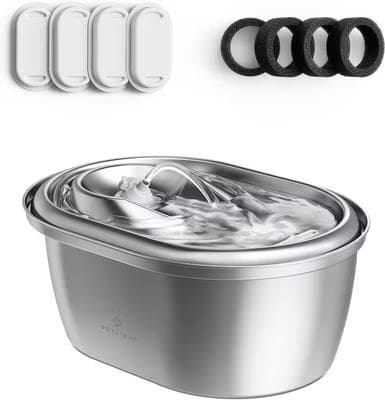
304 food-grade stainless steel pet water fountain, 101 oz. The circulating, filtered water encourages cats to drink more, which supports urinary tract and kidney health.
Webvet may earn a commission when you click through to Chewy, at no extra cost to you.
When it's more than appetite: not eating plus lethargy or sleeping a lot
Appetite loss combined with lethargy or sleeping much more than usual is a red-flag combination that raises the urgency. A cat who is off her food but still bright, curious, and moving normally is worrying; a cat who is off her food and also flat, weak, or hiding is more worrying and should be seen promptly.
Increased sleeping in an old cat is easy to write off as normal aging, but paired with not eating it often reflects real illness: anemia from kidney disease, the metabolic drag of an untreated condition, pain, or the early effects of dehydration. If your elderly cat is not eating much and sleeping a lot, do not wait for a third symptom to appear. For the general (all-ages) version of this pattern and a fuller symptom checklist, see our guide on a cat not eating and lethargic. In a senior cat specifically, the combination should push you toward a same-day or next-day vet call.
Old cat not eating but acting normal, what that means
Here is the senior-specific trap: old cats are masters at hiding illness, so "acting normal" is far less reassuring in a geriatric cat than in a young one. Cats evolved to conceal weakness, and an older cat can look calm, purr, and move around the house while a serious condition progresses underneath. Purring in particular is not proof of wellness; cats also purr when stressed, in pain, or self-soothing.
So if your old cat is not eating much but acting normal, the appetite change is still the signal to trust. A day of genuine food refusal in a senior cat warrants a vet call even if everything else looks fine, precisely because the "everything else looks fine" reassurance is unreliable at this age. For the general treatment of this topic across all life stages, see our companion guide on a cat not eating but acting normal. On this page, the senior rule stands: normal behavior does not cancel out a lost appetite.
How to tempt a senior cat to eat before the vet visit
These senior-adapted tactics can help while you are arranging a vet visit. They are stopgaps, not substitutes for veterinary care, and they should never delay a call when your cat has passed the 24-hour mark.

- Warm the food. Gently warming wet food to body temperature releases aroma, which matters enormously for an older cat with a fading sense of smell. Warm slightly and stir, then test the temperature so it is warm, not hot.
- Offer strong-smelling, soft foods. Pate-style wet food, a spoonful of plain meat baby food (with no onion or garlic), or a little water from a can of tuna packed in water ("tuna water") can rekindle interest. Soft textures also spare a sore mouth.
- Lower the barrier for arthritis. Use a shallow, wide dish so whiskers don't touch the sides, and place it where your cat doesn't have to jump, climb, or crouch painfully. A slightly elevated shallow bowl can help a stiff senior eat more comfortably.
- Reduce stress at mealtime. Feed in a quiet spot away from other pets, noise, and the litter box. Hand-feeding a few bites or sitting nearby can reassure an anxious cat.
- Try small, frequent offerings. Tiny amounts of fresh food several times a day are often more successful than one large bowl left out to go stale.
- Rotate a few tempting toppers. A sprinkle of a favorite freeze-dried meat, a bit of low-sodium plain chicken, or a lick of the liquid from a wet-food can can be enough to trigger the first few bites. Once a cat starts, she will often continue.
- Mind the whiskers and the height. Deep, narrow bowls press on sensitive whiskers and force a painful crouch. A flat plate or shallow saucer removes both problems for an old cat with joint or facial sensitivity.
Set a realistic goal. You are trying to get some calories in and buy a little comfort, not to fully feed your cat back to health at home. If these tactics get her eating a bit, that is good news to report, but it does not cancel the vet visit. If they do not work within a few hours, do not keep trying in a loop; move on to calling your vet. Never force food into a cat's mouth with a syringe unless your veterinarian has shown you how and told you to, because forced feeding can cause aspiration and added stress.
About appetite stimulants and fluids: medications such as mirtazapine and treatments like subcutaneous fluids can be very effective, but they are vet-directed only. Do not attempt to dose or dispense them yourself. If your vet prescribes an appetite stimulant, our overview of mirtazapine for cats and dogs explains how it works. Ask your vet before giving anything. For a broader library of feeding techniques that apply to cats of all ages, see our guide on how to get a cat to eat. And if digestive upset is part of the picture, senior cat digestive problems may help, though a workup still comes first.

Lickable cat treats with real chicken, made to support comfort and tranquility. 12 single-serve 0.5-oz tubes.
Webvet may earn a commission when you click through to Chewy, at no extra cost to you.
What your vet will likely do
Knowing what to expect can make the call easier to place. For a senior cat that has stopped eating, a veterinary visit usually starts with a thorough physical exam, including a careful look in the mouth for the dental disease that so often hides there, plus checking hydration, body and muscle condition, and the abdomen. From there, expect bloodwork and a urinalysis, the tests that reveal kidney disease, hyperthyroidism, diabetes, and signs of liver trouble, all of which are common in older cats and none of which can be diagnosed by looking at the cat alone. Depending on findings, imaging such as X-rays or an ultrasound may be added to look for masses, an enlarged organ, or gastrointestinal disease.
Treatment then follows the cause. That might mean dental care under anesthesia, thyroid medication, a kidney-support plan, anti-nausea medication, fluids to correct dehydration, or a prescribed appetite stimulant to break the anorexia cycle before fatty liver takes hold. The reassuring reality is that a large share of the conditions behind a senior cat's lost appetite are manageable once identified, and many cats go on to eat well again with the right treatment. The cats who do worst are usually the ones whose owners waited.
When appetite loss signals the end of life
This is the hardest part of caring for an old cat, and you deserve honesty here. Yes, appetite loss can be part of the natural end of life for a very old or terminally ill cat, but it can also be a treatable crisis that looks like decline. The two can be genuinely hard to tell apart from the couch, which is exactly why a vet's assessment matters even, and especially, near the end.
End-of-life signs in an elderly cat often cluster together rather than appearing alone:
- Persistent refusal of both food and water
- Profound weakness or inability to stand
- Marked, ongoing weight loss and muscle wasting
- Withdrawal, hiding, or seeking isolation
- Labored or irregular breathing
- Very low body temperature and cold extremities
- Loss of interest in surroundings and people
- Reduced or absent grooming
Seeing several of these together in a cat with a known terminal diagnosis is different from seeing appetite loss in isolation. Isolated appetite loss is much more likely to be a treatable problem, such as dental pain, kidney disease, hyperthyroidism, or nausea, than the end. That is the core reason not to assume the worst and wait at home: a cat you think is "dying of old age" may actually have a fixable condition, and even when the end truly is near, your vet can provide comfort care and guide you compassionately on quality-of-life decisions and, if appropriate, humane euthanasia so your cat does not suffer.
If you are facing this, be reassured that involving your vet is the kindest choice whether the outcome is treatment or a peaceful goodbye. Do not carry that judgment alone. Your veterinarian can walk you through an objective quality-of-life assessment, looking at pain, mobility, hydration, interest in life, and more, so that a heartbreaking decision is grounded in your cat's actual comfort rather than fear or guilt. Many practices also offer at-home hospice guidance and in-home euthanasia for cats who find the clinic stressful, which can make a peaceful passing gentler for everyone. Whatever path fits your cat, you do not have to guess your way through it.
When to call the vet or emergency clinic (do not wait)
Bottom line: with a senior cat, err on the side of calling. The downside of an unnecessary vet call is small; the downside of waiting out hepatic lipidosis or dehydration is catastrophic. Cornell is clear that appetite loss in older cats should be evaluated rather than attributed to aging.

Call a veterinarian or emergency clinic right away if your old cat:
- Has refused all food for more than 24 hours
- Is not eating and not drinking (same-day emergency)
- Is not eating and vomiting, hiding, weak, or collapsing
- Shows jaundice, a yellow tint to the gums, skin, or the whites of the eyes (a red flag for liver trouble)
- Is breathing hard, has a distended belly, or seems in pain
- Is very old (late teens or twenties) and has skipped even a single day of eating
How to tell if a cat's body is shutting down overlaps with the end-of-life signs above: extreme weakness, cold body, labored breathing, unresponsiveness, and total refusal of food and water. But because a treatable crisis can mimic these signs, the safest response to a "shutting down" appearance is still an urgent vet contact, not a decision made at home.
Remember the rule this whole page is built around: an old cat not eating for more than 24 hours is a medical emergency, not a wait-and-see. Senior cats have little reserve, anorexia rapidly sets the stage for fatal fatty liver disease, and the conditions behind a lost appetite are often treatable when caught early. When your older cat stops eating, the best thing you can do is pick up the phone.
This article is for general information and is not a substitute for veterinary care. Always consult your veterinarian about your individual cat.
Frequently Asked Questions
Is my cat not eating at the end of life?
It might be, but do not assume so. Appetite loss can be part of the natural end of life in a very old or terminally ill cat, but it is far more often a sign of a treatable problem such as dental pain, kidney disease, hyperthyroidism, or nausea. End-of-life appetite loss usually comes bundled with other signs, such as profound weakness, refusing water too, hiding, labored breathing, and a cold body. Appetite loss on its own is much more likely to be a fixable condition. Because a treatable crisis can look like dying, the safest step is a vet assessment rather than waiting at home.
What to do if an elderly cat stops eating?
Contact your veterinarian or an emergency clinic right away. In a senior cat, refusing food for more than 24 hours is a medical emergency because anorexia can trigger feline hepatic lipidosis (fatty liver), a potentially fatal liver disease. While you arrange the visit, you can gently tempt her with warmed, strong-smelling wet food, a little tuna water, or plain meat baby food in a shallow dish, but do not let these delay the call. Never give appetite stimulants, syringe-feed, or dose any medication without your vet's direction.
How long can an elderly cat not eat?
Not long, and less than you might think. A senior cat should not go more than about 24 hours without eating before you involve a veterinarian, and far less if she is also not drinking. Older cats have little metabolic reserve, so not eating quickly sets the stage for feline hepatic lipidosis (fatty liver), a serious liver disease driven by the food deprivation itself. The 24-hour mark is a safety threshold meant to get your cat seen before prolonged anorexia has time to do harm, not a guarantee that a full day without food is safe. If your cat is neither eating nor drinking, treat it as a same-day emergency rather than waiting out the full 24 hours.
How do you tell if a cat is nearing the end of its life?
End-of-life signs in a cat usually appear together, not alone. Watch for persistent refusal of both food and water, profound weakness or inability to stand, marked weight loss and muscle wasting, withdrawal or hiding, labored or irregular breathing, a low body temperature with cold paws and ears, loss of interest in people and surroundings, and reduced grooming. Because several serious but treatable conditions can mimic these signs, the most reliable way to know is a veterinary exam, which can also confirm whether comfort care or a peaceful goodbye is the kindest path.
How to tell if a cat's body is shutting down?
A cat whose body is shutting down typically shows extreme weakness, a cold body and extremities, slow or labored breathing, unresponsiveness or detachment from surroundings, and total refusal of food and water. These overlap heavily with end-of-life signs. However, the same picture can be caused by a treatable crisis such as severe dehydration, low blood sugar, or advanced organ disease, so an apparent shutdown should prompt an urgent call to your vet or an emergency clinic rather than a decision made at home.
What is the 3-3-3 rule for cats?
The 3-3-3 rule is a guideline for helping a newly adopted or rescued cat adjust to a new home: expect roughly 3 days for the cat to decompress and hide, about 3 weeks to settle into a routine and start feeling comfortable, and around 3 months to feel fully at home and bonded. It is a behavior and adjustment framework, not a medical rule. It does not apply to a senior cat that has stopped eating. An old cat refusing food for more than 24 hours needs a veterinarian, regardless of how long she has lived with you.
What are end of life signs in an elderly cat?
Common end-of-life signs in an elderly cat include refusing both food and water, significant weight loss and muscle wasting, extreme weakness or difficulty standing, hiding and seeking isolation, labored or irregular breathing, a low body temperature with cold paws and ears, loss of interest in people and surroundings, and stopping self-grooming. These signs typically cluster together, especially in a cat with a known terminal illness. Appetite loss occurring by itself is more likely a treatable condition, so a vet exam is the safest way to interpret what you are seeing.
What is the 3-3-3 rule of cats?
It is the same as the 3-3-3 rule for cats: a settling-in timeline for a newly adopted or rescued cat, roughly 3 days to decompress, 3 weeks to learn the routine, and 3 months to feel fully at home. It describes behavioral adjustment, not health, and has no bearing on why a senior cat is not eating. If an old cat is refusing food, do not wait out any 3-day window. Refusal beyond 24 hours is a medical emergency that warrants calling your veterinarian.
$65 · no membershipHave a health question about your cat?
A licensed vet can assess your cat over video and prescribe online when it's appropriate.
Talk to a vet- Licensed vets
- All 50 states
- same-day Rx
Webvet may earn a commission if you book.

Editor
The Webvet Editorial Team is the in-house group of pet-care editors and writers behind Webvet, operated by Smart Pet Collective. The team researches, writes, and maintains Webvet's pet health, behavior, and medication content. Every article follows a defined editorial process: research from reputable veterinary and scientific sources, careful drafting, mandatory review of medical content by a credentialed veterinarian, and dated publication. Health and medication articles are medically reviewed by a licensed veterinary professional before they go live and are kept current over time.
Veterinarian · BVMS MRCVS
Dr. Pippa Elliott, BVMS, MRCVS, is a veterinarian with nearly 30 years of experience in companion animal practice. Dr. Elliott earned her Bachelor of Veterinary Medicine and Surgery from the University of Glasgow. She was also designated a Member of the Royal College of Veterinary Surgeons. Married with 2 grown-up kids, Dr. Elliott has a naughty Puggle named Poggle, 3 cats and a bearded dragon.


