Cat Not Eating but Acting Normal? A Vet-Reviewed Guide to the Hidden Causes
A cat not eating but acting normal can still be seriously ill because cats instinctively mask pain. Learn the hidden causes, the 24-hour rule, safe home steps, and the emergency signs you should never wait on.

BVMS MRCVS
Medically reviewed by Dr. Pippa Elliott, BVMS MRCVS · Last reviewed

This article contains affiliate links. Webvet may earn a commission when you buy through them, at no extra cost to you.
cat not eating but acting normal is one of the most confusing situations for an owner. Your cat is walking around, grooming, purring, maybe even playing, yet the food bowl sits full. It is tempting to assume nothing is wrong. The uncomfortable truth is that a normal demeanor does not rule out real illness, because cats are experts at hiding how they feel.

This vet-reviewed guide explains why a cat not eating but acting normal can still need help, the nine most common reasons behind it, the critical 24-hour rule, safe things you can try at home, and the exact red flags that mean call your vet or head to the emergency room now.
Cat not eating but acting normal: when it's fine vs. when it's an emergency
Here is the answer-first version. A cat not eating much but acting normal for a single meal or a few hours is usually not an emergency, and often has a simple explanation like a warm day, a food change, or mild stress. But once a cat refuses food for more than 24 hours, or eats far less than usual for several days, it moves out of the "wait and see" zone and into "call the vet" territory, even if your cat still seems fine.
The reason is that appetite loss in cats is a nonspecific warning sign, not a diagnosis. According to VCA Animal Hospitals, anorexia in cats can stem from a wide range of causes across different body systems, including inflammation and pain in the mouth and throat such as stomatitis and gingivitis, gastrointestinal problems, systemic disease involving an organ system like kidney disease or diabetes, cancer, and virtually any painful condition. Because so many different problems funnel into the same visible sign, VCA advises that if a cat has refused food for more than two days, you should consult your veterinarian immediately rather than continue watchful waiting.
A quick note on the flip side: if your cat is not acting normal but eating, that is also worth a vet call. Behavior changes such as hiding, unusual aggression, or lethargy can be significant even when appetite is intact.
| Situation | What it usually means | What to do |
|---|---|---|
| Skipped one meal, otherwise normal | Mild pickiness, heat, minor stress | Monitor, offer food again in a few hours |
| Eating small amounts for 1 to 2 days | Possible early illness or food aversion | Call your vet within 24 hours for advice |
| No food at all for 24+ hours | Genuine concern regardless of demeanor | Call your vet today |
| No food for 2 to 3 days (or overweight cat) | Fatty-liver risk, urgent | Vet or ER now |
| Not eating plus a red-flag symptom | Possible emergency | Emergency vet now |

A soupy, lickable bisque treat that tempts a cat who has gone off solid food. The high-moisture, aromatic texture is easy to lap up and hard for a picky or recovering cat to resist, and it sneaks in extra hydration.
Webvet may earn a commission when you click through to Chewy, at no extra cost to you.
Why a cat can act normal and still stop eating (cats hide illness)
Cats are both predator and prey in the wild. Showing weakness makes a prey animal a target, so cats evolved to mask pain and illness for as long as possible. That instinct does not switch off in your living room. A cat eating small amounts but acting normal may be compensating: grooming, greeting you, and moving around while quietly feeling unwell.
This is exactly why "my cat is not eating much but acting normal, so it must be fine" is a risky assumption. The behaviors we read as "healthy" are partly automatic, and they can persist well into the early stages of disease.
Two clear examples show how normal behavior can coexist with real illness:
- Early kidney disease in senior cats. In early chronic kidney disease, a senior cat's appetite and general demeanor can look nearly normal while the disease is already progressing. Research in the Journal of Feline Medicine and Surgery notes that weight loss in older cats often occurs in spite of a normal or only slightly reduced appetite and should prompt blood work and urinalysis rather than reassurance. In early kidney disease the appetite may be only subtly or variably reduced, a shift so small that owners easily miss it, which is why the demeanor can look fine while the disease advances.
- Dental pain. Feline dental problems such as tooth resorption, gingivitis, and fractured teeth commonly make a cat eat less or drop food while otherwise seeming well, because cats mask oral pain. According to the Cornell Feline Health Center, dental disease affects between 50 and 90 percent of cats older than four, and affected cats may become hesitant to eat, turn their heads oddly while eating, drop food, prefer soft food, or stop eating altogether. Because tooth resorption in particular can be very painful yet develops out of sight below the gumline, it is an easily missed driver of eating changes.
The takeaway: use "acting normal" as reassurance about the pace of the problem, not proof there is no problem.
The 24-hour rule: how long is too long, and why hepatic lipidosis makes it urgent

Answer first: a healthy adult cat should not go longer than about 24 hours without eating before you involve a vet, and going 2 to 3 days with little or no food is a genuine emergency. This holds even if your cat is acting normal.
The load-bearing reason is feline hepatic lipidosis, also called fatty liver. When a cat stops eating, its body starts mobilizing fat stores for energy. Per the Merck Veterinary Manual, hepatic lipidosis is the most common and potentially lethal feline liver disease, driven when anorexia or food deprivation forces fat to move to the liver faster than the liver can process it, causing fat to accumulate in liver cells and impair function. On the timeline, VCA Animal Hospitals notes that cats with hepatic lipidosis have typically gone through a period of little or no eating for three to four consecutive days, and that once the disease sets in it is fatal without rapid, aggressive treatment. That short, days-scale window is why WebVet treats the 24-hour and 2-to-3-day marks as conservative safety thresholds: they are meant to get your cat seen well before the danger zone, not to describe how long is safe.
Overweight cats are at the highest risk. VCA notes the chances of hepatic lipidosis are greater if the cat was overweight or obese before the anorexia began, because a heavier cat has more fat to mobilize to the liver. So a chunky cat that suddenly stops eating is more worrying, not less, than a lean one.
To be clear, there is no reliable, safe survival-time number to plan around. The point of the 24-hour rule is not to calculate how long you can wait. It is to make sure you act well before a cat reaches the danger zone. If you are wondering "when a cat stops eating, how long before they die," treat that worry itself as your cue to call the vet now rather than trying to time it.
For the specific and more dangerous scenario of a cat not eating and not drinking, where dehydration compounds the fatty-liver risk, we cover the shared emergency rule in detail on our companion guide to a cat not eating and not drinking water.

Single-ingredient freeze-dried raw salmon treats with an intense aroma that can tempt a cat who has gone off her food to start eating again.
Webvet may earn a commission when you click through to Chewy, at no extra cost to you.
9 common reasons your cat isn't eating but seems fine
When a cat not eating much but acting normal shows up, the cause usually falls into one of these buckets. Some are minor, several are not, and none of them can be diagnosed from the couch. Use this list to understand the landscape, then let your vet pinpoint the actual cause.
- Dental pain. Tooth resorption, gum inflammation, or a fractured tooth can make chewing hurt. A classic clue is a cat that approaches food eagerly, then backs off, or one that prefers soft food suddenly.
- Early kidney disease. Especially in older cats, subtle appetite decline plus weight loss can be the first sign, while demeanor stays near normal.
- Gastrointestinal upset or nausea. Mild inflammation, hairballs, dietary indiscretion, or pancreatitis can suppress appetite. A cat sniffing food but not eating often feels nauseated.
- Diabetes. A diabetic cat not eating much but acting normal needs prompt attention, since appetite changes in a diabetic cat can signal that blood sugar or insulin needs are off, or that a secondary problem has developed.
- Pain elsewhere in the body. Arthritis, an injury, or a urinary issue can dampen appetite without an obvious limp or cry.
- Stress and environmental change. New home, new pet, moved furniture, a change in feeding location, or a noisy household can all suppress eating.
- Food problems. Spoiled food, a recipe or texture change, an off-putting bowl, or plain boredom. This is the one bucket you can sometimes fix at home.
- Infections and other illness. Respiratory infections in particular reduce appetite partly by blunting the sense of smell. Cats rely heavily on smell to eat. If your cat has congestion or discharge, ask your vet, and note that upper respiratory infection is a topic we treat separately.
- Recent stressors like vaccination, travel, or a vet visit. A short, self-limited dip in appetite can follow, but it should resolve within about a day.
A common and confusing pattern deserves its own mention: the cat not eating food but eats treats. This does not mean your cat is simply being spoiled. Treats are often stronger smelling, softer, and more palatable, so a cat with dental pain or nausea can still manage them while refusing regular meals. An old cat not eating food but eats treats is a particularly important flag, because it points toward oral pain or early systemic disease rather than fussiness. Searching for cat not eating food but eats treats home remedies is understandable, but this pattern is a reason to book a vet visit, not to lean on treats.
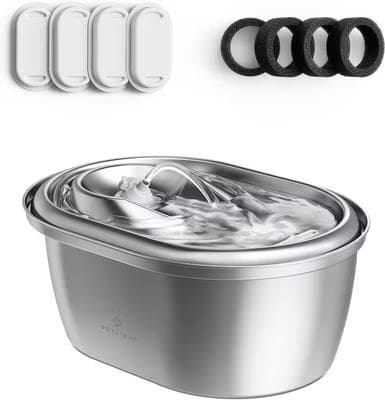
304 food-grade stainless steel pet water fountain, 101 oz. The circulating, filtered water encourages cats to drink more, which supports urinary tract and kidney health.
Webvet may earn a commission when you click through to Chewy, at no extra cost to you.
 $65 · no membership
Have a health question about your cat?
A licensed vet can assess your cat over video and prescribe online when it's appropriate.
 Talk to a vet
- Licensed vets
- All 50 states
- same-day Rx
Webvet may earn a commission if you book.
Is it the food or your cat? Pickiness, boredom, and bowl problems

This is the diagnostic question that makes this situation unique. Is the problem the food, or is it your cat? Sorting this out helps you decide whether a simple fix is reasonable or whether you should skip straight to the vet.
Signs the problem may be the food or setup (lower urgency, worth adjusting):
- Your cat refuses one specific food but eagerly eats another. A cat not eating wet food but acting normal while still eating kibble, or the reverse, points toward preference or texture, not necessarily illness. Many owners ask why is my cat not eating wet food but eating dry food; the answer is often texture, temperature, or freshness rather than sickness.
- The refusal started right after you switched brands, flavors, or the food sat out too long.
- Your cat eats better from a different bowl, a flat plate, or a quieter spot. Whisker fatigue and busy feeding locations are real deterrents.
Signs it is more likely your cat than the food (higher urgency, see the vet):
- Your cat refuses everything, including former favorites.
- A cat sniffing food but not eating repeatedly, which suggests nausea or that eating is uncomfortable.
- Any weight loss, drooling, pawing at the mouth, or bad breath.
- The behavior lasts more than a day, or comes with any other symptom.
A reasonable rule of thumb: if swapping to a fresh, warmed, strong-smelling food gets your cat eating within a meal or two, the food or setup was likely the issue. If your cat still will not eat, assume it is your cat and call the vet. For a deeper walkthrough of tempting a reluctant eater, see our full guide on how to get a cat to eat.
Age and sex matter: kittens, senior cats, and new cats
The right level of concern shifts with your cat's age and situation.
- Kittens. A kitten not eating much but acting normal deserves faster action than an adult. Kittens have tiny energy reserves and can crash quickly, so do not wait a full 24 hours. Call your vet the same day if a young kitten is skipping meals.
- Senior cats. An old cat not eating much but acting normal should raise your antenna, because early kidney disease, dental disease, hyperthyroidism, and other age-related conditions often begin with subtle appetite change. If you also notice an old cat not eating and sleeping a lot, treat the combination seriously and get bloodwork. Our dedicated guide covers the senior cat not eating in depth.
- New cats. A new cat not eating much but acting normal is extremely common in the first days after adoption. Stress and unfamiliar surroundings suppress appetite. Give a quiet space, a consistent routine, and time, but still call your vet if a new cat eats nothing for more than 24 hours.
- Sex and neuter status. Owners often search for a male cat not eating much but acting normal, a female cat not eating much but acting normal, or a neutered male cat not eating much but acting normal. Sex by itself does not change the 24-hour rule. There is one crucial exception: a male cat straining in the litter box while not eating can indicate a urinary blockage, which is a life-threatening emergency covered in the red-flags section below.

Lickable cat treats with real chicken, made to support comfort and tranquility. 12 single-serve 0.5-oz tubes.
Webvet may earn a commission when you click through to Chewy, at no extra cost to you.
When "acting normal" isn't the whole story: pair symptoms to watch

The single most useful thing you can do is look past appetite and check for a second symptom. A cat not eating but acting normal with no other signs is one situation. The same cat with a paired symptom is often a different, more urgent one. The table below routes you to the right next step and, where relevant, to the sibling guide that covers that combination in depth.
| Not eating, plus... | What it can point to | How urgent |
|---|---|---|
| Still drinking water, otherwise normal | Often earlier or milder, but still needs a vet if over 24 hours | Call vet within 24 hours |
| Not drinking either | Dehydration plus fatty-liver risk | Urgent, vet today or ER |
| Not pooping | Possible constipation or GI slowdown | Vet within 24 hours |
| Vomiting | Nausea, GI or systemic illness | Vet soon, sooner if repeated |
| Diarrhea | GI upset, infection, dietary issue | Vet within 24 hours |
| Sleeping more, lethargic, hiding | More likely genuine illness | Vet promptly |
A few of these have dedicated homes so we can go deep without repeating ourselves:
- Cat not eating but drinking water but acting normal. This milder-seeming pattern still deserves attention. See cat not eating but drinking water.
- My cat is eating less and sleeping more but acting normal, or a cat that is clearly lethargic. Lethargy shifts the odds toward real illness. See cat not eating and lethargic.
- Cat not eating and throwing up but acting normal. Vomiting has its own causes and workup. We cover the eating-plus-vomiting angle under our cat throwing up resource rather than duplicating it here, so if vomiting is present, treat it as a reason to call your vet promptly.
- Cat not eating or pooping but acting normal or cat not eating and diarrhea but acting normal. These GI pairings warrant a vet call within a day, sooner if your cat seems uncomfortable.
One reassuring note that is genuinely true: a cat not eating but purring is not necessarily contradictory. Cats purr when content and also to self-soothe when stressed or unwell, so purring alone should not talk you out of a needed vet visit.
How to bring back your cat's appetite at home (vet-safe steps)

If you are asking how do I bring back my cat's appetite, here is the honest framing: these steps are things to try while you arrange a vet visit, not instead of one. They are safe first moves for a cat that has skipped a meal or two and is otherwise well. They are not a treatment for a cat that has refused food for more than 24 hours.
Vet-safe things you can try at home:
- Warm the food. Gently warming wet food to around body temperature releases aroma and can tempt a cat whose smell is dulled. Warm, do not cook, and always test the temperature.
- Offer strong-smelling favorites. A small amount of plain, unseasoned cooked chicken, or a favorite pate, can restart interest.
- Fix the environment. Move the bowl to a quiet, low-traffic spot away from litter boxes and busy walkways. Use a clean, shallow, wide bowl to avoid whisker discomfort.
- Freshen everything. Discard stale food, wash the bowl, and serve a fresh portion. Small, frequent offerings often work better than one large bowl.
- Reduce stress. Calm household, predictable routine, and a safe hiding spot can all help a stressed or new cat start eating.
What to avoid without veterinary guidance:
- Do not syringe-feed or force-feed on your own. According to VCA Animal Hospitals, appetite stimulation and assisted feeding for an inappetent cat should be vet-directed, because syringe and force-feeding carry a real risk of aspiration and nutritional problems and are not a substitute for diagnosis.
- Do not use human appetite tricks or medications. Many are unsafe for cats.
- Do not keep trying home tricks for days. If a meal or two of these steps does not work, that is your signal to stop experimenting and call your vet.
If you want the full playbook of gentle, safe techniques, our detailed guide on how to get a cat to eat walks through each one, and what to feed a sick cat that won't eat is covered there too.
When to call the vet or go to the ER

This section is the one you should not skim. A cat not eating but acting normal can be a slow-building emergency, so use clear thresholds rather than gut feel.
Call your vet (same day) if:
- Your cat has eaten little or nothing for more than 24 hours.
- Your cat is eating much less than usual for 2 or more days.
- You notice weight loss, bad breath, drooling, or pawing at the mouth.
- Your cat is a kitten, a senior, diabetic, or has a known health condition.
Remember the anchor rule: prolonged not-eating is dangerous because of hepatic lipidosis, and a normal-looking cat is not exempt. When you are unsure, the safe move is always to call. No responsible veterinarian will fault you for checking on a cat that will not eat.
Frequently asked questions
How to tell when a cat's body is shutting down?
Signs that a cat may be nearing the end of life often include near-total refusal of food and water, profound weakness or inability to stand, very cold extremities, labored breathing, and withdrawal or hiding. These call for an urgent, compassionate conversation with your veterinarian. Do not assume the worst from appetite loss alone, though, because a cat not eating but acting normal is far more often treatable than end-stage, which is why a prompt vet visit matters.
What are signs of fading cat syndrome?
Fading is a term used mainly for very young kittens who fail to thrive. Signs include weakness, refusal to nurse or eat, low body temperature, constant crying or unusual silence, and lack of weight gain. It is an emergency in kittens because their reserves are tiny. Any kitten that is not eating should be seen by a vet the same day rather than watched at home.
Why is my cat eating small amounts but acting normal?
A cat eating small amounts but acting normal most often reflects early illness the cat is masking, mild nausea, dental discomfort, stress, or a food preference issue. Because cats instinctively hide sickness, reduced intake can be the first visible clue to a real problem. If the reduced eating lasts more than a day or comes with any other symptom, call your vet.
How do I bring back my cat's appetite?
Try warming wet food to release its aroma, offering a strong-smelling favorite in small frequent portions, and moving the bowl to a quiet, clean, low-stress spot, all while you arrange a vet visit. Avoid syringe-feeding or force-feeding unless your veterinarian directs it, because of aspiration risk. If a meal or two of gentle tempting does not work, stop and call your vet rather than waiting.
What do cats do right before they pass away?
Cats near the end of life commonly stop eating and drinking, seek out quiet or hidden places, become very weak or still, may breathe with difficulty, and often disengage from their usual routines. These signs together are very different from a bright, active cat that simply skipped a meal. If you see this cluster of signs, contact your veterinarian promptly for guidance and comfort care.
What is the 3-3-3 rule for cats?
The 3-3-3 rule is a general guideline for adopting a new cat: expect roughly 3 days for your cat to decompress and hide, about 3 weeks to settle into a routine, and around 3 months to feel fully at home. A new cat not eating much but acting normal in those first few days is common and usually stress-related. Even so, a new cat that eats nothing at all for more than 24 hours still needs a vet call.
What is tarzan syndrome in cats?
Tarzan syndrome is not a recognized veterinary medical diagnosis for appetite loss, and it is not a substitute for a real evaluation. If you have seen the term used to explain a cat that will not eat, do not rely on it. Any cat that refuses food for more than 24 hours, or eats far less than normal for several days, should be assessed by a veterinarian to find the true cause.
$65 · no membershipHave a health question about your cat?
A licensed vet can assess your cat over video and prescribe online when it's appropriate.
Talk to a vet- Licensed vets
- All 50 states
- same-day Rx
Webvet may earn a commission if you book.

Editor
The Webvet Editorial Team is the in-house group of pet-care editors and writers behind Webvet, operated by Smart Pet Collective. The team researches, writes, and maintains Webvet's pet health, behavior, and medication content. Every article follows a defined editorial process: research from reputable veterinary and scientific sources, careful drafting, mandatory review of medical content by a credentialed veterinarian, and dated publication. Health and medication articles are medically reviewed by a licensed veterinary professional before they go live and are kept current over time.
Veterinarian · BVMS MRCVS
Dr. Pippa Elliott, BVMS, MRCVS, is a veterinarian with nearly 30 years of experience in companion animal practice. Dr. Elliott earned her Bachelor of Veterinary Medicine and Surgery from the University of Glasgow. She was also designated a Member of the Royal College of Veterinary Surgeons. Married with 2 grown-up kids, Dr. Elliott has a naughty Puggle named Poggle, 3 cats and a bearded dragon.


