The Best Dog Nail Grinder of 2026: Vet-Guided Picks
Compare four dog nail grinders by control, abrasive system, published noise evidence, and fit, then learn vet-guided quick, heat, and anxiety-safe techniques.

BVMS MRCVS
Medically reviewed by Dr. Pippa Elliott, BVMS MRCVS · Last reviewed

This article contains affiliate links. Webvet may earn a commission when you buy through them, at no extra cost to you.
The best dog nail grinder for most homes is the Dremel PawControl 7760-PGK. Its four speeds, two documented abrasive setups, nail guide, and unusually detailed manufacturer instructions give a careful handler more control than the simpler tools in this lineup. The Casfuy Upgraded Quiet 6 Speed is our budget pick, the PATPET Steel Grit Nail Grinder is the compact option, and the Dremel 7350-PT is the simplest Dremel.
WebVet compared current product specifications, manufacturer instructions, replacement availability, and veterinary and behavior guidance. We did not physically test, time, measure, or sound-test these grinders. That matters because published noise claims do not come from one shared protocol, and a product that sounds mild to a person can still bother a dog through pitch, vibration, or the sensation at the nail.
A grinder can make gradual shortening and rounded edges easier, especially when dark nails make one large clip feel risky. It is not automatically safer than clippers. Any rotating abrasive can contact the quick, build friction heat, catch long hair, or frighten a dog if the handler removes too much or pushes through stress.
If you would rather cut than grind, our companion guide to the best dog nail clippers ranks plier, scissor and guillotine clippers by dog size and nail color.
Our Top Dog Nail Grinder Picks
In this specification-based comparison, the Dremel 7760-PGK is best overall because it combines useful speed control, replaceable abrasives, an angle guide, and a model-specific instruction set. Choose a different pick when a lower current price, a steel-grit wheel, or a single uncomplicated speed matters more than maximum adjustability. This product selection combines vet-guided quick anatomy with friction-heat boundaries, so each control is judged alongside safe technique.
Retail names vary: pet nail grinder, electric dog nail grinder, rechargeable dog nail grinder, cordless dog nail grinder, dog toe nail grinder, and professional dog nail grinder can all describe this category. A dog nail trimmer grinder label does not prove professional quality. Exact controls, abrasive compatibility, replacement support, and safe technique matter more than the wording on a listing.
The four products below were selected for distinct, documented roles. The comparison is specification-based, not a report of WebVet product testing. Prices and stock change, so compare the current offer as well as the tool's replacement path before buying.
Best overall: Dremel PawControl 7760-PGK. It offers the broadest documented control in this group, but no grinder can sense the quick or replace careful nail-by-nail inspection. Start with the lowest practical speed, use light pressure, keep the abrasive moving, and stop if the dog shows stress or the nail begins to feel warm.
| Pick | Controls | Abrasive system | Visibility or angle aid | Best fit |
|---|---|---|---|---|
| Dremel PawControl 7760-PGK | Four speeds, 8,000 to 25,000 RPM | 60-grit discs plus sanding-band option | Paw guide or nail guard; not a quick sensor | Most homes and handlers who want adjustable control |
| Casfuy Upgraded Quiet 6 Speed | Six speeds, published 7,000 to 12,000 RPM range | Replaceable grinding head | Two LEDs and protective sleeve; neither detects the quick | Budget-focused buyers who value fine speed steps |
| PATPET Steel Grit Nail Grinder | Two settings, published 8,000 and 17,000 RPM | Replaceable steel-grit wheel | LED and three-port cover; not a quick sensor | Buyers who prefer a compact wheel-and-cover design |
| Dremel 7350-PT | One speed, published 12,000 RPM | 60-grit sanding drum and replaceable bands | No electronic quick detection | Buyers who want a simple Dremel without multiple settings |
Noise note: Dremel publishes 46.25 dB for the 7760-PGK and 50.93 dB for the 7350 family on its own comparison chart. We did not find equivalent, exact-SKU, shared-protocol figures for the Casfuy or PATPET picks, so this table does not rank the four by loudness.
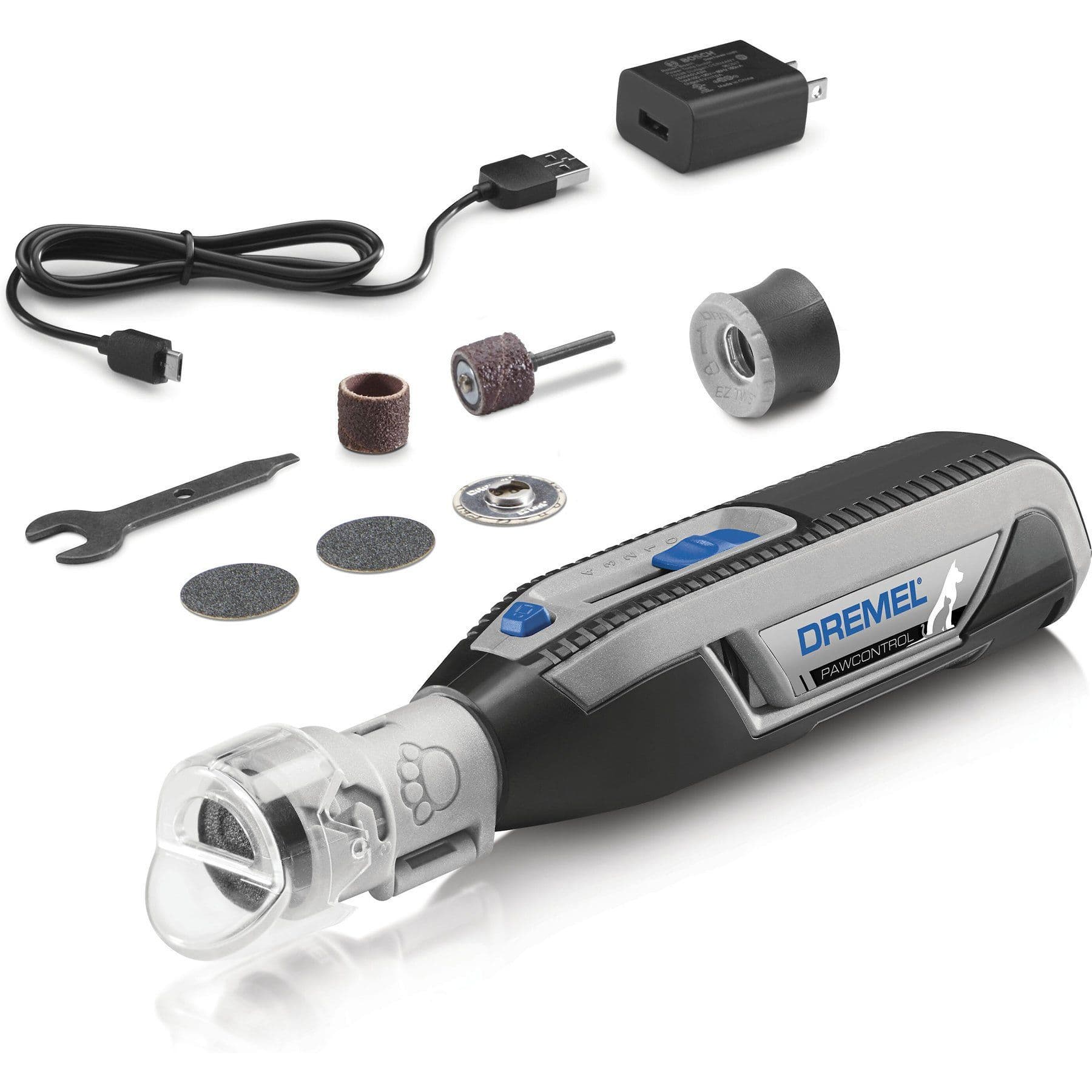
Best Overall: Dremel PawControl 7760-PGK
Webvet may earn a commission when you click through to Chewy, at no extra cost to you.
The Dremel PawControl 7760-PGK is the strongest all-around choice for a handler who wants room to adjust. Dremel's official pet-grooming chart lists four settings from 8,000 to 25,000 RPM, a rechargeable integrated lithium-ion battery, a 9.6-ounce tool weight, 60-grit sanding discs, and a nail guide. The kit also supports freehand use with a sanding band.
That range does not mean a higher setting should be the default. Dremel's pet instructions recommend the lowest setting for most grooming and emphasize light pressure, motion, and brief contact. A cautious handler can begin low, see how efficiently the fresh abrasive removes nail, and only increase speed when the nail thickness and the dog's comfort genuinely call for it.
What stands out and what to weigh
Pros
- Four speeds provide more adjustment than the other locked picks.
- The guide can support a consistent angle, while freehand band use gives an experienced handler another option.
- Dremel sells model-specific 60-grit replacement discs, and standard documented band components are readily identifiable.
- The manufacturer publishes unusually specific grooming and hair-control guidance.
Cons
- The guide is not a quick sensor and cannot show where living tissue ends.
- The integrated battery is not user-serviceable.
- More settings and two abrasive configurations add decisions that a one-speed buyer may not want.
- A worn 60-grit surface can tempt a handler to add pressure, which increases heat instead of restoring cutting efficiency.
The 7760-PGK is also the only pick here for which Dremel publishes a model-specific 46.25 dB figure at its lowest setting. That number can describe the tool under Dremel's documented condition, but it cannot prove that the PawControl is the quietest dog nail grinder across brands. The dog's response remains the meaningful test at home.
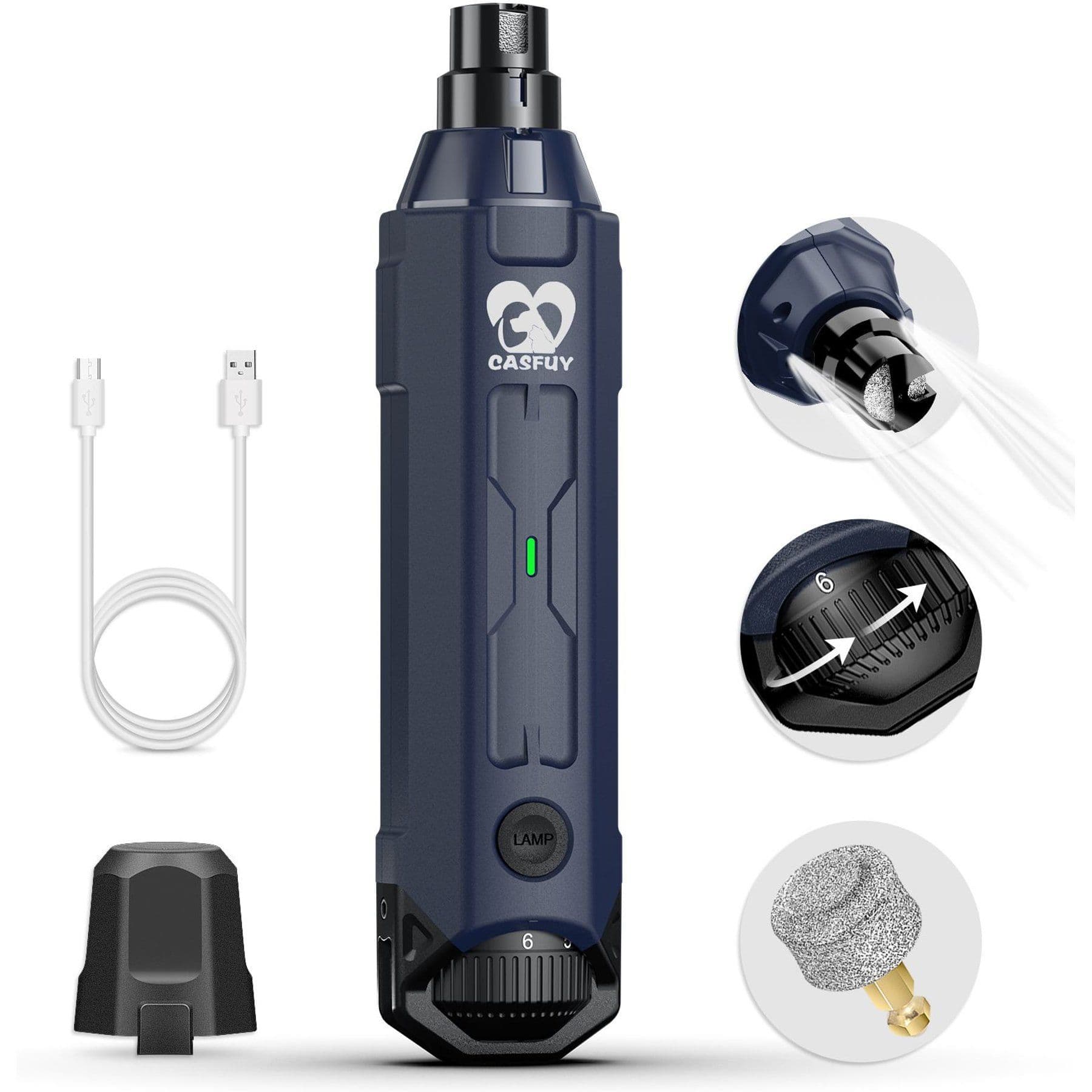
Best Budget: Casfuy Upgraded Quiet 6 Speed
Webvet may earn a commission when you click through to Chewy, at no extra cost to you.
The Casfuy Upgraded Quiet 6 Speed is the budget-oriented choice for buyers who want smaller speed steps, two work lights, and a replaceable head. The current exact Chewy listing documents six speeds across a published 7,000 to 12,000 RPM range, dual LEDs, rechargeability, and a protective sleeve.

Six settings can be useful when a dog accepts one level of sound or vibration better than another. They also let a handler use a lower setting for cautious finishing and reserve a higher setting for a thick nail, provided contact stays light and brief. More settings do not make the grinder self-protecting. The quick, nail temperature, abrasive condition, and dog still need constant attention.
What stands out and what to weigh
Pros
- Six speed steps give the finest published adjustment in this lineup.
- The LEDs can illuminate the work area on translucent or light nails.
- A protective sleeve can help position certain nail sizes near the grinding head.
- A separate replacement-head listing gives the owner a clearer maintenance path than a disposable tool.
Cons
- The exact retail page does not expose a stable manufacturer model number.
- We did not verify a model-specific decibel value for this exact SKU.
- An LED may not shine through an opaque black nail, and it does not detect the quick.
- The protective sleeve is a positioning aid, not a stop that prevents overgrinding.
The budget label reflects the role locked for this roundup, not a promise that Casfuy will always cost less. Check the live price and confirm that the replacement head matches the exact six-speed unit before ordering. Avoid borrowing runtime or sound claims from another Casfuy grinder that looks similar.
Casfuy's replacement listing describes its abrasive as an advanced diamond drum bit. Shoppers may also see this shortened to diamond bit, but the material name does not prove that a head fits every Casfuy body. Match the exact connection and model before installation.
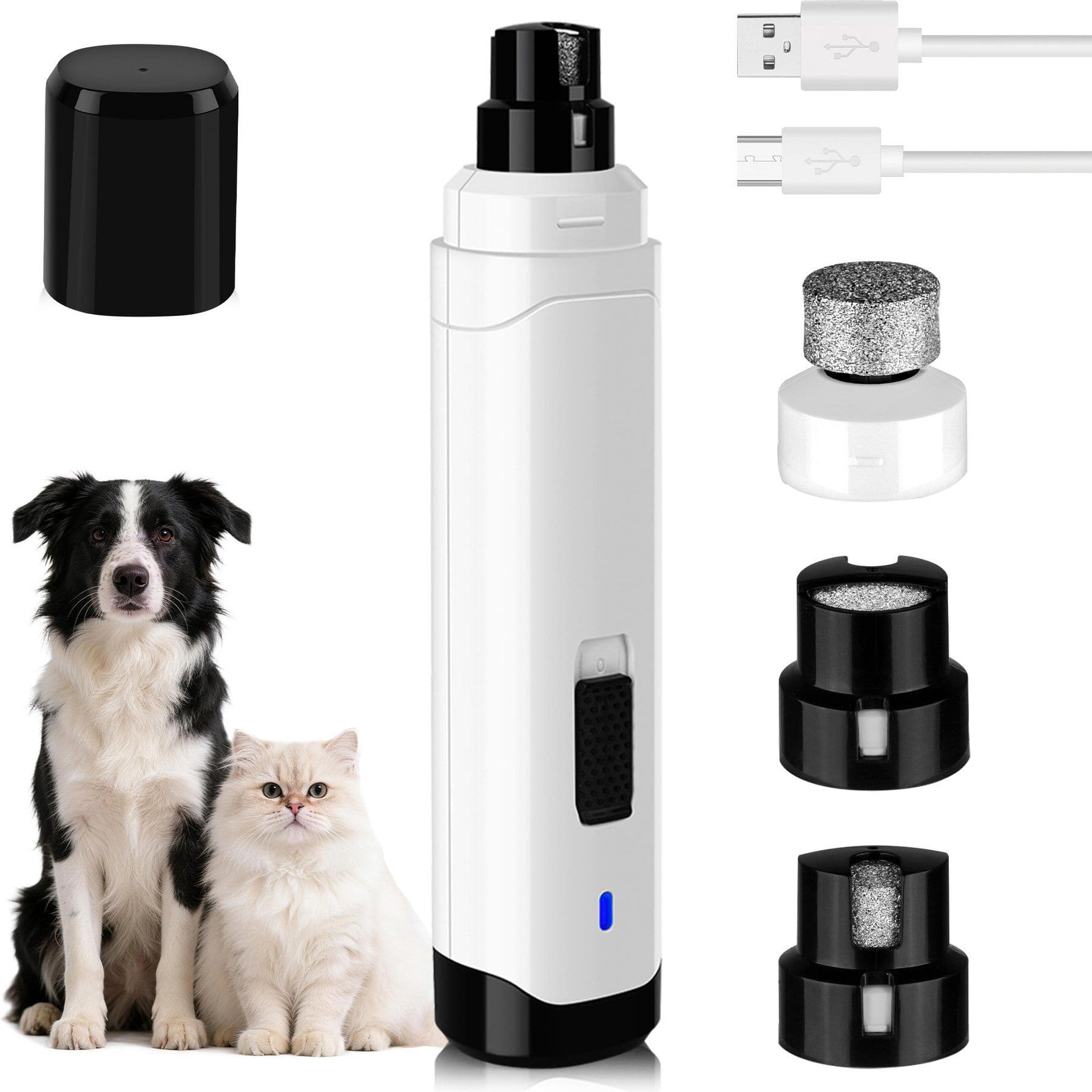
Best Compact Option: PATPET Steel Grit Nail Grinder
Webvet may earn a commission when you click through to Chewy, at no extra cost to you.
The PATPET Steel Grit Nail Grinder is the compact pick for someone who prefers a self-contained wheel, a ported cover, and two speed choices. The current exact Chewy record lists 8,000 and 17,000 RPM settings, three ports for different nail sizes, USB rechargeability, LED illumination, a replaceable wheel, and a brand claim of up to two hours of runtime after a three-hour charge.
Its steel-grit wheel removes the recurring step of sliding a fresh paper band onto a drum. The wheel still wears, loads with nail dust, and needs cleaning or eventual replacement. A metal abrasive should never invite more pressure. Let the surface do the work, and pause if the rate of removal drops.
What stands out and what to weigh
Pros
- The integrated wheel-and-cover design keeps the main choices simple.
- Three openings give options for presenting different nail sizes to the wheel.
- The wheel can be cleaned and replaced rather than treating the whole grinder as disposable.
- USB charging supports portable use without a separate removable battery pack.
Cons
- PATPET's listing maps 17,000 RPM to small and medium pets and 8,000 RPM to medium and large pets. Follow the exact manual and judge removal rate rather than inventing a size rule from speed alone.
- The cover openings will not suit every nail shape or every handler's preferred angle.
- No exact-SKU decibel figure with a documented protocol was verified.
- The LED and cover do not locate or protect the quick.
A replacement wheel is currently listed separately, but names across a brand's accessory catalog can be broad. Match the replacement listing, dimensions, and compatibility statement to the exact PATPET grinder before purchasing spares.
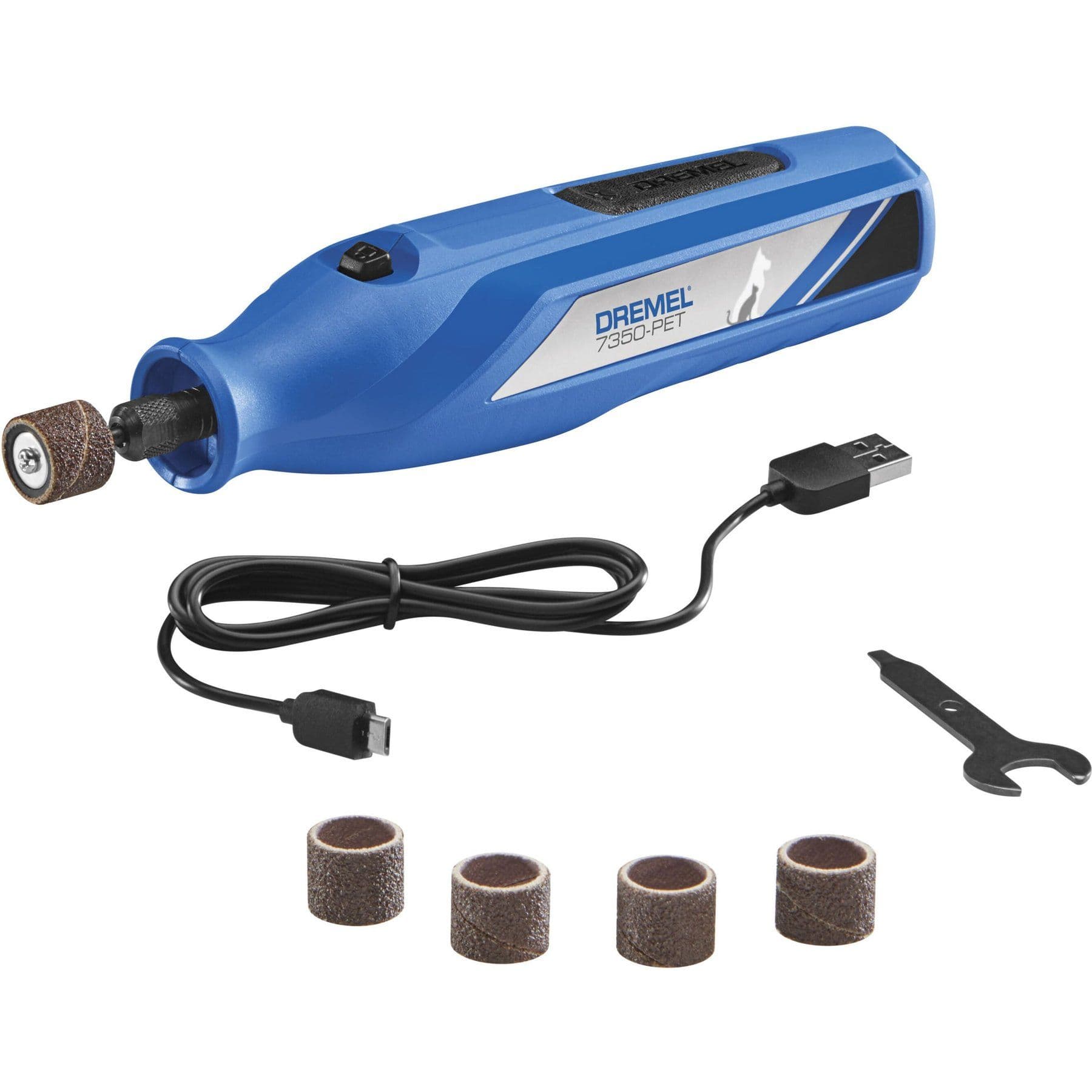
Best Simple Dremel: Dremel 7350-PT
Webvet may earn a commission when you click through to Chewy, at no extra cost to you.
The Dremel 7350-PT is the simple Dremel choice: one speed, one familiar 60-grit sanding-drum system, and no need to decide among several settings. Chewy's exact product record lists a cordless single-speed tool and a 60-grit drum compatible with Dremel sanding components.
There is a naming wrinkle worth knowing. Retailers use 7350-PT, while Dremel's chart and manual use 7350-PET. Dremel's own FAQ discusses the 7350-PT comparison and calls the product the 7350-PET in its answer. The same official material describes the compact, single-speed 7350 family as the simpler entry point beside the more versatile 7760 PawControl.
What stands out and what to weigh
Pros
- A single published 12,000 RPM setting removes setup indecision.
- The 60-grit drum-and-band system is straightforward to inspect and refresh.
- Dremel publishes model-family specifications and handling guidance.
- The compact body and integrated lithium-ion battery make it easy to position around a paw.
Cons
- One speed offers less room to adjust sound, vibration, or removal rate.
- A paper band is a consumable, and a loaded or glazed band should not be rescued with extra pressure.
- The battery is integrated and not user-serviceable.
- The kit does not detect the quick or remove the need for frequent inspection.
Dremel lists a 50.93 dB figure for the 7350 family on the same company chart that lists 46.25 dB for the 7760-PGK. Even within one brand, a number cannot tell you whether a particular dog will accept the pitch and vibration at the paw. Choose the 7350 for simplicity, not because a specification guarantees calm behavior.
Best Dremel Dog Nail Grinders
The best Dremel dog nail grinder depends on whether you want adjustability or simplicity. Choose the Dremel PawControl 7760-PGK for four speeds, a guide, and both disc and band workflows. Choose the Dremel 7350-PT when one 12,000 RPM setting and a conventional 60-grit sanding drum are easier to manage.
The PawControl is the stronger default for a mixed household because nail thickness and tolerance can vary from dog to dog. Beginning at 8,000 RPM gives the handler a lower starting point, while the additional settings provide room when a fresh abrasive and light contact are not removing enough material. Its guide may also help a new user maintain the recommended presentation angle.
The 7350-PT makes a different tradeoff. There is less to configure, but no way to reduce or increase the speed. That can be helpful for someone who wants an on-off routine, yet limiting when the dog's tolerance or nail thickness would benefit from adjustment.
Which Dremel should you choose?
Use these decision rules:
- Pick the 7760-PGK if speed control, a guide, and disc-versus-band choice matter.
- Pick the 7350-PT if one speed and a standard sanding drum feel more manageable.
- Pick neither merely because Dremel publishes sound figures. Your dog's observed comfort is more important than a label.
- Confirm the exact replacement part. A disc, band, drum, and mandrel are not interchangeable just because they share a brand.
Both Dremels depend on a fresh abrasive and light technique. A professional dog nail grinder is not a regulated credential, and using a rotary-tool brand does not turn a home session into professional grooming. The handler still needs paw control, quick awareness, cooling pauses, and a plan to stop before the dog struggles.
Quietest Dog Nail Grinders for Anxious Dogs
There is no defensible quietest dog nail grinder in this four-product lineup because the available sound statements are not all model-specific measurements made under one protocol. Manufacturer noise figures are not comparable without a shared test protocol, and only Dremel publishes a model-specific value for the locked picks. Dremel publishes 46.25 dB for the 7760-PGK and 50.93 dB for the 7350 family on its own chart. Casfuy and PATPET use low-noise marketing language, but we did not verify comparable exact-SKU data for them.
No model is truly a silent dog nail grinder, and the best dog nail grinder for scared dogs is not established by the lowest marketing number. A quiet dog nail grinder can still transmit uncomfortable pitch or vibration through the paw, so gradual exposure and the dog's observed response remain decisive.
That does not make sound irrelevant. It means the buying decision should focus on what can be controlled: the dog's distance from the tool, the setting used, session length, floor vibration, abrasive condition, and the ability to stop. Pitch and vibration can matter as much as the number a sound meter records.

The goal of desensitization is not to distract a panicked dog long enough to finish. It is to change the dog's expectation in steps small enough to remain tolerable. This is cooperative care: progress from tool-off exposure to one brief nail touch without forcing the dog. VCA's handling guidance describes pairing gradual handling with positive outcomes, while a Fear Free chin-rest behavior can give some dogs a clear way to opt in and lift away.
A practical progression looks like this:
- Reward calm paw or leg contact without any tool present.
- Place the powered-off grinder in view, reward, and put it away.
- Turn it on at a distance for one second, reward, and stop.
- Bring the running tool closer over several short sessions without touching the dog.
- Touch the body of the powered-off tool to the leg so the dog learns a new sensation.
- Make one very brief contact with one nail, reward generously, and finish.
Some dogs progress in days, while others need weeks or a different grooming plan. A dog with a bite history, severe panic, painful feet, a damaged nail, or a sudden new aversion should be assessed by a veterinarian or qualified professional. Medication or clinic support can be kinder than repeated restraint when fear is intense.
Among the products, the Dremel PawControl 7760-PGK and Casfuy Upgraded Quiet 6 Speed provide the most speed adjustment, which may help find a tolerable starting setting. The Dremel 7350-PT removes setting changes but offers no lower-speed option. PATPET has two settings. None can promise quiet, low vibration, or acceptance for an individual dog.
 $65 · no membership
Have a health question about your dog?
A licensed vet can assess your dog over video and prescribe online when it's appropriate.
 Talk to a vet
- Licensed vets
- All 50 states
- same-day Rx

Webvet may earn a commission if you book.
Quick-Sensor Grinders and Picks for Large Dogs
The best dog nail grinder with a quick sensor is a misleading search idea because none of these four products has an electronic quick detector. LEDs and guards can improve visibility or angle control, but none of the locked products has a true electronic quick sensor. In short, an LED is not a sensor, and dark nails need incremental grinding. These aids do not identify nerves and blood vessels, predict the quick's length, or stop the abrasive before living tissue.
That distinction becomes especially important with opaque nails. A bright LED may help the handler see the nail surface and collect dust, yet it may not transmit through black keratin. A port may steady a small nail, yet a thick nail can fit poorly or meet the wheel at an awkward angle. Remove tiny amounts and inspect the end of the nail after each pass regardless of the accessory.

For a large dog, power is only one part of fit. The handler must be able to support a heavy paw without twisting the toe, keep hair away, and maintain a stable approach while the dog stands or lies comfortably. Thick nails may require several brief contacts and more than one session instead of one long push.
The picks divide this way:
- Dremel PawControl 7760-PGK: strongest overall large-dog option because four speeds allow gradual adjustment and the guide can support angle control.
- Casfuy Upgraded Quiet 6 Speed: six steps are useful when the handler wants to tune removal rate, but the LEDs remain visibility aids only.
- PATPET Steel Grit Nail Grinder: the wheel may suit an owner who prefers a reusable abrasive surface, though the port size and angle must fit the nail.
- Dremel 7350-PT: simple and capable of gradual work, but a single setting may take longer or feel less adaptable on very thick nails.
Small dogs pose a different control problem. Their nails offer less margin, and a large guard opening or coarse fresh abrasive can remove material quickly. Support one toe, use the lightest practical contact, and inspect more often. The best dog nail grinder for small dogs is the one the handler can place precisely at a tolerable setting, not automatically the smallest tool.
On dark nails, Washington State University's veterinary guidance recommends tiny increments and watching the center of the cut surface change as living tissue approaches. A grinder rounds that surface rather than making one flat clip, but the same stop-and-inspect logic applies.
Are Nail Grinders Good for Dogs? A Vet View
Nail grinders can be good for dogs when they allow gradual shortening, smoother edges, and calmer handling. They are a poor choice when sound or vibration triggers fear, long hair cannot be controlled safely, the paw is painful, or the handler cannot keep contact brief. The right tool depends on the dog and the person using it.
The main benefit is control over how much nail comes off in one pass. A grinder can remove a thin layer and let the handler reassess, which is useful on dark nails. It can also round a freshly shortened edge that might otherwise feel sharp. For some dogs, the steady sound is easier than the squeeze and snap of clippers.
The drawbacks are just as real:
- Friction can heat the nail and cause discomfort or a burn.
- A rotating head can catch long paw hair.
- Nail dust can irritate eyes or airways.
- Vibration travels through the nail even when the motor sounds quiet.
- Contact with the quick can hurt and bleed.
- A fearful dog can injure itself or the handler while trying to escape.
VCA Animal Hospitals notes both the smoothing advantage and grinder-specific risks, including hair entanglement, skin injury, and dust. This is why a grinder should be treated as a powered grooming tool rather than a protective shortcut.
Regular maintenance matters because very long nails can change how a dog places its feet. Texas A&M Veterinary Medicine explains that overgrowth can make walking or running painful and contribute to foot or tendon injury. The appropriate interval varies with growth rate, exercise surface, gait, anatomy, and health, so use a recurring inspection rather than one universal calendar.
Ask a veterinarian or experienced groomer for help when nails are severely overgrown, curled, split, infected, painful, or associated with limping. A professional can also demonstrate positioning and help create a plan for a dog who cannot yet tolerate home care.
Grinder vs. Clippers, and How to Grind Nails Safely
Dog Nail Grinder vs. Clippers
Is it better to cut or grind a dog's toenails? Neither method is universally better. A grinder is not universally safer than clippers; the best tool depends on the dog, handler skill, and tolerance for sound and vibration. Clippers remove length quickly and without motor noise, while a grinder removes smaller amounts and rounds the edge. The safer choice is the tool the handler can control without force, heat, hair entanglement, or one oversized cut.
Clippers make sense when a dog accepts the squeeze, the nails are easy to position, and the quick is visible or the handler is experienced. They are also faster for taking off a clearly safe tip. The downside is that one cut removes a fixed chunk, and dull or poorly sized jaws can crush or split a nail.
A grinder makes sense when gradual removal feels more controllable, dark nails call for repeated inspection, or a smooth finish matters. Its downside is a longer powered session, plus sound, vibration, dust, and heat. A grinder can still reach the quick, so it does not eliminate the central risk.
| Decision | Clippers may fit better | A grinder may fit better |
|---|---|---|
| Dog's sensory tolerance | Dislikes motor sound or vibration | Dislikes the squeeze or clipping snap |
| Nail visibility | Safe tip is easy to identify | Dark nail benefits from tiny passes and inspection |
| Amount to remove | One modest safe tip can come off cleanly | Length should come off in gradual layers |
| Edge finish | A separate file is acceptable | Rounded finish is desired in the same workflow |
| Hair control | Long paw hair is difficult to secure | Fur can be reliably kept away from the rotating head |
| Handler control | Confident placing the clipper and sizing the cut | Confident maintaining motion and limiting contact time |
Many households use both. Clippers can remove an obvious safe hook, then a grinder can smooth the edge. This combined approach is not appropriate when the dog is already near its tolerance limit. Fewer, calmer steps are better than adding a second tool simply to create a perfect finish.
If the animal is a cat, use a species-specific tool and handling plan rather than applying a dog roundup broadly. WebVet's guide to cat nail clippers and trimming covers that separate decision.
How to Grind Dog Nails Safely
The safest way to shorten a dog's nail quickly is not to chase the final length in one session. Remove a small amount, inspect, and repeat only while the nail stays cool and the dog stays comfortable. Severely overgrown nails often need a gradual schedule because living tissue may extend farther toward the tip.
Quick anatomy is simple but consequential: the quick contains blood vessels and nerves, and dark nails require tiny increments with inspection after each pass. In a light nail, it may appear as a pink center. VCA's clipping guidance advises staying roughly 2 to 3 mm away when the quick is visible and taking only about 1 to 2 mm with each clip on dark nails. Those figures are clipper-specific, not grinding-depth targets. With a grinder, make brief passes, clear the dust, and inspect the individual nail after each pass.

Before turning on the tool, prepare:
- A nonslip surface and enough light to see each nail clearly
- The exact grinder manual and a fresh, compatible abrasive
- High-value rewards for a dog who can comfortably eat
- Styptic powder or another veterinarian-approved bleeding-control product
- A towel, sock, band, or careful trim to keep long paw hair away from the rotating head
- Eye protection as directed by the exact manual; Dremel requires it for the 7760-PGK

A controlled grinding sequence
- Check the paw. Look for a split nail, swelling, discharge, bleeding, tenderness, or a foreign object. Do not grind an abnormal or painful nail without veterinary guidance.
- Secure hair, not the dog. Expose the nail while keeping fur away from the head. Position the dog comfortably rather than pinning a struggling body.
- Choose the lowest practical setting. Follow the exact manual. A fresh abrasive at light pressure is safer than a worn abrasive at high pressure.
- Support one toe. Hold near the nail without squeezing a joint or twisting the paw. Stable support reduces accidental side contact.
- Touch briefly and keep moving. Sweep across the tip instead of holding the abrasive in one place. Let the tool's speed and grit remove material.
- Pause and inspect. Check the nail end, temperature, dog, hair, and abrasive before another pass.
- Round only the safe edge. Do not keep polishing after the nail reaches an appropriate length.
- End early if needed. One paw, one nail, or even one successful touch can be a complete training session.
For dark nails, the inspection step carries the most weight. Remove powder so the nail end is visible. As the dry center changes and living tissue appears closer, stop. Do not rely on the LED, guard, port, or a remembered diagram to make the decision for you.
If the quick bleeds, stop the session. Apply styptic powder and steady pressure according to product or veterinary instructions, keep the dog calm, and prevent running until bleeding is controlled. Contact a veterinarian if bleeding does not stop promptly, the nail is torn, pain is substantial, or you are unsure what was injured.
Dewclaws and Scratchboards
Dewclaws need deliberate checks because they may not contact the ground and can be easy to miss. Their position can also make grinder access awkward. Review WebVet's guide to dog dewclaws and nail care before trying to force a powered tool into a poor angle.
A scratchboard is another option for dogs who enjoy voluntary paw movements. Fear Free Happy Homes describes teaching the dog to scratch an abrasive board for rewards. Scratchboards can help with front nails but may not maintain rear nails or dewclaws, so every nail still needs inspection. They supplement rather than replace whole-paw checks.
How often to grind
Check nail length and gait regularly rather than promising one interval for every dog. Some active dogs wear nails on pavement, while others grow quickly or carry weight in a way that leaves certain nails untouched. The goal is a comfortable foot and an appropriate nail length, not adherence to a date.
If nails are long, smaller frequent sessions may encourage the quick to recede over time, but the response varies. Do not remove more living margin in the hope of accelerating the process. A veterinarian or groomer can assess the starting point and demonstrate a safe maintenance plan.
Grit, Bits, and Replacement Heads Explained
Dog nail grinder bits fall into two broad systems in this lineup: replaceable sanding media and reusable hard wheels. Diamond wheels, sanding drums, grit, replacement cadence, and long-hair entanglement risk affect ownership and safety. Sanding bands or discs provide predictable grit and a fresh cutting surface when replaced. A steel-grit wheel or diamond bit can last longer and may be cleanable, but it still needs replacement when wear or damage reduces control.
Grit numbers describe abrasive particle size. A lower grit is generally coarser and removes material more aggressively, while a higher grit is finer and favors smoothing. The locked Dremel kits use 60-grit media, which is coarse enough to remove nail efficiently. Coarse does not mean heavy pressure is appropriate.

| Abrasive | How it behaves | Maintenance | Replace when |
|---|---|---|---|
| 60-grit sanding disc | Flat replaceable surface used with a compatible mandrel or guide | Brush away dust and keep dry | Grit is glazed, torn, curled, loose, contaminated, or slow after cleaning |
| 60-grit sanding band | Sleeve fits a compatible drum for freehand grinding | Remove dust and check that it remains tight on the drum | Band slips, frays, cracks, loads heavily, or removes unevenly |
| Diamond grinding head | Reusable hard surface sold for a model-specific connection | Clean only as the exact manual permits and verify shaft fit | Cutting slows after cleaning, or the head is loose, chipped, uneven, or incompatible |
| Steel-grit or hard wheel | Reusable shaped surface that can be exposed through a cover port | Clean only as the exact manual directs and inspect the wheel mount | Cleaning no longer restores removal, or the wheel is chipped, loose, uneven, or damaged |
A sanding drum and a sanding band are separate parts. The drum supports the replaceable sleeve. A disc needs its documented mandrel, while a guided Dremel setup may use a specific disc diameter. Buying a generic abrasive because the grit number matches is not enough. Diameter, arbor or mandrel fit, guard clearance, and rated speed must also match.
The same compatibility rule applies to the Casfuy Upgraded Quiet 6 Speed and PATPET Steel Grit Nail Grinder. A replacement head may look similar across several tools from either brand but use a different shaft or housing. Match the exact product record and accessory compatibility before purchase. Never force a loose head onto a tool or operate a wheel that wobbles.
When to replace an abrasive
There is no responsible universal replacement schedule. Frequency depends on nail hardness, number of dogs, surface area used, pressure, speed, cleaning, and abrasive quality. Inspect before every session and replace based on performance and condition.
Practical replacement signals include:
- Nail removal becomes noticeably slower after proper cleaning.
- The handler feels tempted to press harder to get the old rate of removal.
- A band slips, frays, tears, or no longer sits evenly on the drum.
- A disc curls, loosens, develops a bald area, or no longer locks securely.
- A hard wheel chips, wobbles, feels loose, or develops uneven wear.
- Dust or residue cannot be removed by the method allowed in the manual.
Keep spare abrasives on hand if nail care is time-sensitive, but store them dry and labeled for the exact tool. A fresh correct abrasive gives better control than stretching a worn part for one more session. Replace the abrasive when cleaning no longer restores performance, or sooner if it is damaged, loose, or uneven.
Dog Nail Grinder Questions
Frequently Asked Questions
What is the best grinder for dog nails?
The Dremel PawControl 7760-PGK is the best overall choice in this guide. The Dremel 7760-PGK's control comes from four speeds and replaceable abrasives, including documented 60-grit disc and band options, plus an angle guide. The best fit can differ for a dog who needs a lower current price, a steel-grit wheel, or one simple speed. Safe grinder selection and use depend on the dog, handler, abrasive condition, and technique. WebVet based this verdict on published evidence, not hands-on testing. These answers focus on the safety questions people also ask before buying.
Does a dog nail grinder with a quick sensor really detect the quick?
No, a dog nail grinder with a quick sensor does not really detect the quick electronically. An LED and guard are not sensors: they can illuminate a nail or help with positioning, but neither identifies nerves and blood vessels or stops the abrasive at a safe depth. Dark nails require incremental grinding with tiny passes, dust removal, inspection after each pass, and a stop as the center changes toward living tissue.
What is the quietest dog nail grinder for an anxious dog?
There is no verified quietest dog nail grinder for every anxious dog. Dremel publishes manufacturer-rated noise for its two tools, while the exact Casfuy and PATPET listings do not provide comparable measurements under one protocol. Choose adjustable controls when useful, then judge the dog's response to sound, pitch, vibration, and handling through desensitization and cooperative care.
Can a dog nail grinder burn the nail?
Yes, a dog nail grinder can burn the nail. Friction creates heat that can cause pain or injury, especially when the abrasive stays in one place, pressure is heavy, or the surface is worn. Use brief contact and low pressure, keep the head moving, and allow cooling pauses. Stop if the nail feels warm or the dog reacts. Follow the exact product manual for model-specific limits.
When should a nail grinder head or disc be replaced?
A nail grinder head or disc should be replaced when removal remains slower after cleaning or when you see damage, looseness, or uneven wear such as tearing, glazing, chipping, or wobble. There is no universal calendar because nail hardness, pressure, speed, and use frequency vary. Confirm the replacement's diameter, mount, speed compatibility, and exact model fit before operating the tool.
$65 · no membershipHave a health question about your dog?
A licensed vet can assess your dog over video and prescribe online when it's appropriate.
Talk to a vet- Licensed vets
- All 50 states
- same-day Rx
Webvet may earn a commission if you book.

Editor
The Webvet Editorial Team is the in-house group of pet-care editors and writers behind Webvet, operated by Smart Pet Collective. The team researches, writes, and maintains Webvet's pet health, behavior, and medication content. Every article follows a defined editorial process: research from reputable veterinary and scientific sources, careful drafting, mandatory review of medical content by a credentialed veterinarian, and dated publication. Health and medication articles are medically reviewed by a licensed veterinary professional before they go live and are kept current over time.
Veterinarian · BVMS MRCVS
Dr. Pippa Elliott, BVMS, MRCVS, is a veterinarian with nearly 30 years of experience in companion animal practice. Dr. Elliott earned her Bachelor of Veterinary Medicine and Surgery from the University of Glasgow. She was also designated a Member of the Royal College of Veterinary Surgeons. Married with 2 grown-up kids, Dr. Elliott has a naughty Puggle named Poggle, 3 cats and a bearded dragon.


