Best Dog Nail Clippers: Vet-Guided Picks by Dog Size and Nail Type
A vet-guided comparison of the best dog nail clippers: plier, scissor and guillotine picks by dog size and nail type, how to find the quick, and what to do if a nail bleeds.

BVMS MRCVS
Medically reviewed by Dr. Pippa Elliott, BVMS MRCVS · Last reviewed

This article contains affiliate links. Webvet may earn a commission when you buy through them, at no extra cost to you.
The best dog nail clippers for most homes are a plier-style clipper with a safety stop, such as the Millers Forge Nail Clipper with Safety Stop for medium and large dogs, or a small scissor clipper such as the Frisco Nail Clippers for puppies and toy breeds. The right choice depends on three things you can check in a minute: your dog's size, how thick the nails are, and whether the nails are white or black.
This guide compares seven picks that are all sold through Chewy, explains the difference between plier, scissor, guillotine and grinder tools, and walks through the vet-guided technique for finding the quick, cutting at the right angle and stopping bleeding if you nick it. WebVet compared current manufacturer specifications, retailer listings and veterinary guidance from VCA, the AKC and the Merck Veterinary Manual. We did not physically test these clippers.
Best dog nail clippers at a glance
- 1Match the clipper style to your dog's size, nail thickness and nail color before you look at brands; the comparison table below does that sorting for you.
- 2For medium and large dogs, a spring-loaded plier-style clipper with a safety stop (Millers Forge) is the professional default; a heavier plier clipper (Safari Professional) handles thick nails.
- 3For puppies, toy breeds and thin nails, a small scissor clipper (Frisco) gives more control than an oversized tool.
- 4A safety guard (Boshel, JW GripSoft) limits how much nail can pass the blade, which helps nervous beginners but does not locate the quick.
- 5Grinders (Dremel 7350-PT) suit dogs that flinch at the snap of clippers and owners who want rounded edges; they are not automatically safer.
- 6Keep a styptic powder plan for every trim. A nicked quick bleeds, and steady pressure plus powder stops it in minutes.
| Pick | Style | Best fit | Safety feature | Main tradeoff |
|---|---|---|---|---|
| Millers Forge Nail Clipper with Safety Stop | Plier, spring-loaded | Medium and large dogs, everyday trims | Adjustable safety stop bar | Blade opening can feel large on toy breeds |
| Safari Professional Nail Trimmer | Plier, double blade with tension spring | Large dogs and thick nails | Blade lock for storage | No guard, so beginners must judge depth themselves |
| Boshel Dog Nail Clipper, Large | Plier with safety guard | Beginners and nervous owners, medium and large dogs | Adjustable guard plus built-in nail file | Guard can block the view of the cut on dark nails |
| Frisco Nail Clippers for Cats and Small Dogs | Scissor | Puppies, toy breeds, thin nails | None (no guard) | Too small for thick adult nails |
| JW GripSoft Deluxe Nail Clipper, Large | Guillotine with cutting guard | Owners who prefer guillotine action on medium and large dogs | Cutting guard, non-slip handle | Blade needs replacing when dull; harder to see black nails |
| Dremel 7350-PT Cordless Nail Grinder | Rotary grinder, single speed | Dogs that flinch at clippers; smoothing after a cut | Sanding band, no blade | Noise, vibration and friction heat; slower than clipping |
| Miracle Care Kwik-Stop Styptic Powder | First aid, not a clipper | Every household that trims at home | Stops bleeding from a nicked quick | Stings briefly; keep it away from eyes |
The table links go to the current Chewy listing for each product. Sizes and colors vary, so match the clipper to your dog's weight class before you buy.
The best dog nail clippers
Each pick below has a distinct job. Read the "best for" line first, then the tradeoff, and skip any pick that does not match your dog's nail size and color.
Best overall: Millers Forge Nail Clipper with Safety Stop
Webvet may earn a commission when you click through to Chewy, at no extra cost to you.
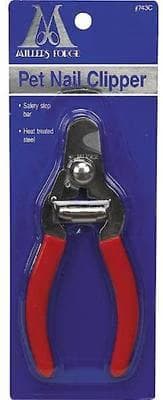
The Millers Forge clipper is the plier-style tool professional groomers reach for, and it is the pick Google's own AI summary names first. The heat-treated stainless steel blades meet like pliers rather than scissors, a spring pops the handles back open after each squeeze, and an adjustable safety stop bar limits how far the nail can slide past the blade.
That safety stop is the feature that matters for home use. Set it to allow only a thin slice, and you can take several small cuts on a dark nail without guessing. Loosen it for a large dog with long, obvious white quicks.
Millers Forge Nail Clipper: strengths and tradeoffs
Pros
- Spring-loaded plier action makes a clean cut on medium and large nails in one squeeze.
- The adjustable safety stop lets a cautious owner control slice depth.
- Forged stainless steel holds an edge through years of monthly trims.
Cons
- The blade opening is larger than a toy breed needs, so it is a clumsy fit for very small nails.
- The stop bar limits depth but cannot show you where the quick is.
- Skip it if your dog weighs under about 15 pounds or has very thin nails; the Frisco scissor clipper below fits better.
Best for large dogs and thick nails: Safari Professional Nail Trimmer
Webvet may earn a commission when you click through to Chewy, at no extra cost to you.
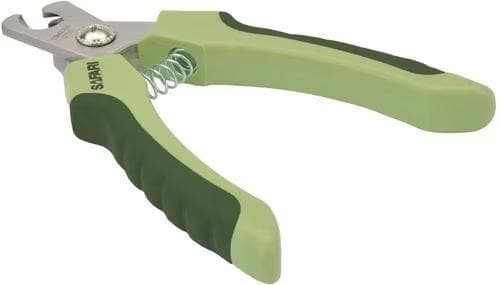
The Safari Professional Nail Trimmer from Coastal Pet is a heavier plier clipper built for big dogs. Coastal describes a double-bladed stainless steel cutter with a tension spring, and the blade opening is wide enough for the thick, dense nails of a Labrador, shepherd or mastiff-type dog that would stall a lighter clipper.
Because there is no guard, this is a tool for an owner who already knows how to find the quick or who works on white nails where it is visible. The blade lock keeps it closed in a drawer.

Safari Professional Nail Trimmer: strengths and tradeoffs
Pros
- Wide, sharp double blade cuts thick large-breed nails without crushing.
- Tension spring and rubber grip reduce hand fatigue over sixteen or more nails.
- Works for left- or right-handed owners.
Cons
- No safety guard, so depth control is entirely on the handler.
- Overkill on small dogs and puppies, where a big blade makes fine control harder.
- Skip it if you are new to trimming or your dog has black nails and you want a guard while you learn.
Best for beginners: Boshel Dog Nail Clipper with Safety Guard
Webvet may earn a commission when you click through to Chewy, at no extra cost to you.
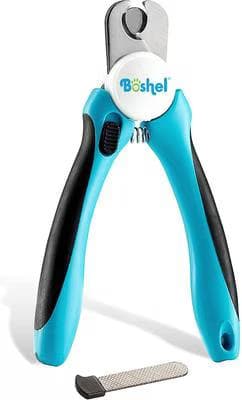
The Boshel clipper pairs sharp stainless steel plier blades with a swing-in safety guard that physically blocks the nail from passing too far, plus a small nail file tucked into the handle for smoothing the cut edge. The non-slip ergonomic handles are sized for medium and large dogs; Boshel sells a separate small-dog version.
For an owner who is nervous about cutting the quick, the guard is a useful training wheel. It does not replace looking at the nail, and on black nails the guard can hide the cut surface, so swing it out of the way once you are confident.
Boshel Dog Nail Clipper: strengths and tradeoffs
Pros
- The safety guard limits slice depth for a beginner taking small cuts.
- A built-in file smooths sharp edges without a second tool.
- Sturdy non-slip handles suit larger hands and bigger dogs.
Cons
- The guard can obscure the view of a dark nail's cut surface.
- Too large for toy breeds and puppies.
- Skip it if you already trim confidently; the guard becomes something to work around rather than a help.
Best for puppies and small dogs: Frisco Nail Clippers for Cats and Small Dogs
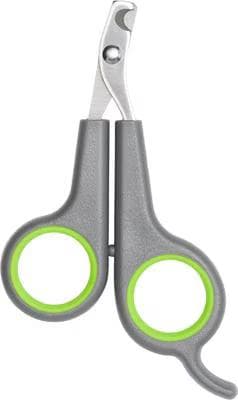
Compact scissor-style clippers sized for trimming the nails of cats and small dogs.
Webvet may earn a commission when you click through to Chewy, at no extra cost to you.
Chewy's house-brand Frisco clipper is a small scissor-style tool with Japanese high-carbon steel blades. Chewy notes that it has no guard, which is a feature rather than a flaw on tiny nails: a full view of the blade and the nail tip is what you want when the whole nail is smaller than a grain of rice.
This is the puppy nail clipper most households actually need, and it doubles for cats (our separate guide to cat nail clippers covers the feline side). It stops being the right tool once an adult dog's nails thicken; by then a medium plier clipper cuts more cleanly.
Frisco Nail Clippers: strengths and tradeoffs
Pros
- Small scissor blades give precise control on puppy and toy-breed nails.
- Inexpensive enough to keep one in the car and one at home.
- Works for cats and small dogs in a multi-pet house.
Cons
- No guard, so a nervous first-timer has nothing limiting slice depth.
- Will crush or struggle on thick adult nails.
- Skip it for any dog over roughly 20 pounds or with dense nails; choose the Millers Forge or Safari instead.
Best guillotine clipper: JW GripSoft Deluxe Nail Clipper
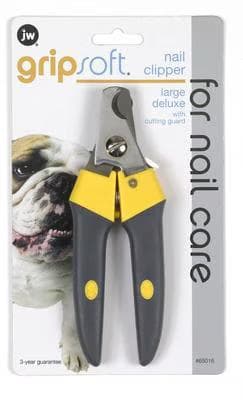
Webvet may earn a commission when you click through to Chewy, at no extra cost to you.
Some owners simply prefer guillotine action, where the nail is fed through a loop and one blade slides across to cut. The JW GripSoft Deluxe is the guillotine pick here: Petmate describes a heavy-duty blade, a cutting guard to reduce the chance of cutting too short, and rubber-sheathed GripSoft handles. It comes in medium and large sizes.
Guillotine clippers cut cleanly when sharp and make it easy to control how much nail sits past the blade. The limitation is visibility: the loop hides the cut surface, which matters most on black nails. Replace the blade when it starts to crush rather than cut.
JW GripSoft Deluxe Nail Clipper: strengths and tradeoffs
Pros
- Guillotine loop naturally limits how much nail can be cut per squeeze.
- Cutting guard and non-slip handle help a steady, repeatable cut.
- Lower price than the heavy plier clippers.
Cons
- The loop hides the cut surface, so reading a dark nail is harder.
- Blades dull and need replacement; a dull guillotine crushes.
- Skip it if you have never trimmed before and your dog has black nails; a plier clipper with a stop bar shows you more.
Best grinder alternative: Dremel 7350-PT Cordless Nail Grinder
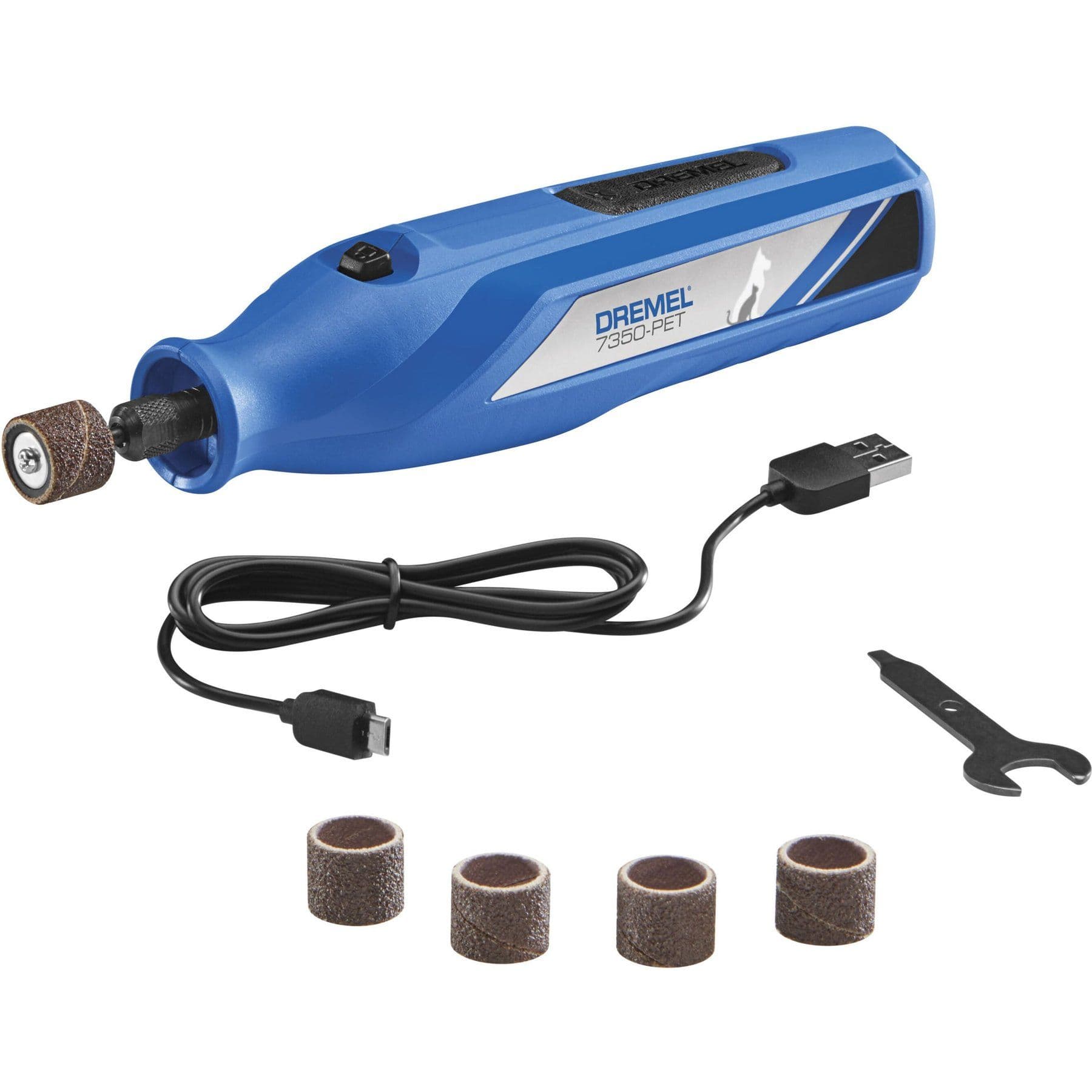
Webvet may earn a commission when you click through to Chewy, at no extra cost to you.
A nail grinder such as the Dremel 7350-PT removes nail with a rotating sanding band instead of a blade, which some dogs tolerate better than the snap of clippers and which leaves a rounded edge. The Dremel 7350-PT is the simplest Dremel: 4-volt cordless, a single speed and one button, and standard 60-grit sanding bands. Dremel publishes a 50.93 dB noise figure for the 7350 family on its own comparison chart.
We treat the grinder as a companion to clippers rather than a replacement. It is slower on thick nails, the band heats the nail if held in one spot, and it can catch long hair. For a full comparison of speeds, guards and quieter models, see our roundup of the best dog nail grinders.
Dremel 7350-PT: strengths and tradeoffs
Pros
- No blade, so there is no single cut that can go too deep.
- Leaves a smooth, rounded nail edge that does not scratch floors or skin.
- One speed and one button keep it simple for a first-time grinder user.
Cons
- Friction heat builds if the band stays on one nail for more than a few seconds.
- Slower than clipping on a large dog with sixteen thick nails.
- Skip it if your dog hates vibration or noise; a sharp clipper is quieter and faster.
The one thing to buy with any clipper: Miracle Care Kwik-Stop Styptic Powder
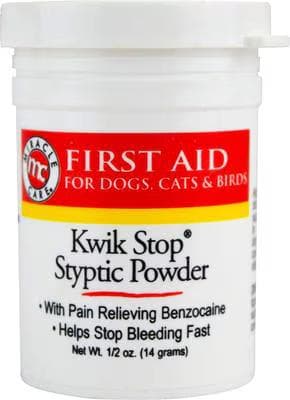
Webvet may earn a commission when you click through to Chewy, at no extra cost to you.
Every owner who trims at home eventually nicks a quick. Kwik-Stop is the styptic powder groomers keep on the table: its listed ingredients include ferric subsulfate, which contracts the tiny vessels in the nail, and benzocaine to numb the tip. Press a pinch firmly onto the bleeding nail and hold for a minute or two.
Keep the jar with the clippers, not in a bathroom cabinet. A nick handled calmly in thirty seconds is a non-event; one that sends you searching the house while the dog panics becomes the reason the next trim is a fight.
Kwik-Stop Styptic Powder: strengths and tradeoffs
Pros
- Stops nail bleeding far faster than pressure alone.
- A single jar lasts years of occasional nicks.
- Also works on minor scratches from grooming.
Cons
- Stings briefly on contact, which some dogs react to.
- Must be kept away from eyes and open wounds beyond a nail nick.
- Skip it only if you already keep a styptic gel or pencil in your grooming kit.
 $65 · no membership
Have a health question about your dog?
A licensed vet can assess your dog over video and prescribe online when it's appropriate.
 Talk to a vet
- Licensed vets
- All 50 states
- same-day Rx

Webvet may earn a commission if you book.
Dog nail clipper types: plier, scissor, guillotine or grinder
Retail names blur together, but there are only four mechanisms. The decision table below matches each one to the nails and the handler it suits, and knowing which mechanism you are holding explains most of the differences in the picks above.
| Clipper type | How it cuts | Best fit | Watch for |
|---|---|---|---|
| Plier (spring-loaded) | Two curved blades meet like pliers; a spring reopens them | Medium to large dogs, thick nails, most adult dogs | Blade opening too big for toy breeds |
| Scissor | Two small curved blades cross like scissors | Puppies, toy breeds, cats, thin nails | Struggles on thick nails; can crush if dull |
| Guillotine | Nail feeds through a loop; one blade slides across | Owners who like a fixed feed depth; medium and large dogs | Loop hides black nails; blade must stay sharp |
| Grinder | Rotating sanding band files the nail down | Dogs that flinch at clippers; smoothing edges | Heat, noise, vibration, hair catching |
Plier and scissor clippers
Plier clippers are the workhorse for adult dogs. The blades are heavy, the spring does the reopening, and a good pair cuts a thick nail in one squeeze without splintering. Scissor clippers are the same idea in miniature: less leverage, but far more precision on nails the size of a grain of rice.
VCA's grooming guidance describes scissor-style clippers as "shaped like scissors, with two moving blades," which is why they feel natural to most people on a first trim. The tradeoff is force. A scissor clipper on a Rottweiler's dewclaw will crush before it cuts.
Guillotine clippers
A guillotine clipper feeds the nail through a ring; squeezing drives a single blade across the opening. The ring gives a consistent depth per squeeze, which some owners find calming. The blade dulls faster than a plier blade because one edge does all the work, and a dull guillotine crushes the nail instead of shearing it. Replaceable blades are the answer, and JW sells them.
Clippers versus grinders
Is it better to cut or grind a dog's nails? Owners weighing a dog nail trimmer vs grinder (or a dog nail clipper or grinder, or a dog nail trimmer or grinder, the wording varies) are usually asking because their dog hates the snap of the blade. There is no single answer to whether the best dog nail clippers or grinders win; it depends on the dog and the nail. For most dogs, clip first and grind second. Clippers remove length quickly with less time handling the paw; a grinder rounds the edge and can shave a little more from a black nail in fine increments. Grinders are not automatically safer. VCA notes that a grinder "leaves nails smooth" with a lower risk of cutting into the quick, but it also warns about hair getting caught and skin burns from friction.
Some dogs tolerate the hum of a grinder better than the snap of clippers; others hate the vibration. If your dog flinches at the clipper sound, try the grinder. Our dedicated comparison of the best dog nail grinders ranks the best dog nail grinder for most homes, a small dog nail grinder and the quieter options, and it is the right place to shop if grinding is your plan.
How to choose dog nail clippers

Four questions settle the choice for most dogs. Answer them in order.
Dog size and nail thickness
Match the blade opening to the nail, not the dog's cuteness. A Millers Forge plier clipper covers most adult dogs; the Safari Professional steps up for heavy nails. Toy breeds and puppies under about 20 pounds do best with a scissor clipper. Medium dogs are the sweet spot for a standard plier clipper with a safety stop. Large and giant breeds with dense, thick nails need a heavy plier clipper such as the Safari Professional; a small clipper will crush and split those nails.
White nails or black nails
Nail color changes the tool more than breed does. On white nails you can see the pink quick through the nail, so almost any sharp clipper works and a safety stop is a convenience. On black nails the quick is invisible from the outside, which changes the tool choice. You want an open view of the cut surface after each slice, which favors a plier clipper with a stop bar over a guillotine loop or a guard that hides the nail.
Clippers marketed with a "quick sensor" or an LED light are a common search. A built-in light can help you see the cut surface of a dark nail. No consumer clipper can sense living tissue inside the nail; the "sensor" claims on listings describe a guard or a light, not a detector. Treat those features as visibility aids and keep taking thin slices.
Safety guards and stops
A guard or safety stop limits how much nail can pass the blade. There is no single safest dog nail trimmer, but for a beginner or an anxious owner a guarded clipper such as the Boshel prevents the one big cut that goes too deep. The cost is view. On dark nails, swing the guard out once you are comfortable and rely on small cuts instead. VCA's advice to trim "just the very tip" of a dark nail is the safer rule than any guard.
Grip, spring and blade quality
Sixteen or more nails per trim adds up. Non-slip handles, a spring that reopens the blades and a blade that shears rather than crushes matter more than brand names. Stainless steel with a clean edge stays sharp through years of monthly trims; PetMD's vet-verified guidance likewise favors stainless steel, safety stops and replaceable or sharp blades. If a clipper starts leaving frayed edges, it is dull or the nail is too thick for it.
How to cut dog nails with clippers

The technique below follows VCA's how-to guidance and the AKC's trimming advice. It is the same whether you use a plier, scissor or guillotine clipper.
Find the quick first
The quick is the blood vessel and nerve that runs into the nail. On a white nail it shows as a pink core; stop well short of it. On a black nail you cannot see it, so trim in thin slices and watch the cut surface. As you get closer, the pale, chalky center of the cut face gives way to a darker, glossy dot. That dot is the beginning of the quick. Stop there.
Cut angle: not sideways, not straight across
Hold the clipper so the blade is perpendicular to the nail and follow the nail's natural downward curve. Do not cut sideways across the nail, which crushes it, and do not lop straight through a long curve in one cut. VCA advises small clips of 1 to 2 millimeters at a time, aiming to make the final cut "at or near the point where the nail begins to curve," about 2 to 3 millimeters away from the quick.
A calm trimming routine
- Sit beside the dog rather than looming over the paw, and have treats and styptic powder within reach.
- Hold the paw gently, press the pad to extend the nail, and clip the very tip.
- Check the cut surface. Pale center: take another thin slice. Dark dot appearing: stop.
- Do a few nails, reward, and take a break if the dog stiffens. Finishing tomorrow beats a struggle today.
- Smooth any sharp edge with a file or a quick pass of a grinder.
How often to trim dog nails
Most dogs need a trim roughly every three to four weeks; the AKC gives that range and VCA says "approximately once a month," sooner for inactive dogs and later for dogs that wear nails down on pavement. The practical test: if you hear clicking on a hard floor or the nails touch the ground when the dog stands, they are due. Merck's routine-care guidance adds that puppies need handling and trims every three to four weeks from early on so the habit sets.
If you cut the quick: how to stop dog nail bleeding

Nicking the quick happens to everyone, including groomers. It bleeds more than you expect and hurts less than the dog's yelp suggests. Here is the sequence.
Styptic powder works because ferric subsulfate constricts the small vessels in the nail; Kwik-Stop adds benzocaine to numb the sting. Once the bleeding stops, leave the nail alone. Do not trim that nail again the same day, and expect the dog to be more guarded about that paw next time. Extra treats at the next session help more than apology.
Dogs that hate nail trims

A dog that fights nail trims is usually reacting to restraint, the sound of the clipper or the memory of a nick. The fix is desensitization, not a firmer grip.
A one-week desensitization plan
The AKC lays out a seven-day plan that works for puppies and most adult dogs. Day one, let the dog sniff the clipper and reward. Day three, touch the clipper to each paw and squeeze it so the dog hears the click, then reward. By day four you are touching the tool to the feet again, and by day seven you are trimming a nail or two each day until the dog does not mind. VCA's behavior guidance is similar: shave a tiny flake from one nail, treat, and stop.
If your dog won't let you cut their nails at all, stop trying to finish the job in one session. One nail a day with a high-value treat beats a monthly wrestling match that teaches the dog to fear the clipper.
What professional groomers do differently
Professional dog groomers use the same plier clippers and grinders you can buy, plus a grooming table, a loop that limits movement and a helper's hands. They also trim far more often, so each trim removes very little. Ask a groomer to show you their hold; most will.
For a dog that panics, VCA notes that a veterinarian "can offer sedation if your dog is very upset by the procedure." Sedated trims are a reasonable answer for a large dog whose nails are dangerously long, and they buy time to start the desensitization plan at home.
Puppy nails and small dogs
Puppy nails are thin, sharp and grow fast. A scissor clipper such as the Frisco pick gives the control you need, and the goal in the first months is habit more than length. Handle the paws daily, clip a single tip when the puppy is sleepy, and reward every time. By the time the adult nails thicken, the puppy accepts the routine and you can move up to a plier clipper.

Toy breeds keep thin nails for life, so the small scissor clipper often remains the right tool. Check dewclaws, which do not touch the ground and can curl into the pad if forgotten.
Caring for your clippers

Wipe the blades after every trim, dry them, and store them closed. Nail dust and moisture dull edges and invite rust. Sharpening and replacing clippers is simpler than most owners expect: plier clippers such as the Millers Forge and Safari can be professionally sharpened by a knife or scissor service, most owners find replacing a ten-dollar clipper every few years simpler, and guillotine blades are designed to be swapped, with a crushing cut as the signal to do it.
If a clipper begins splintering nails or needs two squeezes per cut, it is dull, and a dull blade is the most common cause of a painful trim. Check dewclaws at the same time you inspect the tool; they wear least and overgrow first, and a curled dewclaw is the nail most likely to need a sharp, well-fitting clipper rather than a grinder.
Frequently asked questions
What type of nail clippers do vets recommend for dogs?
Veterinary grooming guidance favors a sharp stainless steel clipper sized to the dog, with a safety stop or guard for owners who are still learning, and replaceable or well-maintained blades. For most adult dogs that means a plier-style clipper; for puppies and toy breeds, a small scissor clipper. Sharp blades matter more than brand, because a dull clipper crushes the nail and hurts.
Do you cut dogs' nails sideways or straight?
Neither. Hold the blade perpendicular to the nail and follow the curve of the nail, taking small slices from the tip. Cutting sideways crushes the nail, and cutting straight through a long curve in one go risks the quick. Stop when the pale center of the cut surface starts to show a darker dot.
What happens if you never trim a dog's nails?
The quick grows longer as the nail does, so the nail can never be brought back to a healthy length without a series of gradual trims. Overlong nails push the toes sideways into splayed toes, change how the paw lands and add joint strain up the leg. Curled nails, especially dewclaws, can grow into the pad.
How do groomers cut the nails of dogs that won't let you?
Groomers use a table, a grooming loop and gentle restraint from a second person so the dog cannot back away, and they trim so often that each cut is tiny. For a dog that panics, a veterinarian can trim under sedation. At home, desensitization over a week or two, one nail at a time, is the lasting fix.
How much does Petco charge for dog nail clipping?
Petco's walk-in grooming salons offer nail trims as a standalone service, and the price varies by location and by whether you add a grind to smooth the edges. Prices are posted at the salon and on Petco's grooming page for your store, so check locally and ask whether a nail trim can be done without an appointment.
Should you hear dog nails on the floor?
No. Clicking on hard floors means the nails are touching the ground when the dog stands, which is the standard sign they are too long. Put the dog on a trim schedule of every three to four weeks and take a little more off each time until the clicking stops.
How do I get my dog's nail quick to recede?
Trim a thin slice every week or two rather than a big cut once a month. Each frequent small trim brings the tip closer to the quick, and the quick shortens back over the following weeks. Stop each cut at the first sign of the darker dot in the center of the nail. It can take a couple of months to reclaim badly overgrown nails.
Do dogs feel better after a nail trim?
Usually yes. Overlong nails change the angle of the toes and make dogs slip on hard floors, so a trim restores normal posture and traction. A dog with sore toes from long nails may move more freely within a day or two. If a dog seems worse after a trim, check for a nicked quick or a nail cut too short.
Why do dogs scream when you cut their nails?
Some dogs scream from fear and anticipation before the blade touches anything, especially if a past trim hit the quick. Others react because the cut reached the nerve in the quick. Go slower, take thinner slices, reward after every nail, and stop for the day at the first sign of panic so the next session starts calmer.
$65 · no membershipHave a health question about your dog?
A licensed vet can assess your dog over video and prescribe online when it's appropriate.
Talk to a vet- Licensed vets
- All 50 states
- same-day Rx
Webvet may earn a commission if you book.

Editor
The Webvet Editorial Team is the in-house group of pet-care editors and writers behind Webvet, operated by Smart Pet Collective. The team researches, writes, and maintains Webvet's pet health, behavior, and medication content. Every article follows a defined editorial process: research from reputable veterinary and scientific sources, careful drafting, mandatory review of medical content by a credentialed veterinarian, and dated publication. Health and medication articles are medically reviewed by a licensed veterinary professional before they go live and are kept current over time.
Veterinarian · BVMS MRCVS
Dr. Pippa Elliott, BVMS, MRCVS, is a veterinarian with nearly 30 years of experience in companion animal practice. Dr. Elliott earned her Bachelor of Veterinary Medicine and Surgery from the University of Glasgow. She was also designated a Member of the Royal College of Veterinary Surgeons. Married with 2 grown-up kids, Dr. Elliott has a naughty Puggle named Poggle, 3 cats and a bearded dragon.


