When Can Puppies Eat Solid Food? Weaning Timeline and Tips
Puppies usually start eating solid food at around three to four weeks of age and finish weaning over the following weeks. Here is a weaning timeline by week, how to start puppies on gruel, what to feed, water, nursing, and orphaned puppies.

BVMS MRCVS

This article contains affiliate links. Webvet may earn a commission when you buy through them, at no extra cost to you.
The answer to "when can puppies eat solid food" is about three to four weeks of age, when VCA Animal Hospitals says weaning naturally begins as the puppies start to develop teeth.
Weaning is gradual rather than a single switch. Puppies first lap a soft gruel of puppy food mixed with milk replacer or water, then eat moistened food, then eat puppy food with no liquid added, while nursing tapers off over the same weeks.
- 1Puppies usually start eating solid food at about three to four weeks of age, when weaning naturally begins as their teeth come in.
- 2A puppy weaning timeline, week by week, runs from milk only, to gruel at 3 to 4 weeks, to soft food at 4 to 6 weeks, to solid food at 6 to 8 weeks.
- 3A puppy's first solid food is a gruel of smooth canned puppy food mixed with puppy milk replacer or water, served in a flat saucer.
- 4Weaning puppies need a complete and balanced puppy food made for growth, not adult dog food, table food, cow's milk, or goat's milk.
- 5A weaning puppy that fails to gain weight or loses weight is cause for alarm; VCA says to contact your vet for instructions, because puppies that begin losing weight may die within 48 hours.
When Can Puppies Eat Solid Food?
Puppies usually begin eating solid food at three to four weeks of age, and weaning finishes over the following weeks, typically by about 8 weeks. The puppy weaning timeline by week below shows each stage.
The age puppies usually start eating solid food is tied to their teeth. The Merck Veterinary Manual says most dogs have 28 deciduous teeth, or baby teeth, and that they begin to erupt at 3 to 5 weeks of age. Weaning starts as those teeth develop.
Veterinary references give slightly different start dates:
- A second VCA page says puppies should begin eating solid food at about 3.5 to 4.5 weeks.
- A 2012 review in Reproduction in Domestic Animals says weaning is usually conducted around 4 to 5 weeks, or as early as 3 weeks in orphaned puppies.
Puppies move from milk to hard food in three steps:
- Milk only: newborn puppies live on their mother's milk, and for orphans VCA says puppy milk replacer should be the sole source of nutrition until 3 to 4 weeks.
- Soft food: a gruel lapped from a saucer, starting at about 3 to 4 weeks.
- Hard food: dry food the puppies chew, which the 2012 review says they can manage by 5 to 6 weeks, after their deciduous teeth erupt.
VCA says table or human food is not recommended for growing puppies, and vegetables from your plate count as table food. Weaning begins weeks after whelping, the birth of the litter; for the stage before birth, see the signs a dog is pregnant.
Puppy Weaning Timeline by Week
A puppy weaning timeline by week runs from about week 3, when the first gruel appears, to about week 8, when VCA says puppies are typically weaned off their mother's milk.
A weaning timeline week by week helps you match each age to the right food, meal count, and nursing level. Puppies raised by their mother and orphans move at different speeds, so the schedule below includes the PDSA hand-rearing schedule for orphans.
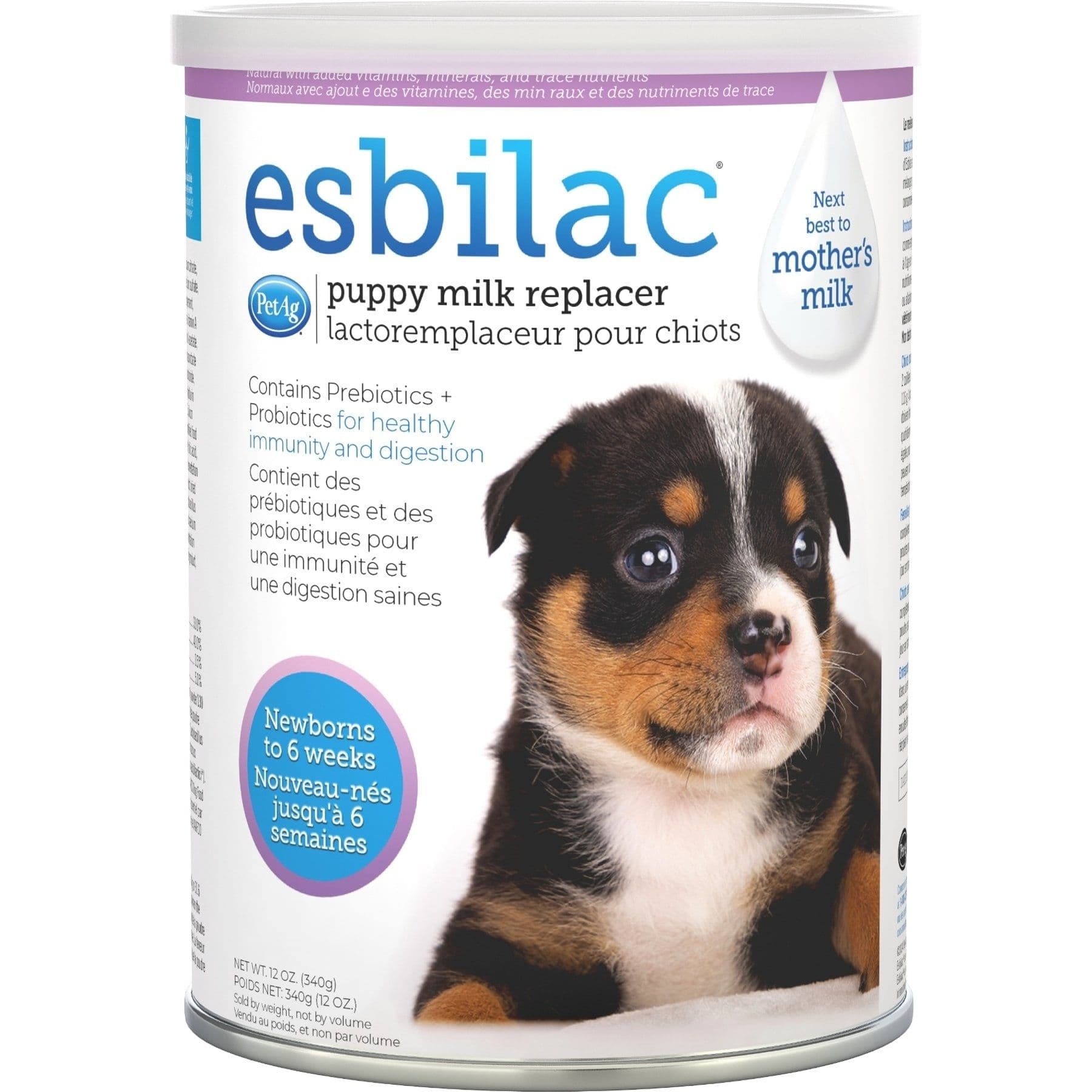
PetAg Esbilac Puppy Milk Replacer Powder, a powdered puppy formula mixed with warm water.
Webvet may earn a commission when you click through to Chewy, at no extra cost to you.
The table below is a week-by-week weaning timeline that pairs each age with what the puppies eat, how often they eat, and what the mother is doing. Its columns give age in weeks, what puppies eat, meals per day, and nursing status, so gruel and nursing changes line up at each stage.
| Age | What puppies eat | Meals per day | Nursing status |
|---|---|---|---|
| Birth to 2 weeks | Mother's milk, starting with colostrum; orphans get puppy milk replacer only | Mother-led nursing; orphans fed every 2 hours in week 1 and every 3 hours in week 2 | Nursing only; the mother starts most nursing sessions |
| 3 weeks | Milk, with a first gruel of puppy food and milk replacer or water, especially for orphans | Orphans fed milk every 3 hours | Nursing fully; nursing becomes less frequent, especially at night |
| 4 weeks | Gruel lapped from a flat saucer, plus water in a shallow dish | Orphans fed milk every 4 to 6 hours, plus softened puppy food | Still nursing; the mother's energy needs peak 3 to 5 weeks after whelping |
| 5 to 6 weeks | Wet or moistened puppy food; dry food can be chewed by 5 to 6 weeks | Small meals about four to five times a day | Still nursing; orphans on the PDSA schedule are fully weaned by week 6 |
| 6 to 8 weeks | Canned or dry puppy food with no milk replacer or water added | 4 meals a day | Usually completely weaned; typically off the mother's milk at about 8 weeks |
| 8 to 10 weeks | Complete puppy food | About 4 meals a day | Completely weaned; the mother's milk production normally stops 7 to 10 weeks after birth |
| 3 months | Puppy food, with more food per meal | 3 meals a day | Weaned |
Mother-raised puppies keep nursing while they learn to eat. Texas A&M veterinary guidance suggests small meals of puppy food about four to five times a day at 5 to 6 weeks, even though the puppies are still nursing.
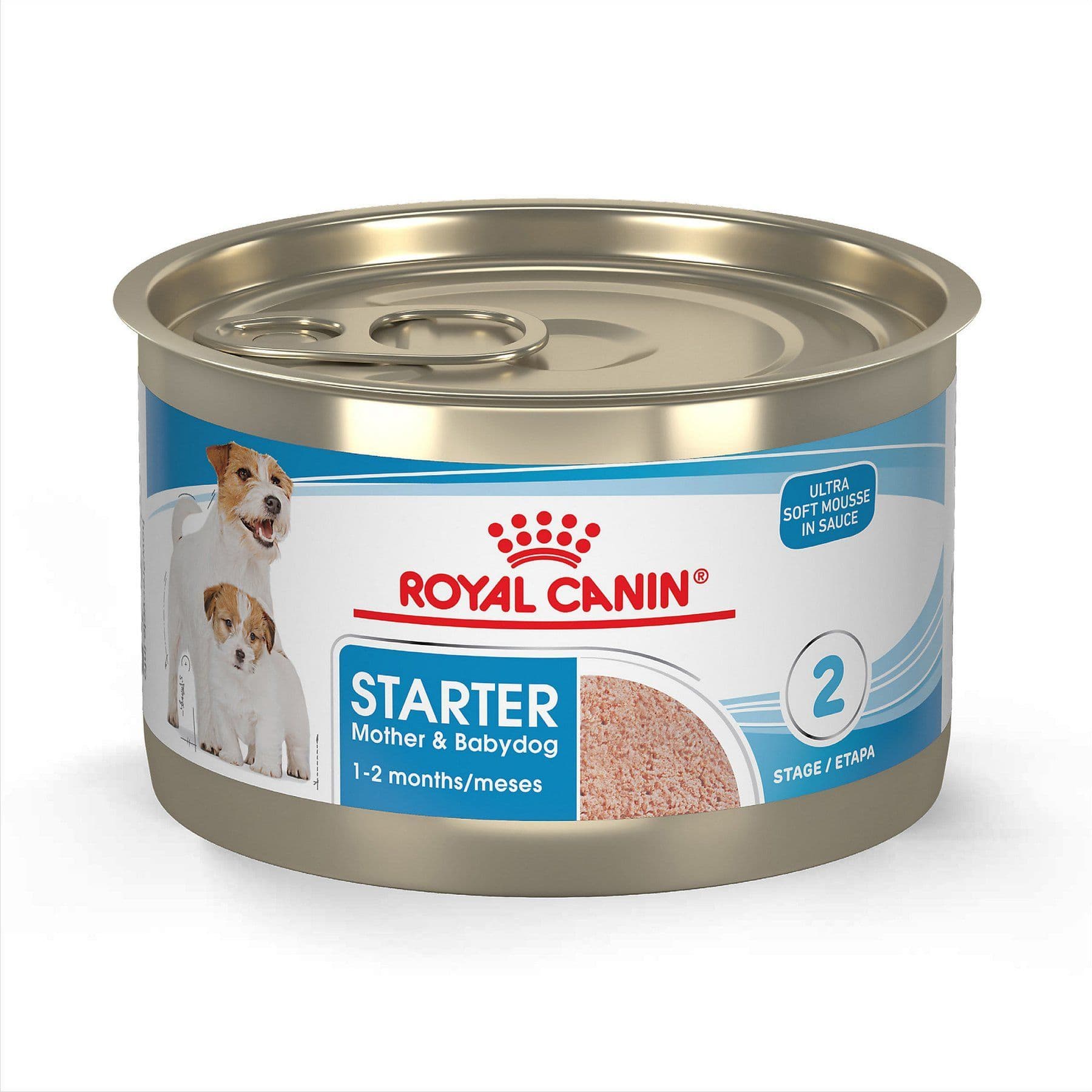
Royal Canin Starter Mother and Babydog Mousse, a soft wet food for nursing mothers and weaning puppies.
Webvet may earn a commission when you click through to Chewy, at no extra cost to you.
Here is what each stage means for a typical litter:
- At 4 weeks, puppies lap gruel, and PDSA adds a saucer of water and softened puppy food for orphans.
- At 5 weeks, PDSA moves orphans to wet puppy food and fresh water, with milk only as a top-up. A 5-week-old puppy can eat dry food once it is moistened.
- At 6 weeks, a puppy can eat dry food, because the 2012 review says deciduous teeth erupt between 21 and 35 days and puppies can chew dry food by 5 to 6 weeks.
- At 6 to 8 weeks, Maddie's Fund says puppies usually eat solid food on their own, canned or dry, with no milk replacer or water added.
- At 7 to 10 weeks, a puppy should eat four meals a day of puppy food, which Merck lists for 6 to 12 weeks.
For a 6-week-old or 7-week-old puppy, feed the meal counts above and weigh each puppy regularly to confirm it keeps gaining.
How to Start Puppies on Solid Food
Puppies start eating solid food by learning to lap from a flat saucer at three to four weeks, first a milk mixture and then a gruel that gets thicker each day.

Learning how to introduce a gruel of puppy food mixed with milk replacer or water is the core weaning skill. Maddie's Fund says the gruel should have the consistency of oatmeal, neither too thick nor too thin, served in a flat dish the puppies can reach.
Follow these steps from VCA and Maddie's Fund:
- Put puppy milk replacer in a flat saucer. VCA recommends a 50:50 mix of milk replacer and water and says not to use goat's milk or cow's milk.
- Mix in canned puppy food. VCA says that as the puppies lap the liquid, they also take in the food.
- Thicken it to oatmeal texture. Maddie's Fund suggests two parts canned food to one part milk replacer or water, adjusted for how thick the food is.
- Reduce the liquid daily until puppies eat canned food with little or no moisture added, which VCA says is ideally at four to six weeks.
- Keep milk feeds going. Maddie's Fund says not to stop bottle feeding or prevent nursing until puppies are fully eating solid food.
Veterinary guidance differs on milk replacer in gruel: VCA uses it, while Maddie's Fund advises avoiding it except for bottle-fed puppies already used to it. For dry food, the 2012 review mixes 1 part dry food with 3 parts water or milk replacer.
How to wean puppies at 3 weeks?
To wean puppies at 3 weeks, offer milk replacer mixed with water in a flat saucer, then stir in smooth canned puppy food as they learn to lap, while milk feeds continue. Three weeks is the early end of the normal window and the recommended start for orphans.
Maddie's Fund says orphans should start around 3 weeks because even the best milk replacers tend to cause diarrhea and constipation and are less complete than mother's milk. VCA adds that hand-raised puppies can start sooner, with soft foods offered once their eyes are open.
What to Feed Weaning Puppies
What to feed weaning puppies is a complete and balanced puppy food made for growth, served first as gruel and later as canned or dry food. Maddie's Fund recommends using the same high-quality food you plan to feed after weaning, to minimize diet changes.
Check the label: VCA says to look for an AAFCO nutritional adequacy statement that the food is formulated for growth or for all life stages, and that adult formulations do not provide optimal nutrition for a puppy.
Weaning puppies move through food textures in this order:
- Wet food mixed into gruel, from about 3 to 4 weeks.
- Canned food with little or no moisture added, ideally at four to six weeks, according to VCA.
- Dry food mixed with water into gruel, then dry kibble, which puppies can chew by 5 to 6 weeks.
- Solid dry or canned food with no water added, usually by 6 to 8 weeks, according to Maddie's Fund.
For the gruel stage, Maddie's Fund says to choose a smooth canned food without chunks so it mixes easily with water or milk replacer. Its shelter-medicine training names Royal Canin Starter Mousse as a good choice for puppies.
In the US, Royal Canin's line includes Royal Canin Starter Mother & Babydog Ultra Soft Mousse, a mousse labeled for weaning puppies up to 2 months old.
Kibble is normally served moistened until puppies eat solid food unaided at 6 to 8 weeks, so a puppy that won't eat kibble at 4 or 5 weeks can be offered it softened. How much kibble a puppy should eat depends on the food's calories and the puppy's weight.
Is egg good for a 2 month old puppy?
A 2-month-old puppy should get its nutrition from a complete and balanced puppy food, so egg is a treat rather than a meal, and raw egg carries real risks. ASPCA Animal Poison Control says raw eggs can carry Salmonella and E. coli and contain an enzyme that can interfere with vitamin absorption.
Merck notes that egg yolks are a good source of biotin, but raw egg whites contain avidin, which blocks biotin absorption. VCA says treats and snacks should stay at no more than 10 percent of daily calories, so ask your vet before adding egg.
How Much and How Often to Feed Weaning Puppies
How much and how often to feed weaning puppies comes down to small, frequent meals. VCA says to feed small amounts approximately four to six times a day once puppies eat canned food with little or no moisture added, and Merck lists 4 meals a day of puppy food from 6 to 12 weeks.
Meal counts drop as puppies grow. VCA says completely weaned puppies at about 8 to 10 weeks should get about four meals daily, and that by three months you can increase the food per meal and cut to three meals a day.
Merck's professional feeding guidance recommends three meals a day from weaning to 6 months, while the 2012 review recommends 4 meals a day during weaning because more meals per day improved stool quality in puppies.
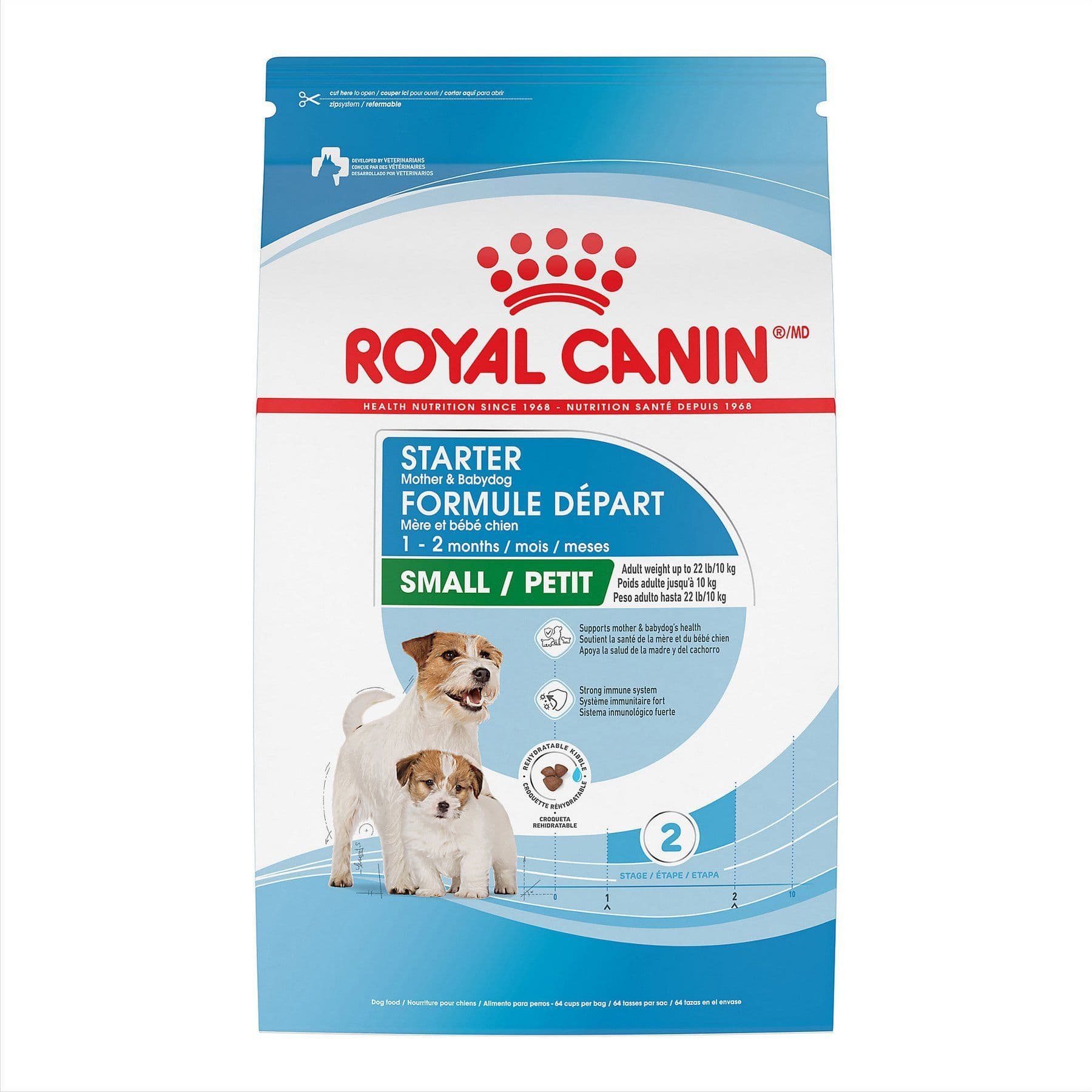
Royal Canin Small Starter Mother and Babydog, a dry food for small mothers and their puppies.
Webvet may earn a commission when you click through to Chewy, at no extra cost to you.
Maddie's Fund gives a simple routine for each feeding:
- Offer the gruel or moistened food for 30 minutes at a time.
- Repeat that 4 times a day.
- Throw away any leftover milk replacer, gruel, canned food mixture, or moistened dry food.
Veterinary references do not give a cup or gram amount per meal for a weaning puppy. They point instead to calories per kilogram, the puppy food label, and steady weight gain, so offer gruel several times a day and watch each puppy's weight.
Published calorie figures give a better starting point:
- The 2012 review puts needs at 130 to 150 kcal per kilogram of body weight per day for the first 3 weeks and 200 to 220 kcal per kilogram after 4 weeks.
- For a newborn puppy, Merck lists 133 kcal per kilogram per day in week 1.
- As a worked example of the review's range, a 2-kilogram (about 4.4-pound) puppy older than 4 weeks would need roughly 400 to 440 kcal a day, split across its four to six small meals. That is arithmetic, not a feeding rule, so confirm each puppy's target with your vet.
For portions and routines after weaning, see how much to feed a puppy and the dog feeding schedule.
When Can Puppies Drink Water?
Puppies start drinking water as solid food begins, once they are readily eating gruel at about 3 to 4.5 weeks of age. Maddie's Fund says to start offering fresh water in a shallow bowl at that point, because water intake must rise as milk intake falls.

Veterinary guidance gives a range rather than a single first-water age. The PDSA hand-rearing schedule for orphans offers a saucer of water at week 4, alongside softened puppy food for lapping, and Maddie's Fund says puppies should be readily drinking water from a bowl by 6 to 8 weeks.
Set up the water bowl with these safety points from Maddie's Fund:
- Use a bowl with low sides.
- Do not fill it so full that a puppy could drown in it.
- Keep the water shallow enough that a puppy cannot push its face in far enough to inhale water, which is called aspiration.
Orphans need careful fluid totals. VCA says puppies need 130 to 220 mL of fluid per kilogram of body weight each day, and that the total fluid fed per day, including milk replacer, should average about 180 mL per kilogram.
A washable mat under the food and water dishes can make cleanup simpler while puppies learn to lap.
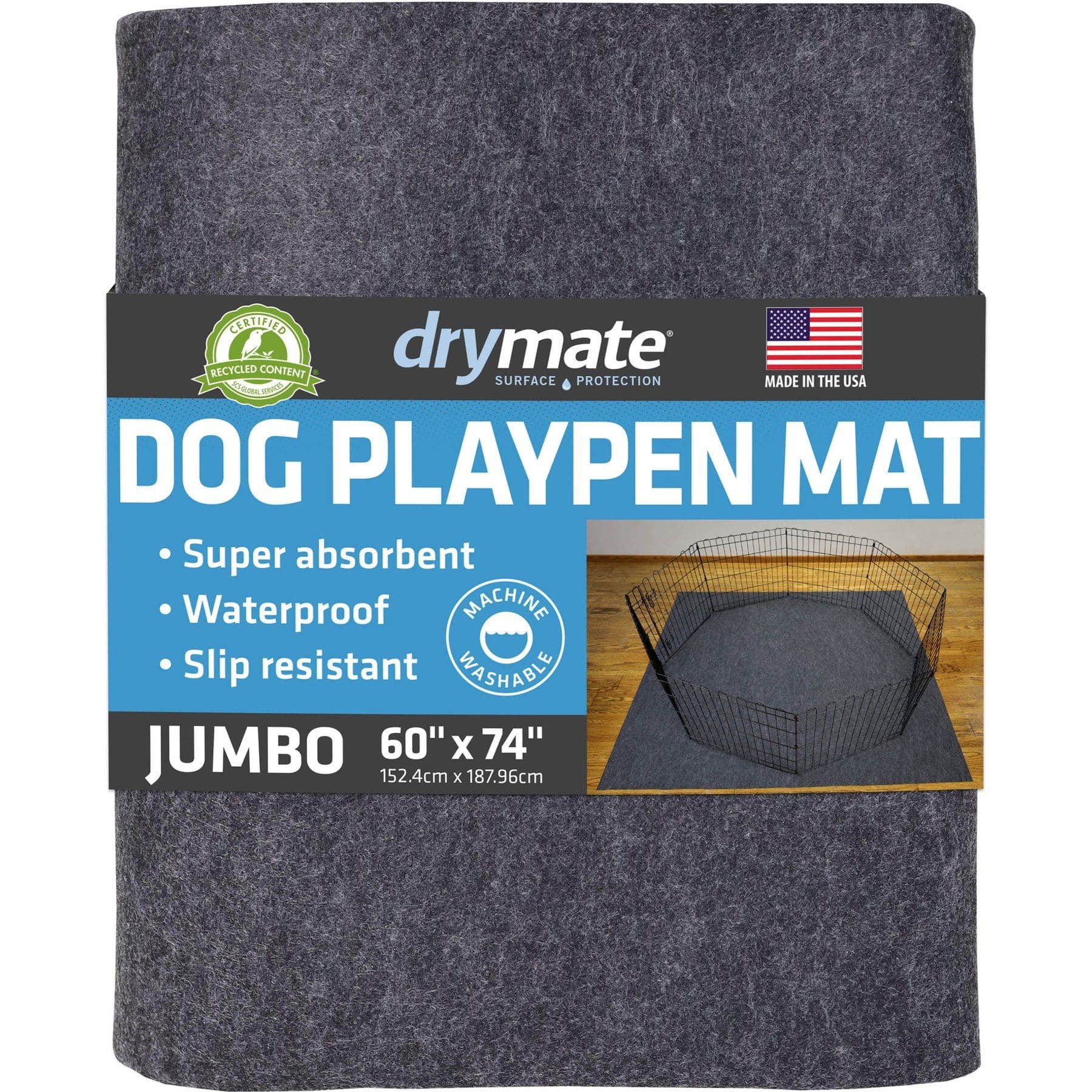
Drymate Dog Playpen Mat, a machine-washable mat for a puppy pen or feeding area.
Webvet may earn a commission when you click through to Chewy, at no extra cost to you.
When Do Puppies Stop Nursing?
Puppies usually stop nursing between about 6 and 10 weeks of age, and VCA says they are typically weaned off their mother's milk at about 8 weeks. Nursing tapers as the puppies eat more solid food rather than stopping on a set day.
Veterinary references give a range rather than one date. The 2012 review says nutritional weaning is usually completed by 6 weeks, although some mothers let puppies nurse to 8 weeks or longer, and VCA says puppies are completely weaned at about 8 to 10 weeks.

The mother's body sets the outer limit. A 2019 review in the Journal of Small Animal Practice says milk production normally ceases between 7 and 10 weeks after giving birth.
A litter is ready to finish nursing when the puppies reach these milestones:
- They eat canned or dry puppy food on their own with no milk replacer or water added, which Maddie's Fund says usually happens by 6 to 8 weeks.
- They drink water readily from a bowl, which Maddie's Fund also expects by 6 to 8 weeks.
- They can feed themselves, which Merck places at about 7 to 8 weeks, the age it says puppies can leave their mother.
- They keep gaining weight as nursing falls away, since VCA says puppies should gain weight each day.
Puppies also need their mother and littermates after the last feed. VCA says puppies should ideally remain with their mother and littermates until they are about 7 to 10 weeks old.
Before puppies go to new homes, ask your vet how weaning fits with the puppy vaccine schedule and with puppy dewormer timing for your litter.
Can 4 week old puppies go all night without nursing?
Not reliably. At 4 weeks, the PDSA schedule gives orphans a milk feed every 4 to 6 hours, and a second VCA page says puppies two to four weeks old do well with feedings every six to eight hours, so a 4-week-old still needs to nurse or be fed during a long night.
Veterinary references give no single figure for how long a 4-week-old puppy can go without nursing. Maddie's Fund says not to prevent puppies from nursing until you are sure they are fully eating solid food, so a 4-week-old litter should stay with its mother overnight.
Night nursing does taper. The 2019 review reports that from day 1 to day 21 after birth, the mother starts nursing less often over time, in particular during the night. Ask your vet for a feeding plan that fits your litter.
Orphaned Puppies and Milk Replacer
Caring for orphaned puppies with a milk replacer means feeding a commercial puppy formula on a strict schedule until weaning begins at 3 to 4 weeks. VCA says puppy milk replacer should be the sole source of nutrition until then, with feeds every 2 to 4 hours in the first week.
Colostrum comes first whenever possible:
- VCA says colostrum, the first few days of the mother's milk, is high in protein and transfers important immune system elements from mother to puppy.
- Merck says puppies must take in adequate colostrum promptly after birth, because antibody absorption from the gut generally ceases by 24 hours.
- PetAg says its Esbilac formula contains no colostrum and that puppies should receive colostrum by nursing from their mother for at least 2 days if possible.
Use a puppy formula, not cow's milk. VCA says the mother's milk has more than twice the protein of cow's milk, and that cow's milk is lower in calories and fat but higher in lactose. The 2012 review says most commercial puppy milk replacers are cow's milk modified to approach the mother's milk.
VCA's bottle-feeding basics for orphans include:
- Feed on a strict schedule: every 2 to 4 hours in week 1, then every 4 to 6 hours until weaning, following the label on the commercial replacer.
- Warm the milk replacer to about 100°F (38°C), without overheating it.
- Avoid cold formula, overly rapid feeding, and overfeeding, which VCA says can lead to regurgitation, aspiration, bloating, and diarrhea.
- Weigh each puppy daily for the first four weeks, then weekly from week five.
- Expect a gain every day; on average, puppies should double their birth weight by day 10.

To mix Esbilac, PetAg says to whisk or shake 1 part powder into 2 parts warm water, not to use a blender, and not to mix more than the puppies will drink in 24 hours.
Product labels can differ from veterinary schedules. PetAg's label says to feed 2 tablespoons (30 mL) of mixed formula per 4 ounces (115 g) of body weight daily, every 3 to 4 hours, while VCA gives every 4 to 6 hours after week one. Ask your vet which fits your litter.
Orphans move to solid food sooner. VCA says to add small amounts of semi-solid or solid growth food to the formula and move to solid food by 5 to 6 weeks. Maddie's Fund teaches the same gruel method for kittens and puppies; for kittens, see weaning kittens.
Common Weaning Problems
Common weaning problems include diarrhea in the puppies, a puppy not eating, and health problems in the mother such as mastitis and eclampsia. The 2012 review says the food transition at weaning usually generates stress, with diarrhea as the main clinical sign.
Diarrhea is common at this age. A 2026 study in Animals reports that puppies show the highest diarrhea prevalence in dogs, with rates of up to 10 to 25 percent in the first year of life, particularly around weaning. For causes and care, see our guide to puppy diarrhea.
Watch the mother as well as the puppies:
- Mastitis: VCA says many cases follow sudden weaning or the death of a puppy, when less milk is removed and excess milk builds up in the glands.
- Eclampsia, or milk fever: VCA says this calcium depletion generally occurs when the puppies are three to five weeks old, just before weaning, and most often in mothers of large litters.
- Energy demands: VCA says the mother needs the most energy three to five weeks after whelping, when she may need two to four times the calories of a normal adult dog.
Formula can be the cause in bottle-fed puppies. Merck says overfeeding formula can cause an osmotic diarrhea with a yellow, curdled look, which its veterinary guidance manages by diluting the formula by 50 percent. Call your vet before changing the formula.
A puppy not eating, or not eating as much as its littermates, needs a closer look. The University of Illinois lists not eating well, restless crying, an inability to be soothed, lack of weight gain, and a body temperature that is too high or too low as signs of fading puppy syndrome.
If a weaning puppy refuses gruel or is vomiting and not eating, follow the same Illinois advice: see a veterinarian right away, because problems can get worse very quickly at that age.
When to Call Your Vet
Call your vet right away whenever a weaning puppy stops gaining weight, struggles to feed, or seems unwell. Knowing when to call a vet matters at this age, because the University of Illinois says problems in young puppies can get worse very quickly, so weigh each puppy regularly during weaning.
Contact your vet about any of these signs:
- A puppy that fails to gain weight or loses weight, which VCA calls cause for alarm.
- Crying during or after eating, which VCA says may mean the puppy is ill, is not getting enough milk, or that the milk has become infected from mastitis.
- Failure to suckle, persistent diarrhea, blood in the urine, unusual vocalization, or a swollen, painful belly, which Merck lists among signs that may indicate sepsis in newborn puppies.
- Not eating well, restless crying, being unable to be soothed by nursing, lack of weight gain, or a body temperature that is too high or too low, which the University of Illinois lists as signs of fading puppy syndrome.
- Frequent liquid or semi-liquid stools. VCA's general advice for dogs is to consult a vet if they persist for more than two days, but for a young puppy, the University of Illinois advises seeing a vet right away when you suspect a problem.
Puppy Weaning FAQs
Frequently Asked Questions
Can 6-week-old puppies go all night without eating?
A 6-week-old puppy should still get about four small meals of puppy food a day, the count Merck lists from 6 to 12 weeks, and veterinary references set no specific overnight limit. Texas A&M suggests small meals about four to five times a day at 5 to 6 weeks.
If you are unsure how to space a 6-week-old puppy's meals between day and night, ask your vet for a plan that fits its weight and appetite.
What should you never feed a puppy?
Never feed a puppy people foods that can be toxic to dogs. ASPCA Animal Poison Control says onions, garlic, and chives can damage red blood cells and lead to anemia, xylitol can cause low blood sugar and possible liver damage, and grapes and raisins can lead to kidney damage.
ASPCA notes that xylitol turns up in gum, candy, baked goods, and toothpaste. If a puppy eats a toxic food, call your vet; the University of Illinois advises seeing a vet right away whenever you think a young puppy has a problem.
What is the healthiest thing to feed a puppy?
The healthiest thing to feed a puppy is a complete and balanced diet made for growth. Merck says to keep feeding a complete and balanced growth diet until the puppy reaches skeletal maturity, not only until obvious growth has stopped, and to feed large or giant breeds a growth diet formulated for them.
At what age do you start giving puppies food and water?
Puppies start on food and water at about 3 to 4 weeks of age. The PDSA hand-rearing schedule offers a saucer of water and softened puppy food together at week 4, and VCA says weaning naturally begins at three to four weeks, as the puppies start to develop teeth.
How long do puppies drink milk from their mother?
Puppies raised by their mother usually drink her milk until about 8 weeks, when VCA says they are typically weaned. Orphans finish sooner: the PDSA hand-rearing schedule has them fully weaned off milk at week 6, and PetAg says Esbilac can be the complete diet for puppies up to 6 weeks old.
What can 3-week-old puppies eat?
Three-week-old puppies eat mostly milk, from their mother or a puppy milk replacer, and can begin lapping a first gruel. VCA says milk replacer should be the sole source of nutrition for orphans until 3 to 4 weeks, when weaning may begin.
A first gruel at this age is smooth canned puppy food mixed with milk replacer or water to the consistency of oatmeal, as Maddie's Fund describes, offered in a flat saucer while milk feeds continue.

Editor
The Webvet Editorial Team is the in-house group of pet-care editors and writers behind Webvet, operated by Smart Pet Collective. The team researches, writes, and maintains Webvet's pet health, behavior, and medication content. Every article follows a defined editorial process: research from reputable veterinary and scientific sources, careful drafting, mandatory review of medical content by a credentialed veterinarian, and dated publication. Health and medication articles are medically reviewed by a licensed veterinary professional before they go live and are kept current over time.
Veterinarian · BVMS MRCVS
Dr. Pippa Elliott, BVMS, MRCVS, is a veterinarian with nearly 30 years of experience in companion animal practice. Dr. Elliott earned her Bachelor of Veterinary Medicine and Surgery from the University of Glasgow. She was also designated a Member of the Royal College of Veterinary Surgeons. Married with 2 grown-up kids, Dr. Elliott has a naughty Puggle named Poggle, 3 cats and a bearded dragon.


