How Much to Feed a Dog: Feeding Chart by Weight
How much to feed a dog comes down to the calories it needs, which depend on weight, age, and activity. Here is a feeding chart by weight, how to turn calories into cups, how often to feed, and how to tell if the amount is right.

BVMS MRCVS

This article contains affiliate links. Webvet may earn a commission when you buy through them, at no extra cost to you.
How much to feed a dog is set by its daily calorie needs: the WSAVA Global Nutrition Committee lists 470 to 590 kilocalories a day for a healthy 10 kg (22 lb) adult dog. How many cups that equals depends on the calories in each cup of food.
Label feeding guides are only a starting point: VCA Animal Hospitals says most dogs fed the label amount will be overfed, because most dogs are minimally active.
- 1How much to feed a dog depends on its daily calories, which change with weight, age, activity, and spay or neuter status.
- 2The starting point is the feeding guide on the food label, adjusted to the dog, because label amounts often overfeed.
- 3A feeding chart by body weight from WSAVA lists 790 to 993 kilocalories a day for a healthy 20 kg (44 lb) adult dog.
- 4A dog's daily cups of food equal its calorie target divided by the kcal per cup on its food label.
- 5A dog eating the right amount holds a body condition score of 4 to 5 out of 9.
How Much Should I Feed My Dog?
Feed your dog the calories it needs daily, starting from the food label and adjusting until it holds an ideal body condition; the chart below turns those calories into cups and grams.
The starting point is the feeding guide on the food label, adjusted to the dog. AAFCO requires feeding directions on most complete and balanced foods, stated as weight of food per weight of dog per unit of time for its life stage, and calls them guidelines that may need modification for a particular pet.
A nutritionist at the Tufts Cummings School of Veterinary Medicine checked the feeding directions on eight randomly chosen dry adult dog foods against standard calorie calculations and found:
- Only two of the eight matched the calculations for dogs of all body weights.
- Four gave too many calories for larger dogs.
- One recommended up to 61% more calories than a dog would need.
Whatever your dog's daily target, VCA says the important thing is a measured portion for the day, made with either a measuring cup or a kitchen scale.
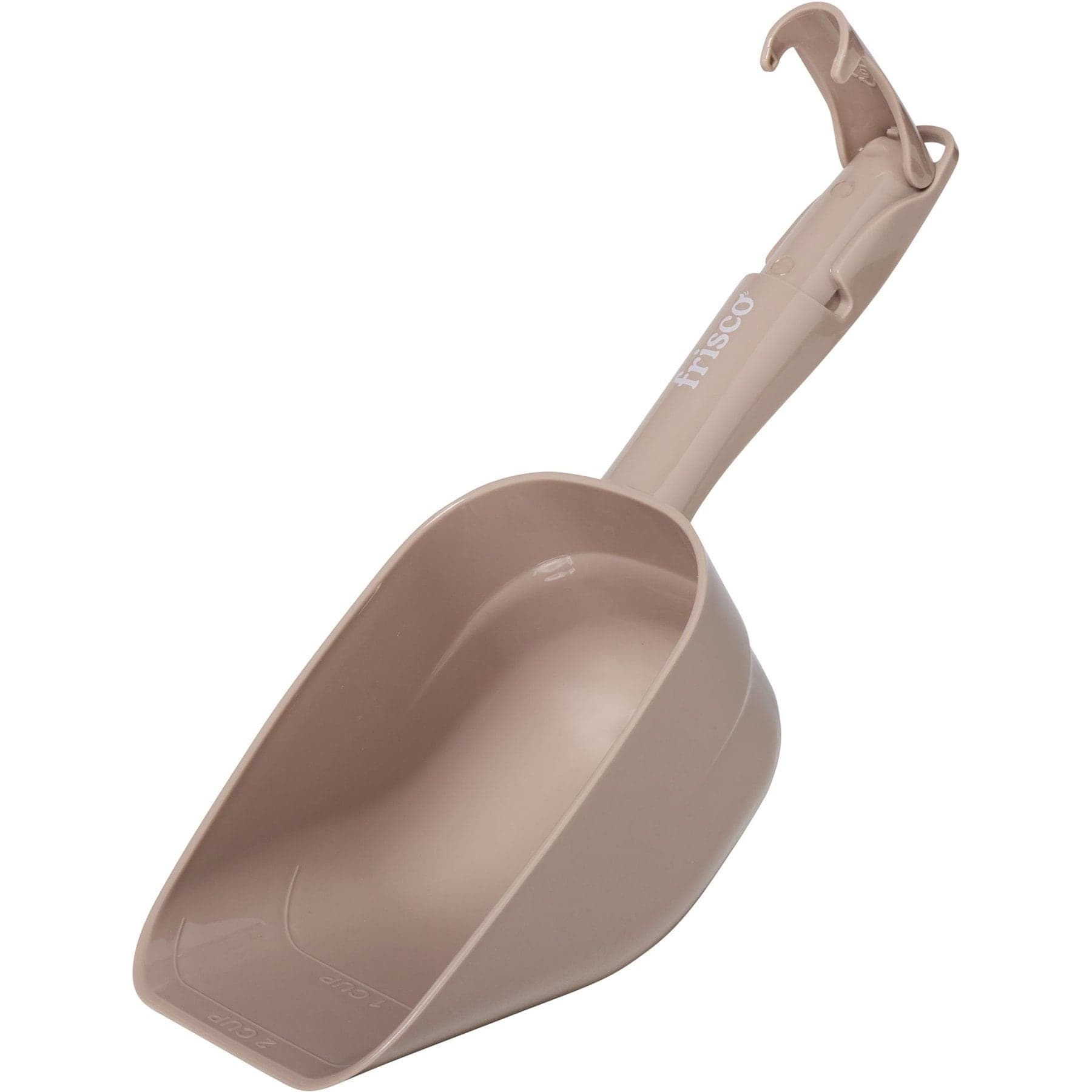
The Frisco Dog & Cat Food Scoop is a pet food scoop for portioning meals.
Webvet may earn a commission when you click through to Chewy, at no extra cost to you.
Dog Feeding Chart by Weight
A feeding chart by body weight lists the daily calories a healthy adult dog needs at each weight, and WSAVA publishes one for average healthy adult dogs in ideal body condition, from 2 to 49 kg (4.4 to 107.8 lb).
This dog feeding chart by body weight gives the daily calories WSAVA lists and the cups and grams each range equals for an example food at 400 kcal per cup or 3,570 kcal per kg, with a body condition check for adjusting the amount.
| Body weight | Daily calories (WSAVA, kcal per day) | Cups per day at 400 kcal per cup (example food) | Grams per day at 3,570 kcal per kg (example food) |
|---|---|---|---|
| 2 kg (4.4 lb) | 140–177 | 0.35–0.44 | 39–50 |
| 5 kg (11 lb) | 280–351 | 0.70–0.88 | 78–98 |
| 8 kg (17.6 lb) | 400–499 | 1.00–1.25 | 112–140 |
| 10 kg (22 lb) | 470–590 | 1.18–1.48 | 132–165 |
| 15 kg (33 lb) | 640–800 | 1.60–2.00 | 179–224 |
| 20 kg (44 lb) | 790–993 | 1.98–2.48 | 221–278 |
| 25 kg (55 lb) | 940–1,174 | 2.35–2.94 | 263–329 |
| 30 kg (66 lb) | 1,080–1,346 | 2.70–3.37 | 303–377 |
| 35 kg (77 lb) | 1,210–1,511 | 3.03–3.78 | 339–423 |
| 40 kg (88 lb) | 1,340–1,670 | 3.35–4.18 | 375–468 |
| 45 kg (99 lb) | 1,460–1,824 | 3.65–4.56 | 409–511 |
| 49 kg (107.8 lb) | 1,560–1,945 | 3.90–4.86 | 437–545 |
To read the chart, divide the calorie range for your dog's weight by the kcal per cup on your own food. The example densities come from Tufts' worked examples, not a recommended food.
WSAVA labels these figures guidance only, so treat them as starting points: some dogs need more or fewer calories to stay trim. For a dog between rows, such as a 50 lb dog, use the two nearest rows, then adjust by body condition.
How much food to feed a dog chart?
A useful chart for how much food to feed a dog lists calories by body weight, because the right number of cups changes from one food to the next. Tufts notes that some labels give only broad bands, such as 1/2 to 1 cup a day for any dog from 0 to 15 pounds.
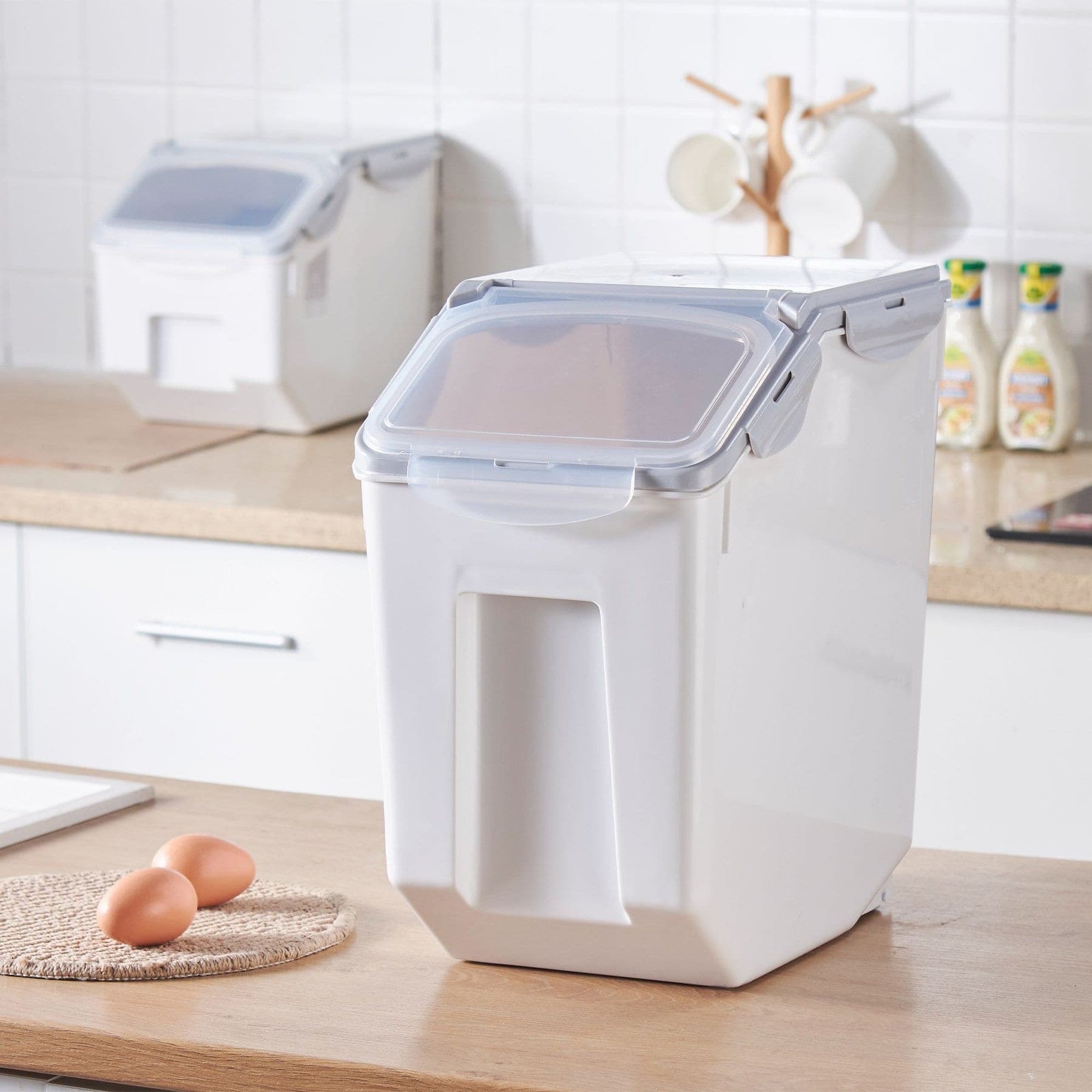
The HANAMYA Container with Measuring Cup is a dog and cat food storage container that comes with a measuring cup.
Webvet may earn a commission when you click through to Chewy, at no extra cost to you.
How Many Calories Does a Dog Need?
A dog's daily calorie needs come from its resting energy requirement (RER), multiplied by a factor for life stage and neuter status. The Merck Veterinary Manual defines RER as the energy a healthy, fed animal uses at rest in a thermoneutral environment: 70 × (body weight in kg) to the 0.75 power.
For dogs over 2 kg and under 45 kg, Merck also allows a linear shortcut, 30 × (body weight in kg) + 70. Merck and the Pet Nutrition Alliance (PNA) then multiply RER by these maintenance factors:
- Intact adult: 1.8 × RER (Merck and PNA)
- Neutered adult: 1.6 × RER (Merck and PNA)
- Obesity-prone adult: 1.4 × RER (Merck)
- Inactive or overweight-prone dog: 1.2 to 1.4 × RER (PNA)
- Dog on a weight-loss plan: 1.0 × RER (PNA)
For a 20 kg (44 lb) dog, RER is about 662 kcal. A neutered adult at 1.6 × RER needs about 1,059 kcal, above WSAVA's 790 to 993, while the inactive-dog factor gives about 794 to 927.
Each result is an estimate. Merck says a dog may need as much as 30% more or fewer calories than calculated for its weight, while PNA puts the spread at up to 50% and calls its equations starting points.
A calorie target becomes a portion only with your food's calorie figure from the bag, so if you pour kibble into a storage bin, keep that label panel.
How Many Cups of Food Should a Dog Eat?
The cups a dog should eat equal its daily calorie target divided by the kcal per cup on its food label, so no single cup amount fits every dog.

Converting calories to cups with the kcal per cup on the label takes one division. AAFCO says the calorie statement must appear under a "Calorie Content" heading, in kcal per kilogram as fed and per familiar unit such as a cup or can, which makes the calories fed per day easier to work out.
Calorie density varies widely between foods. A Tufts review of weight-control foods found dry dog foods ranging from 217 to 440 kcal per cup, so one cup of one food can carry about twice the calories of a cup of another.
Follow these steps to turn your dog's calorie target into cups or grams:
- Find your dog's daily calorie target from the chart above, a calculator, or your vet.
- Read the kcal per cup and kcal per kg under "Calorie Content" on the bag.
- Divide the calorie target by the kcal per cup to get cups per day.
- For grams, divide the kcal per kg by 1,000 to get kcal per gram, then divide the calorie target by that number.
- Split the daily amount into meals.
Tufts shows the math with a cat eating 250 calories a day, and it works the same way for dogs: at 400 kcal per cup, 250 kcal is 5/8 of a cup; at 3,570 kcal per kg, or 3.57 per gram, it is 70 grams. For cat portions, see how much to feed a cat.
Measuring food with a kitchen scale or a level measuring cup keeps those numbers accurate. Tufts explains that the kcal per cup on a label assumes a standard 8 fluid ounce cup filled exactly level, so other cups can give inaccurate counts, and that a cup measures volume, not weight.
Cornell University advises filling the cup so it is level, not heaping, and owners often misjudge portions: a 2019 Veterinary Record study asked 100 dog owners to measure food with three devices, then checked each portion on a gram scale. It found:
- Errors ranged from 47.83% under to 152.17% over the target amount.
- Errors were larger for small amounts, such as 1/4 cup compared with 1 cup.
- A one-cup dry-food measuring cup was more accurate than a two-cup liquid measuring cup and a two-cup commercial food scoop.
The authors say consistent overestimation could be a risk factor for weight gain, and that small dogs are specifically at risk because small volumes were measured least accurately. They recommend three ways to measure more accurately:
- Weigh the food on an electronic gram scale.
- Measure the whole day's food once, then divide it into meals.
- Use a volume-calibrated dry-food measuring device.
If you use a food scoop, fill it level and weigh one level scoopful once, so you know how many grams it really holds.
How Often Should You Feed a Dog?
Most adult dogs should be fed once or twice a day, according to the Merck Veterinary Manual's owner guide, while puppies need more frequent meals. The most common recommendation for how often to feed adult dogs, VCA says, is at least two meals a day.

The Merck Veterinary Manual's feeding guidance calls portion-controlled feeding, such as two premeasured meals at regular times each day, the best regimen for preventing obesity in most adult dogs. Merck's owner guide adds that large-breed dogs should be fed smaller meals at least twice a day to prevent their stomachs from bloating.
Puppies follow a different schedule: Merck says puppies from weaning to 6 months old should be fed three times a day, and puppies 6 to 12 months old twice daily.
Is it okay to feed my dog twice a day?
Yes, feeding your dog twice a day is the most common recommendation for adult dogs, according to VCA. It explains that an empty stomach begins sending hunger signals after 8 to 10 hours, which is why it calls at least two meals a day best.
Splitting one measured daily amount into two meals keeps the day's calories the same. The best times to feed are regular ones: Merck's guidance calls for meals at regular times each day. For a full schedule by age, see WebVet's dog feeding schedule.
If your dog empties its bowl in seconds, a slow-feeder bowl makes it work through the same measured portion more slowly. WebVet compares options in its guide to the best slow feeder dog bowls.
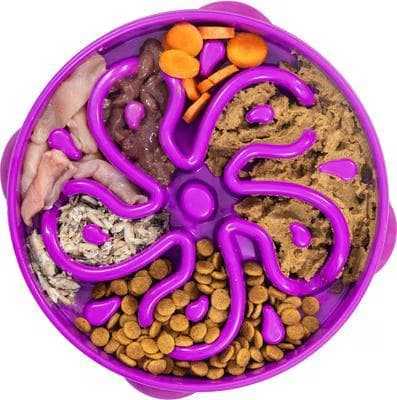
The Outward Hound Fun Feeder is an interactive slow-feeder dog bowl with a maze pattern.
Webvet may earn a commission when you click through to Chewy, at no extra cost to you.
Is it okay for dogs to eat once a day?
Some dogs do fine eating once a day, but it is not the standard veterinary advice. VCA says some less food-motivated dogs do well on one meal a day, while others need more frequent meals, such as dogs that eat only small amounts at a time or dogs with gastroesophageal reflux disease (GERD).
A 2022 GeroScience study from the Dog Aging Project looked at 24,238 dogs for health conditions and 10,474 for cognition. Dogs fed once daily rather than more often had:
- Lower average scores on a cognitive dysfunction scale
- Lower odds of gastrointestinal, dental, orthopedic, kidney and urinary, and liver and pancreas conditions
The authors caution that the study was cross-sectional, that only 8% of the dogs ate once daily, and that it cannot show cause and effect or guide feeding decisions for individual dogs. They suggest only that the twice-daily norm may merit a closer look.
Once-daily feeding is unproven as a health benefit, so Merck's one to two meals and VCA's at least two remain the guidance.
A consistent schedule is easier when someone is home at meal times. If no one is, an automatic feeder such as the PetSafe Eatwell 5-Meal Automatic Dog & Cat Feeder can serve portions you measured in advance at programmed times; see the best automatic dog feeders for more options.
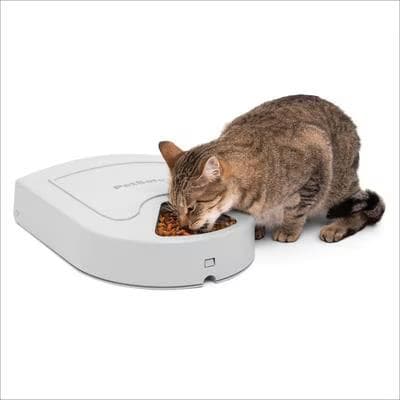
The PetSafe Eatwell is an automatic dog and cat feeder with programmable meal times.
Webvet may earn a commission when you click through to Chewy, at no extra cost to you.
Wet Food vs Dry Food: How Much of Each
A dog needs the same calories from wet food as from dry food, but the wet portion is much larger because canned food is mostly water: the Merck Veterinary Manual puts canned food at 68% to 78% water and dry food at about 10%.

That is why wet food versus dry food amounts cannot be compared gram for gram. AAFCO says canned food has fewer calories per kilogram as fed than dry food because of its moisture, and a Tufts label example lists an adult dry dog food at 3,606 kcal per kg.
The adult canned dog food in that same Tufts example has 1,198 kcal per kg. For canned food, divide your dog's daily calories by the kcal per can on the label; VCA says any unused canned portion should be thrown away after three days.
To feed both, VCA advises reviewing the portion of each type of food with your veterinary team. The arithmetic splits one daily calorie target between the two foods:
- Choose how many calories will come from wet food, and divide that number by the kcal per can.
- Subtract those calories from your dog's daily target.
- Cover the remaining calories with dry kibble, divided by its kcal per cup.
Raw, fresh, and freeze-dried foods use the same math: divide the daily calorie target by the calories per gram or per unit on that food's label. When you switch foods, recalculate from the new label; see transitioning dog food.
Adjusting for Age, Activity, and Spay or Neuter
Adjusting for age, activity, spay or neuter status changes the calorie target, not the method. Merck's maintenance formulas take age and neuter status into account, and VCA says energy requirements vary widely among healthy young adult dogs. Use these adjustments, then confirm the result with your dog's body condition:
- Spayed or neutered dogs: VCA says spayed and neutered dogs have lower energy requirements than intact dogs, and Merck and PNA both use 1.6 × RER for a neutered adult versus 1.8 × RER intact.
- Activity level: VCA says that unless a dog regularly does working roles, agility training, or endurance sports, it typically needs fewer calories than owners assume. Merck notes working dogs can need more than a maintenance diet; an Alaskan sled dog can need 10,000 kcal a day.
- Home life, size, and breed: Merck says household dogs often need fewer calories than kennel dogs, and that breed affects calorie needs independent of size, so a medium-size or large-breed dog can need more or less than its chart row.
- Senior dogs: Cornell's Riney Canine Health Center says most dogs become less active with age and need fewer calories, though a dog still hiking and active every day needs no smaller portion. VCA advises against relying on the label chart for more than a couple of weeks, since it can overestimate.
- Very old dogs: VCA says very old dogs may need more calories and protein to keep a normal physique. For diet choices, see WebVet's guide to senior dog food.
- Puppies, including a 6-month-old dog: Merck uses 3 × RER for puppies under 4 months and 2 × RER after that. See how much to feed a puppy.
- Pregnant or nursing dogs: The chart and factors here cover healthy adults and growing puppies, so ask your vet for a pregnant or nursing (lactating) dog's calorie target.
How to Tell If You Are Feeding the Right Amount
You are feeding the right amount when your dog holds a body condition score (BCS) of 4 to 5 on the 9-point scale, the ideal range in both the Merck Veterinary Manual and WSAVA. Checking the amount with body condition score beats the scale alone.

VCA says BCS matters more than the number on the scale. WSAVA's body condition chart describes a dog at ideal weight this way:
- Ribs easy to feel, with minimal fat covering at a score of 4 and no excess fat at a score of 5
- A waist you can see behind the ribs when you look down from above
- A belly that tucks up when you look from the side
VCA's at-home rib check compares the feel of your dog's ribs with your own hand:
- Like the back of your hand: good body condition
- Like your knuckles: your dog may be too thin
- Like the fleshy palm: your dog may be carrying too much weight
Cornell's Riney Canine Health Center says each point away from ideal equals 10% of body weight, so a dog at BCS 7/9 is 20% over its ideal weight.
Once you set a calorie target, VCA suggests weighing your dog every three to four weeks, and the Pet Nutrition Alliance says to adjust the amount up or down to reach or keep an ideal body condition score. Weight change follows the same check:
- To help a dog lose weight: do not simply cut its current food. VCA says that could cause micronutrient deficiencies over time, and recommends a restricted-calorie therapeutic diet, portion, and meal frequency set with your vet.
- To help a dog gain weight: ask your vet about the right diet and amount first, as Tufts advises for underweight pets, then raise the daily amount and recheck body condition until it reaches 4 to 5 out of 9. See dog weight loss or gain for causes.
Can I overfeed my dog?
Yes, you can overfeed a dog, and it is common. VCA calls obesity the most common preventable disease in dogs in North America, citing a 2022 Association for Pet Obesity Prevention survey that found 59% of dogs overweight.
Cornell names feeding patterns as the most common cause of obesity in an otherwise healthy dog:
- High-fat, low-fiber diets
- Free-choice feeding instead of portioned meals
- Too many treats or table scraps
The University of Illinois College of Veterinary Medicine says overfeeding plays a much bigger role in pet obesity than lack of exercise, and VCA says even moderate overweight can reduce a dog's life expectancy by nearly two years.
Will dogs stop eating when full?
Most dogs will not reliably stop eating when full. The Merck Veterinary Manual says some adult dogs can be fed free choice, but most cannot without becoming obese, and that most dogs eat all their food immediately while some graze through the day.
Genes play a part too: in Labrador retrievers, a 2016 Cell Metabolism study linked a POMC gene deletion to higher body weight and greater food motivation. Measured meals, not appetite, should set the amount.
Treats and Table Scraps
Treats should make up less than 10% of a dog's daily calories and never replace a meal, the WSAVA treat guide says. Keeping treats to a small share of daily calories matters because most treats are not complete and balanced, so Merck sets the same limit to prevent nutrient deficiencies.
To set a treat budget, take 10% of your dog's calorie target: a dog eating 800 kcal a day has under 80 kcal for treats. VCA notes that one large milk bone has about 85 calories, and that treats labeled light are not significantly lower in calories; see WebVet's guide to low calorie dog treats.
Table scraps count toward the same budget: Merck's owner guide says they should never make up more than 10% of a dog's daily calories. WSAVA warns that table scraps can be unhealthy and potentially dangerous, and lists these toxic ingredients:
- Chocolate
- Macadamia nuts
- Onions, leeks, shallots, garlic, and chives
- Grapes, raisins, currants, and sultanas
- Xylitol, a sweetener
- Alcohol and raw yeast dough
- Caffeinated drinks, including coffee, tea, and energy drinks
When to Talk to Your Vet
Talk to your vet before starting a diet, when body condition is 7 out of 9 or higher, and promptly if your dog stops eating. VCA says never to start a diet without the veterinary team, because hypothyroidism and Cushing's disease can contribute to weight gain.
Your vet should also guide feeding in these situations:
- Before a weight-loss diet: VCA says the veterinarian will perform a physical examination and nutritional assessment and recommend blood tests.
- A body condition score of 7/9 or higher: the Pet Nutrition Alliance advises a weight-loss program under the direct guidance of the veterinary team.
- Weight loss faster than 1% to 2% a week: Cornell expects a dog on a weight-loss plan to lose 1% to 2% of body weight per week, and says faster loss might not be safe or might indicate a health problem.
How Much to Feed a Dog FAQs
Frequently Asked Questions
Can a dog skip one day of eating?
A dog that skips eating for a full day needs a vet: VCA's urgent care guidance lists more than 12 hours without eating as a reason to visit urgent care.
A skipped meal is not always low appetite. VCA describes dogs that want to eat but cannot pick up, chew, or swallow food.
Is 1 cup of dog food a day enough?
One cup a day is enough for some dogs, depending on your dog's size and the calories in each cup. At 400 kcal per cup, one cup exceeds WSAVA's 140 to 177 calories for a 2 kg (4.4 lb) dog and falls well short of 640 to 800 for a 15 kg (33 lb) dog.
Tufts found senior dry dog foods ranging from 246 to 408 calories per cup, so read your food's label before settling on a cup amount.
Is dry or wet food better for dogs?
Neither dry nor wet food is better for every dog. VCA says your veterinary team is the best source for a specific recommendation, while the Merck Veterinary Manual's owner guide says dry food is usually better than canned because it helps keep teeth and gums healthy while providing the same nutrition.
Is there a calculator for how much to feed my dog?
Yes. Tufts recommends the Pet Nutrition Alliance Calorie Calculator, which asks for your dog's weight, body condition score, and spay or neuter status, then uses your food's calories per cup, gram, ounce, or can to suggest a feeding amount.
Tufts says over- or underweight pets need a vet instead, and the Pet Nutrition Alliance calls its tool a guideline designed for veterinary professionals. WebVet's feeding calculator divides your dog's daily calorie target by the kcal per cup on your label to estimate cups per day.

Editor
The Webvet Editorial Team is the in-house group of pet-care editors and writers behind Webvet, operated by Smart Pet Collective. The team researches, writes, and maintains Webvet's pet health, behavior, and medication content. Every article follows a defined editorial process: research from reputable veterinary and scientific sources, careful drafting, mandatory review of medical content by a credentialed veterinarian, and dated publication. Health and medication articles are medically reviewed by a licensed veterinary professional before they go live and are kept current over time.
Veterinarian · BVMS MRCVS
Dr. Pippa Elliott, BVMS, MRCVS, is a veterinarian with nearly 30 years of experience in companion animal practice. Dr. Elliott earned her Bachelor of Veterinary Medicine and Surgery from the University of Glasgow. She was also designated a Member of the Royal College of Veterinary Surgeons. Married with 2 grown-up kids, Dr. Elliott has a naughty Puggle named Poggle, 3 cats and a bearded dragon.


