Best Slow Feeder Dog Bowls: Vet-Backed Picks for Fast Eaters
A slow feeder dog bowl turns a 30-second gulp-fest into a safer, calmer meal. Here are the best vet-backed picks by dog size, eating speed, and material, plus how to match difficulty to your dog.

This article contains affiliate links. Webvet may earn a commission when you buy through them, at no extra cost to you.
WebVet may earn a commission from qualifying purchases made through links on this page, at no additional cost to you.
The best slow feeder dog bowl for most dogs is the Outward Hound Fun Feeder, an inexpensive maze-style bowl that stretches a 30-second gulp into a several-minute meal. Vets recommend slow feeders because gulping raises the risk of choking, regurgitation, and bloat, and a ridged bowl is the simplest fix.

Not every dog needs the same bowl, though. A French Bulldog with a flat face, a Great Dane that inhales six cups a day, and a plastic-chewing Lab each do better with a different design, material, and difficulty level. That is where most owners get the purchase wrong.
This guide covers why veterinarians recommend slowing your dog down, our four favorite bowls by size and eating speed, how plastic compares with stainless steel and ceramic, and a difficulty-matching framework so your dog is challenged without being frustrated.
Key takeaway: Fast eating is a health issue, not a quirk. A slow feeder dog bowl paces the meal, which lowers the odds of choking, regurgitation, and gas swallowing, and it adds mental enrichment to every feeding. Match the bowl's difficulty to your dog's snout shape and determination, not just its size.
At a glance: our top slow feeder picks
So what is the best dog slow feeder bowl? For most households it is the Outward Hound Fun Feeder, the same maze bowl Google's own AI-generated answer currently names best overall. It is cheap, effective, easy to clean, and sold in several sizes and ridge patterns.
The rest of our lineup covers the gaps a single plastic maze cannot: a high-capacity budget bowl for big meals, a stainless steel option for chewers and allergy-prone dogs, and a raised ceramic feeder for dogs that eat better at height.
| Pick | Best for | Material (dishwasher?) | Difficulty | Capacity | Price |
|---|---|---|---|---|---|
| Outward Hound Fun Feeder | Best overall | Food-safe plastic (BPA free) (Top rack) | Easy to hard, varies by pattern | About 4 cups in the large size | $11.59 |
| JW Pet Skid Stop Slow Feeder | Big meals on a budget | Plastic with non-skid rubber rim (Check the care label) | Easy | 6 cups | $14.99 |
| OurPets Durapet Premium Slow-Feed | Best stainless steel | Stainless steel (Yes) | Easy | Varies by bowl size | $20.99 |
| PawsPik Raised Ceramic Slow Feeder | Best ceramic, raised height | Ceramic (Check the listing) | Easy to medium | Not specified by the maker | $22.99 |
Prices reflect Chewy listings at the time of writing and can change. Full reviews of all four bowls, including who each one is wrong for, are below.
Quick routing if you already know your dog: plastic-chewers should jump straight to the stainless Durapet, giant-breed households to the 6-cup JW Skid Stop, and stiff or senior dogs to the raised PawsPik. Everyone else starts with the Fun Feeder.
Why vets recommend slow feeder bowls (choking, regurgitation, bloat)

Do vets recommend slow feeder bowls? Yes. Veterinarians routinely suggest slow feeders for dogs that bolt their food, because rapid eating sits at the start of a chain of problems: gagging and choking on unchewed kibble, regurgitation minutes after the meal, swallowed air, and in large breeds, a possible contribution to life-threatening bloat.
The mechanism is simple. A dog that empties the bowl in 30 seconds barely chews, swallows large boluses of dry food, and gulps air with every mouthful. Slowing the meal to several minutes interrupts every link in that chain at once. Here is what each risk looks like.
Choking and gagging
Unchewed kibble is the right size and shape to lodge in the throat. Fast eaters often gag, cough, or hack mid-meal, and a true airway obstruction is an emergency. Dogs that gulp are also more likely to swallow food into the windpipe entrance rather than the esophagus.
A slow feeder dog bowl forces smaller mouthfuls. When a dog can only reach a few pieces of kibble between ridges, each swallow is smaller, better chewed, and far less likely to catch in the throat on the way down.
Regurgitation and aspiration
If your dog eats and then brings the meal back up within minutes, that is usually regurgitation rather than vomiting: a passive return of undigested food from the esophagus, with no abdominal heaving. Speed-eating is one of the most common and most fixable causes in otherwise healthy dogs.
Regurgitation is more than a carpet problem. Food that comes back up can be inhaled into the airway, and aspiration of food material can lead to pneumonia. Pacing the meal keeps food moving in one direction. If regurgitation continues after you slow the meal down, see your vet, since esophageal disease needs ruling out.
Bloat and GDV in deep-chested breeds
The most serious concern is gastric dilatation and volvulus, or GDV, in which the stomach distends with gas and twists on itself. It is rapidly fatal without emergency surgery. The Merck Veterinary Manual describes GDV as an acute, life-threatening condition seen most often in large, deep-chested dogs.
Rapid eating is one of the feeding-practice risk factors reported in large-breed dogs, alongside feeding one large meal a day, according to the American College of Veterinary Surgeons. A slow feeder does not make a high-risk dog bloat-proof, but it directly addresses the gulping and air swallowing owners can actually control.
Deep-chested breeds with a higher reported GDV risk include:
- Great Danes
- German Shepherds
- Standard Poodles
- Weimaraners
- Irish Setters and Gordon Setters
- Saint Bernards
- Basset Hounds, a reminder that deep-chested is about body shape, not just height
For these dogs, the bowl is one piece of a broader plan. Alongside a slow feeder, veterinary guidance for bloat-prone breeds typically includes:
- Feeding two or more smaller meals per day instead of one large meal
- Feeding dogs separately in multi-pet homes so competition does not fuel gulping
- Discussing preventive gastropexy with your vet for the highest-risk breeds, a surgical tack that stops the stomach from twisting
- Learning the emergency signs below so you never lose time deciding whether to go in
Key takeaway: Vets recommend slow feeders because gulping drives choking, regurgitation, aspiration risk, and air swallowing, and rapid eating is a reported risk factor for GDV in large, deep-chested breeds. Pair a slow feeder with two or more smaller meals a day for the biggest safety margin.
Are slow feeder bowls good for dogs? (benefits and evidence)
Yes, slow feeder bowls are good for the overwhelming majority of dogs. They are one of the rare pet products where the mechanism is visible at the first meal: the same portion that vanished in 30 seconds now takes minutes, with smaller mouthfuls and less frantic gulping.
Do slow feed bowls actually work? Watch the clock. Owners and testers consistently measure meal times stretching from well under a minute to five or ten minutes, depending on ridge depth and the dog's determination. Manufacturers claim up to ten-times-slower eating; real results vary by dog, but a several-fold slowdown is typical.
The benefits of a slow feeder dog bowl go beyond speed:
- Fewer choking and gagging episodes because each mouthful is smaller
- Less regurgitation after meals in habitual speed-eaters
- Less swallowed air, which means less burping and flatulence
- Mental enrichment, since working for food is a natural canine behavior
- A calmer mealtime routine, especially in multi-dog homes where competition fuels speed
- Slower eating in dogs on weight-loss plans, which can help a dieting dog feel like the meal lasted longer
The evidence base is practical rather than clinical. No large trial proves slow feeders prevent disease, and we will not pretend otherwise. What is well established is the risk chain they interrupt.
Veterinary sources consistently flag rapid eating as a modifiable feeding-practice risk, and slow feeder bowls demonstrably slow eating, a change you can time yourself at the very first meal. That is the honest case for a $12 purchase, and it is a strong one.
Key takeaway: Slow feeder bowls are good for nearly every dog. They measurably stretch meals from seconds to minutes, cut gulping and its downstream risks, and add daily enrichment. The main way they go wrong is a difficulty mismatch, which the framework later in this guide prevents.
The enrichment piece deserves emphasis. Dogs are natural foragers, and behaviorists note that many animals will happily work for food even when free food is available. A maze bowl turns the most reliable event of the day into a short puzzle session, which is especially valuable for high-energy or easily bored dogs.
Slow feeders work best as part of a sensible routine. Splitting the daily ration into two or more meals matters as much as the bowl, particularly for bloat-prone breeds. If you are rethinking meal timing, our dog feeding schedule guide covers how many meals dogs need at each life stage.
So is it bad if your dog eats too fast? Yes: the evidence above ties speed itself to gagging, regurgitation, and higher bloat risk, which is why slowing the meal down matters more than changing what is in the bowl.
Signs your dog needs a slow feeder
How do you tell if your dog needs a slow feeder? Time a meal. If a standard portion disappears in under a minute or two, your dog is a speed-eater and will benefit from one. Beyond the stopwatch, watch for these signs at and after mealtimes.
- Finishing meals in seconds, barely chewing
- Gagging, coughing, or hacking during or right after eating
- Regurgitating undigested food within minutes of a meal
- Loud gulping sounds or visible air swallowing
- Burping, flatulence, or a gurgling stomach after eating
- Frantic, competitive eating around other pets
- Begging or scavenging immediately after finishing, as if the meal never registered
- Vet advice to slow eating because your dog is a large or deep-chested breed
One or two of these signs is enough to justify a $12 bowl. Speed-eating also has causes worth understanding, from past food scarcity to plain competition. We break those down in why does my dog eat so fast, which pairs with this guide.
Breed and body shape raise the stakes. In a Chihuahua, speed-eating is mostly a mess and comfort issue. In a Great Dane or German Shepherd, the same habit intersects with a known GDV risk profile, which is why vets bring up slow feeders unprompted with large-breed owners.
The best slow feeder dog bowls (picks by size and eating speed)
The short verdict: the Outward Hound Fun Feeder is the best slow feeder dog bowl for most dogs, with the JW Skid Stop as the budget pick and the OurPets Durapet for chewers who need stainless steel. Each ridge pattern below keeps kibble extractable without frustrating the dog into giving up.

What bowl is good for dogs that eat too fast? Any well-designed slow feeder beats an open dish, but the right pick depends on your dog's size, meal volume, snout shape, and how destructive they are with plastic. These four cover almost every fast eater we can think of.
1. Outward Hound Fun Feeder Interactive Bowl: best overall
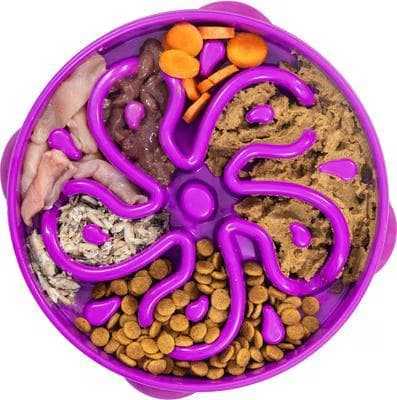
A maze-pattern slow-feeder bowl that makes fast eaters work for each bite, reducing the gulping and swallowed air that trigger regurgitation and vomiting. Holds up to 4 cups.
Webvet may earn a commission when you click through to Chewy, at no extra cost to you.

The Outward Hound Fun Feeder is the default answer for a reason. Its spiral and maze ridge patterns break the food surface into narrow channels a tongue can reach but a muzzle cannot scoop. The brand claims meals slow by up to ten times; a strong several-fold slowdown is what most owners actually see.
It comes in multiple sizes and ridge patterns, so you can pick a shallower layout for a flat-faced dog and a deeper maze for a determined Labrador. The large size holds about four cups. It is food-safe, BPA-free plastic with a non-slip base, and it is top-rack dishwasher safe.
Why we picked it:
- The most effective slowdown per dollar of any bowl we evaluated
- Multiple sizes and difficulty patterns under one product line
- Top-rack dishwasher safe with a non-slip base
Keep in mind: determined chewers can gnaw plastic ridges, and deep mazes frustrate flat-faced breeds. Supervise the first meals and size down in difficulty if your dog gives up.
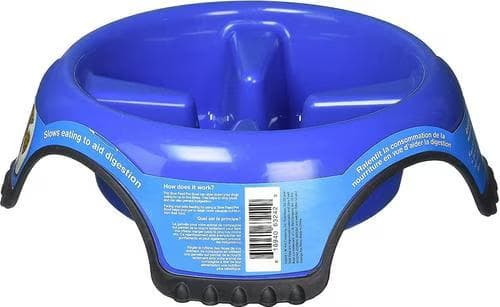
2. JW Pet Skid Stop Slow Feeder: best for large meals on a budget
Webvet may earn a commission when you click through to Chewy, at no extra cost to you.

Feeding a big dog means big portions, and many maze bowls simply cannot hold them. The JW Pet Skid Stop Slow Feeder solves that with a 6-cup capacity and a raised center obstruction that forces your dog to eat around it rather than straight down the middle.
The design is milder than a full maze, which makes it a good first slow feeder or a fit for dogs that quit on harder puzzles. The non-skid rubber rim keeps the bowl planted while an enthusiastic eater pushes it around the floor. Chewy shoppers rate it 4.2 stars at the time of writing.
Why we picked it:
- 6-cup capacity handles giant-breed portions in one bowl
- Gentle difficulty suits beginners, seniors, and easily frustrated dogs
- Non-skid rim stops floor hockey at mealtime
Keep in mind: truly relentless gulpers may outsmart the simple center-obstruction design. If meals are still vanishing in under two minutes, step up to a deeper maze.
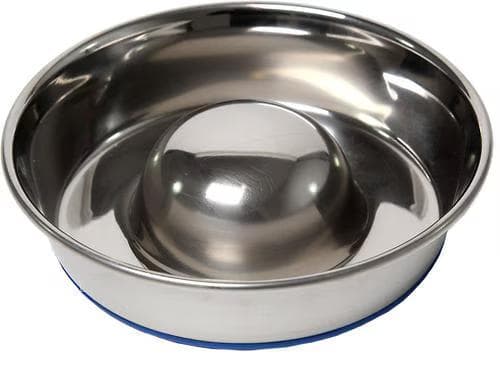
3. OurPets Durapet Premium Slow-Feed: best stainless steel
Webvet may earn a commission when you click through to Chewy, at no extra cost to you.

If your dog chews plastic, has chin acne or skin sensitivities, or you just want the most hygienic material available, the OurPets Durapet Premium Slow-Feed bowl is the stainless steel answer. A raised dome in the center forces the dog to work around the edge instead of vacuuming the middle.
Stainless steel is non-porous, so it never develops the micro-scratches that harbor bacteria in worn plastic, and it goes in the dishwasher without a second thought. A bonded rubber ring keeps it from skating across the floor. Shoppers rate it 4.5 stars on Chewy at the time of writing.
Why we picked it:
- Stainless steel is the most sanitary, durable, chew-proof bowl material
- Fully dishwasher safe with a non-slip rubber base
- The mild dome design works well for wet food as well as kibble
Keep in mind: the slowdown is gentler than a plastic maze. It is the right trade for chewers and sensitive-skin dogs, but extreme gulpers may need a harder puzzle.
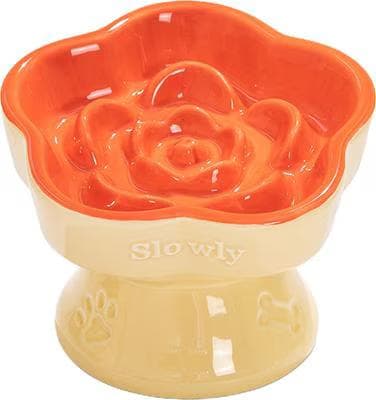
4. PawsPik Raised Ceramic Slow Feeder: best ceramic, raised height
Webvet may earn a commission when you click through to Chewy, at no extra cost to you.

The PawsPik Raised Ceramic Slow Feeder combines two features owners usually have to buy separately: a ceramic slow-feed surface and a built-in raised height. Ceramic is heavy enough that a pushy eater cannot shove it across the room, and it never absorbs odors the way scratched plastic can.
The elevation suits older dogs and dogs with neck or joint stiffness that eat more comfortably without bending fully to the floor. Chewy shoppers rate this bowl 4.6 stars at the time of writing, the highest customer score in our lineup.
One important caveat: elevated feeding has a debated history with bloat risk in large breeds, so talk to your vet before choosing a raised bowl for a deep-chested dog. Our elevated dog bowls guide walks through that evidence in detail.
Why we picked it:
- Ceramic build is heavy, stable, odor-resistant, and chew-proof
- Built-in raised height helps stiff or senior dogs eat comfortably
- The highest customer rating in our lineup at 4.6 stars
Keep in mind: ceramic chips and cracks if dropped, and a cracked bowl should be retired immediately. Confirm care instructions on the listing, since some ceramic feeders are hand-wash only.
How we chose these bowls
This roundup is not sponsored, and no brand had input into the lineup. WebVet earns a commission if you buy through our links, but the picks were selected editorially against the criteria below and the prices shown were verified on Chewy at the time of writing.
We weighed each bowl on:
- Slowdown effectiveness: does the design force smaller mouthfuls rather than just decorating the bowl
- Coverage: together, the four picks had to serve small dogs, giant meals, plastic-chewers, and dogs that need height
- Material safety: food-safe, BPA-free plastic, true stainless steel, or food-safe glazed ceramic
- Cleanability: dishwasher-safe designs ranked ahead of hand-wash-only crevice traps
- Owner satisfaction: verified retailer ratings, from 4.2 to 4.6 stars across the lineup
- Price honesty: every bowl here costs under $25, because a slow feeder does not need to be expensive to work
Choosing by dog size, snout shape, and eating speed
Most slow feeder complaints trace back to a mismatch, not a bad product. A bowl that is perfect for a Border Collie is a wall of frustration for a Pug, and a puppy bowl is a joke to an adult Rottweiler. Here is how to get the fit right the first time.
Puppies
A slow feeder bowl for a puppy should be the easiest version you can find: shallow, wide-spaced ridges and a small footprint. Puppies have short attention spans and small muzzles, and an over-hard maze teaches them to give up on food puzzles entirely, which wastes the enrichment habit you are trying to build.
Slow feeders are generally fine for puppies eating solid food, and building calm eating habits early is easier than fixing frantic ones later. Size up the bowl, and the difficulty, as your puppy grows. If softened kibble is on the menu, pick a smooth-surfaced design that rinses clean easily.
Puppies from large litters often arrive with competitive eating already installed, since littermates raced each other at every meal. An easy slow feeder plus a private feeding spot breaks that association within a few weeks, before the habit hardens into adult speed-eating.
Flat-faced breeds like French Bulldogs
A slow feeder bowl for a French Bulldog, Pug, or other brachycephalic breed needs shallow grooves, wide channels, and a low profile. Flat-faced dogs cannot reach the bottom of deep, narrow mazes, and forcing them to try leads to frustration, gulped frustration-mouthfuls, and abandoned meals.
The irony is that brachycephalic dogs are among the biggest beneficiaries of slower eating, since their airway anatomy already makes gulping and aspiration riskier. Choose an easy-level bowl or a lick mat, and let the wide-open design do the pacing rather than depth.
A quick fit test: your dog should be able to touch the bottom of the channel with their tongue without pressing their face flat into the bowl. If they cannot, the ridges are too deep for their snout, whatever the packaging says about size.
Large and giant breeds
For large dogs, capacity is the constraint nobody checks. A 2-cup maze bowl means feeding a Great Dane in multiple installments, which most owners abandon within a week. Look for bowls in the 4 to 6 cup range, like the large Outward Hound Fun Feeder or the 6-cup JW Skid Stop.
Large, deep-chested breeds are also the dogs with the most to gain medically, given their GDV risk profile. A big fast eater deserves a medium-to-hard difficulty, a heavy or non-skid base, and a feeding routine of at least two meals a day rather than one large one.
Stability matters more as dogs get bigger. A 90-pound dog leaning into dinner will send a light bowl skidding, which speeds eating back up as they chase it. Look for rubber-rimmed bases, heavy ceramic, or a bowl that sits inside a stand.
Small breeds
A small slow feeder dog bowl should match a small muzzle: narrow channels are fine, but ridge height should be modest so a Chihuahua or Yorkie can actually reach the food. Mini versions of the Fun Feeder line work well here.
Skip giant-breed bowls for toy dogs. An oversized maze lets a small dog step into the bowl and eat from above, which defeats the pacing entirely. A snug footprint and modest ridges keep the puzzle honest without straining a tiny neck.
Key takeaway: Fit the bowl to the dog: shallow and easy for puppies and flat-faced breeds, high-capacity and harder for large gulpers, low-ridged minis for toy breeds. When in doubt, start one level easier than you think your dog needs and increase difficulty once they succeed calmly.
Size and snout shape narrow the field; material finishes the choice. Stainless steel and ceramic options for each size, and designs that handle wet food, are compared in the materials section below.
Cons of slow feeders and how to choose the right difficulty

What are the cons of slow feeders? They are real but manageable, and nearly all of them come down to choosing the wrong difficulty, the wrong material, or the wrong dog. Here is the honest list.
- Frustration: a too-hard maze can make a dog whine, paw the bowl, or walk away from meals
- Chewing damage: persistent chewers can gnaw and swallow plastic ridge fragments
- Cleaning effort: deep crevices trap food residue and need real scrubbing, especially with wet food
- Tooth wear: aggressive scraping against hard ridges can wear teeth over years, another reason not to over-pick difficulty
- Slower is not always appropriate: dogs recovering from illness, underweight dogs, or dogs with certain jaw or dental problems may need easy access to food
- Multi-dog friction: a slow eater becomes a target if a housemate finishes first, so feed dogs separately
None of these is a reason to skip the category. They are reasons to match difficulty deliberately instead of grabbing the hardest maze on the shelf, which is the single most common mistake.
The tooth-wear point deserves one practical note. If your dog attacks the ridges with their teeth rather than their tongue, the bowl is too hard or was introduced too abruptly. Ease the difficulty, and mention the habit at your next dental check so your vet can watch for wear.
The difficulty-matching framework
Difficulty in a slow feeder comes from two things: ridge depth and maze complexity. Deep, narrow, winding channels are hard; shallow, wide, open patterns are easy. Match both to your dog's snout shape, measured eating speed, and frustration tolerance using the table below.
| Dog profile | Typical eating speed | Recommended difficulty | Ridge style to look for |
|---|---|---|---|
| Puppy or toy breed | Any | Easy | Shallow, wide-spaced ridges, small footprint |
| Brachycephalic (Frenchie, Pug, Boxer) | Any | Easy | Shallow grooves, wide channels, or a lick mat |
| Average adult, moderate gulper | 1 to 2 minutes per meal | Medium | Standard spiral or maze ridges |
| Large fast eater | Under 1 minute per meal | Medium to hard | Deep maze or spiral, 4-cup-plus capacity |
| Frustrated, anxious, or senior eater | Gives up or walks away | One level easier than current | Shallow ridges, wide channels, smooth edges |
Ridge depth is the lever most owners never adjust. Shallow ridges around a finger's depth slow a dog mildly; deep, narrow channels can double or triple the effect but demand more tongue dexterity and patience. Complexity stacks on top: straight ridges are easier than spirals, and spirals are easier than true dead-end mazes.
Watch for frustration signs during the first week: whining at the bowl, pawing or flipping it, grabbing frantic mouthfuls then backing away, or abandoning food entirely. A frustrated dog is not being stubborn. The puzzle is simply mis-sized for its anatomy or temperament.
The fix is to step down, not to quit. Move one difficulty level easier, or scatter a few pieces of kibble on top of the ridges for the first meals so the bowl starts paying out immediately. Once your dog finishes calmly and consistently, you can step difficulty back up.
Introducing the bowl without drama
How you introduce the bowl decides whether your dog sees a game or an obstacle. A calm first week looks like this:
- Serve the first meal slightly hungry, not ravenous, so motivation is high but frustration is low
- Scatter a few pieces on top of the ridges so the bowl pays out instantly
- Stay nearby for the first two or three meals and praise calm, working eating
- Resist the urge to help by tipping food out, which teaches the dog to wait you out
- Hold the routine steady for a week before judging whether the difficulty fits
Most dogs adjust within two or three meals. If yours is still struggling after a week of consistent feeding, the answer is almost always an easier bowl, not more practice at the wrong level.
When not to use a slow feeder
There are dogs that should skip slow feeders, at least without veterinary guidance:
- Severely brachycephalic dogs that struggle with deep bowls; use a lick mat or shallow tray instead
- Dogs with arthritis or neck pain that find sustained head-down puzzling uncomfortable; consider a raised, easy design
- Resource guarders, since added difficulty can escalate tension around the bowl; work with a behavior professional first
- Underweight, ill, or recovering dogs that need calories in without obstacles
- Dogs with significant dental disease, where scraping against ridges causes pain
If your dog falls into one of these groups and still eats dangerously fast, ask your vet about alternatives such as multiple micro-meals, food-dispensing toys with easy settings, or scatter feeding on a snuffle mat.
Plastic vs stainless steel vs ceramic: materials compared
The at-a-glance comparison table at the top of this guide lists each pick's material; here is what those materials mean in practice, and which dogs each one suits.

Material determines how long the bowl lasts, how clean it stays, and whether it is safe for a chewer. Plastic dominates the slow feeder market because ridges are cheap to mold, but a stainless steel slow feeder dog bowl or a ceramic one is the better long-term buy for many dogs.
| Material | Durability | Hygiene | Best for | Watch for |
|---|---|---|---|---|
| Plastic | Moderate; ridges can be chewed | Good when new; scratches harbor bacteria over time | Most dogs; widest choice of maze designs and difficulty levels | Chewers; replace once scratched or gnawed; choose BPA-free |
| Stainless steel | Excellent; effectively chew-proof | Best; non-porous and dishwasher safe | Chewers, dogs with chin acne or skin sensitivities, wet food feeders | Simpler designs; slowdown is usually gentler than plastic mazes |
| Ceramic | Good; heavy and stable but can chip | Very good while the glaze is intact | Strong dogs that shove bowls, style-conscious households, raised designs | Retire immediately if chipped or cracked; some are hand-wash only |
| Silicone | Good; flexible and travel-friendly | Good; usually dishwasher safe | Travel, crates, and as insert mats inside existing bowls | Light weight means determined dogs can flip it; check for a suction base |
Plastic wins on choice and price. Nearly every difficulty level, size, and ridge pattern exists in plastic, which is why our best-overall pick is one. The rule with plastic is simple: buy BPA-free, inspect it monthly, and replace it on schedule.
Replace a plastic slow feeder when you see:
- Visible scratches or gouges in the ridges, which trap bacteria
- Chew marks or missing fragments, a swallowing hazard
- Clouding or roughness on surfaces that used to be smooth
- Lingering odor after a proper wash, a sign the plastic has absorbed residue
Stainless steel slow feeder dog bowls
Stainless steel is the material most veterinary staff use in clinics for a reason: it is non-porous, effectively chew-proof, and survives daily dishwasher cycles for years. For dogs with chin acne, often aggravated by scratched plastic, switching to steel is a common first recommendation.
The trade-off is design range. Steel cannot be molded into intricate mazes cheaply, so most stainless slow feeders use a central dome or simple raised islands, like the OurPets Durapet Premium Slow-Feed. That gentler geometry still meaningfully slows most dogs, and it is the only sensible choice for a plastic-chewer.
Ceramic slow feeder dog bowls
A ceramic slow feeder dog bowl brings weight and stability that plastic cannot match. A strong dog can push a light plastic maze across the kitchen mid-meal; a ceramic bowl stays put. Glazed ceramic also resists odors and staining, and many owners simply prefer how it looks in the home.
The caveats are fragility and glaze quality. Dropped ceramic chips, and a chipped or cracked bowl can harbor bacteria in the exposed clay and should be retired. Buy from reputable sellers with food-safe glaze, and check care instructions. The PawsPik raised ceramic feeder is our favorite in this material.
Whatever the material, run a monthly bowl check: look for scratches or chew damage in plastic, chips or glaze cracks in ceramic, and a loose or perished rubber base on stainless. Bowls are consumables, and the check takes ten seconds with the bowl already in your hand at wash time.
Metal and silicone variants
You will also see metal slow feeder dog bowls marketed separately from stainless, and silicone slow feeders sold as flexible bowls or inserts. Metal generally means the same stainless steel category, while silicone shines for travel and as inserts, covered in the alternatives section below.
If you are torn between stainless and ceramic, decide on the dog, not the kitchen. A chewer or skin-sensitive dog points to steel; a strong dog that bulldozes lightweight bowls, or one that needs raised height, points to ceramic. Either outlasts several plastic replacements.
Slow feeders for wet and raw food
Slow feeders work with wet and raw food, but the bowl choice changes. Deep, narrow plastic mazes become cleaning nightmares once pate is smeared into them, and soft food packed into tight channels can sour if the bowl is not scrubbed after every meal.
Wet food also behaves differently in the bowl. Kibble tumbles into channels and has to be chased; pate sits wherever you put it. That means the slowdown comes less from the maze and more from how thinly the food is spread, which changes what you should buy.
For the best slow feeder dog bowl for wet food, favor one of these designs:
- Shallow, open ridge patterns that a sponge can actually reach
- Stainless steel dome bowls, which are dishwasher safe and non-porous
- Lick mats, arguably the best wet-food slow feeder of all, since food spreads thin and licking is naturally slow
- Silicone designs that flex under running water so residue releases easily
Spreading wet food thinly across a shallow feeder or mat also stretches the meal longer than mounding it in one pocket. Among our picks, the stainless OurPets Durapet handles wet food best, while the Outward Hound Fun Feeder manages loose or chunky wet food if you choose a wider-channel pattern and clean it promptly.
Raw feeders should be pickiest of all. Minced or ground raw spreads well on lick mats and stainless designs, but chunky raw portions do not belong wedged into plastic channels. For chunked raw, a wide stainless dome bowl or simply hand-portioned feeding paces the meal more hygienically.
Freezing is the wet-food power move. Spread the meal on a lick mat or into a shallow feeder, freeze it for an hour, and even a determined gulper gets a ten-minute meal. It works especially well for summer feeding and crate settling.
Inserts, mats, and other slow-feeding alternatives
A ridged bowl is not the only way to pace a meal. If your dog already has a favorite bowl, or a bowl-shaped puzzle simply does not suit them, the wider slow-feeding family offers several alternatives.
The main types of slow feeders for dogs are:
- Maze and ridge bowls: molded ridges divide food into channels; the classic slow feeder dog bowl design
- Slow feeder inserts: weighted or suction-mounted obstacles that drop into the bowl you already own
- Lick mats: textured flat mats for wet or spreadable food; licking is naturally slow and calming
- Snuffle mats: fabric mats that hide kibble so dogs forage with their nose, adding scent-work enrichment
- Puzzle feeders and food-dispensing toys: balls and puzzles that release kibble gradually as the dog works them
A slow feeder insert is the budget path if you own a bowl you love, especially a stainless one. Good dog bowl inserts either weigh enough that they cannot be flipped out or attach with suction cups.
Cheap, light inserts get plucked out and dropped on the floor by clever dogs within a week. Before buying, check that the insert actually fits your bowl's diameter and sits flush against the base, since a rocking insert becomes a toy instead of an obstacle.
Slow feeder mats split into two jobs:
- Lick mats excel with wet food and double as calming tools during grooming, bathing, or nail trims
- Snuffle mats turn a kibble meal into a five-to-ten-minute sniffing game and are the gentlest option for dogs that find rigid puzzles frustrating
Puzzle feeders and food-dispensing toys sit at the far end of the effort scale. They deliver the biggest enrichment payoff and the slowest meals, but they also scatter kibble, need refilling mid-meal for big eaters, and suit treats and partial rations better than a full dinner every day.
Alternatives beat bowls outright in a few cases: severely flat-faced dogs do better with lick mats, dogs that chew plastic do better with fabric snuffle mats or steel inserts, and multi-pet households can use puzzle toys to separate eaters naturally. For everyone else, the maze bowl remains the simplest daily driver.
Why dogs eat too fast
Speed-eating usually is not greed for its own sake. Common drivers include competition with other pets, a history of food scarcity in rescues, learned habits from crowded litters, plain excitement, and occasionally medical causes such as parasites or conditions that ramp up appetite.
The distinction matters because a bowl treats the symptom. A rescue dog eating like every meal is its last may relax over months of predictable feeding, while a dog whose appetite suddenly spiked needs a vet visit, not a harder maze.
A slow feeder manages the behavior, but understanding the cause tells you whether you also need separate feeding stations, a vet visit, or just patience. For the full breakdown of causes and fixes, read why does my dog eat so fast.
Need one for a cat instead?
Cats gulp too, and fast-eating cats often vomit undigested food minutes after meals. But cats interact with food puzzles differently than dogs: they favor paw-based foraging and hunting-style challenges over tongue-and-muzzle mazes, so simply buying a small dog bowl often flops.
Purpose-built feline designs work far better, from puzzle boards to treat balls that reward batting and stalking. Our guide to cat puzzle feeders covers the best options for slowing a cat down while giving them a genuine hunt.
A slow feeder cat bowl applies the same principle at cat scale: shallower ridges, whisker-friendly spacing, and portions measured in grams rather than cups.
Elevated and raised slow feeders
Raised slow feeders, like our PawsPik ceramic pick, combine pacing with height, which can genuinely help seniors and dogs with neck, back, or joint stiffness eat in comfort. For those dogs, an elevated slow feeder dog bowl solves two problems with one purchase.
For large, deep-chested breeds, though, the evidence on elevated feeding and bloat is genuinely mixed, and some research has associated raised bowls with higher GDV risk rather than lower. That debate deserves its own careful treatment: our elevated dog bowls guide covers the evidence, who benefits, and who should stay at floor level.
Slow feeder dog bowl FAQs
Frequently Asked Questions
Are slow feeder bowls good for dogs?
Yes, for most dogs. Slow feeder bowls reduce choking and gagging, cut post-meal regurgitation, limit swallowed air, and add mental enrichment to every meal. The exceptions are underweight or recovering dogs, dogs with painful dental disease, and severely flat-faced dogs given overly deep mazes, which can cause frustration.
Do vets recommend slow feeder bowls?
Vets commonly recommend slow feeders for dogs that bolt their food. Rapid eating drives choking, regurgitation, and air swallowing, and it is a reported risk factor for GDV (bloat) in large, deep-chested breeds. Vets typically pair the bowl with feeding two or more smaller meals per day.
What bowl is good for dogs that eat too fast?
A maze-style slow feeder like the Outward Hound Fun Feeder is the best starting point for most fast eaters. Choose the JW Skid Stop for very large meals, a stainless steel dome bowl like the OurPets Durapet for plastic-chewers, or a raised ceramic feeder for stiff or senior dogs.
How do I tell if my dog needs a slow feeder?
Time a meal. Finishing in under a minute or two means your dog is a speed-eater. Other signs include gagging or coughing while eating, regurgitating undigested food shortly after meals, loud gulping, post-meal burping or flatulence, and frantic competitive eating around other pets.
What are the cons of slow feeders?
The main cons are frustration when the difficulty is too high, chewed plastic ridges in destructive dogs, extra cleaning effort in deep crevices, and possible tooth wear from aggressive scraping over time. Dogs that are underweight, ill, or resource guarders may need a different approach entirely.
Do slow feed bowls work for dogs?
Yes. A well-matched slow feeder typically stretches a meal from under a minute to several minutes, and the change is visible at the very first feeding. If mealtime has not at least tripled, the bowl is too easy for your dog and you should move up one difficulty level.
What is the best dog slow feeder bowl?
The Outward Hound Fun Feeder is the best slow feeder dog bowl for most dogs: effective, inexpensive, dishwasher safe, and available in several sizes and difficulty patterns. The best bowl for your dog depends on size, snout shape, and material needs, which is why our lineup also includes stainless steel and raised ceramic picks.
Bottom line: Start with the Outward Hound Fun Feeder unless your dog chews plastic, eats giant meals, or needs height, in which case the Durapet stainless, JW Skid Stop, or PawsPik raised ceramic fills the gap. Match difficulty to snout shape and temperament, feed at least two meals a day, and let the bowl do the pacing.

Editor
The Webvet Editorial Team is the in-house group of pet-care editors and writers behind Webvet, operated by Smart Pet Collective. The team researches, writes, and maintains Webvet's pet health, behavior, and medication content. Every article follows a defined editorial process: research from reputable veterinary and scientific sources, careful drafting, mandatory review of medical content by a credentialed veterinarian, and dated publication. Health and medication articles are medically reviewed by a licensed veterinary professional before they go live and are kept current over time.
Related reading

Best Dog Advent Calendars and Cat Advent Calendars for 2026: Vet-Reviewed Picks

How to Help a Cat Lose Weight: A Safe Weight Loss Plan

When Can Puppies Eat Solid Food? Weaning Timeline and Tips
