Are Elevated Dog Bowls Good or Bad? A Vet-Reviewed Look
Elevated dog bowls are a genuine comfort aid for some dogs and a question mark for others. Here is what the actual bloat research found, which dogs should and should not use a raised feeder, and how to pick the right height.

BVMS MRCVS

This article contains affiliate links. Webvet may earn a commission when you buy through them, at no extra cost to you.
An elevated dog bowl looks like a simple upgrade: the food comes up to your dog instead of your dog folding down to the floor. Whether it actually helps depends entirely on which dog is eating from it. For some dogs it is a real comfort aid. For others, the research says slow down.
This explainer walks through what raised feeders genuinely do well, what the bloat evidence actually found (including the one study almost everyone quotes and almost no one cites), which dogs should and should not use one, and how to choose the right height if you decide to try it.
Are Elevated Dog Bowls Good or Bad? The Short Answer

Elevated dog bowls are neither universally good nor universally bad. Veterinarians commonly suggest raised feeding for senior dogs with arthritis or neck and back pain, and for megaesophagus dogs that need gravity's help moving food toward the stomach. For large and giant deep-chested breeds, however, one major study associated raised feeders with an increased risk of bloat, so caution is warranted.
So are you supposed to elevate dog bowls? Only when your individual dog has a reason to benefit. There is no evidence that a healthy, comfortable dog eats better, digests better, or is safer with a raised bowl. Floor-level feeding is the default; elevation is a targeted tool.
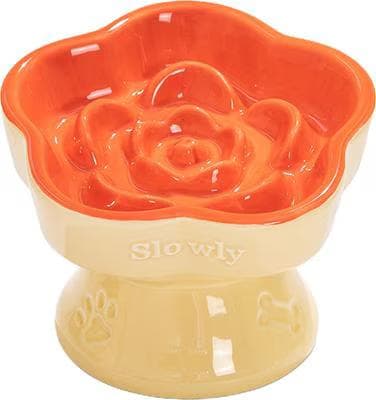
Webvet may earn a commission when you click through to Chewy, at no extra cost to you.
Key takeaway: An elevated dog bowl is a targeted aid, not a universal upgrade. It can make meals easier for seniors, arthritic dogs, and dogs with megaesophagus, but owners of large, deep-chested breeds should talk to their vet first because of an unresolved bloat association.
The Real Benefits of an Elevated Dog Bowl
The honest benefit list is shorter than most product pages claim, but the real entries matter a lot to the dogs they apply to:
- Arthritis and joint pain. A raised bowl lets a stiff dog eat with a more neutral neck and shoulder posture instead of bracing sore joints to reach the floor.
- Senior dogs. Older dogs with reduced flexibility or balance often stand more steadily at a raised feeder, especially on slick floors.
- Neck, back, and post-surgical conditions. Dogs recovering from spinal or orthopedic procedures may be told by their vet to avoid lowering the head to floor level.
- Megaesophagus feeding. Dogs with this condition cannot move food down the esophagus normally, so gravity has to do the work.
- Tidier meals. Some raised stands reduce bowl-chasing and spillage, which is a convenience benefit rather than a health one.
Do Dogs Prefer Raised Bowls?
There is no good evidence that dogs as a group prefer raised bowls. Preference is individual. What owners often interpret as preference is really comfort: a dog whose neck or elbows hurt may eat more willingly, and finish meals faster, once reaching the floor is no longer painful. A young, healthy dog usually shows no difference either way.
A Special Case: Megaesophagus Dogs
Megaesophagus deserves its own note because it is the one condition where feeding position is genuinely medical. The esophagus loses its ability to push food to the stomach, so affected dogs regurgitate meals and risk aspiration pneumonia. Vets manage it partly with upright feeding, using gravity to move food down.
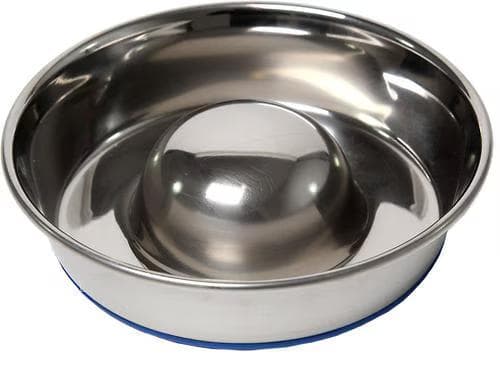
Webvet may earn a commission when you click through to Chewy, at no extra cost to you.
An elevated bowl is often part of that plan, but many megaesophagus dogs need to be fed close to fully vertical, for example in a Bailey chair, and held upright for several minutes afterward. If your dog has this diagnosis, the feeding angle and hold time should come from your veterinarian, not from a product page.
The Bloat Evidence: What the Purdue Study Found
So are raised dog bowls dangerous? For most dogs, no. The question really matters for large and giant deep-chested breeds, where the best available evidence associates raised bowls with higher bloat risk. That makes raised dog bowls for large dogs a good-or-bad question your vet should settle, not the marketing.

Bloat, formally gastric dilation and volvulus (GDV), is a rapid, life-threatening emergency in which the stomach fills with gas and twists on itself. Per the Merck Veterinary Manual, it is most common in large and giant deep-chested breeds and is fatal without emergency treatment. The American College of Veterinary Surgeons lists breeds such as Great Danes, Weimaraners, Saint Bernards, and Irish Setters among the highest-risk dogs.
The raised-feeder question traces to one specific piece of research: the Glickman study, published in JAVMA in 2000 by a Purdue University team. It followed a prospective cohort of about 1,600 large and giant breed dogs to identify non-dietary risk factors for GDV.
The finding that matters here: feeding from a raised feeder was associated with an *increased* risk of GDV in that cohort, not a decreased one. The authors estimated that roughly 20 percent of GDV cases in the large-breed dogs, and about 52 percent in the giant breeds, were attributable to a raised feed bowl. The study also flagged older age, having a first-degree relative with GDV, and faster eating speed among large breeds as risk factors.
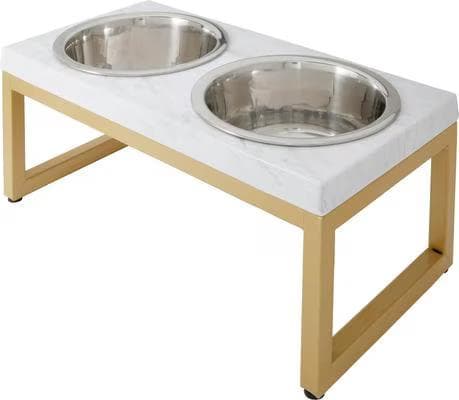
Raised stainless steel double bowl on a marble-look stand. Easier on the neck and joints and a clean, tip-resistant way to keep fresh water available all day.
Webvet may earn a commission when you click through to Chewy, at no extra cost to you.
Key takeaway: The best available study on raised feeders and bloat, Glickman et al., JAVMA 2000, found raised feeders were associated with an increased GDV risk in large and giant deep-chested breeds. It shows an association in that cohort, not proven causation, and it has never been settled by a follow-up trial.
Be careful with what the Glickman study does and does not prove. It was observational: it cannot show that the raised feeder itself caused the bloat. Owners of high-risk dogs may have been more likely to buy raised feeders in the first place, since raised feeding was widely recommended for bloat prevention at the time. But it is equally wrong to spin it away. The one large prospective study we have points in the direction of increased risk, and no ranking evidence since has reversed it.
Is It Better for Dogs to Eat Off the Ground or Elevated?
For most healthy dogs, eating at floor level is the sensible default. It is the natural posture, it costs nothing, and it avoids the unresolved raised-feeder question entirely. Elevated feeding is better only for the specific dogs it is meant to help: seniors, arthritic dogs, dogs with neck or back conditions, and megaesophagus patients under veterinary guidance.
Why Shouldn't I Feed My Dog From a Raised Bowl?
The main reason not to is risk profile. If your dog is a large or giant deep-chested breed, has survived a bloat episode, or has a close relative with a bloat history, the Glickman association is enough reason to keep the bowl on the floor unless your vet says otherwise. A secondary reason is simple pointlessness: a healthy small or medium dog gains nothing measurable from elevation.
Which Dogs Should (and Should Not) Use an Elevated Bowl
So what dog breeds need elevated bowls? Framing it by breed is actually the wrong cut. Need follows condition and body type, not breed name: an arthritic 12-year-old Labrador is a better candidate than a healthy 2-year-old one, and a Great Dane's deep chest argues against elevation regardless of how tall the dog is. The decision table below pairs the common profiles against a verdict.
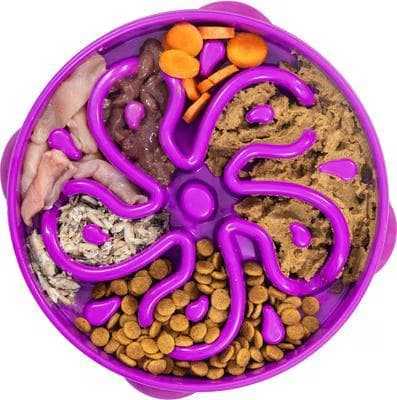
A maze-pattern slow-feeder bowl that makes fast eaters work for each bite, reducing the gulping and swallowed air that trigger regurgitation and vomiting. Holds up to 4 cups.
Webvet may earn a commission when you click through to Chewy, at no extra cost to you.
Do vets recommend a raised bowl here? Broadly: the benefits are real for arthritic seniors, dogs with megaesophagus, and stiff-jointed giants without bloat risk factors, while healthy small dogs and puppies see no proven benefit, and a good floor bowl serves them fine. The verdict table below sorts it by profile.
| Dog profile | Elevated bowl verdict | Why |
|---|---|---|
| Senior dog with arthritis or stiffness | Good fit | Raised feeding reduces painful bending at the neck, shoulders, and elbows |
| Dog with diagnosed megaesophagus | Yes, under vet direction | Gravity-assisted feeding is part of standard management; many dogs need near-vertical feeding, not just a raised bowl |
| Neck, back, or post-surgical restrictions | Good fit, ask your vet | Avoids lowering the head to floor level during recovery |
| Healthy small or medium dog | Optional | No proven benefit or harm; convenience choice at low bloat risk |
| Healthy large or giant deep-chested breed (Great Dane, Weimaraner, Irish Setter, Saint Bernard) | Skip it | Glickman/JAVMA 2000 associated raised feeders with increased GDV risk in these dogs |
| Any dog with a prior bloat episode or a first-degree relative with GDV | Avoid unless your vet directs otherwise | Bloat history was itself a major risk factor in the study; do not add an unresolved one |
| Fast eater of any size | Solve the speed first | Eating speed was a GDV risk factor in large breeds; a floor-level slow feeder addresses it directly |
If your dog lands in two rows at once, for example an arthritic senior Great Dane, that is exactly the case-by-case conversation to have with your veterinarian. Some vets will accept a modest elevation for comfort in an old, low-risk-history dog; others will suggest managing the arthritis another way. Bloat history usually wins the tiebreak.
Do Vets Recommend Elevated Dog Bowls?
Vets recommend elevated dog bowls on a case-by-case basis, not as general advice. Most will suggest one for a dog with arthritis, neck or spinal problems, or megaesophagus, because the mechanical benefit for those patients is clear. Most will also steer owners of healthy large, deep-chested breeds away from them, citing the same JAVMA evidence covered above. What veterinarians broadly do not do is recommend raised feeders as a bloat-prevention measure; that older advice is exactly what the Purdue findings undercut.
If you are unsure where your dog falls, ask two questions at your next visit: does my dog have an orthopedic or swallowing reason to benefit, and does my dog's breed, build, or family history put it at elevated bloat risk? Those two answers settle the decision for almost every dog.
Choosing the Right Height
If an elevated bowl makes sense for your dog, height is what makes it work. Too low and the dog still hunches; too high and it strains upward or eats with an extended neck. The fit rule is built on wither height, the point at the top of the shoulder blades.
How to measure: - Stand your dog square on a flat floor. - Measure from the floor to the withers (top of the shoulder blades), not the top of the head. - Subtract roughly 4 to 6 inches. That is your target bowl-rim height. - Check the posture: your dog should eat with its neck near level or angled slightly down, without splaying the front legs or stretching upward.
| Dog size | Typical wither height | Suggested bowl-rim height |
|---|---|---|
| Toy and small (Chihuahua, Shih Tzu) | 6 to 12 inches | 2 to 6 inches |
| Medium (Beagle, Border Collie) | 13 to 18 inches | 7 to 12 inches |
| Large (Labrador, German Shepherd) | 19 to 24 inches | 13 to 18 inches |
| Giant (Great Dane, Saint Bernard) | 25 inches and up | 19 to 27 inches, only if your vet has cleared elevated feeding |
An adjustable stand is the practical answer for growing dogs or multi-dog homes, since you can dial the height instead of guessing once. A stable, non-tip option like the Frisco Elevated Bowl covers the common heights without wobble, which matters for seniors who lean on the stand as they eat.
Elevated Bowls with Slow Feeders
Elevated slow-feeder combos exist because two problems often show up in the same dog: an older dog that struggles to reach the floor and also inhales its food. The combo puts a ridged or maze-style insert on a raised stand, so the dog eats at a comfortable height and at a slower pace. A raised ceramic option like the PawsPik Raised Ceramic Slow Feeder covers the small-to-medium dog version of that setup.
Slowing the meal down is worth taking seriously on its own, because faster eating was one of the GDV risk factors the Glickman team identified in large breeds. If gulping is the main issue, start with the causes covered in our explainer on why dogs eat so fast, then pick hardware. For specific product picks by dog size and material, our roundup of the best slow feeder dog bowls does the comparison work, including floor-level options for deep-chested breeds that should skip elevation entirely.
One more meal-management lever costs nothing: splitting the daily ration into two or more smaller meals, which is standard advice for bloat-prone breeds. If your routine needs a rework, our dog feeding schedule guide covers meal timing by age and size.
Key takeaway: For a fast-eating dog, fix the speed before the height. A floor-level slow feeder solves gulping without touching the raised-feeder question, and it is the safer default for any large, deep-chested breed.
Frequently Asked Questions
Are elevated dog bowls good for small dogs?
They are fine but rarely necessary. Small breeds have a much lower bloat risk, so the safety question mostly falls away, but a healthy small dog also gains little from elevation. The clearest small-dog case is an aging toy breed with arthritis or a neck condition, where even a few inches of lift eases eating posture.
Should a Great Dane use an elevated dog bowl?
Not by default. Great Danes are the textbook deep-chested, bloat-prone breed, and the Glickman/JAVMA 2000 cohort associated raised feeders with increased GDV risk in giant breeds specifically. Keep the bowl on the floor unless your veterinarian recommends elevation for a specific medical reason and accepts the tradeoff for your individual dog.
Do elevated dog bowls help digestion?
There is no evidence that elevation improves digestion in healthy dogs. The genuine swallowing benefit applies to megaesophagus, where gravity-assisted upright feeding helps food reach the stomach. Claims that raised bowls broadly aid digestion or prevent bloat are not supported, and the bloat claim runs opposite to the best available study.
Should the water bowl be elevated too?
Match the water bowl to the same decision you made for food. A dog raised for arthritis or megaesophagus usually benefits from raised water for the same postural reasons. A deep-chested breed kept at floor level for meals should drink at floor level too, since the raised-feeder association in the research did not separate food from water.
What can I use instead of an elevated bowl for a senior dog?
Options include a low riser of just a few inches, a non-slip mat so the dog stands securely while eating, softer or smaller kibble that needs less head-down time, and treating the underlying arthritis with your vet. For a bloat-prone senior, these floor-adjacent fixes deliver most of the comfort without the unresolved risk question.
The bottom line on the elevated dog bowl: it is a good tool for the right dog and an unnecessary one for most. Match the hardware to your dog's body and history, keep deep-chested breeds at floor level unless your vet says otherwise, and treat any sign of bloat as the emergency it is.

Editor
The Webvet Editorial Team is the in-house group of pet-care editors and writers behind Webvet, operated by Smart Pet Collective. The team researches, writes, and maintains Webvet's pet health, behavior, and medication content. Every article follows a defined editorial process: research from reputable veterinary and scientific sources, careful drafting, mandatory review of medical content by a credentialed veterinarian, and dated publication. Health and medication articles are medically reviewed by a licensed veterinary professional before they go live and are kept current over time.
Veterinarian · BVMS MRCVS
Dr. Pippa Elliott, BVMS, MRCVS, is a veterinarian with nearly 30 years of experience in companion animal practice. Dr. Elliott earned her Bachelor of Veterinary Medicine and Surgery from the University of Glasgow. She was also designated a Member of the Royal College of Veterinary Surgeons. Married with 2 grown-up kids, Dr. Elliott has a naughty Puggle named Poggle, 3 cats and a bearded dragon.
Related reading

Best Dog Advent Calendars and Cat Advent Calendars for 2026: Vet-Reviewed Picks

How to Help a Cat Lose Weight: A Safe Weight Loss Plan

When Can Puppies Eat Solid Food? Weaning Timeline and Tips
