Why Does My Dog Eat So Fast? Vet-Reviewed Causes and Fixes
Fast eating in dogs usually traces to instinct, food competition, or a scarcity history, but parasites, diabetes, and Cushing's disease can drive it too.

BVMS MRCVS

This article contains affiliate links. Webvet may earn a commission when you buy through them, at no extra cost to you.
Why does my dog eat so fast? Most dogs gulp food because of survival instinct, food competition with littermates or housemates, or a history of food scarcity. Medical issues, including intestinal parasites, diabetes mellitus, and Cushing's disease, can also drive a ravenous appetite. Fast eating raises choking, regurgitation, and life-threatening bloat (GDV) risk.

The good news: for most dogs, speed eating is a habit you can manage safely at home. This vet-reviewed guide separates behavioral causes from medical ones, explains when gulping becomes dangerous, and walks through the slow-down methods veterinarians actually recommend.
Key takeaway: Fast eating is usually behavioral (instinct, competition, scarcity history) and manageable with slow feeders and feeding changes. But a sudden ravenous appetite, or any sign of bloat after a meal, is a reason to call your veterinarian right away.
 Sponsored
Want a vet's help with your dog's anxiety or behavior?
Talk to a licensed vet at Dutch over video, often the same day. They can recommend treatment and prescribe it when it's appropriate.
Use code Pets60
Plans start at $12/month · covers up to 5 pets
- Licensed vets in most states
- Rx for 150+ conditions
- 4.7 on Trustpilot
Why Does My Dog Eat So Fast? The Main Causes
Most dogs bolt food for behavioral reasons: instinct, competition with other pets, or a history of scarcity. Sometimes, though, speed-eating signals a medical issue such as parasites or a metabolic disorder, and in deep-chested breeds the habit itself raises bloat risk. The sections below sort out which is which.
Dogs are opportunistic eaters by design. In the wild, a canine that lingered over a meal risked losing it to a competitor, so eating quickly was a survival advantage. Domestic dogs inherit that wiring, and for many of them a full bowl still triggers the same eat-it-before-it-disappears response.
That instinct explains the baseline, but it does not explain why some dogs inhale food without chewing while others graze calmly. The difference usually comes down to learning history and environment. When a dog eats too fast, one of these behavioral causes is typically behind it:
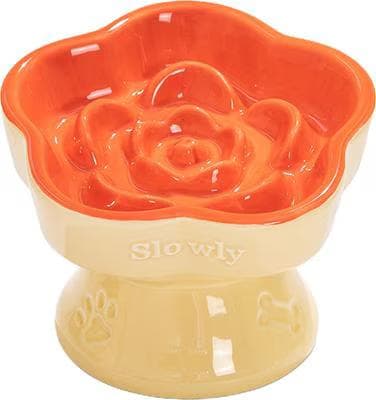
Webvet may earn a commission when you click through to Chewy, at no extra cost to you.
- Litter competition. Puppies from large litters often learned that slow eaters got less. That early scramble around the food dish can persist for life.
- Food scarcity history. Rescues, strays, and dogs from neglect situations may have gone hungry. Gulping became a survival strategy, and the habit outlasts the hardship.
- Multi-dog households and resource guarding. A dog eating beside housemates may bolt food to protect it. Resource guarding does not always look like growling; racing through a meal is a quieter version of the same worry.
- Anxiety and excitement. Mealtime arousal, stress in the home, or an unpredictable feeding routine can all speed a dog up.
- High food drive. Some breeds, notably Labradors and Beagles, are simply intense about food, and highly palatable diets amplify it.
Age and routine play a part as well. Puppies often gulp because food is exciting and self-control is not yet built. Adult dogs fed at unpredictable times may treat each meal as possibly the last. A consistent schedule, calm pre-meal routine, and predictable portions all take urgency out of the bowl.
Why Does My Dog Act Like He's Starving When He Eats?
A dog that acts starving at every meal is usually driven by instinct and learned competition, not actual hunger. A healthy-weight dog on measured meals that is frantic only around food is almost certainly a behavioral case. Disease-driven hunger tends to bring other changes: weight loss, increased thirst, or eating non-food items.
That distinction is the core triage question. A behavioral cause produces a dog that has always eaten this way and is otherwise thriving. A medical cause usually announces itself as a change: a formerly polite eater turns ravenous, or appetite climbs alongside other symptoms. Behavioral causes get management; medical causes get a vet visit first.
Medical Causes: When Fast Eating Signals a Health Problem
Veterinarians call a genuinely increased appetite polyphagia. Polyphagia in dogs matters because the body is either not absorbing nutrients properly or is being pushed by a hormonal signal to eat more. Either way, the dog feels hungrier than it should, and eating speed often rises with it.
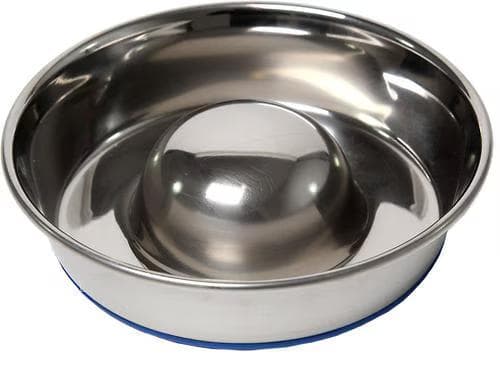
Webvet may earn a commission when you click through to Chewy, at no extra cost to you.
What Causes Ravenous Hunger in Dogs?
The most common medical causes of ravenous hunger in dogs are:
- Intestinal parasites. Roundworms, hookworms, and other worms steal nutrients from the gut, so the dog eats more to compensate. Puppies and dogs overdue for deworming are the classic cases.
- Diabetes mellitus. Without enough insulin action, cells starve even when blood sugar is high. Affected dogs are often hungry, thirsty, urinating more, and losing weight despite eating well.
- Cushing's disease (hyperadrenocorticism). Excess cortisol drives hunger, thirst, panting, a pot-bellied appearance, and thinning skin, most often in middle-aged and older dogs.
- Malabsorption and maldigestion. Conditions such as exocrine pancreatic insufficiency leave food undigested, so the dog is ravenous yet thin, often with greasy stools.
- Medications. Corticosteroids (like prednisone) and some anti-seizure drugs are well-known appetite boosters.
Your veterinarian can rule most of these in or out with a physical exam, fecal test, and basic bloodwork. That is a far cheaper visit than the emergency alternative, and it clears the way to treat the fast eating as the behavioral habit it usually is.
Age offers a rough clue about the likely medical cause. Parasites dominate in puppies and newly adopted dogs. Diabetes and Cushing's disease cluster in middle-aged and senior dogs. Any dog recently started on prednisone or an anti-seizure drug can turn food-obsessed within days. Mention every medication at the appointment.
 Sponsored
Vet care that's always there
Unlimited video calls and messaging with licensed vets for less than a typical vet visit. One membership covers up to five pets.
Use code Pets60
Plans start at $12/month · covers up to 5 pets
- Licensed vets in most states
- Rx for 150+ conditions
- 4.7 on Trustpilot
Is Eating Too Fast Dangerous for Dogs?
Yes, eating too fast can be dangerous for dogs. The most common consequences are gagging, choking, and regurgitation, and the most serious is gastric dilatation-volvulus (GDV), the life-threatening emergency owners know as bloat. Veterinary hospital group VCA lists rapid eating among the factors associated with bloat episodes.
Here is what fast eating can cause, from common to critical:
- Gagging and choking. Unchewed kibble can lodge in the throat. Dogs that inhale food without chewing are the classic offenders.
- Regurgitation. Food swallowed too fast can come back up passively, often as an undigested tube of kibble, minutes after the meal.
- Vomiting. Some gulpers actively vomit after meals because the stomach is suddenly overloaded.
- Digestive upset. Swallowed air and a bolus of unchewed food can mean burping, discomfort, gas, and sometimes diarrhea.
- Bloat (GDV). The stomach distends with gas and can twist on itself, cutting off blood flow. This is a surgical emergency.
Part of the problem is air. A dog bolting kibble swallows large amounts of air along with the food, a habit called aerophagia. That swallowed air stretches the stomach, drives the burping and discomfort many gulpers show after meals, and is one reason rapid eating keeps appearing on lists of factors linked to bloat.
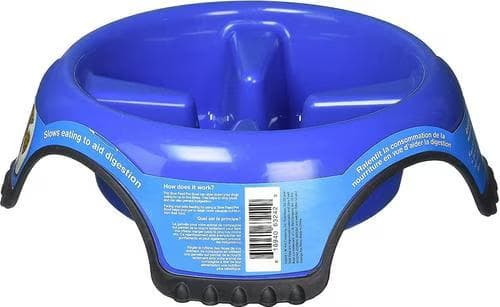
Webvet may earn a commission when you click through to Chewy, at no extra cost to you.
Regurgitation vs. Vomiting: A Quick Check
Regurgitation is passive: food reappears quickly, undigested, with no warning and little effort. Vomiting is active: you see heaving, drooling, and abdominal contractions first. An occasional regurgitation episode right after a gulped meal usually just confirms the dog ate too fast. Repeated episodes, or vomiting paired with lethargy, deserve a veterinary workup.
One pattern deserves its own section, because it is the one that kills dogs: bloat.
What happens when a dog eats too fast, in practical terms? The most common symptoms arrive within minutes: he throws up or regurgitates undigested kibble, gags, or chokes on food swallowed whole. The choking risk is the immediate emergency; repeated regurgitation is the pattern to raise with your vet.
Bloat (GDV) Red Flags and When to See a Vet

Gastric dilatation-volvulus is a rapid, life-threatening condition in which the stomach fills with gas and rotates, cutting off its own blood supply. Per the Merck Veterinary Manual, GDV is fatal without treatment. The American College of Veterinary Surgeons describes it as an emergency requiring prompt stabilization and surgery.
Risk is not evenly distributed. Large, deep-chested breeds, including Great Danes, German Shepherds, Standard Poodles, Weimaraners, and setters, carry the highest risk. Reported risk factors include rapid eating, a single large daily meal, advancing age, and a close relative with a history of GDV.
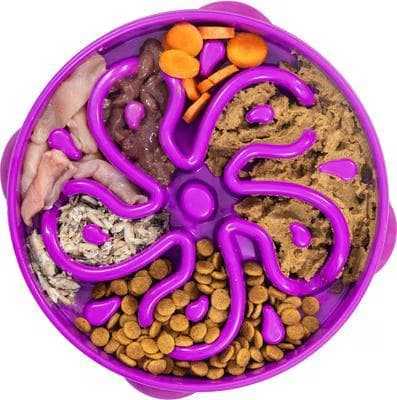
A maze-pattern slow-feeder bowl that makes fast eaters work for each bite, reducing the gulping and swallowed air that trigger regurgitation and vomiting. Holds up to 4 cups.
Webvet may earn a commission when you click through to Chewy, at no extra cost to you.
Know these red flags cold if you own a gulper, and especially a deep-chested gulper. GDV typically strikes within a few hours of a meal, and it progresses fast.
The two most specific early signs are unproductive retching, repeated attempts to vomit that bring up nothing, and a distended abdomen that looks swollen and feels drum-tight. Either one alone justifies an immediate emergency trip.
| Red flag | What you may see | What to do |
|---|---|---|
| Unproductive retching | Repeated attempts to vomit that bring up nothing, or only foam | Go to an emergency vet immediately |
| Distended abdomen | Belly looks swollen or tight, may sound hollow like a drum when tapped | Go to an emergency vet immediately |
| Restlessness and pacing | Cannot settle, keeps changing position, looks anxious or turns to stare at the belly | Go to an emergency vet immediately |
| Excessive drooling | Sudden heavy salivation, often with stretching or a hunched posture | Go to an emergency vet immediately |
| Weakness or collapse | Pale gums, rapid heart rate, wobbling, or going down | This is late-stage. Drive to the nearest emergency hospital now |
For the highest-risk breeds, ask your veterinarian about prophylactic gastropexy, a preventive procedure that tacks the stomach to the body wall so it cannot twist. It is commonly discussed for Great Danes and often performed alongside a spay or neuter. It does not prevent gas distension, but it prevents the deadly rotation.
Why Is My Dog Suddenly Eating So Fast?
Sudden-onset fast eating is a different problem from lifelong gulping. A dog that abruptly starts racing through meals may have a new medical driver: parasites, diabetes, Cushing's disease, a medication change, or new food stress at home. A sudden shift in eating speed or appetite warrants a veterinary visit, not just a new bowl.
One more note for at-risk breeds: raised feeders were once promoted as bloat prevention, but the evidence has not supported that advice, and some research has associated elevated feeding with higher GDV risk in large breeds. Our guide to elevated dog bowls covers when raised feeding helps and when to skip it.
How to Slow Down Your Dog's Eating

Once your veterinarian has ruled out medical causes, slowing a dog down is mostly a matter of engineering the meal. You cannot lecture a dog out of instinct, but you can make gulping physically impossible.

How Do I Stop My Dog From Eating So Fast?
The fastest fix is a slow-feeder bowl, which uses ridges and mazes to force smaller mouthfuls. Puzzle feeders, scatter feeding on a snuffle mat, smaller and more frequent meals, and feeding dogs in separate rooms all work too. Most owners see mealtime stretch from under a minute to five or ten.
Here is the full toolkit, roughly in order of effort:
- Slow-feed bowls. Maze and ridge designs like the Outward Hound Fun Feeder can turn a 30-second meal into several minutes of licking and picking. For dogs that flip lightweight bowls, a skid-resistant design like the JW Skid Stop stays put.
- Puzzle feeders and food-dispensing toys. These add a mental workout to the meal, which also helps anxious and high-drive dogs burn off arousal.
- Scatter feeding and snuffle mats. Tossing kibble across a mat or clean floor makes the dog forage one piece at a time. It is the cheapest option and works with zero equipment.
- Smaller, more frequent meals. Two to three smaller meals beat one large one, and this matters doubly for bloat-prone breeds. An automatic dog feeder can portion mid-day meals when you are at work, and our dog feeding schedule guide covers how to structure the day.
- Hand feeding and training meals. Using part of the ration as training rewards slows intake and builds focus.
- Separate feeding stations. In multi-dog homes, feed in different rooms or crates so no one feels raced. Removing the competition often removes the speed.
Introduce any new feeder gradually. Serve the first meal or two half in the maze bowl and half in the old dish, then transition fully once your dog engages without frustration. Some dogs paw, flip, or abandon a bowl that is too hard on day one, and a bad first impression slows everything.
If your dog eats too fast even with a slow feeder, level up: choose a harder maze pattern, add scatter feeding on top, or split meals further. A determined Labrador can defeat a beginner bowl in a week. Rotating between two or three different feeder styles keeps the challenge fresh.
How do you know it is working? Time the meal. Most gulpers finish a bowl in under 60 seconds; a good slow feeder should push that past five minutes. Less gulping means less swallowed air, fewer post-meal regurgitation episodes, and a calmer dog afterward. If mealtime creeps back under two minutes, increase the difficulty.
Choosing a Slow-Feeder Bowl
The short version: match the maze difficulty to your dog's determination, size the ridges to your dog's muzzle (flat-faced breeds need shallower patterns), pick a heavy or skid-proof base for bowl-flippers, and choose dishwasher-safe materials because ridged bowls trap residue. Kibble suits deep mazes; wet food suits flatter patterns.
We ranked the top options, including budget picks, wet-food-friendly designs, and bowls for giant breeds, in our full guide to the best slow feeder dog bowls. If your dog treats every meal like a race, that guide is the next stop.
Bottom line: Fast eating is usually instinct plus habit, and a slow feeder, scatter feeding, and smaller meals will fix most cases. Rule out medical causes first when the behavior is new, and treat any unproductive retching or a distended belly after a meal as an emergency, every time.
Frequently Asked Questions
Is it bad if my dog eats too fast?
It can be. Fast eating commonly causes gagging, choking, regurgitation, and digestive upset, and it is a reported risk factor for gastric dilatation-volvulus (bloat), a life-threatening emergency. Slowing your dog down with a slow-feeder bowl or scatter feeding meaningfully reduces these risks.
Why does my dog act like he's starving when he eats?
Usually because of instinct and learned competition: littermate scrambles, past food scarcity, or eating alongside other dogs teach a dog to bolt food. If the frantic appetite is new, or comes with weight loss or increased thirst, a medical cause such as parasites, diabetes, or Cushing's disease should be ruled out by your veterinarian.
How do I stop my dog from eating so fast?
Use a slow-feeder bowl or puzzle feeder, scatter kibble on a snuffle mat, split the daily ration into two or three smaller meals, and feed multi-dog households in separate rooms. Most dogs slow from seconds to several minutes per meal with these changes.
Why is my dog suddenly eating so fast?
A sudden change in eating speed or appetite often signals a medical driver: intestinal parasites, diabetes mellitus, Cushing's disease, a new medication such as steroids, or new food stress in the household. Sudden-onset ravenous eating warrants a veterinary exam before you treat it as a habit.
What causes ravenous hunger in dogs?
Veterinarians call it polyphagia. Common causes include intestinal parasites, diabetes mellitus, Cushing's disease, malabsorption conditions such as exocrine pancreatic insufficiency, and appetite-stimulating medications like corticosteroids. Bloodwork and a fecal test can identify most of these.

Editor
The Webvet Editorial Team is the in-house group of pet-care editors and writers behind Webvet, operated by Smart Pet Collective. The team researches, writes, and maintains Webvet's pet health, behavior, and medication content. Every article follows a defined editorial process: research from reputable veterinary and scientific sources, careful drafting, mandatory review of medical content by a credentialed veterinarian, and dated publication. Health and medication articles are medically reviewed by a licensed veterinary professional before they go live and are kept current over time.
Veterinarian · BVMS MRCVS
Dr. Pippa Elliott, BVMS, MRCVS, is a veterinarian with nearly 30 years of experience in companion animal practice. Dr. Elliott earned her Bachelor of Veterinary Medicine and Surgery from the University of Glasgow. She was also designated a Member of the Royal College of Veterinary Surgeons. Married with 2 grown-up kids, Dr. Elliott has a naughty Puggle named Poggle, 3 cats and a bearded dragon.


