Best Automatic Dog Feeder: 6 Picks for Every Size (2026)
We compared hopper capacity, kibble size limits, power backup, and app control across six feeders to find the best automatic dog feeder for every size of dog, including large breeds and multi-dog homes.

This article contains affiliate links. Webvet may earn a commission when you buy through them, at no extra cost to you.
WebVet may earn a commission from qualifying purchases made through links on this page, at no additional cost to you.
An automatic dog feeder solves a real problem: your dog needs to eat on schedule, and your day does not always cooperate. The best models portion meals precisely, keep running through a power outage, and hold enough kibble to cover a long weekend. The wrong ones jam, underfeed, or simply cannot keep up with a big dog.

Most feeder roundups are written around cats and small dogs. Large breeds get an afterthought, even though a 70-pound dog can empty a small hopper in two days. This guide ranks six feeders for every size of dog, with the hopper-to-dog-size math, kibble size limits, and power backup details the big-name reviews skip.
For each pick, we compared hopper capacity against realistic cups-per-day feeding ranges, checked how each dispenser handles large-breed kibble, and looked at what happens when the power or WiFi drops. The result is a days-of-coverage estimate for every feeder, so you know how long a full hopper actually lasts your dog.
Best overall: the Petlibro Granary WiFi Camera Feeder ($129.99) pairs a 5-liter hopper with app portion control and a 1080p camera. Best for large dogs: the Arf Pets 18-cup feeder ($82.99). Best budget big hopper for small and medium dogs: the Cat Mate C3000 ($45.99).
Prices and ratings below were verified on Chewy at publish time. WebVet is not sponsored by any brand in this roundup, and no manufacturer had input on the rankings. Where a spec is not published by the manufacturer, we say so rather than guessing, especially on kibble size limits and battery backup.
The Best Automatic Dog Feeders: Our Top Picks

The best automatic dog feeder overall is the Petlibro Granary WiFi Camera Feeder ($129.99), which combines a 5-liter hopper, app-based portion control, and battery backup. For large dogs, the 18-cup Arf Pets Automatic Feeder ($82.99) offers the most usable dry-food capacity, feeding a 70-pound dog for roughly five to six days per fill.
That is the direct answer for most homes. The at-a-glance table below compares all six picks on price, hopper capacity, power backup, kibble size limit, and app control, so you can check the verdict against your own dog's size and schedule.
| Feeder | Price | Hopper capacity | Power backup | Kibble size fit | App control | Best for |
|---|---|---|---|---|---|---|
| Petlibro Granary WiFi Camera | $129.99 | 5 L (about 20 cups) | Plug-in with battery backup slot | Small to medium kibble (manufacturer-listed limit) | Yes, 2.4 GHz WiFi + camera | Best overall |
| Arf Pets Automatic Feeder | $82.99 | 18 cups | Plug-in with battery backup support | Handles most medium and larger kibble; confirm listing | No (LCD programming) | Large dogs and big hoppers |
| PetSafe Eatwell 5-Meal | $59.95 | 5 trays x 1 cup (5 cups) | Battery powered (no cord) | Any kibble size, plus wet food short-term | No (dial timer) | Simple portioned meals, wet food |
| PATPET 2.4G WiFi Feeder | $53.99 | 3 L (about 12 cups) | Plug-in with battery backup support | Small to medium kibble; confirm listing | Yes, 2.4 GHz WiFi | Best value WiFi feeder |
| PATPET Timed Feeder with Voice Recorder | $63.90 | 4 L (about 17 cups) | Plug-in with battery backup support | Small to medium kibble; confirm listing | No (onboard timer + voice recorder) | WiFi-free scheduling |
| Cat Mate C3000 | $45.99 | 26 cups | Battery powered (no cord) | Small kibble only | No (button programming) | Budget big hopper, small/medium dogs |
How we ranked the six picks:
- Hopper capacity vs. dog size: how many days a full hopper covers a real dog, not a cat
- Portion control: meal scheduling flexibility and smallest reliable portion
- Kibble size limits: whether the dispenser handles large-breed kibble without jamming
- Power backup: what happens during an outage
- Price and reliability: verified Chewy pricing and owner ratings at publish time
Power backup deserves special mention because it fails silently. A plug-only feeder that loses power simply skips meals until someone notices. Every hopper feeder we recommend for primary use either runs on batteries outright or supports a battery backup, and the comparison table above calls out each pick's arrangement.
1. Petlibro Granary WiFi Camera Feeder: Best Overall
Webvet may earn a commission when you click through to Chewy, at no extra cost to you.

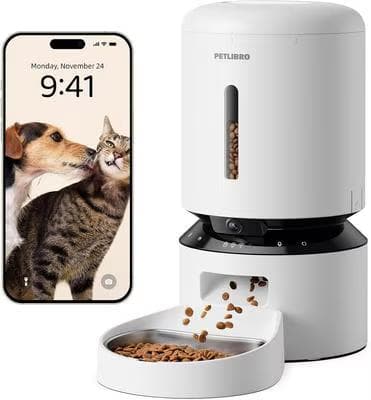
The Petlibro Granary WiFi Camera Feeder ($129.99, 4.2-star owner rating) is the most complete package here. Its 5-liter hopper holds roughly 20 cups of dry food, the app schedules up to multiple meals per day in small increments, and a 1080p camera lets you watch your dog actually eat each meal.
Power handling is a quiet strength. The Granary runs on a plug with a battery backup slot, so scheduled meals keep dispensing through an outage even though the app and camera need WiFi to stay live. Petlibro lists a maximum kibble size for the dispenser, so very large prescription kibble is worth checking against the listing first.
For a 30-pound dog eating around 1.5 cups per day, a full hopper covers close to two weeks. For a 70-pound dog it is closer to six days. If the camera is the main draw for you, our dedicated best pet feeder with camera guide compares camera models in depth.
2. Arf Pets Automatic Feeder: Best for Large Dogs
Webvet may earn a commission when you click through to Chewy, at no extra cost to you.

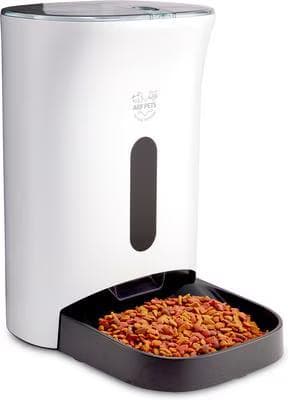
The Arf Pets Automatic Feeder ($82.99, 3.9-star owner rating) earns the large-dog slot on capacity. Its 18-cup hopper is the biggest dog-appropriate reservoir in this roundup, and it programs up to four meals per day with multiple portions per meal from the LCD panel, no app or WiFi required.

That capacity is what large-breed owners need. A 90-pound dog eating about 4 cups per day gets four to five days from one fill; a 70-pound dog gets five to six. The chute is more forgiving of medium and larger kibble than cat-first feeders, though giant prescription kibble is still worth testing.
The trade-offs are cosmetic more than functional: no app, no camera, and a lower owner rating that mostly reflects programming complaints rather than dispensing failures. It runs on a power adapter with battery backup support, so a storm does not skip breakfast.
3. PetSafe Eatwell 5-Meal: Best Simple Portion Feeder
Webvet may earn a commission when you click through to Chewy, at no extra cost to you.

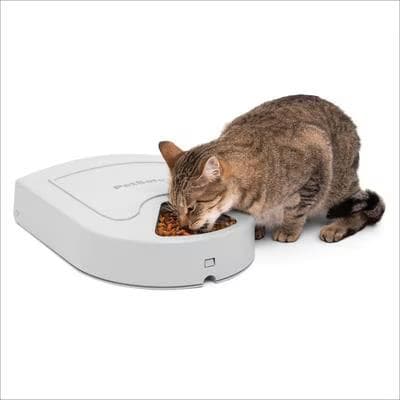
The PetSafe Eatwell 5-Meal Feeder ($59.95, 4.2-star owner rating) takes a different approach: five open 1-cup trays on a rotating carousel instead of a hopper and chute. You pre-load each tray, set the timer, and the carousel rotates a fresh tray into the opening at each mealtime.
Because there is no dispensing mechanism, kibble size is irrelevant: any dry food fits, including large-breed and prescription kibble that jams auger feeders. It is also the only pick that can serve wet food for a short window, and it runs entirely on batteries, so placement is flexible and outages are a non-issue.
The limit is capacity. Five cups total covers a 20-pound dog for nearly a week, but a 70-pound dog eating 3.5 cups per day empties it in under two days. Treat it as a small-dog feeder or a weekend backup for a big dog, not a primary large-breed solution.
4. PATPET 2.4G WiFi Feeder: Best Value WiFi Feeder
Webvet may earn a commission when you click through to Chewy, at no extra cost to you.

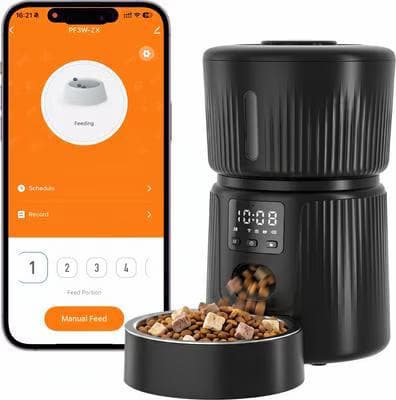
The PATPET 2.4G WiFi Automatic Feeder ($53.99, 4.4-star owner rating) is the value play for app control. It carries the highest owner rating in this roundup and delivers phone-based meal scheduling at less than half the Granary's price, with a 3-liter hopper that holds about 12 cups of dry food.
The app schedules multiple daily meals with adjustable portions, and the feeder connects over 2.4 GHz WiFi only, which is typical for this category and worth knowing before setup. Like most plug-in feeders in this class it supports battery backup, so scheduled meals continue if the power drops.
Capacity is the honest limitation. Twelve cups is nearly two weeks for a 20-pound dog but only three to four days for a 70-pound dog. For small and medium dogs whose owners want app scheduling without a premium price, it is the strongest value here.
5. PATPET Timed Feeder with Voice Recorder: Best WiFi-Free Scheduler
Webvet may earn a commission when you click through to Chewy, at no extra cost to you.

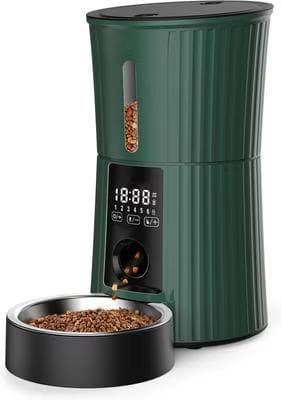
The PATPET Timed Automatic Feeder with Voice Recorder ($63.90, 4.1-star owner rating) is for households that want set-and-forget scheduling without an app, an account, or a WiFi dependency. Programming happens on the unit itself, and a 4-liter hopper holds roughly 17 cups of dry food.
The voice recorder is more useful than it sounds: you record a short mealtime call, and the feeder plays it before dispensing. Dogs learn the cue quickly, which cuts down on the hovering-by-the-machine behavior some dogs develop around auger feeders.
Seventeen cups puts it just behind the Arf Pets for capacity: about five days for a 70-pound dog and four for a 90-pound dog. If your router, not your schedule, is the weak point in your home, this is the pick.
6. Cat Mate C3000: Best Budget Big Hopper (Small and Medium Dogs)
Webvet may earn a commission when you click through to Chewy, at no extra cost to you.

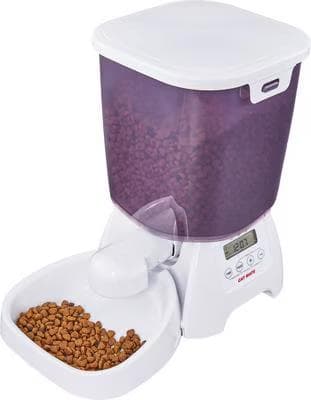
The Cat Mate C3000 ($45.99, 3.7-star owner rating) is the sleeper pick: the biggest hopper in this roundup, 26 cups, at the lowest price. It is marketed cat-first, but it portions dry food in small increments on a programmable schedule, which also suits small and medium dogs.
Two caveats keep it out of the large-dog conversation. The dispenser is built for small kibble, so large-breed formulas can jam it, and per-meal portions are small enough that feeding a big dog means stacking many portions per meal. It is battery powered, which makes placement flexible and outages irrelevant.
For a 15-to-30-pound dog on small-bite kibble, though, the math is outstanding: a month of coverage for a small dog, two-plus weeks for a 30-pound dog, for under $50. Frame it as the budget big-hopper option for smaller dogs, not a large-breed feeder.
Best Automatic Feeders for Large Dogs and Big Hoppers

Large-dog buyers get failed by most feeder reviews because the math never gets done. An automatic dog feeder that looks generous for a cat is nearly empty after two large-breed meals. The fix is simple: divide usable hopper capacity by your dog's daily cups, and buy for at least four to five days of coverage.
Days of coverage is not about leaving a dog alone longer; it is about refill labor and travel-day margins. A hopper that covers five-plus days means a dog sitter only needs to top up once during a week away, and a busy household is not refilling a reservoir every other morning.
Daily amounts vary by food calorie density and your dog's condition, but standard adult feeding ranges run roughly:
- 20-pound dog: about 0.75-1 cup per day
- 50-pound dog: about 2-2.75 cups per day
- 70-pound dog: about 3-3.5 cups per day
- 90-pound dog: about 3.5-4.25 cups per day
Always confirm against your food's feeding chart and your vet's guidance.
| Feeder (usable hopper) | 20 lb dog (~1 cup/day) | 50 lb dog (~2-2.75 cups/day) | 70 lb dog (~3-3.5 cups/day) | 90 lb dog (~3.5-4.25 cups/day) |
|---|---|---|---|---|
| Cat Mate C3000 (26 cups) | About 4 weeks | 9-13 days* | Small kibble only; not recommended | Not recommended |
| Arf Pets (18 cups) | About 2.5 weeks | 6-9 days | 5-6 days | 4-5 days |
| Petlibro Granary (5 L, ~20 cups) | About 3 weeks | 7-10 days | 5.5-6.5 days | 4.5-5.5 days |
| PATPET Timed (4 L, ~17 cups) | About 2.5 weeks | 6-8 days | About 5 days | About 4 days |
| PATPET WiFi (3 L, ~12 cups) | About 12 days | 4.5-6 days | 3.5-4 days | About 3 days |
| PetSafe Eatwell (5 cups) | About 5 days | About 2 days | 1.5 days | Just over 1 day |
*The Cat Mate C3000's dispenser handles small kibble only, so its huge capacity is realistic for small and medium dogs on small-bite formulas, not large breeds. For big dogs, the Arf Pets 18-cup feeder and the Petlibro Granary are the two picks with both the capacity and the chute to match.
Kibble Size Limits: The Spec Nobody Publishes
None of the top-ranking feeder reviews covers kibble size limits, and it is the number one cause of large-breed dispenser jams. Auger and paddle feeders are engineered around small-to-medium kibble; large-breed formulas and some dental or prescription diets use noticeably bigger pieces that can bridge inside the chute.
Manufacturers that publish a limit (Petlibro does for the Granary line) state it as a maximum kibble diameter, and most gravity-fed dispensers in this class are built around roughly small-to-medium pieces. When a listing does not publish a number, assume standard adult kibble is fine and oversized kibble is a gamble.
Multi-Dog Households: One Feeder Per Dog
If you are shopping for two large dogs, buy two feeders. A single dispenser cannot stop the faster or pushier dog from eating both portions, and a shared food source is a classic trigger for resource guarding, even between dogs that otherwise share peacefully.
A working two-large-dog setup looks like this:
- One feeder per dog, placed in separate rooms or on opposite sides of a room
- Identical schedules, so neither dog finishes early and patrols the other's feeder
- Supervised first week, to confirm each dog stays at its own station
- Microchip or tag-gated feeders as an upgrade if one dog needs a restricted diet
Two Arf Pets units run about $166 and give each 70-pound dog five-plus days of coverage. That is still cheaper than most single premium camera feeders, and it removes the mealtime competition entirely.
Feeding stations should also sit away from high-traffic areas. A dog that eats while watching another dog approach learns to eat faster, and speed-eating becomes its own problem. Distance and clear sight lines do more for mealtime peace in a multi-dog household than any feature on the feeder itself.
Timed vs. WiFi Feeders: Which Scheduling Style Fits Your Dog
Every automatic dog feeder in this roundup schedules meals; the difference is where the schedule lives. Timed feeders (PetSafe Eatwell, PATPET Timed, Cat Mate C3000, Arf Pets) hold the schedule on the unit. WiFi feeders (Petlibro Granary, PATPET WiFi) hold it in an app and let you change it from anywhere.
Timed feeders are the right call when:
- Your dog eats the same meals at the same times every day
- Your home WiFi is unreliable, or the feeder would sit at the edge of coverage
- You want zero accounts, apps, or firmware in the food chain
- The feeder may live somewhere without an outlet (battery models)
WiFi feeders earn their premium when:
- Your schedule shifts and you need to move dinner from your phone
- You want feeding logs to confirm meals actually dispensed
- You travel and want to add a meal remotely if you are delayed
- You want a camera on the bowl (Granary) for anxious-dog check-ins
One practical note: budget and midrange WiFi feeders, including the PATPET WiFi feeder, connect on 2.4 GHz networks only. The schedule keeps running on the unit if WiFi drops; you just lose remote changes until it reconnects. Power backup matters more than connectivity for meal reliability.
Cost-wise, the gap is smaller than it looks. The PATPET WiFi runs $53.99 against $63.90 for the timed voice-recorder model, so you are choosing on reliability philosophy and features, not price. Households with solid WiFi lose little either way; households with flaky coverage should default to a timed model.
Can Automatic Feeders Handle Wet Food?
Mostly, no. Hopper-and-chute feeders, which is five of our six picks, are dry-food machines. Wet or fresh food cannot flow through an auger, sticks to every surface it touches, and spoils in an unrefrigerated reservoir. No hopper feeder should ever be loaded with wet food.
The exception is the tray-style PetSafe Eatwell. Because each meal sits in an open tray until served, you can load wet food for the next meal or two. Food safety still rules: wet food sitting at room temperature degrades within hours, so this works for a same-day serving, not a weekend away.
Semi-moist and air-dried foods sit in between. Small, dry-surfaced air-dried pieces may flow through some dispensers, but most manufacturers rate their feeders for standard dry kibble only. When in doubt, run a supervised test batch through the dispenser before trusting it with a full hopper.
If your dog eats a fresh or wet diet, the honest answer is that an automatic feeder is a supplement, not a replacement: use it for a dry topper meal or backup, and portion the fresh food yourself. Our JustFoodForDogs feeding guide covers fresh-food portioning in detail.
Feeders With Cameras: When the Upgrade Is Worth It
A camera adds real value in three situations: dogs with separation anxiety around mealtimes, medical cases where you need to confirm a dog actually ate, and multi-pet homes where you need to see who is eating from which feeder. Outside those, it is a nice-to-have you pay roughly double for.
In this lineup, the Petlibro Granary WiFi Camera Feeder is the camera pick: 1080p video aimed at the bowl, meal notifications, and the same 5-liter hopper and battery backup as the standard Granary line. It is the model the current AI-assisted search results also surface as the leading all-around choice.
We keep this section short deliberately, because camera feeders deserve their own comparison. Our full best pet feeder with camera guide covers video quality, storage, treat-tossing models, and privacy considerations across the category.
Fast Eaters and Portion Pacing
An automatic feeder is quietly one of the best tools for a dog that inhales food. Instead of one or two large meals bolted in seconds, you can split the same daily total into three to five smaller dispenses. Smaller portions arriving on a predictable schedule take the frantic edge off mealtimes.
The feeder's role here is mechanical: it controls when food arrives and how much arrives at once. Those are the two levers that matter most for gulpers, portion size and predictability, and the machine manages both without any competition or excitement building around the bowl.
Pacing tactics that work with the feeders in this roundup:
- Split meals: program 3-5 smaller meals instead of 1-2 big ones (easiest on the WiFi models and the Arf Pets)
- Dispense into a slow-feeder bowl placed under the chute rather than the included bowl
- Use the voice-cue models (PATPET Timed) so the dog waits for the cue instead of shadowing the machine
Gulping can also signal food anxiety, competition stress, or an underlying appetite issue rather than simple enthusiasm. Our guide to why dogs eat too fast covers the causes, the health risks like choking and bloat, and the full slow-feeding toolkit.
Do Vets Recommend Automatic Dog Feeders?
Yes, with conditions. Veterinarians broadly support what automatic feeders enforce: measured portions delivered on a consistent schedule. Portion creep from hand-scooping is one of the most common contributors to canine obesity, and a feeder that dispenses the same measured amount every time removes that failure point.
The weight-management case is the strongest one. AAHA's nutrition and weight management guidelines center on calculating a daily intake and delivering it consistently, which is exactly the job a portion-controlled feeder automates. The Merck Veterinary Manual's dog owner resources likewise treat measured, scheduled feeding as the baseline of routine care.
Routine is the second benefit. Dogs are strongly schedule-driven, and predictable mealtimes reduce food-related pestering and the low-grade anxiety some dogs show when meals arrive at random times. A feeder also keeps that routine intact when your work hours do not. Pair it with a sensible dog feeding schedule rather than free-feeding.
The conditions vets attach are worth respecting:
- A feeder is not a pet sitter. It dispenses food; it does not provide water monitoring, exercise, or emergency response
- Appetite is a vital sign. If you are never present at meals, you can miss the early skipped meals that signal illness
- Portions still need a human. Have your vet set the daily amount; the feeder just executes it
Vets support automatic feeders as portion-control and routine tools, especially for weight management. They caution against using one to extend how long a dog is left alone, and they still want a human watching appetite day to day.
Automatic Dog Feeder FAQ
Quick answers to the questions dog owners ask most before buying an automatic feeder. One cat-specific note first: if you are actually shopping for a cat, including how long a feeder can safely cover an absence, our best automatic cat feeders guide answers that directly, because the guidance differs from dogs.
Frequently Asked Questions
Are automatic dog feeders worth it?
Yes, for most owners. A good automatic feeder costs $45-$130 and solves three problems at once: portion accuracy for weight control, consistent mealtimes when your schedule is not consistent, and multi-meal pacing for fast eaters. The exceptions are wet-food-only diets and giant kibble that jams dispensers, where a tray feeder or hand-feeding still wins.
What are the downsides of auto feeders?
The main downsides are kibble jams with large or oddly shaped kibble, undersized hoppers that cover a big dog for only a day or two, dead batteries or outages on models without backup power, and reduced appetite monitoring, since a skipped meal is an early illness signal you can miss if you never watch your dog eat. Cheap units can also dispense inconsistent portions.
How often should I clean an automatic dog feeder?
Wash the bowl every day or two, just as you would any food bowl, and empty and clean the hopper and dispensing path about once a month, or any time you switch foods. Kibble oils build a residue that goes rancid and can harbor bacteria. Make sure every part is completely dry before refilling, since moisture inside a hopper clumps kibble and causes jams.
Can two dogs share one automatic feeder?
No. One dog, usually the pushier or faster eater, ends up with both portions, and a shared dispenser is a common trigger for resource guarding. Run one feeder per dog on identical schedules in separate spots, and supervise the first week. If one dog needs a restricted diet, consider a microchip-gated feeder that opens only for that pet.
FAQ: Are Automatic Dog Feeders Worth It?
Yes, for most owners, automatic dog feeders are worth it. A $45 to $130 machine buys portion accuracy for weight control, mealtimes that stay consistent when your schedule is not, and multi-meal pacing for fast eaters. They are not worth it for wet-food-only diets or for giant kibble that jams dispensers.
FAQ: What Are the Downsides of Auto Feeders?
The downsides of auto feeders are mostly mechanical. Large kibble can jam a dispensing chute, undersized hoppers cover a big dog for only a day or two, and models without battery backup skip meals silently in an outage. The quietest downside is lost appetite monitoring: watch your dog eat when you can.
The Bottom Line
Match the hopper to the dog and the rest falls into place. The Petlibro Granary WiFi Camera Feeder is the best automatic dog feeder overall for its app control, camera, and battery backup. Large-dog and multi-dog homes should start with the Arf Pets 18-cup feeder; budget small-dog households get remarkable coverage from the Cat Mate C3000.
If you are torn between two picks, let the days-of-coverage table decide. Buy the feeder that gives your dog at least four to five days per fill with room to spare, then spend any remaining budget on features like WiFi or a camera, not the other way around.
Whichever pick you choose, keep the fundamentals: have your vet confirm the daily portion, split it across scheduled meals, check the kibble size against the dispenser, and never let the machine replace your own eyes on your dog's appetite.

Editor
The Webvet Editorial Team is the in-house group of pet-care editors and writers behind Webvet, operated by Smart Pet Collective. The team researches, writes, and maintains Webvet's pet health, behavior, and medication content. Every article follows a defined editorial process: research from reputable veterinary and scientific sources, careful drafting, mandatory review of medical content by a credentialed veterinarian, and dated publication. Health and medication articles are medically reviewed by a licensed veterinary professional before they go live and are kept current over time.
Related reading

Best Dog Advent Calendars and Cat Advent Calendars for 2026: Vet-Reviewed Picks

How to Help a Cat Lose Weight: A Safe Weight Loss Plan

When Can Puppies Eat Solid Food? Weaning Timeline and Tips
