JustFoodForDogs Feeding Guide: How Much to Feed (+ Calculator)
One consolidated JustFoodForDogs feeding guide: verified calories for the core Fresh Frozen, Pantry Fresh and JustFresh recipes, daily portions by dog weight, and how to use the brand's official calculator.

This article contains affiliate links. Webvet may earn a commission when you buy through them, at no extra cost to you.
This article contains affiliate links. Webvet may earn a commission when you buy through them, at no extra cost to you.
The most common question new fresh-food feeders ask is not "which recipe?" It's "how much?" This JustFoodForDogs feeding guide pulls the answer into one place: verified calorie counts for the core recipes across all three product lines, approximate daily portions by body weight, and a plain-English walkthrough of the brand's official calculator.
If you're coming from kibble, the confusion is understandable. Kibble is dry and calorie-dense, so a cup goes a long way. Fresh food is roughly 70 percent moisture, which means the same cup holds far fewer calories. Feed fresh food by kibble habits and you'll underfeed. Eyeball it generously and you'll overfeed. The fix is simple: feed by calories, and let the label (or the calculator) do the work.
- 1The core JustFoodForDogs recipes covered here range from 25 to 49 kcal per ounce, so the right daily amount depends entirely on which recipe you feed.
- 2The brand's Fresh Frozen line ships in 18 oz packages (450 to 882 kcal each, depending on recipe); Pantry Fresh comes in 12.5 oz cartons; JustFresh comes in 12 oz pouches.
- 3A rough starting point for a healthy adult dog is its resting energy requirement (70 x body weight in kg to the 0.75 power) multiplied by an activity factor, then adjusted by your vet.
- 4The official JustFoodForDogs calculator at justfoodfordogs.com builds a custom plan from your dog's details; our tables below are the at-a-glance alternative.
- 5Transition over 7 to 10 days and keep treats under 10 percent of daily calories.

How Fresh Food Portions Actually Work
Forget cups for a minute. Every feeding decision comes down to one number: how many calories your dog needs per day.
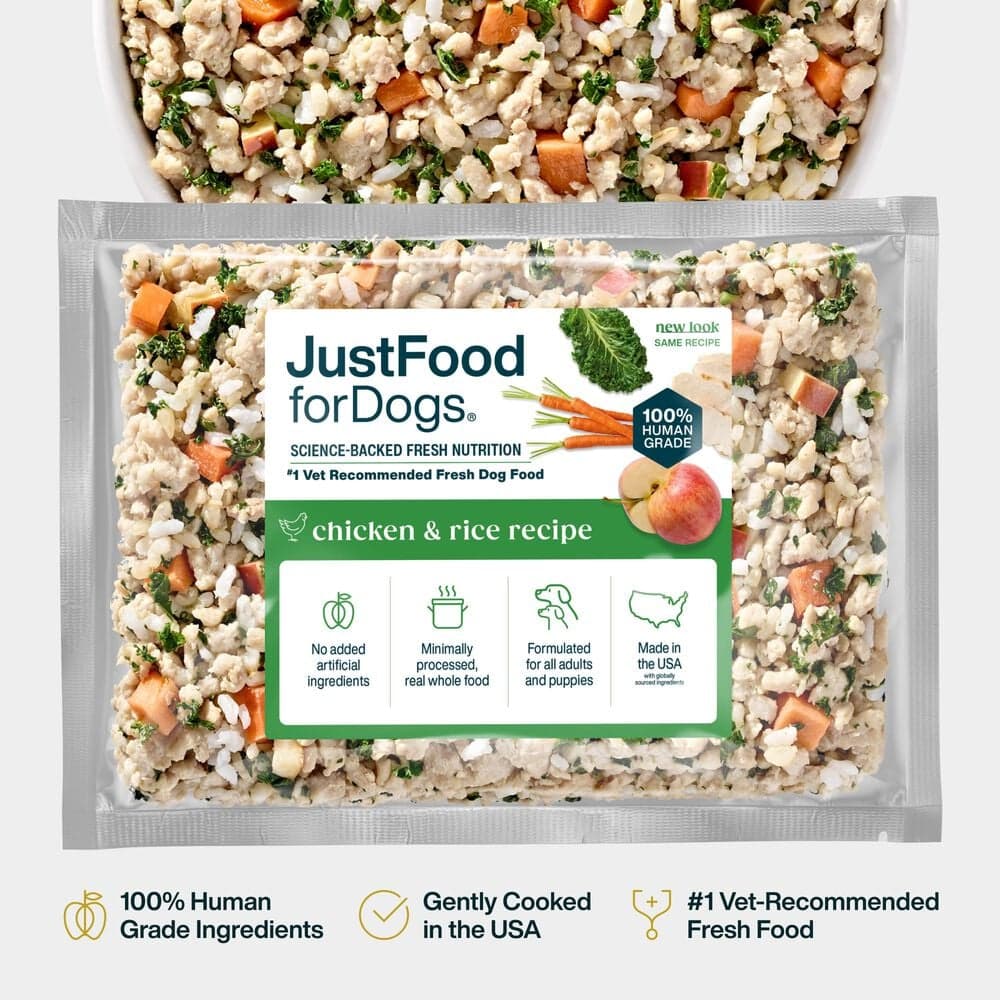
Turn the calorie numbers in this guide into a measured daily portion for the exact recipe you feed.
- Chicken with rice and whole-food ingredients
- Fresh Frozen recipe
- View the recipe and feeding guide
Webvet may earn a commission when you click through to JustFoodForDogs, at no extra cost to you.
Veterinary nutrition starts with the resting energy requirement (RER), the calories a dog burns at rest just running its basic body functions. The Ohio State University Veterinary Medical Center calculates RER by multiplying the dog's body weight in kilograms, raised to the 3/4 power, by 70. A 10 kg (22 lb) adult dog, for example, needs roughly 400 calories a day just for basic functions. That RER then gets multiplied by a factor for life stage, activity and body condition to estimate total daily needs. OSU also notes that individual dogs can vary from these calculated values by as much as 50 percent, which is why every estimate ends with the same instruction: adjust based on your dog's body condition over time, with your vet's input.
Here's why that matters specifically for JustFoodForDogs: the recipes are not interchangeable by volume. An ounce of Turkey & Whole Wheat Macaroni carries 49 calories. An ounce of Venison & Squash carries 25. That is nearly a two-to-one difference, so "2 cups a day" is a meaningless instruction until you know which recipe is in the bowl. The brand prints calorie content on every product page and label, and the next section consolidates all of it.
Calories Per Recipe: The Master Reference
JustFoodForDogs scatters these numbers across product pages and PDFs. Here they are in one table, pulled from the company's current product listings. Fresh Frozen values are per the standard 18 oz package; Pantry Fresh is the 12.5 oz Tetra Pak carton; JustFresh is the 12 oz shelf-stable pouch.
JustFoodForDogs Calories by Recipe
| Line | Recipe | kcal per oz | kcal per package |
|---|---|---|---|
| Fresh Frozen | Turkey & Whole Wheat Macaroni | 49 | 882 per 18 oz |
| Fresh Frozen | Beef & Russet Potato | 44 | 792 per 18 oz |
| Fresh Frozen | Chicken & Rice | 43 | 774 per 18 oz |
| Fresh Frozen | Lamb & Brown Rice | 42 | 756 per 18 oz |
| Fresh Frozen | Fish & Sweet Potato | 26 | 468 per 18 oz |
| Fresh Frozen | Venison & Squash | 25 | 450 per 18 oz |
| Pantry Fresh | Lamb & Brown Rice | 38 | 475 per 12.5 oz carton |
| Pantry Fresh | Beef & Russet Potato | 36 | 450 per 12.5 oz carton |
| Pantry Fresh | Turkey & Whole Wheat Macaroni | 35 | 437.5 per 12.5 oz carton |
| Pantry Fresh | Chicken & Rice | 31 | 387.5 per 12.5 oz carton |
| JustFresh | Beef | 46 | ~552 per 12 oz pouch |
| JustFresh | Chicken | 36 | ~432 per 12 oz pouch |
| JustFresh | Turkey | 34 | ~408 per 12 oz pouch |
| JustFresh | Pork | 35 | ~420 per 12 oz pouch |
A few things worth noticing in that table:
The spread is wide. Within the Fresh Frozen line alone, calorie density nearly doubles from Venison & Squash (25 kcal/oz) to Turkey & Whole Wheat Macaroni (49 kcal/oz). A dog eating 600 calories a day would need about 24 oz of the venison recipe but only about 12 oz of the turkey recipe. Same dog, same calories, half the food by weight.
Format changes the math too. The same recipe lands at different densities across lines. Chicken & Rice is 43 kcal/oz frozen but 31 kcal/oz in the Pantry Fresh carton. If you rotate between formats for travel or convenience, recheck the portion each time.
Lower density can be a feature. The lighter recipes (Fish & Sweet Potato, Venison & Squash) let a dog eat a larger, more satisfying volume for the same calorie budget, which some owners of food-motivated dogs appreciate. Your vet can tell you whether a lower or higher density recipe makes sense for your dog.
Turn the calorie numbers in this guide into a measured daily portion for the exact recipe you feed.
- Enter your dog’s weight and activity
- Compare fresh-food feeding options
- Use your vet’s calorie target for medical needs
Webvet may earn a commission when you click through to JustFoodForDogs, at no extra cost to you.

How Much to Feed by Dog Size
The table below gives approximate daily ranges for healthy adult dogs, built from the standard RER formula with typical adult maintenance factors applied. The ounces column uses Chicken & Rice (43 kcal/oz) as the example recipe; if you feed a different recipe, divide the calorie target by that recipe's kcal/oz from the master table above.
These are starting points, not prescriptions. Spayed/neutered status, age, activity and body condition all move the number, and OSU's guidance is clear that individual dogs can vary up to 50 percent from formula estimates. Confirm with your veterinarian or the official calculator, then adjust to the body condition you can see and feel.
Turn the calorie numbers in this guide into a measured daily portion for the exact recipe you feed.
- Chicken with rice and whole-food ingredients
- Fresh Frozen recipe
- View the recipe and feeding guide
Webvet may earn a commission when you click through to JustFoodForDogs, at no extra cost to you.
Approximate Daily Feeding by Weight
| Dog weight | Approx. daily calories | Example: oz/day of a 43 kcal/oz recipe |
|---|---|---|
| 10 lb | 260-350 | 6-8 oz |
| 20 lb | 440-590 | 10-14 oz |
| 30 lb | 600-790 | 14-18 oz |
| 50 lb | 870-1,170 | 20-27 oz |
| 70 lb | 1,120-1,500 | 26-35 oz |
| 90 lb | 1,350-1,800 | 31-42 oz |
For a reality check against the brand's own numbers: JustFoodForDogs' feeding article puts a fit 30-pound adult dog at around 620 calories daily, which sits right inside the 600-790 range above. At 43 kcal/oz, that's roughly 14.5 oz of Chicken & Rice per day, or about four-fifths of one 18 oz package, split across two meals.
Two practical notes. First, feeding guidelines are daily totals, not per-meal amounts; most adult dogs do well on two meals a day. Second, if your dog is overweight or underweight, don't feed to the weight the scale shows. Your vet will set a target weight and a calorie plan to move toward it.
How to Use the JustFoodForDogs Calculator
JustFoodForDogs publishes a free interactive tool, the dog food calculator,. It works as a short quiz: you answer questions about your dog, including breed and weight, and it returns a custom nutrition plan with recommended recipes and daily portion amounts matched to your answers.
It's the most precise option the brand offers, because it does the recipe-specific math for you and updates automatically as the product lineup changes. Our tables above are the at-a-glance alternative: faster when you just need a sanity check on a portion, and printable for the fridge door.
Whichever you use, recheck the output whenever something meaningful changes:
- Weight change. A gain or loss of more than about 10 percent of body weight shifts the calorie target enough to matter.
- Activity change. A dog that starts daily running, or stops, needs a new number.
- Life stage. Puppy to adult, intact to spayed/neutered, adult to senior. Each transition typically lowers or raises daily needs.
- Recipe change. As the master table shows, switching recipes can nearly double or halve the ounces required for the same calories.
Puppies, Seniors and Special Cases
Puppies burn far more calories per pound than adults, and they need those calories spread across more meals. JustFoodForDogs recommends feeding puppies four times a day until four months old, three times a day until six months, then twice daily as adults. The totals are bigger than intuition suggests: the brand's guidance puts a 30-pound puppy under four months at more than 1,100 calories per day, nearly double the fit-adult figure for the same weight. Also check the AAFCO statement on your recipe. Chicken & Rice, for example, is formulated to meet AAFCO nutrient profiles for all life stages including growth of large-size dogs, while Turkey & Whole Wheat Macaroni is substantiated for adult maintenance through feeding trials, so not every recipe suits a growing puppy.
Turn the calorie numbers in this guide into a measured daily portion for the exact recipe you feed.
- Enter your dog’s weight and activity
- Compare fresh-food feeding options
- Use your vet’s calorie target for medical needs
Webvet may earn a commission when you click through to JustFoodForDogs, at no extra cost to you.
Seniors often need fewer calories as activity drops, but muscle loss is the bigger risk, so don't simply shrink portions without a vet check. Body condition scoring every few months catches drift early.
Pregnant and nursing dogs are their own category. Their calorie needs climb sharply, especially in late pregnancy and peak lactation, but the right amount depends on litter size and body condition. This is a "call your vet" situation, not a chart situation: your veterinarian sets the targets.
Dogs on veterinary diets (weight loss plans, vet-recommended diets for dogs with specific health conditions) should be fed exactly to the plan their veterinarian sets. The tables above are for healthy adult maintenance only.

Transitioning Without Tummy Trouble
Switching foods too fast is the most common cause of soft stool in the first week, and it's entirely avoidable. A gradual transition over about 7 to 10 days, mixing the new food with the old in shifting ratios, prevents most of it:
- Days 1-3: 25% JustFoodForDogs, 75% current food
- Days 4-6: 50% new, 50% old
- Days 7-9: 75% new, 25% old
- Day 10 onward: 100% JustFoodForDogs
Watch for soft stool, gas or a skipped meal along the way. If anything looks off, drop back to the last ratio that worked, hold there a few days, then resume. Sensitive dogs can stretch the schedule longer; there's no prize for finishing in a week.
One math detail people miss: during the transition, the "old food" portion still counts toward daily calories. Mix by calorie share, not by scoop count, especially when moving from calorie-dense kibble to fresh food.
Treats, Toppers and the 10 Percent Rule
Everything that goes in the mouth counts. JustFoodForDogs' own guidance is to limit calories from snacks to no more than 10 percent of the daily diet, which matches standard veterinary advice.
In practice: a 30-pound dog on roughly 620 calories a day has a treat budget of about 60 calories. A couple of training treats and a dental chew can eat that entire budget. If you use food toppers, count them too, and shave the equivalent calories off the main meals. When the treat budget keeps blowing up, reserve a portion of the day's measured food as "treats" instead; fresh food chunks work fine for training.
Frequently Asked Questions
How much should I feed my dog JustFoodForDogs?
It depends on your dog's calorie needs and the recipe you feed, because the core JustFoodForDogs recipes covered here range from 25 to 49 kcal per ounce. As a worked example, the brand estimates a fit 30-pound adult dog needs around 620 calories daily, which is about 14.5 oz of Fresh Frozen Chicken & Rice (43 kcal/oz) per day, split into two meals. Use the official JustFoodForDogs calculator or the weight table in this guide for your dog's starting point, then have your vet fine-tune it.
Do vets recommend JustFoodForDogs?
Yes, many do. JustFoodForDogs develops its recipes with a team of veterinarians and canine nutritionists, its daily recipes are formulated to meet AAFCO nutrient profiles, and the company sells through its own kitchens and retail partners. Fresh, whole-food diets are increasingly recommended across the veterinary field, and JustFoodForDogs is one of the brands built around that approach. That said, no single brand is right for every dog, so ask your own veterinarian whether a JustFoodForDogs recipe fits your dog's age, weight and health status.
Is 2 cups a day enough for a dog?
It depends on the calories in those cups and on the dog. Two cups of a calorie-dense food can be too much for a small dog, while two cups of a lower-density fresh recipe can be too little for a large one. The math that matters is calories per day: estimate your dog's daily calorie need (the OSU resting-energy formula or the JustFoodForDogs calculator both work), check the kcal per ounce on the label of the specific recipe, and divide. Within JustFoodForDogs alone, an ounce of Turkey & Whole Wheat Macaroni (49 kcal) carries nearly double the calories of an ounce of Venison & Squash (25 kcal), so identical volumes are never identical meals.
How many calories are in JustFoodForDogs?
It varies by recipe and product line. Fresh Frozen recipes run from 25 kcal/oz (Venison & Squash) to 49 kcal/oz (Turkey & Whole Wheat Macaroni), with an 18 oz package holding 450 to 882 calories. Pantry Fresh cartons (12.5 oz) range from 387.5 calories (Chicken & Rice) to 475 (Lamb & Brown Rice). JustFresh 12 oz pouches run from about 408 calories (Turkey) to about 552 (Beef). Exact figures are printed on each product's label and listed in the master table in this guide.
How do I transition my dog to JustFoodForDogs?
Move gradually over 7 to 10 days. Start with 25% JustFoodForDogs mixed into 75% of the current food for days 1-3, shift to 50/50 for days 4-6, then 75/25 for days 7-9, and reach 100% around day 10. If your dog develops soft stool or gas, return to the last ratio that worked, wait a few days, then continue. Once fully switched, weigh your dog after two to three weeks and adjust portions if the number moved.
The Bottom Line
Feeding JustFoodForDogs well comes down to three numbers: your dog's daily calorie target, the kcal per ounce of the recipe in the bowl, and the 10 percent treat ceiling. Get those three right and the cups take care of themselves. Use the official calculator for a personalized plan, keep the master table handy for quick checks, and let your veterinarian make the final call on the target, especially for puppies, seniors and dogs with health conditions.
And if you're still deciding whether fresh food is the right direction in the first place, our companion fresh dog food guide walks through how fresh diets compare to kibble across cost, nutrition and convenience.

Editor
The Webvet Editorial Team is the in-house group of pet-care editors and writers behind Webvet, operated by Smart Pet Collective. The team researches, writes, and maintains Webvet's pet health, behavior, and medication content. Every article follows a defined editorial process: research from reputable veterinary and scientific sources, careful drafting, mandatory review of medical content by a credentialed veterinarian, and dated publication. Health and medication articles are medically reviewed by a licensed veterinary professional before they go live and are kept current over time.
Related reading

Low Calorie Dog Treats: Calories and Portion Guide

Minimally Processed Dog Food: What It Means and Why It Matters

Best Soft Dog Food for Senior Dogs: Gentle, Nutrient-Dense Options
