JustFoodForDogs Puppy Food: A Complete Feeding Guide
Which JustFoodForDogs recipes are safe for puppies? A practical guide to the brand's meals formulated to meet AAFCO growth profiles, large-breed considerations, portions by age, real monthly costs, and a gentle transition plan.

This article contains affiliate links. Webvet may earn a commission when you buy through them, at no extra cost to you.
This article contains affiliate links. Webvet may earn a commission when you buy through them, at no extra cost to you.
Bringing home a puppy means making about a hundred decisions in the first week, and the biggest recurring one lands in the food bowl three or four times a day. If you've been researching JustFoodForDogs puppy food, you've probably noticed that fresh, gently cooked diets are on nearly every new owner's radar right now, and for understandable reasons: recognizable ingredients, food that smells like actual food, and a dog who shows up for mealtime like it's an event.
But puppies are not small adult dogs. Their nutritional needs during growth are stricter and less forgiving, especially for large breeds. So before you fill a freezer drawer, it's worth knowing exactly which JustFoodForDogs recipes are appropriate for a growing puppy, how much to feed at each stage, and what the whole thing actually costs. This guide walks through all of it.
- 1Puppies can eat fresh food, but only recipes that carry an AAFCO statement covering growth or all life stages, not adult-maintenance-only formulas.
- 2JustFoodForDogs' Chicken & Rice and Fish & Sweet Potato fresh frozen recipes are formulated to meet AAFCO nutrient profiles for all life stages, including growth of large-size dogs (70 lb or more as an adult).
- 3The Puppy Variety Pack bundles both recipes with full growth statements in one box, which makes early taste-testing easy.
- 4Young puppies eat 3-4 small meals a day; most taper to 2 meals around 6 months. Portions should be adjusted weekly based on body condition and weight.
- 5Budget realistically: fresh food costs scale with your puppy's expected adult size, and portions grow steadily through the first year.

Can Puppies Eat Fresh Food?
Yes, puppies can absolutely eat fresh, gently cooked food. The catch is that the specific recipe matters far more than it does for an adult dog.
Feeding a puppy fresh? Start with the growth-substantiated recipes covered in this guide.
- Chicken with rice and whole-food ingredients
- Fresh Frozen recipe
- View the recipe and feeding guide
Webvet may earn a commission when you click through to JustFoodForDogs, at no extra cost to you.
Growth is the most demanding life stage in a dog's life. Puppies need more calories per pound than adults, along with tightly calibrated levels of protein, fat, calcium, and phosphorus to build bone and muscle on schedule. In the United States, the benchmark for whether a food can do that job is set by the Association of American Feed Control Officials (AAFCO), which publishes nutrient profiles for two life stages: adult maintenance, and growth and reproduction.
Here's the simple version of what to look for on any label or product page:
- "Adult maintenance" means the food is balanced for fully grown dogs only. It is not appropriate as a puppy's primary diet.
- "Growth" or "all life stages" means the food meets the stricter growth profile, so a puppy can eat it as their complete daily diet.
- "Including growth of large size dogs (70 lb or more as an adult)" is an additional phrase that matters enormously for big puppies, and we'll get to why in the next section.
A food labeled for all life stages has to satisfy the growth standard, which is the tougher of the two. That's why an all-life-stages recipe works for both your puppy today and your adult dog later, while the reverse is not true.
So the question isn't really whether fresh food is okay for puppies. It's whether the specific fresh recipe in your cart carries the right AAFCO substantiation. With JustFoodForDogs, some recipes do and some don't, which is exactly why this guide exists.
Which JustFoodForDogs Recipes Are Puppy-Appropriate?
JustFoodForDogs makes a wide menu of fresh frozen recipes, but not all of them are formulated for growth. As of June 2026, the brand's own puppy feeding resources point to two fresh frozen recipes for growing puppies, and both carry the full large-breed growth statement.
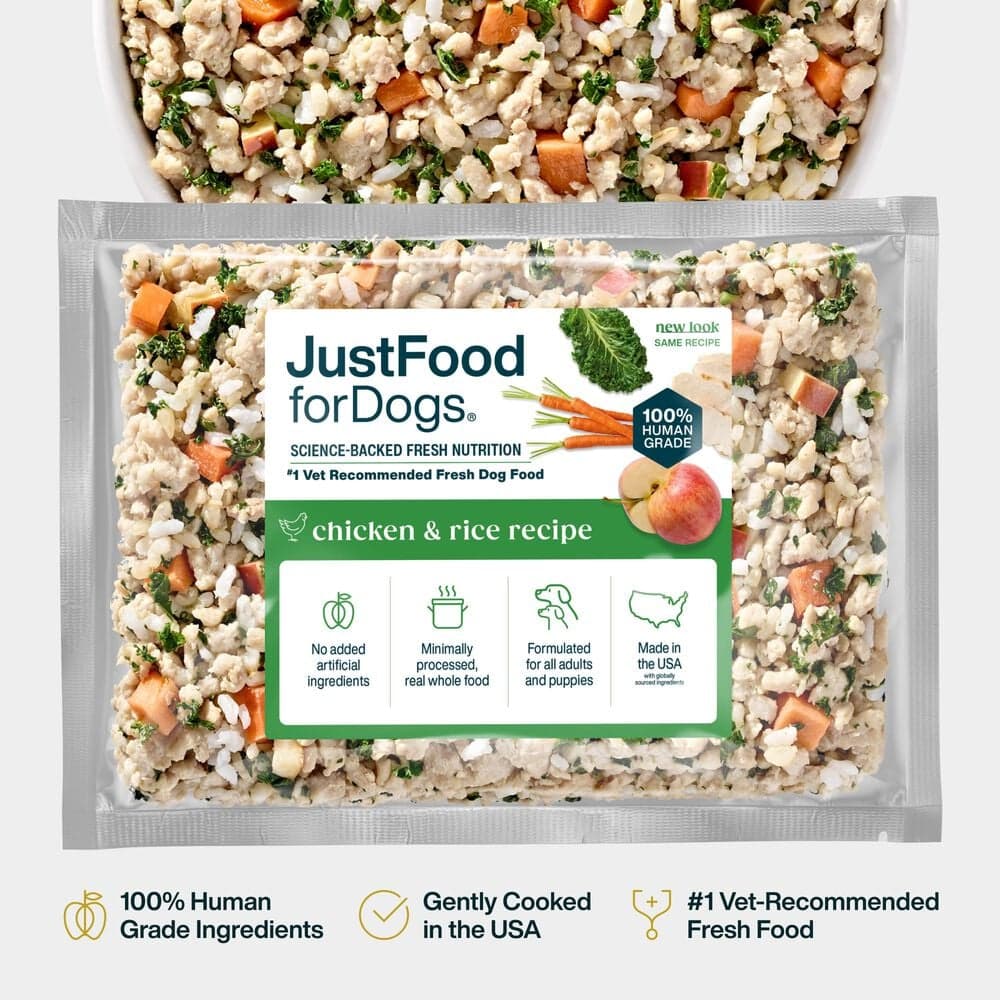
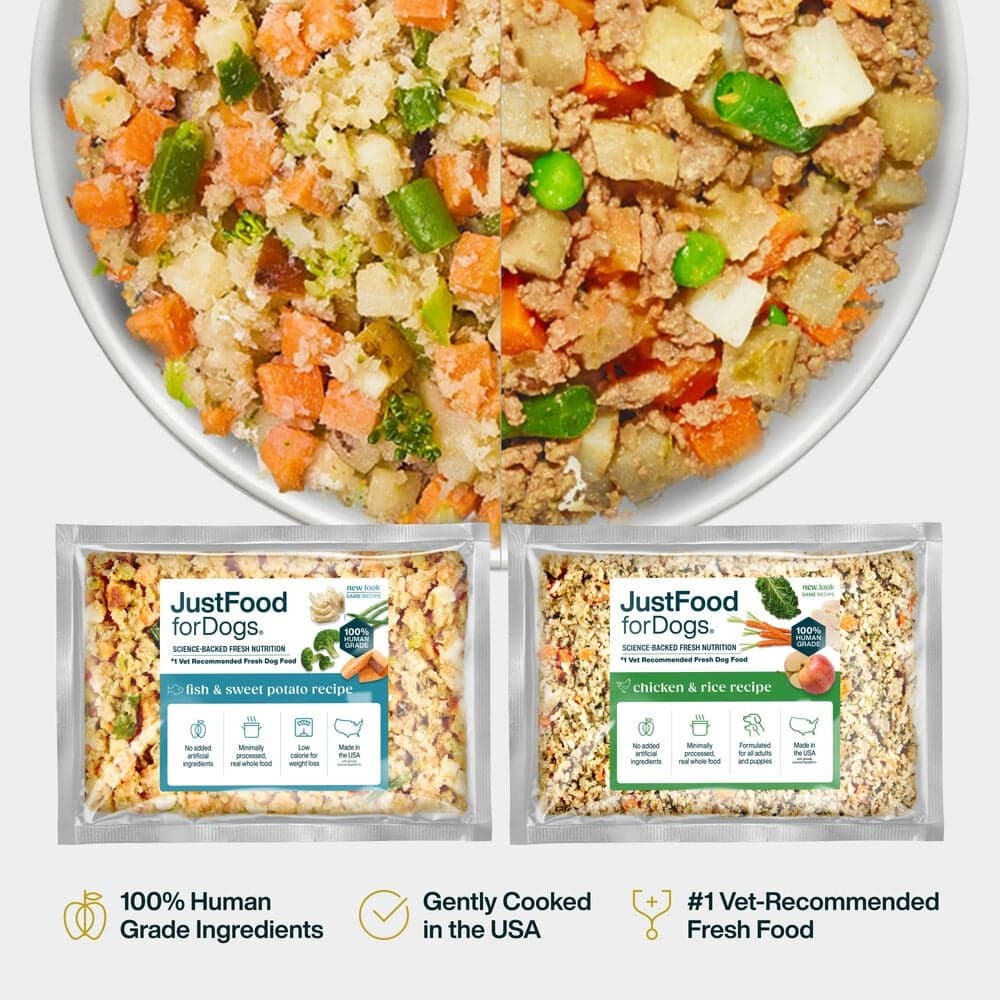
Chicken & Rice is the flagship. The product page states it is "formulated to meet the nutritional levels established by the AAFCO Dog Nutrient Profiles for all life stages, including growth of large size dogs (70 lbs. or more as an adult)." It's built on chicken thighs, white and brown rice, chicken liver, kale, carrots, and apples, and it is the more calorie-dense of the two at 43 kcal per ounce. That density makes it a practical primary diet for puppies who need a lot of energy in a small stomach.

Fish & Sweet Potato carries the same all-life-stages statement, including growth of large-size dogs. It's made with white fish plus sweet potatoes, russet potatoes, green beans, and broccoli. At 26 kcal per ounce it is considerably lighter than the chicken recipe, so expect noticeably larger portions to hit the same calorie target.
Feeding a puppy fresh? Start with the growth-substantiated recipes covered in this guide.
- Chicken & Rice plus Fish & Sweet Potato
- Both recipes meet AAFCO growth profiles
- Seven 18 oz packages per small box
Webvet may earn a commission when you click through to JustFoodForDogs, at no extra cost to you.
The Puppy Variety Pack is the easiest on-ramp. The small box bundles four 18 oz packages of Chicken & Rice and three of Fish & Sweet Potato (7.8 lb total). Because puppies form flavor preferences early, starting with both recipes is a quiet bit of insurance: a dog who grows up eating two proteins is usually a more flexible eater for life. JustFoodForDogs notes these recipes run a bit higher in calcium and phosphorus, which is what growing bodies need.
Pantry Fresh Chicken & Rice, the brand's shelf-stable line, also states it meets AAFCO profiles for all life stages including large-breed growth. It's handy for travel, training weekends, or as a backup when the freezer supply runs out.
The large-breed calcium question
If your puppy's expected adult weight is 70 lb or more, the calcium content of their food during growth is not a detail; it's the headline. Large-breed puppies that consume excess calcium while their skeletons are developing face well-documented orthopedic risks, which is why AAFCO's growth profile includes a separate, stricter calcium ceiling for foods claiming to support large-size-dog growth. For a large-breed puppy, look for the explicit "including growth of large size dogs" wording rather than assuming a generic all-life-stages label covers that stricter calcium limit.
The good news here is straightforward: both of JustFoodForDogs' fresh puppy recipes, and the Pantry Fresh chicken recipe, carry the explicit "including growth of large size dogs (70 lbs. or more as an adult)" statement. If you're raising a Lab, Golden, Shepherd, or anything bigger, that's the line to confirm on the label of any food you buy, from any brand, every time.
Feeding a puppy fresh? Start with the growth-substantiated recipes covered in this guide.
- Enter your dog’s weight and activity
- Compare fresh-food feeding options
- Use your vet’s calorie target for medical needs
Webvet may earn a commission when you click through to JustFoodForDogs, at no extra cost to you.
JustFoodForDogs for Puppies at a Glance
| Recipe | Life-stage statement | Large-breed OK? | Notes |
|---|---|---|---|
| Chicken & Rice (fresh frozen) | All life stages, including growth of large-size dogs (70 lb+ adult) | Yes | 43 kcal/oz; most calorie-dense option; chicken thighs, rice, chicken liver, vegetables |
| Fish & Sweet Potato (fresh frozen) | All life stages, including growth of large-size dogs (70 lb+ adult) | Yes | 26 kcal/oz; cod, pollock, haddock; larger portions needed |
| Puppy Variety Pack | Both included recipes carry the growth statement | Yes | Small box: 4 x Chicken & Rice + 3 x Fish & Sweet Potato (18 oz each) |
| Pantry Fresh Chicken & Rice (shelf-stable) | All life stages, including growth of large-size dogs (70 lb+ adult) | Yes | 31 kcal/oz; 2-year shelf life; useful for travel and backup |
One note of caution: JustFoodForDogs sells many other recipes, including vet support formulas and lighter adult meals. Don't assume the rest of the menu is puppy-appropriate. Check each product page for the growth statement before adding it to a puppy's rotation, and when in doubt, ask your veterinarian.
How Much to Feed a Puppy
Puppy portions are a moving target, and that's normal. Two things change constantly during the first year: how many calories your puppy needs, and how many meals those calories should be split across.
Calories rise with growth, then level off. A puppy's energy needs per pound peak during the rapid-growth months and gradually settle as they approach adult size. Rather than memorizing formulas, anchor on two tools: JustFoodForDogs' puppy feeding calculator, which generates a daily calorie and portion recommendation from your puppy's age and expected adult weight, and your veterinarian, who can adjust that number based on body condition at each checkup. Those weigh-ins matter more than any chart.
Meal frequency tapers with age. Small stomachs and high energy needs mean young puppies do best with several small meals. JustFoodForDogs' own guidance lines up with what most veterinary teams recommend:
- 6 to 12 weeks: 4 meals a day
- 3 to 6 months: 3 meals a day
- 6 to 12 months: 2 meals a day
Try not to stretch a young puppy (under 6 months) much past 6-8 hours between meals. Most dogs stay on a twice-daily schedule for life after the first year.
A practical tip for fresh food specifically: thawed JustFoodForDogs packages keep in the refrigerator for several days in the original sealed packaging (the exact window varies by recipe, so check the pack), so a small-breed puppy working slowly through an 18 oz package has plenty of runway. For big puppies plowing through food, thaw ahead in batches so you're never stuck with a frozen brick at dinnertime.
Transitioning a Puppy to Fresh Food
Puppy stomachs are famously sensitive, and a brand-new home is already a lot of change at once. Whatever food your breeder, foster, or shelter was using, keep feeding it for the first several days while your puppy settles in. Then transition gradually.
Feeding a puppy fresh? Start with the growth-substantiated recipes covered in this guide.
- Chicken & Rice plus Fish & Sweet Potato
- Both recipes meet AAFCO growth profiles
- Seven 18 oz packages per small box
Webvet may earn a commission when you click through to JustFoodForDogs, at no extra cost to you.
JustFoodForDogs recommends a slow, stepped switch that runs about 10 to 11 days:
- Days 1-3: 25% new food, 75% current food
- Days 4-7: 50% new food, 50% current food
- Days 8-10: 75% new food, 25% current food
- Day 11: 100% new food
Mix the two foods together in the same bowl at each meal so your puppy can't simply eat around the new addition. If you see soft stool, gas, or a skipped meal along the way, don't panic and don't push forward: hold at the current ratio for an extra two or three days until things firm up, then resume. A slightly slower transition costs you nothing; a rushed one usually costs you a few messy mornings.

And if your puppy is still in the weaning window? Puppies typically begin moving from milk to softened solid food around 3-4 weeks of age and finish the process by roughly 8-10 weeks. Fresh food's soft texture actually suits weaning well, but very young puppies should make that move under the guidance of whoever is raising the litter, ideally with a veterinarian's input.
What It Costs to Feed a Puppy Fresh
Fresh food is a premium, made-from-real-ingredients choice, and what you will spend depends almost entirely on your puppy's expected adult size, with the daily amount rising through the first year as your growing puppy's portions increase.
As of June 2026, JustFoodForDogs' small boxes (seven 18 oz packages, 7.8 lb of food) list at $76.99 for Chicken & Rice and $83.99 for Fish & Sweet Potato, with the Puppy Variety Pack at $79.99. That works out to roughly $0.61 to $0.67 per ounce at small-box pricing, before any autoship discounts or larger-box savings (bigger boxes ship free and cost less per ounce, and the brand typically runs a steep first-autoship promotion).
Using the calorie-dense Chicken & Rice recipe as the baseline, here are honest ballparks for a puppy's daily intake once they're past the tiny-portion newborn stage:
- Small breed (adult weight around 10 lb): roughly 5-9 oz a day, in the neighborhood of $3-6 a day, or about $100-180 a month.
- Medium breed (adult weight around 40 lb): roughly 16-22 oz a day during strong growth, around $10-14 a day, or about $300-420 a month.
- Large breed (adult weight 70 lb or more): about 28 oz a day to start, increasing as they grow. At full small-box pricing that runs roughly $17 to $24 a day, or about $500 to $700 a month, and ordering larger boxes on Autoship lowers the per-ounce cost, which is how most large-breed feeders keep the monthly spend down.
Treat these as rough planning figures, not quotes: your puppy's actual needs depend on age, activity, and metabolism, and choosing Fish & Sweet Potato (26 kcal/oz versus 43) means feeding noticeably more ounces to hit the same calories. The feeding calculator will give you a number specific to your dog, and buying the larger boxes meaningfully lowers the per-meal cost for medium and large dogs.
Plenty of families also land on a hybrid approach: fresh food as a topper or as one meal a day alongside a quality kibble that also carries a growth statement. If you go that route, keep the combined daily calories in check and have your vet sanity-check the plan. For a wider look at how fresh diets compare across brands and budgets, see our fresh dog food guide.
Frequently Asked Questions
Is JustFoodForDogs good for puppies?
Yes, with the right recipes. JustFoodForDogs' Chicken & Rice and Fish & Sweet Potato fresh frozen recipes are formulated to meet AAFCO nutrient profiles for all life stages, including growth of large-size dogs (70 lb or more as an adult), which means they're substantiated as a complete diet for growing puppies of any size. Stick to those recipes with the full growth statement (or the Puppy Variety Pack that bundles them) rather than the brand's adult or vet-support formulas, and confirm the plan with your veterinarian.
What is the healthiest dog food to feed a puppy?
There's no single healthiest food, but there is a healthy checklist. Look for an AAFCO statement covering growth or all life stages (with the large-size-dog phrase if your puppy will mature at 70 lb or more), a named protein source, calorie information you can actually portion against, and a manufacturer that employs qualified nutrition professionals. From there, the best food is one your puppy digests well, eats reliably, and maintains a lean body condition on. Your veterinarian can help you compare specific options.
Is JustFoodForDogs recommended by vets?
JustFoodForDogs says its recipes are developed by a team that includes veterinarians and board-certified specialists, and the company sells a separate line of vet-support formulas through veterinary authorization. Many veterinarians are comfortable recommending fresh diets that meet AAFCO growth standards for puppies. That said, every puppy is different, so the recommendation that matters most is the one from the veterinarian who has actually examined your dog.
When can puppies start eating JustFoodForDogs?
Puppies can eat JustFoodForDogs' growth-substantiated recipes as soon as they're weaned onto solid food, which typically completes around 8-10 weeks of age. Puppies start sampling softened solids as early as 3-4 weeks. If you're bringing home an 8-week-old puppy, you can begin transitioning to the fresh recipes right away, using a gradual 10-11 day switch from whatever food the puppy was eating before.
How much should I feed my puppy?
It depends on age, expected adult weight, and activity level, and the right amount changes as your puppy grows. Use JustFoodForDogs' puppy feeding calculator for a starting portion, split it into 4 daily meals for puppies 6-12 weeks old, 3 meals from 3-6 months, and 2 meals from 6 months on. Then adjust weekly based on weight and body condition, with your veterinarian as the tiebreaker.
The Bottom Line
JustFoodForDogs is a legitimate option for raising a puppy on fresh food, because the brand did the part that matters: its two core fresh recipes are formulated to meet AAFCO growth standards all the way up to large-breed puppies, and the company publishes the calorie data and feeding tools you need to portion correctly. Start with the Puppy Variety Pack, transition slowly, split meals by age, and weigh your puppy every week. Plan ahead for the larger portions your growing puppy will need, loop in your veterinarian at every checkup, and you'll have set up mealtime, three or four times a day, as one of the easiest decisions you made all year.

Editor
The Webvet Editorial Team is the in-house group of pet-care editors and writers behind Webvet, operated by Smart Pet Collective. The team researches, writes, and maintains Webvet's pet health, behavior, and medication content. Every article follows a defined editorial process: research from reputable veterinary and scientific sources, careful drafting, mandatory review of medical content by a credentialed veterinarian, and dated publication. Health and medication articles are medically reviewed by a licensed veterinary professional before they go live and are kept current over time.
Related reading

Low Calorie Dog Treats: Calories and Portion Guide

Minimally Processed Dog Food: What It Means and Why It Matters

Best Soft Dog Food for Senior Dogs: Gentle, Nutrient-Dense Options
