How Many Treats Can a Dog Have? A Daily Calorie Guide
Work out how many treats your dog can have using its daily calorie target, the 10% limit, and the exact treat label. Includes worked examples, training portions, puppy guidance, and a household plan.

BVMS MRCVS
Medically reviewed by Dr. Pippa Elliott, BVMS MRCVS · Last reviewed

This article contains affiliate links. Webvet may earn a commission when you buy through them, at no extra cost to you.
How many treats can a dog have? Use calories rather than a universal number: for a typical healthy dog, treats and other extras should supply no more than 10% of daily calories. Subtract the calories in chews, toppings, and pill food, then divide what remains by calories per treat and round down. Your veterinary team can set the right daily calorie target and any individual restrictions.
For specific product comparisons, see Petful's best dog training treats.
- 1Start with your dog’s agreed daily calorie target.
- 2Allow no more than 10% for treats and other extras unless your vet gives a different plan.
- 3Subtract other extras first, then divide by calories per treat and round down.
- 4Use part of the measured meal for extra training rewards when appropriate.
 Sponsored
Have a health question about your dog?
Talk to a licensed vet at Dutch over video or message, including nights and weekends.
Use code Pets60
Plans start at $12/month · covers up to 5 pets
- Licensed vets in most states
- Rx for 150+ conditions
- 4.7 on Trustpilot
Work out your dog’s daily treat allowance
The WSAVA Nutrition Committee’s treat guidance uses a maximum of 10% of daily calorie intake for treats. A dog needing 500 kcal a day therefore has a ceiling of 50 kcal from extras. That is an arithmetic example, not a feeding prescription for a particular breed or body weight. A small dog, growing puppy, working dog, and overweight adult may have very different calorie targets and feeding needs.
First, find out whether the amount you already feed includes room for extras.
If the whole daily calorie target is supplied in the food bowl and treats are added on top, the total can exceed the plan. Ask the veterinary team for a written allocation for both main food and extras. Do not take an arbitrary large amount away from a balanced meal to compensate for a treat-heavy day.
- Daily target × 0.10 = maximum calories from all extras.
- Maximum extra calories − other extras = calories available for these treats.
- Available calories ÷ calories per treat = maximum whole-treat count; round down.
| Example daily target | 10% ceiling for all extras | Whole 3 kcal treats if there are no other extras | Whole 4 kcal treats if there are no other extras |
|---|---|---|---|
| 300 kcal | 30 kcal | 10 | 7 |
| 500 kcal | 50 kcal | 16 | 12 |
| 800 kcal | 80 kcal | 26 | 20 |
| 1,200 kcal | 120 kcal | 40 | 30 |
These examples show why “ten treats” is not a general rule. At 4 kcal each, seven whole treats use 28 kcal; eight use 32 and exceed a 30-kcal allowance. At the other end, a dog with a larger allowance could receive more tiny pieces without needing bigger treats. The table assumes there are no other extras, so it is a starting ceiling rather than a daily target to fill.
Now add the rest of the day. Suppose the agreed target is 500 kcal and a chew plus food used for medication already account for 20 kcal. Subtract other extras first: 50 minus 20 leaves 30 kcal. That permits ten whole Pet Botanics Training Reward Chicken treats at 3 kcal each or seven whole 4-kcal treats. It does not permit both full portions. If the other extras already use 50 kcal, there is no additional treat allowance left in that example.

When a label gives only calories per gram
If the label lists kcal per kilogram, divide by 1,000 to get calories per gram. A hypothetical product containing 3,000 kcal/kg supplies 3 kcal/g, so a weighed 5-g portion supplies 15 kcal. A kitchen scale is often more useful for a batch of irregular pieces than a guess at the number. Do not assume every fragment has the same weight; rounding several tiny pieces separately can create a misleading total.
For small rewards with a short ingredient list, Pupford Train Chicken freeze-dried treats are one example. The current manufacturer page for the 4-oz product says less than 2 calories per treat. That is not an exact one-calorie value. Check the package you have or ask the maker for clarification before building a precise daily count from an older listing.
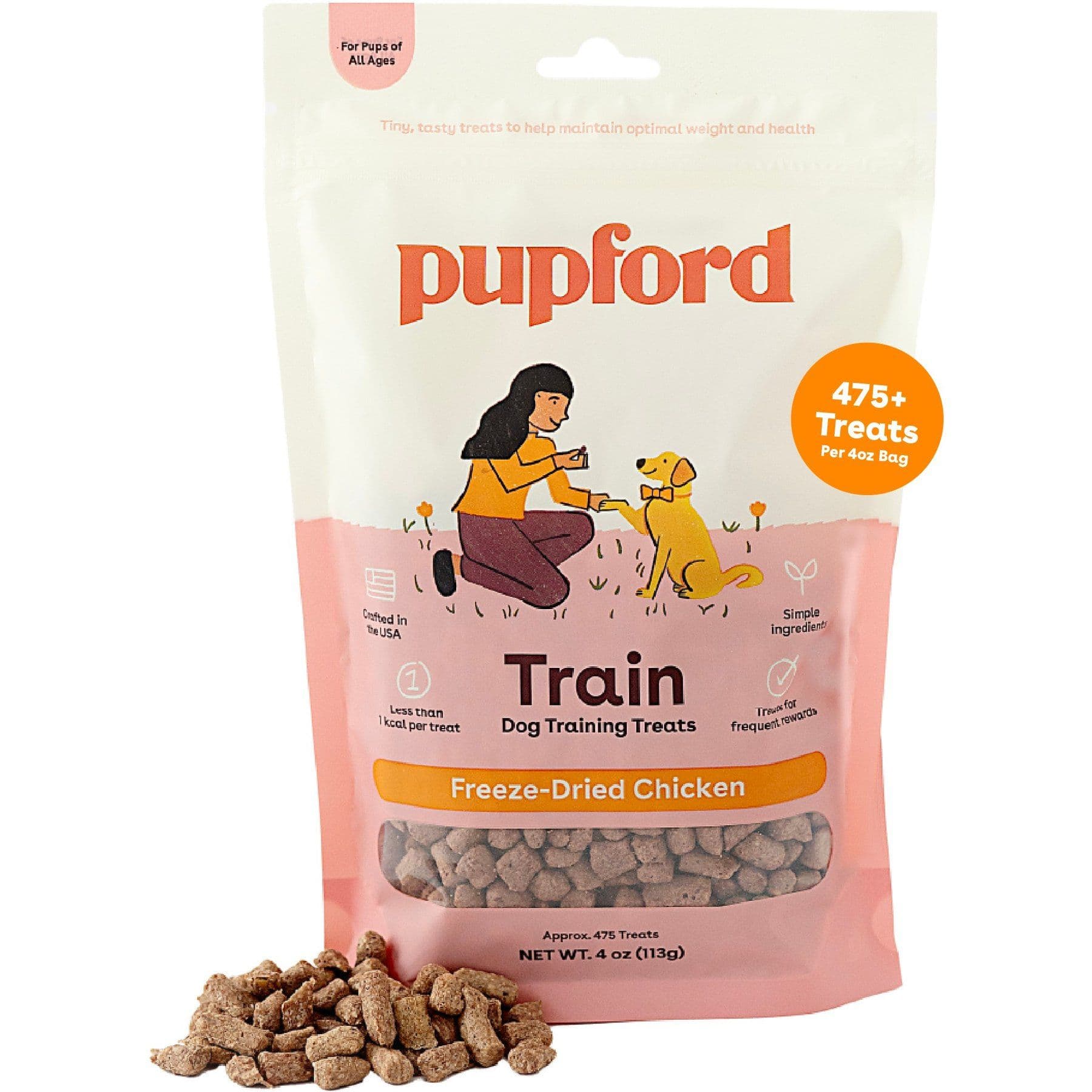
Freeze-dried chicken training rewards with a compact format for rewarding individual repetitions. Check the label for ingredients and feeding directions.
Webvet may earn a commission when you click through to Chewy, at no extra cost to you.
Turn the calorie allowance into training rewards
Frequent training rewards do not have to mean many whole treats. If a soft 4-kcal treat can be divided into four approximately equal pieces, each piece contributes about 1 kcal.
Ten whole treats still contain about 40 kcal whether they are delivered as ten rewards or forty smaller ones. You get the same calories, more reward deliveries. The pieces must remain easy for your individual dog to take and swallow.
| Example preparation | Total food used | Approximate reward deliveries | Total calories |
|---|---|---|---|
| Ten whole 4-kcal treats | 10 whole treats | 10 | 40 kcal |
| The same ten treats, each divided into four | 10 whole treats | 40 | 40 kcal |
| Five whole 4-kcal treats, each divided into four | 5 whole treats | 20 | 20 kcal |
Choose a manageable session goal before filling a pouch. Count out part of the day’s portion, train briefly, and put the remainder back in the same daily container. If you need twenty repetitions, you can plan twenty small pieces rather than reach into a large bag twenty times. For potty training, count the rewards given outdoors along with the ones used in formal practice. They draw on the same daily allowance.
Another option is part of the measured daily food ration. AAHA’s weight-management guidance recommends setting aside some of the main food for rewards. If that food is suitable for the dog and the dog finds it rewarding, move it from the bowl to the training container; do not add another meal’s worth. Reserve separate treats for situations where they help, rather than making every repetition an extra-calorie snack.
- Easy practice at home: try pieces from the measured meal.
- A harder but achievable exercise: use a small, motivating treat within the allowance.
- A longer class: preportion the whole session and tell the trainer about dietary restrictions.
- The allowance is used: choose an appropriate toy, play, praise, or a break instead of refilling the pouch.
The regular Pet Botanics Training Reward Chicken treats give a concrete label example: the manufacturer lists 3 kcal per treat. If you set aside ten whole pieces, you have allocated 30 kcal before splitting them. This is the regular Chicken formula, not a Mini variant. Check the exact formula when buying, and remember that the ingredient list includes pork liver as well as chicken.
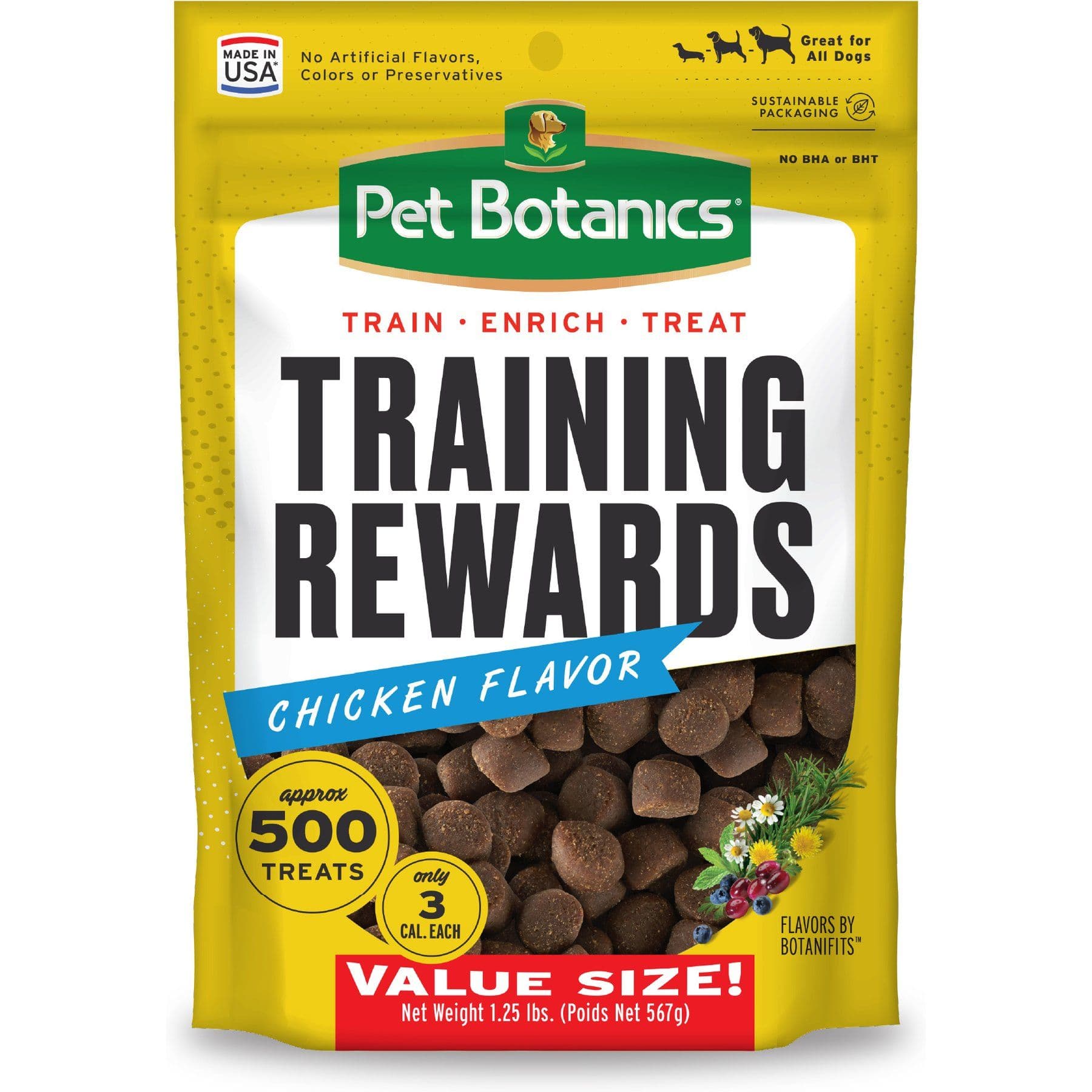
Soft chicken-flavor training rewards in a larger bag for frequent practice. Break rewards into appropriate pieces for your dog.
Webvet may earn a commission when you click through to Chewy, at no extra cost to you.
Reward value is not portion size
A dog may be highly interested in a tiny piece of a particular reward. That does not make the reward calorie-free, and making it larger does not necessarily improve the training. Notice what your dog can eat promptly and comfortably, then practice a task it can understand. If it stops taking food, consider distraction, stress, fatigue, satiation, or a task that has become too difficult before simply offering richer or larger portions.
You can mix ordinary meal pieces with a limited number of special rewards while keeping both totals visible. Avoid shaking together several unknown quantities and assuming the mix is low calorie. When a trainer gives food during class or a groomer uses snacks during handling, ask what and how much was given so you can account for it. The point is a workable routine, not perfect arithmetic around every crumb.
- Using kibble from the measured meal is a budget-friendly strategy for everyday rewards.
- Healthy versus unhealthy training-treat use often comes down to appropriate food in planned portions, versus extra handfuls that displace balanced nutrition or overshoot calories.
- Practicing tricks draws from the same daily treat allowance as other training; it does not create a second snack budget.
The American Veterinary Society of Animal Behavior recommends reward-based training. Keep the dog’s comfort and the learning task central. A clear cue, an achievable step, and a prompt reward help make practice understandable. Food accounting should support that process, not lead to food deprivation or to pushing a worried dog through a situation it cannot cope with. A favourite toy can be the reward too, which costs nothing from the allowance, and our best dog toys roundup sorts toys by the play style your dog already shows.

 Sponsored
Vet care that's always there
Unlimited video calls and messaging with licensed vets for less than a typical vet visit. One membership covers up to five pets.
Use code Pets60
Plans start at $12/month · covers up to 5 pets
- Licensed vets in most states
- Rx for 150+ conditions
- 4.7 on Trustpilot
How many treats can a puppy have?
A puppy needs an allowance based on its growth diet and current feeding plan, not a count copied from an adult dog.
Treats should not displace too much of the balanced food that supports growth. Ask the veterinary team how much room there is for extras and whether pieces of the puppy’s own meal can cover most early training. Revisit the plan as the puppy grows rather than using the same number for months.
Count every source: house-training rewards, handling practice, treats from visitors, food toys, chews, and class rewards. A small puppy can collect a surprising amount from several people who each offer “just one.” Use appropriately sized pieces, supervise eating, and follow age guidance on the package. Do not add a hard chew simply because the puppy is teething, or use an adult dog’s portion as a shortcut.
- Take the current food and treat labels to a puppy appointment.
- Confirm the daily meal amount and the permitted extras.
- Ask which rewards fit any digestive or medical restriction.
- Tell everyone in the household which container supplies that day’s rewards.
Wellness Soft Puppy Bites Lamb & Salmon are a soft puppy-format example that can be considered within that plan. Use the calorie statement on the exact pouch to calculate its portion; this guide does not assume all puppy bites contain the same calories. A lamb-and-salmon flavor also should not be treated as a one-protein food without reading the whole ingredient list.
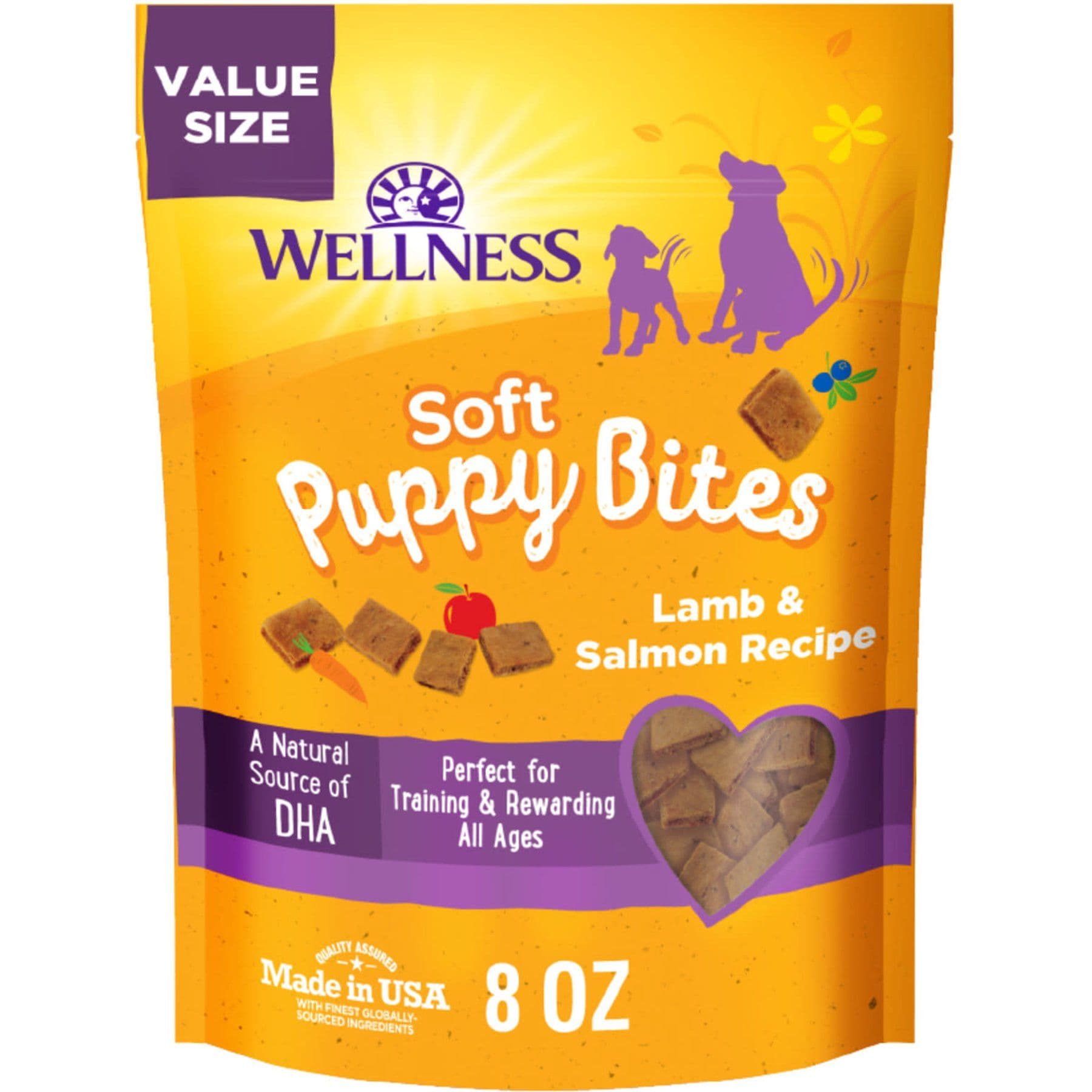
Soft lamb-and-salmon puppy bites formulated for puppies under one year. Tear each bite smaller when rewarding repeated training steps.
Webvet may earn a commission when you click through to Chewy, at no extra cost to you.
If a puppy develops vomiting, diarrhea, poor appetite, or lethargy, do not continue increasing treats to coax participation in training. Contact the veterinary practice for advice; young puppies can become unwell quickly. Record recent food changes and bring the packaging. Once the puppy is comfortable and the feeding plan is clear, gradually resume the short, manageable reward routine recommended by the team.
Choose treats you can count and divide
A useful everyday training treat has a clear calorie statement, a size and texture your dog can manage, ingredients that fit its diet, and enough appeal for the task.
The best format for your routine may be soft, crunchy, or a portion of regular food. There is no need to buy several bags before finding out whether the dog will eat a small sample comfortably and reliably.
Soft, meat-flavored treats can be convenient when they divide easily into a small reward. For fast-eating rewards, choose a suitable piece your dog can take and finish comfortably before the next repetition. The goal is not to make the dog swallow food without chewing: a treat that requires prolonged gnawing may fit a different activity, while a piece that encourages gulping needs reconsideration.
For general ingredient and label decisions, see our healthy dog-treat guide. For more repetition within a restricted extra-calorie allowance, the low-calorie dog-treat guide helps compare serving sizes. A low number per piece can reflect a tiny piece rather than a special metabolic benefit; the full amount consumed remains what matters.
- Clear per-piece calories help when treats are uniform.
- A usable kcal/g value helps when portions are weighed.
- Soft pieces may divide readily; discard unsuitable hard or sharp fragments.
- A treat your dog tolerates and likes is more useful than one chosen only by its marketing claim.
For another exact label example, BLUE Bits Tasty Chicken treats list 4 kcal per bit. Twelve whole bits therefore provide 48 kcal; thirteen provide 52. For a dog whose entire extra allowance is 50 kcal, the thirteenth would exceed it even before another snack was offered. You can divide the twelve into smaller deliveries, but you cannot add the calorie allowance again for each training session.
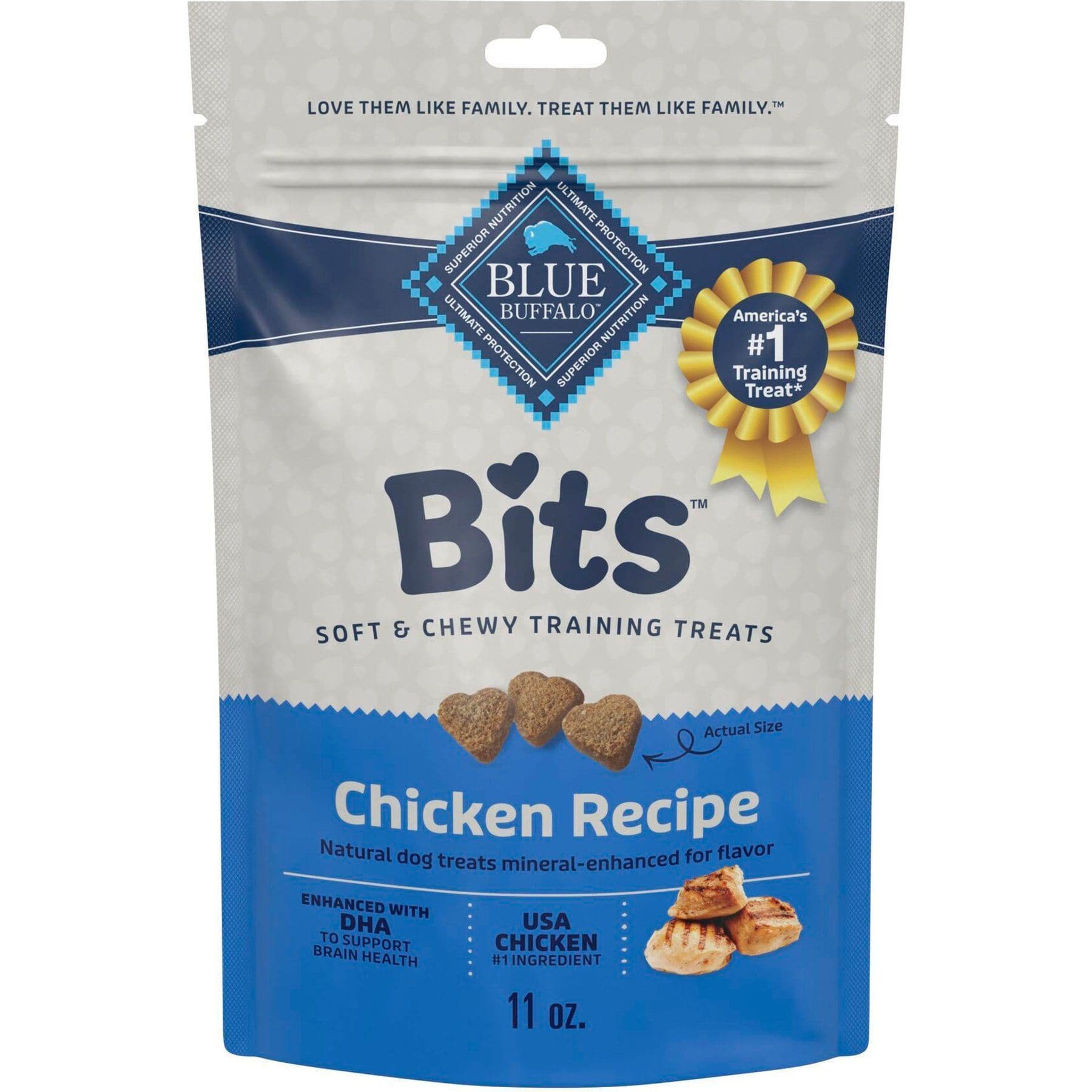
Soft chicken-recipe training bits that can be divided for small rewards. Count treats within your dog's daily food allowance.
Webvet may earn a commission when you click through to Chewy, at no extra cost to you.
When the standard allowance does not fit
Dogs on a weight-loss or veterinary-prescribed diet may need a smaller or more tightly controlled selection of extras. Dogs with a history of gastrointestinal problems may need a carefully chosen reward even when the calories fit. Our sensitive-stomach treat guide explains the selection questions. A lower-calorie snack does not guarantee tolerance, and a small portion does not make an unsuitable ingredient safe. For dogs with diabetes, our diabetic-dog treat guide covers reward choices to discuss with the veterinary team.
Calming, CBD, hemp, joint, and other supplement chews are not ordinary training treats. Their amount depends on the specific product, active ingredients, and veterinary advice, as well as their calories. Do not use this article’s calorie formula to determine a supplement dose or to justify extra medicated chews. Tell your veterinarian about all products your dog receives, including ones that look like snacks.
Share the allowance across the household

Prepare one daily container and agree on who can use it. If two people each calculate a full allowance and both feed it, the dog can receive double the planned extras. Include the dog walker, trainer, visitors, and anyone administering medication. If you have several dogs, label each container; a larger dog’s portion is not automatically suitable for the smaller one.
- 1Fill one daily container after counting other extras.
- 2Keep meal rewards separate from extra treats so neither is counted twice.
- 3Record a chew, topper, or pill food before offering the remaining snacks.
- 4Return unused rewards to the container; do not refill it automatically.
Make the system easy enough to use on a busy day. A note beside the food bin can show the meal amount, treat type, and whether a chew has already been given. If a visitor wants to offer a snack, hand over a portion from the container. For a weekly class, prepare that day’s class rewards in advance instead of treating the lesson as an exception to the daily plan.
Watch the dog’s body condition and weight over time with the veterinary team. The calculated allowance is only a starting framework; the right total intake is the amount that supports the intended condition and life stage. If weight is rising despite the plan, review all food sources and portion measurements. If appetite changes or weight falls unexpectedly, arrange a check rather than assuming the treat budget explains it.
What if your dog has too many treats?
Yes, a dog can have too many treats. Repeated extra calories can contribute to weight gain, and a treat-heavy diet can displace balanced nutrition.
A sudden large portion may also cause digestive upset. The response depends on what was eaten, how much, the dog’s size and health, and whether packaging or a dangerous ingredient was involved. The 10% guideline is a feeding rule, not a poison threshold.
Which treats are unhealthy?
The most unhealthy dog treats for your dog may be ones containing an unsafe ingredient, unsuitable for a medical diet, or simply offered in excessive amounts. There is no useful universal blacklist based only on a brand name. Check the exact ingredients and portion, and keep a complete and balanced main diet as the foundation. Suspected toxicity requires an immediate call, not a calorie calculation.
If the product may contain xylitol, contact a veterinarian or animal poison service immediately; the FDA warns that xylitol can be dangerous to dogs. The same prompt call is appropriate for another potentially toxic food or swallowed packaging. Keep the bag and ingredient list. Do not wait for signs, induce vomiting without instruction, or assume a tiny amount is safe because it fits under a calorie number.
- For an ordinary accidental extra portion, stop further extras and ask the clinic if the amount or your dog’s condition concerns you.
- Seek advice promptly for vomiting, marked diarrhea, pain, unusual weakness, or a dog that seems unwell.
- Do not compensate by skipping needed meals or changing prescribed medication on your own.
- Review how the food was accessed and secure the supply before the next session.
The next useful step is usually a clearer routine, not a more complicated chart. Keep the exact calorie label, count the day’s other extras, and preportion the rewards you plan to use. When training requires more repetitions, use suitable meal portions or smaller deliveries. This preserves the training opportunity while keeping the dog’s overall feeding plan in view.
Daily treat questions
Frequently Asked Questions
What is the 10 treat rule for dogs?
The usual guideline is a calorie percentage, not ten pieces: treats and other extras should provide no more than 10% of daily calories for a typical healthy dog. Ten large biscuits and ten tiny morsels are very different portions. Work from your dog’s agreed calorie target and the exact label, and use a smaller or different allowance if your veterinary team recommends it.
Is it okay for dogs to eat treats every day?
Yes, a suitable reward can be offered daily when it fits the total feeding plan and the dog tolerates it. There is no nutritional requirement to use up the allowance. If today already includes a chew, a food-filled toy, or pill food, there may be less room for packaged treats. Use part of the measured meal or a nonfood reward when the extra allowance is spent.
Do dogs remember if you give them treats?
Dogs can learn that a particular action predicts a reward. The useful training question is whether the reward arrives clearly after the behavior you want, not whether the dog remembers each snack as a favor. Repeating clear, achievable practice matters more than increasing portion size. A reward-based trainer can help you adjust timing and difficulty if your dog seems confused.

Editor
The Webvet Editorial Team is the in-house group of pet-care editors and writers behind Webvet, operated by Smart Pet Collective. The team researches, writes, and maintains Webvet's pet health, behavior, and medication content. Every article follows a defined editorial process: research from reputable veterinary and scientific sources, careful drafting, mandatory review of medical content by a credentialed veterinarian, and dated publication. Health and medication articles are medically reviewed by a licensed veterinary professional before they go live and are kept current over time.
Veterinarian · BVMS MRCVS
Dr. Pippa Elliott, BVMS, MRCVS, is a veterinarian with nearly 30 years of experience in companion animal practice. Dr. Elliott earned her Bachelor of Veterinary Medicine and Surgery from the University of Glasgow. She was also designated a Member of the Royal College of Veterinary Surgeons. Married with 2 grown-up kids, Dr. Elliott has a naughty Puggle named Poggle, 3 cats and a bearded dragon.
Related reading

Ruffwear Polar Trex Review: Winter Dog Boots for Snow, Ice, and Salt

Canada Pooch Dog Boots Review: Soft Shield, Hot Pavement, and Suspender Fit

Pawz Dog Boots Review: Rubber Balloon Boots for Salt, Heat, and Hardwood
