Healthy Dog Treats: Labels, Calories and Everyday Choices
Choose healthy dog treats using calories, ingredient labels, portion size, texture, and your dog’s needs. Compare everyday food forms and learn when a specialized feeding plan takes priority.

BVMS MRCVS
Medically reviewed by Dr. Pippa Elliott, BVMS MRCVS · Last reviewed

This article contains affiliate links. Webvet may earn a commission when you buy through them, at no extra cost to you.
Healthy dog treats fit your dog’s calorie allowance, are safe to chew and swallow, and suit any dietary restrictions. A short ingredient list or an appealing word on the bag cannot establish all three. Start with the purpose of the reward, then check the label and portion before choosing a product or sharing a plain food from your kitchen.
For training-focused product comparisons, see Petful's best dog training treats and high-value dog treats for training.
- 1Check your dog’s calorie allowance and the portion you will actually feed.
- 2Check the whole ingredient list against your dog’s restrictions.
- 3Choose a size and texture your dog can handle safely.
- 4Keep most nutrition in the complete and balanced main diet.

 Sponsored
Have a health question about your dog?
Talk to a licensed vet at Dutch over video or message, including nights and weekends.
Use code Pets60
Plans start at $12/month · covers up to 5 pets
- Licensed vets in most states
- Rx for 150+ conditions
- 4.7 on Trustpilot
What makes a dog treat healthy?
There is no single healthiest dog treat for every individual dog. A tiny soft reward might suit a training session, while a larger snack could use much of a small dog’s daily calories.
The useful question is whether this treat is appropriate for this dog, in this amount, for this purpose. The best healthy treats are ones you can use consistently within that plan, not necessarily the ones with the most impressive front label.
A good dog treat also needs to be enjoyable and practical to use. If your dog leaves it behind, takes a long time to finish it during a short exercise, or cannot handle the texture comfortably, choose a more suitable reward within the same feeding plan.
The WSAVA Nutrition Committee recommends that treats contribute no more than 10% of a dog’s daily calorie intake. Most nutrition should come from an appropriate complete and balanced food. Treats are optional extras; they do not need to provide every vitamin or make up for an unsuitable main diet. Dogs with medical conditions or prescribed diets may need a different approach chosen with their veterinary team.

A recommendation from your own veterinarian can be useful because it considers your dog’s history. A general “vet recommended” or “vet approved” label is not proof that the snack is right for your pet. Ask what the recommendation refers to: a texture, an ingredient restriction, a measured calorie amount, or evidence for a specific benefit. No healthy treat brand is automatically suitable for every dog.
- Everyday reward: choose a familiar snack that is easy to portion.
- Repeated practice: favor a small, quickly eaten piece that keeps the dog interested.
- A dog with restrictions: check the complete formula and the veterinary plan before buying.
- A dog that gulps: reconsider shape and texture, and supervise rather than relying on a package size label.
For a single-ingredient example, The Honest Kitchen Purely One White Fish Filets list dehydrated white fish on the manufacturer’s page. A short list makes ingredients easier to check, but fish is not suitable for every dog. The maker gives approximately 28 calories per fillet, so break a suitable piece into smaller rewards rather than assuming one whole fillet is a small snack. Ask about the fish species if your dog has a specific restriction.
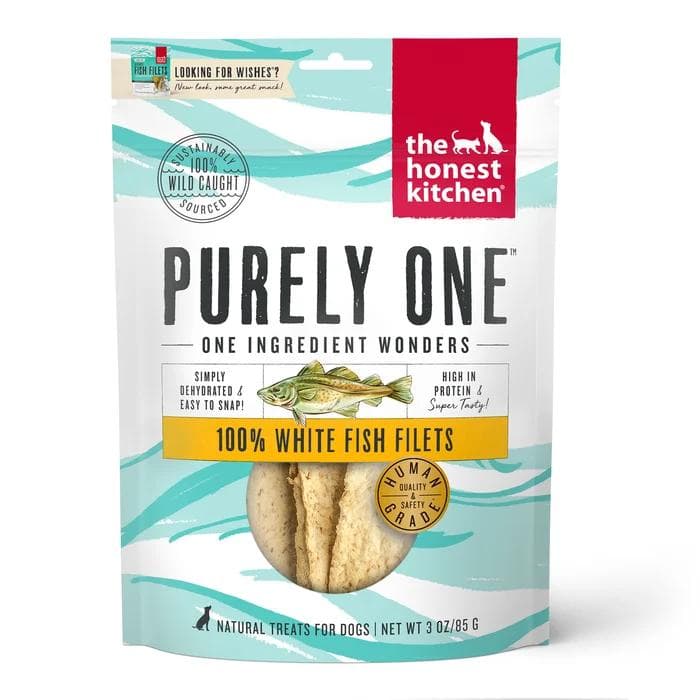
Webvet may earn a commission when you click through to The Honest Kitchen, at no extra cost to you.
Read the label before the marketing claims
Start with the full label: exact flavor and size, calorie content, ingredients, feeding directions, and a contact for the maker. The FDA explains that ingredients appear in descending order by weight. That order identifies ingredients; it is not a scorecard for digestibility, nutritional adequacy, quality control, or whether your particular dog will tolerate the product. “Meat first” alone does not answer those questions.
Check the whole ingredient list, including ingredients named after the headline protein. A chicken-flavor treat may contain pork, egg, fish ingredients, or other animal sources. This matters especially when a veterinarian is investigating a suspected food reaction. Do not use the front-of-bag flavor as a substitute for checking the formula, and check again when you buy a new bag rather than assuming the label never changes.
Look for feeding-purpose language such as “intermittent or supplemental feeding.” It means the product is an extra, not a replacement for a complete meal. To find reliable treats with safe, nutritious ingredients, ask the maker for the missing facts: a usable calorie value, the full formulation, and an explanation of relevant safety controls. A reassuring adjective cannot replace an answer to a concrete question.
- 1Find calories per piece or a usable weight-based calorie value.
- 2Check the whole ingredient list, including secondary proteins.
- 3Read the feeding purpose and age or size directions.
- 4Ask the manufacturer about missing calorie or processing information.
For example, Pet Botanics Training Reward Chicken treats are a multi-ingredient soft reward. The regular Chicken product label lists pork liver first and gives 3 kcal per treat. They illustrate why a flavor name is not an allergen checklist. The regular product is also different from the Mini line, so carry over neither a calorie number nor an ingredient assumption between variants.
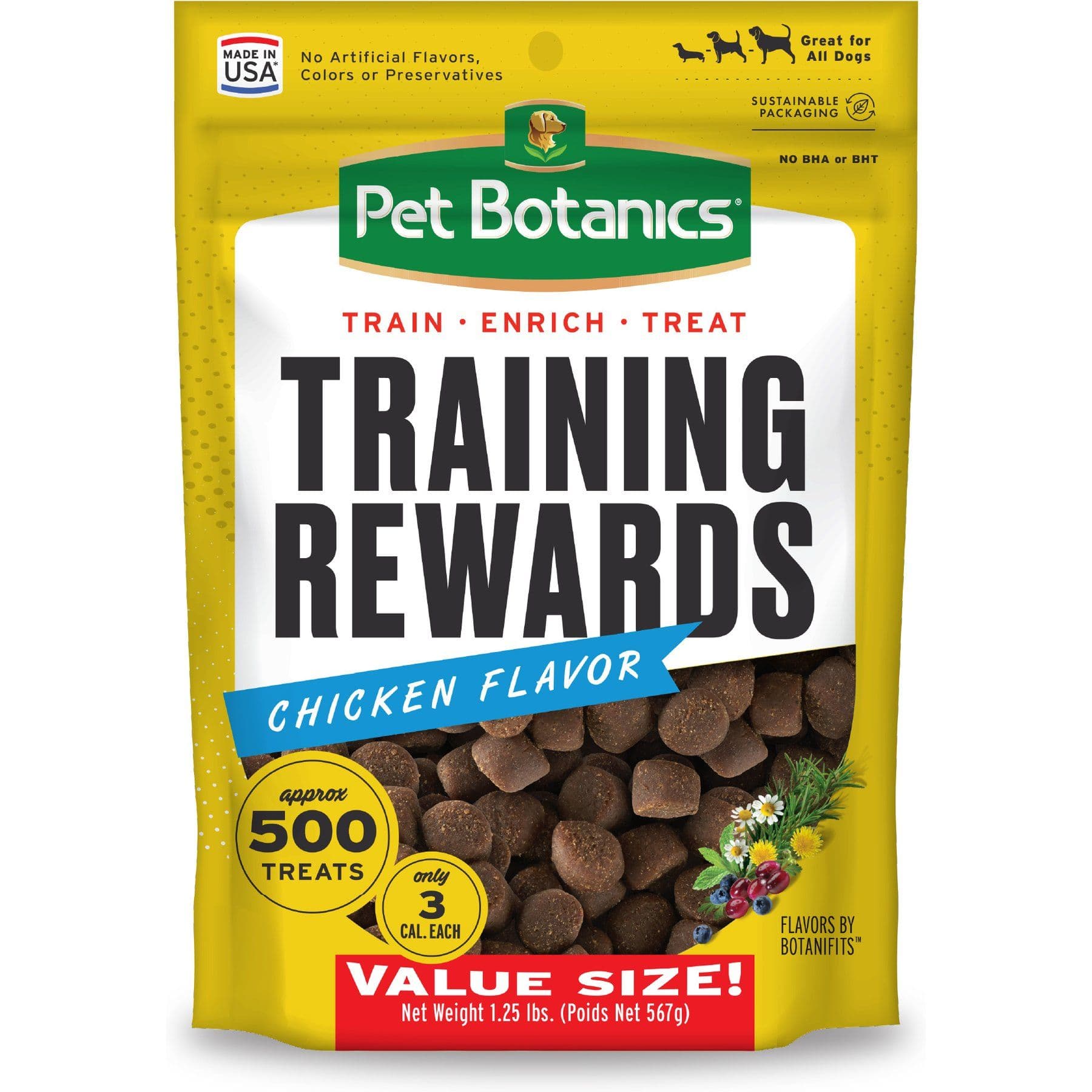
Soft chicken-flavor training rewards in a larger bag for frequent practice. Break rewards into appropriate pieces for your dog.
Webvet may earn a commission when you click through to Chewy, at no extra cost to you.
Natural, organic, grain-free, and minimally processed
AAFCO’s explanation of “natural” concerns ingredient sources and processing; natural does not mean nutritionally complete, calorie-free, or safer for every pet. Nor does organic identify the correct portion for your dog. Evaluate what a claim actually establishes, then return to the calories, ingredients, handling directions, and individual restrictions. A longer ingredient list is not automatically worse, and a one-ingredient snack is not automatically better.
Grain-free does not mean free of all potential allergens, and removing grains is not a general test of treat quality. Similarly, “no added salt” is different from a measured sodium value, and a made-in-the-USA claim is different from evidence about every ingredient or manufacturing control. If a medical plan requires a particular nutrient limit, ask for the actual data rather than interpreting marketing language as a laboratory result.
 Sponsored
Vet care that's always there
Unlimited video calls and messaging with licensed vets for less than a typical vet visit. One membership covers up to five pets.
Use code Pets60
Plans start at $12/month · covers up to 5 pets
- Licensed vets in most states
- Rx for 150+ conditions
- 4.7 on Trustpilot
Compare calories per treat and per portion
The calorie statement is useful only when you know what it describes.
One piece, one gram, and one cup are different units. Two similarly sized snacks may contain different calories, and a large piece broken into four still contains the original piece’s calories. Compare the amount you intend to use, not the number printed largest on the bag.
| Label example | Current manufacturer statement | How to use it |
|---|---|---|
| The Honest Kitchen Purely One White Fish Filets | Approximately 28 calories per fillet | Break into smaller portions; do not treat an irregular fillet as a tiny training bite. |
| Pet Botanics regular Chicken | 3 kcal per treat | Count whole treats at 3 kcal each; keep fragments in the same total. |
| Zuke’s Mini Naturals Peanut Butter & Oats | 2 kcal per piece | Use the exact flavor label and count the whole portion. |
| Fruitables Skinny Minis Pumpkin Berry | 3 calories per bite | Count each bite and check the whole formula. |
| Any treat labeled only kcal/kg | A weight-based energy density | Divide kcal/kg by 1,000 for kcal/g, then multiply by weighed grams. |
The Zuke’s Peanut Butter & Oats label specifies 2 kcal per piece, while Pet Botanics regular Chicken label specifies 3. Fruitables Pumpkin Berry label gives a 3-calorie bite, and The Honest Kitchen describes its much larger fish fillet as approximately 28 calories. These are label examples, not a ranking. A lower value per piece can simply mean a smaller piece. If another label says less than 2 calories, that is an upper bound, not an exact one-calorie value.
If two products give only calories per kilogram, comparing those values tells you about energy density, not the number of safe rewards. You still need the weight of the portion. A kitchen scale may be useful for a batch of irregular pieces; weighing one tiny fragment on an ordinary scale may be too imprecise. Ask the manufacturer for a usable per-piece value if the label leaves you unable to plan.
Match the treat to your dog’s size and life stage
Healthy puppy treats, small-dog rewards, and senior-dog snacks share the same basic questions, but the answers differ.
A Yorkie may have a much smaller extra-calorie allowance than a large active dog. A soft treat may be easier to divide for a puppy or easier for an older dog to manage, yet softness alone does not make it low in calories. Medium and large dogs can often work for tiny rewards; a larger mouth does not create a need for a large biscuit each time.
- Puppies: follow product age guidance and protect the balanced growth diet.
- Small dogs: use pieces small enough for frequent rewards without spending the allowance in one bite.
- Large dogs: watch for swallowing a treat whole; select and supervise for the individual dog.
- Senior dogs: consider chewing comfort, appetite changes, and any prescribed diet rather than age wording alone.
A small soft-format example is Zuke’s Mini Naturals Peanut Butter & Oats. Its current label lists 2 kcal per piece and includes dried cultured whey among the ingredients. A peanut-butter name therefore does not mean dairy-free. Check the package’s life-stage directions and your puppy’s feeding plan before using it; a small soft treat is not automatically suitable for every puppy or an elimination diet.
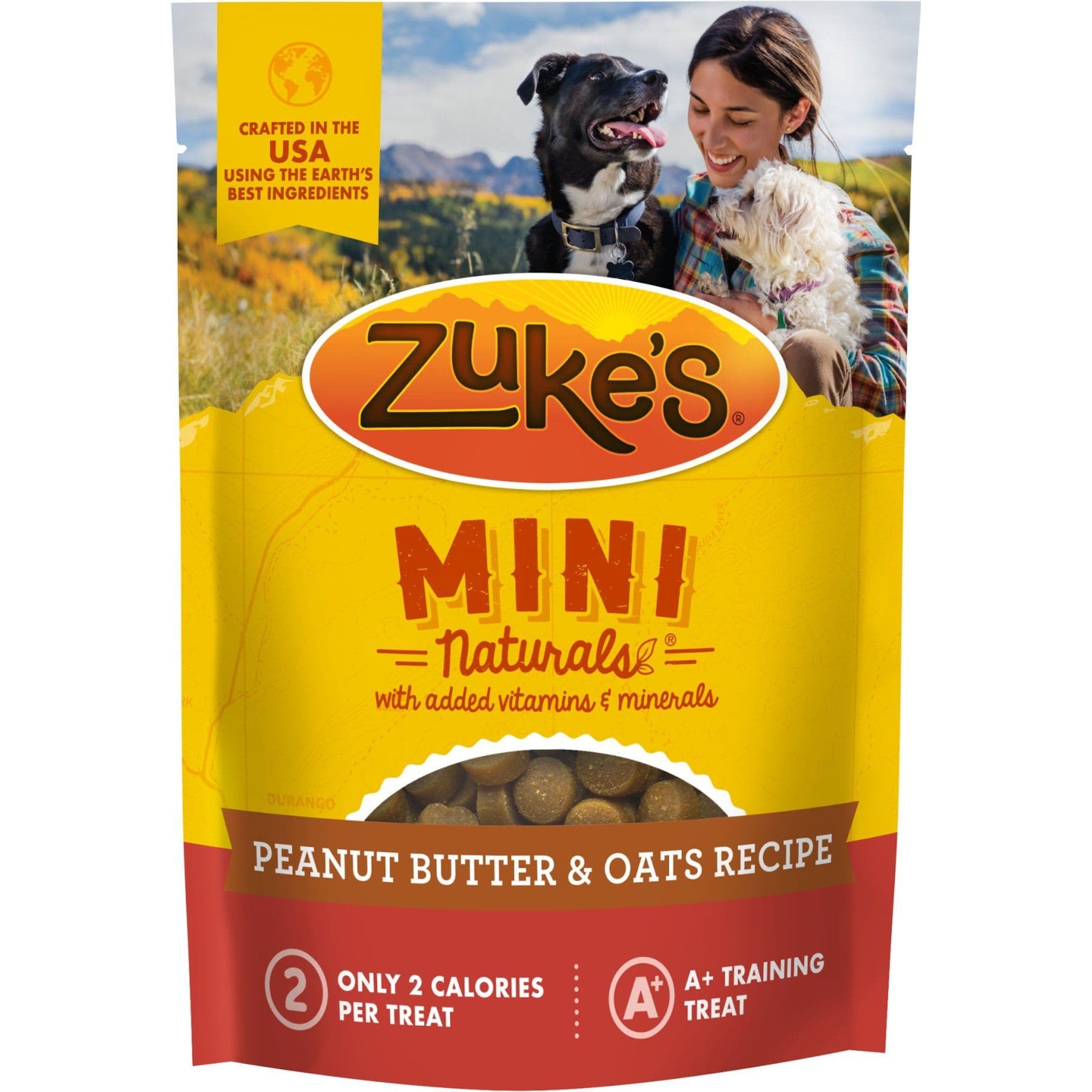
Soft, pea-sized training treats made with peanut butter and oats. Small enough to reward often while keeping treats inside the 10% of daily calories vets recommend.
Webvet may earn a commission when you click through to Chewy, at no extra cost to you.
Watch your dog eat a new texture before putting a handful into a food toy or asking someone else to feed it. Difficulty chewing, a sudden preference for soft foods, or dropping food can deserve a veterinary check rather than simply switching brands. An appetite or chewing change may matter more than whether the packaging says “senior,” “small breed,” or “healthy.”
For an eight-week-old puppy, ask the veterinary team which rewards are appropriate at that first stage of training; a product’s puppy wording is not a substitute for its age instructions. Natural treats for puppies still need the same portion and ingredient checks. A veterinarian-recommended choice should be tied to the puppy’s current diet and needs, not to a universal list of healthy puppy brands.
Fresh foods, homemade treats, and dried rewards
Some healthy snacks for dogs are plain foods already in the kitchen. AAHA lists options such as carrots, green beans, apple slices, and blueberries. Choose small, manageable pieces, remove cores and seeds where appropriate, and serve without sauces, salt, butter, or sweeteners. Start with a small amount to check tolerance. Vegetables and fruit still contribute calories, so count them with the other extras.

| Form | Useful question | Practical limitation |
|---|---|---|
| Fresh plain food | Can this be safely prepared and portioned for my dog? | Perishable; pieces vary in size and calories. |
| Soft packaged reward | Can I divide it cleanly and identify calories per piece? | Flavor names may conceal additional proteins. |
| Dried or freeze-dried reward | What processing was used, and what is the calorie density? | Low moisture and a short ingredient list do not establish pathogen safety. |
| Homemade biscuit | Is the recipe safe, and are yield and total calories known? | Changing size or ingredients changes calories per piece. |
Homemade healthy dog treats are not automatically more nutritious than purchased treats.
A recipe needs safe ingredients, a sensible yield, suitable storage, and a way to estimate the portion’s calories. “Three ingredients” or “no bake” tells you little about those issues. You can also keep the reward simple with a small piece of suitable plain food instead of baking a whole batch. This guide does not label an untested recipe “vet approved.”
Dried meat, freeze-dried chicken, and jerky-style rewards need the same ingredient, calorie, and hygiene checks as other formats. The CDC notes that treats and toppers can be raw, including some freeze-dried products. Do not assume that drying has made an uncooked product sterile. Follow storage directions, wash hands after handling, and ask your veterinary team about raw-product risks if someone in the household or the dog is particularly vulnerable.
Plain does not mean unrestricted
A little plain cooked sweet potato is different from a long, chewy dried strip, just as a small amount of pumpkin is different from pumpkin pie filling. Peanut butter needs a xylitol check and is easy to overportion. Plain cooked meat should be boneless and unseasoned. A safe ingredient can still be unsuitable because of the dog’s condition, the texture, or the amount offered.
The 10% rule and your dog’s daily allowance

For a worked calculation, use our guide to how many treats a dog can have. It starts with the dog’s agreed daily calorie target, subtracts other extras, and converts the remainder into a whole-treat count. Do not guess a universal allowance from breed or body weight alone; activity, body condition, life stage, and medical needs can change the feeding plan.
Fruitables Skinny Minis Pumpkin & Berry provide a 3-calorie bite as another label example for portion planning. The current formula includes pork stock as well as pumpkin, berries, and other ingredients, so it is not a pumpkin-only or meat-free snack. Keep the bag with the daily container so everyone counts the same portion, and recheck ingredients and calories when a formula changes.
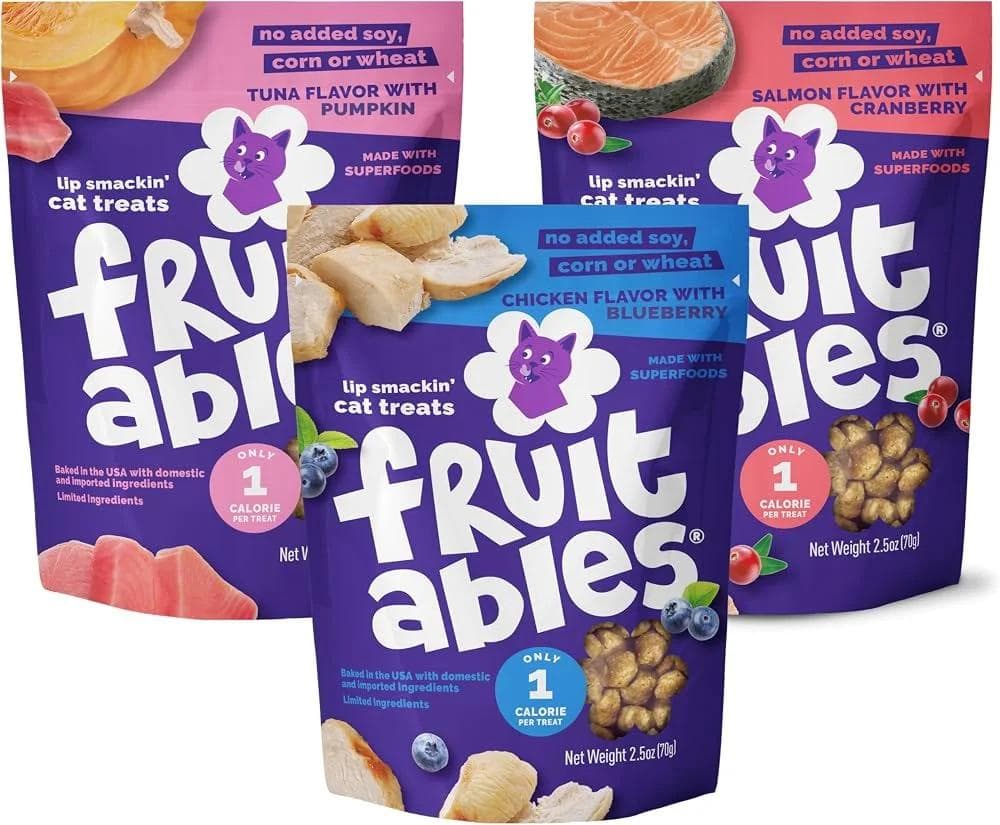
Soft training treats made with real pumpkin and blueberries, small enough to hand over often without breaking the 10% treat rule. The fruit-flavoured reward that skips the prep and the pits.
Webvet may earn a commission when you click through to Chewy, at no extra cost to you.
When an ordinary treat is not the right choice
Dogs undergoing a food trial need consistent control of everything they eat, including training rewards and pill food. The hypoallergenic treat guide explains that decision. The diabetic dog-treat guide covers matching treats to an established diabetes plan. Do not independently change a prescribed meal or insulin routine to make room for snacks.
Foods and chews to leave out
- Avoid bones and excessively hard chews that can injure teeth or the digestive tract.
- Keep treat bags secured so your dog cannot swallow packaging or raid the whole supply.
- If a potentially toxic food was eaten, call promptly with the ingredient list and amount.
- For ordinary new foods, introduce small amounts and stop if they do not agree with your dog.
The FDA’s food-handling guidance recommends clean utensils, suitable storage, and keeping dry pet food in its original packaging. Save the lot and best-before information even if you use a separate container. If your dog becomes unwell after a new treat, the exact product and batch details are more useful to the veterinary team than a broad description such as “natural chicken bites.”
Healthy treat questions
Frequently Asked Questions
What treats can I give my dog every day?
A suitable treat can fit daily if the total amount stays within your dog’s feeding plan. Rotate only as needed for enjoyment or a practical purpose; variety is not required to make treats nutritious. Measure the day’s supply and include chews and food used for pills. A dog with a prescribed diet may need rewards made from that diet rather than ordinary snacks.
Is a scrambled egg good for a dog?
A small portion of thoroughly cooked, plain scrambled egg can be an occasional treat for a dog that tolerates it. Leave out butter, salt, seasonings, onions, and garlic, and include its calories in the day’s extras. Egg is not required to improve a complete diet. For puppies or dogs with a medical diet, ask the veterinary team before adding it.
What is the number one food you should never feed your dog?
There is no useful single-number ranking of dangerous foods: the ingredient, amount, and dog all matter. Keep xylitol, grapes and raisins, chocolate, and onion or garlic foods out of reach. If you suspect a toxic ingestion, contact a veterinarian or animal poison service immediately with the packaging and estimated amount. Do not wait for symptoms or use the treat-calorie allowance to judge toxicity.
For the egg-preparation question above, Purina’s nutrition guidance specifies cooked, plain egg without salt, pepper, or butter. Your dog’s main diet remains the foundation; a safe occasional ingredient does not need to become a daily supplement.

Editor
The Webvet Editorial Team is the in-house group of pet-care editors and writers behind Webvet, operated by Smart Pet Collective. The team researches, writes, and maintains Webvet's pet health, behavior, and medication content. Every article follows a defined editorial process: research from reputable veterinary and scientific sources, careful drafting, mandatory review of medical content by a credentialed veterinarian, and dated publication. Health and medication articles are medically reviewed by a licensed veterinary professional before they go live and are kept current over time.
Veterinarian · BVMS MRCVS
Dr. Pippa Elliott, BVMS, MRCVS, is a veterinarian with nearly 30 years of experience in companion animal practice. Dr. Elliott earned her Bachelor of Veterinary Medicine and Surgery from the University of Glasgow. She was also designated a Member of the Royal College of Veterinary Surgeons. Married with 2 grown-up kids, Dr. Elliott has a naughty Puggle named Poggle, 3 cats and a bearded dragon.
Related reading

Ruffwear Polar Trex Review: Winter Dog Boots for Snow, Ice, and Salt

Canada Pooch Dog Boots Review: Soft Shield, Hot Pavement, and Suspender Fit

Pawz Dog Boots Review: Rubber Balloon Boots for Salt, Heat, and Hardwood
