Why Do Puppies Get Diarrhea? Can Probiotics Help?
Learn common causes of puppy diarrhea, when to call your veterinarian and how feeding, hydration and age-specific probiotic choices fit a sensible daily care plan.
Medically reviewed by Dr. Athena Gaffud, DVM · Last reviewed

This article contains affiliate links. Webvet may earn a commission when you buy through them, at no extra cost to you.
Puppy diarrhea can follow a food change or a stressful move, but parasites, infections and other problems can produce similar signs. Because young puppies can become unwell quickly, the first step is to contact your veterinarian with the puppy's age and symptoms. Looking playful for a few minutes does not make repeated watery stool unimportant.
Probiotics are not a treatment for diarrhea. They may have a place in a veterinarian-approved digestive routine and be suitable for puppies with occasional loose stools, to support normal digestion and stool consistency. PetLabCo.® Probiotic Chews offer dog-specific daily gut health and digestive function support for puppies and dogs 12 weeks and older. That age restriction comes before product selection: a supplement is not a way to diagnose the cause, stop every episode or postpone needed care.
Sponsored content: WebVet maintains editorial control over this article, which is sponsored by PetLabCo.®. WebVet may earn a commission from purchases made through its affiliate links.
Get prompt veterinary advice about puppy diarrhea and check the whole puppy, not just the stool. The puppy age restriction for PetLabCo.® Probiotic Chews is 12 weeks and older.
- Do not fast a puppy before arranging appropriate care.
- If your puppy experiences persistent or recurring diarrhea, seek veterinary care.
- Probiotic supplements may support normal digestive function and stool consistency in puppies. They are not a treatment for puppy diarrhea.
What to do when your puppy has diarrhea
Contact your veterinarian and explain what has changed. Give the puppy's age in weeks, when diarrhea began, how often it has happened and whether there is vomiting, blood, reduced appetite or lower energy. If your puppy is new to the household, say when they arrived and which medical records you have.
A playful puppy with an upset stomach still needs this age-specific assessment. Report bad gas as well as diarrhea, but do not assume that gas identifies the cause. A Golden Retriever puppy and a puppy of another breed both need advice based on their age, current signs and medical history; breed alone does not make repeated diarrhea normal.
While arranging advice, keep your puppy in a comfortable place where you can observe eating, drinking, urination and stool. Keep fresh water available. If the puppy cannot keep water down, seems weak or is deteriorating, tell the clinic immediately; an earlier plan may need to change.
First steps
- Note the time and appearance of each abnormal stool.
- Check whether the puppy is eating, drinking and passing urine normally.
- Gather food labels, vaccination records and deworming information.
- Ask the clinic whether to bring a fresh stool sample.
- Follow the clinic's feeding and appointment instructions for this puppy.
This is how a home treatment plan for puppy diarrhea begins: check for health problems that need an examination, then follow the feeding and monitoring advice suited to the puppy. Home care is useful when the veterinarian has determined that it is appropriate; it is not a separate shortcut around assessing the cause.
Avoid adding several remedies at once. A new food, extra fiber, and an over-the-counter medicine started together can make it hard to identify what your puppy tolerates. Human antidiarrheal medicines also require a veterinarian's decision about the exact drug and patient.
The American Kennel Club's puppy diarrhea guide explains why age, other symptoms and possible causes matter. Even if the eventual explanation is a manageable food or routine change, making the first call gives you a safer, more specific plan than choosing a remedy based only on stool consistency.
When puppy diarrhea needs prompt veterinary care
Repeated watery diarrhea, vomiting, blood in stool, reduced appetite, marked tiredness or weakness warrant prompt veterinary contact. A sick puppy who keeps throwing up needs attention even when the vomit looks like white foam or yellow bile. Those appearances do not identify the cause or make it safe to wait. Tell the clinic if your puppy may have eaten a toxin, medication, toy, fabric or another foreign object, even if you did not see it happen.
A very young or small puppy has less room for a prolonged disruption in eating and fluid balance. Your veterinarian may recommend an examination sooner because of age, size, incomplete vaccination or medical history. Do not use an adult dog's previous treatment plan to decide how long this puppy can wait.
Diarrhea and vomiting together deserve particular attention, even if your puppy is acting normal between episodes. It may be difficult for the puppy to maintain hydration, and the combination has multiple possible causes. Our guide to dog vomiting and diarrhea gives broader context; your puppy still needs an age-specific assessment.
When calling, use concrete descriptions. “Three watery stools since breakfast and refused lunch” is more useful than “a little upset stomach.” Mention any red blood, dark tarry material, painful posture or change in responsiveness. If you are uncertain whether something counts as blood or whether the puppy is drinking enough, say so instead of deciding the observation is harmless.
Ask where to go if the regular practice is closed or cannot see the puppy promptly. If infection is possible, call before arriving so the clinic can explain how to enter safely and reduce contact with other dogs. A veterinary team can assess the urgency without you having to identify the disease yourself.
Supplementing puppies with occasional loose stools: Age comes first
It’s important to factor your puppy’s age and product suitability into your supplement choice - puppy ages are easy to blur together online, but an eight-week-old puppy and a six-month-old puppy are at different stages. Record age in weeks when asking about a supplement. If a rescue or breeder gave an estimated birth date, tell the veterinarian that the age is approximate.
The current PetLabCo.® Probiotic Chews label starts at 12 weeks of age. Do not give this product to an under-12-week puppy based on its small body weight or the fact that it is a dog product. Meeting a weight tier does not cancel an age restriction.
If your puppy experiences occasional loose stools, rather than persistent or recurring diarrhea, then a puppy probiotic may be a suitable supplement to consider as part of their daily wellbeing routine.
For puppies 12 weeks and older, eligibility still involves more than age:
- Check the current weight and exact product directions.
- Review food sensitivities and any prescribed diet.
- Tell the veterinarian about medicines and other supplements.
- Clarify whether the goal is routine support or part of a current treatment plan.
Once your puppy’s condition has been assessed and your vet agrees that daily digestive support is appropriate, PetLabCo.® Probiotic Chews provide an easy-to-follow canine option. They combine probiotics with prebiotics and a postbiotic yeast blend in a soft chew.
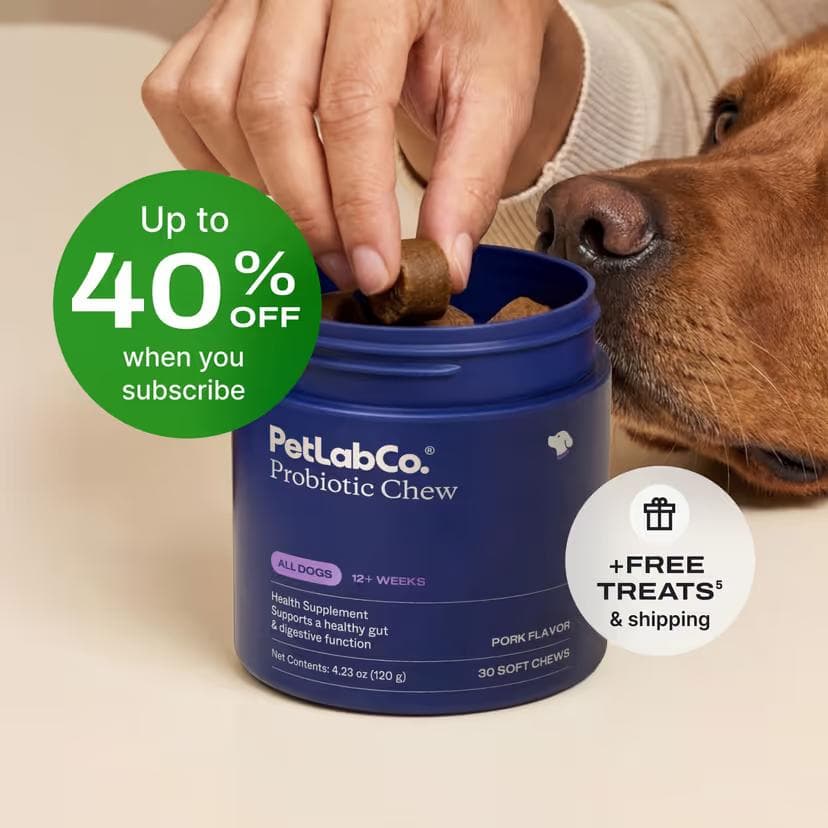
Clinically studied probiotic soft chews that support your dog's gut health while targeting occasional loose stools and seasonal allergies. Pork flavor, 30 chews per tub.
Webvet may earn a commission when you click through to PetLabCo.®, at no extra cost to you.

PetLabCo.®'s guide to puppies and probiotics provides further brand context. Use the current package directions and your veterinarian's advice to make the final choice. A soft chew being easy to offer is a practical advantage, not proof that it is appropriate for every episode of puppy diarrhea.
Why puppies get diarrhea
Several different problems can produce loose stool, so the cause cannot be read from the stool alone. A new home, a disrupted schedule, new treats or a sudden food change may be part of the story. Eating garbage or chewing something unsuitable can also be relevant, especially while a puppy is exploring with their mouth.
Infections and intestinal parasites are another reason to contact the veterinarian rather than assume the problem is stress. Vaccination and deworming records help the clinic understand the puppy's history, but a past treatment does not identify or exclude every current cause. Bring the actual dates and product names if possible.
Common history categories include:
- Food exposure: new meals, treats, table scraps or access to another pet's food.
- Environment: travel, boarding, a recent adoption or contact with unfamiliar dogs.
- Health history: deworming, vaccines, medicines and previous digestive episodes.
- Possible ingestion: toys, fabric, plants, garbage, medications or toxins.
Diarrhea after deworming or vaccination deserves the same careful description as diarrhea at another time. Give the dates even if this was the second vaccination or another planned round of shots. Timing can help your vet investigate, but it does not establish whether the episode is a treatment side effect or another health problem. Do not skip later prescribed prevention or repeat a deworming dose without discussing the situation.
A veterinarian may recommend stool testing or other assessment based on the history and examination. If more than one puppy or dog in the household becomes ill, mention that immediately. Shared exposure can change the questions the clinic asks and the precautions it recommends.
Food and travel exposures
Food or travel histories deserve the same precision. Tell the clinic if diarrhea followed a car ride, a new chew or peanut butter, and provide the ingredient label for anything unusual. Some human foods can contain dangerous additives, including xylitol. A possible toxin exposure requires immediate veterinary advice, not an assumption that the puppy merely ate too much.
PetLabCo.®'s overview of puppy diarrhea covers owner concerns about food, routine and gut support. Those are useful topics for the discussion, while diagnosis remains the veterinarian's job. A product aimed at normal digestive function does not treat parasites, remove a foreign object or replace care for an infection.
What stool changes can tell you
Stool observations help describe the episode, but they do not reliably identify the cause. Color can vary with food and other factors, while consistency reflects how much water the stool contains. Record what you see in ordinary words: watery, soft, coated in mucus, streaked with red blood, or dark and tarry.
Owners often ask what parvo diarrhea looks like in puppies. There is no appearance or smell that safely confirms or excludes parvovirus at home. A puppy can need testing because of age, exposure, vaccination history and illness even when the stool does not resemble an online photograph. Do not use a photo comparison to decide it is safe to wait.
| Observation | What to tell the veterinarian | What the appearance cannot establish |
|---|---|---|
| Watery stool | Frequency, approximate amount, vomiting and appetite | Whether the cause is a food change, parasite or infection |
| Red blood | Whether it is streaking, drops or mixed through the stool | The cause or severity without the puppy's full condition |
| Mucus coating | Whether this is new, recurring or accompanied by straining | A specific organism or diagnosis |
| Dark, tarry-looking stool | When it appeared and any medicines or unusual ingestion | Whether waiting at home is appropriate |
| Yellow or green stool | Food changes, repeated episodes and other symptoms | That the problem is harmless based on color alone |
Veterinary testing, the examination and the history matter more than matching a stool chart. If you can safely take a photograph, it may help the clinic understand your description. Ask whether it wants a sample and how recently it should have been collected. Keep the sample separate from food and household surfaces.
If you notice white specks or milky-looking material in loose stool, describe that too. Food material and other causes can look similar in a photograph, so do not diagnose worms from white specks or rule them out because nothing is visible. The veterinarian can decide whether a sample or testing is needed and which treatment, if any, fits the result.
A little formed stool between loose episodes also does not establish that the problem has resolved. Note the overall pattern and your puppy's behavior. Likewise, visible mucus does not tell you which medicine to buy, and not seeing worms does not rule out parasites. These observations guide the conversation; they should not become an at-home diagnosis.
 $65 · no membership
Worried about your dog's vomiting or diarrhea?
A licensed vet can examine your dog over video and prescribe treatment online when it's appropriate.
 Talk to a vet
- Licensed vets
- All 50 states
- same-day Rx
Webvet may earn a commission if you book.
Getting ready for the vet call
A short, organized history helps the veterinary team decide what to do next. You do not need perfect measurements or a complicated spreadsheet. The important thing is to distinguish what you observed from what you assume, especially if several people feed or walk the puppy.
Start with the puppy's age in weeks and current weight if known. Then give the start time and pattern: one soft stool, several watery stools, or recurring episodes over multiple days. Include whether the puppy is eating, drinking, urinating and acting normally between episodes.
Have this information together:
- Age in weeks and arrival date: including whether the birth date is estimated.
- Vaccine dates: bring records rather than relying on “up to date.”
- Deworming and medicines: names, dates and doses already prescribed.
- Food changes: exact diet, new treats, table food and possible scavenging.
- Stool sample: ask whether to collect one and how to transport it.
- Other animals: recent contact and whether anyone else has diarrhea.
If your puppy may have swallowed a foreign object or a human medication, say that at the start of the call. Have the packaging available when possible. Do not induce vomiting or give a home antidote unless a veterinary professional instructs you to do so for that exact situation.
Write down the advice you receive, including the appointment time, feeding instructions and signs that should trigger an earlier call. If another family member is watching the puppy, share the same instructions. Conflicting home plans can lead to accidental extra servings, inappropriate medicines or a missed change in condition.
Keep the record of signs useful but brief. A timeline with food, stool, vomiting and medication entries is usually easier to interpret than a long list of suspected causes. Add the supplement name and when it was started if one is already part of the routine; that makes the treatment history complete without assuming the supplement caused or fixed the diarrhea.
Feeding and hydration while you follow veterinary advice
Do not fast a puppy to treat diarrhea. Growing puppies have age-specific nutritional needs, and withholding food without veterinary direction is not a safe general rule. Ask the clinic what to feed, how much and how often for your puppy's age and current condition.
Your veterinarian may recommend keeping the usual complete puppy diet, adjusting portions or using a particular short-term food plan. Follow that plan rather than repeatedly switching between rice, chicken, pumpkin and different commercial foods. A homemade bland meal is not automatically a complete diet for growth, especially if it becomes the ongoing routine.
Overeating or unplanned rich treats may contribute to a digestive upset, so record meal amounts and extras. That history does not establish the cause of diarrhea by itself. If you are considering white rice, ask whether it belongs in the short-term feeding plan and what should accompany it; rice alone is not a balanced puppy diet or a treatment for every cause.
Feeding questions for your vet
- Should the usual food continue today?
- Would smaller, more frequent meals suit this puppy?
- Which treats or chews should be paused while signs are assessed?
- When and how should any temporary diet transition back?
To firm up your puppy's poop, address the reason it is loose rather than chasing consistency with extra ingredients. Parasites, infection and a dietary upset do not all need the same response. More fiber is not always the answer, and a firmer-looking stool does not necessarily mean the puppy's overall condition is improving.
Keep clean water available. Do not force water into a puppy's mouth or assume a human sports drink or electrolyte product is appropriate. If drinking triggers vomiting, the puppy refuses water or you are concerned about dehydration, contact the clinic again. Our guide to dehydration in dogs explains useful observations, but home checks cannot rule out a problem in a young puppy.
If a veterinarian approves a supplement as part of the plan, count it as one component of the routine. Avoid layering multiple digestive products on top of one another. Knowing exactly what your puppy is eating makes it easier to assess tolerance and follow the vet's instructions during recovery.
Can probiotics help a puppy with diarrhea?
Probiotics Probiotics provide live microorganisms for a health benefit, but their effects depend on the formulation and the situation. Your veterinarian may recommend a particular product as supportive care or for an ongoing digestive routine. That decision should account for the puppy's age, likely diagnosis, diet and any prescribed treatment.
Probiotics are sometimes used as part of a proactive wellness routine for puppies with occasional loose stools. They are not a treatment for recurring diarrhea.
The right question is not simply what to give a puppy to stop diarrhea. It is what this puppy needs and which part of the plan a probiotic might support. A probiotic is not an antibiotic, dewormer, fluid treatment or remedy for a swallowed object. It also cannot confirm that the cause is a harmless food change.
When discussing a product, separate three issues:
- Practical fit: age eligibility, ingredients, serving directions and format.
- Evidence: the exact formulation, animals studied and outcomes measured.
- Follow-up: what to monitor and when the veterinarian wants an update.
You may choose to supplement your puppy’s diet with a probiotic that has shown signs of support during clinical trials - PetLabCo.® reports a 31-day study of its Probiotic Chew in 24 healthy adult Beagles. The brand-funded, placebo-controlled report describes microbiome and fecal-marker findings. It is useful product context, but those adult-dog results do not establish treatment of puppy diarrhea or a promised time to relief. The brand summary does not link the underlying study paper.
Applying the evidence to a puppy
Broader research is also mixed. A systematic review of acute-diarrhea interventions found no clinically significant shortening of diarrhea with the nutraceuticals it assessed, with varying certainty. This supports keeping the promise specific: possible supportive use when appropriate, without claiming that every probiotic rapidly stops diarrhea.
For a puppy at least 12 weeks old experiencing occasional loose stools, whose veterinarian agrees with the choice, PetLabCo.® Probiotic Chews offer a convenient daily format with clear weight-based directions. Their prebiotic and postbiotic ingredients make the formula broader than a single live-organism ingredient. Keep that label description separate from claims about treating the cause of an active episode.
Clinically studied probiotic soft chews that support your dog's gut health while targeting occasional loose stools and seasonal allergies. Pork flavor, 30 chews per tub.
Webvet may earn a commission when you click through to PetLabCo.®, at no extra cost to you.
Reading the Probiotic Chews label
Read the exact tub before deciding on a serving. ThePetLabCo.® Probiotic Chews discussed here have different directions from the brand's Tailored Probiotic Chews. A familiar name or similar packaging does not mean the same quantity applies across formulas. Related reading: Petful’s PetLabCo. Probiotic Chews review.
The product lists a 4 g soft chew with 3 billion CFU from Bacillus coagulans, Bacillus clausii and Bacillus subtilis. It also lists fructooligosaccharides and galactooligosaccharides at 100 mg each per chew, plus a 75 mg postbiotic yeast blend. CFU describes viable-organism quantity; it does not identify a universal dose needed to treat puppy diarrhea.
For eligible dogs 12 weeks and older, the current label says:
- Under 25 lb: 1 chew daily.
- 25–75 lb: 2 chews daily.
- Over 75 lb: 3 chews daily.
These are label directions for this product, not a prescription for an ill puppy. Confirm your puppy's current weight and suitability with the veterinarian. Do not double the serving after a loose stool or copy a serving from a larger dog in the household.

The pork-flavored formula includes pork liver, which matters for food restrictions or an elimination-diet plan. Check all ingredients on the current product label. The label advises veterinary consultation before use and stopping if the animal's condition worsens or does not improve, and it includes cautions concerning use with medicines.
Store the product as directed in a cool, dry place away from direct sunlight. Keep the tub where your puppy cannot help themselves to extra chews. Tell the veterinarian about an accidental large intake, including the product and approximate amount, rather than assuming a supplement cannot cause a problem.
Clinically studied probiotic soft chews that support your dog's gut health while targeting occasional loose stools and seasonal allergies. Pork flavor, 30 chews per tub.
Webvet may earn a commission when you click through to PetLabCo.®, at no extra cost to you.
Monitoring recovery without a wait-and-see deadline
Some mild digestive disturbances improve after the underlying trigger is addressed, but you cannot assume an individual puppy's diarrhea will resolve itself. Follow the assessment and monitoring plan your veterinarian gives you. Do not decide in advance to wait a fixed number of days or finish a supplement trial before calling again.
The useful trend includes more than stool firmness. Note appetite, drinking, urination, energy, vomiting and how often the puppy needs to defecate. A puppy who produces a slightly firmer stool but becomes quieter or stops eating has not simply “passed” the recovery check.
Keep the record focused on changes:
- Is stool becoming less frequent and easier to pass?
- Is the puppy comfortable and behaving normally between bowel movements?
- Are food and water staying down?
- Have blood, pain, vomiting or weakness appeared?
Ask how soon the clinic expects an update and what counts as a reason to call earlier. The answer depends on age, size, examination findings and treatment. If symptoms worsen or new concerning signs appear, contact the clinic sooner than the planned check-in.
If you are asking how long to let your puppy have diarrhea before seeking help, make the first veterinary contact when you notice the problem. You can then follow an individualized monitoring period if the clinic recommends one. That is different from deciding on a home waiting period before anyone has considered the puppy's age, exposure history or other symptoms.
At each update, report:
- How many abnormal stools occurred since the last conversation.
- Whether the puppy ate the recommended food and kept it down.
- Any new symptom or change in normal behavior.
These details let the clinic reassess the plan with current information. Avoid describing the puppy as simply “better” if the stool improved but appetite or energy did not. If it is difficult to judge the change, explain exactly what you observed and ask whether the puppy should be seen again.
Recurring diarrhea also deserves follow-up, even if each episode seems short. A food diary and a record of treats, medicines, stress and other exposures can help reveal a pattern, but the pattern does not replace testing when indicated. Do not repeatedly restart a home remedy while assuming every recurrence has the same cause.
Nighttime diarrhea matters even if your puppy is acting fine by morning. A Lab or Golden Retriever puppy with chronic or recurring diarrhea needs that pattern assessed just as another puppy does. Record the overnight pattern and last meal, then discuss recurring episodes with the clinic. If diarrhea is followed by apparent constipation, note whether the puppy simply produces less stool or repeatedly strains without success. Avoid treating the two problems alternately with home remedies without reviewing the whole sequence.
Reviewing the daily support plan
If your vet has approved a daily probiotic, monitor its place in the overall routine rather than judging it against a promised number of hours. Ask what changes would justify continuing, stopping or reconsidering it. This keeps the product's role clear and avoids turning supportive care into an open-ended delay in diagnosis.
Keeping the household routine steady
A predictable routine helps you follow the veterinary plan and notice changes. Agree on who feeds the puppy, who gives any prescribed medicines and who records stool or vomiting. This is especially helpful when children or several adults share puppy care and may each offer an extra treat.
Use the same measuring method for meals, keep treats within the agreed plan and avoid sudden additions while the diarrhea is being assessed. Prevent access to garbage, other pets' food and chewable household objects. These steps reduce confusion about exposure; they do not guarantee that diarrhea will not recur.
Household habits to keep consistent include:
- Pick up stool promptly and wash hands after handling it.
- Clean soiled areas and bedding according to veterinary advice.
- Ask about contact with other pets and public dog areas while the puppy is ill.
- Keep a shared list of food, medicines and approved supplements.
If infection is suspected, ask the clinic what cleaning products and separation measures suit the suspected organism. Do not assume that every household cleaner is effective or safe around the puppy. Use products according to their directions and keep the puppy away until the area is safe to enter.

For an eligible puppy whose veterinarian supports ongoing use, a daily soft chew may be a convenient part of that shared schedule. Keep the product name, serving and responsible person written down, just as you would for the rest of the plan. Convenience is most useful when it helps the household follow one consistent set of instructions.
Clinically studied probiotic soft chews that support your dog's gut health while targeting occasional loose stools and seasonal allergies. Pork flavor, 30 chews per tub.
Webvet may earn a commission when you click through to PetLabCo.®, at no extra cost to you.
How this differs from adult-dog diarrhea advice
A puppy who still eats and drinks can still need veterinary attention. Those are useful observations, but they do not rule out parasites, infection or another developing problem. Age, vaccination history and the frequency of diarrhea change how a veterinarian interprets a seemingly cheerful puppy.
Adult-dog advice may discuss a broader range of home-management situations or supplement choices. Do not transfer a fasting instruction, medication dose or waiting period from an adult dog to a puppy. A product's minimum age and the puppy's current health need their own check.
The main puppy-specific decisions are:
- Give the clinic the age in weeks and vaccination history.
- Obtain feeding guidance appropriate for growth; do not fast the puppy.
- Apply the exact supplement age limit before considering body-weight directions.
- Reassess promptly when diarrhea repeats or the puppy's overall condition changes.
For the broader question of choosing digestive support in adult dogs, see our guide to probiotics for dogs with diarrhea. That article covers the general product decision. This guide focuses on the additional age, feeding and follow-up questions that matter when the patient is a puppy.
As your puppy grows, revisit the routine with your veterinarian rather than automatically keeping every temporary addition forever. A clear reason for each food or supplement makes the plan easier to evaluate. The goal is a comfortable puppy and a manageable daily routine, with current signs assessed whenever they appear.
Frequently Asked Questions
Is it normal for puppies to have watery diarrhea but still playful?
A playful puppy can still have an illness that needs assessment. Repeated watery diarrhea is a reason to contact your veterinarian for prompt advice, particularly in a young or incompletely vaccinated puppy. Describe the frequency, appetite, drinking and any vomiting or blood. A burst of normal play does not establish that it is safe to wait for a supplement to work.
What if diarrhea starts after deworming or vaccination?
Record the dewormer or vaccine timing and contact the clinic that treated your puppy. Give the product name, date and other signs; timing alone does not prove the treatment caused the diarrhea. Do not repeat a medicine, change a dose or abandon the remaining prevention schedule independently. The clinic can decide whether the puppy needs assessment or a change in the plan.
What if diarrhea happens mainly at night?
Recurring episodes still deserve a veterinary discussion even when your puppy seems well during the day. Keep a food diary with meals, treats, medicines and stool times, and note any nighttime vomiting or discomfort. The pattern may help guide the history, but it does not establish a cause. Seek earlier advice if watery diarrhea repeats or your puppy's appetite or energy changes.
Can I use a human probiotic for my puppy?
Ask your veterinarian about the exact formulation rather than assuming every human probiotic is harmful or suitable. Organisms, added ingredients and amounts vary, and a puppy needs an age-specific decision. For PetLabCo.® Probiotic Chews, the age restriction is 12 weeks and older. Do not substitute a human product simply to work around that limit or give an unreviewed flavored supplement.
About PetLabCo.® and this guide
PetLabCo.® offers daily dog supplements, including the Probiotic Chews described here. This guide uses the current product label, published research and veterinary resources to explain supportive use and its limits. It does not report hands-on testing or a clinical trial of this product in puppies with diarrhea.
This article is educational and cannot diagnose or treat your puppy. Follow your veterinarian's instructions for signs, feeding, medicines and supplements. Seek urgent care when your puppy is seriously unwell or worsening; do not wait through a supplement trial.
PetLabCo.® products are not intended to diagnose, treat, cure, or prevent any disease. Consult your veterinarian before starting any new supplement regimen.
$65 · no membershipWorried about your dog's vomiting or diarrhea?
A licensed vet can examine your dog over video and prescribe treatment online when it's appropriate.
Talk to a vet- Licensed vets
- All 50 states
- same-day Rx
Webvet may earn a commission if you book.

Veterinarian · DVM
Athena Gaffud, DVM, is a licensed veterinarian and writer based in the Cagayan Valley of the northern Philippines. She runs the website countryvetmom.com. Dr. Gaffud earned her Doctor of Veterinary Medicine degree from the University of the Philippines Los Baños in 2011, ranking in the top 10 and receiving the Best Undergraduate Thesis Award in Large Animals. With over a decade of experience, she has worked as a researcher, a practitioner for small and large animals, and in veterinary technical sales, marketing, and pet insurance. A published author, Dr. Gaffud promotes responsible pet ownership and combats misinformation on animal care through her platforms, including the DocAthena Facebook Page and DocAthena YouTube channel. She is a writer and editor for various pet-related websites such as Total Vet, Honest Paws, PangoVet, Dogster, Catster, My Best PH, Paw Origins, Bully Max, Not a Bully, Paws and Claws CBD, many others. She was also cited in different pet-related media articles such as The Dog People, USA Today, Newsweek, New York Post, Reader’s Digest, Smithsonian Magazine, Woman’s World, Dog Time, Patch, Kinship, Martha Stewart, and many others. Moreover, she is also a published fiction author on Kindle.


