Bored Cat? Signs to Check and Enrichment That Helps
Look beyond unused toys when assessing a bored indoor cat. Check for new health changes, identify a missing opportunity and try one practical improvement at a time.

This article contains affiliate links. Webvet may earn a commission when you buy through them, at no extra cost to you.
A bored cat may seek more interaction, lose interest in familiar activities or find inconvenient ways to explore. But those observations do not diagnose boredom. A cat that suddenly sleeps more, stops playing or changes eating or litter-box habits may be ill, uncomfortable or stressed.
Start by comparing the behavior with your cat's usual pattern. Then look for a specific missing opportunity, such as hunting play, a comfortable lookout or access to resources without another pet blocking the way. One thoughtful change is easier to evaluate than a room full of new toys.
Check for a change before calling it boredom
Check new behavior changes with your veterinarian when appropriate. For an otherwise well cat, observe when the behavior happens, add one suitable activity or resource, and judge voluntary engagement rather than assuming a new purchase solved boredom.
Cats rest for much of the day, and a familiar resting routine is different from new withdrawal. Ask whether the cat still responds to favorite activities, moves comfortably, eats normally and uses the litter box as usual. Compare with their own baseline rather than another cat's energy level.
New or persistent changes deserve veterinary attention, especially when several appear together. Reduced jumping may reflect discomfort. New vocalizing may have several explanations. Repeated licking, appetite changes and litter-box problems should not be treated by simply increasing entertainment.
- Record when the change started and whether anything else changed at home.
- Note eating, drinking, toileting, grooming and movement.
- Describe what the cat does rather than labeling it “sad” or “bored.”
- Share videos of intermittent behavior if you can record without disturbing the cat.
The Feline Veterinary Medical Association's life-stage guidance emphasizes that changes in normal behavior can be significant. This is particularly useful when an older cat quietly gives up a favorite high perch: the solution may include easier access and a health assessment, rather than a more exciting toy.
You do not need to wait for a dramatic symptom before discussing a persistent change. Equally, a calm afternoon nap alone is not evidence of illness or inadequate care. The useful distinction is stable, comfortable rest versus a change in the cat's ordinary activity or responsiveness.
Is my cat bored of his food, or is something wrong?
A change in eating is not a reliable boredom test. Notice whether your cat is refusing meals, dropping food, approaching then turning away, or otherwise changing a familiar routine. Seek veterinary advice about reduced intake rather than repeatedly replacing food to test whether the cat is bored.
How can you tell if a cat is bored and lonely?
Look at the context and the cat's response to different opportunities. Seeking contact may support adding predictable social time; avoiding another cat may call for separate resources instead. Neither a bored-looking face nor time spent alone proves loneliness. Persistent new withdrawal deserves assessment, especially with changes in eating, movement or litter-box use.
Choose the relevant follow-up guide
Bored cat toys are tools for an identified activity: a wand supports hunting play, a puzzle supports food searching, and a tunnel supplies cover. Choose the activity from the observed pattern first. The linked product roundup handles model comparisons once you know what opportunity you want to add.
For a cat seeking a chase, the Frisco Bird Teaser Wand can support a short supervised hunting game. Let the cat catch it and store it away afterward.
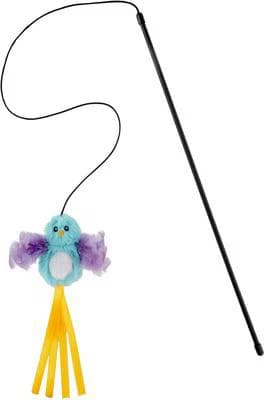
A bird teaser for supervised stalking and catching games. Put the wand away after play.
Webvet may earn a commission when you click through to Chewy, at no extra cost to you.
If your cat seems bored at night, compare that pattern with their usual sleeping, feeding and social routine. If the pattern mainly happens at night, use the established guide to keeping your cat quiet at night for that specific routine. Nighttime activity or vocalizing should not automatically be relabeled boredom.
Note its timing, any new health changes and what the cat does before and afterward.

This article helps assess unmet daytime opportunities; the night guide explains ways to adjust the sleep-and-noise routine.
For choosing products once you know which play opportunity is missing, our toys for bored indoor cats roundup compares the options. More toys are not necessarily the first answer: you may need a different way to use an existing toy, a quieter location or an easier task.
Possible signs your indoor cat needs more to do
These patterns can suggest an opportunity to improve the environment when health and immediate stress concerns have been considered. Each still needs context. Ask what happens just before the behavior and what the cat gains from it.
Persistent bids for interaction
A cat may follow you, bring objects, paw at your desk or begin playing with household items when there is little else to do. If this occurs predictably when you sit down after work, schedule a brief activity before starting your own routine. Reward calm engagement rather than waiting for the cat to escalate.
Interest in everything except the toys
Toy availability is not the same as a play opportunity. A mouse that never moves may become part of the floor. Try changing how you use an existing toy: move it around a box, pause, let it disappear briefly and allow a catch. Avoid waving it continuously in the cat's face.
For a food-search trial, offer part of the usual ration in the Catit Play Treat Puzzle. Make the first task easy enough that the cat can succeed.

An easy food-search activity to introduce with part of the usual ration and supervision.
Webvet may earn a commission when you click through to Chewy, at no extra cost to you.
Repeated investigation of restricted places
Cupboards, counters and doors may offer novelty or a better view. Look for what the location provides. A stable viewing place or an accessible elevated route may be more useful than another floor toy. Door interest also needs escape prevention, and a secure catio is a separate project with containment and weather requirements.
Little variation during active periods
A cat can have plenty of belongings yet few choices. If the same bed, food bowl and toy are in one crowded corner, consider the layout. Quiet resting space, scratching opportunities and play space serve different needs. In multi-cat homes, a resource is not truly available if another cat routinely blocks the approach.
None of these patterns makes a cat “bad,” and punishment does not identify the missing opportunity. A useful description is “paws at the cupboard before dinner” rather than “acts out constantly.” The concrete description gives you something to change and measure.
Find the missing activity or resource

To choose a plausible unmet need, look at the situation immediately before the behavior. Repeated ankle ambushes when people move make a predictable hunting game a useful first trial; persistent searching around feeding areas suggests an easy food-search task; retreating when another cat enters calls for separate resources and safer access.
These are working hypotheses, not diagnoses. Prefer the explanation supported by repeated context, change one thing, and judge whether the cat becomes more comfortable. A new or escalating behavior still needs a health assessment.
| Pattern you observe | Opportunity to try | What would count as useful engagement |
|---|---|---|
| Stalking ankles or moving household objects | Supervised prey-style play | Stalking, chasing and catching the toy safely |
| Searching around feeding time | An easy food puzzle with part of the ration | Calm investigation and successful food access |
| Seeking a high viewpoint | Stable accessible perch or route | Voluntary use and comfortable descent |
| Avoiding shared spaces | Separated resting places and resources | More choice without being blocked by another cat |
| Watching outdoor movement | Comfortable secure view | Relaxed observation with the ability to leave |
Cat Friendly Homes' hunting guidance explains why indoor cats still benefit from opportunities to stalk and catch. Use physical toys to provide an outlet, and keep your hands and feet out of the game. Stop if the cat becomes uncomfortable or the activity causes conflict with another pet.
Our existing toys for bored indoor cats guide covers product choices. This page helps decide what kind of opportunity is missing. If your cat seems physically energetic and enjoys repetitive movement, a cat exercise wheel may be worth assessing, but it requires space, gradual training and realistic expectations.
It is not a general cure for inactivity.
- Screen-based cat TV is optional. Some cats watch calmly; others become frustrated or try to leap at the display. Observe the response and follow interested viewing with a physical activity. A screen should not become a substitute for all the other choices in the home.
A SmartCat Ultimate Sisal Scratching Post creates a scratching opportunity. Its usefulness depends on the cat's preferred surface and location, not a promise to cure boredom.
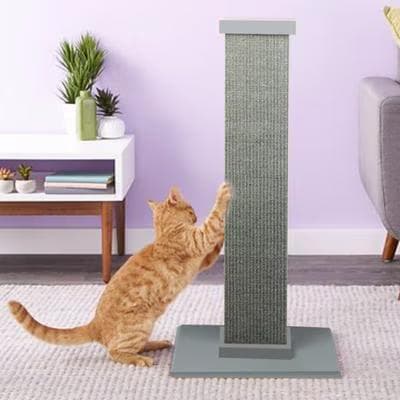
An upright sisal scratching post for a cat that prefers a vertical scratching surface. Place it where your cat already chooses to scratch.
Webvet may earn a commission when you click through to Chewy, at no extra cost to you.
Example: chasing feet after a quiet day
Suppose a cat eats normally, moves comfortably and uses the litter box as usual, but repeatedly stalks moving feet after a quiet afternoon. The strongest first enrichment hypothesis is an unmet opportunity to hunt and catch, because the behavior follows a moving target. Start with supervised prey-style play.
If that cat instead hides only when another cat enters the room, lack of entertainment is a weaker explanation. The first resource to improve is safe retreat and access without competition. These examples show how context changes the first action; neither pattern rules out illness when other signs change.
The Frisco Crinkle Play Tunnel offers a place to investigate or play around. Keep its openings clear, inspect it for damage and remove it if your cat chews or gets caught on it.
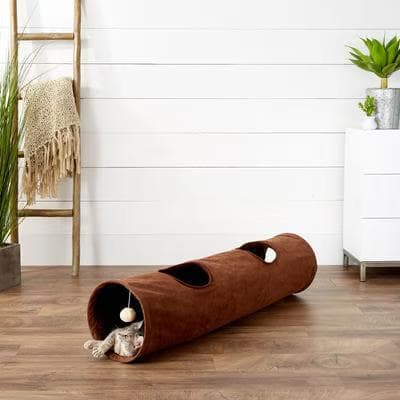
A crinkly tunnel for exploration and supervised play, with clear entry and exit routes.
Webvet may earn a commission when you click through to Chewy, at no extra cost to you.
Use a short observation log that can change the next action
Choose a repeatable situation, such as the period before your evening meal. Write down what normally happens, then try one change during comparable opportunities. Do not wait for an enrichment experiment when appetite, movement or toileting changes already need veterinary advice.
| Example log entry | Interpretation to test | Next action |
|---|---|---|
| Before dinner: stalked ankles; after a short catchable-toy game: ate and rested | Hunting play may meet an opportunity missing from that time of day | Repeat the manageable routine and watch whether the pattern holds |
| Puzzle offered: approached, pawed once, left; food remained inaccessible | The task may be too difficult rather than uninteresting | Expose food and simplify the first step |
| New perch: used only while the other cat was outside the room | Access or social pressure may be the limiting factor | Provide separate resources and an unobstructed approach |
| Enjoyed a toy but still stopped jumping onto the sofa | Play interest does not explain the mobility change | Keep the health observation separate and seek assessment |
These are hypothetical examples, not proof of a diagnosis or a promised result. Record behavior in the same way on later opportunities: what preceded it, voluntary participation, and what happened afterward. One successful evening is a reason to repeat a routine, not to declare every concern resolved.
When the first enrichment attempt does not work
Change difficulty before buying a replacement. For a puzzle, make food visible and reachable. For a wand, try slow movement behind cover with pauses and a catch. For a perch, check its approach and location. These adjustments test different barriers; repeating the same difficult task tests very little.
| Response | Change one thing | Avoid this conclusion |
|---|---|---|
| Watches the toy but never approaches | Offer more distance or cover | The cat is lazy |
| Approaches only after another pet leaves | Arrange separate access | The toy needs stronger movement |
| Uses the activity once, then ignores it | Revisit timing or rotate an existing option | You must buy a more expensive version |
| New withdrawal persists across settings | Arrange veterinary assessment | A longer entertainment session will fix it |
Keep a successful change small enough to repeat on an ordinary weekday. If it requires rearranging the entire room every evening, simplify it. Consistent access to a chosen activity is more useful than an elaborate routine that rarely happens.
Try a small enrichment change and track the response
A one-change observation log pairs the time and context of a behavior with voluntary engagement, appetite and litter-box observations. That record helps avoid labeling every nuisance as boredom. Compare the same everyday situation before and after one small change, then decide whether to continue, adjust or seek veterinary advice.
Keep the first experiment manageable. Choose one time of day when the cat is usually awake and receptive. Offer the activity briefly, allow the cat to leave and note what happened. You are looking for comfortable participation, not a performance.
- The behavior you wanted to understand and when it occurred.
- The activity or resource you changed.
- Whether the cat approached voluntarily and how they engaged.
- Whether they settled or remained frustrated afterward.
- Any changes in appetite, litter-box use or movement.
For example, a cat that paws at the office door each evening might engage with a wand game before you start work. If they then settle nearby, you have a useful routine to repeat. If they ignore the game and keep pacing, reconsider the cause rather than repeatedly buying toys of the same type.
If your cat will not play, make the task easier before making it faster. Move the toy at floor level, allow longer pauses or try a different time. A cat may prefer crawling behind cover to chasing in the open.
For food puzzles, begin with visible, easy-to-reach food and account for it in the daily feeding plan.
Make the environment usable
- Put preferred resources where the cat feels comfortable using them.
- Offer separate play sessions when cats have different styles or one monopolizes toys.
- Preserve a quiet retreat when visitors, children or other pets are active.
- Make entry and exit routes easy rather than forcing large jumps.
- Store string toys and damaged items safely when supervision ends.
If household conflict or unpredictable activity is prominent, use the broader cat stress-relief guide and discuss persistent concerns with your veterinarian. Boredom and stress are not interchangeable labels, and one cat can have several unmet needs at once.
Review the pattern after several opportunities, not only one attempt. Keep changes that the cat chooses and remove activities that create conflict or frustration. A modest, repeatable routine that fits your household is more useful than an ambitious enrichment schedule nobody can sustain.
Read a mixed response accurately
An improvement in one behavior does not mean every concern had the same cause. A cat may enjoy a new food puzzle and still avoid jumping onto the sofa. Keep the mobility observation separate and discuss it with your veterinarian instead of deciding the puzzle has addressed the whole problem.
Likewise, a brief burst of interest on the first day may reflect novelty. Look for comfortable use on later occasions and rotate a small selection of activities when interest declines. Rotation does not have to mean constant buying: changing a box's location or the way an existing toy moves can create a new opportunity.
Keep the routine sustainable
When describing the result, stay concrete: “She used the perch twice today and descended comfortably” is more informative than “She's no longer bored.” The observation tells you what to keep, what to watch and which unresolved changes still need attention.
Questions about bored cat
Frequently Asked Questions
How do you help a bored cat?
First consider new health or behavior changes. For an otherwise well cat, provide a suitable opportunity to hunt through play, forage, climb, scratch or observe. Change one thing at a time and judge whether the cat participates comfortably.
What are the signs of a bored cat?
Possible patterns include persistent bids for interaction, little variation in activity, interest in household objects and loss of interest in familiar toys. These signs are not specific to boredom. New withdrawal, appetite changes, litter-box problems or altered movement require a different level of attention.
Are cats ok with doing nothing all day?
Cats need rest, but they also need opportunities to perform normal behaviors and make choices. A comfortable familiar rest pattern differs from an environment with no play, exploration or social options. New inactivity should be discussed with a veterinarian rather than assumed to be normal.

Editor
The Webvet Editorial Team is the in-house group of pet-care editors and writers behind Webvet, operated by Smart Pet Collective. The team researches, writes, and maintains Webvet's pet health, behavior, and medication content. Every article follows a defined editorial process: research from reputable veterinary and scientific sources, careful drafting, mandatory review of medical content by a credentialed veterinarian, and dated publication. Health and medication articles are medically reviewed by a licensed veterinary professional before they go live and are kept current over time.


