Catio Guide: Choose and Set Up a Safer Outdoor Cat Space
Choose a catio around your home, your cat's habits and safe access. Compare enclosure styles, assess materials and weather protection, and plan a gradual introduction with practical daily checks.

This article contains affiliate links. Webvet may earn a commission when you buy through them, at no extra cost to you.
A catio is an enclosed outdoor space where your cat can watch, sniff, climb and rest without roaming the neighborhood. The right one starts with your home and your cat's habits: a small window enclosure can suit a quiet observer, while a walk-in structure offers more room for movement and shared time.
Before comparing attractive designs, answer three questions. Can your cat get back inside? Can the enclosure prevent an escape from every side, including above and below? Can you manage heat, rain and other weather at that location? If one answer is no, resolve it before buying.
What is a catio?
A catio, short for cat patio, is an outdoor cat enclosure attached to a house, connected by a tunnel or freestanding. Unlike an ordinary fenced yard, it has an overhead barrier and boundaries designed to contain a climbing cat. A household insect screen cannot substitute for those boundaries.
For an indoor cat, the useful addition is choice: somewhere to explore, followed by somewhere familiar to retreat. A catio does not replace the indoor home, interaction or play. A bare cage in full sun offers very different conditions from a shaded enclosure with comfortable resting places.
- 1Choose a secure enclosure with a roof or overhead barrier, protected edges and reliable latches.
- 2Plan indoor access or directly supervised visits with a way to bring your cat inside promptly.
- 3Check weather protection at the hottest and wettest times of day, not only when you first measure.
An indoor catio or room-divider enclosure serves a different purpose: separating space within the home. If the aim is outdoor access, check that any advertised enclosure is designed for exterior use. Product names alone do not establish resistance to weather or escape.
Choose a catio for your space
Start your catio ideas with the route from home to enclosure, then choose a layout. A compact lookout and a walk-in garden room solve different problems; floor area alone is a poor way to compare them.
The Aivituvin Catio Outdoor Cat House combines a wood frame, mesh areas and a sheltered compartment. Check the usable floor area and cleaning access, not only the number of levels.
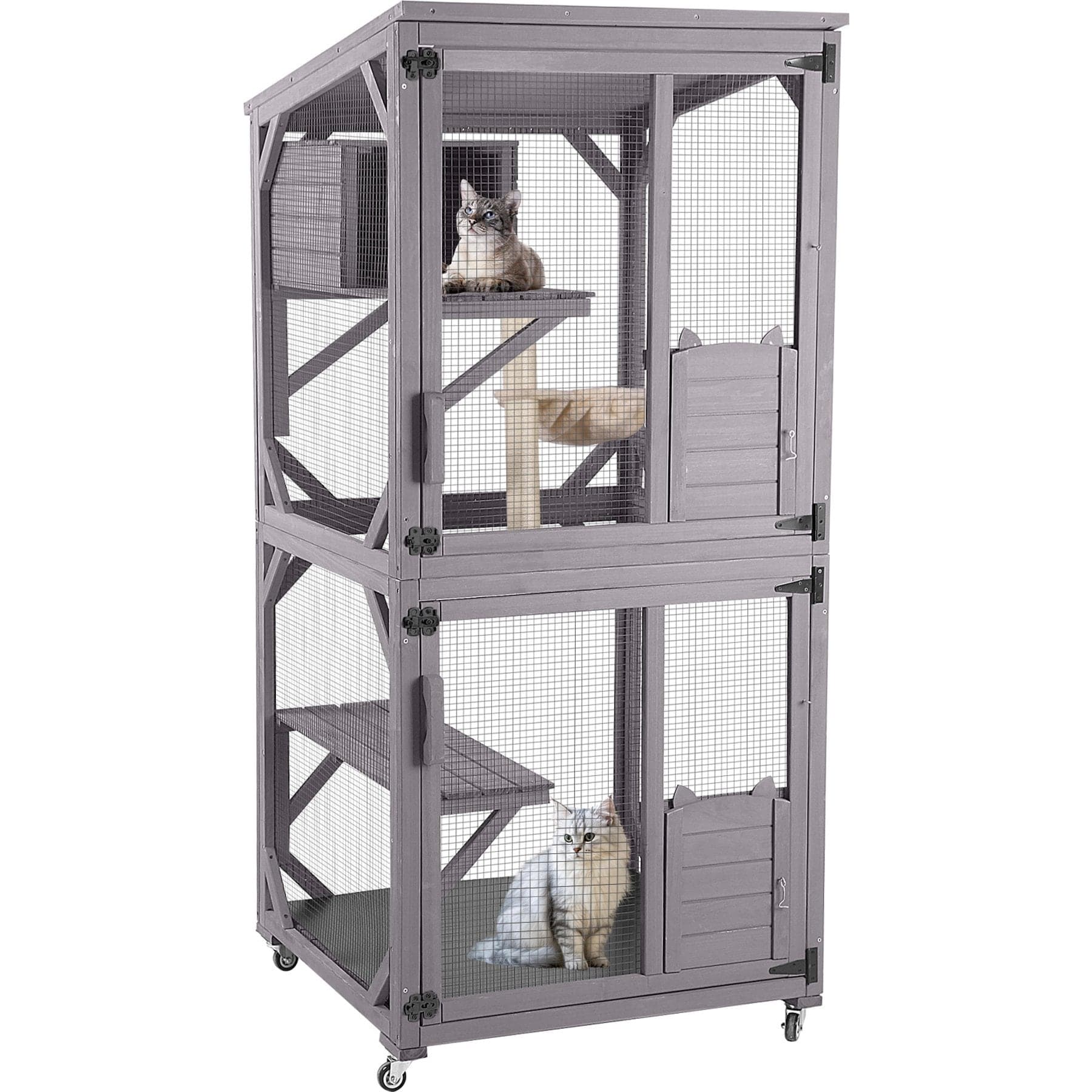
A wood-framed option to compare against your measured space and cleaning-access needs.
Webvet may earn a commission when you click through to Chewy, at no extra cost to you.
Catio designs should follow the available entrance, base and cleaning access. Free catio designs can suggest layouts, but their supports and weather protection must suit your building. Use the comparison below to choose a format, then use the DIY planning guide to assess construction before buying materials.
| Catio location choices | When it may fit | Check before committing |
|---|---|---|
| Window box | A cat that mainly wants a lookout | Supported mounting, an escape-resistant window connection and access for cleaning |
| Patio or porch enclosure | A home with a suitable level outdoor area | Anchoring, drainage, roof coverage and a secure door or tunnel connection |
| Balcony catio | An apartment with permission for an enclosure | Full enclosure, mounting restrictions, wind exposure and unobstructed human exits |
| Freestanding garden catio | More room for climbing and human access | Secure transfer from the house, a suitable base and a weather plan |
| Portable pop-up enclosure | Short, supervised visits | Secure closure, stable placement and the maker's limits on outdoor use |
A balcony catio must be fully enclosed. Netting above a railing does not solve every opening or attachment. Obtain permission before fixing anything to an apartment's walls or exterior, and keep required human exits clear.
A catio attached to the house is a connected system: a strong frame with a loose tunnel connection still has a weak point. For a catio on a porch, measure usable floor area after allowing for human passage and the door swing.

Size should follow usable movement
A large catio gives you options, but awkward shelves do not improve it. Sketch where the cat can stand, turn, stretch, rest and return indoors. For multiple cats, check whether one could block the only route past a perch. Provide separate resting positions where possible.
For a small catio, choose a few useful furnishings. A low platform and clear floor may serve an older cat better than a tall obstacle course. A portable catio on wheels needs stable parking and the specified securing method; wheels do not prevent wind damage or tipping.
Use this stop/go check before purchasing:
- Indoor access: Can the cat retreat, or can you directly supervise every visit and bring them inside?
- Secure enclosure: Can you inspect all surfaces, seams and openings, including the base and roof?
- Weather protection: Can you keep the occupied area comfortable and close it when conditions change?
If you cannot resolve one of these, choose another location or improve the indoor environment first. Indoor alternatives include appropriately installed cat wall shelves or, for a suitable cat and available floor space, a cat exercise wheel.
For example, a renter with an upstairs window needs permission and a specified support method before considering a window box. A homeowner with a level patio may have room for a walk-in enclosure, but still needs a secure entrance. A sunny balcony with no reliable shade fails the weather check regardless of its size.
Compare two sites before buying the larger enclosure
Consider a hypothetical choice between a small shaded patio beside an accessible window and a larger sunny patch at the far end of the yard. The distant site offers more floor area, but adds a transfer route, weather exposure and more ground to prepare. Compare those completed systems, not their square footage alone.
The Coziwow Outdoor Walk-in Catio is a walk-in format with multiple internal platforms. Confirm the footprint and the work needed to prepare its site.
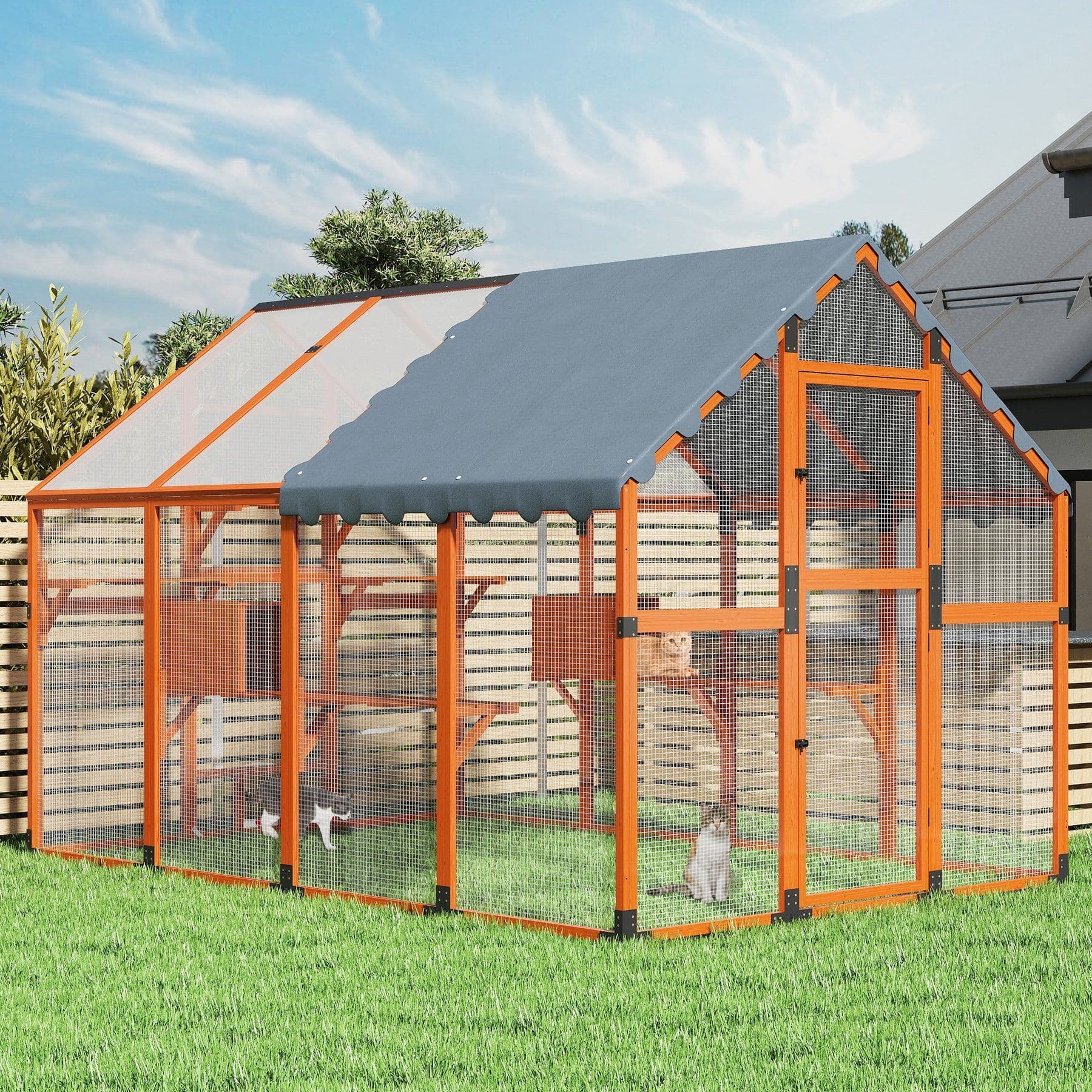
A walk-in enclosure format; confirm its assembled footprint, roof coverage and door layout.
Webvet may earn a commission when you click through to Chewy, at no extra cost to you.
| Decision | Near-house patio | Distant garden site |
|---|---|---|
| Access | Can use a short connection if the window and wall suit it | Needs a fully enclosed route or supervised secure transfer |
| Weather | Check building shade throughout the intended visit | Plan shade, shelter and prompt return across the yard |
| Maintenance | Check door swing and room to clean against the wall | Allow access around the enclosure and along any tunnel |
| Expansion | Limited by the patio and human passage | May have more room but a larger base and boundary to maintain |
Choose the smaller site when it reliably provides retreat, shade and maintainable boundaries while the larger one cannot. Choose the garden site when those added requirements are resolved and the cat will use the extra space. A bigger structure is useful only after its route and conditions work.
Separate a roof cover from a complete roof boundary
A solid cover sheds some weather; mesh closes a climbing escape route. A design may combine both, but a small rain canopy over an otherwise open enclosure does not contain the cat. Trace the boundary across the entire top and every junction before counting the roof as complete.
| Feature in a kit photo | Question to resolve in the included-parts list |
|---|---|
| Transparent roof panel | Is it included, and where will shade come from as the sun moves? |
| Mesh roof | What protects a resting area from rain and strong sun? |
| Tunnel shown beside the enclosure | Is the tunnel and its connection hardware included? |
| Shelves and sleeping box | Are they usable by this cat and reachable for cleaning? |
A useful quote names the base, enclosure, roof coverage, access connection and installation work separately. Keep optional furniture separate until the boundary is complete. This makes two kit prices comparable and prevents a low headline price from hiding the most important missing component.
Catio kits: what to check before buying
A ready-made catio kit saves some design work, but it does not remove site preparation or assembly. Ask for the actual installation instructions before ordering. Pictures may show optional tunnels, shelves or roof panels that are not included in the price. Compare complete setups rather than the lowest headline price.
When browsing a catio for sale, distinguish a flat-packed kit from a pre-built catio delivered assembled. Both may need site work. A large outdoor catio for sale can look generous in a photograph but leave too little room once its door swings open or a maintenance path is added beside it.
Your shortlist should answer these questions:
- What are the assembled outside dimensions and usable inside dimensions?
- Does it need a level slab, deck, prepared ground or another specified base?
- How is it anchored, and which mounting hardware is included?
- Is the roof weatherproof, merely enclosed with mesh, or optional?
- Can a person reach every corner and retrieve the cat without dismantling the structure?
- Are replacement mesh panels, latches and fittings available?
For a premade catio, inspect the window or door connection as closely as the frame. A prebuilt enclosure may need a custom filler panel around the opening. Whether you choose a metal catio or wooden structure, check the mesh, connections and latch separately.
The VistaGato VistaBella Window Catio illustrates a compact window-mounted format. Its mounting and opening requirements need to match your actual window.
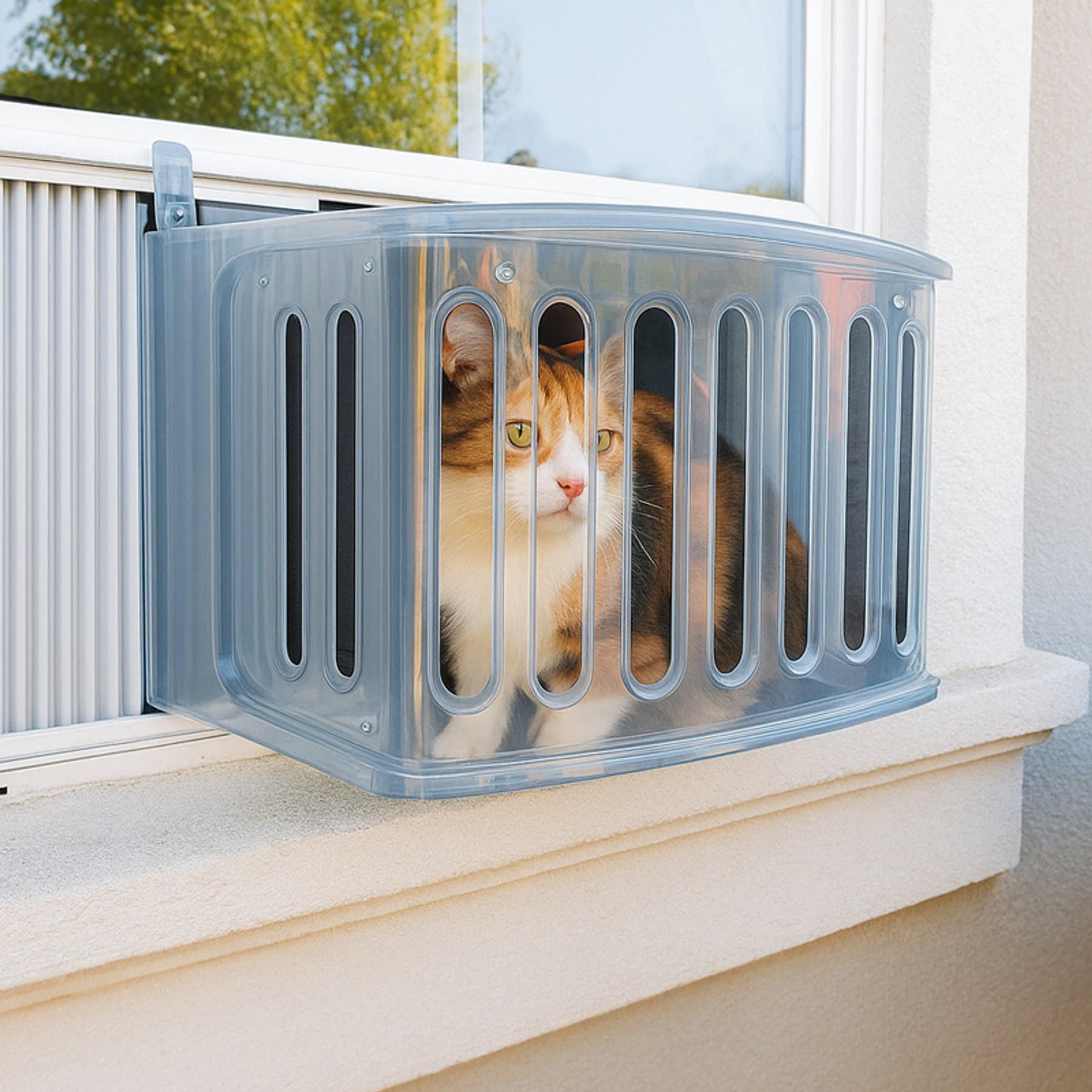
A window-mounted option; check the exact opening, support and installation requirements first.
Webvet may earn a commission when you click through to Chewy, at no extra cost to you.
The best catio meets the site's constraints and supports behavior your cat enjoys. Luxury does not guarantee good placement; a cheap catio must pass the same access and weather checks. A temporary tent cannot automatically substitute for a permanent structure.
Check the enclosure from roof to ground
Inspect the catio as a continuous boundary. Work around the entire structure rather than testing only its front door. Check the roof connection, frame joints, mesh edges, corners and ground interface. A gap hidden behind a plant or furniture is still an opening.
Best Friends Animal Society's catio guidance emphasizes enclosing the top and base as well as providing cleaning access. Apply that principle to the actual site: decking, soil and a concrete patio create different attachment and maintenance questions. A qualified installer can assess structural support and anchoring when these are uncertain.

Compare frame maintenance as well as appearance:
- Metal catio: check joints and protection against corrosion where relevant.
- Wooden catio: inspect cracks, softened timber and loose fasteners.
- Cedar catio: inspect it like other timber structures. The wood's name does not certify strength or make every finish suitable around cats.
Mesh, screens and netting
Choose screening intended for animal containment and your installation. Ordinary insect screens are not designed to contain a climbing cat.
- Welded mesh: inspect frame attachments and sharp cut ends.
- Netted systems: check the specified attachment, tension and inspection requirements. The name “cat netting” alone does not establish suitability.
A screened catio needs more than ordinary porch insect mesh. For a catio net, check how the edges, overhead span and door are secured and inspected for wear. Adding an improvised net to a rigid frame does not necessarily solve its weakest boundary.
Openings must suit the individual cat; a gap containing an adult may not contain a kitten. Check the product's size and life-stage guidance. Keeping a cat inside also does not exclude every insect or outdoor hazard.
Doors and weather
Use the latch arrangement specified for the enclosure and confirm that it fully engages every time. A human access door needs enough clearance to open without trapping the cat against furniture. Before entering or leaving, locate the cat; a closed structure offers no protection while someone holds the door open.
A containment roof may not exclude rain. Provide shade as the sun moves, dry resting areas and a way to end visits. Check puddling and surfaces heated by sunlight. Follow the maker's weather limits and bring the cat indoors when conditions become unsuitable.
The EighteenTek Outdoor Cat Pen uses a portable pop-up mesh format. Treat it as an option for directly supervised visits, with the manufacturer's setup and weather limits.
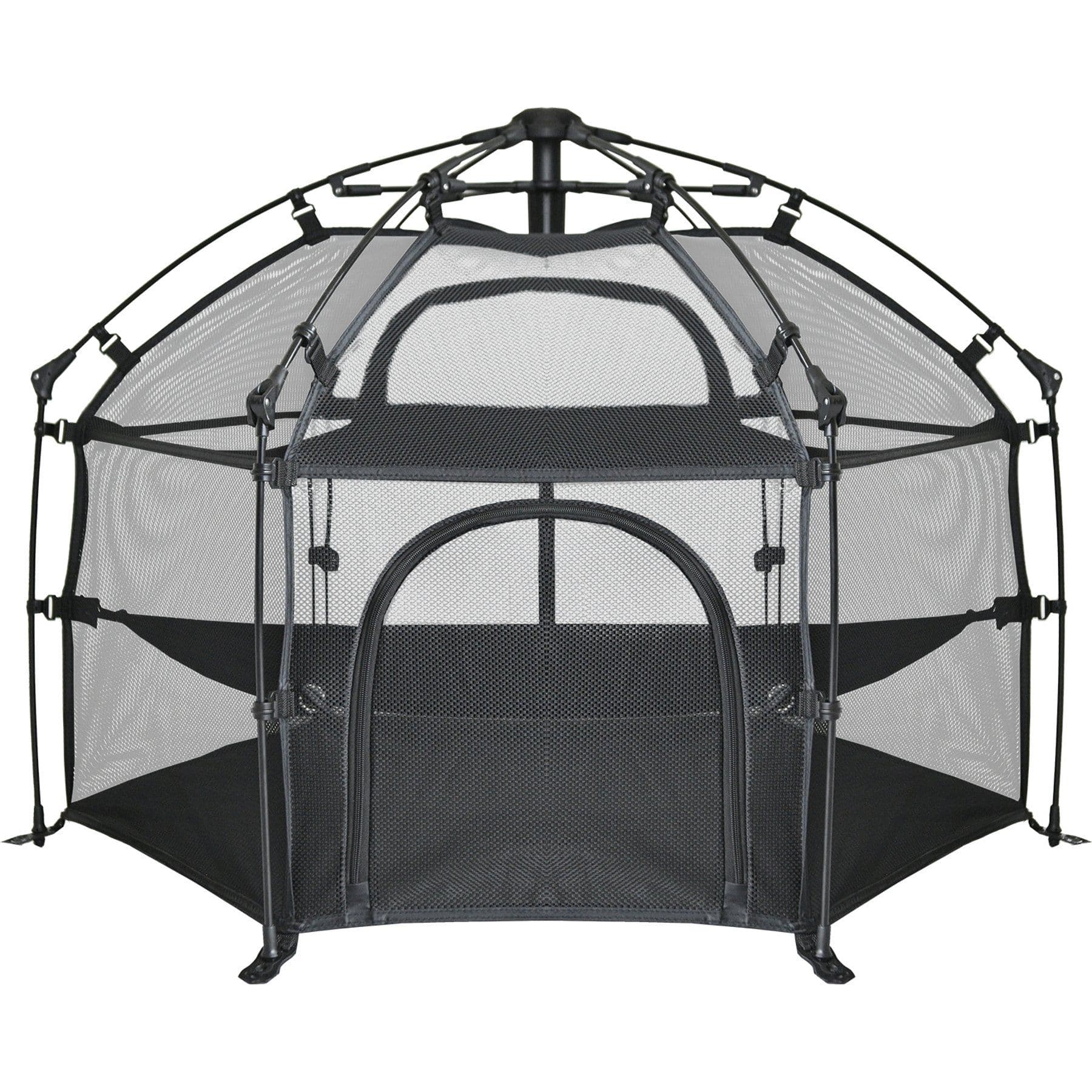
A portable mesh option for directly supervised visits, not a permanent outdoor habitat.
Webvet may earn a commission when you click through to Chewy, at no extra cost to you.
When a window catio makes sense
A window catio can provide a compact outdoor lookout without using much garden space. Window-mounted boxes are especially appealing where the cat already likes a particular sill. Their main constraint is the connection: the box, mounting supports and remaining window opening must form a secure unit.
Check permission and the window connection
Before choosing a window box catio, record the window type, opening dimensions, sill construction and outside support. Check how you will secure the window and reach the box for cleaning. A design in a promotional photograph may not fit your wall or opening.
For renters, establish which attachments are permitted before buying a kit. For an elevated window, do not improvise support or rely on the cat's light weight as proof that the installation is adequate. Our window catio guide covers the detailed fit and access decisions for these smaller enclosures.
Build a catio or buy one?
Building can accommodate an unusual space; buying a kit can reduce design work. Neither is always cheaper. A DIY catio estimate should include frame, mesh, roof, base preparation, fasteners, finish, tools and access connection, plus your time and any professional help needed for structural questions.
Compare a written DIY materials list with a fully equipped kit quote. Check what happens if a part arrives damaged, a panel does not fit or the cat needs a different access arrangement. Our DIY catio guide walks through planning and construction decisions; this overview is not a set of load-rated building instructions.
| Your situation | More practical starting point | Work still required |
|---|---|---|
| Standard space, limited tools, available kit fits the entrance | Compare complete kits | Check the base, attachment instructions, assembly and weather exposure |
| Unusual footprint and competent building help | Price a custom plan | Verify materials, structural details, enclosure boundaries and access |
| Unclear permission or no secure route outdoors | Resolve the site first | A kit purchase or free plan cannot solve an unsuitable location |
Make the space useful to your cat
Catio furniture should leave room to move and offer behaviors the cat chooses: looking out, scratching, hiding, stretching and resting. Begin with a comfortable platform, a protected retreat and clear access back to the house. Add further accessories after observing how the cat uses the space.

For shelves and ramps, follow the relevant load and installation instructions. Give an older or less mobile cat a route that does not require large jumps. Outdoor furnishings need to tolerate the conditions where they are placed; an indoor carpeted tree can stay damp after rain even when the frame still looks intact.
Place each catio shelf where the cat has a clear landing area and a way down. Catio shelving should not block the access door or create a high dead end where one cat can trap another. Low, broad platforms can be more useful than squeezing several narrow ledges into a small enclosure.
Keep enrichment manageable:
- Provide fresh water in a sheltered location and clean the bowl regularly.
- Include scratching surfaces appropriate for outdoor exposure.
- Keep plants identified and appropriate for cats; do not assume ornamental grass is cat grass.
- Remove damaged toys and loose strings, and supervise play with wand toys.
- Leave enough open space to inspect, clean and reach the cat.
If you want a small edible grass tray, first read what cat grass is and how to grow cat grass. Grass is optional enrichment, not a requirement for a catio or a treatment for digestive problems.
Outdoor access is one option within a broader routine. Our toys for bored indoor cats guide compares products for indoor play. Cat TV explains a screen-based option and when it may frustrate a cat, while signs of boredom helps distinguish a need for more activity from changes that deserve veterinary attention.
Introduce the catio and keep checking it
Use voluntary access: let the cat investigate from indoors at their own pace. Keep first visits short and stay nearby. Avoid carrying a reluctant cat outside and closing the route behind them. Familiar bedding may help, but an unobstructed return route matters more.
Investigate escape attempts rather than leaving the cat outside until they settle. Our guide to cats trying to escape covers the broader behavior. If the cat remains tense, review noise, exposure and furnishings; the cat stress relief guide covers the wider home environment.
Daily inspection and supervision
Make a daily inspection part of the routine. Before visits, check closures, visible damage, water and conditions. After storms or maintenance, inspect the whole enclosure for loose fittings, worn mesh, damp bedding and objects obstructing an exit.
Choose supervision before opening access. Stay with the cat during introduction, and throughout portable-enclosure use. If a fixed enclosure has no free route indoors, supervise the visit and bring the cat in before conditions change. Do not leave them waiting outside for you.
Catio questions
Frequently Asked Questions
Do vets recommend catios?
Yes, veterinary guidance includes catios as an option for controlled outdoor access. VCA's indoor-cat enrichment guidance describes enclosed outdoor spaces alongside other ways to meet cats' behavioral needs. Suitability still depends on the individual cat and installation. Ask your veterinarian about mobility, health and parasite-prevention needs; an enclosure does not make every outdoor condition appropriate.
Do catios make cats happy?
Some cats enjoy the sights and extra space; others prefer indoors. Provide a choice and a way to retreat indoors. Relaxed exploration and resting matter more than the visit's length. Persistent hiding, escape attempts or distress mean you should end the visit and reconsider the setup.
Can you leave a cat in a catio?
Start with supervised visits. A catio cannot replace the indoor home. Longer access depends on the enclosure, return route, environment and individual cat; a roof alone is not enough. If you cannot monitor conditions or retrieve the cat promptly, keep them indoors.
Does an indoor cat still need parasite prevention with a catio?
Discuss outdoor exposure with your veterinarian. Mosquitoes and other small insects can pass through mesh, and local risks vary. VCA's catio guidance includes veterinarian-approved parasite prevention. Containment does not replace prevention, screening or vaccination decisions based on your cat's health and location.
What if my cat refuses to use the catio?
Begin with an open doorway and short sessions, allowing the cat to approach or turn away. Check for a slippery entrance, unfamiliar noise or exposed resting spot. If a comfortable indoor cat consistently declines outdoor access, improve their indoor options rather than forcing catio use.
Is a portable catio suitable for everyday outdoor access?
Check a portable enclosure's intended setting, closures, anchoring and weather limits. Lightweight mesh tents need direct supervision; they cannot automatically substitute for permanent structures. Put the cat indoors before moving or packing the enclosure unless its instructions explicitly provide another safe method.

Editor
The Webvet Editorial Team is the in-house group of pet-care editors and writers behind Webvet, operated by Smart Pet Collective. The team researches, writes, and maintains Webvet's pet health, behavior, and medication content. Every article follows a defined editorial process: research from reputable veterinary and scientific sources, careful drafting, mandatory review of medical content by a credentialed veterinarian, and dated publication. Health and medication articles are medically reviewed by a licensed veterinary professional before they go live and are kept current over time.


