Window Catio Guide: Kits, Fit and Apartment Options
A window catio must fit the building as well as the cat. Compare four enclosure approaches, measure the right spaces and plan secure access before ordering or installing.

This article contains affiliate links. Webvet may earn a commission when you buy through them, at no extra cost to you.
A window catio gives an indoor cat an enclosed outdoor perch reached through a window. Choosing one starts with the building: the window opening, the surrounding wall, the support method and permission to install it. A box that looks compact in a product photo can still be unsuitable for your apartment or house.
The options below serve different spaces, from a small insert-style perch to a taller enclosure with several platforms. Compare them by fit and access before price. This is a research-based selection guide; we have not installed or load-tested these products.
Measure the window before choosing a catio
Measure the usable opening and attachment area, confirm the exact installation method, and plan a secure connection with a way to close access. “Window catio” does not automatically mean drill-free, portable or suitable for an upper-floor apartment.
A window-mounted catio transfers its load through the mounting system specified for that model. A larger catio with window access may instead stand on its own base and use the window only as an entrance.
Those are different installations: a catio attached to a window still needs a continuous, secure connection, but the window frame should not be assumed to support the enclosure. Identify which system you are buying before measuring or choosing fixings.
Record the opening type
Record how the window opens before measuring. A vertically sliding sash, a horizontally sliding window and an outward-opening casement create different constraints. Screens, handles, trim, tracks and exterior projections can all interfere with a product that appears to fit the opening's width.
Measure three separate things:
- The usable opening: the space available when the window is in the intended position, including clearances around moving parts.
- The attachment area: the surrounding surface that will support or secure the catio according to its instructions.
- The usable cat space: the interior platform and entry opening the cat will actually navigate.
Do not use the glass measurement as a substitute for any of these. A wide enclosure can have a relatively small entry, while a compact-looking box may require substantial clear wall around the window. Write the measurements down and compare them with the exact model's current manual.

Which window catio approach suits a renter versus a homeowner?
For renters, start with the lease and the property manager's requirements. Drilling, exterior attachments and changes visible from outside may need permission. A product advertised as apartment-friendly does not override those conditions. Condominiums and shared buildings may have separate exterior rules.
For upper-floor windows, consider installation and future cleaning access as well as the finished perch. If attaching, inspecting or removing the enclosure requires leaning out of a window, stop and arrange a competent installer or choose a different setup. A suction-cup indoor perch is not an outdoor enclosure or a structural mounting solution.
Keep emergency exits and required access clear. Check whether the window must remain usable for ventilation, maintenance or escape. If the catio would prevent that, select another location. Our broader catio guide covers ground-level and freestanding alternatives.
Make the cat's route practical
Imagine the whole journey: getting onto the indoor approach, stepping through the opening, turning around outside and returning. An older cat may need a low stable approach rather than a large jump. In a multi-cat home, think about whether one cat can block the only doorway.
If the main goal is a comfortable view rather than outdoor air, an indoor cat window perch may be a simpler fit. It also keeps exterior construction out of the decision. Outdoor access is useful only when the installation and the individual cat's response make it practical.
- If you want to build your own window catio, start with its support and enclosure plan. For a homemade window box, our DIY catio guide explains the construction sequence and complete budget. Use it after confirming the window and attachment location here. A free plan still needs materials, suitable supports and a secure connection; it is not a shortcut around building fit.

- If the site is awkward, compare a competent builder's quote with a compatible manufactured system before deciding which route costs less overall.
Three common window situations
- A rented apartment with a vertically opening sash: begin with permission and the exact usable track dimensions. An insert-style product may avoid some exterior work, but you still need to establish how it is secured and whether the lease permits it. Do not assume an “apartment” label means the product works with every sash or can remain installed during an emergency.
- A house with a ground-floor horizontal slider: a product made for vertical windows may not fit even if the opening is wide enough. Compare a system designed for the slider or a properly connected ground-level enclosure. Access from the yard can simplify cleaning, but the window junction still needs complete containment and a way to close off entry.
- An outward-opening casement or an obstructed basement window: check the path of the moving window, exterior ground level and any well or surrounding wall. A box that blocks the sash or sits in a wet confined area is a poor match. Resolve those site constraints before shopping. If no practical connection exists, an indoor viewing place can serve the immediate observation need.
An RV window adds different movement, mounting and travel constraints. Do not transfer a fixed-house installation method to a vehicle without the relevant manufacturer's guidance. A portable enclosure also needs its own supervised access plan; it should not be described as a window catio merely because it can sit nearby.
Worked measurement example: the opening is only one number
Habitat Haven’s window-enclosure instructions require its box to clear the window frame by at least 6 inches on every side for attachment. That is specific to this system. It shows why measuring only the open glass area can produce an unsuitable order.
Suppose the outer frame you measured is 30 inches wide and 40 inches high. Adding that system’s 6-inch allowance on both sides gives a 42-by-52-inch surrounding envelope to investigate. This arithmetic is a preliminary fit screen, not an order size or proof that the wall can support the enclosure.
| Measurement or condition | Example finding | Decision |
|---|---|---|
| Outer frame | 30 × 40 inches | Record separately from the clear cat-access opening |
| System-specific surrounding allowance | 6 inches on each side | Investigate a 42 × 52-inch area around the frame |
| Nearby obstruction | Downspout sits within that attachment area | Ask the supplier about a different arrangement before ordering |
| Wall and support | Construction not yet established | Resolve installation support; dimensions alone do not pass this check |
Now check the moving window. A casement sash may swing into the proposed box; a sliding sash may leave less usable opening once an insert is fitted. Measure in the operating position, then confirm how access closes. A product fitting the wall does not establish that the window can still work.
A window insert and a window enclosure solve different jobs
Habitat Haven’s window-door insert specifications distinguish its ordinary insert from the tunnel-connection version. The latter requires an opening at least 18 inches high. A window that opens only 15 inches therefore fails that version’s stated requirement even if there is ample wall space outside.
An insert closes the window opening around a cat passage. The enclosure supplies the outside boundary. Price and verify the junction between them, including any tunnel, rather than assuming two individually suitable products connect. For an elevated installation, include safe assembly and cleaning access in the feasibility decision.
| Home constraint | Useful starting choice |
|---|---|
| No permission to drill exterior supports | Ask about a purpose-designed permitted system; otherwise keep the viewing perch indoors |
| Window opens but has little surrounding wall | Obtain a model-specific fit review before choosing a box |
| Suitable lower window and accessible outside ground | Compare support, weather and maintenance requirements across the shortlist |
| Only an upper-story window is available | Price competent installation and future maintenance before product selection |
Window catio options to compare
Use this shortlist to identify a suitable type, then check the exact listing and installation instructions. A product's marketing language about happiness, anxiety or “all-weather” use does not establish a medical benefit or remove the need for shade, supervision and maintenance.
| Option | Design to consider | Main fit question |
|---|---|---|
| VistaGato VistaBella Window Catio | Compact window product with included accessory functions | Does this exact package fit the window and the way you intend to use it? |
| PawHut Playground Window Catio | Taller multi-level wooden enclosure | Can the building support and provide access to the whole structure? |
| Coziwow Wooden Window Catio | Broad wooden window box | Does the window and surrounding attachment area match the manual? |
| Petscosset Window Catio | Tall enclosure with platforms and several doors | Can you inspect every platform and manage all access doors? |
VistaGato VistaBella Cat Window Catio, Litter Box & Perch
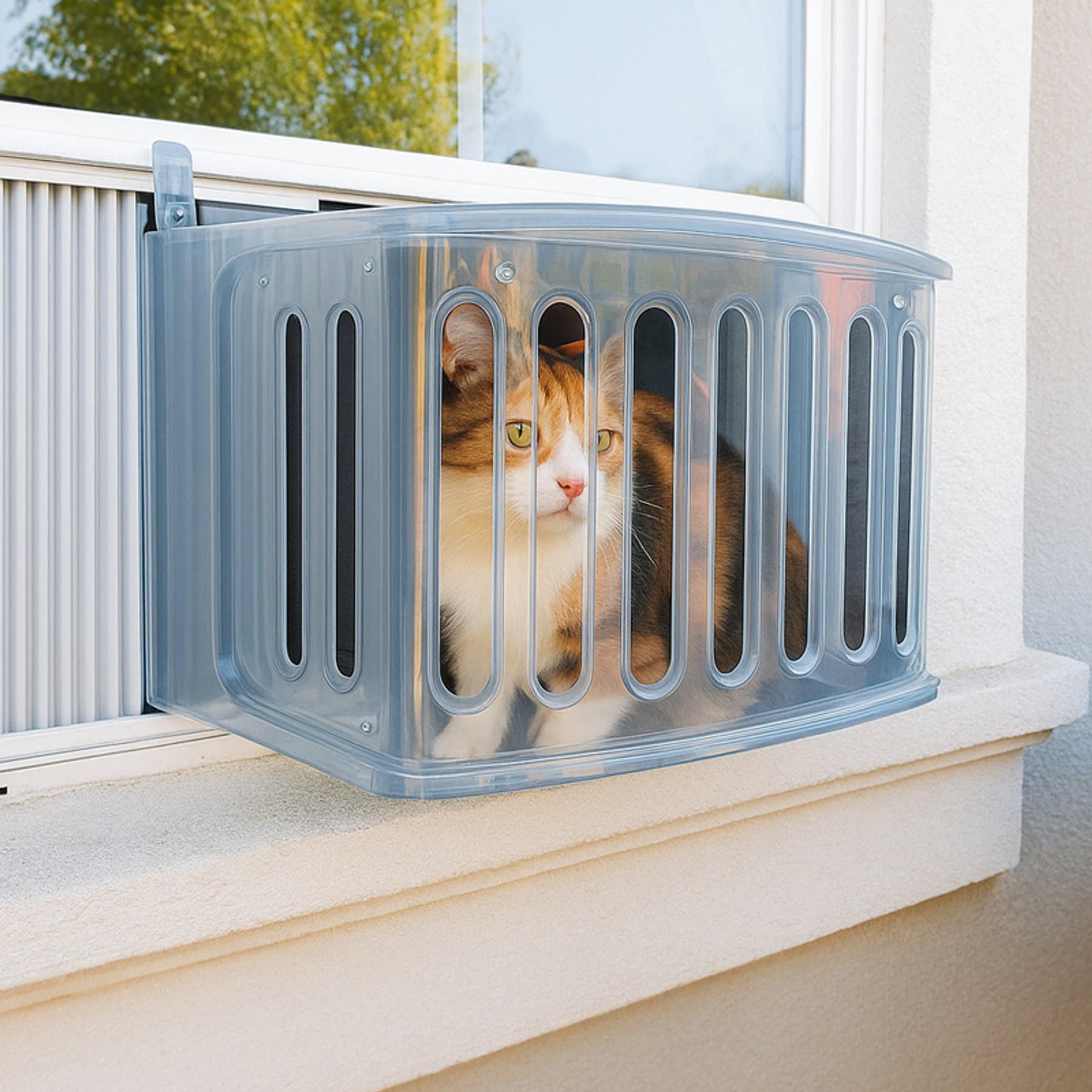
A window-mounted option; check the exact opening, support and installation requirements first.
Webvet may earn a commission when you click through to Chewy, at no extra cost to you.
The VistaGato VistaBella Window Catio is a compact window product to investigate when an exterior wooden structure would be impractical. The selected listing includes catio, litter-box and perch functions in its product identity. Confirm the actual package contents and installation instructions before deciding which functions suit your home.
Its appeal is a contained installation concept, but fit remains model-specific. VistaGato uses several closely related product names, and dimensions or included weather components from another model should not be transferred to the VistaBella. Match the retailer's product number and current manual before relying on any window measurement.
Think about whether you want a resting view, a toileting location or both. If using a litter accessory, you still need convenient cleaning access and an indoor alternative whenever outdoor access closes. Do not assume that moving a litter area toward a window will suit every cat or household.
- Before ordering, ask how cat access closes, how the window stays secured and what parts remain in place when the product is not being used. Compare return conditions for an opened or installed product. A compact box is useful only if the route, maintenance and window function work together.
PawHut Catio Playground Cat Window Box Outdoor Cat House, Gray
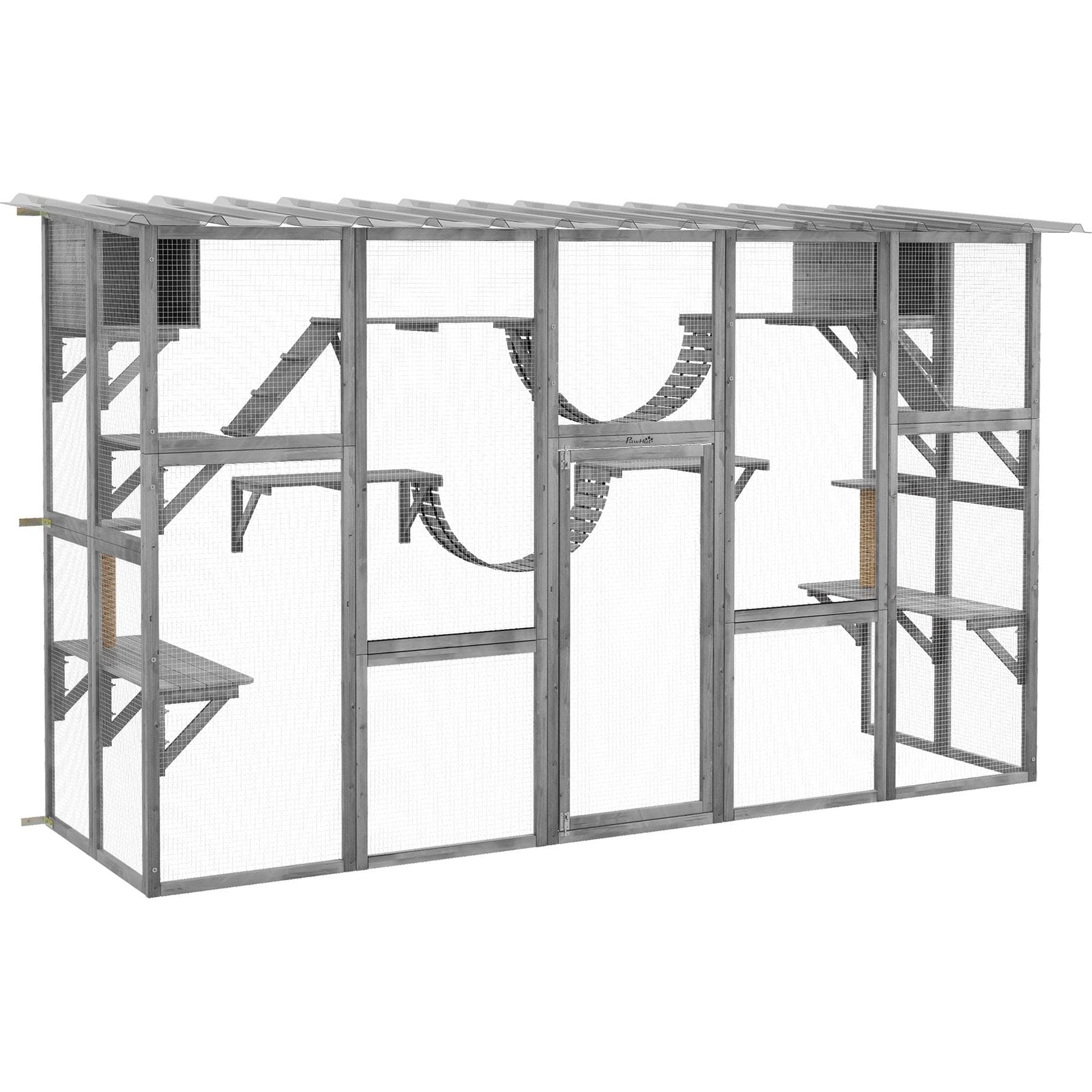
A window-box enclosure format to compare by mounting access, usable space and the complete connection to your home.
Webvet may earn a commission when you click through to Chewy, at no extra cost to you.
The PawHut Playground Window Catio is a multi-level window-box approach for a location with more vertical space. Its catalog specifies several levels and a tallest point of 5.1 feet, making vertical clearance a more consequential purchase check than for a shallow perch.
That may give a confident climber more choices, but height also increases the importance of access, support and cleaning reach.
- Before buying, identify where every support or fixing will go. Confirm the complete installed dimensions in the exact model's manual rather than using the footprint of a similar PawHut enclosure. Check the entry alignment with your window and the clearance needed to open any doors for maintenance.
- Do not choose it simply because the description suggests room for several cats. Usable resting space, comfortable transitions and the ability to leave without being blocked matter more than a generalized capacity claim. A cat that mainly wants to lie down and watch may prefer a broader simple platform.
- The practical tradeoff is a larger structure to inspect. Make sure you can reach the upper and lower areas safely from an appropriate working position. If routine cleaning would involve leaning out of an elevated window, choose another arrangement or obtain professional installation and maintenance advice.
Coziwow Window Catio Wooden Outdoor Cat Enclosure, Grey, Large
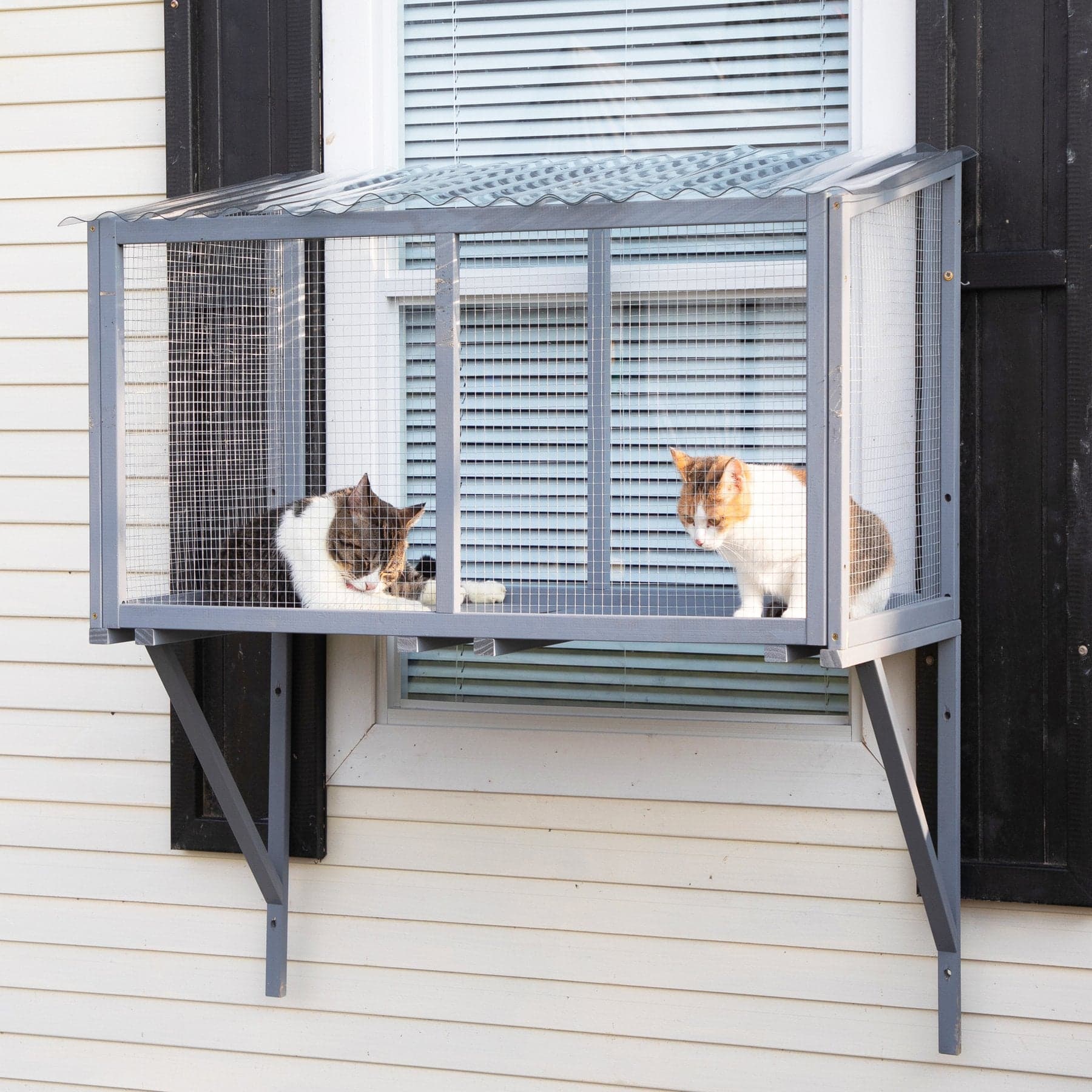
A wooden window enclosure; compare the full assembled shape with your available support and cleaning access.
Webvet may earn a commission when you click through to Chewy, at no extra cost to you.
The Coziwow Wooden Window Catio catalog describes pine construction, reinforced brackets, a roof and surrounding mesh.
Its broad window-box form suits comparing horizontal resting room rather than counting stacked platforms. The manufacturer's window-catio page describes a broad box with a roof and mesh. Match the retailer's exact model and dimensions to that documentation before purchase.
A broad resting area can be useful for a cat that likes to lie down and watch. It also means the enclosure projects from the building, so the supports and the surrounding wall matter.
- Check that the planned mounting does not rely on decorative trim or on a window component that was never intended to carry the enclosure.
- Ask how rain drains, which surfaces need maintenance and whether you can close the cat's access independently of the outer structure. A roof does not guarantee shade throughout the day. Follow the sun across the site before deciding that a sheltered-looking window is comfortable in summer.
Petscosset 68-in Outdoor Wooden Cat Window Box Catio with Platforms, Grey
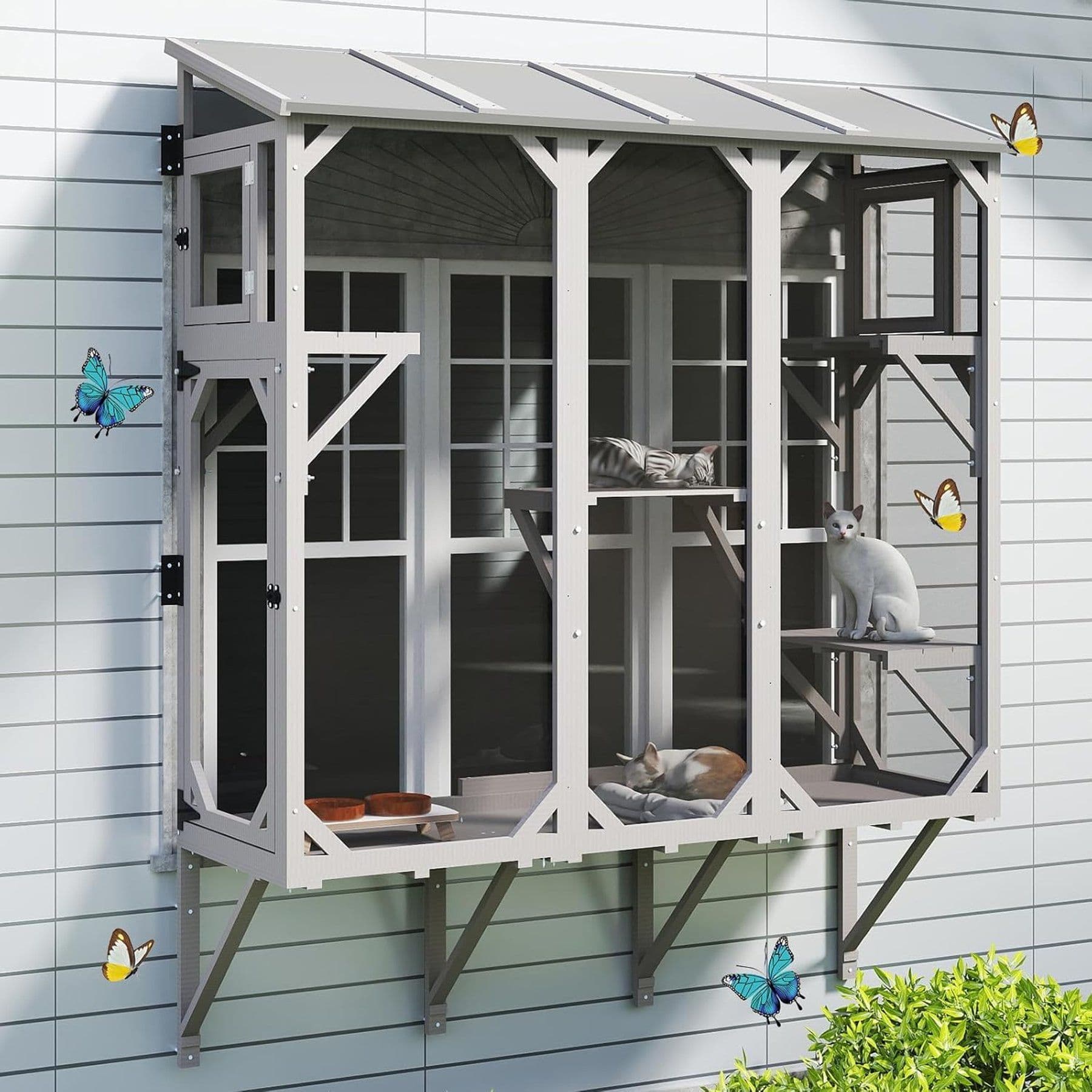
A taller window-access enclosure with platforms; plan its footprint, anchoring and maintenance route before buying.
Webvet may earn a commission when you click through to Chewy, at no extra cost to you.
The Petscosset Window Catio is a tall wooden option with several platforms.
The current catalog specifies solid wood with mortise-and-tenon joints, triangular supports, four platforms, two lockable doors and a removable door. Those access points distinguish it from a simple single box and create more closures to inspect.
Treat those as components to assess against your site, not as proof that the structure suits every window or every group of cats.
- The larger form may provide more choices for a cat that comfortably moves between levels. Check whether the lowest and highest areas are actually useful for your cat. An older cat may need a gentler route than the product photograph suggests, and a nervous cat needs a clear way back indoors.
- Confirm the exact assembly and wall-attachment instructions before ordering. Check that doors can open without hitting a fence, wall or other object, and decide how you will keep the cat inside while cleaning. Multiple doors are convenient only when you can control each opening reliably.
- Measure the maintenance space as well as the enclosure. You should be able to inspect platforms, closures and the window junction without unsafe reaching. Keep the current product identity with the manual so replacement parts or support questions refer to the correct version.
When a custom or modular option makes more sense
An unusual window may need a different approach. Habitat Haven's window enclosure is a modular option with specific surrounding-clearance and attachment requirements. A made-to-order or custom solution can help address an awkward site, but it still requires accurate measurement and a suitable building connection.
If you are considering construction instead, our DIY catio guide covers the complete budget and build sequence. Compare installed costs, including help, support materials and access, rather than assuming a kit is always cheaper or a homemade box is always easier.
Plan the connection and weather protection
An open window is useful only when its complete opening leads into a secure enclosure. There is no need to decide that all cats prefer windows open or closed: offer access voluntarily, retain a comfortable indoor alternative, and close access when weather or the enclosure condition makes it unsuitable.
An ordinary insect screen is not a substitute for a cat-safe enclosure connection.
Check the complete connection
The window-to-catio connection is part of the enclosure. A secure box attached near an open window is not enough if there is an uncovered gap between them. Follow the exact product's instructions for the opening, insert, tunnel or wall junction.
Think through four everyday states:
- Cat access open: the route is continuous, enclosed and comfortable to use.
- Cat access closed: you can prevent entry during poor weather or maintenance.
- Cleaning in progress: the cat cannot follow you through an unsecured door.
- Window in ordinary use: locks, ventilation and other required functions remain appropriate.

Do not treat foam, tape or an improvised fabric panel as structural containment unless the product's specified system explicitly uses it for that purpose. Weather sealing and cat containment are different jobs. A draft seal can make a room more comfortable without securing an escape route.
Check sun, rain and exposure
A window can feel mild indoors while the exterior box becomes hot in direct sun. Inspect the location at different times of day and consider the season. Clear panels, dark surfaces and limited air movement can change conditions inside the enclosure.
Provide a way to bring the cat back indoors promptly. Do not leave access open merely because a product is advertised for outdoor use. During severe heat, cold, storms or other unsuitable conditions, keep the cat indoors.
- A weather-resistant material claim concerns the product; it is not a promise that the animal can remain comfortable in all weather.
- Check for water collecting on the floor, damp bedding and surfaces that become slippery. Furnishings should be stable and suited to their exposure. Keep hanging cords and loose materials out of the cat's reach, and avoid adding plants unless you have confirmed their identity and suitability.

Write a short access plan before installation
Decide who closes access when weather changes, when nobody can supervise and when someone cleans the enclosure. Keep that method simple enough that every household member can use it. A closure hidden behind furniture or difficult to reach is likely to be inconvenient at the moment you need it.
For example, a morning-use routine might begin with checking the latch and outside temperature, opening the indoor access while you remain nearby, and closing it before leaving. That is a household planning example, not a universal safe duration. Your location, product and cat determine whether the routine is suitable.
Keep the doorway usable
In multi-cat homes, watch the doorway during initial use. A cat resting across the only entrance can prevent another from leaving. Add space or change the arrangement if the route becomes a point of conflict; a larger advertised enclosure capacity does not resolve a blocked entrance.
Install and introduce the enclosure
Use the manufacturer's installation instructions and obtain competent help when the wall, supports or access make the job uncertain. Inspect the delivered components before assembly. Stop if parts are missing, damaged or do not match the instructions; improvising a substitute changes the system you are relying on.
Before allowing the cat in, inspect the roof, mesh, floor, doors and window junction from both sides where safely accessible. Test closures and the method for shutting off access. Confirm that no sharp edge, exposed fastener or loose component sits along the route.
Let the cat choose the first visit
Open access in comfortable weather while you remain nearby. Let the cat approach, sniff and retreat. You can make the indoor approach easier with a stable step or appropriate wall-shelf route, but do not place a reluctant cat outside and close the return route.
Watch the first visits for confidence and physical ease. A cat that pauses at an unfamiliar threshold may simply need time. A cat that cannot turn comfortably, slips or struggles to return needs a setup change.
If the wider household environment is already stressful, address that through cat stress relief rather than expecting the new enclosure to fix it.
Inspect before reuse
Before each use, check visible damage, closures and weather. After storms or building work, inspect the whole connection again. Follow the product's maintenance guidance and arrange repairs before reopening access. The inspection needs to remain practical months after installation, which is why safe reach and cleaning access belong in the buying decision.
If you remove the enclosure seasonally, reassess it before reinstalling. Check stored parts for damage, confirm the mounting instructions still match the components and repeat the fit and closure inspection. Treat a move to another window as a new installation decision, not a simple relocation of a proven setup.
Questions about window catio
Frequently Asked Questions
What is a catio that can be attached to a window?
It is an enclosed outdoor space connected to a window so the cat can enter from the home. Some are compact window boxes; others are larger structures reached through the window or a secure tunnel. Their installation methods are not interchangeable.
How does a catio connect to a window?
It depends on the product or plan. The connection may use a specified window insert, a directly attached enclosure or an enclosed transition. Every edge around the route must be secured, and you need a way to control access. Follow the exact system's instructions rather than adapting a different model's method.
Are catios good for indoor cats?
They can offer voluntary outdoor observation and exploration while limiting roaming. The benefit depends on secure construction, comfortable conditions and the cat's response. A frightened cat or an overheated enclosure does not become enriching merely because it is outside.
Is it cruel to not let a cat go outside?
Indoor cats can have a good quality of life when their environmental and social needs are met. Outdoor access is one optional opportunity, not the only way to provide enrichment. If a window catio cannot be installed securely, improve indoor play, resting choices and observation space instead.

Editor
The Webvet Editorial Team is the in-house group of pet-care editors and writers behind Webvet, operated by Smart Pet Collective. The team researches, writes, and maintains Webvet's pet health, behavior, and medication content. Every article follows a defined editorial process: research from reputable veterinary and scientific sources, careful drafting, mandatory review of medical content by a credentialed veterinarian, and dated publication. Health and medication articles are medically reviewed by a licensed veterinary professional before they go live and are kept current over time.


