Cat Wall Shelves: Picks, Safe Mounting and Layouts
Good cat wall shelves start with a usable route. Compare four shelf systems, plan comfortable landings and descent, and match the installation method to your actual wall.

This article contains affiliate links. Webvet may earn a commission when you buy through them, at no extra cost to you.
Cat wall shelves can add climbing routes and resting places without filling the floor with furniture. The best setup is one your cat can enter, turn around on and leave comfortably.
Attractive shelves do little good if the first step is too high, the landing is too narrow or the only route ends in a dead end.
Plan the route before buying a set, then match the mounting instructions to your wall. This guide compares four product approaches using current seller information and explains what to verify. We have not installed or load-tested these products.
Plan a route your cat can use both ways
Design the descent as carefully as the climb. Choose usable platform sizes, secure traction and a mounting method approved for the actual wall. A shelf's advertised load limit does not certify a different anchor, damaged wall or improvised installation.
Start where your cat already feels comfortable. A route beside a familiar resting place may be more useful than one above a noisy appliance or in a room the cat avoids. Consider the view, nearby activity and whether another pet can block the approach.
VCA's play and enrichment guidance describes elevated resting areas as one useful choice for cats. It distinguishes a cat choosing a high perch from a cat hiding there because the rest of the home feels unsafe. If the cat cannot move around normally without being chased, address that environment rather than building higher shelves.
Use a round-trip route audit before shopping:
- Entry: Can the cat reach the first surface without an ambitious leap?
- Turn: Is there room to change direction or pass a doorway?
- Rest: Is the resting shelf large and comfortable enough for this cat?
- Descent: Can the cat return through the same route or another safe route?
Choose spacing for the cat, not the photograph
There is no universal spacing that suits kittens, athletic adults and older cats equally. Watch the movements your cat already makes comfortably, and plan a gentler starting route. A manufacturer may suggest spacing for a system, but your cat's mobility and the shape of the landings still matter.
Shorter transitions and broader landings give the cat more choices. Leave headroom above the shelf and room for the body to turn. A cat that can leap onto a platform may still struggle to reverse direction on it. Avoid a layout that requires a blind jump around a corner.

For a cat whose jumping ability has changed, ask your veterinarian about discomfort or mobility problems. Lower shelves, stable intermediate platforms or a floor-level retreat may be more appropriate than encouraging the cat to attempt the old route. Accessibility is a design input, not a reason to pressure the cat.
Keep travel and resting space distinct
A narrow step is a transition, not necessarily a bed. A long shelf can offer a travel route but still need a broader resting place. A hammock introduces movement and a different surface, which some cats like and others avoid.
- Use stable broad surfaces where the cat needs to turn or rest.
- Keep routes away from open flames, hot appliances and hazardous objects.
- Avoid tempting jumps across doorways or over unstable furniture.
- Consider a second route where cats share the wall.
- Leave enough clear approach space for the cat to choose whether to climb.
A stable cat tree can provide an entry point, but it must be positioned and secured appropriately. Our cat-tower guide covers that separate product choice. Do not assume a tree becomes stable simply because the wall shelves are secure.

Plan for the room you actually have
In a small living room, begin with one resting destination and a gentle approach. A broad low entry, one intermediate surface and a comfortable perch may solve the need better than filling every available wall.
Leave ordinary walking routes clear so the cat does not have to launch through people's movement to reach the first shelf.
- At a corner, check both the landing and the turn. A cat should not have to commit to a leap before seeing the next surface. A purpose-designed corner component may be useful when its dimensions and mounting fit, but putting two unrelated shelves close together does not automatically create a comfortable junction.
- Above a sofa, consider the people using it. A shelf can offer social proximity, but a busy seat, a reclining mechanism or a child climbing the furniture may change the approach. Avoid relying on a movable chair as the only step down. If furniture moves during cleaning, restore the route before allowing use.

Give shared routes a way out
Two cats can turn a single attractive resting shelf into a contested destination. Where space and installation allow, separate resting spots and more than one approach can reduce the need to pass directly through another cat's space. Observe the cats rather than assuming that side-by-side shelves mean both are comfortable.
Watch for waiting, staring, blocking and changes in which rooms a cat uses. A cat that stops approaching after another starts occupying the lower shelf may not have “lost interest.” Consider whether access has changed. Provide an alternative usable resting place while you work on the environment.
Do not place food on a high shared shelf simply to draw both cats onto it. Food can add competition to a route that is still unfamiliar. Introduce cats separately when needed and keep preferred resources available elsewhere.
Can the cat climb down as easily as up?
- Entry: the first step is reachable from a stable surface without launching across a busy walkway.
- Turn: the cat has turning room without balancing at the edge or reversing through a narrow gap.
- Rest: the usable platform supports the cat's preferred resting posture; a slim travel step is not counted as a bed.
- Descent: each lower landing is visible and has a nonslip surface; the cat does not need to jump onto unstable furniture.
- Escape: a second route or separate destination prevents another cat from controlling the only way down.
For example, a corner shelf may look connected from the room but hide the next landing from a cat standing on it. Rotate the arrangement or add a suitable landing in the plan before making holes. Do not test the uncertainty by placing a cat on the finished high shelf.
Use the same review when adding one new component later. A hammock, bridge or scratching element can change the available path even if its mounting holes do not move. Keep the comfortable route your cat already uses until the addition is accepted.
Worked layout: a lookout above a sofa
Use the round-trip route audit on this sketch: test entry, turning, resting and descent separately. A wall arrangement that ends at a high bed can strand the cat at a dead end. Draw the visible landing space for the return journey before deciding where the mounting brackets go.
Suppose your cat already steps comfortably onto a stable low platform and likes resting near the sofa. Plan one destination first: a broad rigid resting shelf with a visible descent. Sketch the cat’s body on the usable surface, not just the shelf’s outline; a cutout or curved edge reduces usable space.
| Part of the route | Draw it before drilling | What would change the layout |
|---|---|---|
| Entry | A permanent stable approach outside the walking aisle | The only approach is a chair that regularly moves |
| Intermediate landing | A visible surface with room to pause and turn | A narrow step forces an immediate second jump |
| Resting destination | Enough clear surface for this cat to settle | A hammock or hole occupies the intended turning area |
| Return route | Lower landings visible from above | The cat must jump behind the sofa or across a doorway |
For a shared route, draw where a second cat could sit. If that single position blocks entry and descent, add a genuinely separate approach or choose separate destinations. Two adjacent beds reached through one narrow step still share the same bottleneck.
Catastrophic Creations’ spacing guidance gives 12–18 inches vertically and no more than 24 inches horizontally for its furniture. Treat that as a manufacturer starting point, not a minimum jump target or a rule for other systems. Shorten transitions for the individual cat and follow the exact mounting layout.
Cat wall shelf options to compare
The products below offer different functions. Choose the piece that solves a route or resting need instead of treating every multi-piece set as a complete layout. Dimensions, included hardware and load guidance must be checked for the exact current variant.
| Product | Main use to consider | Design question before buying |
|---|---|---|
| Frisco Cat Silhouette Shelves with Bridge | Two platforms connected by a bridge | Can the cat comfortably cross the bridge and use both approaches? |
| TRIXIE Lounger Wall Shelves | Separate wall-mounted resting pieces | Can the pieces form an accessible route with separate resting choices? |
| FUKUMARU Hammock with Two Steps | A hammock and two approach steps | Does the wall layout allow an easy route to and from the hammock? |
| allforpaws Skywalk Groom & Play Platform | A platform with grooming and play features | Does this add a useful destination without creating dangling-toy hazards? |
Frisco Cat Silhouette with Bridge Wall Mounted Cat Wall Shelves
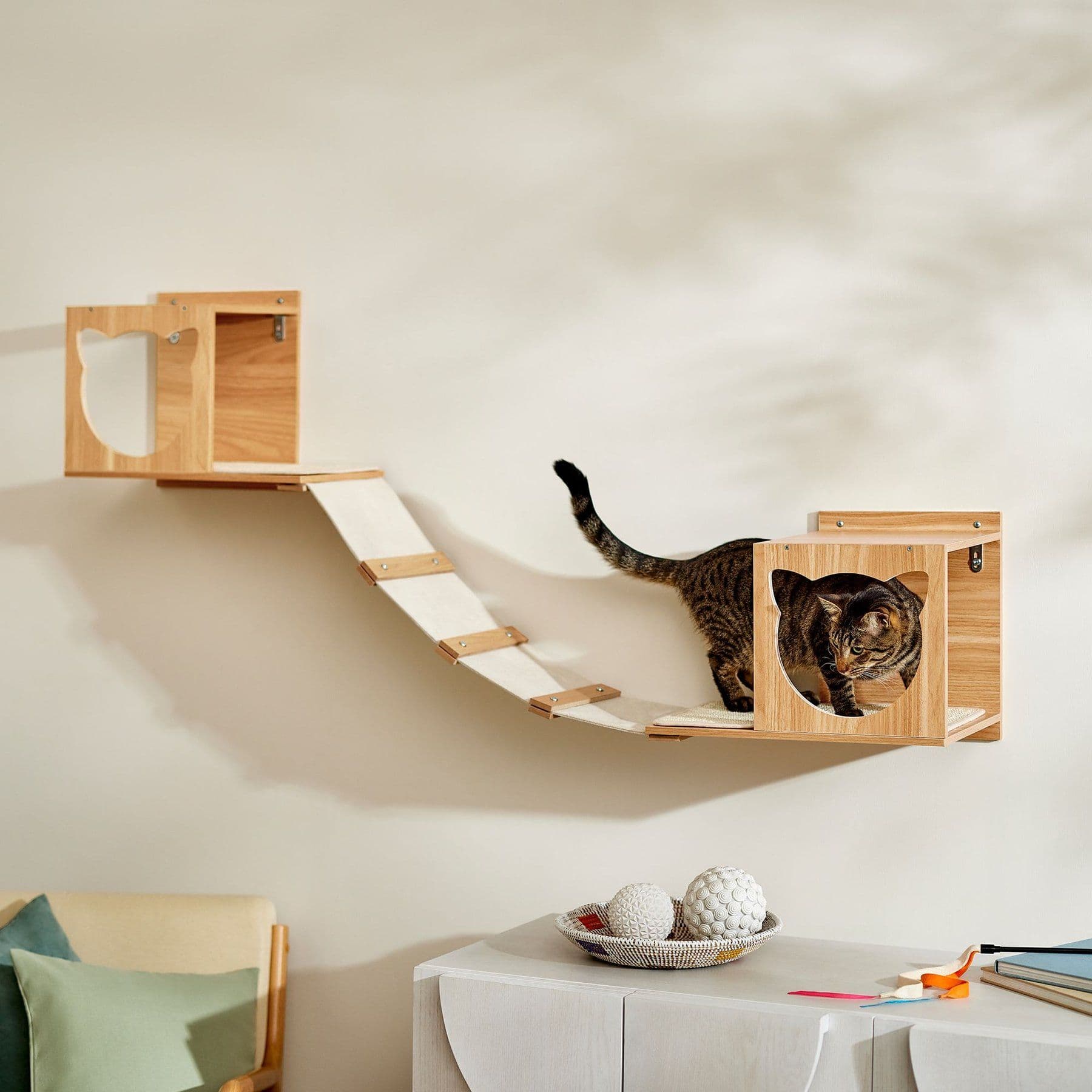
Two wall-mounted platforms connected by a bridge for a planned climbing route. Check the mounting requirements first.
Webvet may earn a commission when you click through to Chewy, at no extra cost to you.
The Frisco Cat Silhouette Shelves with Bridge combines two cat-shaped cubbies connected by a bridge. It is an option for a cat that enjoys covered resting spots and is comfortable walking across a flexible connection. The seller also describes scratching surfaces within the cubbies.
The useful question is whether the route works from both ends. If the bridge becomes the only path between a high shelf and the way down, a hesitant cat may avoid the entire arrangement. Plan another comfortable approach or begin with a lower setup permitted by the installation instructions.
Measure the cubby openings and internal space against your cat's size. “Cat furniture” does not establish that every adult cat can turn or rest comfortably inside it. Think about how you will clean the enclosed areas and inspect the bridge connections over time.
- Consider it for cats that already like enclosed resting spaces.
- Check each cubby's mounting requirements rather than only the bridge.
- Inspect flexible parts for wear and keep the route clear below.
- Supervise initial use of any attached teaser and follow the toy's safety guidance.
TRIXIE Lounger Wall Mounted Cat Shelves, Brown
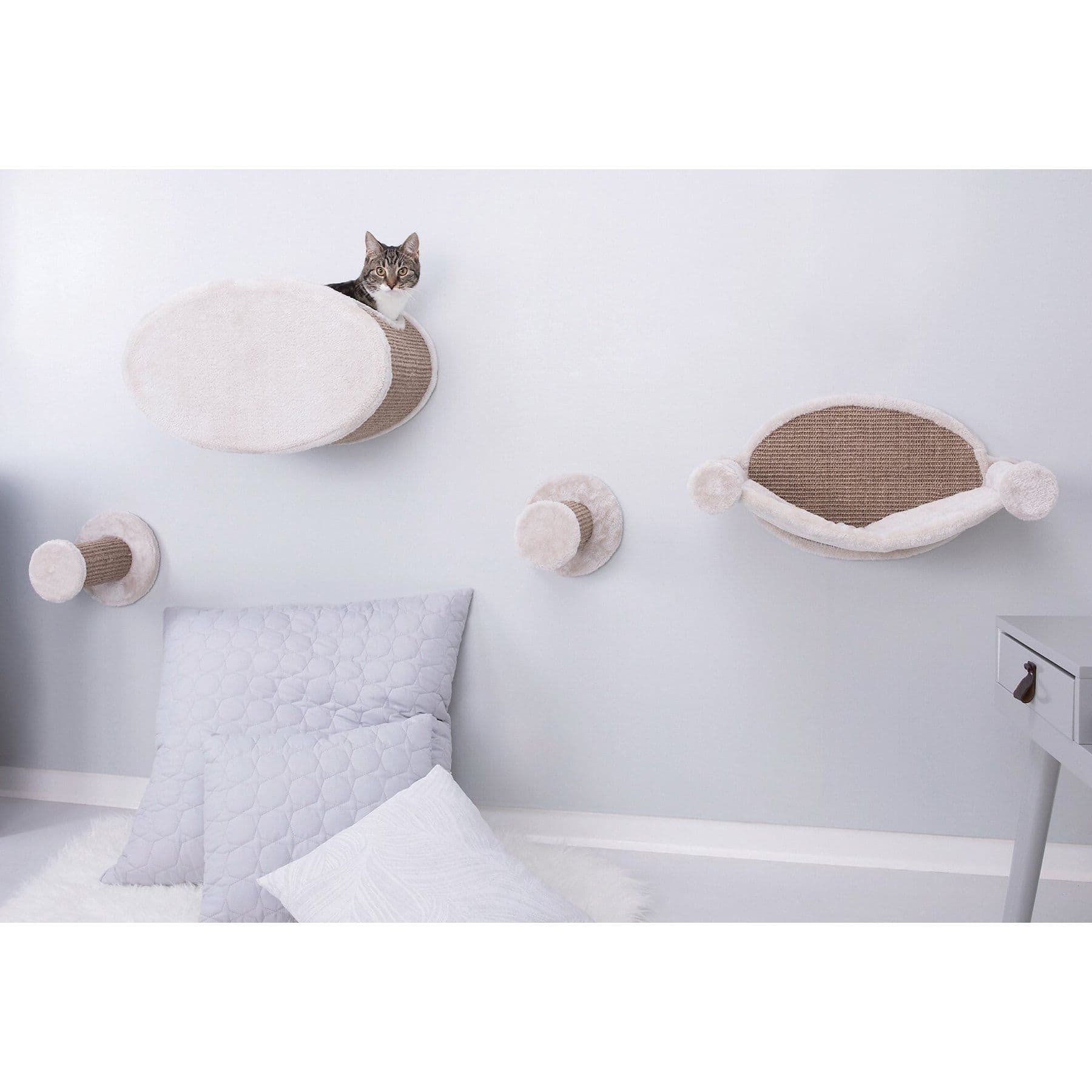
Wall-mounted resting pieces for adding separate elevated choices. Match the mounting method and spacing to your wall and cat.
Webvet may earn a commission when you click through to Chewy, at no extra cost to you.
The TRIXIE Lounger Wall Shelves combines different surfaces: steps, a hammock and a condo. That can be useful when you want to offer several resting and movement choices in one area. The arrangement still needs to suit the wall and cat; included components do not dictate a safe universal spacing.
Start by locating the resting destination, then work backward to a comfortable entry and descent. A hammock should not be the only landing after a difficult jump for a cat that has never used one. The condo should remain reachable for cleaning and for checking that the cat is comfortable inside.
Confirm the dimensions of each component and the mounting instructions for the Brown variant. Review the load guidance as a system of components, not a single number applied to every surface. Where a product includes anchors, confirm that they are appropriate for your wall type rather than assuming the supplied packet fits every building.
- Consider it when different textures and resting positions match the cat's habits.
- Make the initial layout easier than the cat's maximum jumping ability.
- Keep a clear exit from the condo.
- Inspect coverings and scratching surfaces as part of routine maintenance.
FUKUMARU Hammock with Two Steps Set, Grey
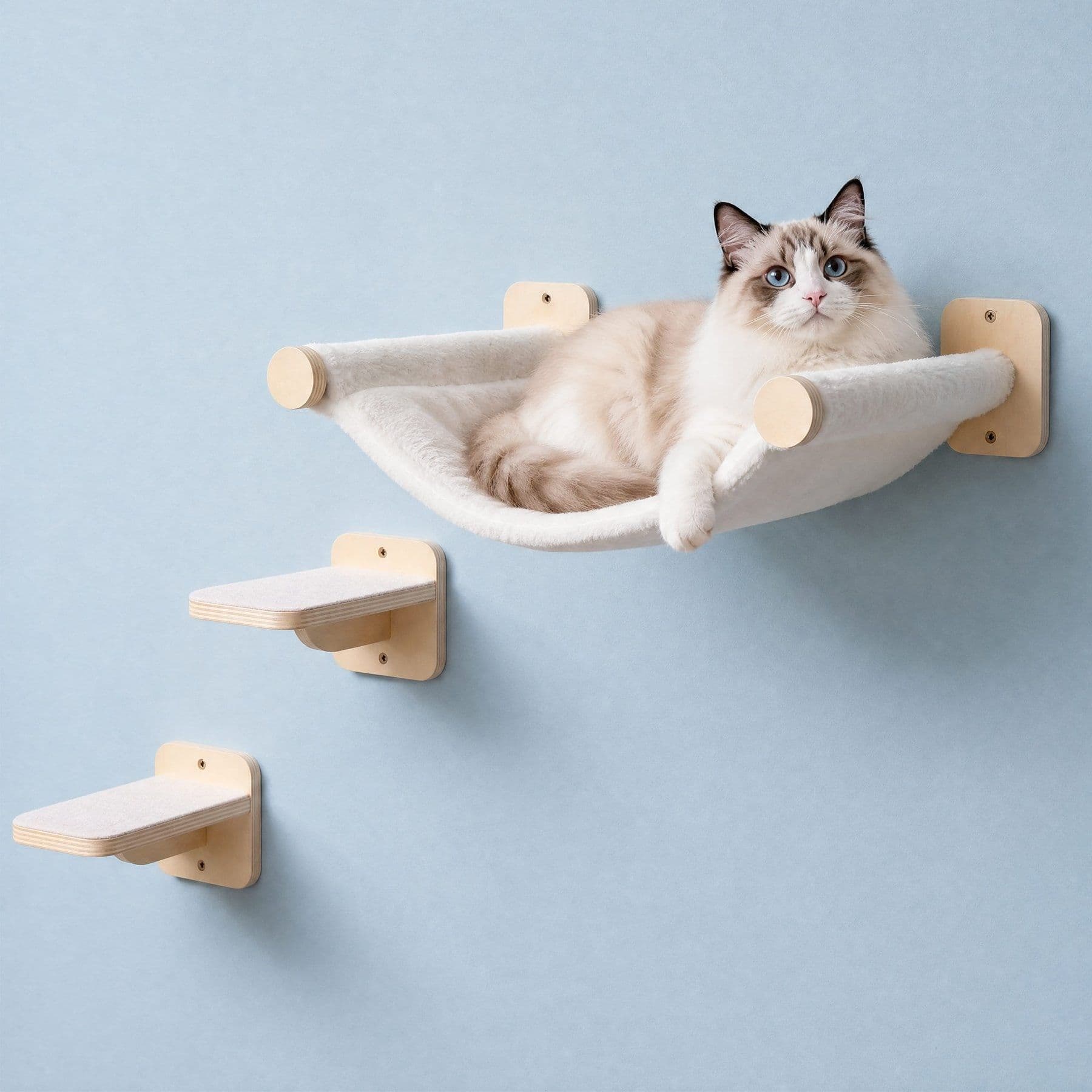
A wall hammock and two steps for building a climbing route with resting space. Verify the mounting requirements before installation.
Webvet may earn a commission when you click through to Chewy, at no extra cost to you.
The FUKUMARU Hammock with Two Steps combines a hammock with two steps, making it a focused option for a small resting route rather than a whole-wall installation. It may suit a location where you can create a gentle approach to one preferred perch.

The current seller describes carpeted steps and a padded hammock. Evaluate those surfaces separately: steps need secure footing, while the hammock needs room for the cat to settle and a way to leave without a difficult jump. A cat that likes rigid shelves may not choose a hammock immediately.
Check the exact manual's stud-spacing and hardware requirements before marking the wall. Do not transplant a load claim from another FUKUMARU set. Similar photographs and names can hide different dimensions or mounting patterns.
- Consider it for a compact route to a resting spot.
- Check whether the hammock fabric can be removed and how it should be cleaned.
- Leave space for the cat's body to turn on the approach.
- Start low and easy enough for voluntary exploration.
allforpaws Skywalk Groom & Play Platform, Beige
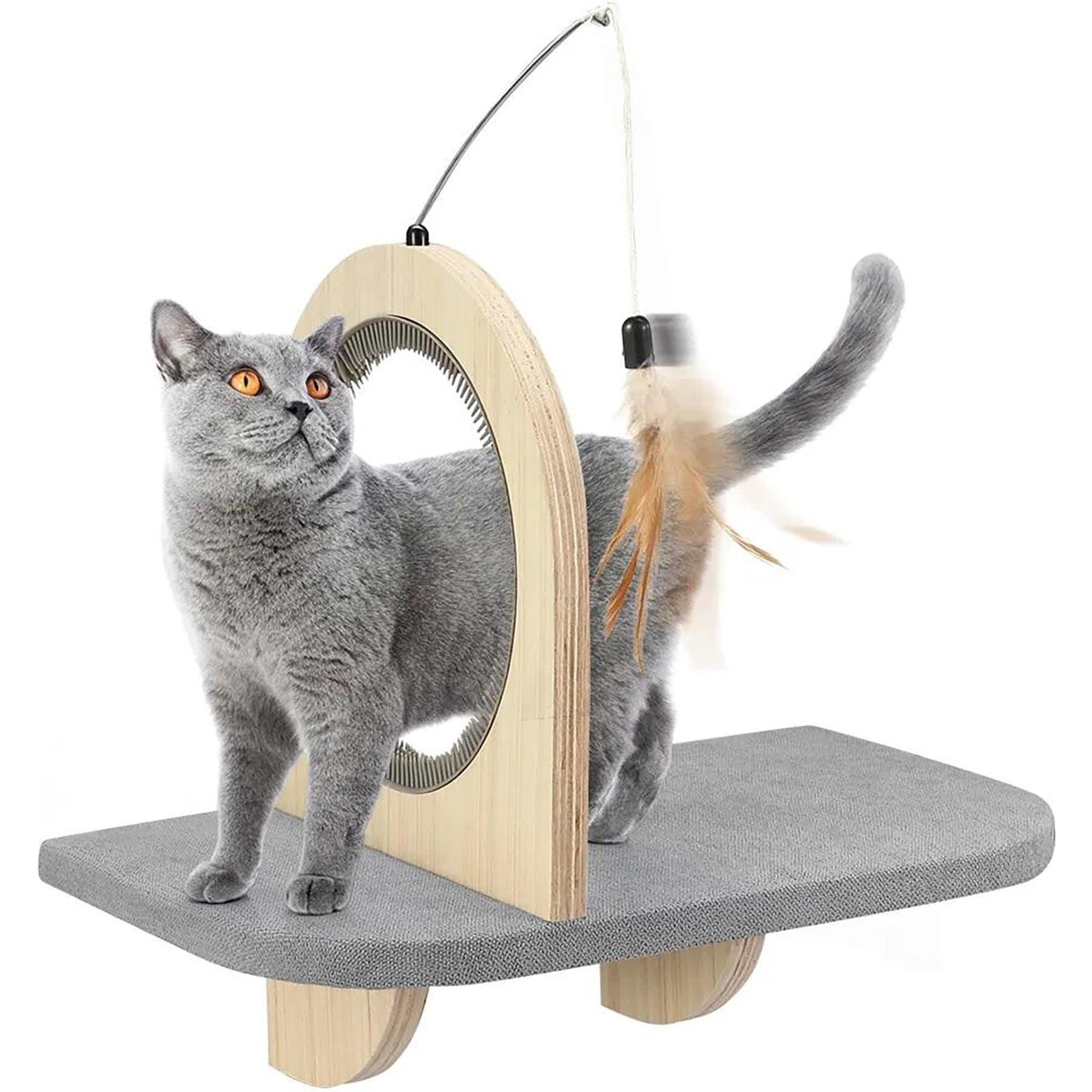
A wall platform with a grooming arch and play attachments. Plan its approach and supervise play with dangling toys.
Webvet may earn a commission when you click through to Chewy, at no extra cost to you.
The allforpaws Skywalk Groom & Play Platform adds grooming and play features to a wall-mounted destination.
The seller describes a built-in brush and a hanging feather toy. Those additions may interest a cat that likes rubbing and investigating objects, but they do not replace the need for a usable platform and secure mounting.
Check accessory suitability
Choose it because the platform fits a route, then assess whether the extras suit your cat. A cat that chews or swallows toy parts needs a different arrangement or removal of the accessory as the product allows. Do not encourage frantic batting at a hanging toy beside a difficult drop.
Confirm the platform's usable dimensions, bracket positions and weight guidance. Consider how the grooming surface can be cleaned and replaced if worn. A feature that is awkward to inspect may be less useful than a simpler shelf in the same location.
- Consider it as one destination within an accessible route.
- Keep play calm while the cat learns the surface.
- Inspect the brush, toy and attachments for damage.
- Follow the manufacturer's instructions before altering or removing components.
Compare rigid shelves and replaceable coverings
If none of these forms suits the room, a simpler rigid shelf may be easier to plan around. For example, Catastrophic Creations' wall-mounted shelf lists specific widths and mounting details, while The Refined Feline's Lotus Branch is a long curved option.
These illustrate why dimensions and installation details matter more than the general label “cat shelf.”
Look for a surface that gives traction without creating loose edges your cat can pull up. Check whether a covering is removable, washable, spot-clean-only or replaceable. Do not assume that a soft-looking surface can go in the washing machine. Ease of maintenance affects whether the route stays usable over time.
Read dimensions as length, depth and usable surface
Catastrophic Creations’ rigid shelf specifications provide an example: 18- and 34-inch lengths share an 11-inch depth, while the escape-hatch version has an 8-inch opening. The longer shelf adds travel length; it does not add front-to-back room for turning or sleeping.
Cut a paper footprint and place it on the floor where the cat already rests, keeping loose materials supervised. Compare the resting posture with the outline. This is a space check, not a strength test. A large curled-up cat and the same cat stretched out use very different areas.
| Form | Useful for | Tradeoff to resolve |
|---|---|---|
| Rigid shelf | Predictable footing and turning | Depth and traction may matter more than length |
| Hammock | A cat that already chooses fabric resting spots | Moving fabric changes the landing; provide a stable approach |
| Cubby | Covered resting | Opening size and interior cleaning access |
| Bridge | Connecting two destinations | A hesitant cat needs another usable route |
Mounting details can also change by version. The current Catastrophic Creations shelf page permits a specified mixed stud-and-anchor arrangement, while its general FAQ discourages anchors as the primary support. Use the exact model’s current diagram and ask the maker to resolve a conflict; do not generalize either statement to every shelf.
Match mounting hardware to the wall
Mounting is a wall-specific task. Wood studs, metal studs, masonry and other wall constructions require different methods. Identify what you have and follow the product's instructions for that material. If you cannot determine the wall construction or the correct fixing, use a competent installer.
Drywall alone is not a universal answer for a jumping animal's furniture. Some manufacturers specify stud mounting; others allow particular anchors in particular configurations. That permission belongs to that product and setup. A packet of generic anchors with a high number on the label does not certify your shelf installation.
Before drilling:
- Read the full current manual and identify all required fixing points.
- Locate the intended supports and check the wall's condition.
- Confirm that the route avoids pipes, wiring and other hidden services.
- Mark a level layout with the required spacing.
- Check clearances and the cat's round-trip route again.

Do not hang the shelf from the first two holes that happen to line up and leave the rest unused. Do not substitute a different screw length or anchor because it is already in a drawer. If the instructions do not cover your situation, ask the manufacturer or installer before proceeding.
Understand load limits
An advertised capacity usually depends on the specified installation. It does not mean the shelf is safe on any wall or under every impact. Cats jump, turn and land; multiple cats may occupy the same surface. Discuss those realities when choosing the system rather than treating body weight as the only input.
Inspect the assembled shelf before the cat uses it. Movement, a loose bracket or damaged wall material needs correction. Never put the cat onto a questionable shelf to see whether it holds. Follow the manufacturer's inspection and maintenance guidance after installation.
If mounting is not allowed in your home, choose a floor-standing alternative designed for its purpose. A window catio has its own exterior installation requirements and is not a workaround for prohibited drilling. A stable cat tree or suitable indoor perch may be more practical.

What about DIY and no-drill cat shelves?
For a DIY shelf, all the same questions remain: material strength, platform size, traction, brackets, fixing points and wall support. A decorative shelf intended for stationary ornaments has not automatically been designed for a jumping animal. Use a documented design and suitable hardware, and get help with the structural details when needed.
Be especially cautious about treating adhesive strips or ordinary suction fittings as an alternative mounting system. “No-drill” describes an installation feature, not a universal load rating. Use only a product designed for that purpose, its specified surface and its stated use.
If the arrangement cannot provide a secure route, choose a floor-standing product instead of improvising a wall attachment.
Follow the instructions for the exact shelf set
TRIXIE Lounger wall-mounted cat shelves combine components with different shapes. Use the TRIXIE Lounger instructions for the exact model and color variant you receive to identify the fittings, assembly order and supported mounting method. A product photograph does not replace the fixing diagram.
If the instructions supplied with a set conflict with the wall you have, resolve that before installation. Keep the model number and manual together so a replacement bracket or later move refers to the same system.
Introduce and maintain the climbing route
Let the cat discover the lowest accessible part first. You can reward interest with a small treat or a familiar toy, but do not place the cat high on a shelf and expect them to find the way down. Keep early exploration calm and make every return route obvious.
Watch how the cat moves rather than whether the layout looks complete. Hesitating repeatedly at the same gap, turning awkwardly or jumping past a narrow surface tells you where the route may need adjustment. Make a safe change to the layout according to the mounting instructions rather than coaxing harder.
A practical first-week check
- Observe entry and descent, not just climbing.
- Check whether one cat blocks another's route.
- Remove nearby objects that become unintended stepping stones.
- Inspect fasteners, coverings and flexible connections as directed.
- Keep the floor and furniture below free of hazards.

If a cat ignores the route, consider location, surface preference and ease of entry before adding more components. A high perch in a quiet unused room may not suit a cat that wants to rest near you.
A cat may also prefer a rigid platform to a hammock or a broad low shelf to a narrow high one.

- Wall shelves provide one kind of movement. A cat exercise wheel offers another, and a secure catio provides outdoor observation. None replaces the need for normal play, scratching resources and comfortable social space. If the cat stays elevated because another pet is intimidating them, use the cat stress-relief guide and seek individualized help.
- Maintenance should be easy enough to repeat. Keep the manual and product identity, inspect wear after vigorous use or any unusual movement, and replace damaged components with approved parts. If the wall or mounting changes during decorating or repairs, reassess the installation before reopening the route.
Questions about cat wall shelves
Frequently Asked Questions
How much weight can cat wall shelves hold?
Capacity varies. The listing for the FUKUMARU Hammock with Two Steps Set, Grey (SKU 4181934), specifies support up to 30 pounds and compatibility with 16-inch stud spacing. Follow its mounting instructions and assess your wall; this is not a capacity guarantee for every installation.
Consider multiple cats and landing forces. A rating from a different shelf or a generic wall anchor does not establish the capacity of your setup.
What are alternatives to cat wall shelves?
Stable cat trees, suitable indoor window perches and low resting platforms can offer observation or climbing without a wall route. Choose an alternative designed for the available space and your cat's mobility.
Are cat shelves a good idea?
They can provide useful vertical choices when the cat can enter, rest and descend comfortably and the shelves are correctly mounted. They are less useful when the route is inaccessible, poorly positioned or substitutes for addressing household conflict.
What is the best way to hang cat shelves to walls?
Follow the exact product's instructions for your wall construction. Identify supports and services before drilling, use all required fixings and get competent installation help when the wall or method is uncertain.
What are the best wall mounted cat shelves?
The best choice fits the intended route, cat size, resting style and wall. Compare usable dimensions, traction, cleaning and mounting requirements before choosing between a rigid shelf, cubby, bridge or hammock system.
Do cat shelves need to be in studs?
Many systems specify stud mounting, while some permit particular anchors or mixed arrangements. Follow the exact manual. Do not assume drywall mounting is acceptable because another brand allows it.
What is the best material to use for cat shelves?
Look for a structurally suitable product with a stable usable surface and traction that can be maintained. Wood, metal and textile components have different cleaning and wear needs. Material alone does not prove installation strength or comfort.
How wide should cat shelves be?
Choose enough usable space for the intended task and your cat's body. A travel step, a turning landing and a sleeping shelf need different space. Measure and watch your cat's comfortable movements rather than relying on one universal width.
Can I mount a cat shelf on drywall?
Only when the exact product and specified installation method permit the wall construction you have. Otherwise use the required studs or another approved method. Get an installer or manufacturer to resolve uncertainty before allowing the cat onto the shelf.

Editor
The Webvet Editorial Team is the in-house group of pet-care editors and writers behind Webvet, operated by Smart Pet Collective. The team researches, writes, and maintains Webvet's pet health, behavior, and medication content. Every article follows a defined editorial process: research from reputable veterinary and scientific sources, careful drafting, mandatory review of medical content by a credentialed veterinarian, and dated publication. Health and medication articles are medically reviewed by a licensed veterinary professional before they go live and are kept current over time.


