Cat Tower Buying Guide: Height, Perches, and Weight
A cat tower comes down to four numbers: height, usable perch count, base footprint, and weight capacity. Here are the five height tiers, the household each one suits, and how to read a listing before you buy.

This article contains affiliate links. Webvet may earn a commission when you buy through them, at no extra cost to you.
A cat tower is the tall, multi-level end of the cat furniture category, and the purchase really comes down to four numbers: how high it stands, how many usable perches it carries, how much floor it occupies, and how much weight each platform holds. Get those four right for your room and your cats, and almost everything else is preference.
This guide is built around those numbers. You get five height tiers with the household each one suits, a way to count perches that reflects how cats actually use a structure, the footprint measurement to take before you order, and a plain reading of what "heavy duty" means on a spec sheet. Scratching behavior itself, why cats scratch and how posts should be built, belongs to our cat trees and scratching posts guide, so this page stays on the tower decision.
- 1Most adult cats are well served by a tower between 4 and 6 feet, which puts the top perch above human eye level without needing ceiling clearance.
- 2Count usable perches, not advertised levels: a cubby, a hammock, and a top platform are three separate resting spots, but a small stepping platform is not one.
- 3Plan on one comfortable resting spot per cat plus one spare, the same resource rule veterinary behavior guidance applies to litter boxes and feeding stations.
- 4Measure the base footprint and add roughly six inches of clearance on the approach side, because a 24 by 20 inch base needs more open floor than the carton suggests.
- 5Most towers publish no weight capacity at all, so judge platform thickness, post diameter, and base width instead of trusting the word sturdy.
- 6Anchor anything over five feet to the wall with an anti-tip strap, especially on carpet, on uneven floors, or in a home with children or dogs.
- 7Replaceable sisal posts and a wide, heavy base are the two features that decide whether a tower lasts two years or ten.
What counts as a cat tower
Walk any pet aisle and you will see the same object sold as a tower, a tree, a condo, and a gym. The category has no governing standard, so the words are marketing rather than specification. What separates a tower from the rest in practice is verticality: multiple stacked levels reaching four feet or higher, connected by posts, usually with at least one enclosed space and one open top perch.
What is the difference between a cat tower and a cat tree?
Nothing standardized, which is exactly why listings are confusing. Retailers tend to use "tower" for the taller, narrower, multi-level builds and "cat tree" as the umbrella term that covers everything from a single post with one perch up to a six-foot structure. "Condo" usually signals an enclosed cubby is included, and "scratching post" means a single vertical surface with no resting platform at all. Because none of these nouns are regulated, read the stated height, the level count, and the base dimensions rather than the word in the product title. Two listings named identically can differ by two feet of height and ten pounds of shipping weight.
Height matters because vertical space is a genuine feline need rather than a luxury. Veterinary behavior guidance on feline environmental needs describes a safe, elevated retreat as one of the core resources every indoor cat should have, alongside separated food, water, litter, and resting areas. A tower delivers that retreat in a footprint a bookshelf-sized patch of floor can absorb. A tall plush build like the Yaheetech Multi-Level 63-in Plush Cat Tree is a good mental picture of the mainstream version of this category: five-plus feet, several platforms, a cubby, and sisal-wrapped posts on a carpeted base.
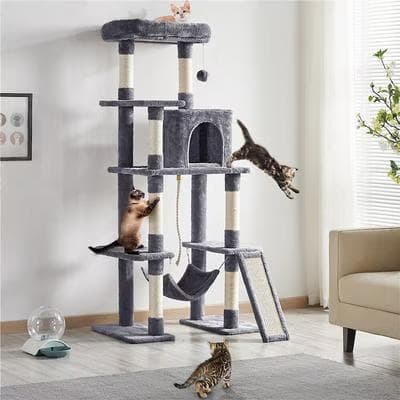
63-inch multi-level cat tree with plush perches, a condo, a hammock, sisal scratching posts, and a dangling toy. Dark gray.
Webvet may earn a commission when you click through to Chewy, at no extra cost to you.
Cat tower height tiers and what each one is for
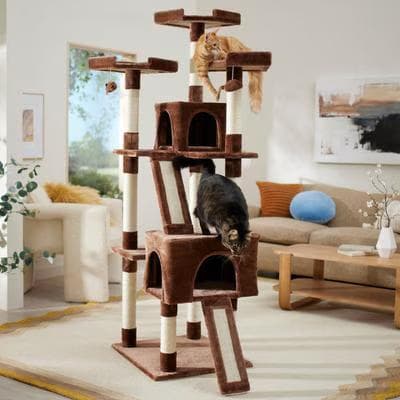
Height is the single most searched question in this category and the one no retail collection page answers with numbers. The tiers below are drawn from published product specifications across the mainstream category, so treat them as typical rather than universal. Perch counts and base dimensions vary by maker, but the pattern holds closely enough to shop with. The Frisco 72-in Faux Fur Cat Tree & Condo is a useful benchmark for the mainstream tall tier.
Webvet may earn a commission when you click through to Chewy, at no extra cost to you.
| Height tier | Typical usable perches | Typical base footprint | Best suited to |
|---|---|---|---|
| Under 3 ft | 1 to 2 | 16 x 12 in | Kittens, senior cats, rentals, and rooms with no spare floor |
| 3 to 4 ft | 2 to 3 | 16 x 16 in | One adult cat, bedrooms, and first towers for nervous cats |
| 4 to 5 ft | 3 to 4 | 20 x 16 in | The default for one or two average adult cats |
| 5 to 6 ft | 4 to 6 | 24 x 20 in | Two to three cats, active climbers, and window placement |
| Over 6 ft | 5 to 8 | 28 x 24 in or wider | Multi-cat homes with 8 ft ceilings and space to anchor it |
How tall should a cat tower be?
For most households, 4 to 6 feet is the answer. That range clears standard furniture, puts a cat above human eye level where they feel secure, and still fits under an 8 foot ceiling with room to jump onto the top perch. Go below 4 feet when the cat is a kitten, is arthritic, or when the tower has to live in a tight bedroom corner. Go above 6 feet only when you have the ceiling clearance, a wall you can anchor to, and more than one cat who will actually use the extra tiers. Taller is not automatically better: a cat who cannot reach the top platform in two comfortable hops will simply use the middle of the tower and ignore the rest.

Spacing between levels matters as much as total height. Comfortable steps sit roughly 12 to 16 inches apart for an average adult cat, close enough that the climb is a step rather than a leap. When a tall tower stacks its platforms 20 inches apart to hit an advertised height with fewer parts, older and heavier cats stop using the upper half within weeks.
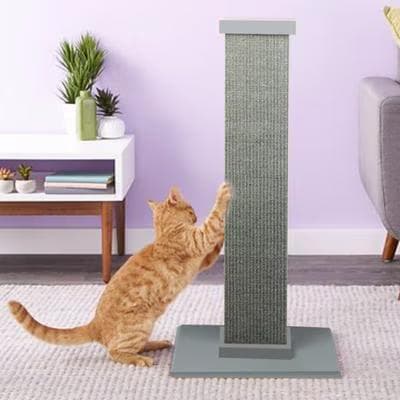
One trade-off buyers miss on tall towers: total height does not mean tall scratching surfaces. Many six-foot builds break the posts into 12 to 16 inch segments between platforms, which is shorter than a cat's full stretch. If your cat stretches high on the doorframe, add a full-height scratching surface separately. A wall-style cardboard panel such as the Necoichi Premium Comfort Cat Scratcher Wall adds that vertical stretch without adding a single inch of floor footprint, and a floor-standing option like the SmartCat Ultimate Scratching Post gives a taller sisal surface than most tower segments do.
Webvet may earn a commission when you click through to Chewy, at no extra cost to you.
Perch count, layout, and how cats use each level
Listings advertise "levels," and levels are a poor proxy for what your cat gets. A stepping platform that a cat crosses in one stride is a stair, not a destination. A perch is a surface a cat can settle on with all four feet tucked, which in practice means roughly 10 inches across for an average cat and 14 inches or more for a large one.
How many perches or levels does a cat tower need?
Count one comfortable resting spot per cat, then add one spare. A single-cat home is well served by two or three real perches, because cats rotate between spots as the sun moves and as the household gets noisy. Two cats need at least three, ideally four, and they should not all be stacked on one narrow column, since a cat who wants distance from a housemate needs a horizontal option, not only a higher one. Three or more cats need a wide tower with separated perches on different sides, or two smaller towers in different rooms, which usually works better than one tall structure everyone has to queue for.

The mix of perch types matters more than the raw number. A well-laid-out tower gives a cat three genuinely different postures to choose from:
- An enclosed cubby at or near the bottom, which is the hiding option nervous cats use first and the one most likely to be occupied during a thunderstorm or a visit from guests.
- A padded hammock or cradle in the middle, which suits cats who want to be near the action while off the floor.
- An open top platform with a rim or a lip, which is the surveillance spot and the one confident cats claim.
- A ground-level bed or open base pad, which older cats and cats who dislike climbing will use even when the rest of the tower goes untouched.
Layout beats height when cats are competing. Two perches on opposite sides of a tower at similar heights reduce standoffs far more effectively than stacking one more platform on top, because cats resolve social tension with distance and clear escape routes rather than with altitude alone.
Footprint, base size, and where a tower fits
The specification most buyers skip is the one that causes returns. A tower's base is the part that lives in your room permanently, and the tall silhouette in the product photo hides how much floor the base and the approach path actually claim.
How much floor space does a cat tower take up?
Mainstream towers land between roughly 16 by 12 inches at the small end and 28 by 24 inches for six-foot multi-cat builds, with wide platform layouts spreading wider still at the top than at the base. Measure the base dimensions from the listing, then add about six inches of clear floor on whichever side the cat approaches from, because a cat who has to squeeze between a sofa arm and a post will start using the sofa arm instead. Also check the widest platform, not just the base: overhanging top perches on tall towers can extend several inches past the footprint and collide with a curtain, a lamp, or an open door.

Three placement rules save most of the trouble:
- Put it where the family already is. A tower in a spare bedroom gets used far less than the same tower in the corner of the living room, because cats want elevation near activity, not exile from it.
- Aim for a window view if you can manage it. A tower beside a window earns hours of use per day that the identical tower against an interior wall will not.
- Leave the corner tight. Two walls behind a tall tower cut wobble noticeably and give you a stud to anchor into.
If floor space is the binding constraint and the window is the real attraction, a window-mounted perch solves the problem without a base at all. Options like the K&H Window Lounger Cat Perch attach to the window rather than standing on the floor, which makes them a sensible companion to a shorter tower in a small living room. For readers who need the whole structure to stay compact, our guide to small cat trees for tight spaces covers the compact formats in detail.
Weight capacity and stability: what heavy duty actually means
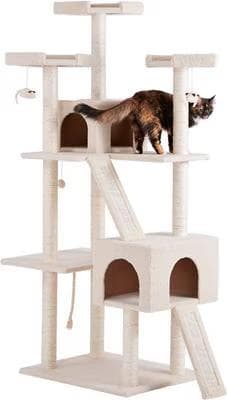
"Heavy duty" is the least regulated phrase in this category. Across the pages currently ranking for this term, none published a weight capacity figure at all while still selling stability as the headline benefit. That absence is the single most useful thing to know before you shop, because it tells you the number is usually not there to compare. The Frisco 72-in Large Base Faux Fur Cat Tree & Condo is a useful benchmark for what a broader footprint looks like.
Webvet may earn a commission when you click through to Chewy, at no extra cost to you.
How much weight can a cat tower hold?
When a maker does publish a capacity, it is nearly always stated per platform rather than for the whole unit, and it describes static load rather than a cat landing from a jump. Read it as a floor, not a ceiling: a platform rated for a given weight is being described at rest, and a 15 pound cat landing hard generates considerably more force than 15 pounds. When no figure is published at all, which is the common case, judge the build instead. Thicker platforms, posts you cannot flex by hand, bolts that pass through the platform rather than screws biting into a particleboard edge, and a base heavier than the top assembly all matter more than any marketing adjective on the box.

How do I stop a cat tower from wobbling or tipping?
Wobble almost always traces to one of four causes, and all four are fixable. Start by re-tightening every bolt after the first 48 hours and again a month later, because plush-wrapped joints compress and loosen as they settle. Next, check the floor: thick carpet lets a base rock, so slide a thin plywood board or a hard chair mat under it. Third, level the base with furniture shims if the floor itself is uneven. Finally, anchor anything over five feet to a wall stud with an anti-tip strap, the same hardware used for bookcases and dressers. A wide base helps, and a practical working rule is to look for a shorter base dimension at least a third of the total height before you rely on the tower without a strap.
Window perches deserve a mention here because they are one of the few products in this space where a maximum supported weight is routinely printed on the listing. A mounted perch such as the Coziwow Cat Window Perch will state a limit, and that limit is worth taking literally, especially with a heavy cat or with two cats who like to share a sunny spot. Check the number, check the mounting method, and re-check the mount every few weeks.
Materials and what actually wears out first
Nearly every mainstream tower is built from the same three material families, and each one fails in a predictable way. Knowing which failure you will hit first tells you what to prioritize.
- Sisal rope posts fray from the top down where the cat pulls hardest. The best towers let you re-wrap or replace a post, which is the single most valuable longevity feature in the category and one that almost no budget model offers.
- Carpet and faux fur platforms shed, mat, and hold odor. They are comfortable and cheap, and they are the reason a three-year-old tower looks tired even when the frame is fine. Vacuuming with an upholstery head and keeping claws trimmed with a decent pair of cat nail clippers slows the shredding noticeably.
- Particleboard and MDF cores sag at the middle of unsupported spans after repeated landings, especially on wide platforms with a single central post. Solid wood frames avoid this and last the longest, at a real cost in price and shipping weight.
A flat cardboard scratcher placed near the tower absorbs a surprising amount of the wear the posts would otherwise take, and cardboard is the surface many cats prefer for horizontal scratching. A durable lounge-style option such as the PetFusion Ultimate Cat Scratcher Lounge works well next to a tower for exactly that reason: it gives the horizontal option the tower does not have.
Which cat tower tier suits your household
This is the question behind the query. Height, perches, and footprint only matter once they are matched to the cats who live with them.
| Household | Start with this tier | Minimum usable perches | The feature that matters most |
|---|---|---|---|
| Single adult cat | 4 to 5 ft | 2 to 3 | A window-adjacent placement |
| Kitten under one year | Under 3 ft, or 3 to 4 ft | 2 | Low first step and a wide base |
| Senior or arthritic cat | Under 3 ft | 1 to 2 | Ground-level bed and steps under 10 in apart |
| Two cats | 5 to 6 ft | 3 to 4 | Perches on opposite sides, not stacked |
| Three or more cats | 5 to 6 ft, or two towers | 4 plus one spare | Separation and a second exit route |
| Large breed over 15 lb | 4 to 6 ft, reinforced | 2 to 3 | Platform width of 14 in or more |
| Small apartment | 3 to 4 ft | 2 | Base under 18 in on the long side |

Which cat tower is right for a multi-cat household?
Prioritize width and separation over height. Two cats on a narrow six-foot column will compete for the single top perch, while the same two cats on a five-foot tower with perches on opposite faces will settle into their own spots within days. Aim for one comfortable resting place per cat plus one spare, give at least two of those spots a clear escape route that does not pass another cat, and consider splitting the budget across two smaller towers in different rooms rather than one large one. Cats share vertical territory by time-sharing and distance, and a layout that offers both is worth more than an extra foot of height.
Do older cats and kittens need a different cat tower?
Yes, and in the same direction: lower and easier. Kittens are fearless but uncoordinated, so a first tower should be short, wide-based, and have a first step under about eight inches so a fall is trivial. Senior cats and cats with arthritis need the opposite of a challenge: closely spaced steps, a ramp or a low first platform, a soft ground-level bed, and no expectation that they will use the top. If a cat who used to climb suddenly stops, that is worth a conversation with your veterinarian rather than a furniture upgrade, and our guide to mobility changes in senior cats explains what is normal and what is not.
Cat towers for large cats and heavy breeds
Maine Coons, Ragdolls, Norwegian Forest Cats, and any cat over about 15 pounds change the specification meaningfully: platforms need to be wider and thicker, posts need more diameter, and the base has to counterweight a much heavier animal moving at the top. Rather than half-answer that here, we built a separate guide. Start with cat trees for large cats for reinforced platform sizing, perch dimensions by breed, and which builds hold up to a heavy landing.
Small-footprint cat towers for apartments
If the footprint table above ruled out everything you liked, the answer is usually a different format rather than a compromised tower. Compact builds, wall-mounted shelves, and window perches all deliver vertical territory in far less floor space. Our roundup of small cat trees for tight spaces covers the sub-18-inch-base options and how to get real height out of a narrow corner. A small cat tree with a bed can still fit, but verify that the bed does not crowd the only usable perch.
Design-forward and novelty cat tower shapes
Flower and cherry blossom cat tree designs, hot pink finishes, mushroom shapes, cloud platforms, and furniture-grade wood builds have become a genuine sub-category, and they are worth considering if the tower has to live in a room you care about aesthetically. The trade-offs (usually less total perch area for the same footprint, and sometimes a narrower base) are covered in our guide to modern cat trees.
Where to buy a cat tower and what each price tier gets you
Prices in this category move constantly with sales, so treat the tiers below as what a given budget typically buys rather than as fixed figures.
| Price tier | What it typically includes | What to check carefully |
|---|---|---|
| Under $60 | 2 to 4 ft, particleboard core, carpet or faux fur, 1 to 2 perches | Base weight, post flex, and whether hardware is bolts or staples |
| $60 to $150 | 4 to 6 ft, several perches, a cubby, sisal posts, anti-tip strap often included | Platform width for larger cats and whether posts are replaceable |
| $150 to $300 | 5 to 7 ft, thicker platforms, wider base, better fabric, sometimes solid uprights | Shipping weight as a proxy for build, and return policy on a bulky item |
| Over $300 | Solid wood frames, furniture finishes, replaceable components, long service life | Lead times, assembly complexity, and whether the design suits your cat's habits |
Where can I buy a cat tower near me?
Big-box pet chains and general retailers stock towers on the shelf for same-day pickup, and that in-store selection skews toward the 3 to 5 foot range in budget and midrange builds because those are the sizes that fit a pallet and a car. Online specialists carry the wider range, including tall multi-cat builds and solid-wood models that no store stocks locally. The practical move is to search the retailer's own site with your zip code and filter to in-stock-at-store rather than searching generically, since local inventory changes weekly and the store page will show you the exact model on the floor today.
Are Walmart, PetSmart, and Amazon cat towers any good?
Broadly, yes, for the tier they occupy. The mass-market channel is largely supplied by the same factories using the same particleboard, sisal, and carpet, so the retailer logo tells you far less than the spec sheet does. Compare stated height, base dimensions, platform width, and shipping weight across listings and you will find near-identical products at different prices. Where the channels genuinely differ is service: return policy on a heavy boxed item, whether replacement parts are sold, how honest the listed dimensions are, and whether customer photos show the tower in a real room. Clearance and seasonal sales are common in this category, so a midrange tower is often available at a budget price if you are willing to wait.
Assembly, placement, and getting your cat to use the tower
Assembly is the step every ranking page skips, and it is a real factor when the box weighs 40 pounds and the instructions are a single diagram.
How hard is a tall cat tower to assemble?
Plan on 30 to 60 minutes for a five to six foot tower, a hex key that is usually included, and a second person for the last two levels. The parts themselves are simple: platforms, posts, bolts, and washers stacked in order. The difficulty is handling, because a half-built tower is awkward and top-heavy while you align the upper posts. Two habits prevent most problems. Leave every bolt finger-tight until all the parts are seated, then tighten in stages from the base upward. And build the tower in the room where it will live, since a completed six-foot unit does not turn a tight corner or clear a standard doorway easily.
Once it is standing, getting a cat to actually use it is mostly patience and placement:
- Put it where the household spends time, ideally with a window view, rather than in a spare room.
- Move something that already smells like your cat, a used blanket or a favorite bed cover, onto one of the perches.
- Reward the climb rather than the tower. Place a treat on the first platform, then the second, over a few short sessions instead of lifting the cat onto it.
- Try catnip or silvervine on the posts and platforms, and re-apply after a week if the first attempt gets no reaction.
- Give it two to three weeks before you conclude it failed. Many cats investigate a new structure only after the newness wears off.
If your cat uses the perches happily but keeps scratching the sofa instead of the posts, that is a post-preference problem rather than a tower problem, and our guide to what to do when a cat will not use the scratching post walks through the fixes.
Cat tower questions
Frequently Asked Questions
Do indoor cats really need a cat tower?
They need vertical space, and a tower is the most efficient way to provide it in a small footprint. Veterinary guidance on feline environmental needs identifies an elevated, safe resting place as a core resource for indoor cats, alongside separated food, water, and litter areas. Shelves, window perches, and cleared furniture tops can all serve the same purpose. A tower simply bundles elevation, a hiding spot, and a scratching surface into one object, which is why it is usually the easiest single purchase for a cat living entirely indoors.
What is the best cat tower for a large cat?
Large and heavy cats need wider platforms, thicker decking, larger post diameter, and a base heavy enough to counterweight them at the top, which is a different specification from a standard tower. Breed weights, platform dimensions, and reinforced builds are covered properly in our guide to cat trees for large cats, which is the right starting point for a Maine Coon, Ragdoll, or any cat over roughly 15 pounds.
Is there a small cat tower for an apartment?
Yes, and the compact formats are a genuine category rather than a downgrade. Sub-18-inch bases, wall-mounted shelving, and window perches all deliver vertical territory without claiming much floor. The trade-off is usually perch count rather than quality. Our roundup of small cat trees for tight spaces covers the options and how to get useful height out of a narrow corner or a rental you cannot drill into.
Where can I find a pink, flower, or cute-looking cat tower?
Design-forward towers are now a real sub-category, including flower and mushroom shapes, cloud platforms, and furniture-grade wood builds that suit a living room you care about. They generally trade some perch area and base width for looks, which matters more with heavy or multi-cat households. Our guide to modern cat trees covers the aesthetic options and the practical compromises each shape involves.
Are wooden cat towers better than carpeted or plush ones?
Solid wood lasts longer and resists the platform sag that particleboard develops under repeated landings, and it usually holds a heavy cat more confidently. Plush and carpeted towers are warmer, quieter, cheaper, and often more attractive to cats who like to knead a soft surface. The practical answer for most homes is a wood or reinforced frame with soft pads on the perches, which gets the structural life of one and the comfort of the other without paying full furniture prices.
Why does my cat scratch the furniture instead of the post on the tower?
Usually because the post does not offer what the cat wants: it may be too short for a full stretch, wrapped in a texture the cat dislikes, or placed away from the spot the cat is trying to mark. Cats scratch to stretch, to maintain claws, and to leave visual and scent marks in socially important places, which is why the sofa near the door often wins. Our guide to what to do when a cat will not use the scratching post walks through diagnosing and fixing post preference.
How long should a cat tower last, and when should I replace it?
A midrange tower used by one or two cats typically gives several years of service, with the sisal posts fraying first and the fabric matting next. Replace or re-wrap posts when the rope unravels enough to snag claws. Replace the whole tower when a platform flexes underfoot, when a joint will not stay tight after re-torquing, or when the base has developed a rock you cannot shim out. A structure that moves under a cat teaches the cat to stop using it.
Sources

Editor
The Webvet Editorial Team is the in-house group of pet-care editors and writers behind Webvet, operated by Smart Pet Collective. The team researches, writes, and maintains Webvet's pet health, behavior, and medication content. Every article follows a defined editorial process: research from reputable veterinary and scientific sources, careful drafting, mandatory review of medical content by a credentialed veterinarian, and dated publication. Health and medication articles are medically reviewed by a licensed veterinary professional before they go live and are kept current over time.


