Best Puppy Crates: Divider Panels, Size-Up Timing, and Vet-Reviewed Picks
Vet-reviewed guide to puppy crates: why one adult-size crate with a divider beats buying three, how to estimate adult size, which styles suit a chewing puppy, and the crates to set up on day one.

BVMS MRCVS

This article contains affiliate links. Webvet may earn a commission when you buy through them, at no extra cost to you.
The best puppy crate for most homes is the crate your dog will need as an adult, closed down with a divider panel. Set the divider so the puppy can stand, turn around, and lie down, with no spare end to use as a toilet. Move it back as the puppy grows, and one crate lasts for life.
The size rule comes before any brand: choose the puppy crate by expected adult size, not by the puppy in your arms. On PetMD's vet-reviewed sizing chart, a Corgi or Beagle belongs in the 30 inch class and a Labrador Retriever in the 42 inch class.
We compared six wire crates listed on Chewy in October 2026 by adult size class, divider, floor grid, pan, and doors.
| Crate | Best fit | Material and format | Key listing detail | Main tradeoff |
|---|---|---|---|---|
| MidWest Double Door Collapsible Wire Puppy Crate with 1/2 inch Floor Grid, 35 inch | Puppies in early house training that benefit from a raised floor | Wire crate with a black e-coat finish, front door plus top panel | Adjustable floor grid and two leak-proof pans | Highest price of the six; the listing does not mention a divider |
| EliteField 3-Door Collapsible Wire Dog Crate with Divider, 36 inch | Puppies headed for the 41 to 70 lb adult class that need several ways in | Steel wire, folding, three doors | Divider and slide-out ABS pan included, per the maker | No floor grid; the maker lists it at 36 x 24 x 26 inches |
| MidWest iCrate Double Door Fold & Carry Dog Crate, 36-in, 41 to 70-lbs | Medium-breed puppies, at home and in the car | Coated welded wire, folds flat without tools, front and side doors | Divider panel, leak-proof pan, rubber feet, carry handle | No floor grid in the listing |
| Frisco Heavy Duty All-in-1 Multi-Stage 3 Door Collapsible Wire Dog Crate, Small | Small-breed puppies that need a grid and a divider together | Coated wire, three doors on the front, side, and top | Floor grid for puppies up to 30 lb, removable pan, divider | The listing gives no inch dimensions for the Small size |
| Yaheetech Foldable Wire Dog Crate with Divider, Black, 42 inch | Large-breed puppies in the 71 to 90 lb adult class, such as Labradors | Powder-coated wire, two doors, folds with locking buckles | Pull-out waterproof tray, dual locks, carry handle | The listing does not describe the divider or give dimensions |
| Frisco Fold & Carry Single Door Collapsible Wire Dog Crate, 30 inch & Frisco Quilted Dog Crate Mat, Ivory, 30-in | Small-breed puppies expected to fill a 30 inch crate | Wire crate, single door with dual latches, sold with a mat | Plastic base pan plus a quilted plush mat | No divider in the listing; the mat is sold as soft, not chew-proof |

 Sponsored
Want a vet's help with your dog's anxiety or behavior?
Talk to a licensed vet at Dutch over video, often the same day. They can recommend treatment and prescribe it when it's appropriate.
Use code Pets60
Plans start at $12/month · covers up to 5 pets
- Licensed vets in most states
- Rx for 150+ conditions
- 4.7 on Trustpilot
Why one crate with a divider beats buying three
A growing puppy needs a small space now and a much bigger one later. You can cover both with one crate or with a string of crates.
MidWest Homes for Pets makes the case for one: its crates come with a free divider panel, which it says lets you buy one crate for your dog's lifetime and save money in the end.

Veterinary guidance lands in the same place. PetMD, in an article reviewed by Jennifer Coates, DVM, gives two routes for a puppy: buy a crate for the expected adult size and use a removable divider, or buy several crates as the puppy grows.
The American Kennel Club points the same way, suggesting an expandable crate as large as the typical adult size of your dog's breed. Humane World for Animals adds that if your dog is still growing, you should choose a crate that will accommodate their adult size.
- 1Buying one crate with a divider beats buying three smaller crates: the divider shrinks the space now and moves back as your puppy grows.
- 2Start by estimating adult size from the breed, the parents, and a simple weight check, then buy that crate length once.
- 3Set the divider so the puppy can stand, turn around, and lie down, with no spare end to use as a toilet.
- 4Move the divider back whenever the fit gets tight, and take it out once your dog is full grown and reliably clean in the crate.
- 5For a puppy that chews, a coated wire crate is the sturdier material choice.
The divider route wins on three practical counts:
- Cost: you pay for one crate once, instead of a new crate at each growth stage.
- Fit control: a divider sets the exact space the puppy needs at each stage, rather than settling for whichever fixed crate size happens to be closest.
- Continuity: the puppy keeps the same crate in the same spot from the first night into adulthood, so the space it learns to settle in never changes.
Buying more than one crate still has a place. PetMD says purchasing multiple crates is a good option when the adult size of the pup is difficult to estimate, as it can be with a mixed-breed puppy whose parents are unknown.
Humane World for Animals also notes that some shelters rent crates, so owners can trade up as the puppy grows.
For everyone else, match the crate length to the adult size you expect, then let the divider do the work while the puppy grows. The weight bands and example breeds here follow PetMD's vet-reviewed crate chart, and the growth timing follows the AKC and VCA Animal Hospitals.
| Expected adult size | Example breeds | Crate length to buy once | Divider use as the puppy grows | When growth usually ends |
|---|---|---|---|---|
| Toy | Check the breed standard and both parents | The smallest crate that fits the adult dog; MidWest's iCrate line starts at 18 inches | Short divider phase with frequent checks, since toy puppies reach adult size early | Small breeds: 6 to 12 months |
| Small to medium, 26 to 40 lb | Beagle, French Bulldog, Boston Terrier, Corgi | 30 inch, the 30 x 20 x 23 in row | Divider from day one, moved back over the first months | Small breeds: 6 to 12 months; medium breeds: around 12 months |
| Medium to large, 41 to 70 lb | English Bulldog, Bull Terrier, Australian Cattle Dog, Pit Bull Terrier | 36 inch, the 36 x 24 x 26 in row | Divider in use for most of the first year | Medium breeds: around 12 months |
| Large, 71 to 90 lb | Labrador Retriever, Golden Retriever, Boxer | 42 inch, the 42 x 28 x 30 in row | Divider moved back in steps for a year or more | Most large breeds: 12 to 18 months |
| Giant | Mastiff and other giant breeds | 48 inch, the largest iCrate and LifeStages size; compare XL crates if the adult will not fit | Divider stays in use the longest | Giant breeds: 12 to 18 months; mastiffs: up to about 2 years |
The same buy-once logic applies to adult dogs, and our guide to the best dog crates covers crates for grown dogs of every size. The rest of this article stays with puppies and the decisions that come with a growing dog.
Our picks: the best puppy crates
WebVet did not test these crates hands-on. Each pick rests on its Chewy listing, the maker's published details where they exist, and the vet-reviewed sizing guidance cited throughout. Where a listing gives a length, we matched it to an adult size class on PetMD's chart.
All six are wire crates for a reason. The American Kennel Club says metal crates are best for dogs that tend to chew through other materials, and PetMD calls coated steel wire crates excellent options for durability and easy cleaning.
How to narrow the six down to one:
- A raised floor for house training: the MidWest 35 inch and the Frisco Multi-Stage are the two listings with a floor grid.
- A divider in the box: the EliteField, the iCrate, the Frisco Multi-Stage, and the Yaheetech all come with one.
- A small puppy crate: the Frisco Multi-Stage Small or the Frisco 30 inch bundle.
- A medium-breed puppy, 41 to 70 lb as an adult: the iCrate 36 or the EliteField 36.
- A large puppy crate for a Labrador or similar breed: the Yaheetech 42 inch.
- Travel and the car: the folding models, with the iCrate listing naming home, vehicle, and vacation rental use, and the Yaheetech folding down with locking buckles and a handle.
- The lowest price: the Frisco 30 inch bundle.
No crate fixes a behavior problem on its own. If a puppy keeps peeing or pooping in the crate, check the space before anything else: the AKC explains that a crate that is too large lets a dog eliminate and then sit away from the mess. Moving the divider forward is the first fix to try.
A puppy that cries all night in the crate, hates the crate, or shows crate anxiety needs a training plan more than a different crate. Our guides to a puppy crying in the crate and how to crate train a puppy walk through that side step by step.
MidWest Double Door Collapsible Wire Puppy Crate with 1/2 inch Floor Grid, 35 inch: best puppy crate with a floor grid
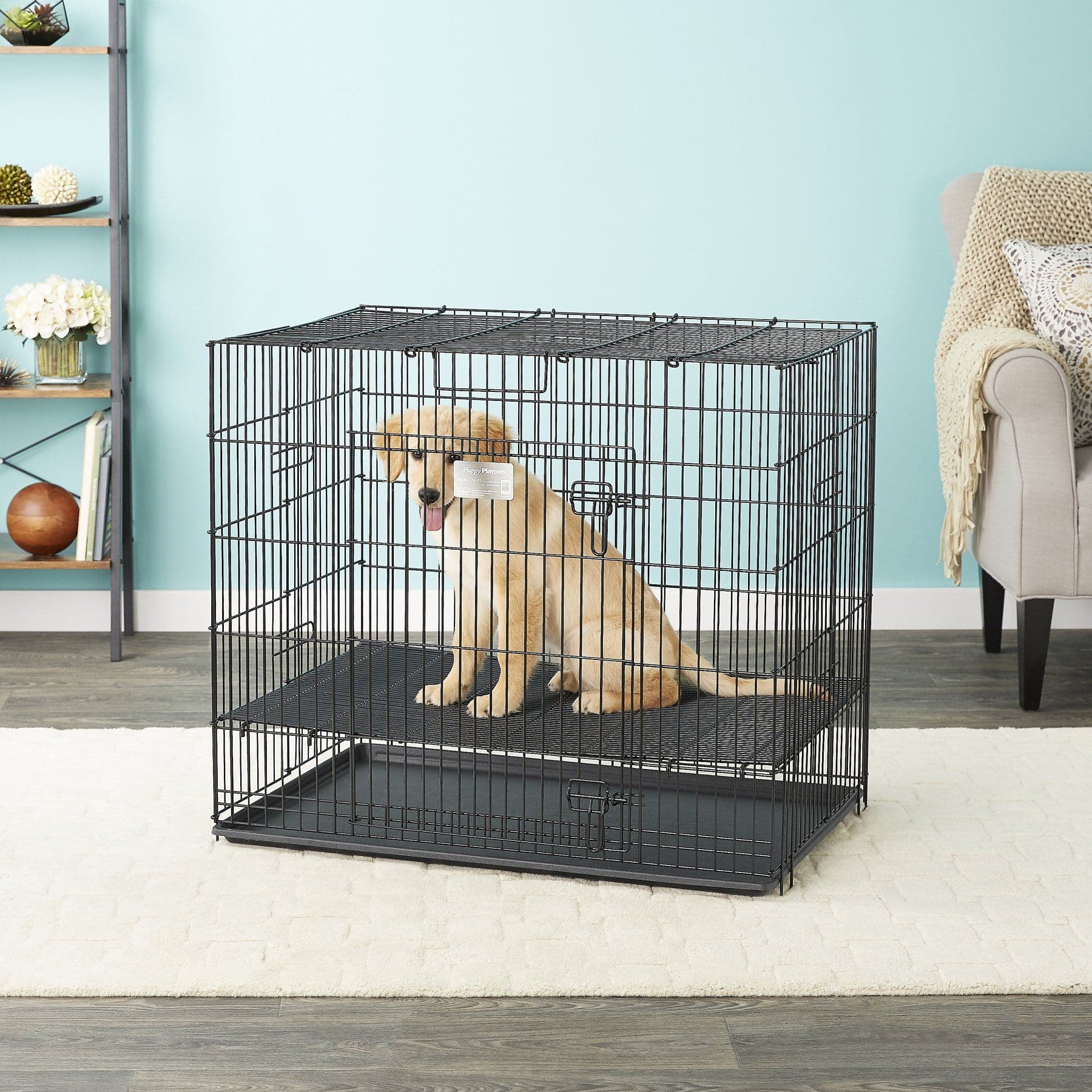
A 35-inch wire puppy crate with an adjustable floor grid and two leak-proof pans, per its Chewy listing.
Webvet may earn a commission when you click through to Chewy, at no extra cost to you.
This crate is built around its floor grid. Chewy's listing describes a paw-friendly metal grid that keeps the puppy raised off the crate floor if an accident happens. It was listed at $194.99 on Chewy when we checked in October 2026.
What the listing confirms:
- A floor grid that adjusts up or down to suit a growing puppy, for longer use
- Two easy-to-remove, leak-proof replacement pans
- A durable black e-coat finish
- Two ways in: a front door and a top panel
- Grid spacing of 1/2 inch or 1 inch depending on size; this 35 inch model carries the 1/2 inch grid in its product name
Who it suits: a puppy still in early house training, when accidents happen and a raised floor keeps paws out of the mess. The top panel also gives you a second way to reach a small puppy besides the front door.
The tradeoff: it was listed at about four times the price of the Frisco 30 inch bundle on Chewy in October 2026. The listing text also does not mention a divider panel.
At 35 inches it falls between PetMD's 30 and 36 inch rows, so measure against the adult your puppy will become before you commit.
EliteField 3-Door Collapsible Wire Dog Crate with Divider, 36 inch: best three-door crate with divider
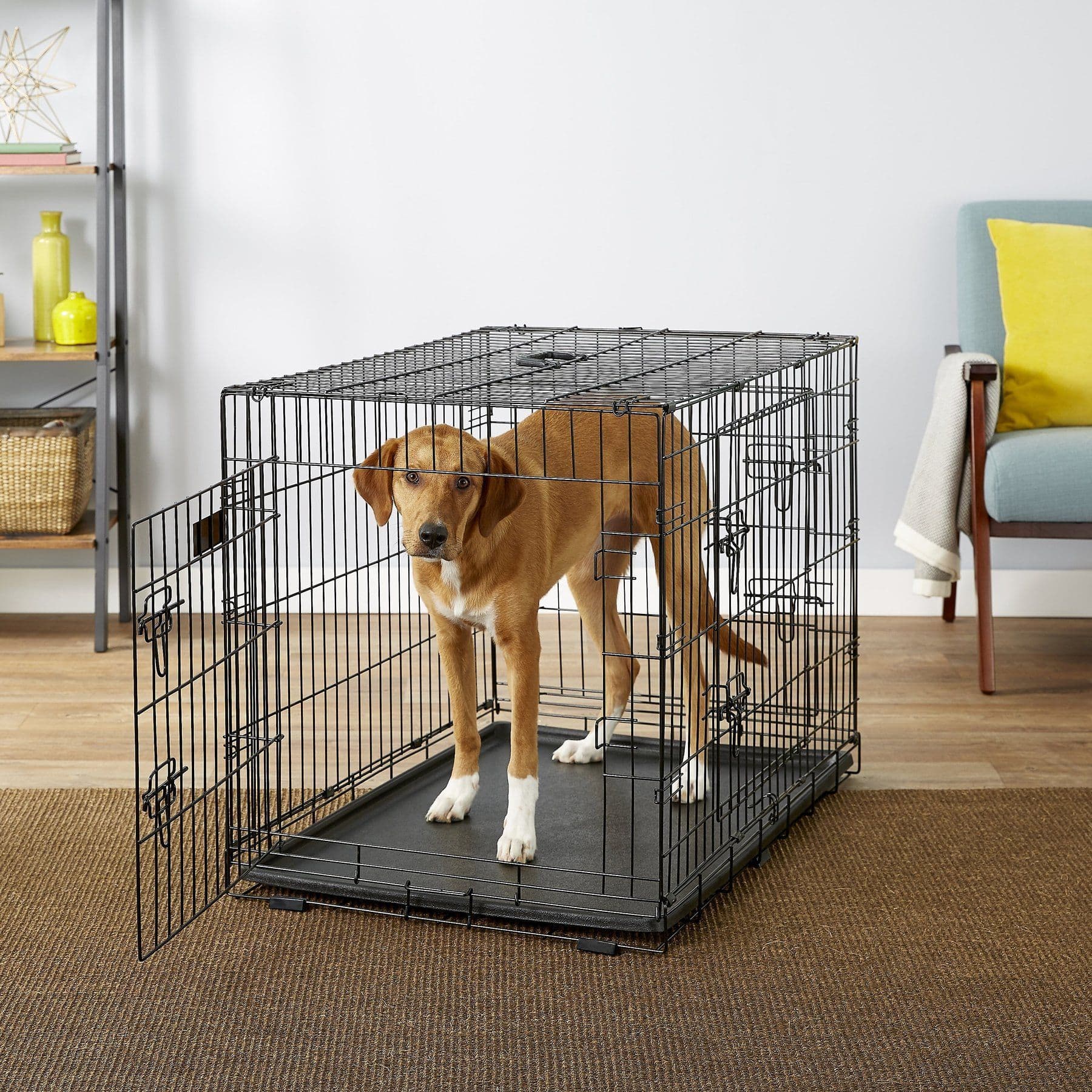
A three-door steel wire crate with a divider, sold for weaning and housetraining puppies, in the 36-inch size.
Webvet may earn a commission when you click through to Chewy, at no extra cost to you.
EliteField's crate pairs a divider with three doors, making it one of the two three-door crates in our set. It was listed at $91.19 on Chewy at the time of writing.
EliteField lists this size at 36 inches long, 24 inches wide, and 26 inches high, a match for PetMD's 36 x 24 x 26 inch row. The maker adds a slide-out ABS pan and two self-locking bolt latches on each of the front, side, and back doors.
What the listing confirms:
- Three doors, giving your puppy several ways in and out and you several ways to reach in
- Solid steel construction that the listing calls easy to clean
- An added divider so a puppy can grow into the crate
- Sold for weaning puppies from their mother and for housetraining
- A folding design pitched as a traveling home
Who it suits: a puppy expected to reach the 41 to 70 pound adult class, such as an English Bulldog or Australian Cattle Dog, PetMD's 36 x 24 x 26 inch row.
Three doors also help when the crate has to sit against a wall or in a corner and you still need a door you can reach.
The tradeoff: neither the listing nor the maker mentions a floor grid, so accidents land on the pan. Check the 26 inch height against your puppy's expected adult size before ordering.
MidWest iCrate Double Door Fold & Carry Dog Crate, 36-in, 41 to 70-lbs: best value crate a medium-breed puppy grows into
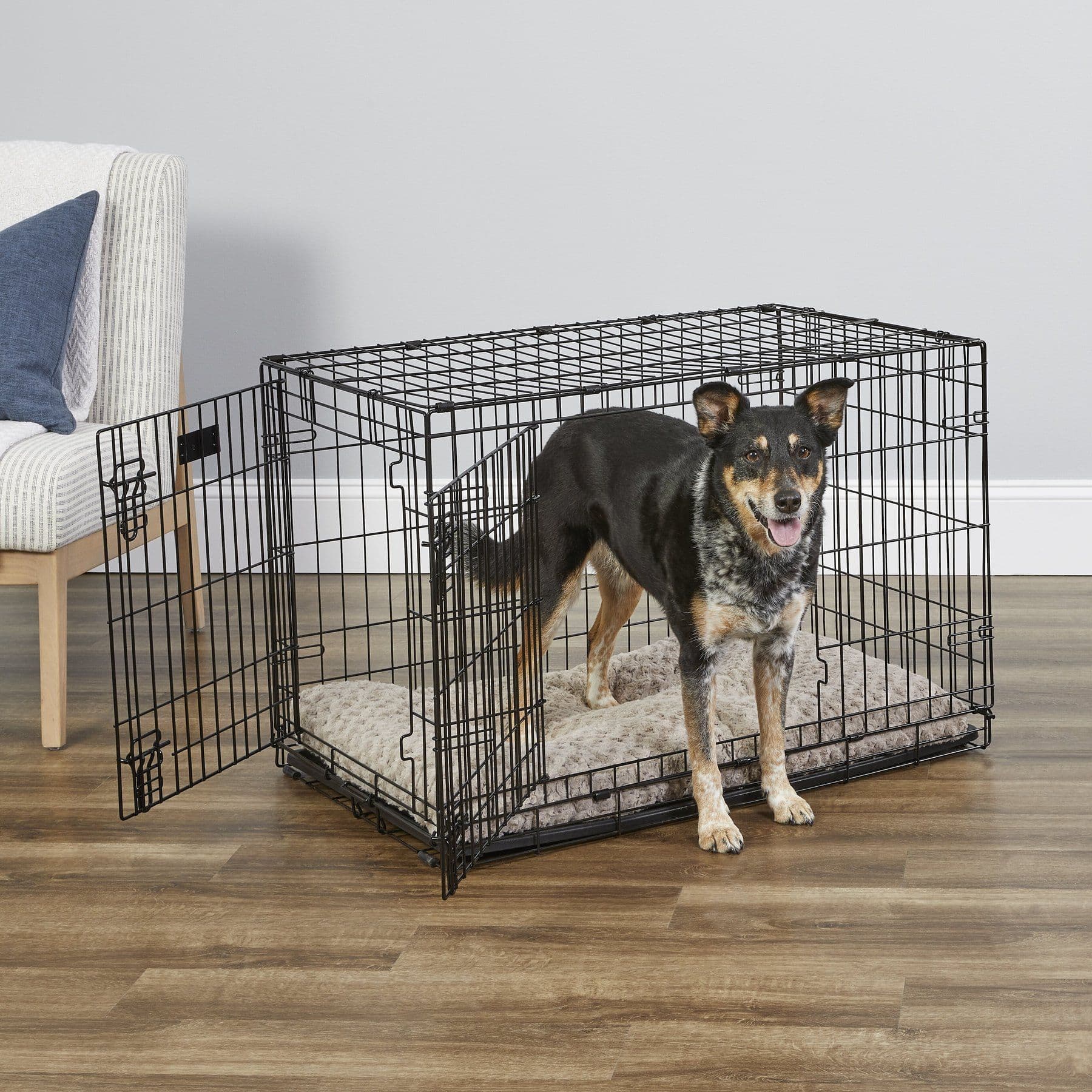
A fold-flat 36-inch wire crate with front and side doors, a divider panel, and a leak-proof pan.
Webvet may earn a commission when you click through to Chewy, at no extra cost to you.
The iCrate is MidWest's widest-ranging crate line. The maker lists seven sizes from 18 to 48 inches, in single or double door, with a divider panel in the box.
This is the 36 inch double-door model, sold for dogs of 41 to 70 pounds. It was the lower-priced of the two 36 inch crates on our list on Chewy at the time of writing.
From the maker size data:
- MidWest's size data puts this model at 35.6 inches long, 21.9 inches wide, and 24.5 inches high, smaller than PetMD's 36 x 24 x 26 inch row.
- For a tall adult in the 41 to 70 pound class, check that 24.5 inch height against the 2 inch head clearance PetMD recommends.
What the listing confirms:
- Front and side doors, so the crate can sit against a wall, in a corner, or anywhere that suits your space
- An included divider panel, so it works as a puppy kennel or a full-size crate
- A leak-proof pan, rubber feet to protect floors, and a carrying handle
- MidWest's Paw Block and locking tips on the slide-bolt latch
- Coated, precision-welded wire that the listing says resists rust and wear
- Folds flat without tools, with the listing naming home, vehicle, and vacation rental use
- Large openings and low thresholds for easy entry and exit
Who it suits: a medium-breed puppy headed for the 41 to 70 pound class, in a home that wants one crate for the living room and the car. The divider and pan cover the puppy months; the fold-flat frame covers travel.
The tradeoff: there is no floor grid in the listing, so accidents land on the pan. The listing also opens with a reminder to measure for the right fit, and the weight band in the name is a guide, not a guarantee. Measure against the adult dog's expected length and height. MidWest's one-year warranty covers manufacturing defects only, not damage caused by the dog.
Frisco Heavy Duty All-in-1 Multi-Stage 3 Door Collapsible Wire Dog Crate, Small: best multi-stage crate for a growing puppy
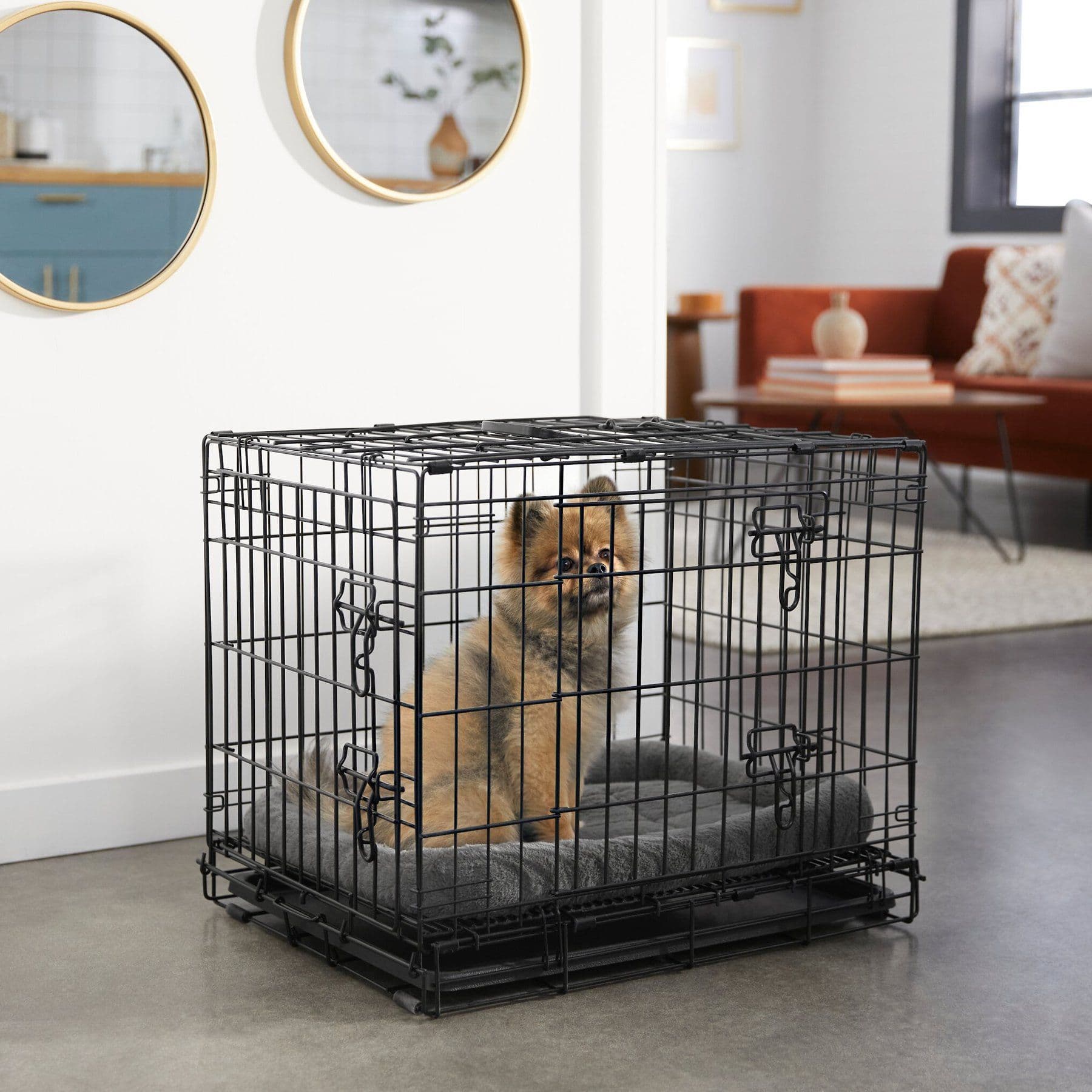
A three-door wire crate with a floor grid for puppies up to 30 pounds, a removable pan, and a divider panel.
Webvet may earn a commission when you click through to Chewy, at no extra cost to you.
Frisco's Multi-Stage crate is the only pick that lists both a floor grid and a divider panel. That combination covers the two big puppy jobs: keeping the space small and keeping the puppy off any mess. It was listed at $51.79 on Chewy when we checked in October 2026, the second-lowest price of the six.
What the listing confirms:
- A floor grid that elevates puppies up to 30 pounds during potty training
- A removable, easy-to-clean pan that catches anything that falls through
- A divider panel for adjusting the interior space as your puppy grows
- Three doors, on the front, side, and top
- A fold-and-carry design with no tools needed for assembly
- Nonskid rubber feet, coated wire, and dual bolt latches on each door
Who it suits: a small-breed puppy in house training. VCA Animal Hospitals says small breeds usually reach adult size between 6 and 12 months, so the grid and divider stages pass within the first year and the crate carries on as a plain adult crate.
The tradeoff: the listing gives no inch dimensions for the Small size, so confirm the measurements on the product page against your puppy's expected adult size. The grid is rated for puppies up to 30 pounds, so a puppy that will pass that weight outgrows the grid stage.
Yaheetech Foldable Wire Dog Crate with Divider, 42 inch: best budget crate for large-breed puppies
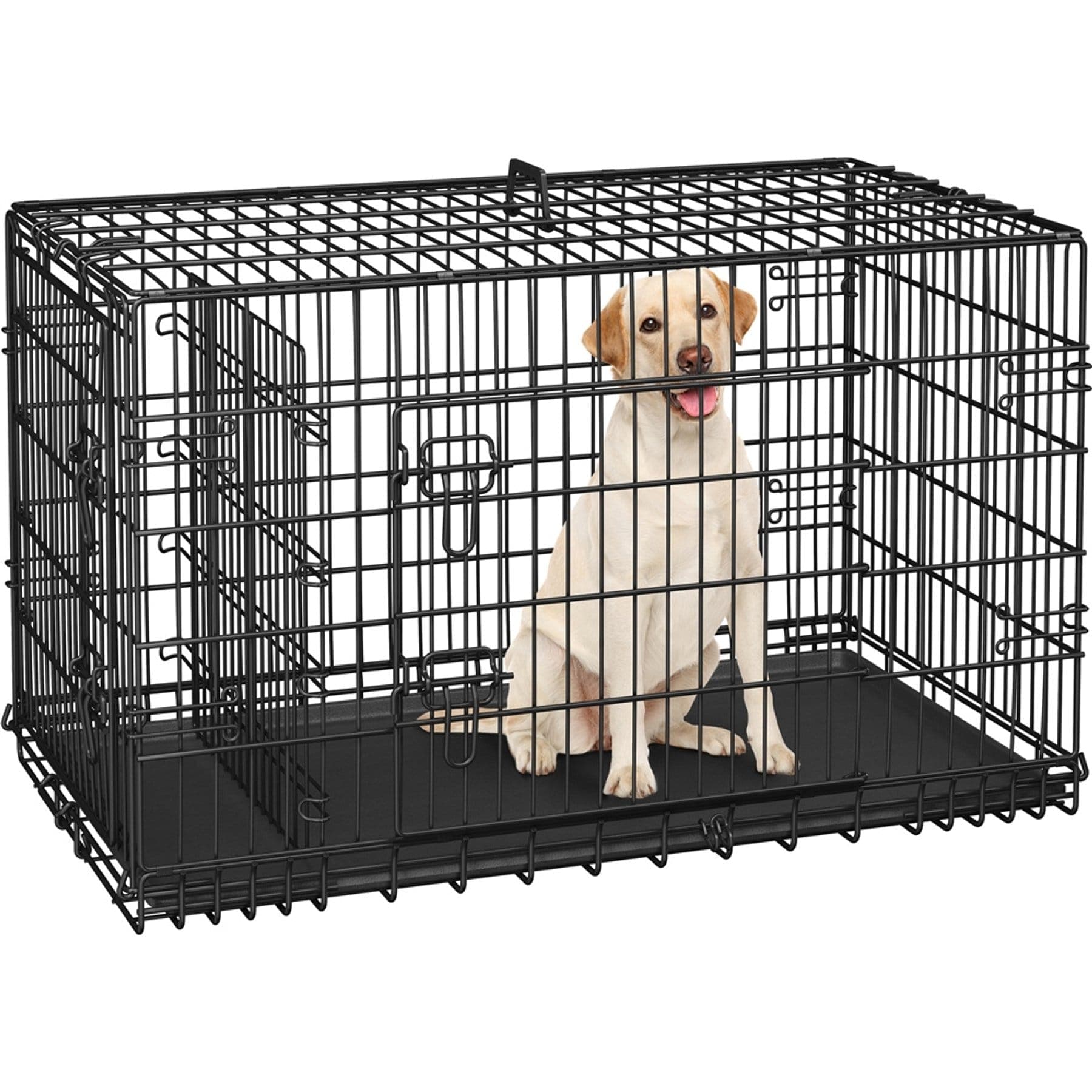
A 42-inch double-door wire crate with a divider, dual locks, and a pull-out waterproof tray at a budget price.
Webvet may earn a commission when you click through to Chewy, at no extra cost to you.
This is the only 42 inch crate on our list. That is the crate size PetMD's chart gives for Labrador Retrievers, Golden Retrievers, and Boxers in the 71 to 90 pound range. It was listed at $68.99 on Chewy when we checked in October 2026, less than the EliteField 36 inch and the MidWest 35 inch.
What the listing confirms:
- Powder-coated wire reinforced with metal locks
- Two doors with a dual-lock system that the listing pitches as escape prevention
- A pull-out waterproof tray for cleanup and odor control
- A frame that folds down with locking buckles, plus a handle for carrying
- A divider, named in the product title
Who it suits: a Labrador or other large-breed puppy whose owner wants to buy the adult crate on day one without paying a premium. VCA says most large breeds reach adult size between 12 and 18 months, so the divider earns its place here for longer than on the smaller picks.
The tradeoff: the listing text does not describe the divider or give dimensions, and Yaheetech's own website carries no product details for it. Check the measurements on the product page against PetMD's 42 x 28 x 30 inch row before you buy.
Frisco Fold & Carry Single Door Collapsible Wire Dog Crate, 30 inch: best starter crate for small-breed puppies
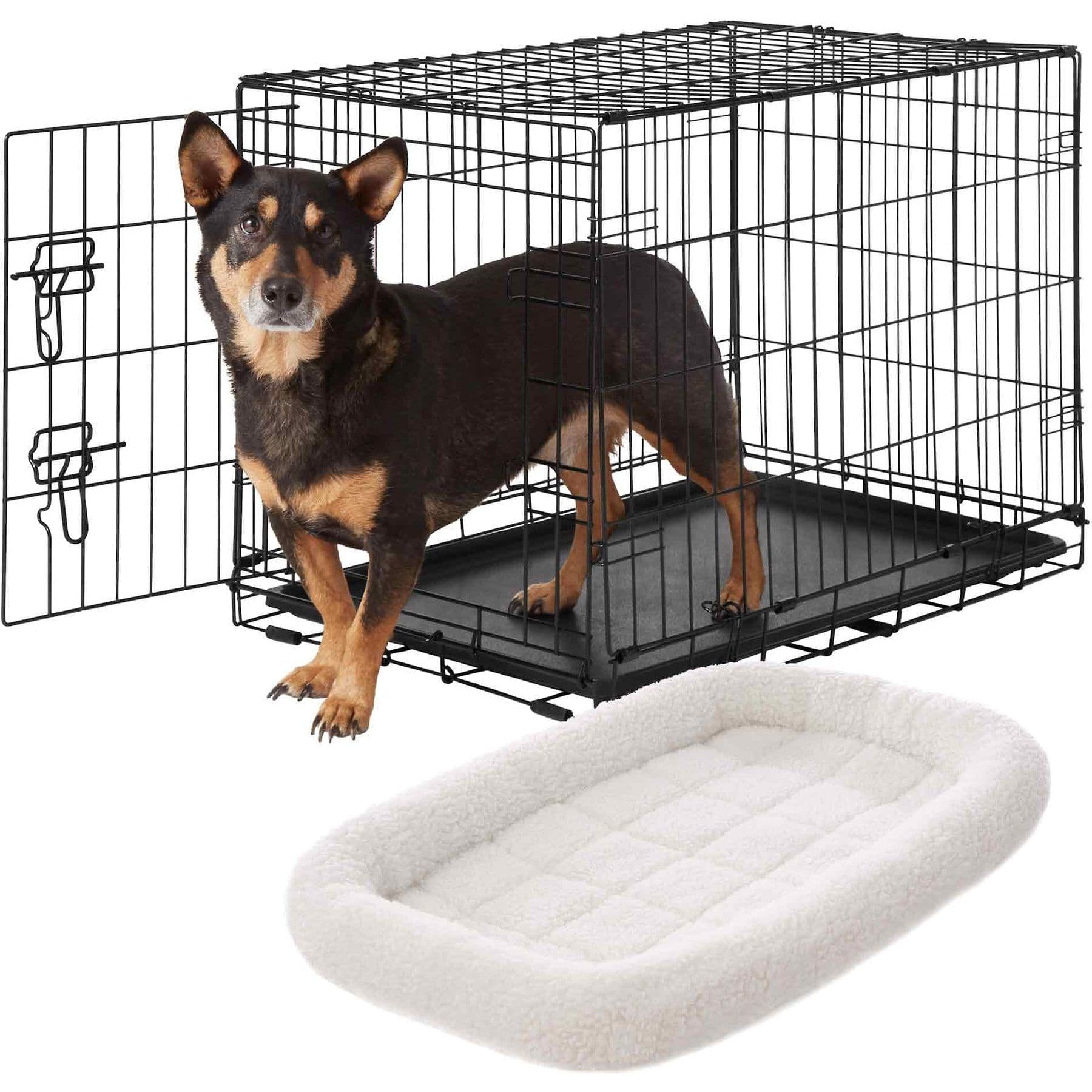
A 30-inch single-door wire crate sold with a quilted crate mat and a plastic base pan, at the lowest price here.
Webvet may earn a commission when you click through to Chewy, at no extra cost to you.
This bundle pairs Frisco's 30 inch Fold & Carry crate with a quilted crate mat. It was listed at $47.86 on Chewy when we checked in October 2026, the lowest price of the six. Thirty inches is the crate class PetMD gives for 26 to 40 pound dogs such as Beagles, French Bulldogs, Boston Terriers, and Corgis.
What the listing confirms:
- A single door that opens, closes, and locks with dual latches
- An included plastic base pan for cleanup
- A quilted plush mat made with ultra-soft material and a foam pad underneath
Who it suits: an owner who wants a 30 inch crate and its bedding in one low-cost order, for a small-breed puppy that will grow into that class. It also suits an older small-breed puppy that already fills much of a 30 inch crate.
The tradeoff: the listing does not mention a divider panel, so a young puppy gets the full 30 inches from day one, the extra space the AKC links to eliminating in the crate.
Two cautions on the bedding:
- Preventive Vet also says bedding for young puppies should ideally be chew-proof and waterproof, and the listing sells this mat on softness.
- Hold it back until your puppy stops chewing bedding.
The figures below come from the makers' published specifications where they exist, and from the Chewy listings otherwise.
| Crate | Listed size | Exterior size (L x W x H) | Doors | Divider | Floor grid | Pan or tray |
|---|---|---|---|---|---|---|
| MidWest 35 inch puppy crate | 35 inch | Not published | Front door and top panel | Not published | Yes, adjustable, 1/2 inch spacing | Two leak-proof pans |
| EliteField 3-Door, 36 inch | 36 inch | 36 x 24 x 26 in | Front, side, and back | Yes | Not published | Slide-out ABS pan |
| MidWest iCrate 36 double door | 36 inch | 35.6 x 21.9 x 24.5 in | Front and side | Yes | Not published | Removable leak-proof plastic pan |
| Frisco Multi-Stage, Small | Small | Not published | Front, side, and top | Yes | Yes, for puppies up to 30 lb | Removable pan |
| Yaheetech Foldable, 42 inch | 42 inch | Not published | Two doors | Yes | Not published | Pull-out waterproof tray |
| Frisco Fold & Carry, 30 inch | 30 inch | Not published | Single door | Not published | Not published | Plastic base pan |
 Sponsored
Vet care that's always there
Unlimited video calls and messaging with licensed vets for less than a typical vet visit. One membership covers up to five pets.
Use code Pets60
Plans start at $12/month · covers up to 5 pets
- Licensed vets in most states
- Rx for 150+ conditions
- 4.7 on Trustpilot
Buying for the adult size: estimating how big your puppy will get
So how big should a puppy crate be? Big enough for the dog your puppy will become. That makes the adult estimate the most important number in the whole purchase, and it is worth checking against more than one source before you order.
MidWest Homes for Pets says to look up your puppy's breed on the AKC or another reputable resource and use the size given for the adult. It adds two cautions: males and females of the same breed differ, and the size of the puppy's mom and dad matters if you know it.

Work through the estimate in this order:
- Look up the breed's adult size, using the male or female figure that matches your puppy.
- Ask the breeder or shelter about the parents' size, if it is known.
- Run a weight check using PetMD's rules of thumb once your puppy is old enough.
- Match the estimate to a crate class on PetMD's chart, and to our dog crate size chart for breed-by-breed measurements.
- For a mixed breed with unknown parents, make an educated guess, as MidWest suggests, or take PetMD's several-crates route.
Weight multipliers, and their limits
PetMD gives two weight rules of thumb. For medium to large breeds, multiply the puppy's weight at 4 months by 2. For small and toy breeds, multiply the weight at 6 weeks by 4, or the weight at 8 weeks by 3.
Here is how that plays out with simple numbers:
- A small-breed puppy weighing 5 pounds at 8 weeks: 5 x 3 gives an estimate of about 15 pounds.
- A medium-breed puppy weighing 30 pounds at 4 months: 30 x 2 gives about 60 pounds, PetMD's 41 to 70 pound row and a 36 inch crate.
- A large-breed puppy weighing 40 pounds at 4 months: 40 x 2 gives about 80 pounds, the 71 to 90 pound row and a 42 inch crate.
Treat those results as estimates, not a standard. PetMD says the best way to tell when a dog is fully grown is to check the growth plates with an X-ray. The medium and large breed check also only works at 4 months, which may be after the crate is already in use, so lean on breed and parents first.
How long your puppy keeps growing
Growth timing tells you how long the divider stays in. VCA Animal Hospitals says small-breed dogs usually reach adult size between 6 and 12 months, while most large-breed dogs get there between 12 and 18 months. Some breeds, such as mastiffs, may keep growing until around 2 years old.

Common breed examples
A Lab puppy crate is the classic buy-once case. PetMD's chart puts Labrador Retrievers, along with Golden Retrievers and Boxers, in the 71 to 90 pound row with a 42 x 28 x 30 inch crate.
A 42 inch crate with a divider, such as the Yaheetech Foldable Wire Dog Crate with Divider, Black, 42 inch, covers a Labrador puppy from the first night.
How the same chart sorts other common puppies:
- Corgi: the 30 x 20 x 23 inch row, for dogs of 26 to 40 pounds, so plan around a 30 inch crate with a divider while the puppy is small.
- Beagle, French Bulldog, Boston Terrier: the same 30 inch row as the Corgi.
- English Bulldog, Bull Terrier, Australian Cattle Dog, Pit Bull Terrier: the 36 x 24 x 26 inch row, for dogs of 41 to 70 pounds.
- Golden Retriever and Boxer: the 42 inch row alongside the Labrador.
Toy breeds sit below PetMD's 30 inch row, so measure the breed's adult size closely. Our guide to the best small dog crates compares the smaller sizes, and MidWest's iCrate line goes down to 18 inches.
Setting the divider: how much room a puppy needs
The divider has one job: give the puppy the space it needs today and no more. MidWest Homes for Pets puts the target as just enough room to stand, turn around, and lie down comfortably, without excess space that might lead to accidents inside the crate.
The American Kennel Club frames the same fit as room to sit, stand, and lie down, and explains the risk on the other side. A crate that is too large can encourage a dog to eliminate in it, because the dog can sit away from the mess.
MidWest's FAQ goes tighter still, suggesting you insert the divider so the puppy has only enough room to lie down. Treat that as the snug end of the range, and the stand, turn, and lie-down rule as the everyday working setting.
Setting the puppy crate divider on day one
- Put the bedding in first. PetMD points out that crate mats and beds take up additional space, so size the space with the bedding in place.
- Slide the divider in across the width of the crate, not the length. MidWest's pro tip is that the divider panel should fit extremely snug across the width.
- Let the puppy in and watch: it should be able to stand, turn around, and lie down without a spare end.
- Check the height while you are there. PetMD says a sitting dog should have at least 2 inches of clearance above its head.
- Recheck the fit regularly as the puppy grows, which MidWest also advises.
Reading the signs that the divider is wrong
- Too far back: accidents at one end while the bed stays clean, the pattern the AKC describes.
- Too close: the puppy cannot turn around without bumping the sides, or cannot stretch out to lie down.
- Loose panel: a divider that shifts or leaves gaps at the sides is not fitted snug across the width, which is the fit MidWest's tip calls for.
When to move the divider and size up
The crate size stays fixed; the space inside it changes. That is the simplest answer to what size crate your puppy needs at any stage: the crate is sized for the adult, and the divider is set for today. MidWest's FAQ says to move the divider panel back as your puppy grows to accommodate the larger size.
MidWest's sizing guide adds that you should regularly check your dog's size and adjust the divider so the space stays appropriate and comfortable. The FAQ notes that once your dog is big enough and reliable about not eliminating in the crate, you can remove the divider panel altogether.

A divider schedule by adult size
How long the divider stays in depends on how long your puppy keeps growing. The American Kennel Club, quoting Jerry Klein, DVM, and VCA Animal Hospitals give these timelines:
- Small breeds: typically stop growing by 6 to 8 months (AKC), so the divider phase is short and the moves come quickly.
- Medium breeds: reach adult size around 12 months (AKC), so expect to move the divider through most of the first year.
- Large breeds: most reach adult size between 12 and 18 months (VCA), so the divider stays in for a year or more.
- Giant breeds: grow until 12 to 18 months (AKC), and mastiffs may keep growing until around 2 years (VCA), so the divider keeps moving the longest.
When to move the divider back
Move it in small steps rather than one big jump, and run the fit check after each move. These are the signals to act on:
- The puppy can no longer turn around without bumping the sides.
- The puppy cannot lie stretched out without touching the divider.
- After a move, accidents start appearing in the new space, a sign to step the divider forward again.
When to size up the crate itself
A divider changes length only. MidWest describes it as adjusting the length of the living space, so it cannot add height. If your dog sits in the crate and has less than the 2 inches of head clearance PetMD recommends, the crate is too small, whatever the divider position.
PetMD's rule for that moment is simple: if any of the fit checks are too tight for the dog, go to the next size up. That is why the adult estimate matters so much. A 30 inch puppy crate bought for a dog that ends up in the 36 inch class means buying again.
For giant breeds that outgrow the 48 inch class, our guide to the best XL dog crates covers the larger sizes.
Wire vs plastic for a chewing puppy, and floor grids
For a puppy that chews, material decides how long a crate lasts. The American Kennel Club says metal crates are best for dogs that tend to chew through other materials, which is why every pick here is a wire crate.
PetMD calls coated steel wire crates excellent options and gives four reasons:
- Durable construction
- Easy cleaning
- Good ventilation
- A view, so the dog can see what is going on around it

Where a plastic kennel fits
A plastic kennel has its own strengths. The AKC says plastic crates work both in the house and as travel carriers, and that they are easy to clean.
For a puppy that chews, though, the AKC's guidance still points to metal. That makes a plastic kennel the better fit as a travel crate than as the main home crate during the chewing months.
Here is how the three common materials compare for a young puppy, using the AKC and PetMD guidance:
- Wire crate: the AKC's pick for dogs that chew through other materials; PetMD adds durability, easy cleaning, ventilation, and a view out.
- Plastic kennel: works in the house and as a travel carrier, and is easy to clean, per the AKC; a second choice for a puppy that chews.
- Soft, fabric crate: the AKC calls it an economical choice only for a small breed dog that is not going to chew on it.
That last condition rules out a puppy that is still chewing. Our picks for the best soft dog crates are worth a look once chewing has settled.
Crates for travel and the car
A folding wire crate can double as the travel crate, so one purchase covers home and the road. Several listings in our picks are written with travel in mind:
- MidWest iCrate 36: folds flat without tools, has a carrying handle, and names your vehicle and a vacation rental among its uses; the listing says its Paw Block and latch locking tips keep a dog safe at home and in the car.
- Yaheetech 42 inch: folds down with locking buckles and has a handle for carrying.
- EliteField 36 inch: pitched by its listing as a traveling home.
- Frisco Multi-Stage and Frisco 30 inch: both use a fold-and-carry design.
If you also want a plastic kennel for trips, the AKC's note that plastic crates double as travel carriers makes a two-crate setup reasonable: wire at home for the chewing puppy, plastic for the car.
Floor grids and crate pans
A floor grid is a raised metal floor that sits above the crate pan. The MidWest Double Door Collapsible Wire Puppy Crate with 1/2 inch Floor Grid, 35 inch listing says its grid keeps the puppy elevated off the crate floor in the event of an accident.
What the listings and retailers say about grids:
- Adjustable height: the MidWest puppy crate grid adjusts up or down to suit a growing puppy.
- Spacing by size: MidWest offers its puppy crate grids with either 1/2 inch or 1 inch spacing, depending on the size.
- Weight limit: the Frisco Heavy Duty All-in-1 Multi-Stage 3 Door Collapsible Wire Dog Crate, Small grid elevates puppies up to 30 pounds, with a removable pan underneath that catches anything that falls through.
- Add-on grids: PetSmart lists a MidWest Life Stages floor grid as a separate accessory with 1/2 inch spacing, made for MidWest's single and double door Life Stages crates.
- Replacement pans: PetSmart also lists a MidWest ABS plastic replacement pan, sold separately in multiple sizes.
The crate pan is the other half of the floor. Here is what each listing or maker page says about it:
- MidWest LifeStages: a removable, leak-proof plastic pan, according to the maker's page
- MidWest iCrate 36: a durable, leak-proof pan
- EliteField 36 inch: a slide-out ABS pan, according to the maker's page
- MidWest 35 inch puppy crate: two leak-proof replacement pans under the grid
- Frisco Multi-Stage: a removable, easy-to-clean pan under the grid
- Yaheetech 42 inch: a pull-out waterproof tray
- Frisco 30 inch: a plastic base pan
A grid does not replace a correctly set divider. It keeps paws clean after an accident, while the divider is what makes accidents less likely in the first place.
Puppy crate setup: bedding, placement, and what to leave out
A good setup keeps the crate safe, easy to clean, and close to the family. Start with what goes on the floor, then decide where the crate lives, then strip out anything that could hurt a puppy left alone.
Bedding and blankets
Preventive Vet says that with young puppies, whatever goes in the crate, if anything, should ideally be both chew-proof and waterproof. Humane World for Animals adds that bedding should be washable and suited to your dog's size and chewing habits.

That shapes the choice between a crate bed, a blanket, or nothing at all:
- A puppy that chews bedding: start with a bare pan or grid, or a chew-proof, waterproof pad, and add soft bedding later.
- A puppy that leaves bedding alone: a washable crate bed or blanket suited to its size is fine.
- Any bedding: remember PetMD's point that beds and mats take up space, and reset the divider with the bedding in place.
Plush crate mats, like the one in the Frisco 30 inch bundle, belong in the second group. Bring in the soft bed once your puppy has shown it will sleep on bedding rather than chew it.
Placement: the bedroom is a fine start
Preventive Vet says young puppies do better when their crate is close to their family, and that the bedroom is a fine place to start.
Crate time is only part of a puppy's day. The rest belongs to people, play, and new experiences, which our puppy socialization checklist lays out.
Wherever the crate sits, Preventive Vet says to keep it away from outlets and power cords. Check the walls and floor around all sides of the crate, since a puppy can reach through wire bars.

Water in the crate
Water is a question for your veterinarian. Preventive Vet suggests that if your puppy has accidents in the crate at night, you speak with your veterinarian about removing access to water an hour or two before bedtime and through the night.
It also notes that some dogs have medical conditions that need constant water access, so do not cut water without that conversation.
Toys
The AKC says toys left in a crate while the dog is unsupervised should be large enough that the dog cannot swallow them whole, and tough enough, or soft enough, for its chewing style. It warns that power chewers can shred plush toys into choking hazards.
Toys also change how you set the divider. VCA Animal Hospitals says the crate should be large enough for the dog to stand, turn, and play with its toys, so leave a little room for a toy when you set the panel.
Preventive Vet adds that not every dog is ready for the privilege of having toys left in the crate unsupervised. For durable options during the mouthy months, our guide to puppy teething toys covers what to look for.
What not to put in a dog crate?
Leave out the collar and tags, anything your puppy could chew up and swallow, and anything near power.
Preventive Vet says dogs should ideally go into the crate without a collar, because dangling tags and collars can catch on crate bars and create a strangulation hazard, and the AKC says to remove the collar whenever your dog is in the crate.
The full list of what to keep out:
- Collars and ID tags: both can catch on the bars.
- Clothing your puppy might chew or eat: Preventive Vet calls this a big no, since retrieving swallowed fabric can need surgery.
- Bedding a young puppy shreds: use chew-proof, waterproof bedding or none until chewing settles.
- Toys small enough to swallow whole, and plush toys for a power chewer.
- Puzzle toys with small parts, unless you are there to watch.
- Power cords and outlets within reach of the crate.
Puppy crate questions
Frequently Asked Questions
How big should a crate be for a puppy?
Buy the crate for your puppy's adult size, then use a divider to cut the space down to what the puppy needs now.
MidWest's FAQ says crate size should be set by how big your dog will be when fully grown, with a divider panel adjusting the length of the living space as the puppy grows. Inside that space, the puppy should be able to stand, turn around, and lie down.
Should I buy a puppy crate with a divider?
Yes, if you are buying for adult size, as PetMD, the AKC, and MidWest all suggest. Without a divider, a young puppy has far more room than it needs.
PetMD warns that a too-large crate is not ideal for house training because it can lead to accidents in the crate. The EliteField, iCrate, Frisco Multi-Stage, and Yaheetech crates above all include one.
What size crate does a corgi puppy need?
PetMD's chart places the Corgi in the 26 to 40 pound class, with a 30 x 20 x 23 inch crate, so plan around a 30 inch crate for a corgi puppy.
Fit a divider while the puppy is small, and confirm the adult dog has at least 2 inches of head clearance when sitting. If the crate turns out tight, PetMD says to go up a size.
How do I use a divider for potty training?
Set the divider so the puppy has only the room it needs to stand, turn, and lie down.
MidWest explains the logic: with limited space, a puppy that does not want to eliminate where it sleeps will stand up and let you know when it has to go, so you can take it out to potty. Move the divider back gradually as the puppy grows and stays clean.
What toys are safe to leave in a puppy crate?
A durable chew toy that is too large to swallow whole and suited to your puppy's chewing style, according to the AKC. Skip plush toys for strong chewers, since they can be shredded into choking hazards.
The AKC also says to supervise your dog with puzzle toys in the crate, because some have small parts. Leave toys in unsupervised only once your puppy has shown it is ready.

Editor
The Webvet Editorial Team is the in-house group of pet-care editors and writers behind Webvet, operated by Smart Pet Collective. The team researches, writes, and maintains Webvet's pet health, behavior, and medication content. Every article follows a defined editorial process: research from reputable veterinary and scientific sources, careful drafting, mandatory review of medical content by a credentialed veterinarian, and dated publication. Health and medication articles are medically reviewed by a licensed veterinary professional before they go live and are kept current over time.
Veterinarian · BVMS MRCVS
Dr. Pippa Elliott, BVMS, MRCVS, is a veterinarian with nearly 30 years of experience in companion animal practice. Dr. Elliott earned her Bachelor of Veterinary Medicine and Surgery from the University of Glasgow. She was also designated a Member of the Royal College of Veterinary Surgeons. Married with 2 grown-up kids, Dr. Elliott has a naughty Puggle named Poggle, 3 cats and a bearded dragon.
Related reading

Best Soft Sided Dog Crate and Travel Crate Picks: When Fabric Works and When It Does Not

Best Small Dog Crate Picks for Toy and Small Breeds: Right-Sized, Not Cramped

Best XL Dog Crate Picks for Giant Breeds: XXL Sizes Measured, Built to Last
