Puppy Teething Toys: Best Picks by Stage, and What to Avoid
A teething puppy will chew anything, and the wrong chew can crack a tooth that is still coming in. Six vet-informed puppy teething toys matched to the teething stage, plus the hardness test and the chews to avoid.

This article contains affiliate links. Webvet may earn a commission when you buy through them, at no extra cost to you.
A teething puppy will chew whatever is in reach, and the wrong object can crack a tooth that has not finished coming in. The best puppy teething toys are soft enough to dent under your thumbnail, sized so they cannot be swallowed, and matched to the week of teething your puppy is in.
This guide maps the teething timeline to the toys that suit each stage, gives you a hardness test you can run on anything already in the house, explains how to chill a toy without turning it into a hammer, and names the popular chews that fracture puppy teeth.
Teething is normal development rather than an illness, not a condition to be treated. Most puppies get through it on nothing more than the right toys and steady supervision. A few situations do need a veterinarian, and those are flagged where they come up as you read.
 Sponsored
Want a vet's help with your dog's anxiety or behavior?
Talk to a licensed vet at Dutch over video, often the same day. They can recommend treatment and prescribe it when it's appropriate.
Use code Pets60
Plans start at $12/month · covers up to 5 pets
- Licensed vets in most states
- Rx for 150+ conditions
- 4.7 on Trustpilot
Puppy teething stages: a week-by-week timeline

The five stages of puppy teething are the toothless newborn weeks, baby teeth arriving between roughly two and eight weeks, a quiet gap once that set is complete, the heavy eruption stretch from about twelve to twenty weeks, and a finishing stretch through six or seven months. Every puppy runs early or late.
Incisors erupt first, at the very front of the mouth, followed by the canines and then the premolars further back. That eruption order is what makes 12 to 20 weeks the worst stretch: the large canines and the wide premolars push through together. Expect the mouth to be sore and the chewing to escalate.
Eruption windows come from published veterinary dentistry references such as the American Veterinary Dental College, and they vary by individual puppy. Treat every range below as typical rather than exact.
- 1Teething peaks between roughly 12 and 20 weeks. That peak is when the canines and premolars erupt together, and most puppies finish by six or seven months.
- 2A teething toy has to be soft enough that it dents under a thumbnail. If it takes no mark at all, it is too hard for a mouth that is still erupting teeth.
- 3Size the toy so your puppy cannot fit it behind the back teeth, and check every toy weekly for chunks missing from the edge.
- 4Antlers, real bones, hooves, and adult hard nylon are the most common causes of a fractured puppy tooth.
Tooth eruption follows the same order in almost every puppy. The deciduous teeth, or baby teeth, are pushed out as the permanent teeth arrive underneath them, which is why you find tiny hollow shells in the carpet rather than whole teeth with roots attached. That is normal for a teething puppy.
You can usually place your own puppy by looking. Lift the lip and check the front: a gap where a baby incisor came out, or an adult tooth pushing through beside a baby one still hanging on, tells you more than the birth date on the paperwork does. Blood spots on a toy are normal.
What that means at each age: under 3 months, stick to very soft rubber and fabric. The best chews for puppies under 6 months are still soft rubber rather than natural chews or bones. An 8 week old puppy teething toy should be the softest thing in the box.
| Stage | Eruption window in weeks | Teeth erupting | What you notice | Toy firmness that suits it |
|---|---|---|---|---|
| 1. Newborn | 0 to 2 weeks | None, the mouth is toothless | Nursing only, no chewing at all | No teething toys needed |
| 2. Baby teeth in | 2 to 8 weeks | Deciduous incisors, then canines and premolars | Needle-sharp teeth, mouthing littermates | Very soft rubber and fabric, supervised |
| 3. Quiet gap | 8 to 12 weeks | Nothing new, the 28 baby teeth are complete | Ordinary play biting, settling into a new home | Soft rubber, plush only while you watch |
| 4. Peak eruption | 12 to 20 weeks | Adult incisors, then canines and premolars | Frantic chewing, blood spots, baby teeth on the floor | Soft to medium rubber that dents under a thumbnail |
| 5. Finishing | 20 weeks to about 7 months | Molars and the last premolars | Chewing eases, the adult set of 42 completes | Medium rubber, still no hard nylon or antler |
When puppy teething peaks and when it ends
Teething is worst from about twelve to twenty weeks and is usually over by six or seven months, once the adult set of 42 teeth is in place. Small breeds often finish earlier and large breeds later, but the pattern holds.
Two signs mark the end: the everything-in-the-mouth chewing settles down, and you stop finding tiny teeth in the carpet. During the peak weeks, all of this is normal:
- Chewing that intensifies for a few weeks and then eases off
- Small spots of blood on toys, bedding, or your sleeve
- Baby teeth found on the floor, or swallowed harmlessly with food
- Sore gums, more drooling, and a smaller appetite for a day or two
The best puppy teething toys
The best thing for a teething puppy to chew on is a toy made of soft natural rubber, either hollow so you can stuff and chill it, or shaped as a textured teething ring that reaches the back gums. Those two formats cover almost every teething puppy. Everything below is a variation on them.
The six picks below are grouped by shape, because shape decides which part of the mouth a toy can reach. Sizes and materials come from each manufacturer’s published specifications.
KONG Puppy: the stuffable classic
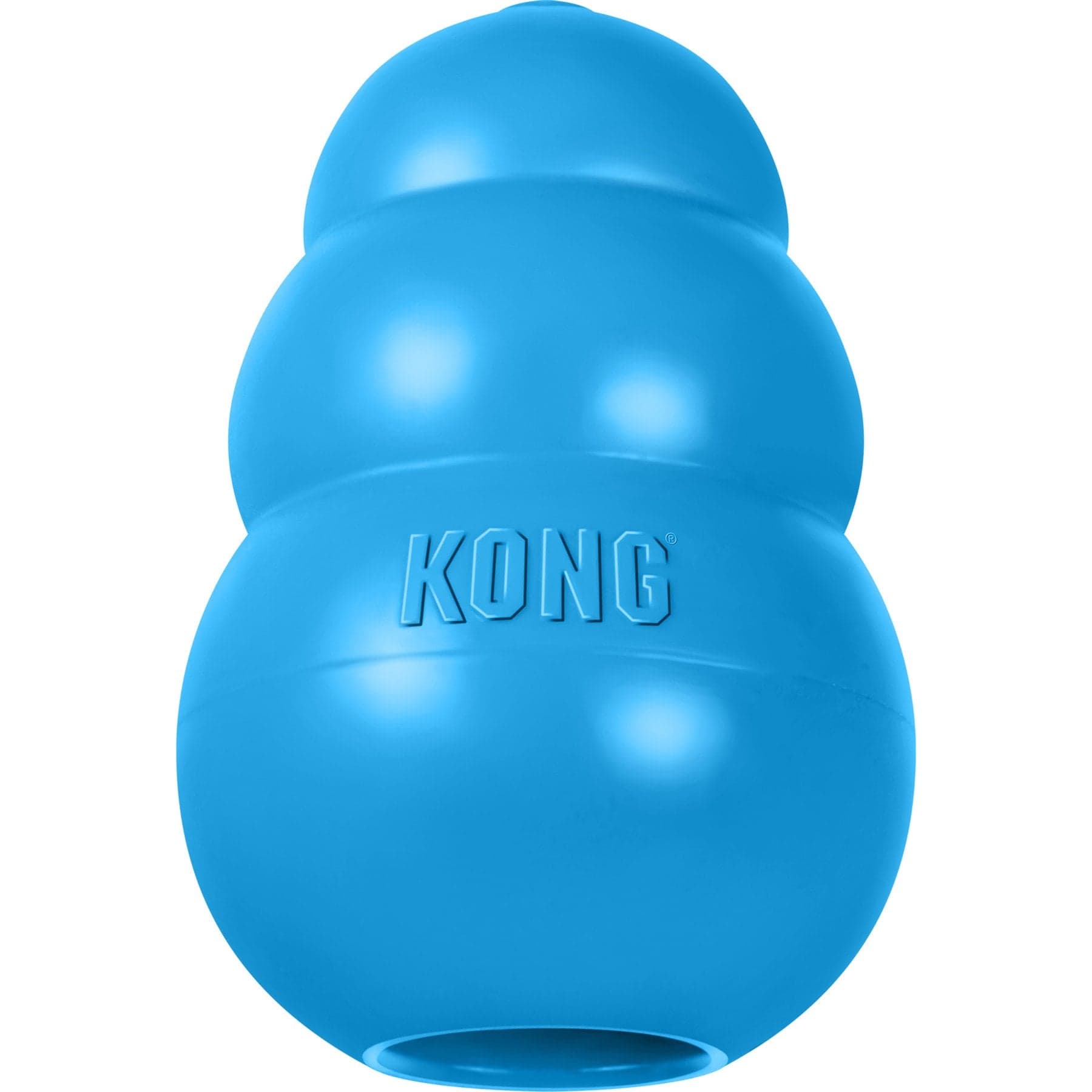
KONG's softest rubber, formulated for baby teeth. Stuff it, freeze it, and it buys fifteen to thirty minutes while cooling sore gums. Size up so it cannot sit behind the back teeth.
Webvet may earn a commission when you click through to Chewy, at no extra cost to you.

KONG makes its puppy line from a softer natural rubber than the classic red adult KONG, specifically for mouths that still hold baby teeth. The shape is the familiar hollow snowman, so it can be stuffed and chilled, and the bounce stays unpredictable enough to hold a puppy’s attention.
- Material: soft natural rubber, noticeably more flexible than the red adult KONG
- Format: hollow and stuffable, which makes it the easiest pick to chill
- Sizing: extra small through large, sized by adult body weight rather than age
- Supervision: yes, and retire it once the rubber wall is chewed through
Where it falls short: a determined four-month-old wears through the thinner puppy rubber faster than an adult wears through the red version. That is the trade for a material soft enough to be safe on erupting teeth.
Nylabone Puppy Chew Ring: the back-gum specialist
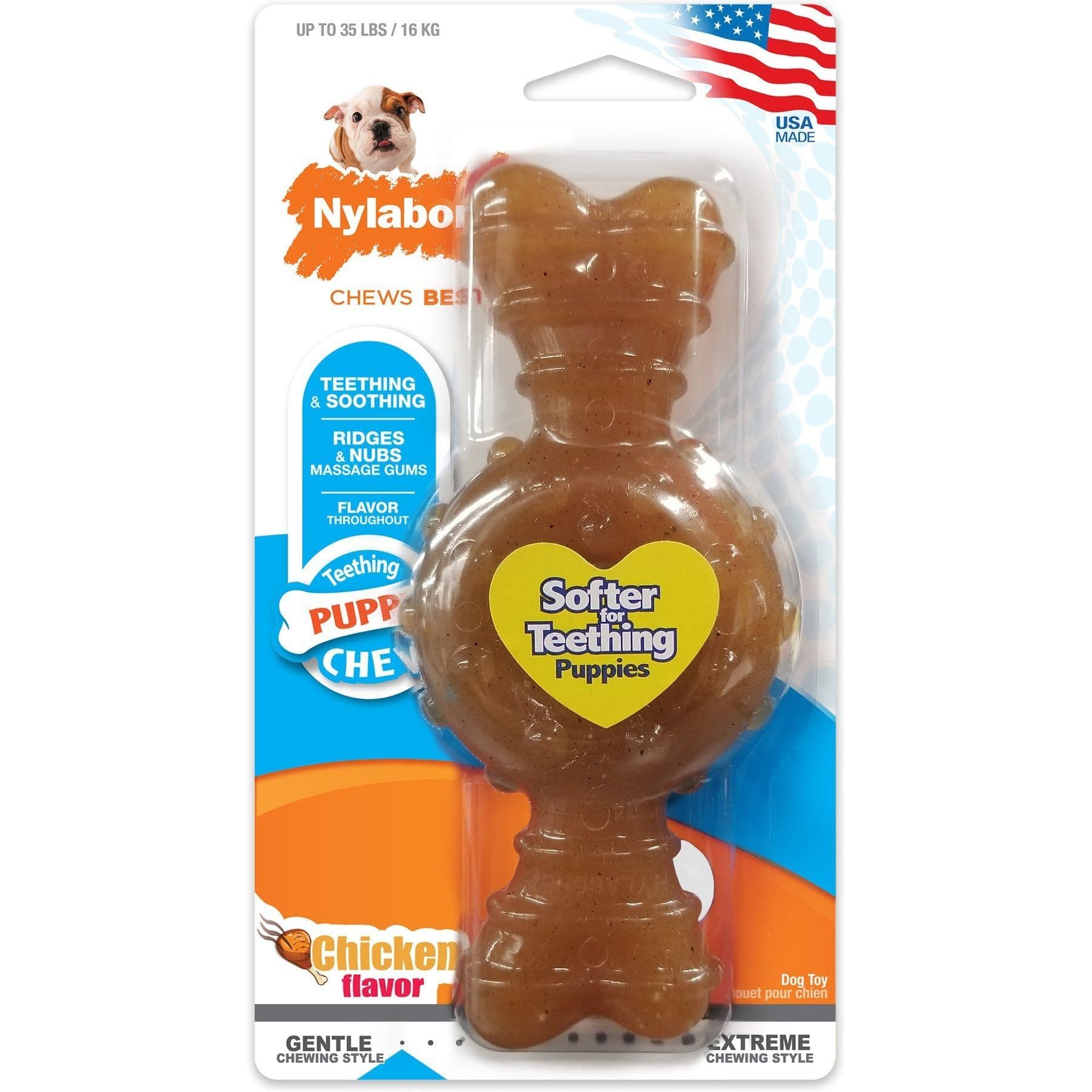
Nylabone's soft Puppy Chew ring with ridges and nubs across the surface, shaped so a puppy can get the rim between the back gums. Replace it once the nubs wear flat.
Webvet may earn a commission when you click through to Chewy, at no extra cost to you.

Nylabone’s Puppy Chew range is made of a softer, puppy-friendly material than its adult nylon, and the ring is the gentlest format in it. The ring shape is the reason to buy it: a puppy can get the rim between the back gums, which is exactly where the premolars are pushing through during the peak weeks.
- Material: puppy-specific soft material, not the hard adult nylon
- Format: textured ring with ridges and nubs across the surface
- Sizing: sold in puppy sizes by weight band; the medium is made for puppies up to about 35 pounds
- Supervision: yes, and replace it once the nubs are worn flat
One caution applies to the whole brand. Nylabone’s adult hard nylon sits on the same shelf, looks similar in the packet, and is far too rigid for a puppy. Check the packaging says puppy before it goes in the basket, and leave the firmer Puppy Power Chew line until the adult teeth are in.
KONG Puppy Binkie: the freezer pick
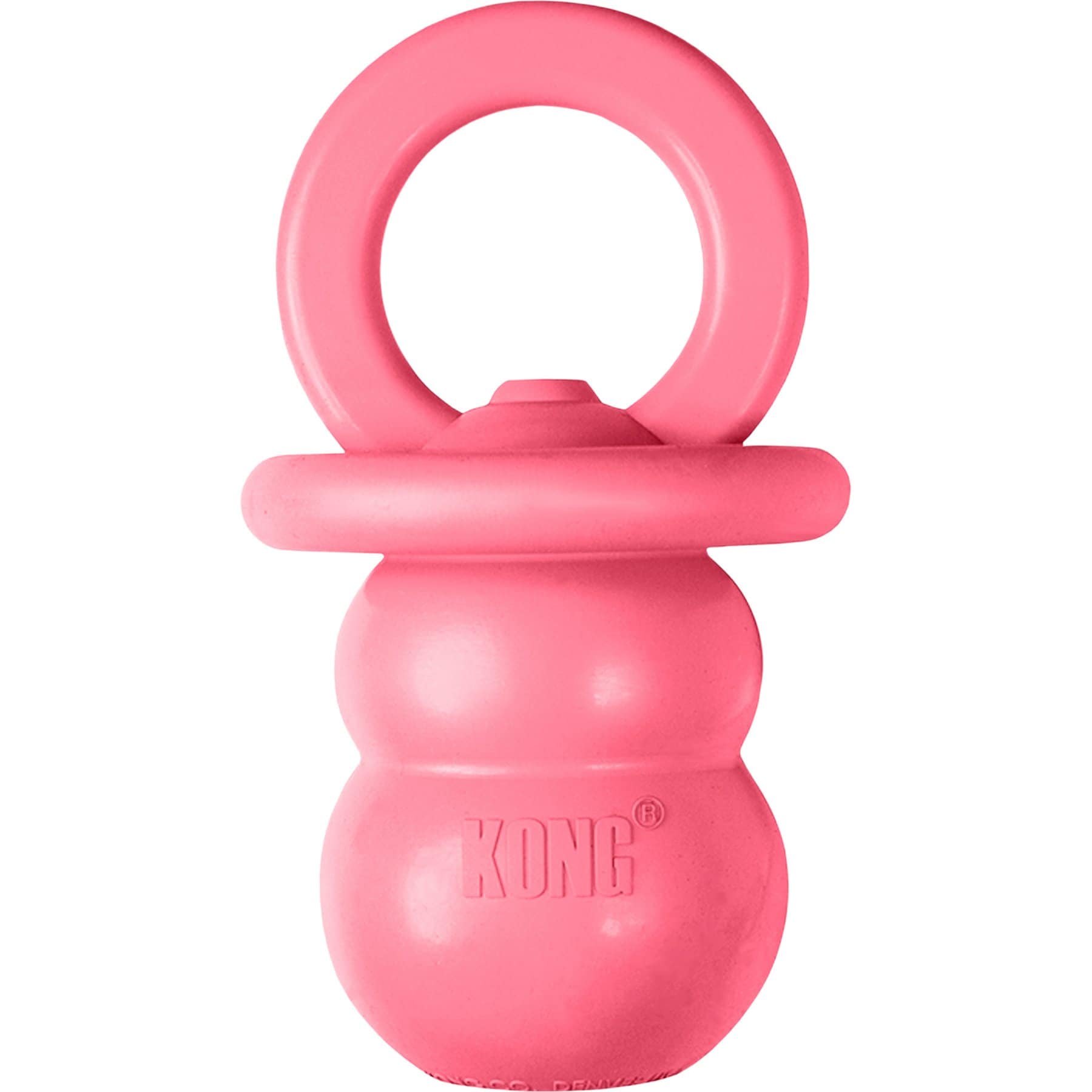
The same soft puppy rubber in a grooved bulb shape that holds a soft filling in the middle. The second stuffable to own, so one can live in the freezer while the other is in use.
Webvet may earn a commission when you click through to Chewy, at no extra cost to you.

The Binkie is the one to keep in the freezer. It is the same soft puppy rubber in a pacifier shape, with a grooved bulb at one end that holds a soft filling, so it is the easiest of these to stuff, chill, and hand over when the gums are at their sorest.
The shape earns its place. A narrow stem lets a puppy pull the bulb back onto the molars, which is the area a ball or a cone never reaches.
- Material: soft natural puppy rubber, the same grade as the KONG Puppy
- Format: pacifier shape with a treat-holding groove in the bulb
- Sizing: small and medium, chosen by adult body weight
- Chilling: stuff it, then about an hour in the freezer, never overnight
Inspect the narrow stem rather than the bulb. The shape fails at its thinnest point, so that is where a chewed-through wall shows first.
Benebone Puppy Wishbone: the one a small puppy can hold
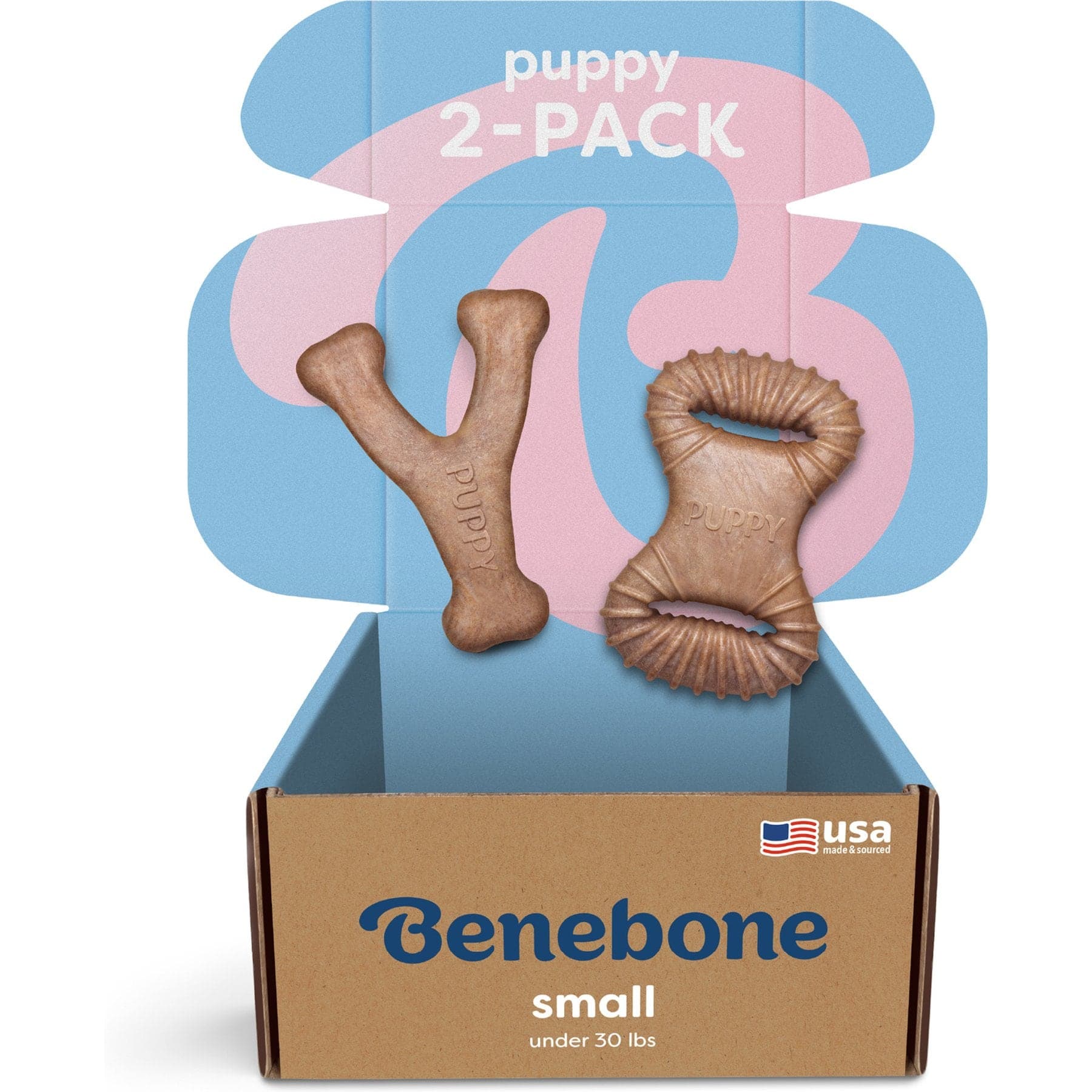
Benebone's puppy pack: a softer-than-adult wishbone a small puppy can pin under a paw, paired with a smaller dental chew. The firmest pick here, so run the thumbnail test first.
Webvet may earn a commission when you click through to Chewy, at no extra cost to you.

Benebone’s puppy pack is formulated softer than the brand’s adult wishbones, which sit firmly in the too-hard category for a teething mouth. The curved arms are the point: a puppy pins one arm under a paw and works the raised arm with the side teeth instead of chasing the toy around the floor.
- Material: puppy-specific nylon, softer than the adult Benebone line
- Format: curved wishbone, usually paired with a smaller dental chew
- Sizing: puppy sizing only, with the small aimed at toy and small breeds
- Supervision: yes, and retire it at the first crack or splintered arm
This is the firmest pick here, so run the thumbnail test on the one that arrives before handing it over. If it takes no mark at all, put it away until the adult teeth are fully in.
West Paw Toppl: the licking toy
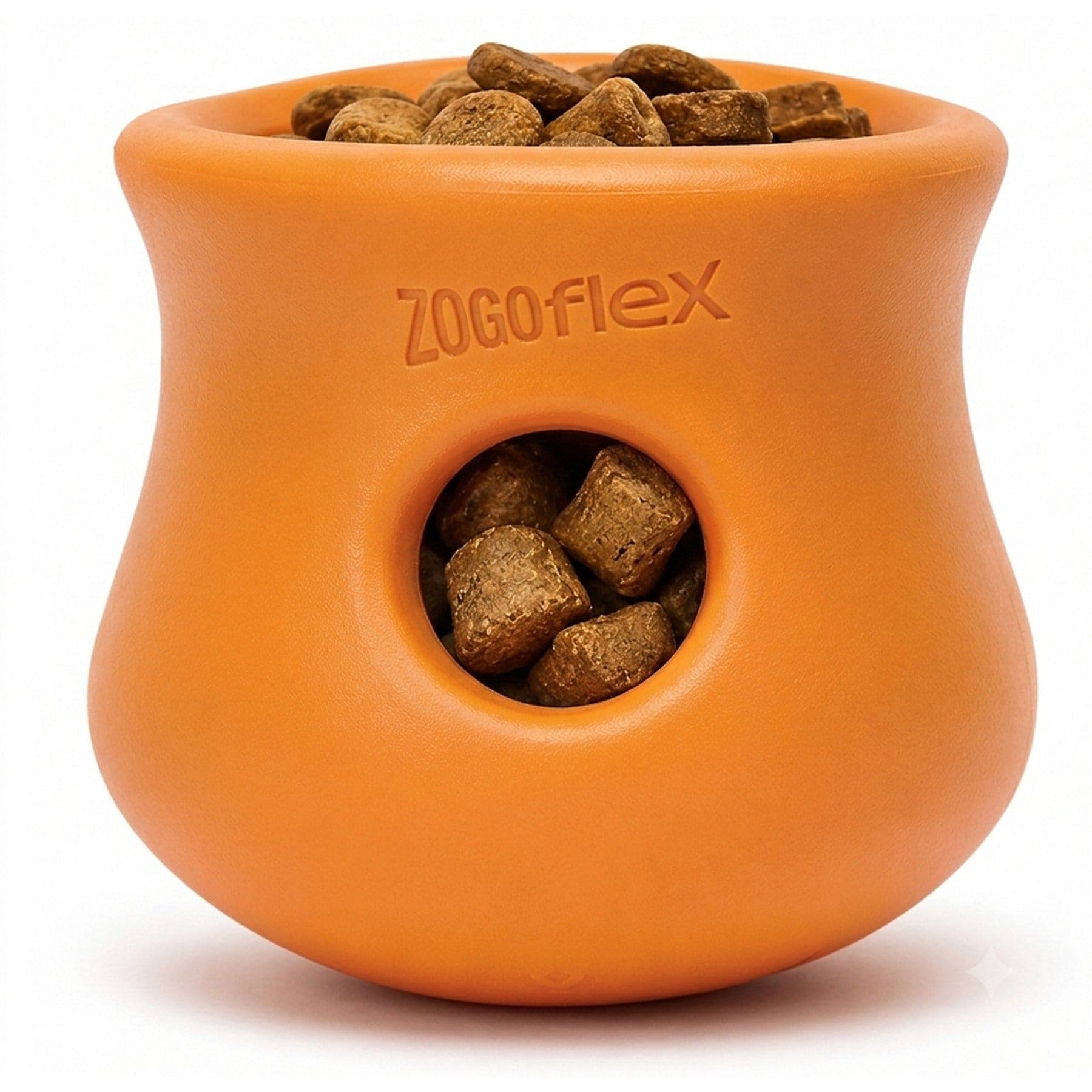
A thick, flexible Zogoflex cup with internal ridges, made to be stuffed, frozen, and worked at. Two sizes lock together to make the puzzle harder, and it survives the dishwasher.
Webvet may earn a commission when you click through to Chewy, at no extra cost to you.

The Toppl is an open-topped cup rather than a closed toy, which changes what a puppy does with it. Tipped on its side and stuffed, it becomes a licking toy first and a chew toy second, and licking settles a sore mouth the way gnawing cannot.
West Paw makes it from Zogoflex, a soft, recyclable, dishwasher-safe thermoplastic elastomer that flexes under thumb pressure the moment you squeeze it. That is why it belongs in a teething article: you can verify the softness in your own hand rather than trusting a label. The small and large cover most puppies, and an extra large exists for the biggest breeds.
- Material: Zogoflex, soft and flexible, dishwasher safe and recyclable
- Format: open cup that can be stuffed, frozen, and licked out
- Sizing: small, large, and extra large, with the small suiting most puppies under 20 pounds
- Supervision: yes, though it holds up better than most soft rubber
It is the most expensive toy here. What the money buys is the material and the guarantee, not a teething feature the cheaper picks lack.
Playology Young & Active Teething Bone: for the puppy who ignores toys
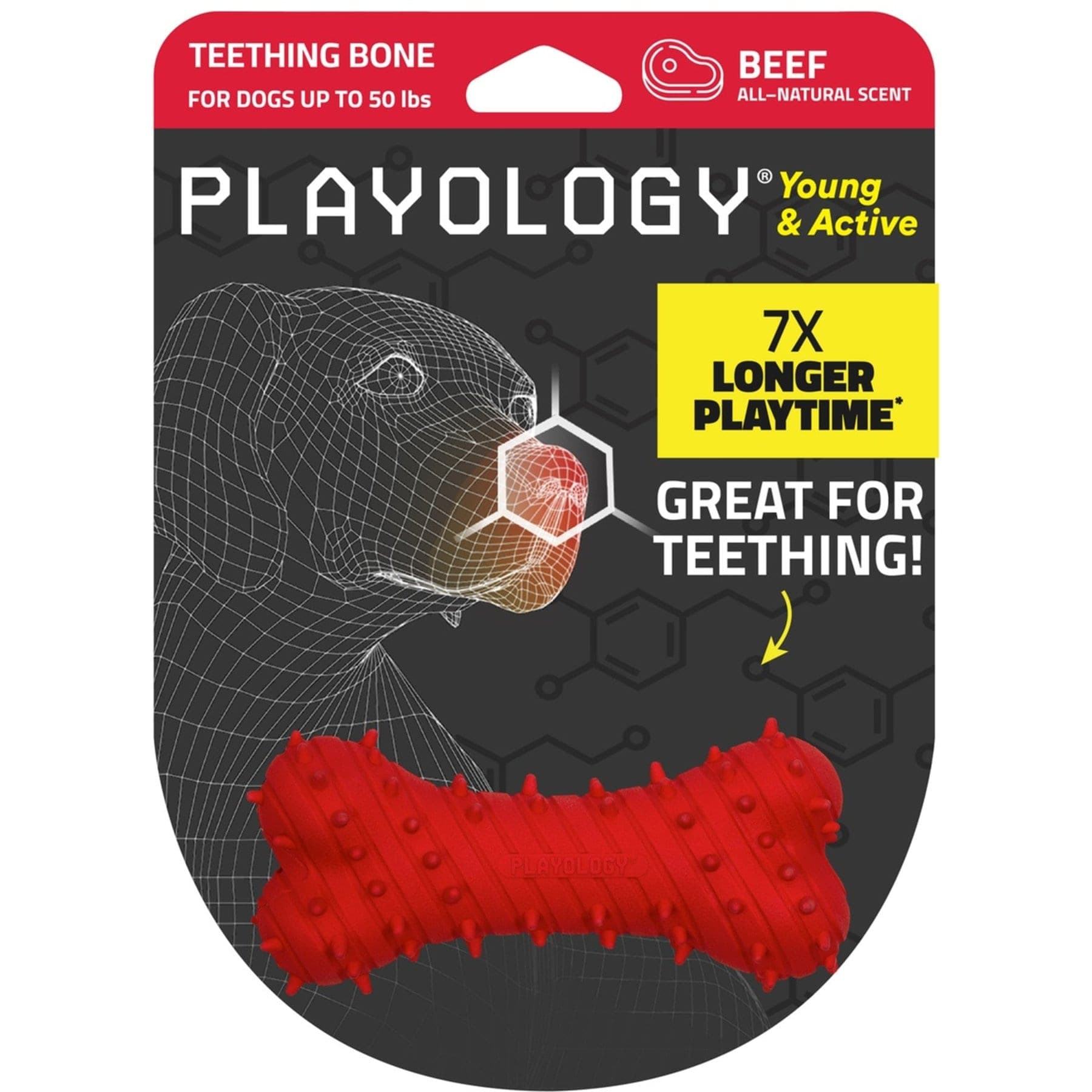
Playology's puppy teething bone with beef scent infused through the rubber, so the smell survives chewing and washing. For the puppy who walks past every toy in the box.
Webvet may earn a commission when you click through to Chewy, at no extra cost to you.

Playology infuses scent through the material rather than coating the outside, so the smell survives chewing and washing. For a puppy who walks past every toy in the box and goes back to the chair leg, that scent draw is the reason to buy it.
- Material: rubber with beef scent infused throughout
- Format: a bone with soft solid nubs along its length and a squeaker inside
- Sizing: medium and jumbo, chosen by puppy weight
- Supervision: yes, and expect it to be carried around before it is chewed
It costs more than a plain rubber bone and does not chew any better. Buy it for the specific problem of a puppy who ignores toys, not as a general upgrade.
 Sponsored
Vet care that's always there
Unlimited video calls and messaging with licensed vets for less than a typical vet visit. One membership covers up to five pets.
Use code Pets60
Plans start at $12/month · covers up to 5 pets
- Licensed vets in most states
- Rx for 150+ conditions
- 4.7 on Trustpilot
How we picked these puppy teething toys
The best toys for a teething puppy are chosen on material and size, not brand. We screened for four things: a material soft enough to dent, a shape that reaches the back gums, a size the puppy cannot swallow, and a manufacturer that publishes a genuine puppy-specific line. Every pick clears all four.
These are researched, vet-informed selections built from published manufacturer specifications and from how each category behaves in a teething mouth, rather than hands-on durability results. Good puppy chew toys and good teething toys for puppies are the same products during these weeks.
| What we screened | The rule we applied | Why it matters |
|---|---|---|
| Material and size, not brand | Soft natural rubber, puppy-grade nylon, or fabric only | Hard materials fracture erupting teeth whatever the name on the box |
| Firmness | It has to dent under a thumbnail or flex when squeezed | A toy that takes no mark at all is harder than a puppy tooth |
| Size | Too wide to sit behind the back teeth, sized by adult weight | Swallowing and gulping are the other half of the risk |
| Shape | Reaches the back gums, or anchors under a paw | The premolars are where peak teething actually hurts |
| Supervision required | Every toy here is a supervised toy, without exception | Wear happens fast, and a chewed-off piece is an obstruction risk |
| Price | Roughly five to twenty-five dollars covers the whole list | Price buys material quality and a guarantee, not a teething feature |
On price, what the price actually changes is the material and the guarantee. A five dollar teething ring and a twenty-five dollar Zogoflex toy both pass the softness test, but the expensive one lasts longer, survives the dishwasher, and gets replaced if it fails. Neither buys a better teething feature.
One more screen: a puppy who inhales food is a puppy who will try to swallow a toy. If that sounds like yours, size up, and read our guide to why some dogs eat so fast before buying the smallest option on the shelf.
Puppies that destroy every toy
If your puppy is going through soft rubber in a week, resist the instinct to buy something harder. An indestructible dog toy, a durable dog toy, or anything sold as a dog chew toy for aggressive chewers is built for adult enamel, and those are the materials that fracture erupting teeth.
During teething the answer is rotation and supervision, not escalation. Keep three or four soft toys in play, swap them daily, retire a chewed one early, and come back to the durable and indestructible category once the adult teeth are in at around seven months.
How to tell if a teething toy is safe: the thumbnail test

What vets recommend for teething puppies comes down to one material rule rather than a brand list. The thumbnail test is how you judge whether a toy is too hard, and it works on any toy already in the house. Press a thumbnail into it: if the surface dents, it is soft enough.
The safest puppy teething toys are simply the ones that pass this test in your hand. Small puppy teething toys and large puppy teething toys follow the same rule, sized to the dog rather than made softer for it.
One point applies to the whole category: no vet recommended puppy chew toy is safe to eat. A Nylabone puppy chew, like every nylon chew, is built to be gnawed at, not swallowed, and swallowed fragments are a choking hazard and a gastrointestinal obstruction risk in a puppy.
Hardness is only half of it. Size is the other half, and it is the half that sends puppies to surgery. Any toy small enough to sit behind the back teeth can be swallowed whole, so buy for the size your puppy is growing into:
- Buy by adult body weight, not by current weight and not by age
- If the whole toy fits inside the mouth, it is already too small
- Size up as the puppy grows, and retire the outgrown one that day
- Two puppies in one house means two toys, and no shared chewing
Then there are the wear signs that mean a toy has to be retired, which almost nobody talks about. Check every toy weekly, in good light, and look for chunks missing from the edge, a chewed-through wall, a torn seam, or an exposed squeaker. A teething puppy destroys toys fast.
- Chunks missing from the edge, or a bite taken out of a rim
- A wall chewed all the way through on a hollow toy
- A torn seam, loose stitching, or leaking stuffing
- An exposed squeaker, rope core, or plastic insert
- Any fragment small enough for your puppy to swallow whole
What vets recommend adult dogs chew on
The advice changes once the adult teeth are in. A dog with a full set of permanent teeth in fully formed bone can handle firmer materials than a teething puppy can, so vet recommended dog chew toys for adults are a separate conversation from this one.
The rule that carries across both is the hardness test. It is why safe dog chew toys for aggressive chewers, and any chew marketed as vet approved for adult dogs, can still be the wrong purchase for a sixteen-week-old puppy.
What to avoid: chews that crack puppy teeth

Avoid anything that will not give under pressure. Antlers, real bones, hooves, hard nylon made for adult dogs, and ice cubes are the usual culprits, and a slab fracture of an upper premolar is the usual result. The Merck Veterinary Manual pet-owner section covers how those tooth fractures are treated.
The mechanism is simple. Enamel is hard but brittle, and a puppy biting down on something that will not deform sends all of that force into the tooth. A tooth that is still erupting has less support in the bone to absorb it, so it chips or shears instead.
| Chew | Why it is wrong for a puppy | Safer swap |
|---|---|---|
| Antlers | Rock hard and will not deform, a leading cause of fractured premolars | A soft puppy-rubber stuffable such as the KONG Puppy or the Binkie, chilled |
| Real bones, raw or cooked | As hard as tooth enamel, and cooked bone splinters | A stuffable hollow rubber toy, chilled |
| Hooves | Brittle as well as hard, and they split into sharp shards | A textured rubber teething ring |
| Adult hard nylon | Built for adult teeth and far too rigid for erupting ones | The same brand’s puppy line, which is deliberately softer |
| Ice cubes and fully frozen toys | Plain ice cubes are too hard and chip teeth | A stuffed soft toy chilled for about an hour |
| Tennis balls | Abrasive felt grinds enamel, and the ball can be crushed and swallowed | A rubber ball made for puppies |
| Sticks and stones | Splinter, puncture the mouth, and cause obstructions | Any of the picks above, offered as a swap |
Supervised-only categories deserve a mention here too. Rope, plush, and anything with detachable parts are fine under close supervision and risky without it. Retire any of them at the first torn seam or the first chunks missing from the edge, and treat rope strands as the worst offender of the lot.
- Rope: swallowed strands can cause a linear foreign body, which is a surgical emergency
- Plush: stuffing and squeakers come out fast under teething pressure
- Anything with a detachable eye, bell, ribbon, or plastic insert
- Anything borrowed from the human toy box, including baby teethers
Edible chews and dental chews for puppies
Edible chews are a different category from toys and are not what this article covers. Bully sticks, yak chews, and dental chews are eaten rather than gnawed and handed back, so the questions become hardness, calories, and how fast the piece gets small enough to swallow.
Yak chews come up constantly for young puppies. They are rock hard, which puts them in the same bracket as antlers for a mouth that is still erupting teeth. Our guide to vet recommended dental chews covers edible chew hardness and the age at which those chews make sense.
Freezable teething toys and how to use cold safely

The best thing for puppies to chew on when teething is a soft rubber toy that has been stuffed and briefly chilled. Cold soothes sore gums, and the filling keeps the puppy working at it, which is why a chilled stuffed toy outlasts every dry chew in the box. Chilled, not frozen solid.
The common mistake is over-chilling. A soft rubber toy left in overnight comes out rigid, and a rigid toy is the exact hardness problem this whole article is about. Aim for cool rather than rock solid, and check it with a thumbnail before it goes down on the floor.
Not every toy is freezable. The teething toys for puppies that freeze well are the hollow soft rubber ones, because there is somewhere for the filling to sit. A solid toy left in the freezer comes out frozen through, colder and harder, which is the opposite of what a sore mouth needs.
What goes inside matters as much as the cold. Keep the filling to food your puppy already eats, count it against the daily ration, and skip anything with xylitol, chocolate, grapes, raisins, or onion. Our guide to healthy dog treats covers safe fillings and portions. Options that work:
- Soaked puppy kibble mashed with a little warm water
- A spoonful of the puppy’s own wet food, smoothed into the cavity
- Plain unsweetened yogurt, if dairy agrees with your puppy
- Plain canned pumpkin, never pie filling and never spiced
- A thin smear of peanut butter, checked on the label for xylitol
Not everything belongs in the freezer. Rope, plush, and fabric stiffen and hold moisture, hard plastic goes brittle, and anything with an electronic squeaker should stay out. Soft rubber and food-grade silicone are the formats worth chilling.
Homemade puppy teething toys that are actually safe
There are safe homemade teething options, and there are homemade ideas that are not safe. The one to start with is a damp knotted washcloth: soak a clean cotton washcloth, wring it out, tie a loose knot in the middle, and chill it for about half an hour. Supervise every minute.
DIY puppy teething toys follow the same rules as bought ones: soft, cold, and supervised. Homemade frozen treats for teething puppies belong in the freezer only long enough to firm up, and a DIY frozen chew toy still has to pass the thumbnail test before your puppy gets it.
It works because it is soft, cold, and slightly abrasive, which is what a sore gum wants. It stops being safe the moment your puppy pulls threads out, so treat it as a five-minute supervised toy, not something left in the crate. Options that are safe with supervision:
- A damp knotted washcloth, chilled for about half an hour and watched throughout
- A large raw carrot offered whole, for puppies already eating solid food, taken away once it is short enough to swallow
- A silicone ice tray of soaked kibble and water, frozen and popped out one cube at a time onto a mat
- A clean cotton rope toy knotted at both ends, retired at the first loose strand
Now the homemade ideas to skip. Frozen water bottles crack into sharp plastic. Old shoes and knotted socks teach a puppy that fabric is fair game. Plain ice cubes chip teeth. Human baby teethers are built to a different standard and are not sized for canine jaws. None of these is worth the risk.
- Frozen water bottles, which crack into swallowable plastic shards
- Old shoes, socks, and knotted T-shirts, which blur the line for a puppy
- Plain ice cubes, which are hard enough to chip an erupting tooth
- Human baby teethers, which are not built or sized for a dog’s jaw
- Anything held together with glue, staples, string, or a printed coating
KONG and Nylabone puppy teething toys compared
KONG and Nylabone dominate this category and they solve different problems. KONG teething toys for puppies are soft natural rubber built around stuffing and chilling. Nylabone puppy chew toys for teething puppies are a softer nylon and rubber blend built around texture, with rings, keys, and sticks.
The KONG Puppy Teething Stick sits between them. It is soft puppy rubber with ridges along its length that hold a paste or a treat, so it works as a texture toy and a stuffable toy at once, in small, medium, and large.
Both brands sell more than one puppy shape. Nylabone puppy chew rings sit alongside a puppy starter kit and a puppy pacifier, while KONG offers the teething stick and the Binkie. What you put in a puppy KONG matters as much as which shape you buy. A quick way to choose:
- Choose KONG if you want to stuff and chill, and if your puppy settles into a long licking session
- Choose Nylabone if your puppy wants something firm to press the back gums against
- Choose the KONG Puppy Teething Stick if you want texture and stuffing in one toy
- Either way, check the packaging says puppy, because both brands sell much harder adult versions
The most common mistake on this shelf is buying the adult version of the right brand. A hard nylon Nylabone and a red adult KONG are both excellent products for the wrong dog.
When your puppy chews your hands and the furniture
A teething puppy who is chewing you is not being difficult. The mouth hurts and your hand is in reach. The fix is substitution: take the hand or the chair leg out of play, put an appropriate toy into the mouth instead, and reward your puppy for taking it.
Keep a toy within arm’s reach in every room, because the swap only works if it is instant. Have a small food reward ready for the moment the toy is taken. Our guide to dog training treats covers what to use and what size.
- Keep three or four approved toys in every room your puppy can reach
- Swap silently, without scolding, then praise the second the toy goes in
- Block access to chair legs, cables, and skirting boards while teething peaks
- Offer a chilled stuffed toy just before the times of day the chewing usually starts
Chew toys after teething ends
Once the adult set is complete at around six or seven months, the material rules relax. A dog with permanent teeth can use firmer rubber and denser chews, and the right choice then depends on chewing style rather than on eruption.
Adult dog chew toys sort by that style. Gentle nibblers, average chewers, and outright destroyers need different materials, natural dog chews enter the picture for the first time, and chew toys for small dogs are a narrower shelf than the one you shopped for a puppy.
So the toy that kept your puppy busy at four months is usually shredded in a week at nine, and puppy chew toys should not simply be replaced like for like once teething finishes.
Puppy toys beyond teething
Teething toys are one part of a puppy’s toy box. The best puppy toys to keep them busy are often not chew toys at all: fetch toys, tug toys, snuffle mats, and the best puzzle toys for puppies all do jobs a teething toy cannot.
A practical split during the peak weeks is half chewing and half enrichment. Once a stuffed toy has been licked clean, a puzzle feeder or a snuffle mat covers the next stretch without adding pressure to a sore mouth.
Size matters here too. The best puppy toys for small dogs are lighter and narrower than the standard version, and the best toys for an 8 week old puppy lean heavily on enrichment rather than on hard chewing, because that mouth is not ready for much yet.
Puppy teething toy questions
Frequently Asked Questions
How long should a puppy teething toy stay in the freezer?
About an hour is usually enough, and a teething toy should not stay in the freezer overnight. Stuff a hollow soft rubber puppy toy, lay it flat, and take it out while it is cool rather than rock solid. A toy left in that long comes out rigid, and rigid is the hardness that fractures an erupting tooth. Check it with a thumbnail: if it still dents, it is safe.
What size teething toy should I get for my puppy?
Buy the size that matches the weight your puppy will reach as an adult, not the weight on the scales today. The toy should be wider than the back of the mouth so it cannot slip behind the molars, and your puppy should never fit the whole thing inside. Size up as the puppy grows, and if you are between two sizes on a teething toy, take the larger.
When should I throw away a puppy teething toy?
Throw a puppy teething toy away as soon as it stops being one solid piece. Check every toy weekly and look for chunks missing from the edge, a wall chewed all the way through, a torn seam, an exposed squeaker, or any fragment small enough to swallow. Teething puppies wear toys out far faster than adult dogs, so a toy that looked fine last week often should not still be in the basket.
Are Nylabone chews safe for a teething puppy?
Nylabone chews from the puppy line are safe for a teething puppy, and the adult line generally is not. The puppy line is deliberately softer, in rings, keys, and sticks sized for small mouths, while adult hard nylon is not for puppies and is rigid enough to fracture an erupting tooth. The packaging tells you which is which, so look for the word puppy before buying, and treat either as a supervised toy.
My puppy still has baby teeth at seven months. Is that a problem?
It can be. A baby tooth still sitting in your puppy’s mouth beside a fully erupted adult tooth at seven months is a retained baby tooth, and it usually needs removing. Two teeth crowded into one socket trap food and plaque, and the baby tooth can push the adult one out of position permanently. Book a dental check with your vet rather than waiting for it to fall out, because the window for a simple fix is limited.

Editor
The Webvet Editorial Team is the in-house group of pet-care editors and writers behind Webvet, operated by Smart Pet Collective. The team researches, writes, and maintains Webvet's pet health, behavior, and medication content. Every article follows a defined editorial process: research from reputable veterinary and scientific sources, careful drafting, mandatory review of medical content by a credentialed veterinarian, and dated publication. Health and medication articles are medically reviewed by a licensed veterinary professional before they go live and are kept current over time.


