Indestructible Dog Toys: Best Picks for Aggressive Chewers
No dog toy is truly indestructible, but some outlast the rest by a wide margin. Compare eight tough chew toys by material, format, and guarantee, and learn the thumbnail test that shows whether a toy is hard enough to fracture a tooth.

This article contains affiliate links. Webvet may earn a commission when you buy through them, at no extra cost to you.
Indestructible dog toys are the most oversold category in the pet aisle. No dog toy survives every dog, and a determined power chewer will get through any of them given enough sessions.
What genuinely changes from one toy to the next is how long that takes, how the toy fails when it finally does, and whether the failure leaves a swallowable chunk on the rug or a harmless set of tooth marks. That last part is why this comparison matters more than the marketing does.
The gap between the toughest toys and an average one is real and large, and the safest tough toys are rarely the hardest ones. Below are eight picks chosen on material, construction, published guarantee terms, and failure mode, plus the sizing and hardness checks that decide whether any of them will work for your dog.
 Sponsored
Want a vet's help with your dog's anxiety or behavior?
Talk to a licensed vet at Dutch over video, often the same day. They can recommend treatment and prescribe it when it's appropriate.
Use code Pets60
Plans start at $12/month · covers up to 5 pets
- Licensed vets in most states
- Rx for 150+ conditions
- 4.7 on Trustpilot
Are indestructible dog toys real?

No. The toys sold under that name are not truly indestructible, and the brands with the strongest durability reputations are careful never to claim otherwise. Read their own copy and you will find phrases like virtually indestructible, guaranteed tough, or built for power chewers. Put three destroyed toys beside one intact rubber ring and the pattern is obvious: the toys that failed had seams, air chambers, or stuffing, and the ring had none of them.
Every one of those is a durability claim with an escape hatch built into it. The honest version is that toughness is a spectrum set by three things: the material, the shape, and the individual dog.
A ninety pound mastiff who chews with slow grinding pressure destroys different toys than a forty pound heeler who shakes and shreds. Hardness is not the whole answer either, because the hardest materials on the shelf are the ones most likely to break a tooth.
How each toy format fails
It helps to know exactly how each format gives up, because that is what tells you how dangerous the last day of a toy is:
- Rope unravels into long strands, and a swallowed strand is the most dangerous failure in this whole category.
- Hollow rubber balls and treat shells crack at the thinnest point, then split into curved pieces with edges.
- Plush and fabric toys open at a seam first, after which the stuffing and the squeaker come out quickly.
- Hard nylon bones shed small shavings continuously and eventually crack near a knuckle end.
- Solid rubber rings and balls wear down slowly and evenly, which is the least dangerous way for a toy to end its life.
Which of those failures should worry you depends on how your dog uses a toy. A shredder and a gulper need very different toys even at the same body weight. Four chewing styles cover almost every dog, and these labels come up again in every pick below:
- Shredder: works at a seam, a corner, or a tag, pulls material apart, and is more interested in dismantling than in swallowing.
- Gulper: swallows whatever comes loose, sometimes within seconds, which makes any toy that produces fragments a genuine emergency risk.
- Power chewer: clamps down and grinds with the back teeth under sustained pressure, beating toys through force rather than technique.
- Gentle mouther: carries, licks, and mouths without real force, and can safely use toys that would last one afternoon with any of the other three.
- 1No dog toy is truly indestructible. The realistic goal is a toy that lasts a long time and fails safely, not one that never fails.
- 2Run the thumbnail dent test before you buy. If your thumbnail leaves no mark at all, the toy is hard enough to fracture a tooth.
- 3Match the toy to your dog’s chewing style and mouth size. A shredder, a gulper, a power chewer, and a gentle mouther all need different formats.
- 4Read the guarantee before you pay the premium for it. One-time replacement and unlimited replacement are very different promises.
- 5Retire any toy that has cracked, split, lost a piece you cannot find, or worn down small enough to swallow, guarantee or not.
The best indestructible dog toys for aggressive chewers
The toughest toys for a hard chewer are solid, single-piece rubber and reinforced hard nylon, and the safest of those are the ones you can still dent with a thumbnail.
The picks below were selected on material, construction, published guarantee terms, and how each toy fails. WebVet did not chew, crush, or lab-test any of them, and no durability figure here is our own measurement.
Each entry names the chewing style it suits, the hardness verdict, and the limit worth knowing before you buy. Prices move constantly, so check the current listing rather than trusting a number in any roundup, including this one.
- Goughnuts MaXX Ring: solid natural rubber with a built-in wear indicator, for power chewers.
- West Paw Zogoflex Tux: stuffable, floats, dishwasher safe, with a one-time replacement guarantee.
- Ruff Dawg Indestructible Ball: a solid rubber ball for gulpers who need a fetch toy with no hollow core.
- Jolly Pets Tug-n-Toss: puncture-resistant hard plastic that keeps working after a tooth goes through it.
- Nylabone Power Chew: hard nylon for grinding chewers, on strict supervision conditions.
- Benebone Wishbone: hard nylon in a shape a dog can actually hold, with the same hard nylon caveats.
- Tuffy Ultimate Ring: layered fabric for shredders and tuggers, not for a power chewer left alone.
- Chuckit! Ultra Ball: high-bounce rubber for fetch, and only for fetch.
Goughnuts MaXX Ring: best overall for a power chewer
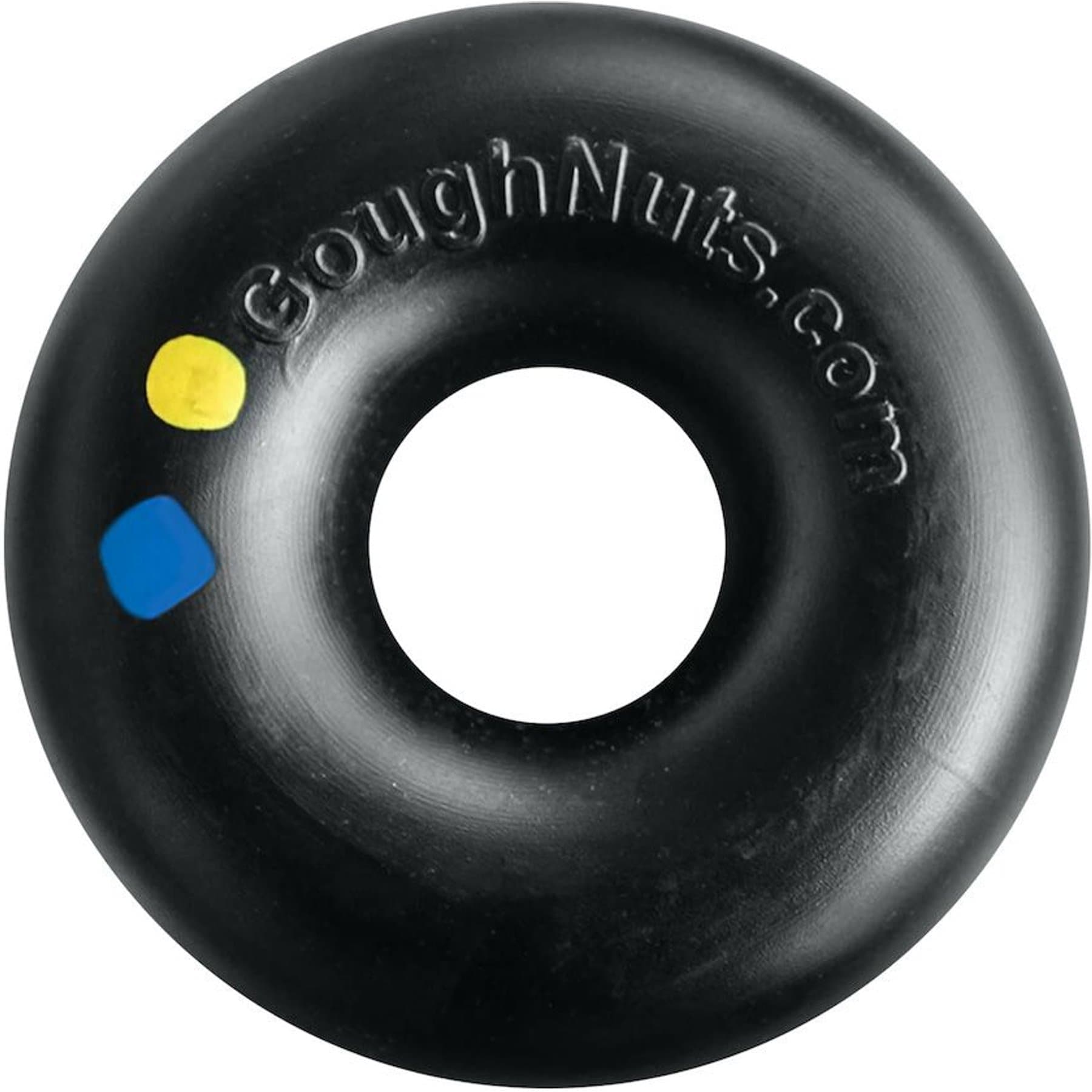
Solid natural rubber ring with a red inner layer: when red shows, the toy has failed its inspection and comes out that day. Heavy, awkward to pin on the back teeth, and built for power chewers.
Webvet may earn a commission when you click through to Chewy, at no extra cost to you.
Goughnuts molds solid, single-piece natural rubber toys in the United States, and the MaXX line is the heaviest version of them. There is no hollow core, no seam, and no stuffing, so there is nothing for a dog to open. Chewy lists the black MaXX ring as the Goughnuts Heavy Duty Ring.
A power chewer works the surface down slowly instead of cracking it, which is the wear pattern you want from a tough toy. The reason to choose this over any other rubber ring is the wear indicator.
A red layer sits underneath the black outer rubber, and when red shows the toy is compromised and comes out of rotation that day. Goughnuts publishes a replacement policy tied to that red layer, so confirm the current terms and return process before you count on it.
- Weight and price: it is heavy, and it costs several times what a supermarket ball does.
- Size range: the larger sizes are simply too big for a small dog to carry.
West Paw Zogoflex Tux: best stuffable tough toy
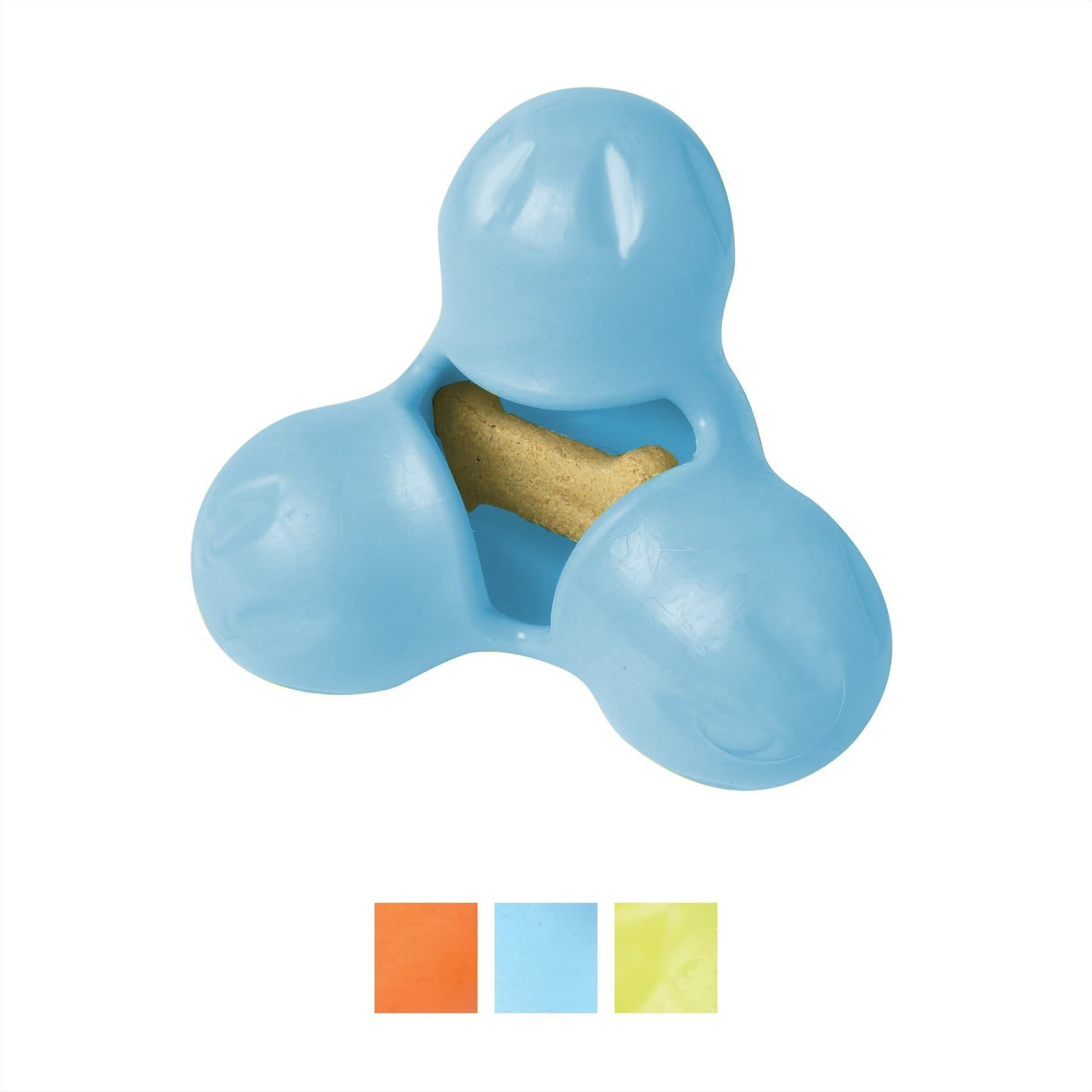
West Paw's stuffable tough toy in Zogoflex: real give under a thumbnail, a hollow centre for food, floats, dishwasher safe, and backed by a one-time replacement guarantee.
Webvet may earn a commission when you click through to Chewy, at no extra cost to you.
The Tux is West Paw’s stuffable tough toy, molded in Montana from Zogoflex, the company’s own pliable and recyclable material. It has real give under a thumbnail, which is exactly what you want for dental safety.
- The hollow center takes a smear of peanut butter or a portion of the daily food ration, so the toy does a job beyond chewing.
- Zogoflex toys float and go through the dishwasher, which matters more than it sounds for anything that holds food.
The trade-off is cosmetic: a soft material marks and dents fast, so a Tux looks thoroughly chewed long before it is unsafe.
West Paw publishes a one-time replacement guarantee on Zogoflex toys and takes the damaged toy back to be recycled. Terms and shipping arrangements do change, so read the current policy at purchase rather than assuming.
Ruff Dawg Indestructible Ball: best solid rubber ball
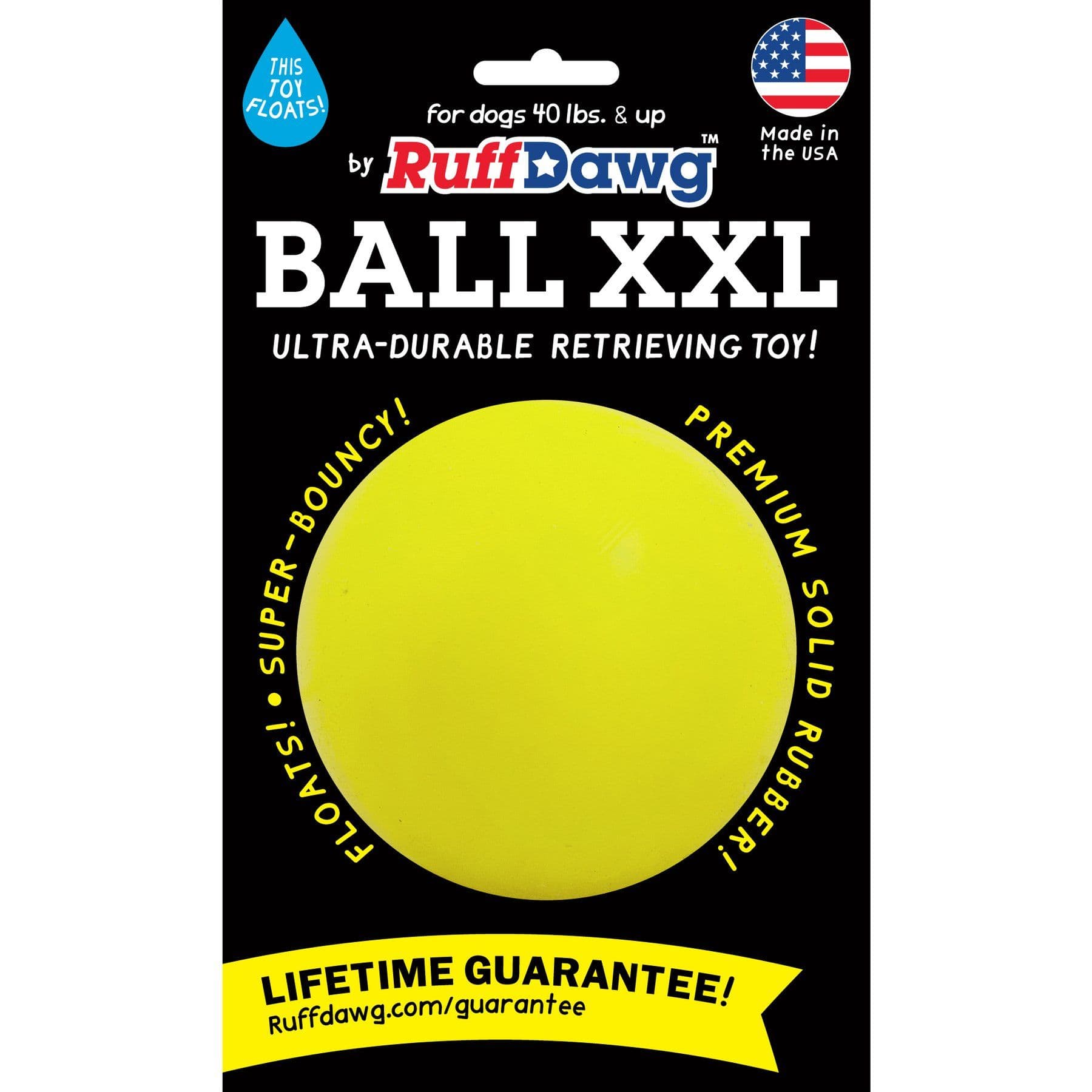
A solid natural rubber ball with no air chamber, seam, or squeaker, so it cannot crack into shards. Floats, survives the dishwasher, and carries a lifetime replacement policy.
Webvet may earn a commission when you click through to Chewy, at no extra cost to you.
This is a solid natural rubber ball with no air chamber, no seam, and no squeaker, made in the United States. Hollow balls fail by cracking and then splitting into curved shards, and a gulper will swallow one of those shards before you have crossed the room.
A solid ball cannot produce that failure, which is why it is the format to choose for a dog who eats whatever comes loose. It floats, it survives a dishwasher cycle, and it comes in several diameters so you can pick one too large to sit behind the back teeth.
Ruff Dawg publishes a lifetime replacement policy on its rubber toys, and like every guarantee in this category that is a promise about the next toy rather than a claim this one cannot be damaged. Expect less bounce than a hollow ball, so it suits rolling fetch better than high-bounce games.
Jolly Pets Tug-n-Toss: best for slam-and-shake dogs
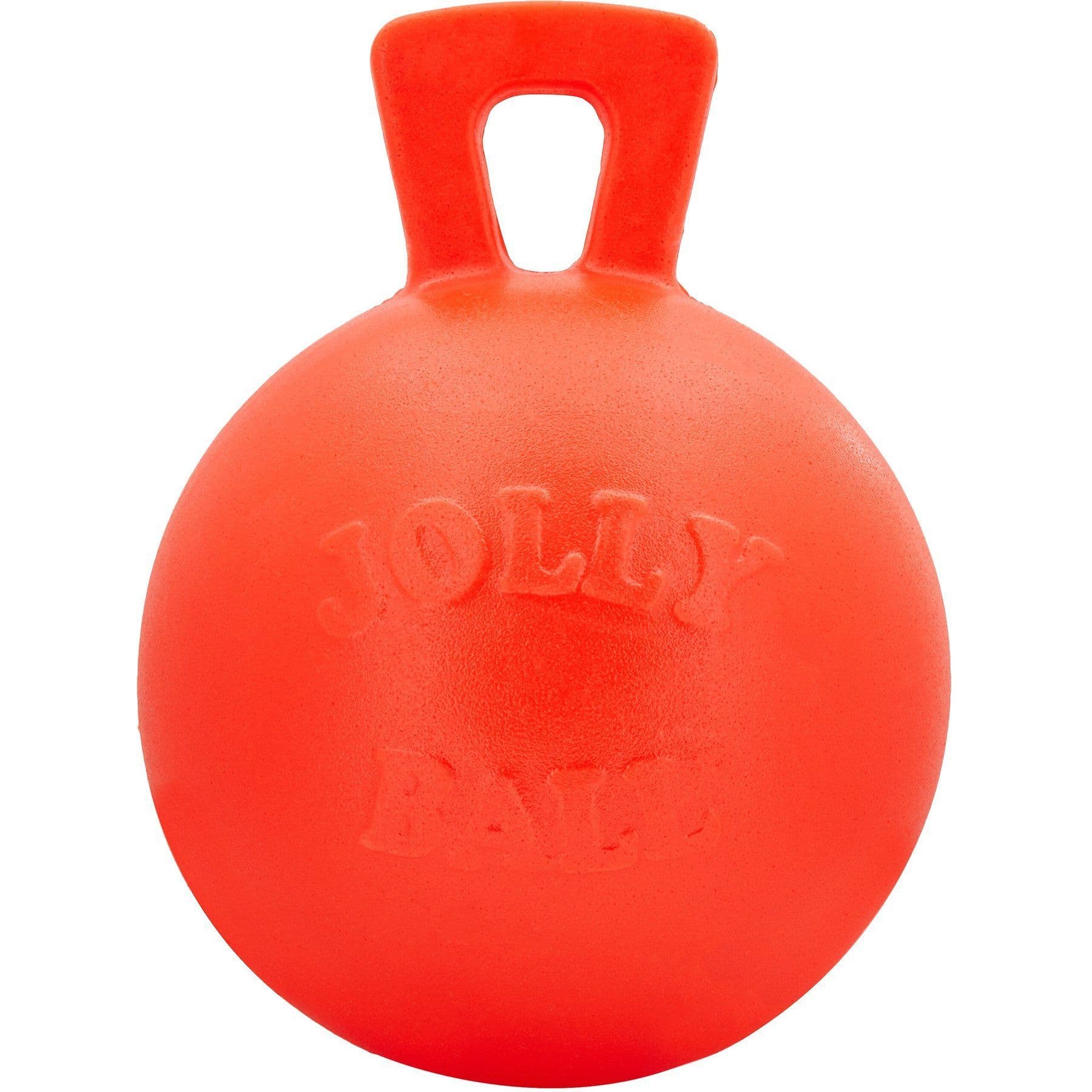
Thick puncture-resistant polyethylene that keeps its shape after a tooth goes through it, with a moulded handle for slam-and-shake dogs. Active play only; put it away afterwards.
Webvet may earn a commission when you click through to Chewy, at no extra cost to you.
Jolly Pets makes its ball range from thick, puncture-resistant polyethylene rather than rubber, and the useful part is what happens after a tooth goes through it. The ball does not deflate or collapse.
A dog can put holes in it and it holds its shape, which is the opposite of how an inflated or thin-walled hollow ball behaves once it is breached.
The molded handle gives a slam-and-shake dog something to grab and swing, which makes it a good outdoor toy for a big dog who plays with the whole body rather than just the jaw.
- The plastic is hard. This is not a toy for long solo grinding sessions: use it for active play and put it away afterwards.
- Sizes run large. The handled version is genuinely awkward for a small dog to carry.
Nylabone Power Chew: hard nylon, on strict conditions
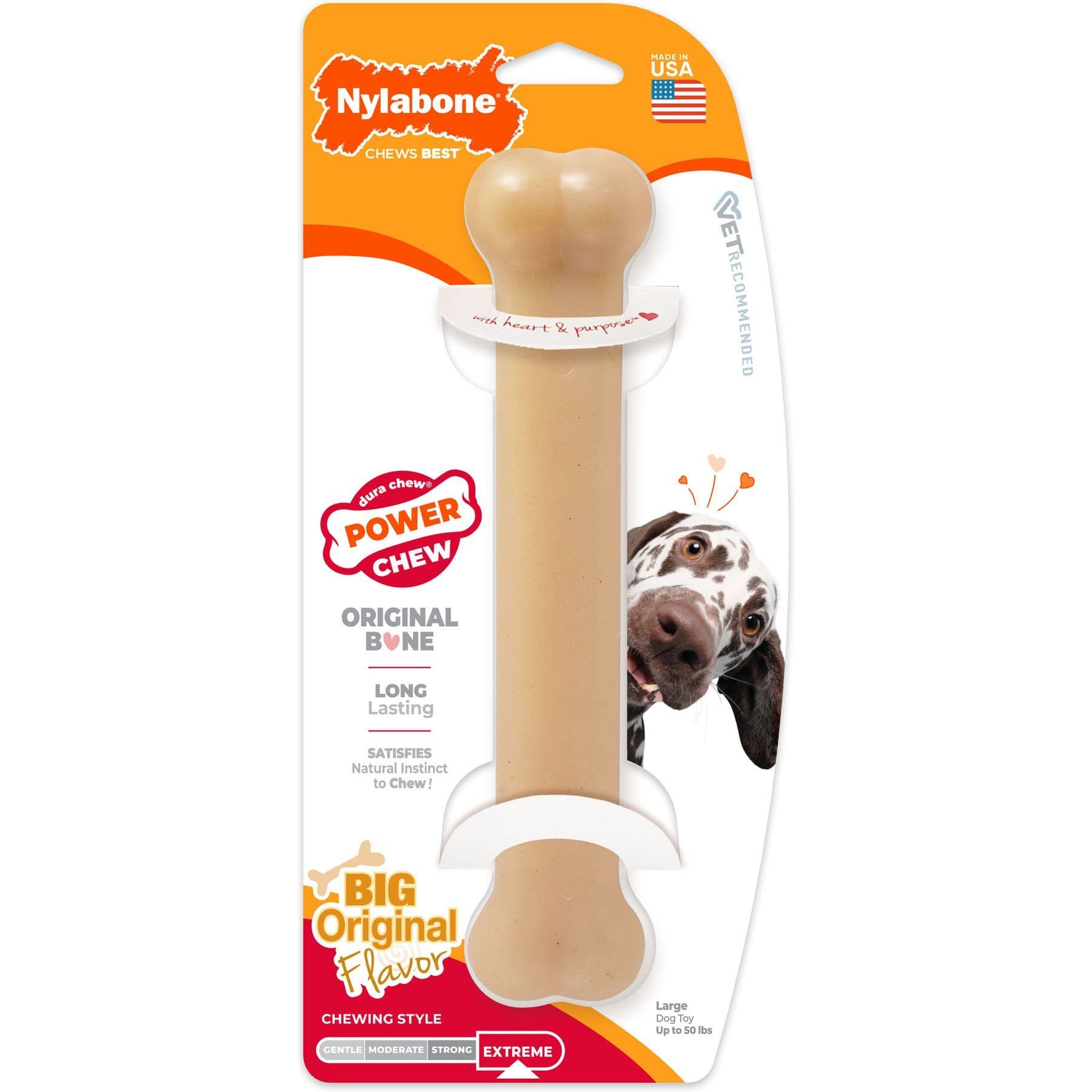
Nylabone's durable nylon line for the same narrow case as the Benebone: supervised sessions, a dog with sound teeth, sized so it cannot be pinned on the carnassials, retired at the first crack.
Webvet may earn a commission when you click through to Chewy, at no extra cost to you.
Hard nylon is the most durable chew toy material widely sold, and the Power Chew range is the best known version of it. A grinding chewer can work one for months, and the textured surface scrapes at the tooth while they do it.
That durability is precisely why this pick comes with conditions attached rather than a straightforward recommendation. Nylon this hard does not dent under a thumbnail, and material harder than the tooth itself is what fractures teeth. So use it on strict terms:
- Use it only in the room with you.
- End the session yourself rather than letting the dog decide.
- Check the toy afterwards.
- Retire it at the first crack or missing piece.
Size up rather than down, and replace it once the knuckle ends are worn away. If your dog has already chipped or fractured a tooth, skip hard nylon altogether and ask your veterinarian what is appropriate instead.
Benebone Wishbone: hard nylon with a better grip shape
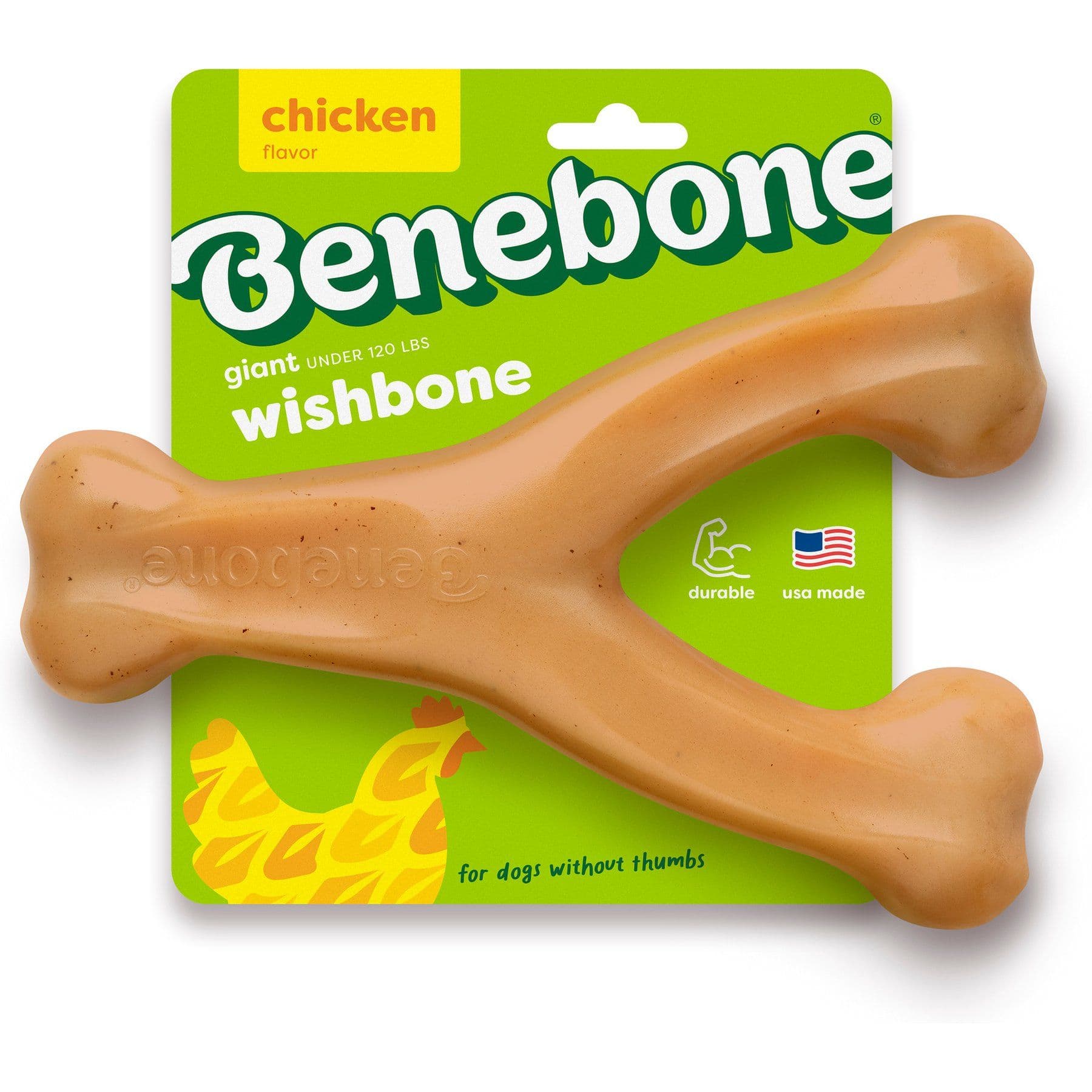
Flavoured hard nylon a dog can pin under a paw. It fails the thumbnail test, so it is a supervised, conditional pick for dogs who destroy and swallow pliable toys, never the household default.
Webvet may earn a commission when you click through to Chewy, at no extra cost to you.
The Benebone is also hard nylon, and it solves a practical problem the straight nylon bones have: dogs cannot hold them steady.
The curved wishbone shape lets a dog pin one arm under a paw and work the other end, so a session lasts longer without the toy skidding across the floor and ending the game early.
Flavor runs through the whole toy rather than being sprayed on the surface, which keeps most dogs interested past the first week. Everything in the Nylabone entry applies here too:
- It will not dent under a thumbnail, so it carries the same tooth fracture risk.
- The same supervision conditions and the same retirement rule apply.
Benebone publishes wear-based replacement guidance, and once the ends are chewed down or the surface has started flaking, the toy goes in the trash rather than back in the toy box.
Tuffy Ultimate Ring: best tough fabric toy for shredders
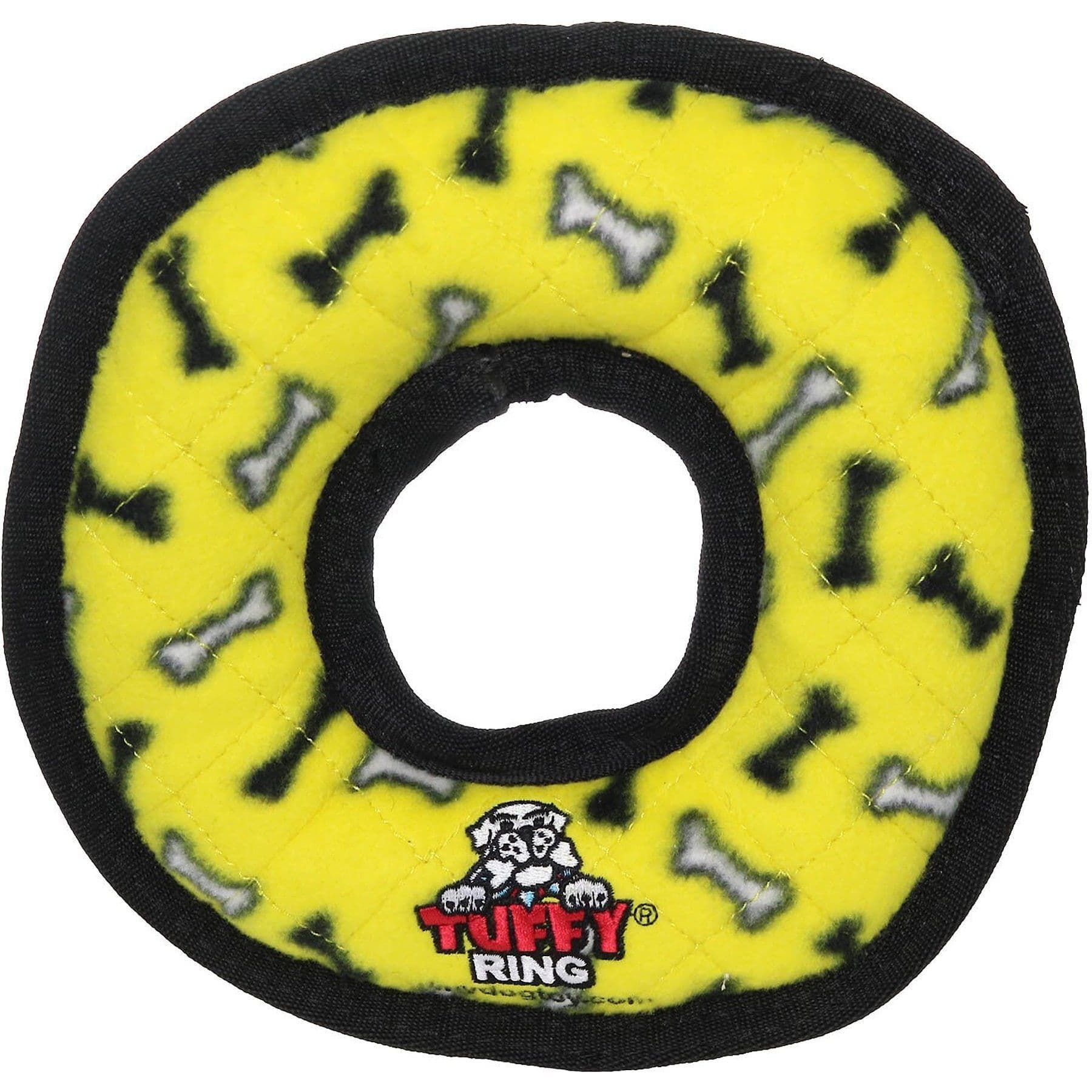
Layered fabric with multiple rows of stitching and no limbs for a shredder to target. Supervised sessions only, and retire it the moment an inner layer shows.
Webvet may earn a commission when you click through to Chewy, at no extra cost to you.
Tuffy toys are the only fabric toys on this list, and they earn the place through construction rather than material. Several layers of tough fabric are sewn together with multiple rows of stitching, so a dog who finds a seam has to get through four or five of them instead of one.
The brand rates each toy on its own toughness scale, which ranks its range against itself and is not a durability guarantee. For a shredder this is the honest answer: a toy that survives being shaken, thrown, and tugged, and one you can put through a washing machine afterwards.
For a determined power chewer working alone it is not the right toy. Fabric of any specification fails once a tooth opens the stitching, and the stuffing and squeaker inside are exactly what a gulper should not reach. Treat it as a supervised tug and fetch toy rather than something left down overnight.
Chuckit! Ultra Ball: best for fetch, and only for fetch
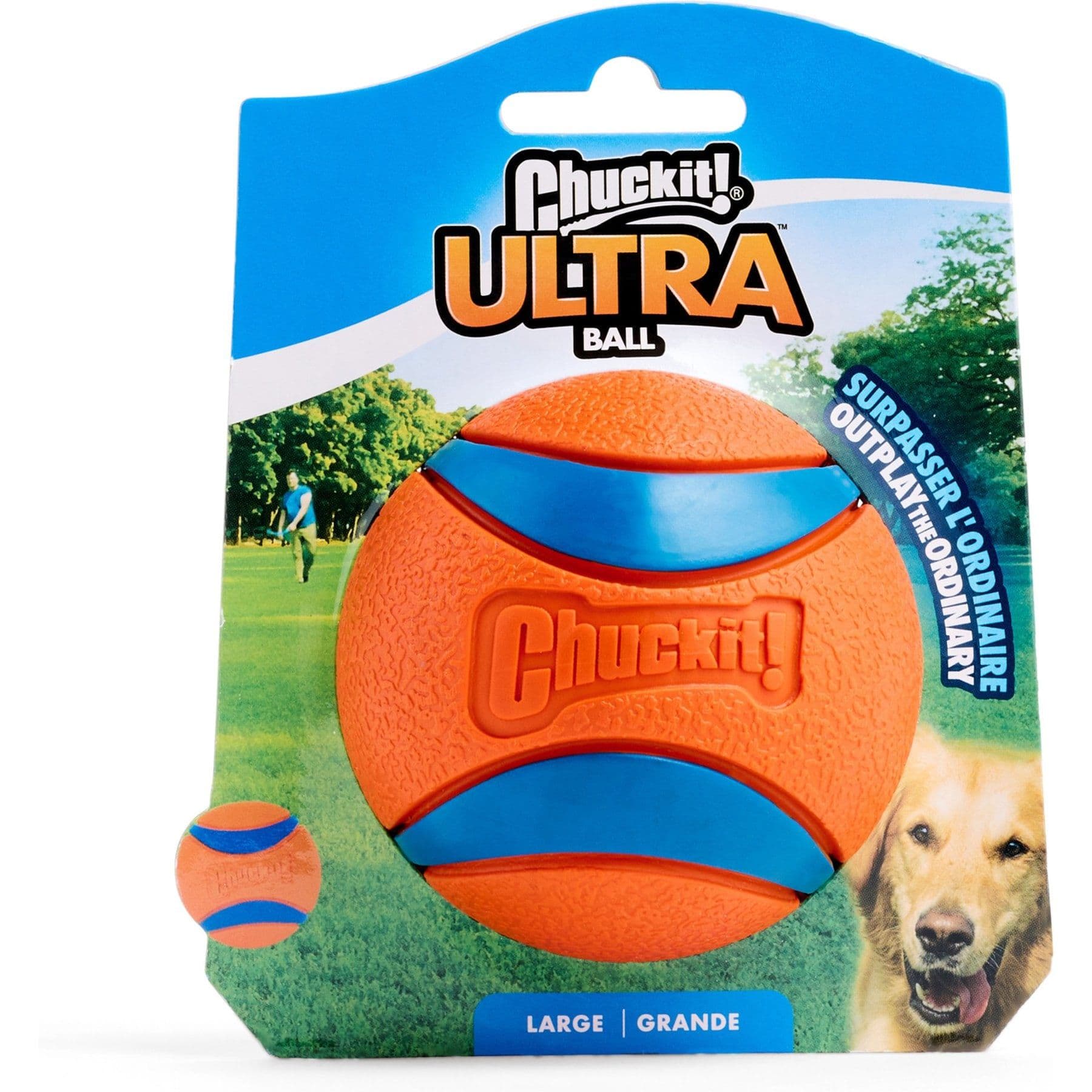
High-bounce solid rubber that floats, shows up on a lawn, and skips the abrasive felt of a tennis ball. A fetch ball, not a chew toy: size up and put it away after the game.
Webvet may earn a commission when you click through to Chewy, at no extra cost to you.
This is a high-bounce natural rubber fetch ball sized to fit a ball launcher, and it is on the list because so many people buy one expecting a chew toy. It is not one.
Chuckit! designs it for throwing and retrieving, and a power chewer left alone with it will open it in a single sitting. For its actual job it is excellent.
It floats, it bounces far higher than a tennis ball, and the smooth rubber does not abrade tooth enamel the way the gritty felt on a tennis ball can over years of fetching. Use it on three conditions:
- Buy a size too large to sit fully in the back of the mouth.
- Take it away when the game ends.
- Replace it as soon as the surface splits anywhere.
 Sponsored
Vet care that's always there
Unlimited video calls and messaging with licensed vets for less than a typical vet visit. One membership covers up to five pets.
Use code Pets60
Plans start at $12/month · covers up to 5 pets
- Licensed vets in most states
- Rx for 150+ conditions
- 4.7 on Trustpilot
Matching toy toughness to your dog’s chewing style and size

Match the toy to how your dog chews and to the size of their mouth, in that order. Buying the hardest thing on the shelf is the most common mistake in this category, and it is the one that ends with a trip to a veterinary dentist.
Watch one full chewing session before you decide. A dog who picks at a corner with the front teeth is a different buyer from a dog who clamps down with the back molars and holds.
The table maps the four styles to the format that fits, the one to avoid, and the failure mode to watch for.
| Chewing style | What it looks like | Format that fits | Format to avoid | Failure mode to watch |
|---|---|---|---|---|
| Shredder | Works at seams, corners, and tags; pulls material apart | Layered fabric toys, solid rubber rings | Single-seam plush, rope | Stuffing and squeaker exposed once a seam opens |
| Gulper | Swallows whatever comes loose, often immediately | Solid one-piece rubber, oversized solid balls | Hollow shells, rope, anything with a squeaker | A swallowed fragment and a possible obstruction |
| Power chewer | Clamps and grinds with the back teeth under sustained pressure | Heavy solid rubber rings, thick molded rubber | Thin-walled hollow toys, light plastic | Surface worn flat, then a crack through the body |
| Gentle mouther | Carries, licks, and mouths without real force | Almost anything, including plush and soft rubber | Nothing in particular | Slow wear rather than sudden failure |
Size is the second filter, and it needs to be more specific than the weight range printed on the packaging. Indestructible dog toys for large dogs are mostly a sizing question rather than a different product.
The toy has to be too large to sit entirely behind the back teeth, because that is where a toy gets wedged across the roof of the mouth or swallowed whole.
- Measure the width of your dog’s muzzle just behind the canine teeth. At its narrowest point the toy should be wider than that.
- Treat the weight range on the packaging as a starting point, then size up if your dog sits at the top of a range or is a determined chewer.
- Never let a dog use a toy sized for a smaller dog, including a hand-me-down from a previous dog in the house.
- Check the fit again as a toy wears. A ring that has lost a third of its diameter is not the toy you bought.
- In a multi-dog house, size every shared toy for the biggest mouth, then supervise the smaller dogs with it.
Chewing style also predicts which risk matters most. The gulper is the profile to take seriously, because the swallow happens faster than you can react.
If your dog also inhales meals in seconds, the same swallow-first habit tends to show up with toy fragments, and slowing the eating down is worth doing for the same underlying reason.
Chew toys for big dogs are the same solid formats scaled up: a large rubber ring, a solid ball wider than the back of the mouth, or a thick-walled stuffable. Undersize any of them and they fail. Small-breed power chewers follow the same rule in reverse: solid, seamless, and sized so the dog can still carry it, never a scaled-down soft toy. Size to jaw width and body weight rather than to the label: the toy must be wider than the gap between the back teeth, and heavy enough that the dog cannot fling it.
Chew toy picks for small and large dogs
Size-specific picks sit outside this page, but the principle is short. A small dog needs the same solid, single-piece construction a big one does, just in a diameter they can actually carry and hold down with a paw.
A large dog needs a toy that cannot be swallowed whole, which is not the same thing as a bigger version of a light toy. Two sizing errors cause most of the trouble.
Buying down for a small dog leaves a toy that fits entirely inside the mouth, and buying a soft oversized toy for a big power chewer produces a fast, messy failure with pieces everywhere. Our full dog chew toys guide covers the small-dog and large-dog picks in detail.
What makes a dog toy tough: materials compared

Solid natural rubber gives the best balance of durability and dental safety, because it resists tearing while still yielding under pressure. Hard nylon lasts longer, but it manages that by being harder than the tooth working on it, which is a trade you should make deliberately rather than by accident.
Every tough toy material sits somewhere on a line between flexible and rigid. Flexible materials wear down. Rigid materials break things. The table below is the practical version of that trade-off.
| Material | Dents under a thumbnail | What it resists | Suits | Watch for |
|---|---|---|---|---|
| Solid natural rubber | Yes, slightly | Tearing, crushing, sustained grinding | Power chewers and gulpers | Slow surface wear; retire when a piece is missing |
| Zogoflex and similar pliable molded material | Yes, easily | Tearing and stretching | Power chewers who need a stuffable toy | Looks chewed early; judge by missing material, not marks |
| Hard nylon | No | Almost everything except a long, determined grind | Grinding chewers, supervised only | Tooth fracture risk, shavings, cracks at the knuckle ends |
| Hard molded plastic | Barely | Punctures without collapsing | Slam-and-shake players | Hard edges once a hole has been opened |
| Ballistic nylon and fire-hose fabric | Not applicable, woven | Abrasion and tearing across the weave | Shredders and tuggers | Fails at the stitching rather than the fabric |
| Rope and braided cotton | Not applicable | Very little | Supervised tug only | Swallowed strands and linear foreign bodies |
| Single-seam plush | Not applicable | Nothing | Gentle mouthers | Stuffing and squeaker within seconds of a seam opening |
The hardness check that matters takes two seconds and works in a shop aisle.
- Press your thumbnail firmly into the surface of the toy.
- If it leaves a visible dent, the material will give a little under a tooth.
- If your nail leaves nothing at all, the toy is harder than the tooth that will be working on it.
The injury this thumbnail dent test prevents is a slab fracture, where a slab of enamel and dentin shears off the side of a tooth.
It happens most often to the large upper fourth premolar at the back of the mouth, the carnassial tooth a dog uses to crush hard objects, and repairing it usually means a root canal or an extraction.
The American Veterinary Dental College publishes owner guidance on chewing and tooth fracture, and the Merck Veterinary Manual dog owner section covers the dental consequences in more depth.
Kevlar, ballistic nylon, and fire-hose fabric
There is no mainstream chew toy made from solid Kevlar, and there is a sound reason for that. Kevlar is an aramid fiber woven into a fabric.
It is superb at resisting cutting and abrasion across the weave, which is why it turns up in protective gear, but a woven fabric is only ever as strong as the stitching holding it into a shape. A tooth through a seam undoes the whole toy regardless of what the fiber is called.
What Kevlar dog toys actually are
Toys advertised as Kevlar dog toys are generally fabric toys using an aramid fiber in the thread or in one layer of the shell rather than as the body of the toy.
If a listing makes the claim, read the material description before paying extra for it, and set your expectations at tough fabric toy rather than body armor.
The two fabrics doing the real work in this corner of the category are ballistic nylon and decommissioned fire hose. Both are heavy woven materials chosen for abrasion resistance:
- Ballistic nylon is rated in denier, and a heavier denier resists abrasion better. It is what most reinforced fabric toys and heavy-duty tug toys are built from.
- Fire-hose material is thick, stiff, and rubber lined, which is why it shows up in police and working dog training equipment.
- Both fail the same way. The weave holds and the stitching gives, so the seams are the part you inspect, not the panels.
- Neither is safe for a gulper. A chewed fabric edge produces threads and strips that are very easy to swallow.
For a shredder, a well made fabric toy with several layers and multiple rows of stitching is a genuinely good choice and often outlasts a cheap rubber toy. For a power chewer working alone, no fabric of any specification is the right answer.
Balls, rings, bones, and rope: which format survives

Solid rings and solid balls last longest, in that order, because neither has a hollow space, a seam, or a thin wall to crack. Format matters as much as material: the same rubber that survives months as a solid ring will fail in an afternoon as a thin-walled hollow ball.
And yes, a dog can still destroy any of them. The useful question is how, because that decides how dangerous the last day of the toy is going to be:
- Solid rings are the most durable shape available. They thin gradually and evenly, and there is no interior to reach. Retire one when the diameter has dropped enough for it to fit fully in the mouth.
- Solid balls have no air chamber to burst and produce no shards. Buy one too large to sit behind the back teeth.
- Hollow balls and treat shells are convenient and stuffable, but they crack at the thinnest point and split into curved pieces with edges. Reasonable for a gentle mouther, poor for a gulper.
- Hard nylon bones are extremely long lived, and they are the only format here that can fracture a tooth on an ordinary day. Supervised sessions only.
- Rope is the highest-risk format on the list, and the one most often sold as tough. There is no such thing as an indestructible dog rope toy.
- Plush and stuffed toys are never indestructible, whatever the packaging says. The good ones survive by layering fabric, not by resisting teeth.
Rope earns the strongest caution because it is so widely marketed as a durable toy. A swallowed strand can act as a linear foreign body, catching at one end while the intestine keeps moving against it, and that is a surgical emergency rather than something to monitor.
Use rope for supervised tug and take it away afterwards, and stop using it entirely with any dog who swallows what comes loose. VCA’s pet owner library and the Merck Veterinary Manual dog owner section both cover gastrointestinal obstruction and its early signs.
If you know or suspect your dog has swallowed part of a toy, call your veterinarian or an emergency clinic straight away rather than waiting to see what happens.
Tuffy, West Paw, and Goughnuts compared
These three brands come up constantly in tough toy searches, and they are not really competitors in the way the results suggest. They solve three different problems. Goughnuts builds solid rubber for power chewers, West Paw builds pliable molded rubber that carries food, and Tuffy builds layered fabric for dogs who shake and shred.
Read across the table by your dog’s chewing style rather than by whichever column sounds toughest. A Tuffy is the wrong answer for a grinding power chewer and the right answer for a shredder who wants something to swing around the yard.
| Brand | Material | What it handles | Guarantee shape | Wear indicator | Chewing style it suits |
|---|---|---|---|---|---|
| Goughnuts | Solid one-piece natural rubber, no hollow core | Sustained crushing and grinding | Replacement tied to the red inner layer showing | Yes, a red layer under the outer rubber | Power chewer |
| West Paw | Zogoflex, a pliable molded material | Chewing, tugging, and food stuffing | One-time replacement on Zogoflex toys | No, judge by missing material | Power chewer who needs a stuffable toy |
| Tuffy | Multiple fabric layers with several rows of stitching | Shaking, tugging, and throwing | No durability guarantee, a toughness rating scale instead | No, inspect the seams | Shredder and tugger |
Guarantee terms are the detail most likely to change between reading this and buying, so confirm the current policy on the brand’s own site rather than on a retailer listing.
Goughnuts: the red safety-indicator layer and when to pull the toy
The red inner layer is the only built-in retirement cue in this brand set, and it is most of the reason Goughnuts is worth the price for a serious chewer.
- The toy is molded in two layers, a colored outer rubber over a red core.
- As long as you can see only the outer color, the toy is intact.
- The moment red shows through anywhere, the toy has been chewed past its safe depth.
That turns a judgment call into a visual check anyone in the house can make, which matters because the ordinary retirement decision (is this cracked enough to be dangerous yet?) is exactly the call people get wrong.
Goughnuts publishes a replacement policy tied to that red layer: you return the toy showing red and they replace it. Confirm the current process, what proof they ask for, and who covers shipping before you rely on it as part of the value.
The Goughnuts range runs from the original ring and the stick to the MaXX line, with a Goughnuts MaXX ring, a MaXX stick, and a solid ball, all molded in the same natural rubber with the red indicator core. The MaXX grade is the heaviest-duty version, built for the dogs that work through the standard Goughnuts ring.
West Paw: Zogoflex material, float, and the one-time replacement guarantee
Zogoflex is West Paw’s own thermoplastic elastomer, and the surprising thing about it is that it is soft. It gives clearly under a thumbnail, it stretches rather than snapping, and it is far kinder to teeth than any hard nylon.
It is also recyclable, dishwasher safe, and it floats, which turns a chew toy into a water fetch toy without a second purchase. The catch is cosmetic and it puts people off unnecessarily. Zogoflex marks easily, so a Tux or a Hurley looks thoroughly destroyed within a week while remaining structurally sound.
Judge it on missing material, not on tooth marks. West Paw publishes a one-time replacement guarantee on Zogoflex toys and takes the damaged toy back to be recycled into new ones. One time is the operative phrase: it is a single replacement per toy rather than an endless supply.
- 1Zogoflex is soft enough to pass the thumbnail dent test, which makes it one of the safer tough materials for teeth.
- 2The Tux and similar hollow shapes hold food, so one toy can serve as both a chew outlet and a slow feeder.
- 3Dishwasher safe and floats, which matters for any toy that regularly holds food.
- 4The replacement guarantee is one-time per toy rather than unlimited, and brands revise terms, so read the current policy at purchase.
- 5Surface marks and tooth dents are normal on Zogoflex. Retire on missing material, a split, or a piece you cannot find.
Tuffy: layered soft construction and what it survives
Tuffy toys work through construction rather than material. Several layers of fabric are stitched together with multiple rows of stitching along every seam, so a dog who finds an edge has to work through all of them instead of one.
The brand publishes a toughness number for each toy, which ranks its own range against itself and is not a claim that any of them is indestructible. That construction is genuinely good at surviving shaking, tugging, and throwing, which is what a shredder does with a toy.
It is not built to survive a power chewer grinding at one spot for an hour, and the manufacturer does not pretend otherwise. There is stuffing and usually a squeaker inside, and that detail decides the rule: if your dog swallows whatever comes loose, a fabric toy is a supervised toy only.
- 1Layered fabric and multiple rows of stitching are what make a Tuffy tough, not an exotic fiber.
- 2The toughness scale ranks Tuffy toys against each other. It is not a durability guarantee and not a cross-brand rating.
- 3Best for shredders and tuggers who shake a toy rather than grind it down in one spot.
- 4Wrong choice for a power chewer left alone, because the seam is the weak point and stuffing is what comes out of it.
- 5Machine washable, which is a real advantage for a toy that lives outdoors or in a mouth all day.
Lifetime guarantees and replacement policies, decoded
Search for indestructible dog toys with a lifetime guarantee and you will find plenty of them. A lifetime guarantee is a replacement policy, not a durability rating.
It tells you what the brand will do after the toy fails, which means the brand expects it to fail. That is worth understanding before you pay a premium for the promise, because the promise is often a large part of why the toy costs what it does.
The differences that actually matter are the number of replacements, the proof of destruction required, and who pays return shipping. A one-time replacement is a single free do-over. An unlimited policy behaves more like a subscription. Neither one makes a damaged toy safe to keep using.
| Guarantee shape | What it actually covers | Proof usually asked for | Return shipping | Common exclusions |
|---|---|---|---|---|
| One-time replacement | A single free replacement after the dog damages the toy | The damaged toy returned, or photographs of it | Varies by brand; confirm before claiming | A second claim on the same toy, normal wear, resold items |
| Wear-indicator replacement | Replacement once a built-in indicator layer is exposed | The toy returned showing the indicator | Usually the owner ships the toy back | Damage without the indicator showing, wrong size for the dog |
| Lifetime replacement | Repeated replacements for as long as the policy runs | The destroyed toy returned | Usually the owner pays to return it | Commercial use, resale, damage that is not chewing |
| Satisfaction or money back | A refund rather than a replacement, usually inside a set window | Receipt, and often the toy itself | Varies by brand | Claims made outside the stated window |
| No guarantee | Nothing. Durability is the only promise being made | Not applicable | Not applicable | Not applicable |
- How many replacements? Once per toy, once per household, or genuinely unlimited?
- What proof of destruction is required? Photographs, the physical toy mailed back, or the original receipt?
- Who pays return shipping each way, and is there a handling fee on top?
- What voids it? Normal wear, the wrong size for the dog, a second dog using it, and resale are the usual exclusions.
- How long does a claim take, and does the replacement carry the same guarantee as the original?
There is one thing guarantees quietly encourage that you should refuse to do: keeping a damaged toy in play while the replacement is on its way. A guarantee does not make a damaged toy safe. Take it out of rotation on the day you notice the damage, then start the claim.
Brands revise these terms without much notice, so read the current policy on the manufacturer’s own site at the moment you buy rather than trusting any summary, including this one.
What to do when your dog destroys every toy

If every toy dies within a week, the answer is rarely a tougher toy. For a dog that destroys everything, the fix starts before the purchase.
A dog who dismantles everything is usually under-exercised, under-stimulated, or working off stress, and destruction is the outlet that happens to be available. Change the job the chewing is doing and the toys start lasting longer on their own.
Work on what the chewing is for first, then change the supply:
- Give the chewing a scheduled outlet. A predictable daily chew session takes the pressure off the rest of the day.
- Make food the toy. Stuff a durable hollow toy with part of the daily ration, or with a measured portion of healthy dog treats, and freeze it so it lasts.
- Rotate. Keep three or four toys in circulation and swap them weekly so nothing is boring enough to be worth destroying.
- Add work before the toy. A sniffing walk, a short training session, or a puzzle feeder beforehand lowers the intensity a dog brings to a chew.
- Match the toy to the dog’s real style rather than buying further up the hardness scale every time one fails.
When you need to take a destroyed toy away, trade up instead of chasing the dog. Chasing turns a dangerous object into a prize and teaches a dog to swallow the evidence next time.
Offer something better, such as a high-value dog training treat or a different toy, and collect the pieces while your dog is busy with the swap.
Edible chews are a different product from a chew toy and are not a substitute for one. Dental chews, bully sticks, antlers, and rawhide are consumed rather than kept, and they carry their own choking, tooth fracture, and calorie considerations. Our guide to vet recommended dog dental chews covers that category separately.
When sudden destruction means something else
If destruction started suddenly in an adult dog who was previously fine with toys, treat it as information rather than a shopping problem. A sudden onset, especially aimed at doors, windows, and exit routes, is a recognized sign of separation distress, and no toy resolves that on its own.
When to retire a tough chew toy
Retire a toy the moment it can produce a swallowable piece. In practice that means any crack running through the body, any missing chunk you cannot find, any exposed stuffing or squeaker, any fraying rope, and any toy worn down enough to fit fully behind the back teeth.
Check the toys your dog uses most once a week, and check any hard toy immediately after every session. A guarantee does not change the rule: a toy waiting to be replaced still goes in the trash rather than back on the floor.
Our safe dog chew toys guide owns the full inspection routine and the hardness standard in detail.
- 1Any crack running through the body, or a missing chunk you cannot find.
- 2An exposed inner layer, stuffing, or squeaker, or rope that has started to fray.
- 3A toy worn down small enough to swallow, even if it started out the right size.
- 4A guarantee does not change the rule: a toy waiting to be replaced goes in the trash, not back on the floor.
Where KONG fits for a hard chewer
KONG’s black Extreme line is the version built for hard chewers, and that rubber is noticeably firmer than the classic red.
For most power chewers it belongs on the shortlist alongside the solid rubber picks above, under the same rules: buy a size too large to swallow, stuff it so the chewing has a job to do, and retire it when a piece goes missing.
KONG carries enough range, sizing, and stuffing technique to deserve its own page, so we cover the line in a dedicated guide rather than compressing it into a single entry here. Our KONG dog toys guide covers it. Goughnuts vs KONG is not a like-for-like contest: the KONG Extreme is a hollow stuffable, the Goughnuts ring is solid with a wear indicator, and a true power chewer usually ends up owning one of each.
Hard-chewing puppies need different toys
A hard-chewing puppy is not a small power chewer, and most of the toys in this guide are wrong for one. Puppy teeth are erupting, loose, or newly through, and hard nylon or dense rubber sized for an adult dog can chip a baby tooth or damage an adult tooth that has not finished forming.
Softer, pliable, correctly sized chew toys are the right answer during teething, along with cold or frozen options for sore gums. Our puppy teething toys guide covers what is appropriate at each stage and when to move up.
Puzzle and interactive toys for dogs that need a job
If your dog destroys toys out of boredom rather than out of a genuine chewing drive, a tougher toy buys you a few days and solves nothing.
Puzzle feeders and interactive toys give the same dog somewhere to put the same energy, and they usually last longer because the dog is problem solving rather than demolishing.
A sensible pattern is one durable chew toy for the chewing drive plus a rotating puzzle or interactive toy for the mental work. We cover both in separate guides, including how to step the difficulty up as a dog gets better at them. See our dog puzzle toys guide for the difficulty ladder and our interactive dog toys guide for the formats that move.
Where this fits in our dog chew toy guides
This page covers the toughest end of the chew toy category: the toys built for dogs who destroy ordinary ones, and the materials, formats, and guarantees behind them. It deliberately leaves out several neighboring subjects that have guides of their own.
Searches for VOHC approved chew toys really point at edible dental products: the Veterinary Oral Health Council seal is about measured plaque and tartar reduction, and our vet recommended dog dental chews guide explains which products carry it.
- The full chew toy category, including everyday and budget picks, sits in our main dog chew toys guide.
- Safety rules, the hardness standard, and the weekly inspection routine belong to our safe dog chew toys guide.
- Edible chews are covered in our vet recommended dog dental chews guide.
- Puppies, KONG specifically, and puzzle toys each have a dedicated page.
Indestructible dog toy questions
Frequently Asked Questions
How much should you spend on an indestructible dog toy?
Enough to get solid, single-piece construction, because that is what the price buys. The cheapest hollow shells split first, because a thin wall cracks at its weakest point and then comes apart.
A solid rubber core costs more because it uses several times the material and has no seam or interior to fail, and that accounts for most of the gap between a supermarket ball and a premium ring.
Above that tier you are generally paying for a guarantee, a wear indicator, or manufacture somewhere with tighter material rules, and any of the three can be worth it for a dog who destroys everything cheaper. Prices move constantly, so compare current listings rather than trusting a figure quoted in any roundup.
Can you leave a tough chew toy with your dog unsupervised?
It depends on the condition of that specific toy rather than on the brand name. A solid, one-piece rubber toy in good condition, sized so it cannot fit fully behind the back teeth, is reasonable to leave down with a dog you know well.
Check the toy before you leave the room: no cracks, no missing pieces, no exposed inner layer, and no wear that has made it small enough to swallow.
Never leave down a rope toy, a plush or fabric toy, a hard nylon bone, or anything already damaged. If your dog is a gulper who swallows whatever comes loose, treat every toy as a supervised toy.
A swallowed fragment is an emergency rather than something to watch, so call your veterinarian or an emergency clinic straight away if you think one has gone down.
Does a lifetime guarantee mean you never have to replace the toy?
No. A lifetime guarantee is a promise about who pays for the next toy, not a promise that this one stays safe once it is damaged. Many are one-time replacement policies rather than unlimited ones, most ask for the damaged toy back as proof of destruction, and return shipping arrangements differ from brand to brand.
The part that matters is what you do while the claim is running. A guarantee does not make a damaged toy safe, so take it out of rotation the day you notice the damage and start the claim afterwards rather than leaving it on the floor in the meantime.
Can a hard chew toy damage your dog’s teeth?
Yes. Any object harder than the tooth itself can cause a slab fracture, where a piece of the tooth shears off the side.
It happens most often to the large upper fourth premolar at the back of the mouth, the carnassial tooth dogs use to crush hard objects, and repairing it usually means a root canal or an extraction. Hard nylon bones, antlers, hooves, real bones, and ice cubes all sit in that category.
Run the thumbnail dent test before buying: if your nail cannot mark the surface at all, the toy is too hard for unsupervised chewing.
Signs of a fractured tooth include chewing on one side only, dropping food, pawing at the mouth, reluctance to take a toy, or a sudden change in appetite, and every one of them needs a veterinary dental exam rather than a wait-and-see week.

Editor
The Webvet Editorial Team is the in-house group of pet-care editors and writers behind Webvet, operated by Smart Pet Collective. The team researches, writes, and maintains Webvet's pet health, behavior, and medication content. Every article follows a defined editorial process: research from reputable veterinary and scientific sources, careful drafting, mandatory review of medical content by a credentialed veterinarian, and dated publication. Health and medication articles are medically reviewed by a licensed veterinary professional before they go live and are kept current over time.


