Interactive Dog Toys: What Actually Keeps a Dog Busy
Interactive toys ask a dog to solve something for his food or chase something that moves. Compare the five formats, see how many minutes each realistically buys, learn how to stop a dog quitting on a new toy, and find out what is safe to leave out.

This article contains affiliate links. Webvet may earn a commission when you buy through them, at no extra cost to you.
Interactive dog toys ask your dog to do something before he gets the reward. He has to nose kibble out of a rubber shell, snuffle it out of fleece, chase a ball that rolls off on its own, or slide a lid across to reach a single piece of food.
That one difference, a problem to solve instead of an object to hold, is what separates these toys from the squeaky plush that has been under the sofa since March.
The hard part is not finding one. It is working out which format suits this particular dog, how many minutes it will realistically buy you, and which toys can stay on the floor when nobody is home. Here is what this guide covers:
- Five formats, sorted by what each one asks your dog to do.
- An honest attention span for every format.
- A named pick for each one.
- The rules that decide what stays out and what goes in a cupboard.
 Sponsored
Want a vet's help with your dog's anxiety or behavior?
Talk to a licensed vet at Dutch over video, often the same day. They can recommend treatment and prescribe it when it's appropriate.
Use code Pets60
Plans start at $12/month · covers up to 5 pets
- Licensed vets in most states
- Rx for 150+ conditions
- 4.7 on Trustpilot
What makes a dog toy interactive
A toy is interactive when your dog has to solve something to get what he wants. A tennis ball is a toy. A ball that only releases kibble when it is nudged at the right angle is an interactive toy, because the food appears only if the dog works out the angle.
The reward can be food, movement, or a person joining in, but there is always a step between the dog and the payoff. What can mentally stimulate a dog is exactly that step: sniffing, licking, nudging, or solving for the payoff.
- 1Interactive toys work by putting a problem between your dog and a reward, and the reward is almost always food or movement.
- 2Most formats hold a dog for five to twenty minutes, not the hours the packaging implies. A frozen stuffed rubber toy is the one real exception.
- 3Match difficulty to the dog or he quits. Load the first sessions so obviously that he wins in seconds, then make it harder.
- 4Fabric mats, squeakers, removable puzzle pieces, and anything with a battery come up off the floor before you leave the house.
Sorting the category into formats makes the decision far easier, because each one asks your dog to do a different thing:
- Stuffable treat toys. Hollow rubber shapes the dog licks, chews, and rolls to work food out through the openings.
- Foraging toys. Snuffle mats, fleece balls, and rolled towels that bury small pieces of food so he has to use his nose.
- Puzzle boards. Flat trays with sliding covers, spinners, and drawers he moves with a nose or a paw.
- Wobble and tip feeders. Weighted bases that rock back upright and drop kibble a few pieces at a time.
- Self-moving and chase toys. Balls that roll on their own, automatic launchers, and flirt poles you drive by hand.
| Format | What the dog has to do | Realistic attention span | Can you reload it? |
|---|---|---|---|
| Stuffable treat toy | Lick, chew, and roll food out of a hollow shell | 10 to 20 minutes packed, 30 to 60 minutes frozen | Yes, and freezing it makes it last much longer |
| Foraging mat or fleece ball | Sniff and nose food out of folds of fabric | 5 to 15 minutes | Yes, but it needs washing regularly |
| Puzzle board | Slide, lift, or spin pieces to uncover food | 2 to 10 minutes once he knows the trick | Yes, in seconds |
| Wobble or tip feeder | Push and knock the toy over to shake kibble loose | 10 to 20 minutes with a full meal inside | Yes, a whole meal at a time |
| Self-moving or chase toy | Chase, catch, and restart a toy that runs away | 5 to 15 minutes before most dogs stop | No, it runs on a battery or on you |
Those ranges are editorial estimates drawn from published product guidance and the way each format generally behaves, not stopwatch trials, and a determined chewer or a bored adolescent will land outside them. The pattern still holds. Nothing here buys a whole afternoon, and any product that implies otherwise is selling you the packaging.
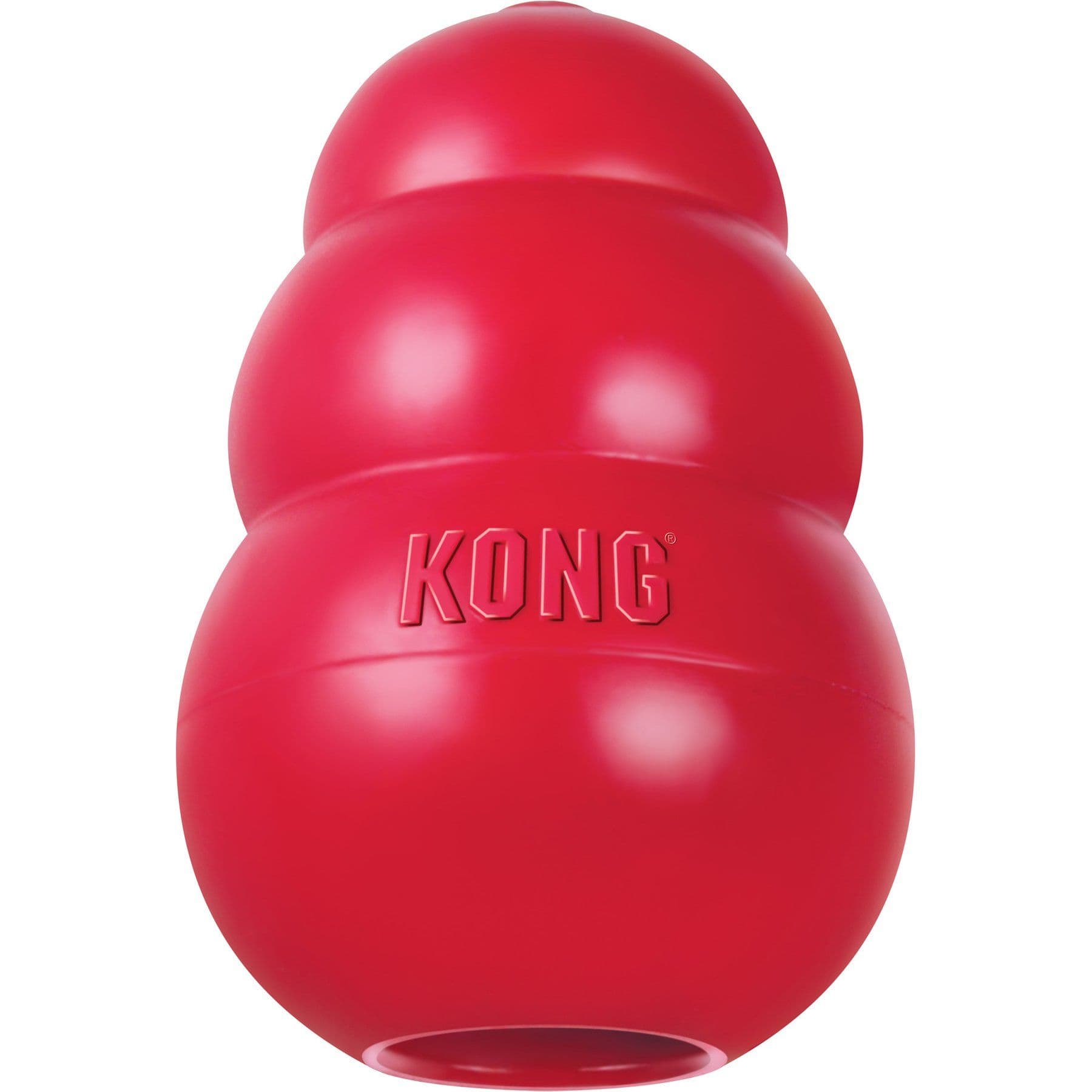
The red natural rubber cone that passes the thumbnail test and turns a five-minute toy into an hour of work once it is stuffed and frozen. Buy the largest size your dog can carry.
Webvet may earn a commission when you click through to Chewy, at no extra cost to you.
One more boundary worth drawing. Chewing is a different behavior from problem-solving. A dog who mainly wants to gnaw on something is asking for a chew rather than a puzzle, and dental chews and edible chews are their own category with their own safety rules.
How much mental stimulation a dog actually needs
Most adult dogs do well on roughly 15 to 30 minutes of deliberate mental work a day, split into short sessions rather than one long one. That is the honest answer behind the popular fifteen-minute figure.
Fifteen minutes of concentrated sniffing, problem-solving, or training genuinely does settle a dog, and it works because the effort is focused, not because the number itself is magic.
What 15 minutes of mental stimulation looks like
- Five minutes of scatter-feeding part of breakfast into the lawn or a snuffle mat.
- Five minutes of a food puzzle or a stuffed rubber toy after the afternoon walk.
- Five minutes of nose games in the evening: a treat hidden under one of three cups, or sending him to find a named toy.
Split like that it fits around a normal day, and the split matters more than the total. Two five-minute sessions and one ten-minute session beat a single twenty-minute marathon, because dogs concentrate in bursts and a session that runs past the point of frustration teaches your dog that the toy is not worth starting.
Enrichment is not a replacement for exercise and it is not a treatment for a behavior problem. It is the daily outlet that stops a healthy dog inventing his own job, which is the idea behind environmental enrichment as described by the Ohio State University Indoor Pet Initiative.
If your dog is destroying baseboards, barking for hours, or pacing, that is a conversation with your vet or a qualified behaviorist rather than a bigger toy budget.
How we chose these interactive dog toys
There is no single best interactive dog toy, and any guide that names one is guessing about your dog. The best one is the format that matches how your dog likes to work.
A nose-driven dog wants foraging, a chewer wants tough rubber he can lick and gnaw at, and a dog who lives for movement wants something that runs away from him. Choose the format first, then the product.
These are researched, vet-informed selections rather than lab tests. WebVet did not run timing trials or destruction testing on any toy here. The judgement below comes from published manufacturer specifications, how each format behaves in ordinary use, and general enrichment and play guidance from sources including VCA Animal Hospitals and the ASPCA.
- Format fit. Each pick represents one of the five formats above, rather than five versions of the same rubber ball.
- A real job for the dog. Every pick asks for something specific: sniffing, licking, nudging, sliding, or chasing.
- Size and chew-strength options. Toys sold in one size only were skipped, because a toy sized for a spaniel is a swallowing risk for a retriever.
- Cleanability. Anything that holds wet food has to survive regular washing.
- Published safety guidance. Makers who say nothing about sizing, supervision, or when to retire a toy did not make the list.
Know what each format is for before you click a price. In a shopping carousel a wobble feeder, a sliding puzzle, and a self-rolling ball look interchangeable, and they do completely different things for your dog. For toys sorted by play style rather than by job, see our best dog toys roundup.
Treat-dispensing and foraging toys

This is the group that keeps a dog entertained longest, and it is where most owners should start. Food is the strongest motivator most dogs have, so a toy that releases it slowly holds attention far better than one that does not.
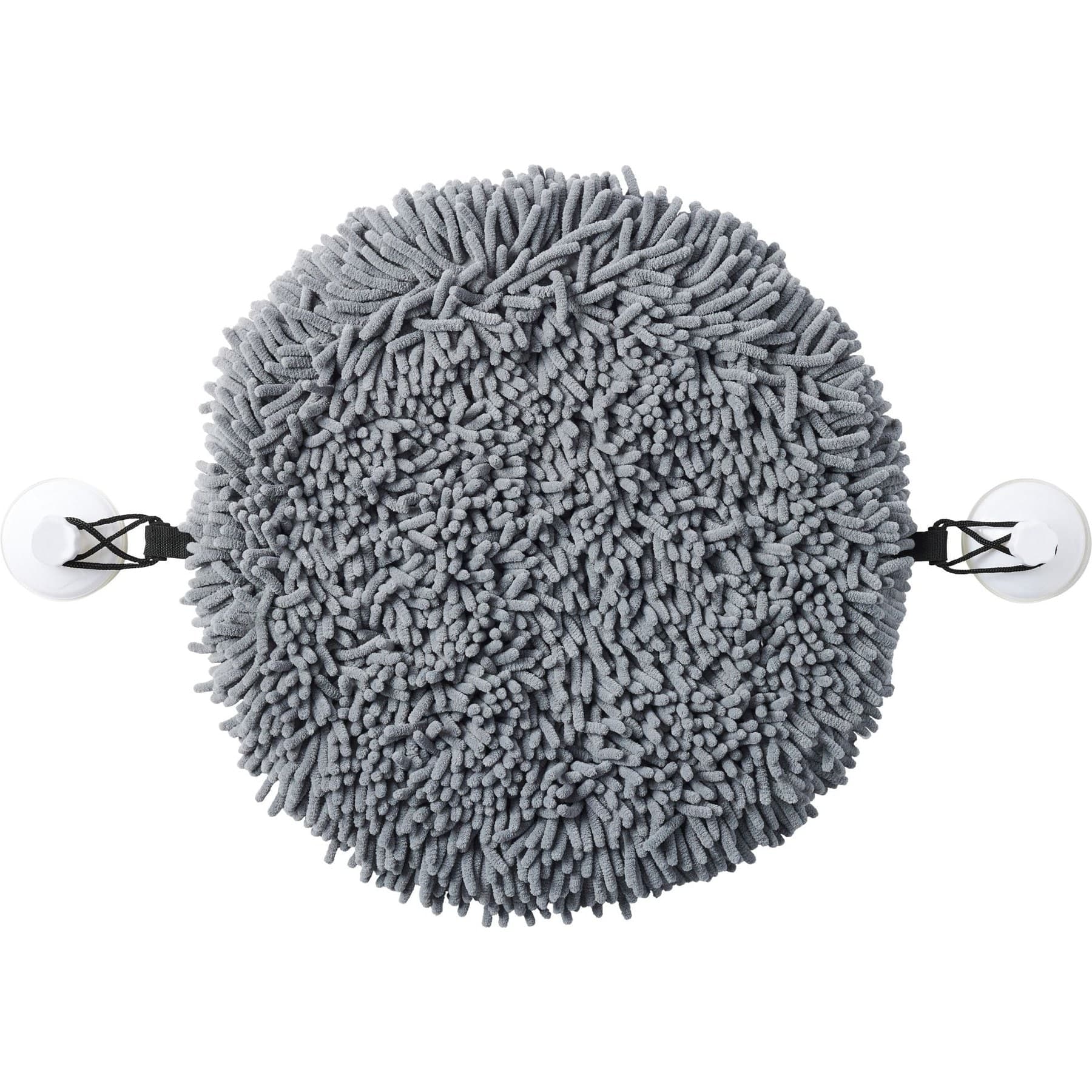
A shaggy mat you scatter kibble into for five to ten minutes of nose work. Machine washable, with suction cups for smooth floors. Supervised, since the pile is chewable.
Webvet may earn a commission when you click through to Chewy, at no extra cost to you.
Packed and frozen, a stuffable rubber toy is the only thing on this page that reliably runs past half an hour.
Two habits make this whole group work. Load the toy so the first pieces fall out almost immediately, which teaches your dog that effort pays.
Then vary what goes in, so the toy does not become predictable. Dry kibble, a few healthy dog treats, a smear of wet food, and a mix of all three all behave differently inside the same toy. A snuffle mat with kibble hidden in the fleece holds most dogs for a few minutes; afterwards, check it for missing pieces before it goes back in the cupboard.
KONG Classic: the stuffable standard
The KONG Classic is the toy most vets and trainers reach for first, and it earns that. It is a hollow natural-rubber snowman shape you pack with kibble, wet food, or something sticky, and your dog has to lick and chew it out through openings at both ends.
It bounces unpredictably when he drops it, which restarts the game without you.
Packed, it holds most dogs ten to twenty minutes. Stuffed with wet food and frozen overnight, it can run closer to an hour, which makes it the single best thing to leave with a dog as you go out.
- It comes in several sizes and firmness grades, including a softer puppy version and a tougher black one for hard chewers.
- Buy the size the maker lists for your dog by weight, not the one that looks right in the photo, and size up if he empties it in two minutes.
Frisco Snuffle Mat: foraging for a fast eater
A snuffle mat is a fabric base covered in shaggy fabric strips. You scatter dry food across it, work the pieces down into the fabric, and your dog has to push his nose through the pile to find each one.
It turns thirty seconds of eating into five to fifteen minutes of sniffing, which is exactly what a dog who inhales his food needs.
Sniffing is genuinely tiring work, and this is the cheapest way to buy it indoors on a wet day. The Frisco mat is machine washable and has suction cups underneath, which matters more than it sounds, because any mat that holds food gets greasy quickly and a mat that slides gets ignored.
- Use dry food or dry treats rather than anything wet, and take the mat up when the session ends.
- Fleece strips are chewable, and a dog left alone with one may decide the mat itself is the snack.
Planet Dog Orbee-Tuff Snoop: a treat toy that has to be worked
The Snoop is a flexible rubber ball with a deep cone folded down inside it. You drop treats into the cone, and your dog has to push, roll, and squeeze the ball to shake them back out through the opening.
Because the walls flex, food does not simply fall out when the toy tips over, so emptying it takes real work rather than luck.
It suits a dog who has outgrown a plain treat ball but will not sit still for a puzzle board, and it is one of the better choices for a dog who plays standing up and moving around.
- You can make it easier by folding the cone shallower for the first few sessions and harder by pushing it deeper.
- Rinse it out after anything greasy, and check the rim for chew damage before you reload it.
KONG Wobbler: turn a whole meal into a job
A wobble feeder is a weighted dispenser that refuses to stay knocked over. The Wobbler unscrews in the middle for filling, and every time your dog shoves it, it rocks back upright, spins, and drops a few pieces of kibble through the hole in its side.
The small Wobbler holds about half a cup of dry food and the large about a cup, so a small dog's meal or a good part of a larger dog's meal can go through it, and that is what makes it useful. It converts a bowl of food into ten to twenty minutes of work with no extra effort from you.
Use a lighter load for the first week so food comes out easily, then fill it fuller as your dog gets good at it. Two practical warnings:
- It is loud on a hard floor, so put it on a rug if you have neighbors below.
- It is a solid object being knocked around a room, so it does not belong near a glass door, a television stand, or a sleeping cat.
Outward Hound Nina Ottosson Dog Brick: a first puzzle board
Puzzle boards are the format that most often ends up in a cupboard, because owners buy a hard one first.
The Dog Brick is a sensible entry point: a flat tray with sliding covers and removable bone-shaped covers over a row of treat compartments, so you can start with everything open and cover more of it as your dog works out the mechanics.
Boards are also the shortest-lived format on this page.
- Once a dog knows the trick, most clear a full board in two to five minutes, so treat it as a starter rather than the afternoon entertainment, and keep it for supervised sessions only.
- Dogs chew the removable plugs, and the plugs are exactly the size that gets swallowed.
If a graded difficulty ladder is what you actually want rather than a play style, that is a separate decision and a dedicated puzzle guide will take you further than one pick here.
 Sponsored
Vet care that's always there
Unlimited video calls and messaging with licensed vets for less than a typical vet visit. One membership covers up to five pets.
Use code Pets60
Plans start at $12/month · covers up to 5 pets
- Licensed vets in most states
- Rx for 150+ conditions
- 4.7 on Trustpilot
Self-moving and automatic interactive toys

These are the toys that carry on without you, and they answer the real question behind most searches for a dog toy that moves on its own: can something else play with my dog for a while?
Partly. A self-moving toy holds most dogs for five to fifteen minutes before the novelty wears off, and almost every dog stops sooner if no person in the room is reacting at all.
They come in three types, and they suit very different dogs:
- Self-rolling balls. Battery balls that judder, roll, and bounce off walls, then switch themselves off after a set period.
- Automatic launchers. Machines that throw a tennis ball a set distance for a dog who has learned to drop the ball back in.
- Flirt poles. A pole, a length of bungee, and a lure on the end, driven by you. Not automatic, but the most reliable chase toy there is.
Cheerble Wicked Ball: a ball that starts the game itself
A self-rolling ball is the closest thing to a toy that plays on its own. The Wicked Ball moves in unpredictable bursts, backs away from obstacles, and has timed play and rest modes so it is not rattling around the kitchen all afternoon.
For a dog with real prey drive and nobody free to throw for him, it does work.
Two honest limits:
- Most dogs lose interest inside fifteen minutes, because a ball that never gets properly caught stops being satisfying.
- A hard chewer will crack the shell, at which point there is a battery and a motor inside a toy in your dog's mouth.
This is a supervised toy. Check the case for cracks after every session, and retire it the moment the shell splits.
PetSafe Automatic Ball Launcher: fetch without your shoulder
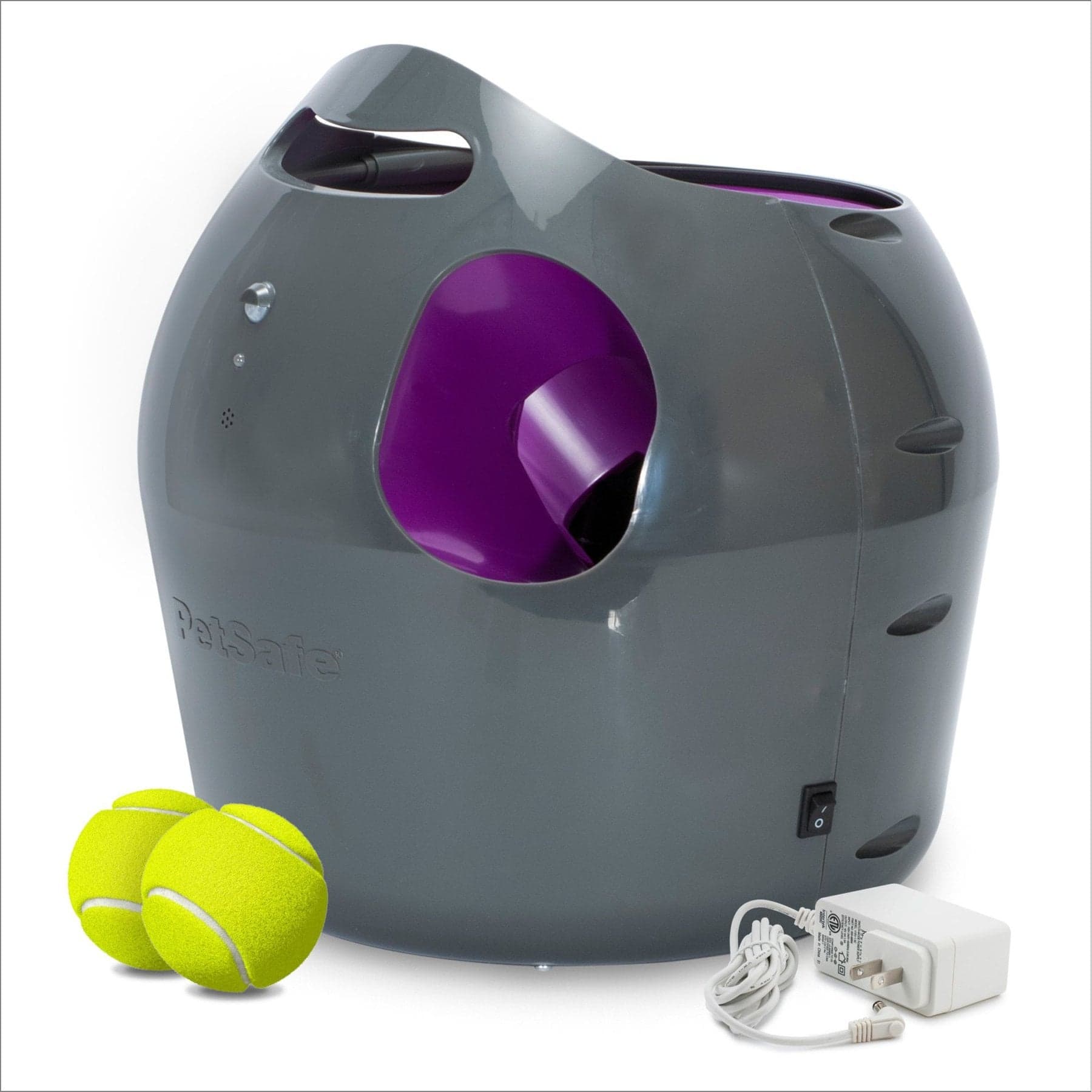
Throws a tennis ball for a dog who already brings it back and drops it in the hopper, with adjustable distance and angle. Teach the release first, and keep sessions short.
Webvet may earn a commission when you click through to Chewy, at no extra cost to you.
An automatic launcher throws a tennis ball for a dog who already knows how to bring it back and drop it into the hopper. Distance and angle are adjustable, and it rests itself between throws so a dog cannot run non-stop.
For a fetch-obsessed dog in a household that cannot throw a ball two hundred times a day, it is the most genuinely useful machine on this list.
It needs teaching first. Most dogs need a week of you hand-feeding the ball into the chute before the penny drops, and a dog who never learns to release the ball will simply stand there holding it.
- Set it up outdoors or down a long hallway with nothing breakable in the flight path.
- Keep sessions short, because repetitive high-speed fetch with hard stops and turns is demanding on joints, and a machine will keep throwing long after a young dog should have stopped.
Squishy Face Studio Flirt Pole: the chase toy you drive
The Squishy Face Studio Flirt Pole is a fishing rod for dogs: a rigid pole, a bungee line, and a lure you drag along the ground. It is the highest-intensity toy here and the most space-efficient, because it burns a chase-driven dog out in about ten minutes in a small yard.
It is also the only toy in this group that builds impulse control, since your dog only gets the lure when you decide to let him catch it.
- Work the lure low and along the ground rather than up in the air, so he is not twisting and landing awkwardly, and let him win regularly or he will give up.
- Keep sessions to five or ten minutes, skip it altogether for puppies whose growth plates are still open, and put the whole thing away afterwards.
- A bungee cord and a fabric lure left on the floor is a chew toy waiting to be swallowed.
Matching interactive toys to size and chewing strength

Get sizing right before anything else, because it is the mistake that turns a good toy into a hazard. A toy small enough to fit fully inside your dog's mouth can be swallowed or lodged at the back of his throat, and that is the most common way an interactive toy causes real harm.
When your dog sits between two sizes on a maker's chart, go up rather than down.
| Your dog | Formats that fit | Formats to skip | Check the label before ordering |
|---|---|---|---|
| Small dog under 20 lb | Snuffle mats, small stuffable rubber, shallow puzzle boards | Full-size wobble feeders and launchers built around standard tennis balls | That the smallest size still fits a treat you can realistically load |
| Medium dog 20 to 50 lb | Almost everything, since this is the size most toys are designed around | Nothing in particular, but avoid toys with no size chart at all | The weight range printed for each size, not the photograph |
| Large dog over 50 lb | Large stuffable rubber, wobble feeders, launchers, flirt poles | Small rubber toys, fleece balls, and anything he can hold entirely inside his mouth | That the large size is actually in stock, not simply listed |
| Heavy chewer, any size | Firm one-piece rubber treat toys rated for tough chewers | Fabric mats, plush hide-a-toys, battery balls, plastic puzzle boards | Whether the maker offers a tougher grade of the same toy |
| Senior dog or worn teeth | Snuffle mats, lick surfaces, softly loaded stuffable toys | Hard plastic puzzles and firm rubber that needs real jaw force | How soft the material is and whether food can be smeared rather than chewed out |
Chewing strength changes the answer more than body size does. A 15-pound terrier who destroys everything needs the same tough rubber as a Labrador, just in a smaller size.
Watch what happens in the first ten minutes with a new toy. If he is working at the seams and edges instead of the food, he is a chewer, and fabric and thin plastic are off his list for good.
West Paw Zogoflex Toppl: the interactive toy for heavy chewers
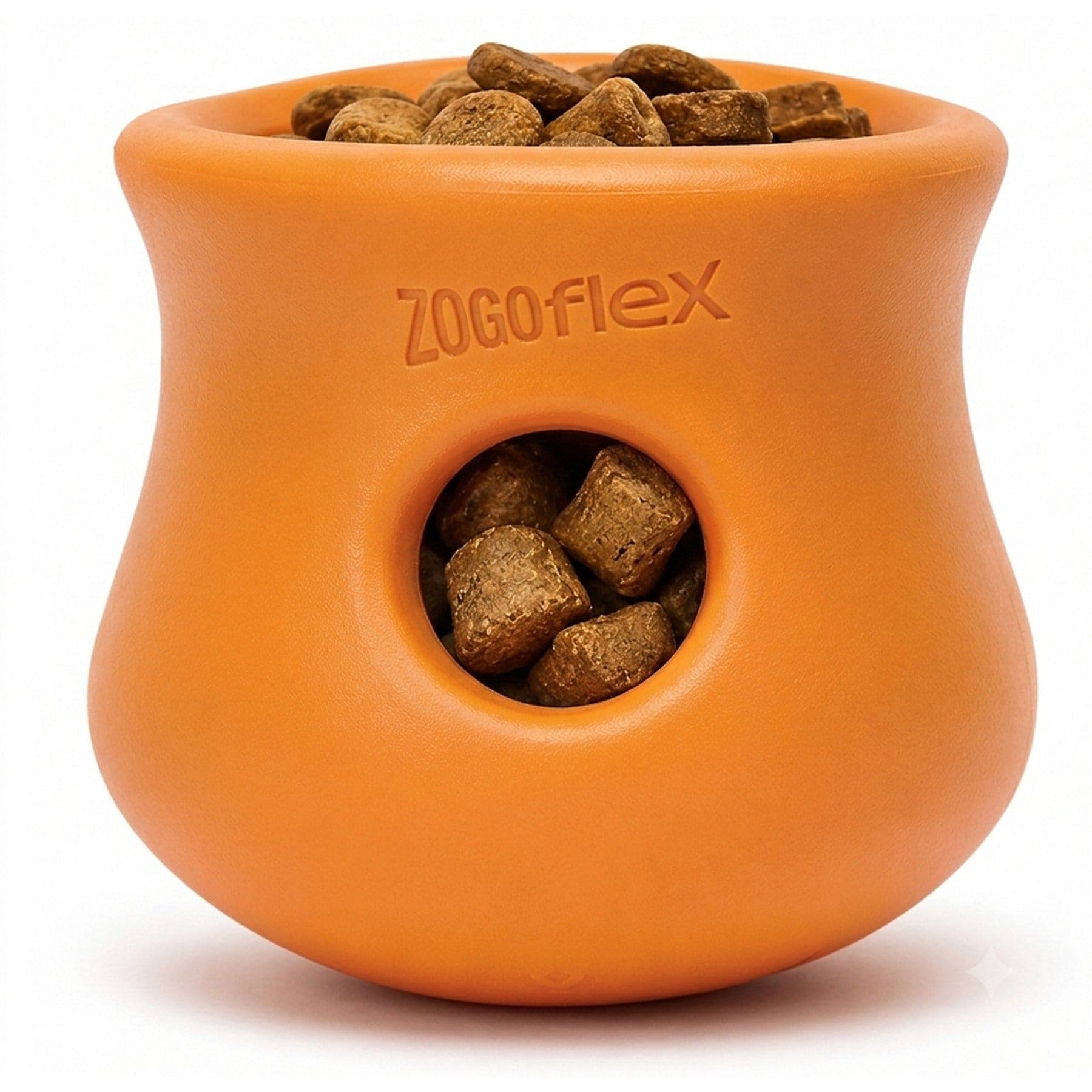
A thick, flexible Zogoflex cup with internal ridges, made to be stuffed, frozen, and worked at. Two sizes lock together to make the puzzle harder, and it survives the dishwasher.
Webvet may earn a commission when you click through to Chewy, at no extra cost to you.
The Toppl is a thick one-piece rubber cup with a rolled lip and a treat cavity, made from West Paw Zogoflex material, which the maker backs with a replacement policy if a dog chews through it.
- There are no seams, no glued parts, and no thin walls, which is exactly what a power chewer defeats on other treat toys.
- It is dishwasher safe, and two sizes lock together into a harder puzzle once your dog masters one on its own.
For a dog who has already shredded a snuffle mat and cracked a plastic puzzle board, this is the format that survives. Fill it with wet food and freeze it and it holds a heavy chewer longer than it holds a gentle dog, because for him the chewing is the point rather than an obstacle.
As with any rubber toy, retire it when the rim goes soft, a piece is missing, or a crack appears.
Interactive toys for a bored dog home alone

The honest answer to what keeps a dog entertained for hours is that no toy does, but one gets close. A rubber toy packed tight with wet food and frozen solid will occupy most dogs for thirty to sixty minutes, which is the longest single stretch anything on this page will buy.
Everything else is measured in minutes, so the workday has to be built out of several small jobs instead of one big one. Toys to keep a dog busy while at work are the one-piece stuffables and a snuffle mat put down just before you leave, loaded so the dog gets an easy win in the first minute.
- 1A frozen stuffed rubber toy is the best single thing to leave a dog with. Expect thirty to sixty minutes, not a workday.
- 2Leave two or three loaded toys in different rooms rather than one, so finding them is part of the job.
- 3The rest of a workday is covered by what happens before you leave and by a midday break, not by a better toy.
- 4A dog who panics rather than gets bored when you leave needs help from your vet or a behaviorist. No toy treats distress.
A routine that actually holds up looks like this:
- Walk or train before you go, so your dog is settled rather than wound up when the door closes.
- Hand over the frozen stuffed toy as you leave, which also gives the departure something good attached to it.
- Hide two or three small foraging toys around the room, or scatter part of his breakfast into a rug.
- Book a midday walk or a visit once the day runs past five or six hours, because that is the gap no toy fills.
One distinction matters more than any product here. Boredom looks like chewing, digging, and finding trouble, and it responds well to having more to do.
Distress looks like panting, drooling, pacing, howling, and damage aimed at doors and windows, and it starts within minutes of you leaving.
If it is distress, a better toy is the wrong answer, and the right one is a plan from your vet or a qualified behaviorist. The American Veterinary Society of Animal Behavior publishes owner resources on finding one.
The first session: how to stop your dog quitting on a new toy
Most interactive toys fail on day one, and it is almost always because the first attempt was too hard. A dog who tries a puzzle for thirty seconds, gets nothing, and wanders off has learned that the object does not pay, and he will walk past it next time too.
The fix is to make the first session look almost too easy.
Three steps, in this order:
- Load it obviously. Lids off, holes wide open, food visible and already half falling out. He should get something within the first five seconds.
- Sit with him. Stay on the floor, point at the food, tap the toy, and be pleased when it works. You are teaching him the toy is worth starting, not testing him.
- Raise the difficulty after two easy wins. Once he has emptied it twice without help, close one lid, narrow one hole, or pack it a little tighter. One change at a time.
Read the failure correctly. A dog who sniffs the toy once and walks away found it too hard. A dog who empties it in twenty seconds and looks around bored found it too easy and needs the next step up.
Frustration in between looks like barking at the toy, flipping it over, or abandoning it mid-attempt, and it is a signal to help rather than to wait him out.
When to make a toy harder again
Expect to reset the same toy every few weeks. Dogs get good at things, and a puzzle that took ten minutes in January takes ninety seconds by March.
That is not the toy wearing out, it is your dog getting better, and it is the cue to make it harder or rest it for a couple of weeks.
Safety rules for interactive toys

Here is the rule that matters most. Interactive toys with fabric, squeakers, batteries, or removable pieces are supervised toys, and only solid one-piece rubber in the right size stays on the floor when you leave.
Ingestion is the risk nobody prints on the packaging, and a swallowed squeaker or a mouthful of fleece is emergency surgery rather than an inconvenience.
Food toys in a multi-dog house
Food-loaded toys are one of the most common triggers for a fight between dogs who otherwise get along, because a high-value item in a shared space is precisely where resource guarding shows up.
Feed puzzle toys in separate rooms or behind a baby gate, collect the empties before you open the door again, and never let one dog approach another who is still working on a loaded toy.
If either dog stiffens, freezes over the toy, or growls, treat that as information rather than naughtiness and get a behaviorist involved early.
Keeping food toys clean
Anything that has held wet food needs washing, and the practical answer differs by material:
- Solid rubber toys go on the top rack of the dishwasher, or get scrubbed inside with a bottle brush and hot soapy water.
- Fabric mats go in the wash on a gentle cycle with a mild detergent and no fabric softener.
- Rigid plastic puzzle boards are usually hand-wash only, because dishwasher heat warps them out of shape.
Let everything dry fully before you reload it. Damp fleece folded into a cupboard grows mold quickly, and a rubber toy with wet food still in the cavity will smell within a day.
A toy that has become unpleasant is a toy your dog stops working at, which is the quiet way a good purchase gets abandoned.
DIY enrichment and toy rotation

The best boredom busters for dogs cost nothing. These all do the same job as a manufactured toy, and your dog cannot tell the difference:
- A cardboard box with kibble folded inside sheets of newspaper.
- A muffin tin with treats under tennis balls.
- A bath towel rolled up with food in the folds.
- The whole breakfast scattered across the lawn.
Supervise the cardboard ones, because a fair number of dogs eat the box.
Rotation is the other half, and it answers the most common complaint in this whole category: the toy that worked stopped working after a week. It did not break. Your dog got good at it, and it stopped being a problem worth solving.
- Keep the bulk of the toys in a closed bin out of reach, with three or four out at any time.
- Swap the set every three to five days instead of adding to the pile on the floor.
- Rest a toy he has mastered for two weeks, then bring it back one level harder.
- Retire anything damaged rather than returning it to the bin.
A toy that comes back after two weeks away is close to new again, which is why rotation beats buying. If homemade builds and no-cost workday activities are what you actually want rather than something to order, that is a subject in its own right. Our dog enrichment toys guide covers it, DIY builds and the workday plan included.
Puzzle toys and difficulty levels
Puzzle boards are sold in graded levels, running roughly from lift-a-lid at level one up to multi-step boards where one action unlocks the next at level four.
This guide names one starter board, because for most people the real choice is a play style rather than a difficulty rating.
If your dog already clears a level-two board in under a minute and you want to know what to buy next, the difficulty ladder is a separate decision and a dedicated dog puzzle toy guide is the place to work through it.
Slow-feeder bowls at mealtime
A slow-feeder bowl is the everyday version of a food puzzle: a ridged or mazed bowl that makes a dog eat around obstacles instead of inhaling a meal in twenty seconds.
It solves speed at mealtimes rather than boredom during the day, so it sits alongside the toys on this page rather than replacing them.
If eating too fast is the problem you are really trying to fix, our guide to slow feeder dog bowls compares the shapes, depths, and materials in full.
When your dog destroys every toy
Some dogs go through interactive toys in an afternoon, and at that point you are buying durability rather than cleverness.
The short version: firm one-piece rubber with no seams survives, while fabric, plush, thin plastic, and anything glued together does not.
Buy one size up from the chart, retire toys at the first crack, and accept that a toy with a battery inside is not a candidate for a dog like this. Durability grades and destruction-tested picks are a guide of their own. Start with our indestructible dog toys guide, and read our dog chew toys guide for chew formats sorted by chewing style.
Choosing the right KONG
The KONG range is one toy in several firmness grades and half a dozen sizes, and picking the wrong combination is the usual reason it disappoints.
Broadly, the softer puppy grade suits young mouths and older dogs, the standard red suits average chewers, and the black extreme grade is for dogs who flatten the red one.
Size comes from your dog's weight on the maker's chart, and going up a size is the fix for a dog who empties it in two minutes. Working out which one your dog needs is worth doing properly on a guide dedicated to the range. That is our KONG dog toys guide.
Interactive dog toy questions
Frequently Asked Questions
How long will an interactive dog toy actually keep my dog busy?
Five to twenty minutes for most formats, which is far less than the packaging implies.
A puzzle board holds attention for two to ten minutes once your dog knows the trick, a snuffle mat for five to fifteen, a wobble feeder or a packed rubber toy for ten to twenty, and a self-moving ball for five to fifteen before most dogs walk away.
The one real exception is a rubber toy stuffed with wet food and frozen solid, which can run thirty to sixty minutes.
Those are editorial estimates drawn from published product guidance rather than timed trials, and an individual dog will land either side of them, but nothing in this category buys a whole afternoon.
Do treats from a puzzle toy count toward my dog's daily food?
Yes. Everything that goes into a food toy comes out of the daily ration, not on top of meals.
The simplest system is to measure the whole day of food into one container each morning and load the toys from that container, so a puzzle session replaces part of a meal instead of adding to it.
If you use treats rather than kibble, keep them small and low in calories, and remember that a smear of peanut butter or wet food inside a rubber toy is real calories too.
Two or three food-toy sessions a day stacked on top of normal meals is enough to put weight on a dog within a couple of months.
My dog gave up on the puzzle in thirty seconds. What do I do?
Make it dramatically easier and start again. A dog who quits in the first minute has decided the toy does not pay, so take the lids off, widen the openings, leave food visibly falling out, and sit on the floor helping him.
Once he has emptied it twice without help, that is two easy wins and you can make one small change: close a lid, narrow a hole, or pack it tighter. Change one thing at a time.
If instead he empties it in twenty seconds and looks bored, the opposite is true, and he needs the next step up rather than more encouragement.
Which interactive dog toys are safe to leave with a dog alone?
Only solid one-piece rubber treat toys in the correct size, and only after a damage check.
Everything else comes up off the floor: fabric snuffle mats, plush hide-a-toys, anything with a squeaker, rope with loose strands, puzzle boards with removable pieces, and any battery-powered ball. Those are safe to leave out only while you are in the room watching.
Before you go, squeeze the rubber toy, look along the rim and openings for cracked or chewed edges, and check it for missing pieces. If a chunk is unaccounted for, assume your dog swallowed it and call your vet.
How do you clean a snuffle mat or a treat-dispensing toy?
It depends on the material. Fabric mats go in the wash on a gentle cycle with a mild detergent and no fabric softener, then air dry, since heat from a tumble dryer can distort the backing.
Solid rubber toys go on the top rack of the dishwasher, or get scrubbed inside with a bottle brush and hot soapy water. Rigid plastic puzzle boards are usually hand-wash only, because dishwasher heat warps them.
Whatever the material, let it dry fully before you reload it, because damp fleece and leftover wet food both turn a food toy unpleasant within a day or two.

Editor
The Webvet Editorial Team is the in-house group of pet-care editors and writers behind Webvet, operated by Smart Pet Collective. The team researches, writes, and maintains Webvet's pet health, behavior, and medication content. Every article follows a defined editorial process: research from reputable veterinary and scientific sources, careful drafting, mandatory review of medical content by a credentialed veterinarian, and dated publication. Health and medication articles are medically reviewed by a licensed veterinary professional before they go live and are kept current over time.


