KONG Dog Toys: Which Color and Size Is Right for Your Dog?
KONG dog toys come in four rubber formulas and a graded set of sizes, and the color tells you how firm the rubber is. Here is how to match the formula to your dog, size it safely, and stuff it without adding calories.

This article contains affiliate links. Webvet may earn a commission when you buy through them, at no extra cost to you.
KONG dog toys look like one product sold in a rainbow of colors, and that is exactly why so many owners buy the wrong one. The color is not decoration. It tells you how firm the rubber is.
Firmness decides whether your dog works at the toy for half an hour or opens it up in ten minutes. Size decides whether the toy is safe at all: one small enough to fit fully inside a dog's mouth is a choking hazard, not a chew.
This guide settles the three decisions standing between you and the right toy: which rubber formula matches how your dog chews, which size is safe, and what is safe to pack inside. These are researched, vet-informed selections drawn from KONG's published specifications and veterinary guidance, not from first-hand product testing.
 Sponsored
Want a vet's help with your dog's anxiety or behavior?
Talk to a licensed vet at Dutch over video, often the same day. They can recommend treatment and prescribe it when it's appropriate.
Use code Pets60
Plans start at $12/month · covers up to 5 pets
- Licensed vets in most states
- Rx for 150+ conditions
- 4.7 on Trustpilot
What KONG dog toys are and how the line is organized
- 1Color is the first decision, because the color is the rubber formula. Pink and blue are the soft puppy rubber, red is the everyday Classic, purple is the softer Senior rubber, and black is the firm Extreme formula for power chewers.
- 2A safe size is one your dog cannot fit fully into its mouth. If your dog falls between two weight bands, or there is a bigger dog in the house, buy the larger one.
- 3Your stuffing choice decides how long the toy lasts and whether it is safe. Build fillings from the dog's own measured food, screen any peanut butter for xylitol, and count it against the daily ration.
- 4A KONG is enrichment, not dentistry. It does not replace toothbrushing, a veterinary dental cleaning, or a walk.
A KONG is a hollow, roughly snowman-shaped toy made from natural rubber, with an opening at each end so you can pack food inside.
Joe Markham founded the company in 1976 after his own dog wore his teeth down chewing rocks and sticks, and the original shape came from a piece of rubber suspension out of a Volkswagen bus.
That accidental shape is still the point. It bounces unpredictably instead of rolling in a straight line, it stands up on a floor, and it holds a meal. For a buying decision, it helps to split the toys into three groups.
- The stuffable rubber core. The Classic and its three siblings (Puppy, Senior, and Extreme) are the same shape in four different rubber formulas, sold in a graded set of sizes.
- Shapes built around one game. The Wobbler is a feeder, the Wubba is a tug toy, the Jumbler and the Flyer are for fetch, and the Goodie Bone and Tires are chews with a treat cavity.
- Soft plush. Cozies and Knots are play toys for gentle mouths and supervised games, not chew outlets for a dog who dissects things.
KONG also puts its name on beds, crates, harnesses, collars, leashes, brushes, and edible treats. None of that is covered here. This guide stays with the toys, because the toys are where the color and size decision lives.
Are KONG dog toys good for dogs?
Answer first: yes, KONG toys are good for dogs, and the reason is not durability. A stuffed rubber toy turns eating into a job. Instead of inhaling a bowl of kibble in ninety seconds, a dog licks, nudges, chews, and problem-solves for ten to forty minutes.
That is mental enrichment, and it is what veterinary and behavior guidance keeps pointing at for dogs who are bored, crated, or left alone through a workday.
Chewing itself is normal canine behavior rather than a fault to be trained away, as general pet-owner resources from the American Kennel Club explain, and a dog with no acceptable outlet finds one in your baseboards.
- 1What it does well: mental enrichment, a legal chewing outlet, slower eating, and something to do inside a crate or during alone time.
- 2What it is not: a dental chew. Textured rubber is not plaque control, and no rubber toy controls tartar the way a veterinary-accepted dental product does.
- 3What it also is not: a substitute for exercise. Enrichment sits alongside a walk, it does not replace one.
- 4It is not a babysitter either. A rubber toy is a supervised item for any dog who can remove pieces of it.
That first limit is worth repeating, because marketing around textured rubber blurs it. If you want a cleaner mouth rather than a busier dog, brushing plus a product with veterinary dental acceptance is the plan, and our guide to vet recommended dog dental chews covers what carries that acceptance.
Do vets recommend KONG toys?
Individual veterinarians recommend them constantly, and veterinary organizations recommend the category. That distinction matters. No professional body endorses a brand of toy, but food-dispensing and puzzle toys are standard advice in veterinary guidance on environmental enrichment.
The American Animal Hospital Association publishes its own explainer on choosing a KONG size and rubber color, and broader owner resources from the AVMA and VCA Animal Hospitals cover enrichment and chewing behavior in more depth.
KONG colors: which rubber formula fits your dog

Start with the color, because it is the only thing that changes what the toy actually is. All four rubber formulas are the same shape. The line is color coded by rubber formula, so the color on the shelf tells you the firmness before you touch it.
What differs is how firm the rubber is and who it was formulated for: pink and blue for puppies, red for the everyday Classic, purple for seniors, and black for power chewers.
Most owners pick by breed or by weight, and that is the mistake. A 90-pound Newfoundland who mouths a toy gently does not need black rubber. A 25-pound terrier who removes chunks of everything absolutely does. Run these three questions on your own dog first.
- Does your dog gut a stuffed plush toy in one sitting? A dog who opens seams and pulls out stuffing is telling you it works to destroy, not just to chew.
- Does your dog work a rubber toy with its back teeth, wedging it into the molars and grinding? Front-teeth nibbling is light chewing. Back-teeth grinding is where rubber fails.
- Has your dog ever removed a chunk of rubber from anything? One removed chunk moves your dog into the power-chewer category permanently, whatever its size or breed.
Zero yes answers means the red Classic is almost certainly right, and the softer formulas are then decided by age rather than by chewing. One yes puts you in moderate territory. Two or three puts you on black rubber, with supervision.
| Color | Formula | The dog it fits | The chewing behavior that selects it | What it is not for |
|---|---|---|---|---|
| Pink or blue | KONG Puppy | Puppies still on baby teeth | Soft mouthing and teething, no rubber loss | Any dog with adult teeth, or a puppy already removing rubber |
| Red | KONG Classic | Most adult dogs, the average to moderate chewer | Licking, nudging, front-teeth chewing with no rubber loss | Dogs who grind with the back teeth or have removed a chunk before |
| Purple | KONG Senior | Older dogs with worn teeth or sore jaws | Gentle chewing that a firmer formula makes uncomfortable | Strong-jawed seniors who still chew hard, who need Classic or Extreme |
| Black | KONG Extreme | Power chewers of any size, and past toy destroyers | Back-teeth grinding, plush gutting, any history of removing rubber | Puppies, and seniors with dental pain who need a softer bite |
Two practical notes on that table. The pink and blue puppy toys are the same rubber rather than two different softnesses, so pick whichever color you prefer. And a dog's formula is not fixed for life.
Life stage moves a dog down the range as teeth wear, and chewing style moves a dog up it. A puppy who has already stripped rubber off a teething toy belongs on the Classic or the Extreme long before the calendar says it is an adult.
KONG publishes the current formula and size options for each line on kongcompany.com, which is worth checking before you order.
KONG Classic
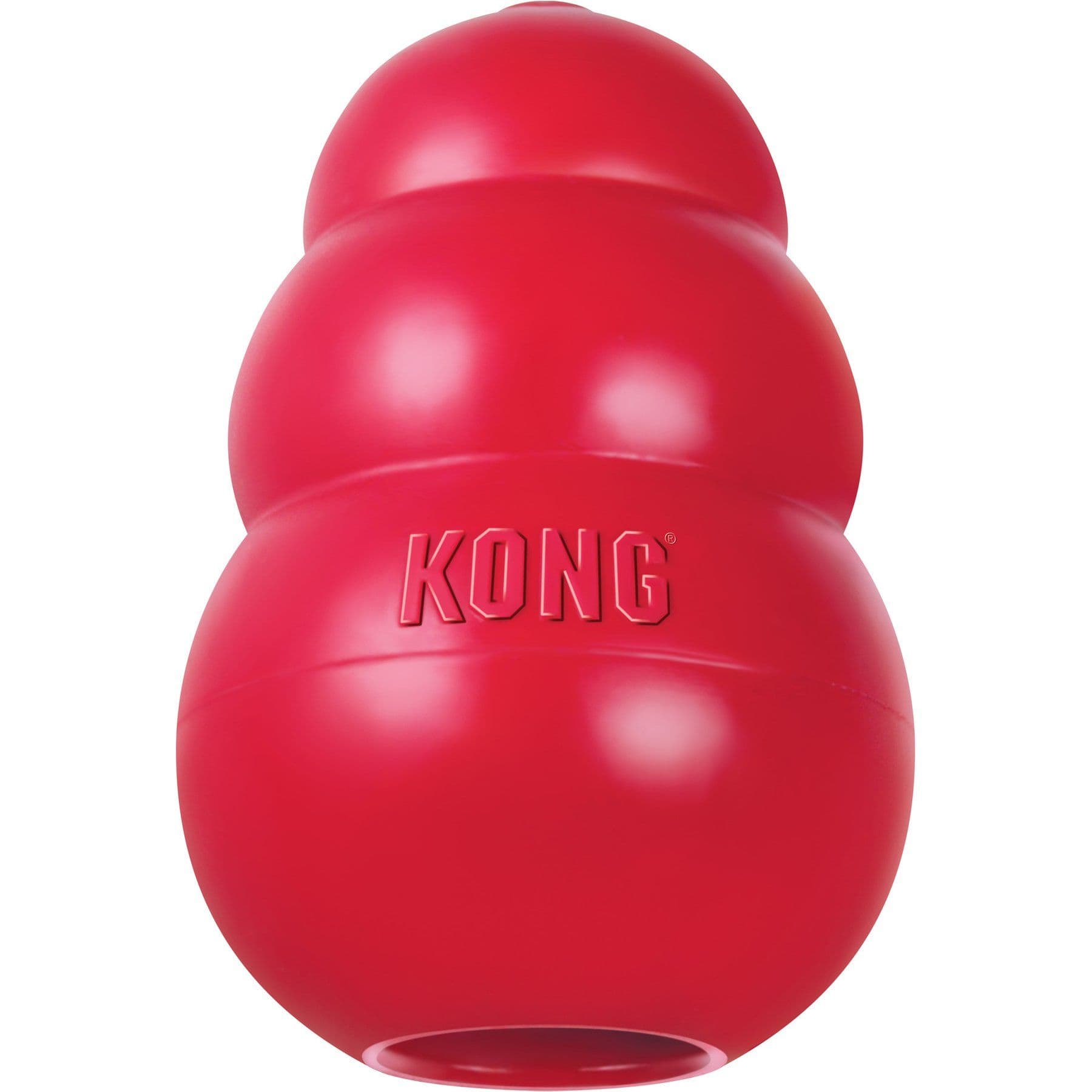
The red natural rubber cone that passes the thumbnail test and turns a five-minute toy into a long session once it is stuffed and frozen. Buy the largest size your dog can carry.
Webvet may earn a commission when you click through to Chewy, at no extra cost to you.

The red Classic is the default answer for most dogs and the one to buy first if you are unsure. It is medium-firm natural rubber, hollow, open at both ends, and it holds enough food to keep an average adult dog busy for ten to thirty minutes.
It also comes in the widest set of sizes in the line, from extra small to double extra large, so it is the easiest KONG to size correctly. Buy it if your dog answered no to all three behavior questions, or one yes at most.
Skip it if your dog has ever taken a piece out of a rubber toy. That dog needs the Extreme, not a larger Classic.
KONG Extreme
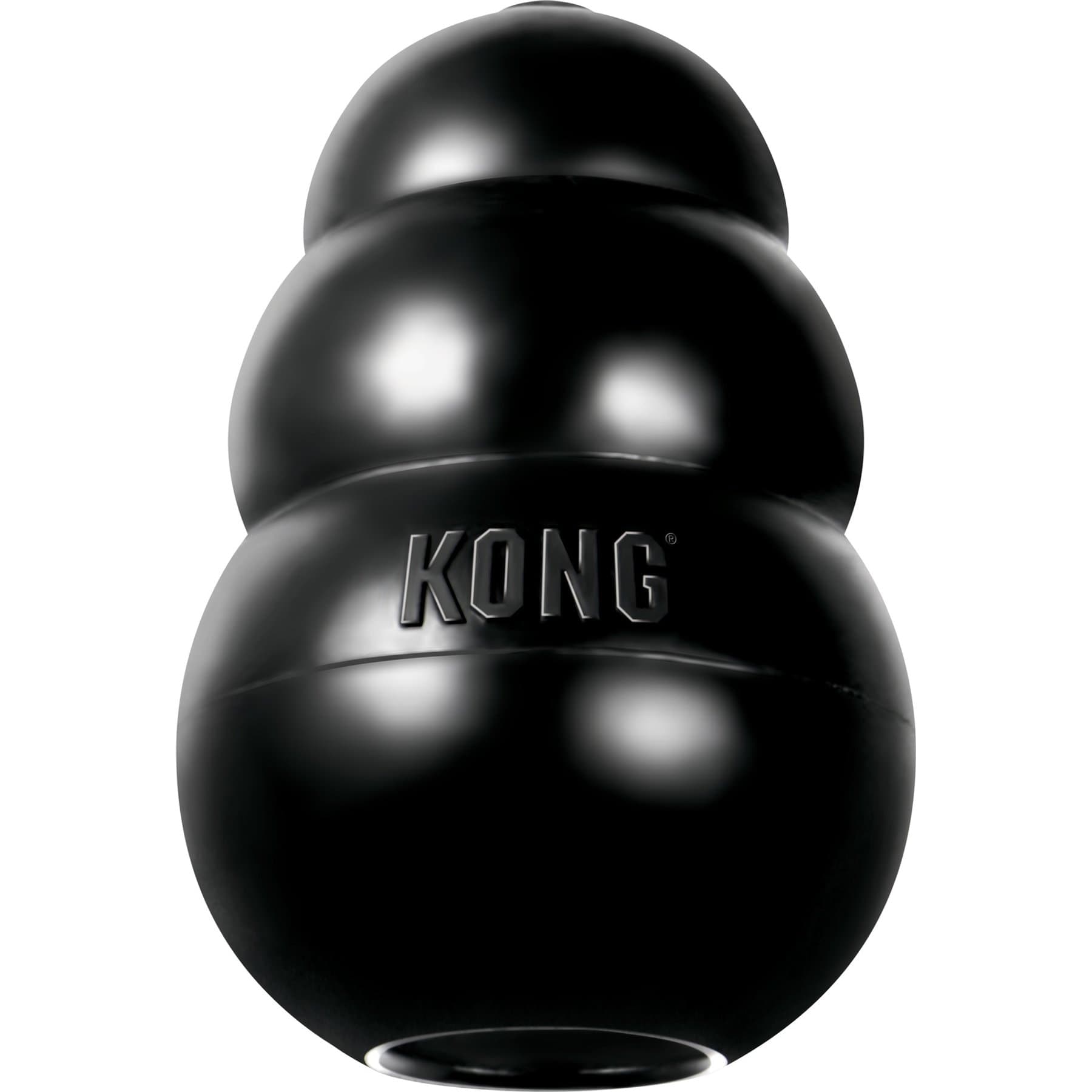
KONG's firmest rubber in the same hollow shape: denser rather than tooth-hard, so a destroyer who has opened a Classic gets more sessions without crossing the hardness line.
Webvet may earn a commission when you click through to Chewy, at no extra cost to you.

The black Extreme is the firmest rubber KONG makes, and it is the only sensible choice for a dog who grinds with the back teeth. Same shape, same hollow core, same stuffing routine as the Classic. The rubber simply resists a harder bite for longer.
For a determined chewer that is the difference between a toy that lasts months and one that lasts a weekend. Buy it in the largest size that suits your dog rather than the size the weight chart minimally allows.
It is not chew-proof, and the company does not claim it is. Give a black KONG to a dog genuinely intent on destroying it, leave that dog alone for an afternoon, and you can still come home to missing rubber. Supervision is part of the product.
KONG Puppy
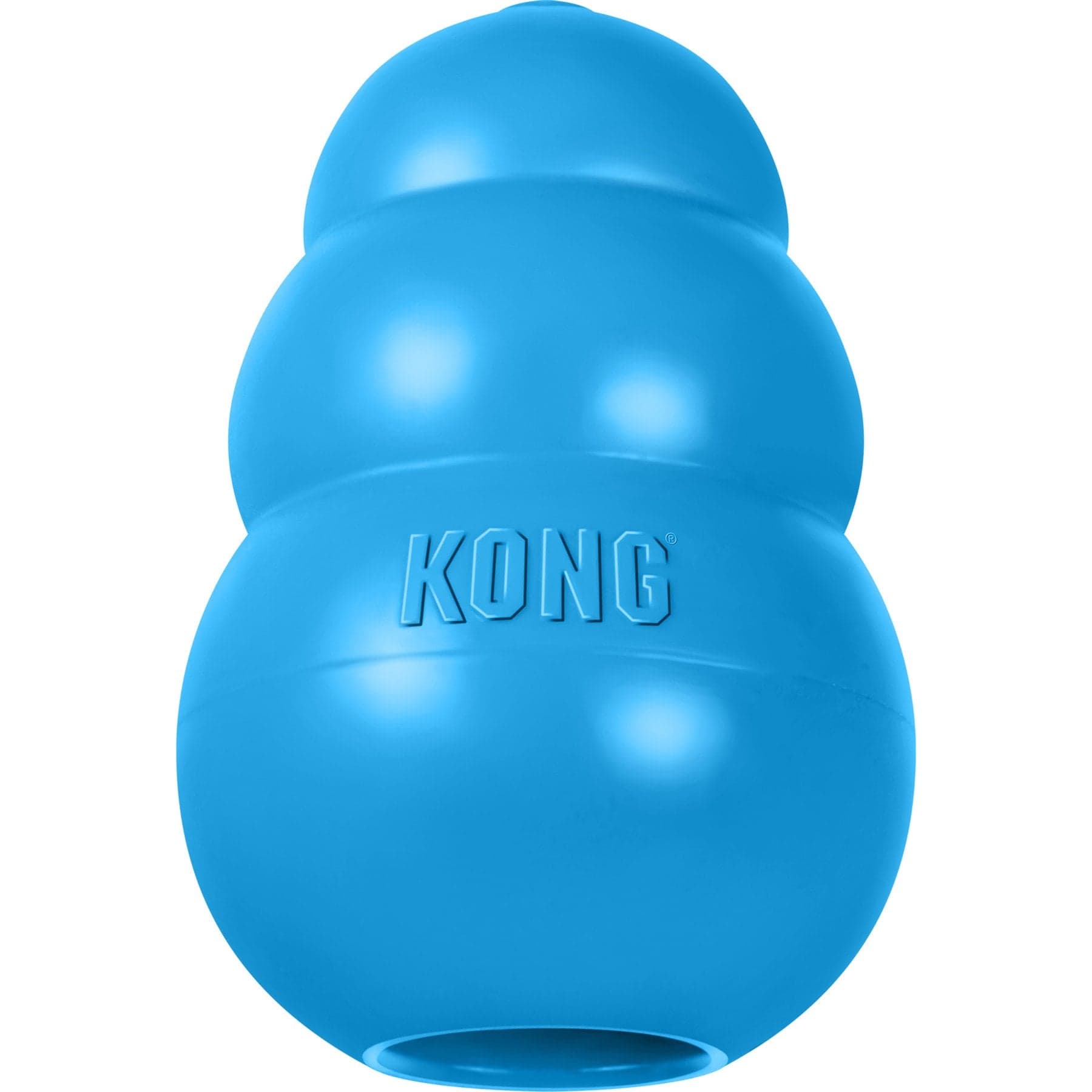
KONG's softest rubber, formulated for baby teeth. Stuff it, freeze it, and it buys fifteen to thirty minutes while cooling sore gums. Size up so it cannot sit behind the back teeth.
Webvet may earn a commission when you click through to Chewy, at no extra cost to you.
The pink and blue Puppy toys use the softest formula in the line, made for baby teeth and the sore gums that come with them. A firm rubber toy is genuinely uncomfortable for a teething puppy, and an uncomfortable toy gets abandoned in favor of your table leg.
Stuffed with something soft and then frozen, a Puppy KONG is one of the more useful things you can hand a puppy at eight in the evening. Size it for the puppy now rather than for the adult dog it will become.
Move off this formula once the adult teeth are in, or sooner if the puppy starts removing rubber. Soft rubber and a determined adult bite are a bad combination.
KONG Senior
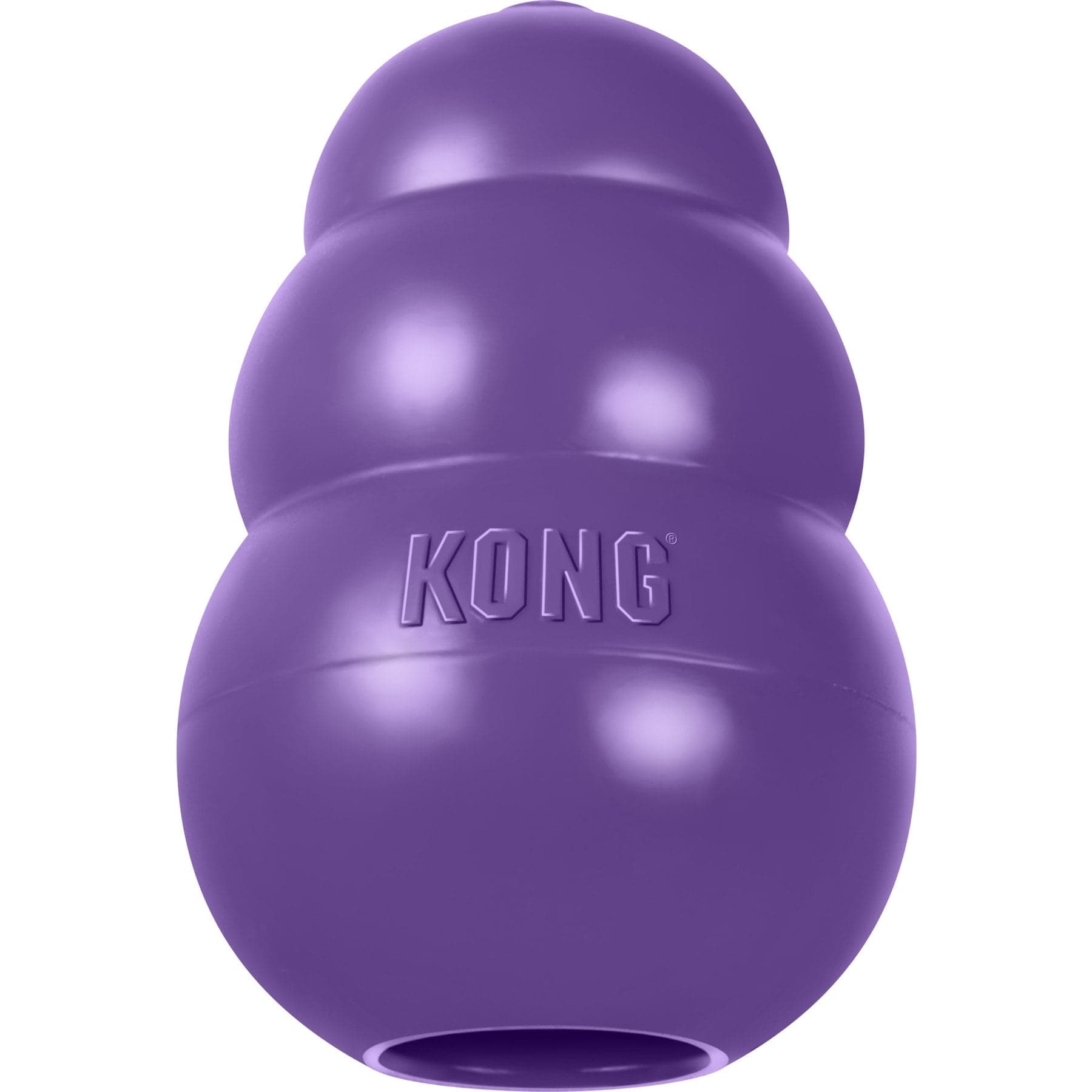
KONG's purple Senior rubber sits between Puppy and Classic in firmness, for older dogs with worn or sensitive teeth who still want to chew. Age alone does not put a dog on purple.
Webvet may earn a commission when you click through to Chewy, at no extra cost to you.
The purple Senior sits between the Puppy and the Classic in firmness. It exists because older dogs often still want to chew but have worn or sensitive teeth, and a red Classic can be too much work to be worth the food inside it.
If your older dog has started ignoring a toy it used to love, softer rubber plus a wetter, easier filling is usually the fix rather than giving up on toys. Sore teeth are also worth mentioning at the next vet visit.
Age alone does not put a dog on purple. A ten-year-old Labrador with a sound mouth and a hard bite still belongs on the Classic or the Extreme.
 Sponsored
Vet care that's always there
Unlimited video calls and messaging with licensed vets for less than a typical vet visit. One membership covers up to five pets.
Use code Pets60
Plans start at $12/month · covers up to 5 pets
- Licensed vets in most states
- Rx for 150+ conditions
- 4.7 on Trustpilot
How to size a KONG for your dog

Size by your dog's mouth first, then check the weight chart. The widest part of the toy has to be wider than the back of your dog's mouth, so the toy cannot be swallowed or lodged behind the molars.
If you can picture the whole toy disappearing inside your dog's mouth, it is too small, whatever the box says. KONG publishes weight bands for each size, and they are a good starting point.
Use them to narrow the choice to one or two options, then let the mouth-fit check decide between them.
| KONG Classic size | Typical dog weight (KONG published band) | Mouth-fit check |
|---|---|---|
| Extra small | Up to about 5 lb | Must still be too wide to sit fully behind the molars of a toy-breed adult |
| Small | Up to about 20 lb | If a small terrier can carry it inside a closed mouth, go up a size |
| Medium | About 15 to 35 lb | The most commonly mis-bought size; check it against the dog, not the breed |
| Large | About 30 to 65 lb | Standard for most retrievers and shepherds; go up for a hard chewer |
| Extra large | About 60 to 90 lb | Choose over Large for deep-chested breeds with roomy mouths |
| Double extra large | About 85 lb and up | Confirm the widest part clears the back of the mouth on a giant breed |
Two things a chart cannot tell you. Size options are not identical across the whole line, so the color you want may not exist in every band and you should confirm the options on the listing. And a dog sitting right on a boundary should always go up.
A KONG Extreme XL is the usual answer for a power chewer in the 60 to 90 pound band, and the XXL exists for the dogs above it.
Why a KONG has a hole at each end
The two openings do two different jobs. The large hole at the wide end is how food goes in and how the dog gets it out.
The small hole at the narrow tip is a safety vent. It stops a vacuum forming when a dog pushes its tongue deep into the toy chasing the last of the filling.
Without that vent, a dog working hard at a stuffed toy can generate enough suction to trap its tongue inside, which is a genuine emergency with some single-opening rubber toys. The second hole also makes cleaning far easier, because water runs straight through.
How to use a KONG day to day, and whether daily is fine
Yes, you can give your dog a KONG every day, and most dogs do better when it is a daily fixture rather than an occasional treat.
Two conditions apply. The food inside has to come out of the daily ration rather than sit on top of it, and the toy has to be one your dog cannot dismantle.
The simplest routine is to make the toy the meal. Measure breakfast or dinner as usual, pack some or all of it into the toy instead of the bowl, and hand it over. Nothing about the day's calories changes.
- Crate training and alone time. Handing over a stuffed toy as you leave gives the dog something to do at the exact moment it would otherwise start rehearsing anxiety.
- Fast eaters. Packing a meal into a toy or a feeder slows a gulper down with no training required.
- Confinement and recovery. A dog on restricted exercise after surgery still needs mental work, and this is one of the few options that involves no movement.
- Evenings. The hour when a bored dog invents a job for itself is the best-value slot in the day for a stuffed toy.
Two limits on daily use. Supervise any dog who can remove rubber, and take the toy away once the food is gone if your dog treats an empty toy as a chew target rather than losing interest in it.
And if your dog is on a weight plan, a prescription diet, or a restricted diet for any medical reason, talk to your vet about what goes inside before you build a daily habit around it.
What to put in a KONG (and what to leave out)

The best thing to put in a KONG is your dog's own food. What is safe to stuff is a shorter list than most owners expect: measured kibble moistened slightly so it packs, or a portion of the dog's regular wet food. Both come straight out of the daily ration.
Everything else, peanut butter included, is a topping that should be small, screened, and counted. The foods to leave out are not ones dogs dislike: they are toxic, they splinter, or they are rich enough to trigger pancreatitis.
Pack from the wide opening. Something sticky goes in at the narrow end first as a plug, the bulk of the food goes in the middle, and something easy sits at the mouth so the dog gets an immediate win and stays interested.
| Safe to stuff | Why it works | Leave out | Why |
|---|---|---|---|
| The dog's measured kibble | Free in calorie terms, straight out of the daily ration | Chocolate and cocoa | Toxic to dogs, and a packed toy delivers it fast |
| Regular wet or canned dog food | Packs well, freezes well, already balanced | Grapes and raisins | Linked to acute kidney injury even in small amounts |
| Xylitol-free peanut butter, a small amount | Highly motivating; use as a plug or a finish, not the filling | Anything sweetened with xylitol or birch sugar | Causes a rapid, dangerous blood sugar crash and liver injury |
| Plain canned pumpkin, not pie filling | Low calorie, packs and freezes well | Onions, garlic, chives, and leeks | Damage red blood cells, and they hide in leftovers and gravy |
| Plain unsweetened yogurt, if dairy suits your dog | Freezes into a filling that lasts | Cooked bones and bone fragments | Splinter, and can perforate the gut |
| Small training treats and the regular biscuits | Easy to portion and easy to count | Macadamia nuts | Toxic to dogs even in small quantities |
| Mashed banana or plain cooked sweet potato | Sticky enough to slow the dog down | Fatty trimmings, bacon fat, rich leftovers | A well-recognized trigger for pancreatitis |
| Wet food mixed through kibble, then frozen | The longest-lasting standard filling | Alcohol, caffeine, and heavily salted food | All are harmful, and the toy makes them easy to consume |
For the toppings, keep the portions honest. Small training treats are the easiest filler to count, and our guides to dog training treats and healthy dog treats cover which ones are worth using.
If your dog swallows something from the leave-out column, your own vet and the ASPCA Animal Poison Control Center are the two numbers to call.
Then do the arithmetic no product page does for you. Treats and extras should stay at roughly ten percent of a dog's daily calories, and a generously stuffed toy blows through that if the filling sits on top of dinner instead of replacing part of it. Freezing a stuffed KONG roughly doubles how long it lasts, and when that actually helps is the long evening stretch, a crate session, or a hot afternoon. For a quick reward an unfrozen toy is fine. Read the label on any sugar-free peanut butter first: the xylitol warning applies to dogs even in small amounts.
- Weigh the whole day's food in the morning, the way you normally would.
- Set aside the portion that will go in the toy, and treat any peanut butter or yogurt on top as part of that same allowance.
- Feed what is left in the bowl. Done this way, a daily stuffed toy costs no extra calories at all.
Which KONG is the toughest, and what still breaks it
The toughest KONG is the black Extreme. It is the firmest rubber formula the company makes, and for a dog who works toys with the back teeth it outlasts the red Classic by a wide margin.
If your dog has a history of destroying toys, that is the one to buy, in the largest size that suits the dog.
It is still not indestructible, and that is worth saying plainly because search results for this brand are full of the word. No rubber toy is chew-proof. The failure mode is rarely dramatic tearing. It is small gouges at the rim that become missing chunks.
- Sustained back-teeth grinding with nobody watching. The rim goes first, and a dog with an hour alone can take real pieces out of it.
- The wrong size. A toy a dog can get fully into its mouth gets attacked with the molars from every angle instead of being pushed around the floor.
- Dogs who chew from anxiety rather than for food. That dog is not working at the filling, it is working at the toy, and the toy loses eventually.
- Heat and age. Rubber left in a hot car or a sunny yard for a season goes softer and tackier, and soft rubber tears.
If your dog is removing rubber from a black Extreme, the answer is not a tougher toy. It is supervision, a different plan for the chewing drive, and a conversation with your vet or a qualified behavior professional about why the chewing is that intense.
A dog who consumes toys is a dog at real risk of an intestinal obstruction, and an obstruction is surgery. That risk is why the size rule and the retirement rule in this guide are not optional extras.
The best KONG dog toys for aggressive chewers are therefore the black Extreme shapes, bought a size up, stuffed so the chewing has a job, and still supervised.
When to replace a KONG, and how the warranty works

Retire a KONG the moment it is missing rubber, and inspect it every time you fill it. That is the whole rule. A rubber toy is safe while it is intact and becomes a swallowing hazard the moment it is not. A KONG is not indestructible, and the satisfaction guarantee is a replacement policy rather than a durability promise.
The inspection takes five seconds and belongs in the filling routine, because the toy is already in your hand. Doing it then, rather than when you happen to notice damage, is what keeps it from being skipped.
KONG publishes a satisfaction guarantee on its rubber toys, and it is worth using rather than quietly binning a chewed one. The company asks owners to get in touch through its customer care channels with details of the toy and the purchase.
The current terms and the contact route are published on kongcompany.com. Keep the receipt, and if a toy failed unusually fast, keep a photo of the damage as well.
Cleaning is the other half of maintenance. Rinse the toy after every stuffed session so old food does not sit in the cavity, and give it a proper wash weekly. Rubber KONGs are dishwasher safe on the top rack. Rope, plush, and fabric toys are not.
Beyond the Classic: KONG shapes for fetch, tug, puzzles, and plush
- 1The shape range is not a set of upgrades. Each shape serves one play style, and buying the wrong shape is how a toy ends up ignored under the sofa.
- 2Solo chewing and food work: Classic, Extreme, Goodie Bone, and Tires.
- 3Fetch and chase: Jumbler Ball, Extreme Ball, and the rubber Flyer disc.
- 4Games that need you on the other end: the Wubba for tug, plus rope and knot toys.
- 5Mealtime puzzles: the Wobbler, which dispenses a whole meal as the dog knocks it over.
- 6Comfort and gentle play: Cozie and Knots plush, for soft mouths and supervised sessions only.
One question cuts through the whole carousel of product names: what does your dog do with a toy when you are not involved?
A dog who carries and cuddles wants plush. A dog who chases wants a ball or a disc. A dog who chews wants rubber. A dog who is bored at dinner wants a feeder. Buy for that, not for the picture on the packaging.
KONG Wobbler

The Wobbler is a weighted treat-dispensing feeder that stands upright, then wobbles and tips when the dog nudges it, releasing kibble a few pieces at a time. It unscrews in the middle for filling and cleaning.
It is the pick for a dog who inhales dinner. Turning a ninety-second meal into a fifteen-minute puzzle needs no training. It is loud on tile, though, and it is a supervised item for any dog who would rather chew the base than solve it.
If gulping is your actual problem, our guide to why dogs eat too fast covers what sits behind it, and our roundup of slow feeder dog bowls covers the quieter option for a hard-floor household. On a difficulty ladder the Wobbler sits with the level 2 dispensers in our dog puzzle toys guide.
KONG Wubba

The Wubba is a tug and fetch toy, not a chew toy: a squeaky ball and a tennis ball wrapped in reinforced fabric, with long tails to grab. The tails give you and your dog a handhold each, and they make the toy easy to throw.
This is the one pick here that requires a human on the other end. Left alone with a dog, the fabric comes apart and the squeaker inside becomes something to swallow.
Used as intended, in a supervised game of tug or fetch, it is one of the better exercise toys the brand makes. Put it away when the game ends, because a tug toy that lives on the floor becomes a chew target.
KONG Jumbler Ball
The Jumbler is a ball with a second ball rattling inside it and a moulded handle on the outside. The handle is what makes it work. Dogs who cannot comfortably pick up a plain ball can carry this one, and you can throw it further than a tennis ball.
The inner ball moves and squeaks, which keeps a dog interested between throws. It is a fetch and carry toy rather than a chew toy, so pick it for a dog whose game is chasing, and inspect it for punctures after hard sessions.
KONG Extreme Goodie Bone
The Goodie Bone is black Extreme rubber in a bone shape, with a recessed cavity at each end that holds a treat or a smear of filling.
The recesses are the useful part. They hold food in a way a smooth rubber bone cannot, so the dog keeps working at it rather than abandoning it after a minute.
Buy it as a second toy for a power chewer who already has an Extreme rather than as a replacement. The bone shape rolls less and lies flatter, which some dogs prefer for long chewing sessions in a crate.
KONG Flyer
The Flyer is a rubber disc for dogs who love a frisbee but wreck a hard plastic one. Rubber flexes, so it is easier on teeth and gums when a dog catches it mid-air, and it does not shatter into sharp fragments.
It is a fetch toy only. Leave it out on the lawn with a chewer and it becomes a rubber snack. Bring it in after the game and inspect the edge the way you would inspect a Classic, because the rim is where a disc gets chewed.
KONG Cozie and Knots plush
The plush lines cover dogs who want something to carry rather than something to destroy. Cozies are soft squeaky characters with reinforced seams. Knots have a knotted rope skeleton inside the plush, so they hold their shape longer.
Neither is a chew outlet. If your dog answered yes to the plush-gutting question earlier, these are supervised play toys at best, and a genuinely destructive dog should not have them at all. The stuffing and the squeaker are the hazard, not the fabric.
KONG for a teething puppy
For a teething puppy the short answer is the pink or blue Puppy formula, sized for the puppy now rather than for the adult it will become, stuffed with something soft and frozen solid.
Cold filling gives sore gums real relief, and a frozen toy lasts long enough to cover the evening stretch when a teething puppy is at its most destructive. Re-size it as the puppy grows, and move off the soft formula once the adult teeth are through.
If your puppy is already removing rubber from a Puppy KONG, go straight to the Classic in the correct size. The full age-by-age teething timeline, and the toys to avoid while adult teeth erupt, sit in our dedicated puppy teething guide.
What is better than a KONG?
For stuffable rubber, nothing in the category is meaningfully better, which is why the shape has been copied for decades. Where other brands genuinely beat it is at the extremes. There is no indestructible KONG dog toy, and no indestructible dog ball from any brand: the black Extreme is the toughest rubber KONG makes, and a dog who defeats it needs a solid-rubber specialist rather than a tougher KONG.
Some rival brands build thicker, denser rubber aimed squarely at dogs who destroy a black Extreme, and some build tougher fabric toys than KONG's plush lines. If your dog has already gone through an Extreme, that is the moment to look at those specialists rather than buying the same toy again.
Our separate head-to-head comparison of the toughest non-KONG brands is the more useful read at that point. What does not change is the rest of this page: sizing, supervision, calorie accounting, and retiring a damaged toy apply to every brand. Our dog chew toys guide covers the wider category by chewing style.
KONG dog toy questions
Frequently Asked Questions
Are KONG dog toys dishwasher safe?
The rubber ones are. KONG rubber toys, including the Classic, Extreme, Puppy, and Senior formulas, can go in the dishwasher on the top rack, which is the easiest way to shift dried food out of the cavity. Skip the heated dry cycle if your machine has one, because sustained high heat is hard on rubber over time. The rubber formulas differ in firmness but not in how you wash them. What cannot go in the dishwasher is anything soft: rope, plush, fabric-covered toys such as the Wubba, and anything with a squeaker inside. Those go in the washing machine on a gentle cycle, get hand-washed, or get thrown out.
How do you get peanut butter out of a KONG?
Soak it first, then brush it. Fill the toy with hot water and a drop of dish soap and stand it in a mug for fifteen or twenty minutes, which softens the dried film a rinse alone will not shift. Then run a narrow bottle brush right through the cavity, from the wide opening to the tip, and rinse under the tap until water runs clear out of the small hole. A dishwasher top rack handles whatever is left. If you want to avoid the problem entirely, use peanut butter as a thin plug at the tip and a smear at the mouth rather than as the bulk of the filling.
Can you freeze a stuffed KONG, and how long does it last?
Yes, and freezing is the easiest way to make a stuffed toy last longer. Pack it, stand it upright in a mug so the filling does not run out, and freeze it solid. That takes about four hours, and freezing overnight is the practical way to do it. A wet filling a dog would finish in five to ten minutes at room temperature typically stretches a filling to twenty or thirty minutes once frozen, and longer for a dog who works methodically. Freezing suits wet food, plain yogurt, pumpkin, and mashed banana. It does little for dry kibble on its own, so moisten the kibble first. Frozen toys are also the standard answer for teething puppies, because the cold soothes sore gums.
My dog destroyed a KONG. What should I do?
Take the toy and every piece of it away from your dog first, and collect the pieces so you can work out whether any rubber is missing. Swallowed rubber is the real risk, and a piece large enough to lodge in the gut is an intestinal obstruction, which means surgery. If you cannot account for the missing rubber, or your dog starts vomiting, straining, going off food, or acting painful, call your vet the same day. Then use the remedy: KONG publishes a satisfaction guarantee on its rubber toys, so contact its customer care team with the purchase details before you throw the evidence away. Treat the destruction as information too. A dog who dismantles a Classic needs the black Extreme, and a dog who dismantles an Extreme needs supervision and a different plan rather than a tougher toy.

Editor
The Webvet Editorial Team is the in-house group of pet-care editors and writers behind Webvet, operated by Smart Pet Collective. The team researches, writes, and maintains Webvet's pet health, behavior, and medication content. Every article follows a defined editorial process: research from reputable veterinary and scientific sources, careful drafting, mandatory review of medical content by a credentialed veterinarian, and dated publication. Health and medication articles are medically reviewed by a licensed veterinary professional before they go live and are kept current over time.


