Dog Puzzle Toys: The Best Picks by Difficulty Level
Most owners buy a puzzle one level too hard, then decide their dog is not interested. Here is how to pick the right starting level, load it without adding calories, and know when a session has run long enough.

This article contains affiliate links. Webvet may earn a commission when you buy through them, at no extra cost to you.
Dog puzzle toys are food-holding toys your dog has to solve. Slide a panel, lift a lid, nose a flap, or sniff kibble out of a fleece mat. Finding one is not the hard part. Almost every list names twenty of them without ever telling you which one your dog can actually solve today.
This guide fixes that. Every pick below sits on a four-level ladder, from a mat a beginner cracks in one sitting to a multi-step expert puzzle that takes weeks. You also get the three rules the packaging leaves out: where the food comes from, how long a session runs, and when to retire a puzzle.
 Sponsored
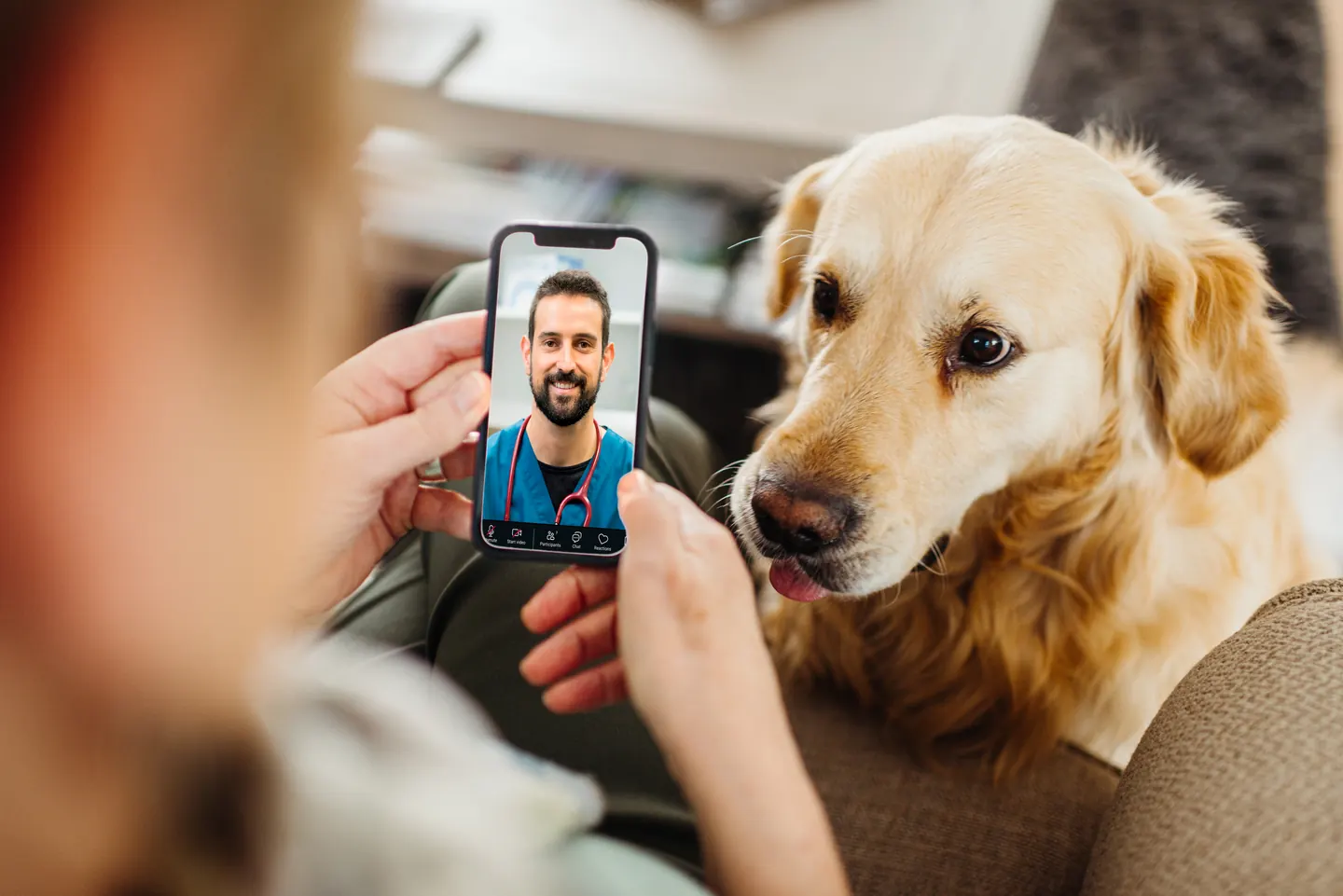
Want a vet's help with your dog's anxiety or behavior?
Talk to a licensed vet at Dutch over video, often the same day. They can recommend treatment and prescribe it when it's appropriate.
Use code Pets60
Plans start at $12/month · covers up to 5 pets
- Licensed vets in most states
- Rx for 150+ conditions
- 4.7 on Trustpilot
What dog puzzle toys actually do for a dog
Yes, puzzle toys are really good for dogs. Working food out of a container taps foraging behavior, a normal instinct a modern house gives no outlet for. The Ohio State Indoor Pet Initiative treats food-based problem solving as core mental enrichment, not a novelty, and it is a cheap win.
What a puzzle asks a dog to do is different from what a chew toy asks. A chew toy rewards jaw pressure and repetition. A puzzle toy holds food behind a mechanism and rewards a decision: nose this flap, not that one, and in this order. That decision is the entire product.
The payoff is behavioral rather than physical, so it helps to be precise about what one loaded puzzle actually delivers:
- A calmer dog for the next hour or so, not the next eight
- A slower meal, because kibble comes out a few pieces at a time
- An outlet that is not barking, digging, or redecorating the sofa
- A structured way to feed on a day when the weather kills the walk
- Low-pressure problem solving for a puppy or a newly adopted dog still settling in
Key takeaway: this guide settles four decisions. Which difficulty level to buy first, which format suits your dog’s nose and jaw, how long one session should run, and when a used puzzle comes out of the rotation for good. When in doubt, start one level below where you think your dog belongs.
What a puzzle does not do is replace exercise or fix a behavior problem by itself. A dog alone all day with a stuffed toy is still a dog alone all day. Enrichment sits alongside walks, sniffing time, training, and company, and it does not stand in for any of them.
It also does not have to be expensive. A rolled towel with kibble inside is a real puzzle. What the paid versions buy you is durability, a surface you can wash, and a difficulty you can dial up, which starts to matter as soon as your dog gets good.
Snuffle mats, treat dispensers, and sliding puzzles: the formats explained

Five formats cover almost everything sold as a dog puzzle, and they ask for completely different things. Sniffing, tipping, lifting, licking, and sequencing are separate skills, and a dog who is brilliant at one can be hopeless at another.
Pick the format first, then the level. A scent-driven hound and a paw-first terrier will not enjoy the same board, and buying the wrong format is the most common reason a puzzle ends up in a closet after a week.
Whatever the format, load it with something small enough to use over and over. Measured kibble is the default. Small training treats are the upgrade when you need to raise the stakes for a dog who is not yet convinced the toy is worth the effort.
| Format | What the dog has to do | Loading and mess | Suits |
|---|---|---|---|
| Snuffle mat | Sniff loose food out of fleece strips | Dry food only, seconds to load | Nose-driven dogs, seniors, first timers |
| Treat dispenser or wobbler | Nudge, roll, and tip a container until food falls out | Dry food, noisy on hard floors | Movers, high-energy dogs, whole meals |
| Lift-and-slide board | Lift lids and push panels with nose or paw | Dry or semi-moist, quick to load | Most dogs, the standard starting board |
| Stuffable rubber toy | Lick and chew food out of a cavity | Wet, sticky, best frozen | Lickers, crate time, hot days |
| Multi-mechanism board | Combine two or more actions in the right order | Dry, slower to load | Dogs that empty a level 2 board in minutes |
Snuffle mats
A snuffle mat is fleece strips knotted through a woven backing. You scatter dry food into the pile and the dog noses it out. There is no mechanism to learn, which makes it the gentlest possible introduction and the safest option for a dog who paws hard at plastic.
It is also the easiest format to make harder. Fold the mat in half, roll it into a tube, or press the food right down against the backing before you set it on the floor.
Treat dispensers and wobblers
A treat dispenser holds a volume of dry food and releases it as your dog knocks the toy around. Weighted versions right themselves, which keeps a dog working instead of chasing a toy under the sofa. Most have an adjustable opening, so you can widen the hole for a beginner.
The trade-off is noise. A hard plastic dispenser on a tiled kitchen floor is loud enough to put a sound-sensitive dog off the whole idea, so start that dog on a rug.
Lift-and-slide boards
These are the boards most people picture: a sliding puzzle with panels to push, a molded tray with food wells hidden under lids, or a stack of spinning discs. They are the backbone of the difficulty ladder, because makers build the same basic shape at four different levels of complexity.
Loose pieces are the thing to watch. Bone-shaped lids and pegs come out by design, and a dog who would rather chew than solve will treat them as the prize instead of the food.
Stuffable rubber toys
A stuffable is a hollow rubber shape you pack with wet food and then freeze. The work is licking and extracting rather than sequencing, so it lasts longer than a board and holds up to jaws that would flatten molded plastic.
Freezing is the whole trick. The same toy that empties in a few minutes at room temperature will hold a dog considerably longer straight out of the freezer, and it costs nothing to do.
Multi-mechanism boards
The top of the range combines actions: pull a peg out, then swing the flap it was locking. The dog has to hold one step in mind while doing the next, and that is a genuinely different task from lifting a lid off a well.
Do not buy one first. A dog who has never solved anything will nose it twice and walk away, and you will conclude they are not a puzzle dog when in fact they started three levels too high.
The difficulty levels, and where your dog should start

Start at level one and work up, even if you are sure your dog is cleverer than that. The rule prevents the most common failure in this category, which is a dog who gives up inside two minutes and never goes back to the toy again, whatever you load it with.
The difficulty ladder runs one through four in order. It puts snuffle mats and open stuffable rubber toys at the bottom, sliding puzzles and dispensers in the middle, and locking multi-step boards at the top, so advanced dog puzzles are the end of a progression rather than a separate species of toy.
Makers print their own numbers. Outward Hound prints a level from one to four on its Nina Ottosson boards and Trixie prints an activity number on the box, so you can shop advanced dog puzzle toys directly rather than guessing from a photograph.
| Difficulty level | The skill it asks for | Typical toy | The readiness signal to move up |
|---|---|---|---|
| Level 1: beginner | Find loose food by smell, with no mechanism to operate | Snuffle mat, open stuffable, wide-mouth dispenser | Empties it in under five minutes with no help, twice in a row |
| Level 2: intermediate | Move one thing to reveal food: lift a lid, spin a layer, tip a dispenser | Lift-and-slide board, weighted dispenser | Clears every compartment without pausing and starts nosing the toy before you set it down |
| Level 3: advanced | Do two or more things in the right order, such as slide one tile before the next will move | Sequential sliding board, rotating board with pegs | Works methodically through the whole board in one session, with no random pawing |
| Level 4: expert | Sequence several moves, some of which do nothing until an earlier move is made | Locking sliders and multi-step boards | Top of the ladder. Rotate, reload, and change format rather than escalating |
Those maker numbers are not standardized across brands, so the table above describes each difficulty level by the skill it asks for and by the signal that means your dog is ready to move up a level.
Buying a level too high has a second cost: a frustrated dog chews. A cracked lid or a split slider usually starts with a dog who could not solve the toy, gave up, and began biting it instead, so starting low protects the toy as much as it protects the dog.
Placing your own dog takes about one session. Give a level 1 toy on a normally hungry day and watch what actually happens rather than what you hoped would happen. Read that first session like this:
- Empties it fast and looks around for more: buy a level 2 next
- Works it out slowly but finishes: stay at level 1 for a week, then move up
- Paws at it hard, then walks off: stay at level 1 and make the food better
- Never engages at all: change the format before you change the level
- Picks the whole toy up and carries it away: you have a chewer rather than a solver, and material matters more than level
Moving up one level too early costs you nothing but a returned toy. Doing it repeatedly costs you a dog who has learned that these things are not worth trying, and that lesson is much harder to undo than it was to teach.
Difficult dog puzzles are only difficult relative to the dog in front of them. A level 3 board is easy for a collie who has spent a month at level 2, and impossible for a dog who has never solved anything at all.
You can also make a level harder without buying anything. Leave some compartments empty so the dog has to check all of them, close a dispenser opening by a notch, or set the board on a rug so it cannot slide away across the floor.
How we chose these dog puzzle toys
There is no single highest-rated dog puzzle toy, and any page naming one is answering a different question than the one you asked. Star ratings and dog puzzle toys reviews pool beginner dogs and expert dogs together, so one board collects five stars for being easy and one star for being too easy.
That is why the top dog puzzle toys below are grouped by difficulty level instead of ranked one to eight. A rating only means something once you know which dog gave it.
These are researched, vet-informed selections rather than lab results. We did not run a testing program and will not pretend otherwise. We worked from published product specifications, maker level numbering, care instructions, and the enrichment guidance published by veterinary bodies. Every pick had to clear the same bar:
- A difficulty you can identify, either printed by the maker or obvious from the mechanism
- A surface you can actually clean, because wet food sits in the wells between sessions
- No small part that comes free by accident, and a plain warning where a design needs one
- A way to make it harder or easier, so one purchase covers more than a single week
- A format that fills a real gap rather than a fifth version of the same board
We ruled things out too. Anything sold mainly as a chew, anything that needs a battery, and anything whose only claim is that it cannot be destroyed sits outside this list, because those are different jobs answered by different guides.
The best dog puzzle toys by difficulty level
The best puzzle toy for a dog is the hardest one they can still solve, which is why this list runs easiest to hardest rather than best to worst. Read down to the level you placed your dog at, buy that one, and ignore the rest until your dog earns the step up.
Formats are mixed on purpose. A beginner slider and an expert build ask a dog for completely different things, and two dogs at the same difficulty level often need different mechanisms, so every level below offers a nose option and a paw option wherever both of those exist, which is not always.
Frisco Snuffle Mat: the best first puzzle (level 1)
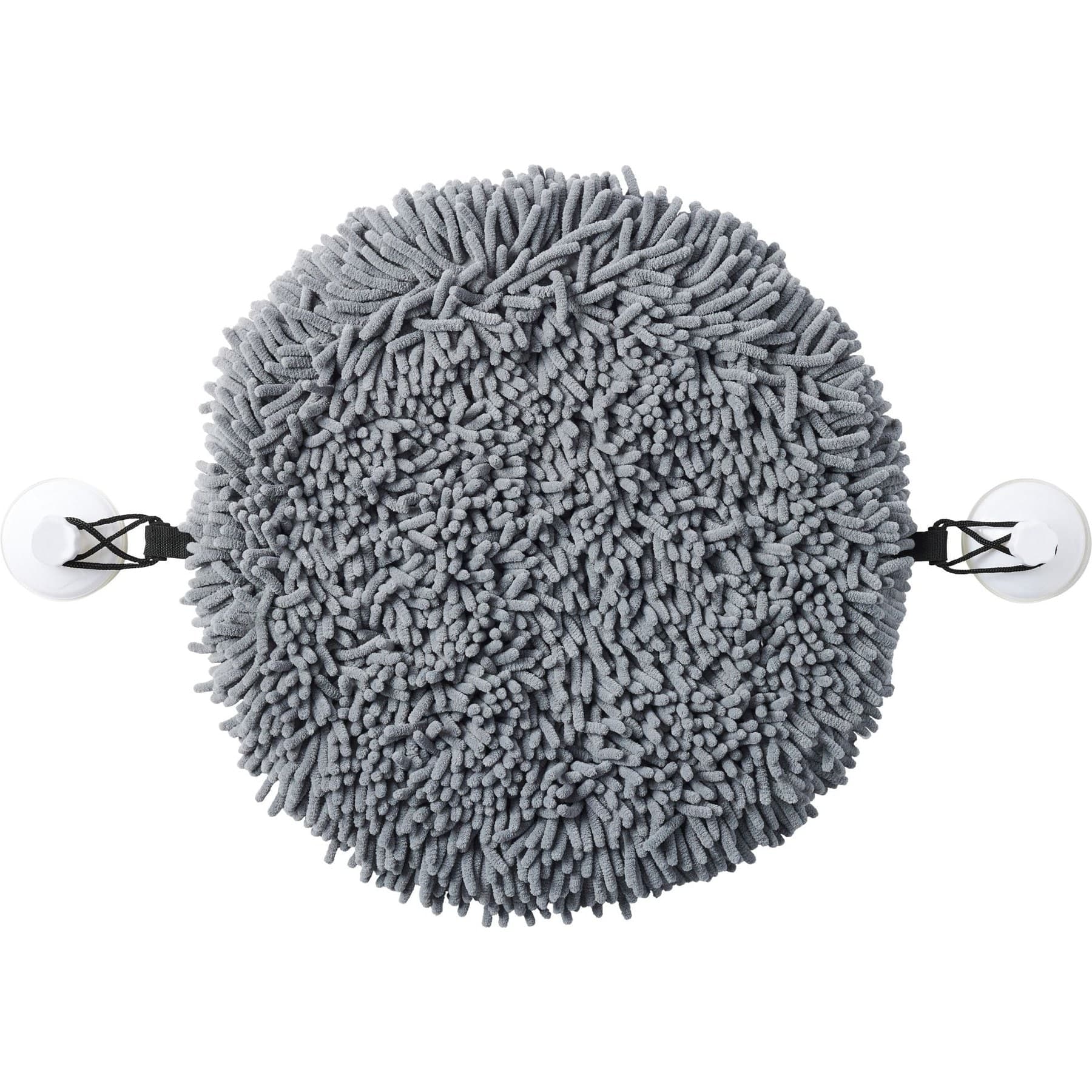
A shaggy mat you scatter kibble into for five to ten minutes of nose work. Machine washable, with suction cups for smooth floors. Supervised, since the pile is chewable.
Webvet may earn a commission when you click through to Chewy, at no extra cost to you.
The Frisco Snuffle Mat is a slab of shaggy fabric strips on a backing with suction cups underneath, roughly the footprint of a large placemat. You scatter dry food into the pile, put it on the floor, and your dog noses through it. There is nothing to learn and nothing to break.
That is why it is the right first purchase in most households. It works for a puppy, a senior with stiff joints, a nervous rescue, and a flat-faced dog who cannot reach into a deep well. It also goes through a washing machine, which no wooden board does.
Three things to know before it hits the floor:
- A committed shredder will eventually pull strips loose, so treat this as a supervised toy rather than a leave-them-to-it one.
- It takes dry food only, which rules it out as a frozen summer project.
- To make it harder, fold it in half, roll it into a tube, or work the kibble right down against the backing.
Outward Hound Nina Ottosson Puppy Hide N' Slide: the best beginner board (level 2)
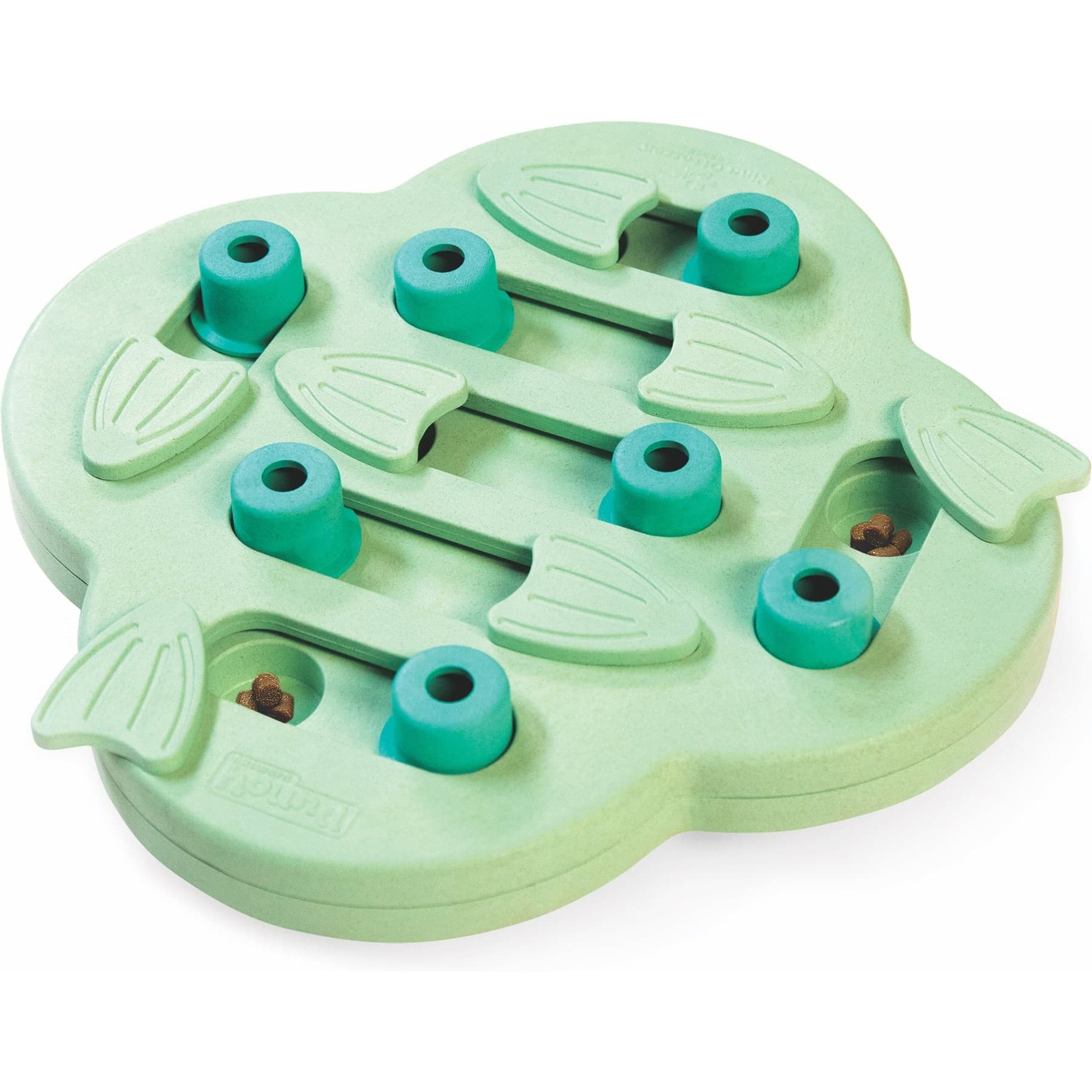
Outward Hound's gentlest Nina Ottosson board: sliding blocks and swivel flaps with no loose pieces. Start with treats under the flaps and load it with the puppy's own dinner rather than extras.
Webvet may earn a commission when you click through to Chewy, at no extra cost to you.
The Puppy Hide N' Slide is the board that teaches the actual concept: move something, find food underneath. Treat compartments sit under swivel flaps and sliding covers on a flat tray, and your dog shifts them with nose or paw. Outward Hound rates it a level two, but with no loose pieces and the treats placed just under the flippers it is the gentlest first board, and despite the name it suits any adult dog who has never solved a board.
It is worth owning even if your dog is clever, because it is the cheapest way to learn how your dog approaches a problem at all. Nose-lifters and paw-scrapers need different things at level 2, and one session with this board tells you which one you have.
Living with it:
- There are no loose pieces to count back in, which is the reason to start here rather than on a board with removable lids.
- Outward Hound asks for a hand wash in warm soapy water rather than a dishwasher cycle.
- Harder version: leave half the compartments empty, then close every flap and cover anyway.
West Paw Toppl: the best stuffable you can freeze (level 1 to 2)
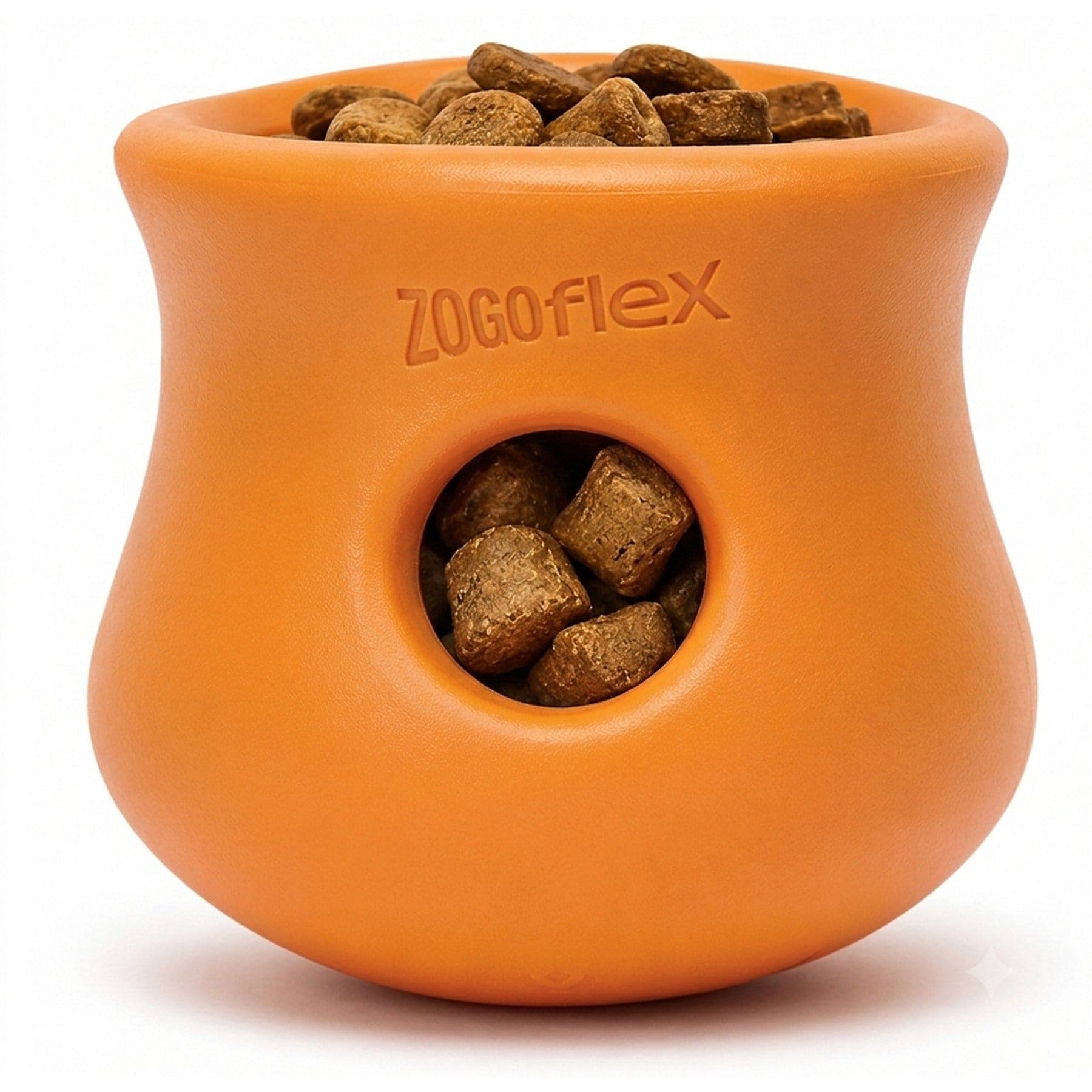
A thick, flexible Zogoflex cup with internal ridges, made to be stuffed, frozen, and worked at. Two sizes lock together to make the puzzle harder, and it survives the dishwasher.
Webvet may earn a commission when you click through to Chewy, at no extra cost to you.
The Toppl is an open-topped rubber cup with internal ridges, made from West Paw’s Zogoflex material. Pack it with wet food and freeze it, and it becomes a long slow licking job rather than a quick puzzle. It is dishwasher safe, which the wooden boards are not.
The clever part is that two sizes nest together. Fit a small Toppl inside a large one and your dog has to work the inner cup free before reaching most of the food, which turns a level 1 toy into a level 2 one for the price of a second toy.
Why it earns a slot, and what to watch:
- It is the pick for crate time, hot afternoons, and dogs whose jaws would flatten a plastic board.
- West Paw publishes a replacement guarantee on the Zogoflex line, and the terms are worth reading if your dog is hard on toys.
- Watch the calories here more than anywhere else. A Toppl packed with wet food or nut butter is a meal, not a snack, so subtract puzzle food from meals and keep it inside the daily calorie ration.
PetSafe Busy Buddy Twist ‘n Treat: the best adjustable difficulty (level 2)
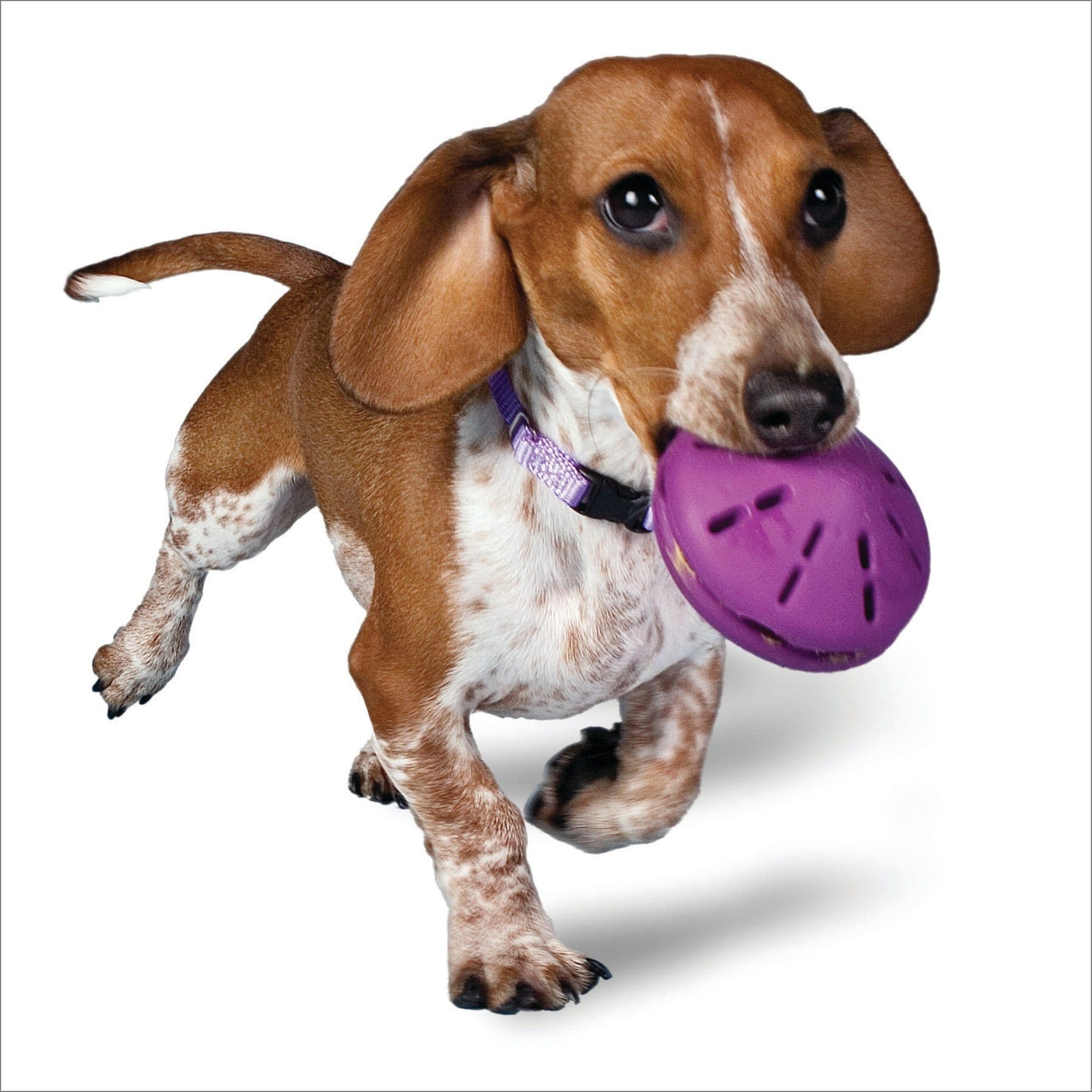
Two saucer halves screw together around a food cavity: twist them apart for an easy first session, tighten a turn each time your dog gets faster. Quiet flexible rubber, top-rack dishwasher safe.
Webvet may earn a commission when you click through to Chewy, at no extra cost to you.
Two saucer-shaped halves screw together around a food cavity. Twist them further apart and food falls out easily. Twist them tight and the same load takes several times as long. The difficulty dial is built into the toy rather than sold separately.
That makes it the most forgiving thing to buy when you genuinely cannot tell what level your dog is at. Open it right up for the first session, then close it a turn every time your dog gets faster at emptying it.
The details that matter:
- It takes dry food, paste, or a mixture of the two, and PetSafe lists it as top-rack dishwasher safe.
- Flexible rubber is quieter on hard floors than a weighted dispenser, and kinder to a dog who bites rather than nudges.
- Inspect the edges regularly, because flexible rubber shows chew damage well before it actually fails.
- It is a small toy, better as a second course or a crate job than as a whole dinner for a big dog.
KONG Wobbler: the best dispenser for a whole meal (level 2)
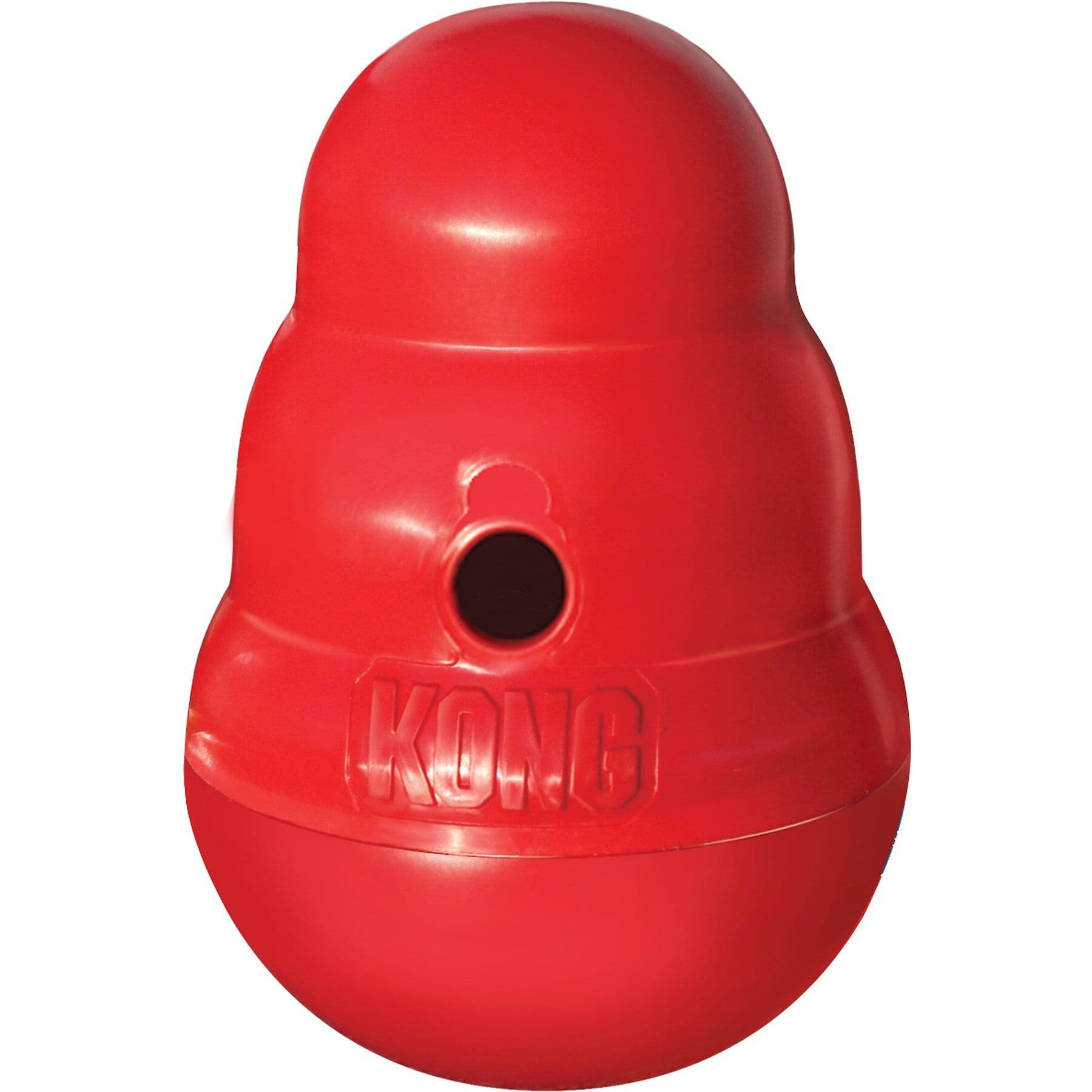
A weighted KONG-shaped dispenser that sits upright until nudged, then wobbles, spins, and drops kibble as it rolls. Unscrews to fill, and turns a bowl of dry food into a moving job.
Webvet may earn a commission when you click through to Chewy, at no extra cost to you.
The Wobbler is a weighted, KONG-shaped dispenser that rights itself every time your dog knocks it over. It sits upright until a nose or paw tips it, then wobbles, spins, and rolls, dropping kibble from the hole in its side as it goes.
Capacity is the reason to own one. The small holds about half a cup of dry food and the large about a cup, so a whole meal for most dogs can go through the toy instead of a handful at a time, which is the difference between genuine enrichment and a novelty.
It also gets a dog up and moving in a way a static board never does, which suits high-drive dogs who clear boards quickly and then look around for the next thing. Three practical notes:
- It is loud on tile or laminate. Use a rug or a folded blanket underneath.
- It rolls, so close the doors and block the gap under the sofa first.
- It unscrews in the middle, so wash it after any wet food and let both halves dry before refilling. At heart this is a dry-food toy.
Outward Hound Nina Ottosson Dog Brick: the best step up (level 2)
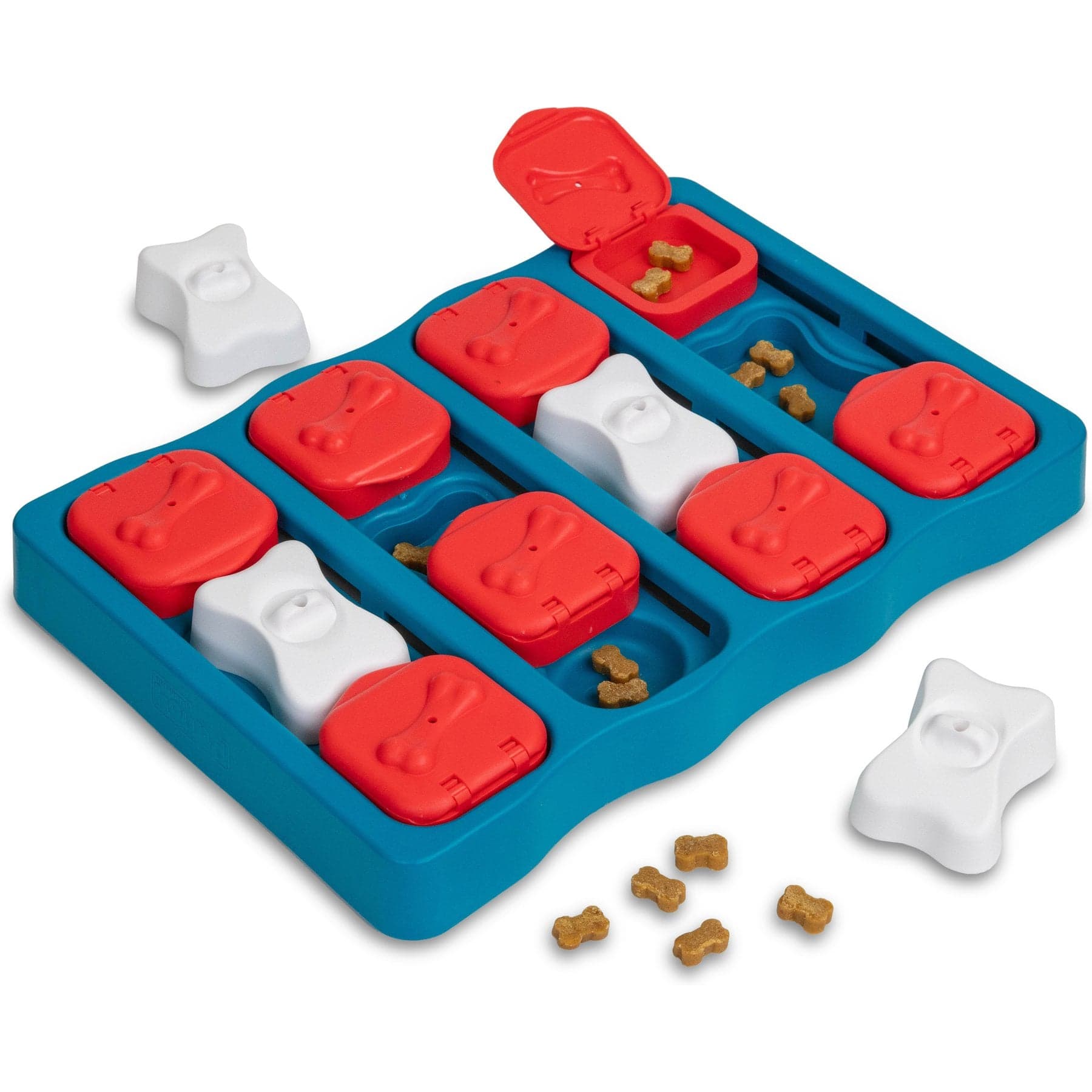
Outward Hound's level 2 board: sliding covers, flip lids, and removable bone pieces over a row of compartments. Start with everything open and cover more as your dog learns.
Webvet may earn a commission when you click through to Chewy, at no extra cost to you.
The Dog Brick lines up a row of treat compartments on a flat tray and covers them three ways: sliding blocks, flip-open lids, and removable bone-shaped pieces that sit over the wells. Outward Hound rates it a level two.
It is the natural next purchase after the Hide N' Slide because the actions stack rather than simply getting harder. Swivelling a flap is one movement. Lifting a bone cover and then sliding the block beneath it means working out two moves on one compartment, which many dogs need a full session to work out.
Three things worth knowing:
- The removable bone pieces raise the difficulty usefully, and they are the pieces to count back in at the end.
- The base is wide, but a large dog can still flip it. Set it on a rug or wedge it into a corner.
- Load it with dry food only. Wet food dries into the shallow compartments and the blocks stop sliding smoothly.
Outward Hound Nina Ottosson Challenge Slider: the best advanced puzzle (level 3)
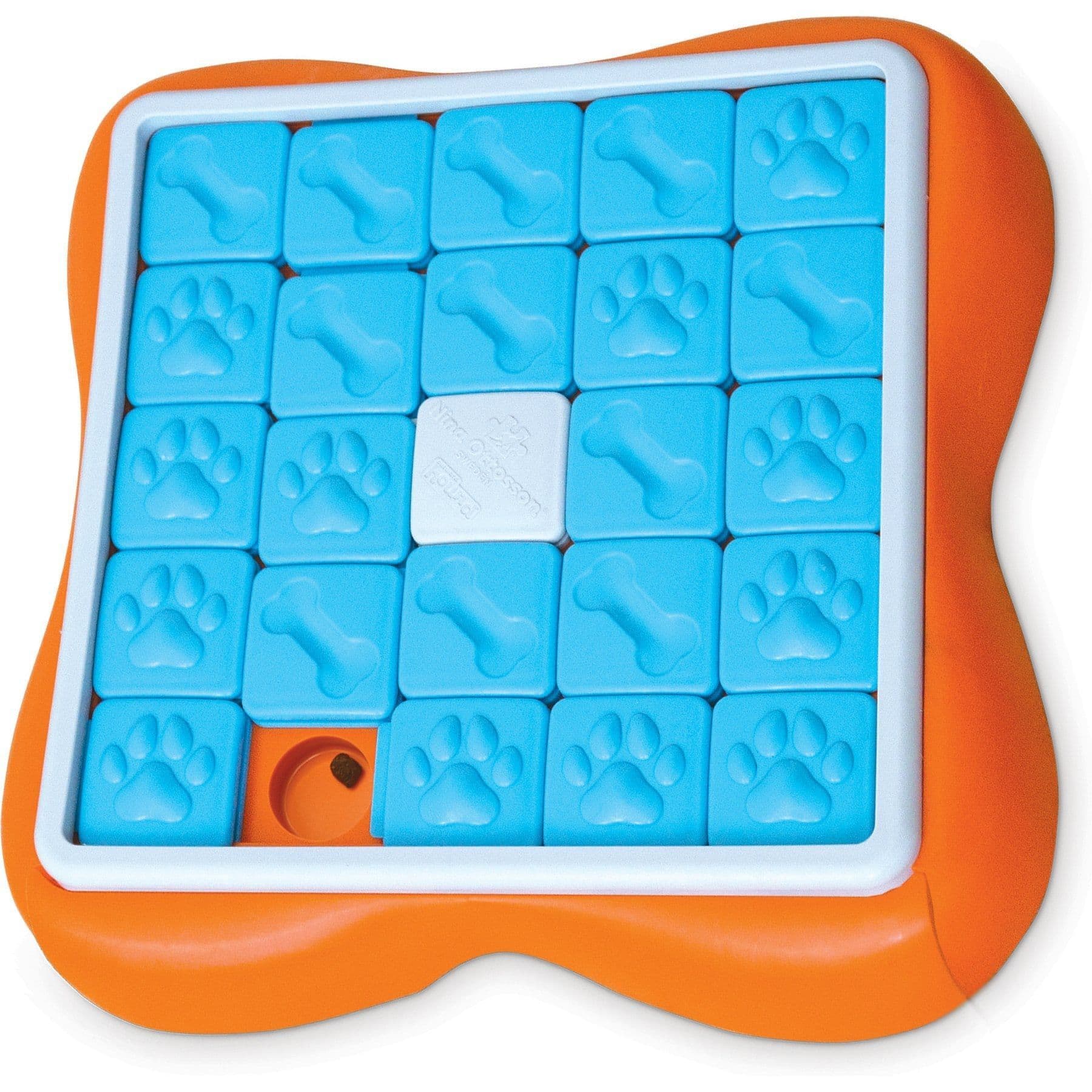
An advanced Nina Ottosson board for dogs who have mastered level 2: tiles slide one at a time in a set order to uncover food, with several ways to make it easier or harder.
Webvet may earn a commission when you click through to Chewy, at no extra cost to you.
The Challenge Slider is where a puzzle stops being one move. Sliding tiles cover the food, they only move where the layout allows, and your dog has to shift them one at a time in the right order to open a well. Outward Hound rates it as an advanced puzzle for dogs who have mastered the level 2 boards.
That ordered sequence is the real jump in difficulty, and it is why a dog who flies through a level 2 board can sit in front of this one looking genuinely stuck. Expect the first session to run much longer, and expect to help.
How to introduce it, and how to look after it:
- Start with only a few wells loaded and the tiles already part-way open, so the first move is obvious. Fill more wells and close the tiles fully as your dog gets faster.
- The tiles stay attached, so there is less to swallow than on a board with pegs, but this is still not a toy to walk away from, and not a toy for a dog who chews anything unfamiliar.
- Hand wash it. The tile channels trap food, and a dishwasher cycle is not what composite boards are built for.
- If your dog starts solving it in a few minutes, rotate rather than buy. Put it away for two weeks and bring out something else.
Outward Hound Nina Ottosson Tower of Treats: the best expert puzzle (level 4)
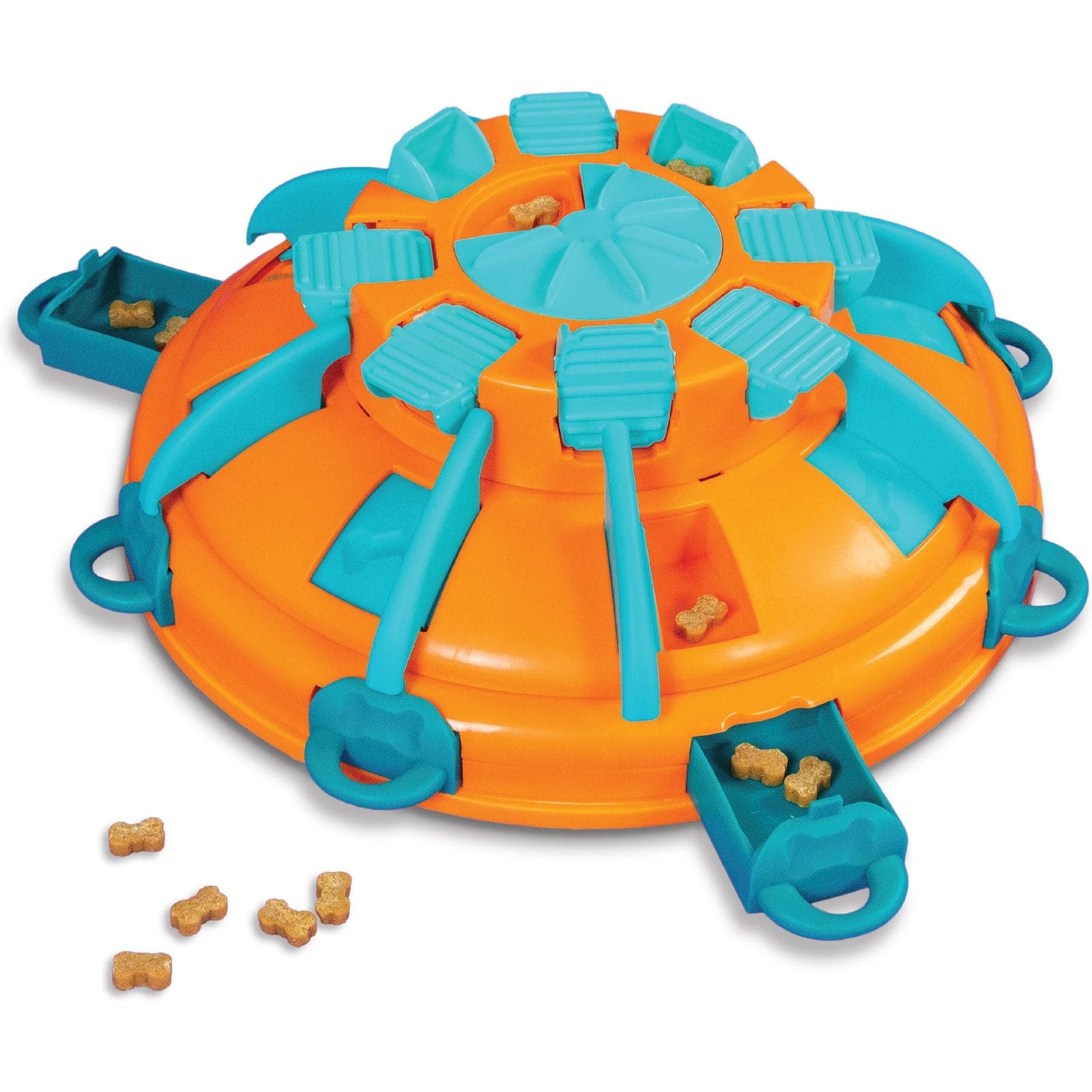
Outward Hound's level 4 expert puzzle: a series of actions in a set order, flipping levers, spinning wheels, sliding doors, and unlocking drawers. Only for a dog who has finished level 3.
Webvet may earn a commission when you click through to Chewy, at no extra cost to you.
The Tower of Treats sits at the top of the published ladder. It asks for a series of actions in a set order, with levers to flip, wheels to spin, doors to slide, and drawers that only come open once the step before them is done. Outward Hound rates it a level four, for dogs who have already finished a level 3 puzzle.
Buy it only for a dog who has genuinely finished level 3. There is no shame in never needing one. The dogs that do need it tend to be young working breeds who treat a level 2 board as a warm-up exercise.
What the first two weeks look like:
- Coach the first few sessions. Show the first move, let your dog take the second, and resist finishing it for them.
- Supervise closely. A frustrated dog at level 4 is far more likely to chew the mechanism than a satisfied dog at level 1.
- Once a dog beats a level 4 board, escalation stops working. Rotate toys, change the format rather than the level, and hide the toy itself around the house.
 Sponsored
Vet care that's always there
Unlimited video calls and messaging with licensed vets for less than a typical vet visit. One membership covers up to five pets.
Use code Pets60
Plans start at $12/month · covers up to 5 pets
- Licensed vets in most states
- Rx for 150+ conditions
- 4.7 on Trustpilot
Matching a puzzle to your dog size, chew style, and age
Size, chew style, and age rule out different toys, and between them they matter more than the number on the box. A large dog puzzle and a small dog puzzle are not the same product in two sizes: one has to be too heavy to lift, the other shallow enough to reach into.
Work through the three in order. Size decides whether the toy stays on the floor, chew style decides which materials are safe, and age decides how much frustration is fair to ask a dog for.
| Your dog | Material to choose | Level to start at | What to avoid |
|---|---|---|---|
| Small or toy breed | Light plastic or fleece, shallow wells | Level 1 to 2 | Deep wells a short muzzle cannot reach into |
| Large or giant breed | Heavy wide-based boards, weighted dispensers. A large dog puzzle has to be too heavy to lift. | Level 1 to 2, then move up quickly | Anything light enough to pick up and shake |
| Flat-faced breed | Snuffle mats, open stuffables, shallow trays | Level 1 | Narrow compartments and deep dispenser necks |
| Determined chewer | Solid rubber stuffables only | Any level | Boards with loose lids, pegs, or covers |
| Puppy under six months | Fleece and soft rubber | Level 1 | Hard plastic edges and small removable parts |
| Senior or arthritic dog | Flat mats and low, stable boards | Level 1 to 2 | Anything needing sustained standing or hard pawing |
| Working breed at a loose end | Rigid multi-step boards | Level 2 upward | Level 1 toys, which will bore them within a day |
Size does most of the ruling out, and it works in three directions:
- Puzzle toys for large dogs need weight before difficulty. The best dog puzzle toys for large dogs are the ones a Labrador cannot lift and tip out: a wide heavy base, a weighted dispenser, or a mat that lies flat.
- A small dog puzzle has the opposite problem. Shallow wells, wide gaps, and a light lid a small nose can shift matter more than the number printed on the box.
- Dog puzzles for smart dogs are as much a size question as a brains question. A clever working breed in a big body beats a large dog puzzle by brute force long before they beat it by thinking.
The chewer row is the one owners most often ignore. A dog who mouths every new object is not going to solve a board, they are going to test whether it comes apart, and the loose pegs and lids that make a board interesting are the pieces that get swallowed.
If that describes your dog, stay with solid rubber stuffables and snuffle mats and treat the whole rigid board category as off limits until the mouthing settles down.
Age cuts in both directions:
- Puppies need very easy wins. A puppy who fails twice will not try a third time, and early frustration is worth avoiding while the whole world is still new.
- Adolescents are the real market for levels 3 and 4, because that is the stage with the most persistence and the fewest outlets.
- A senior dog can keep problem solving long after the joints have gone.
That last group is the one most often written off, and wrongly. Stiff hips and a slower nose do not stop a dog wanting to solve something, so keep the puzzle flat on the floor, choose sniffing over pawing, and halve the session rather than dropping it for a senior dog. For puppy-sized picks across the whole first year, see our best dog toys for puppies guide.
How long a puzzle session should last
Ten to fifteen minutes is the right target for a single loaded puzzle, and that is roughly what one properly filled board or mat takes for a dog working at the right level for them.
Fifteen minutes of mental stimulation means fifteen minutes of a dog actually problem solving, not fifteen minutes of the toy lying on the floor. A dog who empties a mat in ninety seconds and then lies down beside it has had ninety seconds.
Two shorter sessions beat one long one. Attention for this kind of work fades, and a dog stopped while still keen comes back to the toy enthusiastically tomorrow. A dog worked until they were bored of it does not.
Key takeaway: aim for ten to fifteen minutes of real problem solving per session, once or twice a day. Make the first session on any new puzzle deliberately easy: load it generously, leave the hardest mechanism open, and stop while your dog is still interested rather than waiting for them to give up.
Where the fifteen-minute figure gets oversold is as a substitute for exercise. It is a useful addition to a day that already contains walks and sniffing, and a poor replacement for a day that does not contain either.
Timing helps as well. A puzzle lands best just before you need calm, so before a work call or in the half hour before guests arrive, rather than immediately after a walk when your dog is already flat out on the floor.
When to step in, and when to let your dog work at it

Let your dog struggle for about two minutes with no progress, then step in and help. The struggle is where the value sits, so stepping in at the first pause teaches a dog to look at you instead of the puzzle. Sustained failure teaches them to stop trying at all. Recognising frustration early, and knowing when to step in, is the whole skill: a dog who walks away, paws at the board, or starts chewing it has hit the limit for today.
Knowing when to step in is a skill worth building. Every dog has a frustration threshold, and the signal to watch is not effort but disengagement: a dog who is still working looks busy and slightly obsessive, while a dog who gives up does something visibly different with their whole body.
Stop and help when you see any of these:
- Sits back from the puzzle and looks away, or looks at you instead
- Barking at the toy, or picking it up and dropping it over and over
- Pawing hard and fast at the same spot with no change of tactic
- Walks away from the puzzle and lies down while food is still clearly inside
- Whining, yawning, lip licking, or shaking off, which are stress signals rather than play
Helping does not mean solving it. Move one piece, expose one well, or tip the toy so a single piece of food falls out, then step straight back. Your dog has to make the next move for the session to count for anything.
If two prompts do not restart your dog, the puzzle is a level too hard. End it cleanly, feed the rest of the food from a bowl or a mat, and drop back a level tomorrow. Nothing at all is lost by doing that.
There is a second reason not to leave a struggling dog alone with a board. Frustration is exactly the point at which a dog switches from solving to chewing, and that is when pieces get swallowed rather than moved.
What keeps a dog busy for hours, and what does not
Nothing food-based keeps a dog busy for hours, and that is worth saying plainly because the promise is everywhere. A puzzle occupies most dogs for somewhere between five and twenty minutes. A frozen stuffable stretches further. Neither one fills an afternoon.
What actually covers longer stretches is a combination of things rather than one heroic toy:
- A frozen stuffable, which is the longest-lasting food option in this category
- A long-lasting chew, which works the jaw rather than the brain and lasts differently
- A window with something happening outside it, which costs nothing at all
- A rotation of three or four toys, so nothing is ever completely familiar
- A proper sniffing walk earlier in the day, which does more for afternoon calm than any toy
- Company, which no product on this page replaces
Chewing is a separate lane and a genuinely useful one, but it is not problem solving. If what your dog actually wants is something to work on with their teeth for half an hour, a vet-informed look at dental chews is a better use of your money than a fourth board.
Size changes the answer too. Mental stimulation toys for large dogs have to survive being picked up and slammed, while mental stimulation toys for small dogs need shallow wells and a lid light enough for a small nose to shift.
Rotation is the cheapest upgrade available to you. A puzzle that has sat in a closet for three weeks is close to a new toy again, and novelty comes from where you put it too: the same mat behind a chair or at the top of the stairs is a different problem each time.
Puzzle toys when you leave the house

A puzzle does not extend how long a dog can safely be left alone. It changes the first fifteen minutes of that time and nothing after it, and the toy is empty long before the day is. Buy one for the enrichment, not for permission to stay out any longer.
On the eight-hour question: most adult dogs cope comfortably with a four to six hour stretch, and a routine eight-hour absence sits at the far end of what is reasonable. It usually needs a midday break from a walker, a neighbor, or daycare, and no toy changes that arithmetic.
If you do leave a puzzle down while you are out, the safety rules change:
- No removable parts at all. No pegs, no loose lids, no small covers.
- Solid rubber stuffables are the only category most dogs should have unsupervised.
- Nothing with a crack, a chewed edge, or a piece missing.
- Nothing brand new. A toy should have been solved with you in the room before it is left with your dog alone.
- Hand it over before you start getting ready, not as you walk out of the door.
- Dog puzzle toys for crate time are a narrower category still. A stuffable rubber toy works in a crate because nothing comes apart. A board with pegs and lids does not belong in one.
The timing point matters for anxious dogs. A toy handed over at the door quickly becomes a reliable warning that the door is about to close, which is the opposite of what you were going for.
If your dog panics when left rather than simply being bored, that is separation anxiety territory, and a puzzle is not the answer. It is a behavior problem with a proper treatment path behind it, and your dog should not simply be handed a toy and left with it.
Start with your vet, who can rule out pain first and refer you onward. The American Veterinary Society of Animal Behavior publishes owner resources on finding qualified help.
Puzzle feeders and mealtime pacing for fast eaters
If the real problem is a dog who inhales dinner in twenty seconds, a puzzle is a roundabout fix. Feeding equipment designed for pacing is the direct one, and it is cheaper to buy and far easier to wash.
A ridged bowl slows a meal every single day without you having to load anything, which is the practical difference between the two. Our guide to the best slow feeder dog bowls covers the shapes, the sizes, and the flat-faced exceptions.
It is also worth understanding why your dog eats that way in the first place, because the cause changes what you should do about it. We cover that in why does my dog eat so fast. Plenty of households end up running a slow feeder for meals and a puzzle for the gap between them.
Puzzles for power chewers
Dog puzzle toys for aggressive chewers barely exist as a category, and that is the honest answer. Molded boards are designed to be moved, not bitten, and the loose lids and pegs that make them interesting are precisely the pieces that end up swallowed.
Durable dog puzzle toys tend to be durable because they have almost no moving parts, which is also what stops them being much of a puzzle. The workable list for a strong chewer is short:
- Tough dog puzzle toys in practice means solid rubber stuffables with no removable parts, frozen to make them last
- Heavy weighted dispensers with no lid, used on a rug and picked up again afterwards
- Snuffle mats, supervised only, since fleece strips do eventually come loose
Beyond that, indestructible dog puzzle toys are really a materials decision: rubber grade, wall thickness, and whether the maker publishes a replacement guarantee. Interactive dog toys for aggressive chewers get judged on those things rather than on difficulty levels, and they deserve a guide of their own. Our indestructible dog toys roundup covers that decision, and our dog chew toys guide sorts chew formats by chewing style.
One rule holds across all of it: a chewer earns supervision, not a tougher toy. There is no puzzle on sale that survives a determined dog left alone with it for an afternoon.
Where KONG toys fit in a puzzle routine
A KONG dog toy is the stuffable most households own long before they own a board. On this ladder, KONG dog puzzle toys sit at level 1 empty, level 2 packed, and comfortably higher once they have been frozen, which is exactly where most dogs should start.
The line fills roles a rigid board cannot:
- Crate and confinement time, where a hard board with loose pieces is unsuitable
- Wet food, paste, and anything else you want to freeze solid
- The KONG Wobbler, which is a weighted dispenser rather than a stuffable and belongs with the level 2 dispensers above
- KONG Extreme dog toys and the other firmness grades, which exist for heavy chewers
Choosing between those grades and sizes is a separate decision. KONG toys for aggressive chewers get picked on rubber firmness and how hard your dog bites, not on how clever they are, so it needs a dedicated guide rather than a line here. Our KONG dog toys guide covers the colours, sizes, and shapes.
For the purposes of this ladder, treat any stuffable as a level 1 to 2 toy and raise the difficulty by freezing it, not by buying a different one.
Interactive and moving toys beyond puzzles
Puzzles sit still and wait to be solved. Interactive dog toys that move roll away, make a noise, or react when a dog touches them, and that is a different kind of fun rather than a harder version of the same thing.
Moving toys suit dogs who chase rather than solve. A dog who loses interest in a board within a minute but will chase a rolling toy across a room is telling you something useful. The best interactive dog toys for large dogs are the heavier ones, for the same weight reason that governs boards.
They also bring their own considerations, and they are not the same ones a board raises:
- Batteries, and what happens when they run flat halfway through a session
- Noise, which rules some of them out in an apartment or with a sound-sensitive dog
- Floor surface, since a rolling toy needs somewhere to actually roll
- Whether the toy is safe to leave on the floor unsupervised at all
Those are a guide of their own rather than something to half answer here. There is no need to pick a side either. Most households end up owning one puzzle, one stuffable, and one thing that moves. Our interactive dog toys guide covers them.
Mental stimulation beyond a food puzzle
Food puzzles are the easiest form of mental work to buy, which is not the same as being the best or the only one. Plenty of genuinely tiring mental work involves no toy at all.
Cheap alternatives that do the same job:
- Five minutes of training, which is more mentally demanding than most boards
- Hiding food around one room and letting your dog find all of it
- A sniffing walk where your dog picks the route and sets the pace
- Teaching the names of two toys and then asking for one of them
- A cardboard box with a towel and a handful of kibble buried in it
Rotating between food puzzles and non-food work also protects you from the trap this category can fall into, which is a dog who only engages with anything when food is visibly on offer.
If your dog is restless rather than under-worked, interactive dog toys for boredom are the other half of the answer, and the broader question of what to own for mental stimulation without committing to boards is a larger comparison than a puzzle roundup can carry honestly.
Where puzzles fit in a wider enrichment routine
Enrichment is the whole environment, not a single product. A puzzle covers the foraging part of it and leaves everything else untouched, which is why a dog with a drawer full of boards can still be under-stimulated.
A reasonable weekly shape looks something like this:
- Daily: at least one walk where sniffing is allowed to take as long as it takes
- Daily: one food-based problem to solve, which is where a puzzle sits
- Several times a week: short training sessions, which cost nothing but attention
- Weekly: somewhere new, even if it is only a different street
- Always: rest, because a dog who never switches off is not enriched, just tired
Puzzles earn their place on that list because they are the easiest item to deliver on a bad day. Rain, illness, or a work deadline, and the puzzle still happens on the kitchen floor.
Most of the rest is free. DIY dog enrichment ideas cover a towel with kibble rolled inside, a cardboard box, or a scatter feed in the yard, and dog mental stimulation toys DIY builds rotate endlessly because nothing was bought in the first place.
Dog enrichment ideas while at work are the hardest slice, because anything you leave behind has to be safe unsupervised. Dog enrichment ideas without food matter there: a view, a radio, a change of bedding. Building out the rest of that routine is a bigger topic than a puzzle roundup should own. Our dog enrichment toys guide covers the routines, the DIY builds, and the workday plan.
DIY dog puzzles you can build in five minutes

DIY dog puzzle toys are real puzzles. A five minute homemade puzzle built from household items you already own asks your dog for exactly the same problem solving as a molded board at the same difficulty level, and your dog has no idea one of them came out of a kitchen drawer.
Here is how to make dog puzzle toys from what is already in the kitchen. These are easy DIY dog puzzles rather than craft projects, and each one takes about five minutes to build:
- Muffin tin and tennis balls: drop food into the cups, cover each one with a ball, and let your dog nose them out. Use balls too big for your dog to swallow, and swap them for crumpled paper if your dog shreds them.
- Towel roll: scatter kibble along a flat towel, roll it up loosely, and let your dog unroll it.
- Cardboard box and cardboard tubes: stand the tubes upright in the box and drop food into some of them.
- Egg carton: put food in a few of the cups and close the lid without fastening it down.
- Two bowls and a dish towel: food in one bowl only, towel draped over both, so your dog has to find the right one.
The muffin tin build is the closest thing to a free level 2 board, and it scales properly. Use three balls for a beginner, every cup for a dog who has the idea, and swap the balls for crumpled paper to change the texture.
DIY dog puzzles for large dogs follow the same weight rule as bought ones. Use a heavy roasting pan rather than a foil pan and a box a big dog cannot simply pick up and carry off to the sofa.
Cardboard builds have a shorter life and make a bigger mess, which is the trade. They are also the ones most dogs love best, because shredding is half the fun and the food is a bonus on top.
None of this replaces a manufactured puzzle if you want something washable, repeatable, and safe to leave on the floor. It is the cheapest way to find out whether your dog enjoys the format before you spend anything at all.
Puzzle safety, cleaning, and supervision

Two rules cover most of this. Retire a puzzle the moment it is damaged, and wash it a good deal more often than feels necessary.
Damage is easy to miss because it arrives gradually. What you are looking for is any change that turns a molded edge into a loose piece:
- A cracked lid, a split tray, or a warped slider
- A chewed edge that has gone rough, sharp, or thin
- A peg, bone cover, or block that is missing and cannot be found
- Fleece strips pulled loose from a snuffle mat backing
- Any part small enough to fit whole in your dog’s mouth that was not designed to come out
Once any of those appear, the toy is finished. It does not go out in the yard, it does not become the outdoor one, and it does not get left with your dog while you think about it. Throw it out and buy another.
How to clean dog puzzle toys is the part nobody reads until something smells. Wet food, saliva, and nut butter sit in the wells between sessions, and a board used daily but washed monthly grows things you would not tolerate in a food bowl.
- Wash after every use with wet food, paste, or anything frozen
- Wash dry-food boards at least weekly, and dry them fully before storing
- Machine wash fleece snuffle mats and dry them completely, since damp fleece sours fast
- Nina Ottosson dog puzzles are not dishwasher safe as a rule. Outward Hound asks for a hand wash in warm soapy water, and composite and wooden boards warp in a machine.
- Check whether a toy is dishwasher safe before it goes anywhere near one. Solid rubber stuffables usually are, molded and wooden boards usually are not.
Supervision is the third rule and the one that quietly prevents everything else. A puzzle is an activity you do with your dog nearby, not a device you deploy and walk away from, and every safety rule above depends on somebody being in the room.
There is one more risk that has nothing to do with the toy itself. Food on the floor between two dogs is a resource guarding situation, and a puzzle concentrates a whole meal into a single high-value object. Feed puzzles in separate rooms in a multi-dog house and pick both toys up afterwards.
Dog puzzle toy questions
Frequently Asked Questions
Do dog puzzle toys tire a dog out as much as a walk?
No. A dog puzzle toy does not tire a dog out as much as a walk does, because mental work tires differently from physical work. Fifteen minutes of puzzle work takes the edge off a dog who has already been exercised, or holds a day together when the walk genuinely cannot happen. Used as a substitute several days running, most dogs get restless, because the need to move, sniff outdoors, and see the world is not met by dog puzzle toys on the kitchen floor. Treat it as an addition to the walk, not a swap for it.
How often should you change a dog puzzle toy?
Rotate between puzzles every one to two weeks rather than buying replacements. If your dog solved it in two minutes, the puzzle toy is more familiar than it is easy: put it away, bring out a different one, and reintroduce the first two weeks later. Buy a harder difficulty level only when your dog finishes the current one quickly and methodically across several sessions in a row. Three or four toys in rotation covers most dogs for years, especially if you also change where you put them down.
Can two dogs share one puzzle toy?
Not at the same time. A puzzle toy concentrates food into one object on the floor, and guarding over food is common even between two dogs who share a water bowl happily. Give each dog its own puzzle in separate rooms, or behind a closed door or a baby gate, and collect both toys when the session ends. If either dog stiffens, freezes over the toy, or blocks the other one away from it, stop using puzzles around both dogs and ask your vet about a referral before you try again.
Are wooden dog puzzle toys better than plastic?
Plastic is the more practical choice for most households. A wooden puzzle looks better and often feels more solid, but wooden puzzle material absorbs moisture, saliva, and food residue, and it cannot be scrubbed hard or run through a dishwasher without damage. Plastic washes clean, which matters when the same board is loaded with wet food several times a week. Wood also splinters when a determined dog chews it. Choose wooden dog puzzle toys if your dog solves calmly and you feed dry food, and plastic if there is any chewing or anything wet involved.

Editor
The Webvet Editorial Team is the in-house group of pet-care editors and writers behind Webvet, operated by Smart Pet Collective. The team researches, writes, and maintains Webvet's pet health, behavior, and medication content. Every article follows a defined editorial process: research from reputable veterinary and scientific sources, careful drafting, mandatory review of medical content by a credentialed veterinarian, and dated publication. Health and medication articles are medically reviewed by a licensed veterinary professional before they go live and are kept current over time.


