Best Dog Toys for Puppies by Age
A puppy's toy needs change four times in its first year. Here are the best dog toys for puppies staged by age from eight weeks to twelve months, plus the size check that keeps a toy from being swallowed.

This article contains affiliate links. Webvet may earn a commission when you buy through them, at no extra cost to you.
The best dog toys for puppies are not the highest rated toys on the shelf. They are the ones that fit the mouth your puppy has today. At eight weeks a puppy has soft deciduous teeth and a jaw that cannot dent nylon. At five months it will shred what survived.
So this guide stages every pick by age. Three things follow from that, and they are what you get below.
- The picks your puppy can use now. Ordered by the earliest age each toy suits, so you buy three or four things rather than forty.
- The size check. The two part test that decides whether a toy is safe for your particular puppy, and it works at the shelf without a tape measure.
- The pen rule. A plain answer on what may stay with your puppy alone, and what only comes out while you are sitting there.
One thing to settle before the picks. Toys are enrichment and behavior management, not medical care. Nothing here treats a health problem, and no toy is a substitute for supervision with a young puppy. If your puppy swallows part of a toy, call your veterinarian rather than waiting to see.
 Sponsored
Want a vet's help with your dog's anxiety or behavior?
Talk to a licensed vet at Dutch over video, often the same day. They can recommend treatment and prescribe it when it's appropriate.
Use code Pets60
Plans start at $12/month · covers up to 5 pets
- Licensed vets in most states
- Rx for 150+ conditions
- 4.7 on Trustpilot
The best dog toys for puppies

A new puppy needs a starter set of four toys, not forty. Something soft to chew, something you can stuff with food, something long and floppy to swap for your hands, and something that smells like company at night. Everything else on the shelf is one of the purchases that can wait.
Ratings do not decide this list. A highly rated toy that is rated for adult jaws is still the wrong toy for a nine week old puppy. So the best puppy toys here are chosen for fit first, and a good first toy is one your puppy can succeed with today.
Those four toys cover the four jobs a puppy toy does, and a starter set that misses one of them leaves a gap you will feel by the second week. A treat stuffed rubber toy is the workhorse. Comfort toy choice decides the first fourteen nights. The other two are a chew and a puzzle.
- A chew takes teething pressure off your furniture and off your ankles.
- A stuffable rubber toy turns twenty minutes of solo time into paid work.
- A comfort toy gives a puppy that has just left its litter something to sleep against.
- A food puzzle gives a bored brain something to solve, which is most of the difference between a tired puppy and a destructive one.
Most puppy toy lists are a top ten of adult toys, and the groups they use are toy purpose or play style. Neither gets the owner of an eight week old puppy a staged answer. The result is a page of products the puppy cannot use for three months. These picks are ordered by age.
- 1What your puppy needs at its current age. The right list at eight weeks is not the right list at seven months, and buying the seven month list early risks a cracked baby tooth.
- 2Which toys are safe to leave with an unattended puppy in a crate or playpen, and which ones only come out while you are sitting there.
- 3What to skip until the adult teeth are in, so you are not buying the same category twice in four months.
- 4How many toys are enough, and how to rotate a small box so it feels new to your puppy every week.
Most people start searching for puppy toys because needle teeth found their hands. That nipping problem is what sends them looking in the first place, yet almost no shopping page connects toy choice to it. Veterinary guidance is consistent: puppies nip because mouthing is how they explore the world, not because they are being aggressive.
Redirecting a puppy nipping onto a toy instead of onto your hands is a three step swap: stop moving, offer the toy at mouth height, then pay the transfer. Practice the swap for a hand in calm moments, not once the puppy is already wound up. A floppy toy beats a ball here.
- Stop moving. A hand that jerks away is a better game than a hand that goes still, so freeze first and say nothing.
- Offer at mouth height. Put the toy exactly where your hand was, at the height the puppy was aiming, and hold it steady until the puppy commits.
- Pay the transfer. Ten seconds of tug, or one small soft training treat, makes the toy worth more than the hand was.
The table below lines up every pick by the job it does, the earliest age it suits, and whether supervision is needed while your puppy has it. Use it to assemble a starter set in one pass, then read the entries for your stage.
| Pick | The job it does | Earliest age | Supervision needed |
|---|---|---|---|
| KONG Puppy | Stuffable soft rubber chew for solo time | Eight weeks | No, one piece rubber is pen safe |
| KONG Puppy Binkie | Teething shape with treat pockets | Eight weeks | No, once sized correctly |
| Snuggle Puppy | Comfort and settling for the first nights | Eight weeks | Yes, inserts and seams need eyes on |
| West Paw Toppl | Open bowl food puzzle that scales up | Ten weeks | No, one piece with no small parts |
| Multipet Lamb Chop | Long floppy toy for hand redirection and tug | Eight weeks | Yes, plush with a squeaker |
| Nylabone puppy chew | Softer nylon chew for erupting adult teeth | Twelve weeks | Light, check the ends weekly |
| Benebone puppy chew | Paw held wishbone chew for the chewing peak | Sixteen weeks | Light, retire at the wear line |
| Nina Ottosson puppy puzzle | First slide and lift food puzzle | Twelve weeks | Yes, until the puppy stops chewing the lid |
| Chuckit! indoor ball | Soft motion and fetch inside the house | Ten weeks | Yes, ball size is the whole risk |
| Snuffle mat | Nose work that drains energy without impact | Eight weeks | Yes, fleece is chewable |
One note on how the picks were chosen. WebVet did not lab test or destruction test any of these toys. They are researched, vet informed selections built from published manufacturer specifications, veterinary guidance on puppy dentition, and the safety rules further down this page.
KONG Puppy: the toy to buy first
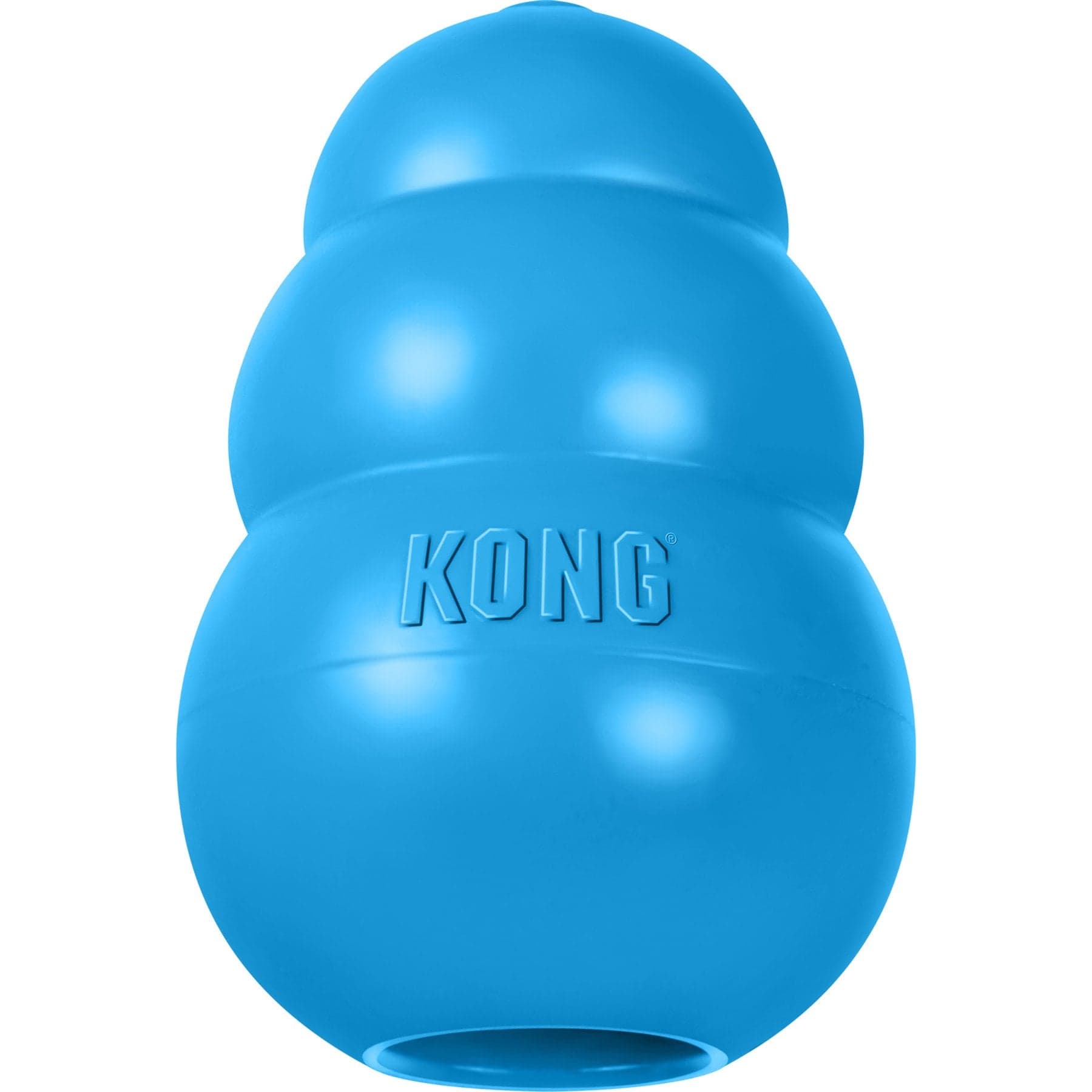
KONG's softest rubber, formulated for baby teeth. Stuff it, freeze it, and it buys fifteen to thirty minutes while cooling sore gums. Size up so it cannot sit behind the back teeth.
Webvet may earn a commission when you click through to Chewy, at no extra cost to you.
If you buy one toy before the puppy comes home, buy this one. KONG Puppy uses a rubber the company formulates softer than its classic adult red, for the deciduous teeth of a dog under about nine months. It is a single molded piece, so no squeaker can work loose and no seam can split.
The value is what goes inside. A smear of wet food, a spoon of plain canned pumpkin, or part of the daily kibble ration buys fifteen to thirty minutes of licking. Frozen, it lasts longer and cools sore gums at the same time.
Size it up, not down. The toy should be too wide to sit behind the back teeth, which often means the size above what a weight chart suggests for a growing puppy. With nothing to detach, it is one of the few toys that can stay in a playpen with an unattended puppy.
KONG Puppy Binkie: a teething shape with treat pockets
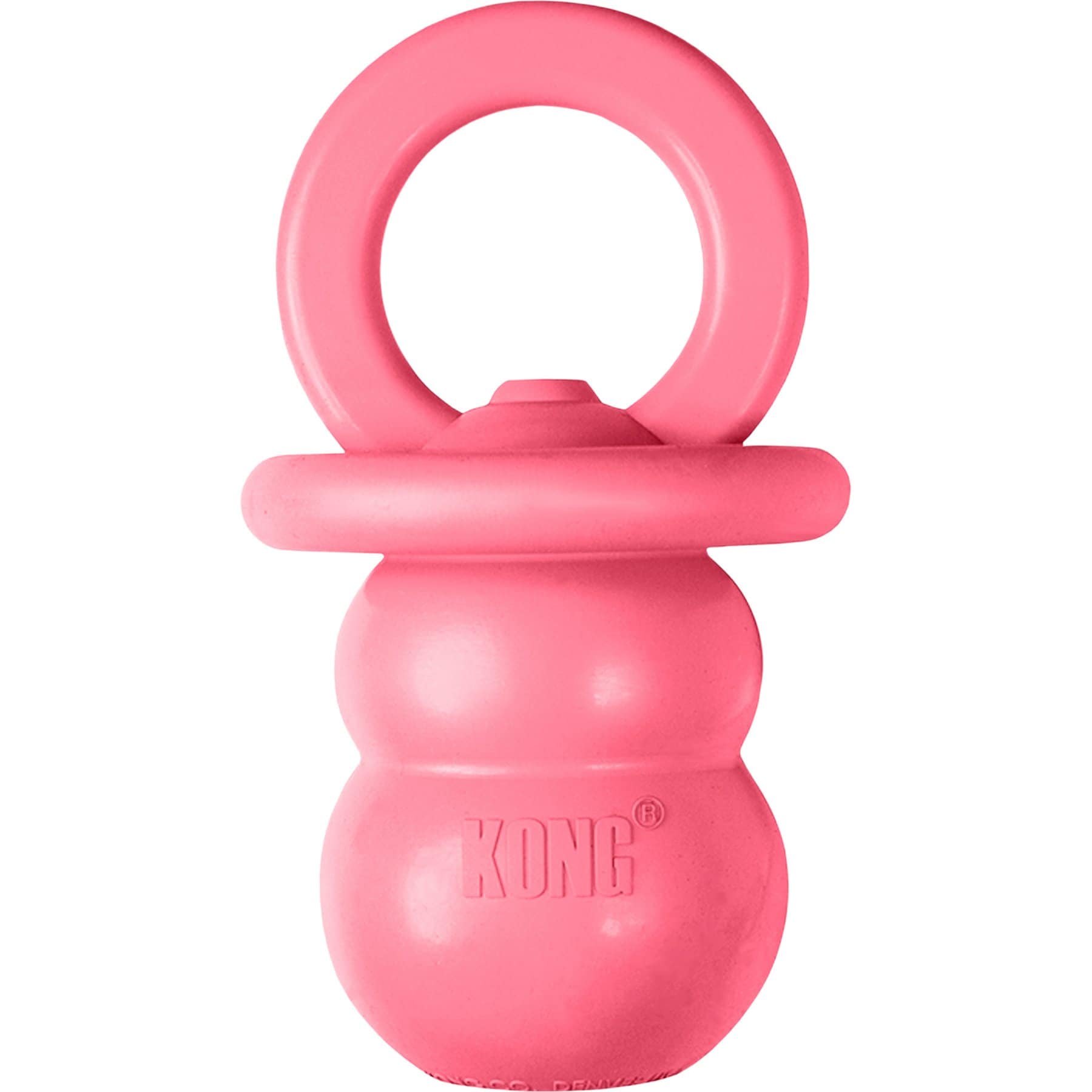
The same soft puppy rubber in a grooved bulb shape that holds a soft filling in the middle. The second stuffable to own, so one can live in the freezer while the other is in use.
Webvet may earn a commission when you click through to Chewy, at no extra cost to you.
The KONG Binkie is the same puppy rubber in a pacifier shape: a stuffable bulb on a ring handle, grooved so a soft filling stays put instead of being licked out. Puppies who ignore a plain cone often work at this one, because the bulb sits across the sore back gums.
Treat it as a companion to the KONG Puppy rather than an alternative. Two stuffable toys let you keep one in the freezer while the other is in use, which is what turns a stuffed toy into a daily routine rather than an occasional treat.
Snuggle Puppy: the heartbeat toy for the first nights
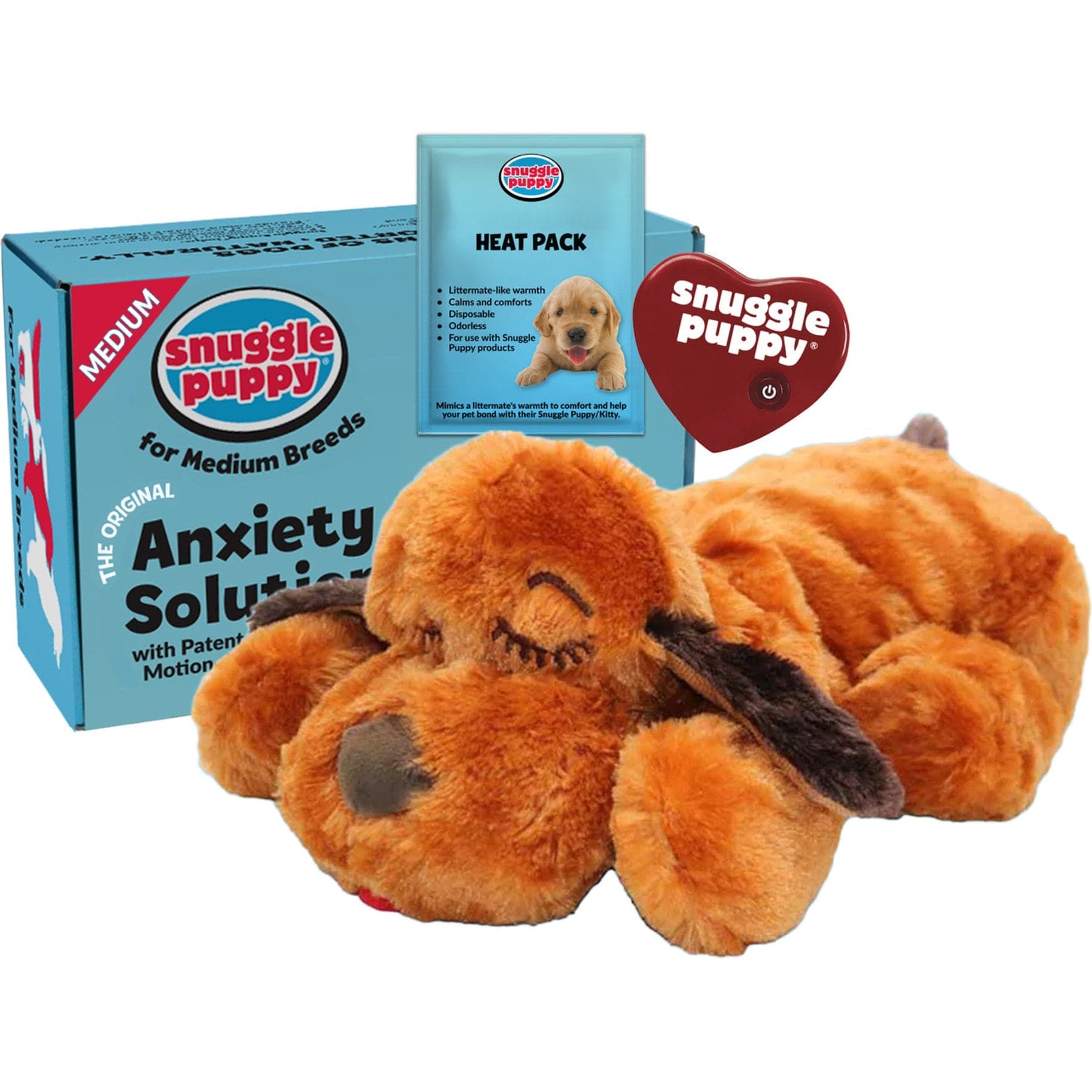
A plush with a pulsing heartbeat unit and a warm pack pocket for a puppy's first nights alone. A supervised comfort item for beside the crate, not a chew toy.
Webvet may earn a commission when you click through to Chewy, at no extra cost to you.
Smart Pet Love built the Snuggle Puppy around one idea. A plush body holds a battery powered pulsing unit and an optional warm pack in an internal pocket, so a puppy sleeping alone for the first time has something that feels vaguely like a littermate.
Be honest about what it is. This is a plush toy with removable inserts, which makes it a supervised item rather than a chew. It belongs beside a sleeping puppy behind a crate door you can hear, not left in a pen with a puppy who has discovered that seams come apart.
West Paw Toppl: the food puzzle that grows with the puppy
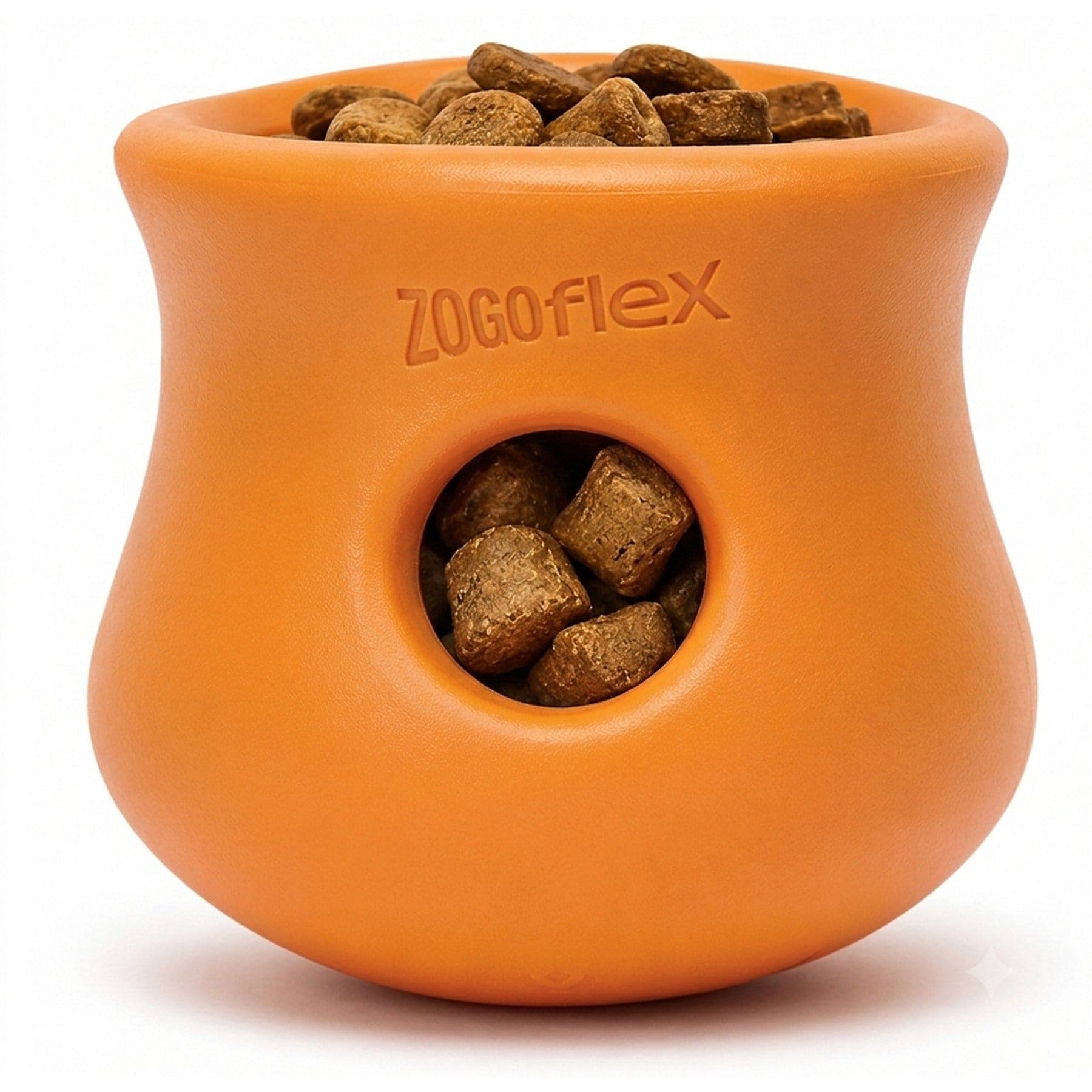
A thick, flexible Zogoflex cup with internal ridges, made to be stuffed, frozen, and worked at. Two sizes lock together to make the puzzle harder, and it survives the dishwasher.
Webvet may earn a commission when you click through to Chewy, at no extra cost to you.
The Toppl is an open topped bowl with internal ridges, made in one piece from West Paw Zogoflex, dishwasher safe and freezer safe. Unlike a narrow cone it is easy for a young puppy to succeed at, and that matters: a puppy that fails at a food puzzle walks away and does not come back.
Start it open and easy at around ten weeks, with dry kibble that falls out on any nudge. Once your puppy empties it in under a minute, wedge the food in wet and freeze it, or nest the small size inside the large one. That upgrade path is why it outlasts the puppy stage.
Multipet Lamb Chop: the floppy toy that beats a hand
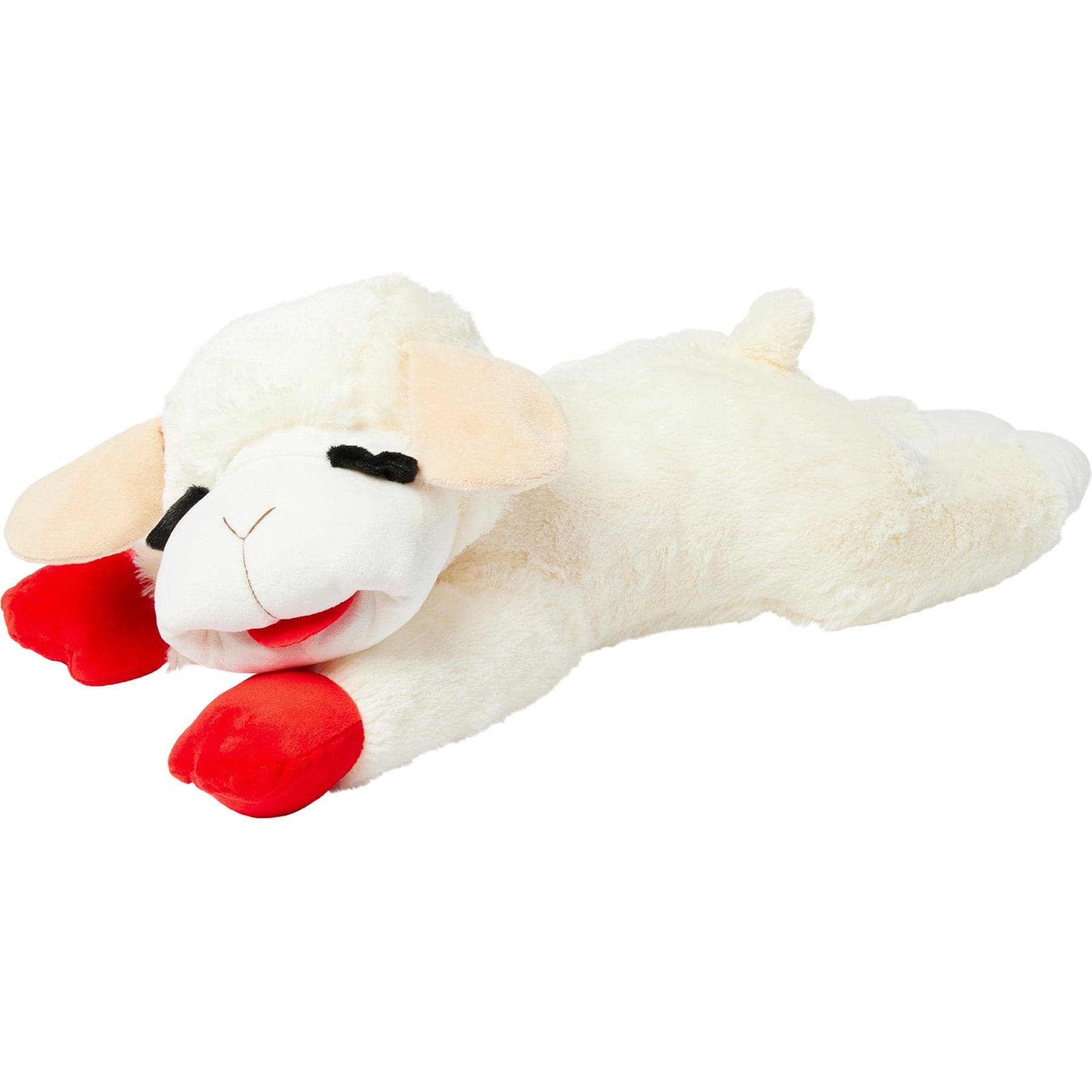
The soft, floppy plush dogs choose for themselves, with minimal stitched detail and a single squeaker. A carry-and-sleep toy, not a chew toy: watch the neck and leg seams.
Webvet may earn a commission when you click through to Chewy, at no extra cost to you.
This is the toy for the nipping problem. The classic Lamb Chop plush is long, soft and floppy, with limbs a puppy can grab from any angle, which makes it far easier to substitute for a forearm than a ball or a rigid chew. The smaller sizes suit a puppy under fifteen pounds; the linked jumbo is the size for a large-breed puppy who will grow into it.
It holds stuffing and a squeaker, so it stays a supervised toy for as long as you own it. Tug is meant to be a two player game, and the moment your puppy settles down alone to dissect it, the session ends and the toy goes back on the shelf.
Nylabone puppy chew: softer nylon for erupting teeth
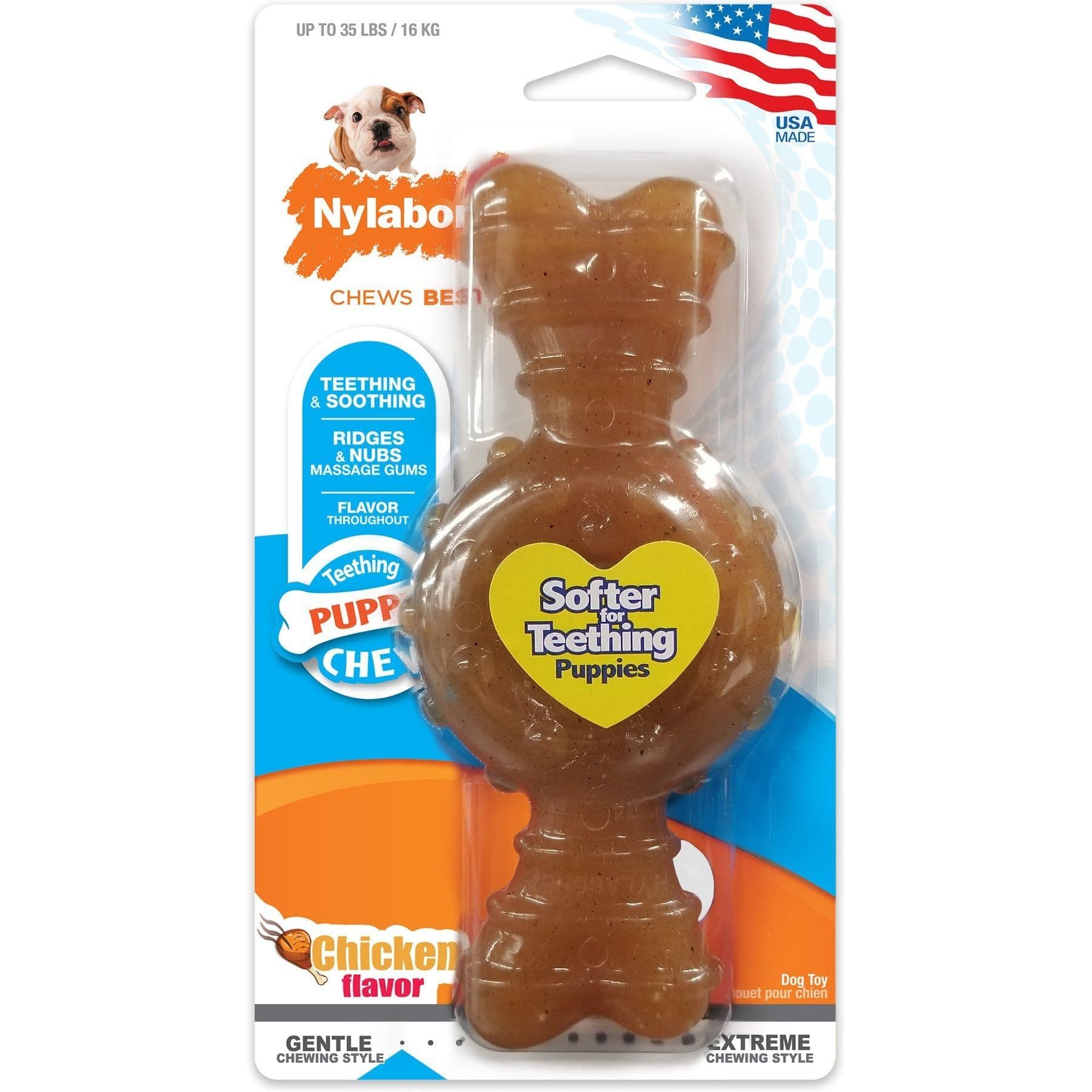
Nylabone's puppy-specific softened nylon, sized by body weight, for the stage after baby teeth start giving way. For pure chewing, not food work.
Webvet may earn a commission when you click through to Chewy, at no extra cost to you.
Adult nylon chews are far too hard for a puppy. Nylabone makes a puppy specific line that is softened and sized by body weight, and the distinction matters: veterinary dental guidance warns that a chew which will not flex is capable of fracturing a tooth. A puppy-grade nylon gives a little more than the adult version, but it is still the firmest thing in the box, so hold it back until the baby teeth start loosening.
Nylon works differently from rubber. It is not stuffable and it is not a food toy, so it earns its place as the thing your puppy chews when it simply wants to chew, usually from around twelve weeks as the first adult teeth arrive. Raised bristles on the surface are normal wear.
Benebone puppy chew: a wishbone a puppy can hold
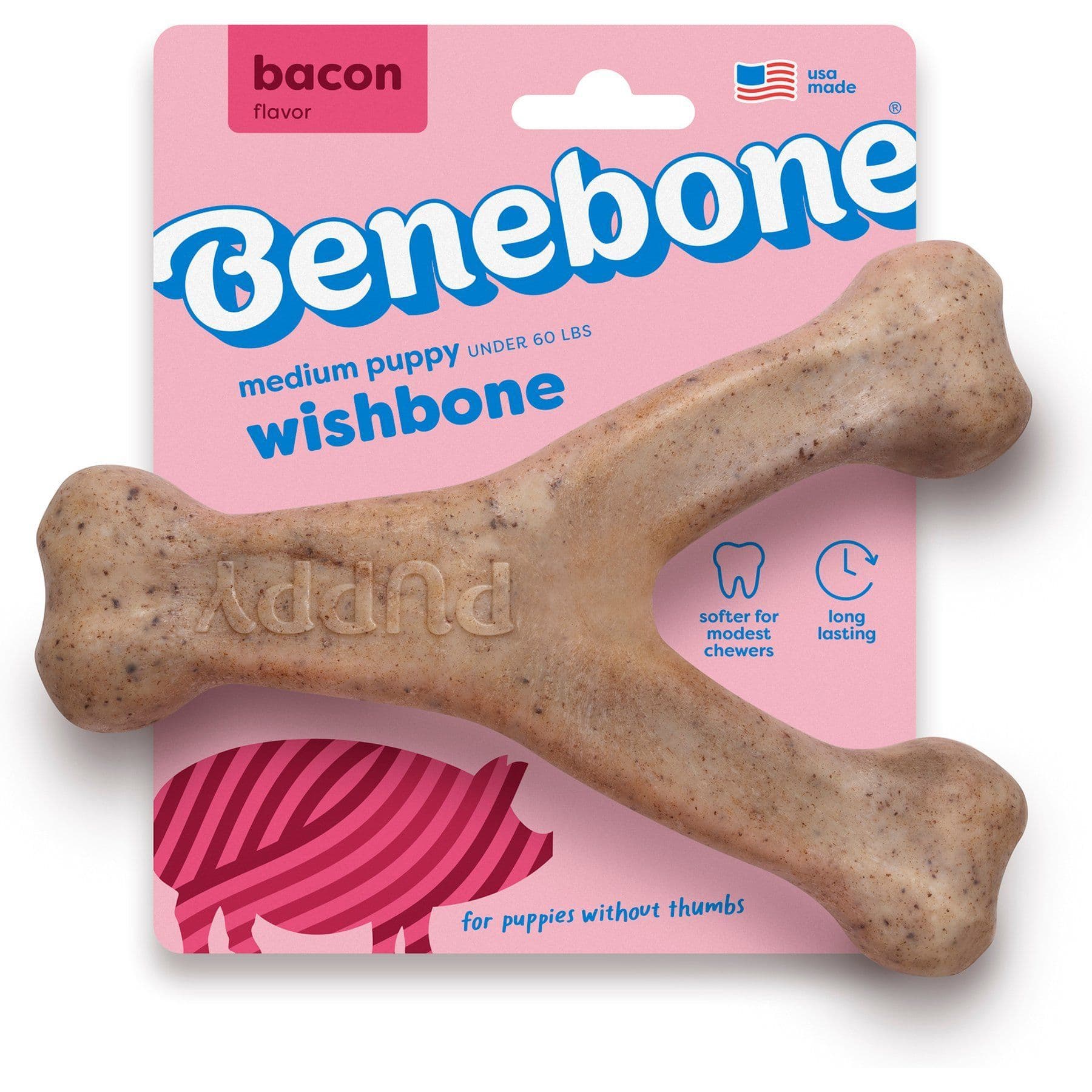
A softer-than-adult nylon wishbone a puppy can pin under a paw. Hold it back until the baby teeth start loosening, and run the thumbnail test on the one that arrives.
Webvet may earn a commission when you click through to Chewy, at no extra cost to you.
Benebone puppy chews use a nylon the company makes softer than its adult range, and the wishbone shape is the point. The curve lets a puppy trap one arm under a paw and work the other end with the side teeth, which is how dogs prefer to chew anyway.
Do not hand this to an eight week old puppy. Nylon of any grade belongs to the stage after the baby teeth start giving way, and hard material against a mouth full of deciduous teeth is one of the most common ways puppies chip them. Sixteen weeks is a fair earliest date.
Nina Ottosson puppy puzzle: the first thing to solve
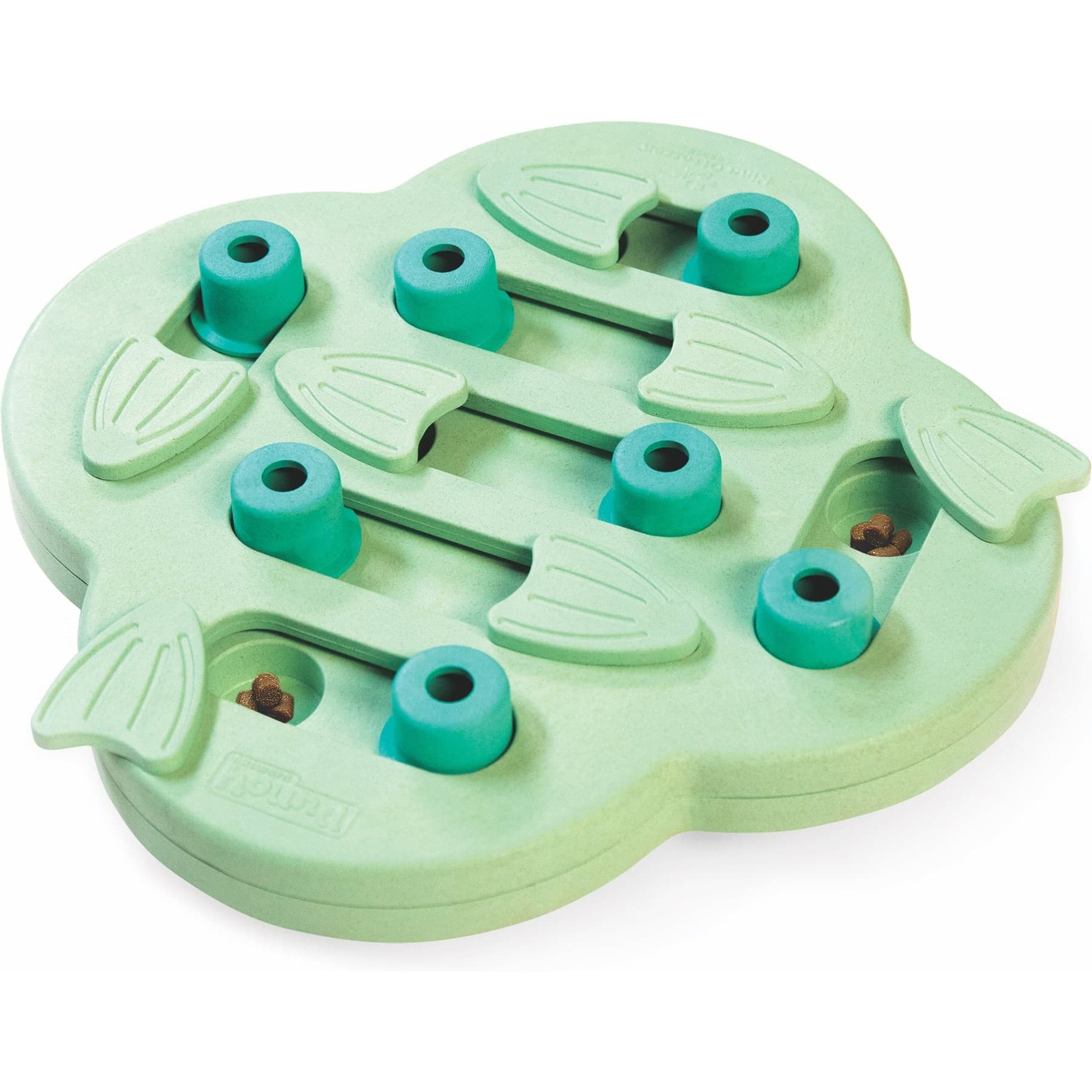
Outward Hound's easiest Nina Ottosson design: sliding covers and swivel flaps with no loose pieces. Load it with the puppy's own dinner rather than extras.
Webvet may earn a commission when you click through to Chewy, at no extra cost to you.
Outward Hound rates its Nina Ottosson puzzles by difficulty, and the puppy labeled designs sit at the easiest end of that scale: sliding covers and shallow wells rather than stacked compartments or pieces that lift out. That is the right starting point. A first puzzle should look almost insultingly easy to you.
Load it with the puppy dinner rather than extras. Using the regular ration keeps calories in check and turns a meal that would vanish in forty seconds into five minutes of nose and paw work. The sliding pieces are plastic, so this one stays supervised until your puppy stops chewing the lid.
Chuckit! indoor ball: motion without the hazard
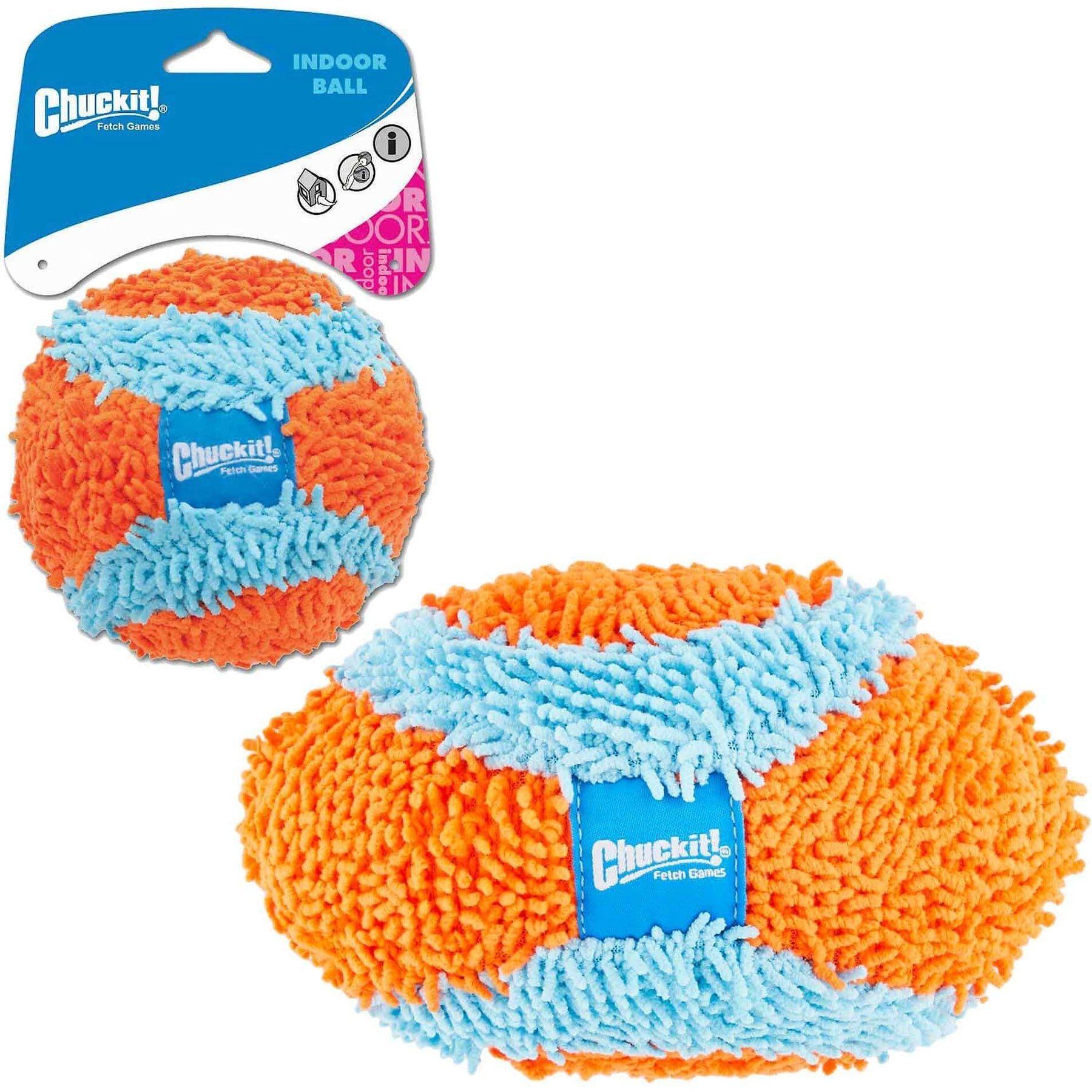
Soft fabric-covered Chuckit! indoor toys built for rolling across floors rather than long throws. Buy a size too wide to pass the back teeth, now and in two months.
Webvet may earn a commission when you click through to Chewy, at no extra cost to you.
Puppies need to chase something, and the Chuckit! indoor ball is a soft fabric covered ball built for rolling across floors rather than long outdoor throws. It is light enough that a ten week old puppy can push it around, and it will not take out a lamp on the first bounce.
Ball size is where the danger lives, with any brand. A ball that fits neatly in the mouth can slide back over the tongue. The ball you buy should be too wide to pass the back teeth, and it should still be too wide when your puppy is a third bigger in two months.
Snuffle mat: fifteen minutes of nose work
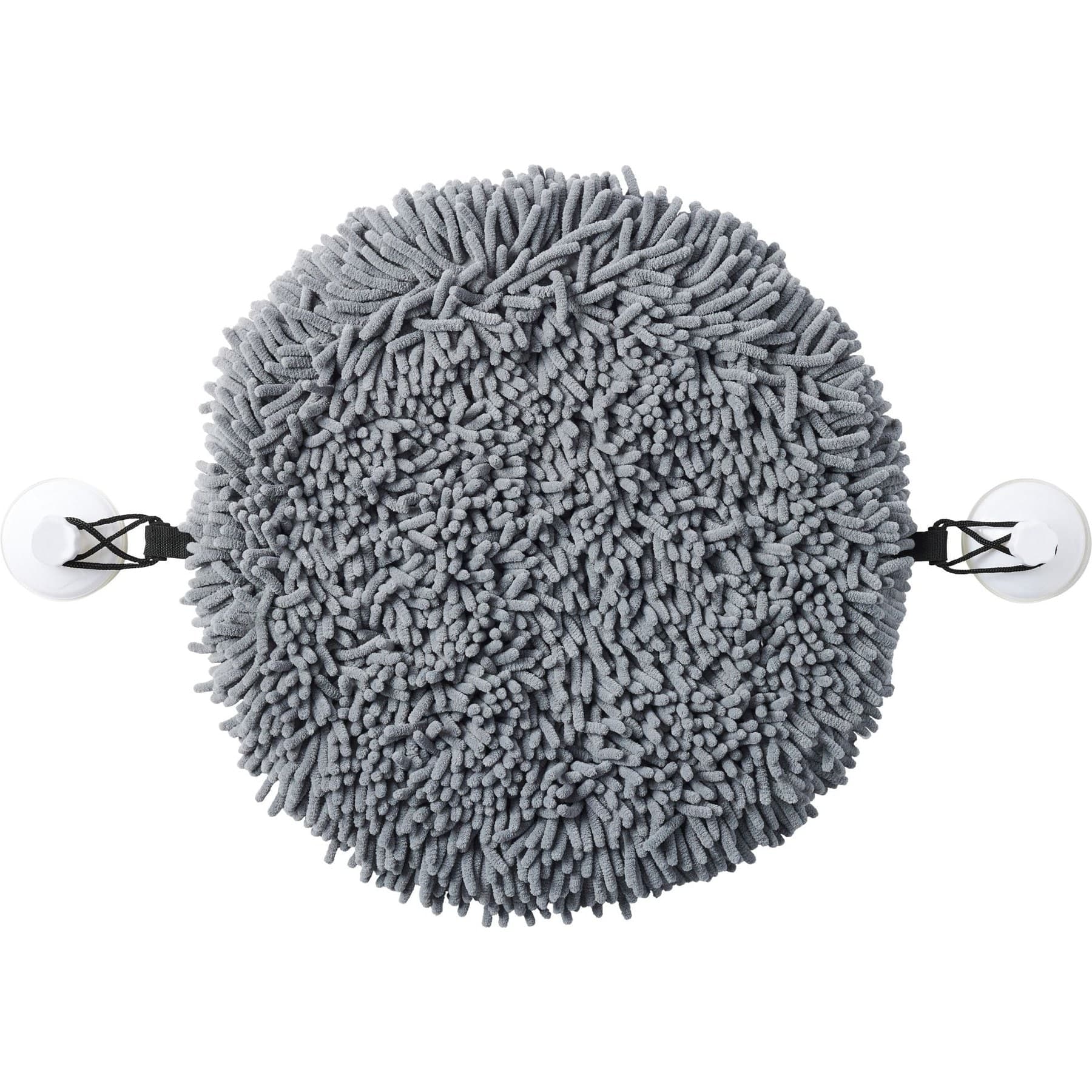
A shaggy fleece mat you scatter kibble into for fifteen minutes of nose work. Machine washable, with suction cups for smooth floors. Supervised, since fleece is chewable.
Webvet may earn a commission when you click through to Chewy, at no extra cost to you.
A snuffle mat is a fabric base with dozens of fleece strips knotted through it. Scatter kibble into the pile and the puppy has to work nose first to find it. As environmental enrichment it is the cheapest win available, and it produces the flat out nap that a walk sometimes does not.
It suits the very youngest puppies, because no jaw strength is involved and there is nothing mechanical to solve. Fleece is chewable, though, so this is a supervised toy and a washable one. Shake the dust out after every use and machine wash it when it starts to smell.
 Sponsored
Vet care that's always there
Unlimited video calls and messaging with licensed vets for less than a typical vet visit. One membership covers up to five pets.
Use code Pets60
Plans start at $12/month · covers up to 5 pets
- Licensed vets in most states
- Rx for 150+ conditions
- 4.7 on Trustpilot
Puppy toys by age: 8 weeks to 12 months

Picks staged by puppy age beat picks staged by product category, because the limit is never the toy, it is the mouth. From eight to ten weeks a puppy is chewing on teeth it is about to lose. By six months it has the adult mouth it will keep for life.
Published veterinary references put the puppy set at 28 deciduous teeth and the adult set at 42, with permanent teeth erupting from roughly three to seven months. Those timings come from published sources rather than anything we measured, and the Merck Veterinary Manual pet owner section covers the detail.
The table sets out what each stage can handle, the toy types that fit, what to hold back, and how closely to supervise. The stage labels carry through the picks above, so a dog toys shortlist for one month of puppyhood does not become a shopping list for the next.
| Stage | What the mouth can handle | Toy types that fit | What to hold back | Supervision level |
|---|---|---|---|---|
| Eight to ten weeks | Soft deciduous teeth, very little jaw power | Soft latex, thin natural rubber, small plush, a stuffable puppy rubber toy filled wet | All nylon, dental chews, tennis balls, rope | Constant while awake |
| Ten to sixteen weeks | Baby teeth loosening and dropping, sore gums | Chilled rubber teethers, treat pockets, a first food puzzle, a floppy tug toy | Rope, adult nylon, anything with a removable squeaker | Constant for plush, short solo spells with one piece rubber |
| Four to six months | Adult teeth erupting, the chewing peak | Firmer natural rubber, puppy grade nylon, larger stuffable toys | Cooked bones, adult strength nylon, any worn plush | Solo time with one piece rubber only |
| Six to twelve months | Full adult set, adolescence, strongest jaw so far | Adult size durable rubber, harder puzzles, tug and fetch toys | Anything already outgrown, thinned or gouged | Solo time with durable rubber, supervise plush and rope |
Eight to ten weeks: the first toys home
Which toys suit a puppy at 8 to 10 weeks comes down to one rule: nothing harder than the toy can dent. The whole mouth is still deciduous, jaw strength is negligible, and an eight week old puppy is exploring texture rather than destroying anything. Soft latex, thin natural rubber and small plush all work.
Puppies this young like anything they can pick up and carry, which is why a floppy plush usually beats a hard chew in the first week. For an eight week old puppy, first toys home should be one stuffable rubber toy, one soft carry toy, and one thing that smells like company at night.
Hold back everything hard. There is no place yet for nylon, antlers, hooves or a dental chew, and a standard tennis ball is both abrasive and, for many puppies, the wrong size in a dangerous direction.
Ten to sixteen weeks: baby teeth start dropping
Toy choice changes at ten weeks, and it changes for a physical reason: the deciduous teeth loosen and the gums get sore. A puppy that was happy carrying a plush now wants to bear down on something, and from 10 to 16 weeks cold helps far more than hardness does.
Chilled rubber toys, wet food frozen inside a stuffable toy, and a damp twisted washcloth from the freezer all take the edge off. This is also the window to introduce a first food puzzle, while the puppy is curious and not yet strong enough to simply crush it.
You may find loose teeth, blood spots on a toy, or a tooth on the floor. That is normal and rarely needs attention, though a baby tooth still in place beside an erupting adult tooth is worth mentioning at the next vaccination visit.
Four to six months: the chewing peak
Four to six months is the chewing peak, and it is the stage that catches people out. The adult teeth are coming through, the jaw has real power for the first time, and toys that survived twelve weeks of gentle mouthing start failing in a single afternoon.
Change the kit rather than the puppy. Move from soft puppy rubber to the firmer versions, add a puppy grade nylon or wishbone chew for pure chewing, and increase the number of frozen stuffed toys rather than the number of corrections. An outlet has to be available at all times.
Six to twelve months: adolescence
From six to twelve months you are dealing with adolescence, a full adult set of teeth and the strongest jaw the dog has had. Most puppies are through the worst of the teething chew, but plenty develop a second destructive phase between seven and ten months driven by boredom rather than sore gums.
Toy choice moves to adult sizing. A six month old puppy of a medium breed can usually take an adult durable rubber toy, harder puzzles with lift out pieces, and proper tug and fetch toys. Keep sizing generous, because a growing mouth closes the gap on a toy fast.
Comfort toys for the first nights home

Comfort and heartbeat toys for the first nights home do one job. They give a puppy that has just lost its littermates something warm and rhythmic to press against. Puppy heartbeat toys pair a plush body with a pulsing insert, and puppy plush toys without an insert do a weaker version of it.
Expect them to shorten the crying rather than end it. Most of the settling comes from where the crate sits, the bedtime routine and how tired the puppy is. Put the crate beside your bed for the first week or two, and the toy inside it.
- 1A heartbeat plush helps a puppy settle at night, especially in the first two weeks after it leaves the litter. That is the claim worth making for it.
- 2It is a supervised item, not an overnight chew. Puppy stuffed toys carry stuffing, seams and often a battery pocket, none of which belong in a pen with a puppy you cannot hear.
- 3Once your puppy works the seam rather than curling against it, take it out and swap in a one piece rubber toy for solo hours.
Hygiene matters more than people expect, because these toys live in a crate with a puppy that is not yet reliably clean. Buy one you can wash, take the insert out before it goes in the machine, and own a second so the crate is never bare on wash day.
- Choose plain over noisy. A squeaker turns a comfort toy into an arousal toy, which is the opposite of what a bedtime item should do.
- Match the size to the puppy. A plush the puppy can drape over is more use than a small one it will carry around, and small plush toys are easier to swallow whole.
- Keep it for the crate. A toy that is only available at bedtime keeps its meaning. One that is out all day is just another thing on the floor by week three.
If the crying does not improve after two or three weeks, or if your puppy panics rather than protests when left alone, the answer is not a better toy. That pattern is worth raising with your veterinarian, because early separation distress responds much better to early help.
Interactive and puzzle toys a puppy can actually solve

The best interactive puppy toys are the ones your puppy wins at in the first thirty seconds. Interactive puppy toys and puzzle toys for a puppy fail for one reason above all others: they are too hard, the puppy gives up, and the toy becomes something it walks past.
Start a level below where you think your puppy is. There are three tiers worth knowing, and a puppy should move through them in order rather than starting in the middle.
- Scatter and sniff. A snuffle mat, or kibble tossed into a towel. No mechanism and no failure state, which makes it suitable from eight weeks.
- Nudge and lick. An open bowl rubber toy or a stuffable cone with loose dry food. The reward comes out on almost any contact, which teaches a puppy that working at a toy pays.
- Slide and lift. A proper food puzzle with covers to move. This is where puppy treat toys become genuine problem solving, and it usually suits a puppy from around twelve weeks.
Use the daily ration rather than extras, and keep any extras tiny and soft. Puzzle feeding is a better use of a meal than a bowl, and it takes the heat out of a gulper: if you recognize the dog who inhales dinner, a puzzle or a slow feeder bowl is the practical fix.
Raise difficulty by changing the food, not by buying a harder toy. Dry kibble is easy, wet food is harder, and wet food frozen overnight is harder again. A small soft training treat hidden in the wells will pull a hesitant puppy back to a puzzle it had given up on. When your puppy clears the slide-and-lift tier, our dog puzzle toys guide ranks the next levels.
Toys that keep a puppy busy when you cannot

How do you keep a puppy entertained all day? You do not, and trying is the mistake. A puppy of eight to sixteen weeks sleeps for most of a twenty four hour day, so the target is three or four short bursts of paid occupation, with rest in between.
Puppy mental stimulation toys and puppy boredom toys work best in that shape. A bored puppy is loud, mouthy and destructive, and the best puppy toys to keep them busy share one feature: the puppy has to work for food. Chewing, licking and foraging are self rewarding and self limiting.
- Frozen stuffed rubber toys. The single most reliable way to buy yourself twenty minutes. Keep two or three in the freezer at all times.
- Snuffle mats and scatter feeding. Five minutes of nose work tires a puppy out of all proportion to the time it takes, and it keeps a bored puppy occupied without impact on growing joints.
- A chew that is genuinely allowed. Puppies chew whether or not you provide an outlet, so the real choice is between your table leg and something age appropriate.
- A puzzle at the right level. Occupying, but only for as long as the puppy is still winning at it.
Unsupervised solo play is asked about constantly and never resolved, so here is the plain answer. One piece rubber toys with nothing to detach may stay in a pen with a puppy on its own. Everything else should come out only when a person is present, then go back on a shelf.
Decide once what your puppy may have alone and what needs supervision, then keep two physically separate boxes so the decision is not remade at eleven at night. The pen box holds one piece rubber and nothing else. The play box holds everything else and lives up on a shelf.
How many toys a puppy needs is a question usually raised and then answered in two sentences. Here is the specific version: four or five out at once, about a dozen owned in total, and the rotation habit doing the work another toy purchase would not. Fewer than four starves the rotation.
One boundary worth naming. This page is about toys, not food. Anything your puppy is meant to eat, whether an edible dental chew or a bag of healthy treats, belongs with the guides that cover it rather than in a toy box.
Puppy toy safety, sizing, and supervision

Almost no puppy toy page gives you a size rule, and none of them explains the check. Here it is: a toy your puppy cannot slip behind its back teeth is safe, and one that can is a swallowing hazard. That single check separates the two. Nothing else matters if a toy fails it.
The size check that keeps a toy from being swallowed takes three seconds. Hold the toy across the mouth at the level of the back teeth. If it is wider than that gap it cannot travel backwards over the tongue, which is how balls and small plush toys become emergencies.
What can a 9 week old puppy chew on, then? Soft natural rubber, soft latex, and plush under supervision. At nine weeks old the whole mouth is baby teeth, and the safest puppy toys at that age are the ones that give way rather than the ones that last longest.
Materials sort into three groups, and only two of them belong in a young puppy mouth. Natural rubber and thermoplastic rubber both flex under a thumbnail, while nylon does not, which is why a nylon chew is a later purchase rather than a first one for a mouth full of baby teeth.
- Natural rubber. Flexible, stuffable and the most forgiving material for deciduous teeth. The default at eight weeks.
- Thermoplastic rubber. Firmer, often dishwasher and freezer safe, usually molded in one piece with nothing to detach.
- Nylon. Hard, not stuffable, and appropriate only once adult teeth are arriving, and then only in a puppy grade formulation.
Knowing when to retire a worn toy is the set of wear checkpoints nobody names, and it is what prevents the incident. Owners keep chewed toys in circulation until something comes off, which is backwards, because the signs show days earlier. Run these checks weekly and bin anything doubtful rather than putting it back.

Two outcomes make the weekly minute worth it. A piece that lodges in the throat is a choking hazard and an immediate emergency. A piece that goes down and sticks is a gastrointestinal obstruction, which usually means surgery. Neither is common, and both are close to entirely preventable with careful sizing and prompt retirement.
General pet owner guidance from the American Veterinary Medical Association and the ASPCA dog care section is worth reading on the wider household hazards, because the same swallowing risk applies to socks, cords and children toys.
What to keep out of a puppy toy box
Some things should not be in the box at all. Avoid cooked bones, hard adult nylon against baby teeth, rope that is shedding loose fibers, anything with small detachable parts, and hand me down adult toys from an older dog. Each one is a common gift with a specific failure mode.
- Cooked bones of any kind. They splinter along the grain and the fragments are sharp. Weight bearing bones are also hard enough to fracture a tooth.
- Adult strength nylon. A chew that will not dent under a thumbnail can crack a deciduous tooth. Puppy graded nylon exists for exactly this reason.
- Fraying rope. Rope toys shed long threads that get swallowed and can bunch in the intestine. Supervised tug is a different proposition from a rope left in a pen.
- Small detachable parts. Plastic eyes, sewn on noses, bells and rigid squeakers are all the wrong size in the wrong direction.
- Hand me downs from an adult dog. They are sized for a bigger mouth, hardened for a stronger jaw, and usually already worn. Tennis balls fall in here too.
Supervision is a real intervention rather than a disclaimer. Most toy incidents happen in the ten minutes nobody was watching, and the honest position, echoed across published veterinary advice including the VCA pet owner library, is that no toy is a substitute for supervision with a young puppy. Our vet-reviewed safe dog chew toys guide sets out the hardness standard that applies once the adult teeth arrive.
Teething toys get their own guide
Teething relief comes from cold and from give, not from hardness. Freezing a toy is the cheapest upgrade available: a wet stuffed rubber toy left overnight in the freezer does more for sore gums than any specialist product, and puppy teething toys work best in pairs so a cold one is always ready.
Puppy chew toys for the teething window should be soft enough to dent, wide enough not to swallow, and available more than one at a time. A damp knotted washcloth from the freezer works too, under supervision, and costs nothing. Which of the best teething toys for puppies earn a place is a longer conversation. Our puppy teething toys guide covers that window stage by stage, including what to avoid.
When your puppy graduates to tougher toys
Somewhere between six and twelve months the softness question flips into a durability question. Toys that were correct for baby teeth start lasting minutes, and owners start looking at indestructible dog toys for aggressive chewers and the best dog toys for heavy chewers instead.
Two things are worth knowing first. Nothing is genuinely indestructible, and any product sold on that claim is selling a warranty rather than a guarantee. And the step up should be gradual, because a dog that has only ever had puppy rubber can crack a tooth on a chew built for a determined adult. Our dog chew toys guide sorts adult chew toys by chewing style, which is the right next read once the adult teeth are in.
Choosing among the KONG puppy toys
KONG dog toys are the most recommended answer to almost every puppy question, which is exactly why people get stuck choosing between them. The KONG puppy toys line is a softer rubber than the adult range, color coded pink and blue, and sized by the weight of the dog rather than by age.
For a first purchase the plain stuffable cone is the safer bet, and the Binkie is the better second toy rather than the better first one. The classic red, the black extreme, and the various fetch and dental shapes are adult products that should wait until the puppy formulation is outgrown. Our KONG dog toys guide covers every formula, size, and shape in the line.
Interactive toys for the rest of your dog's life
The puzzles and treat toys here are entry level by design, and most dogs outgrow them within a year. Interactive dog toys as a category run well past that: multi step puzzles, treat dispensing balls that scale by difficulty, and interactive toys for a puppy that keep working for an adult dog.
Two cautions carry across from the puppy rules. Anything with a battery or a motor stays a supervised toy for life, and interactive dog toys for aggressive chewers are a genuinely different product class from the ones built for a dog who works a puzzle politely.
Puppy toy questions
Frequently Asked Questions
How many toys does a puppy actually need?
Owners ask how many toys a puppy needs because the shops make it look like forty. A puppy actually needs four or five in circulation at once and about a dozen owned in total, spread across the four jobs: a stuffable rubber toy, a chew, a soft floppy toy for tug and hand redirection, and a food puzzle or snuffle mat. Swap the rest weekly. More than five out at a time and a puppy stops valuing any of them, because novelty is most of what makes a toy interesting.
Are rope toys safe for puppies?
Rope toys are safe for puppies only as supervised tug, and they come out of the pen the moment they start shedding. The risk is specific rather than theoretical: a puppy that lies down and strips loose threads off a rope swallows them, and long thread like material can bunch and cause an intestinal obstruction that needs surgery. A frayed end is the sign to retire the toy immediately. Used as supervised tug only, with a person on the other end and the rope put away afterwards, it is a fine two player game.
How do you get a puppy to chew toys instead of your hands?
You get a puppy to chew toys instead of your hands by making the swap pay better than the hand did. Stop moving your hand the instant teeth land, because a moving hand is the game. Offer the toy at mouth height, exactly where the hand was, and hold it still until the puppy commits. Then reward the transfer with ten seconds of tug or a small soft treat. A long floppy toy works far better than a ball. Be consistent for about a week and end play whenever teeth touch skin.
Can you leave a puppy alone with a toy?
Yes, but only with one piece rubber. A stuffable rubber toy or an open bowl rubber feeder has nothing to detach, nothing to unpick and no filling, which is what makes it the one category safe to leave with an unattended puppy in a crate or playpen. Nothing with stuffing, an exposed or loose squeaker, a battery pocket, a rope end or sliding plastic parts should stay with a puppy alone. Keep the two categories in physically separate boxes, because that decision is much easier to hold when it is only made once.
When should you throw a puppy toy away?
You should throw a puppy toy away the moment any of four things is true. A torn seam with stuffing showing, a loose or exposed squeaker, chunks missing from rubber or nylon, or any fragment small enough for the puppy to swallow whole. Gouges and raised bristles are ordinary wear, but missing material means a piece has already gone somewhere. Nylon chews retire when the raised ends are worn down to the shaft. Check the whole toy box weekly rather than waiting for something to fail.
What age is a puppy chewing the worst?
Four to six months is the worst chewing age for most puppies. That window is when the permanent teeth push through, the gums are uncomfortable and the jaw finally has real power behind it, so toys that survived the first three months start failing quickly. Expect a second, milder burst between seven and ten months driven by adolescence and boredom rather than teething. Neither phase is fixed by correction. Both are managed with an age appropriate chew available at all times, more frozen stuffed toys in the rotation, and enough sleep.

Editor
The Webvet Editorial Team is the in-house group of pet-care editors and writers behind Webvet, operated by Smart Pet Collective. The team researches, writes, and maintains Webvet's pet health, behavior, and medication content. Every article follows a defined editorial process: research from reputable veterinary and scientific sources, careful drafting, mandatory review of medical content by a credentialed veterinarian, and dated publication. Health and medication articles are medically reviewed by a licensed veterinary professional before they go live and are kept current over time.


