Dog Safe Chew Toys: What Vets Recommend and What to Avoid
Which chew toys are actually safe for your dog? A vet-reviewed guide to the two hardness tests, a material-by-material verdict, a sizing rule keyed to your own dog, and knowing when to throw a chewed toy away.

BVMS MRCVS
Medically reviewed by Dr. Pippa Elliott, BVMS MRCVS · Last reviewed

This article contains affiliate links. Webvet may earn a commission when you buy through them, at no extra cost to you.
Search for dog safe chew toys and you get a Reddit thread, a handful of single-clinic blog posts, and four store collections that flatly disagree with each other. One highly ranked page recommends a hard nylon power chew for strong chewers.
Another says that same nylon is exactly what fractures teeth. Both cannot be right, and the shopper is left guessing in the aisle. Veterinary dentists settle it with two checks that take about ten seconds and work on a toy already sitting in your living room.
This guide hands you those checks first, then applies the same standard to every material in the toy bin: natural rubber, thermoplastic elastomer, nylon, rope, wood, bamboo, leather, hard plastic, and the tennis ball your dog will not give up. After that comes the part almost nobody publishes.
- How to size a toy against your actual dog instead of a weight range on a package.
- How long a chewing session should really run.
- How to tell when a toy that survived has quietly become dangerous.
- Exactly what to do in the minutes after your dog swallows a piece of one.
What makes a dog chew toy safe
A chew toy is safe when three things are true at the same time. Your thumbnail leaves a visible dent in its surface. It is too large for your dog to swallow or to wedge behind the back teeth. And it goes in the bin the moment it cracks, tears, or loses a piece.
- 1Pliable enough to dent: if your thumbnail leaves no mark in the thumbnail press test, the toy is harder than your dog's teeth and can fracture one.
- 2Too big to swallow: the toy must not fit entirely behind the molars or pass the back of the throat, even after weeks of wear.
- 3Retired on sight: a cracked, torn, or gouged toy is a swallowing and choking hazard no matter how much it cost or how much your dog loves it.
That standard exists because a chew toy can hurt a dog in three separate ways, and they are not interchangeable. Fixing one does nothing to protect against the others.
- Too hard. The toy wins the contest against enamel and the tooth loses. This is the injury that ends in a root canal or an extraction under general anesthesia.
- Too shreddable. The dog tears pieces off and swallows them, and those pieces can cause a gastrointestinal obstruction days later.
- Too small. The whole toy goes down or gets inhaled, which is a choking hazard rather than a slow obstruction.
- Too worn. A toy that passed on day one can fail every test by week six, once the surface is gouged and chunks are missing.
Notice that the second and third failures pull against the first. Make a toy hard enough that a destructive chewer cannot shred it and you have built something that can crack a tooth.
Make it soft enough to be kind to teeth and a determined chewer will eat it. Every recommendation here lives in that narrow band.
Why there is no single safest chew toy
There is no single safest chew toy for every dog, and any page that names one is guessing about yours. A gentle nine-year-old spaniel and a two-year-old Malinois who destroys everything need different toys off the same shelf. The standard stays constant; the product that meets it does not.
The American Veterinary Dental College warns owners away from chew objects that will not give, and the American Veterinary Medical Association pet owner library covers the same ground from the household side. Neither one is selling you a toy, which counts for a great deal in a category this crowded with marketing claims.
The two tests vets use before you hand over a chew toy

The safest thing for a dog to chew on is any object that passes two checks: your thumbnail leaves an impression in the surface, and tapping the object against your own kneecap would not hurt. Fail either one and the object is harder than tooth enamel is built to survive under full jaw pressure.
These are published veterinary rules of thumb, not something we invented or measured. Vets teach them because they have to work in a store aisle, with no equipment, on a product whose packaging says nothing useful about hardness.
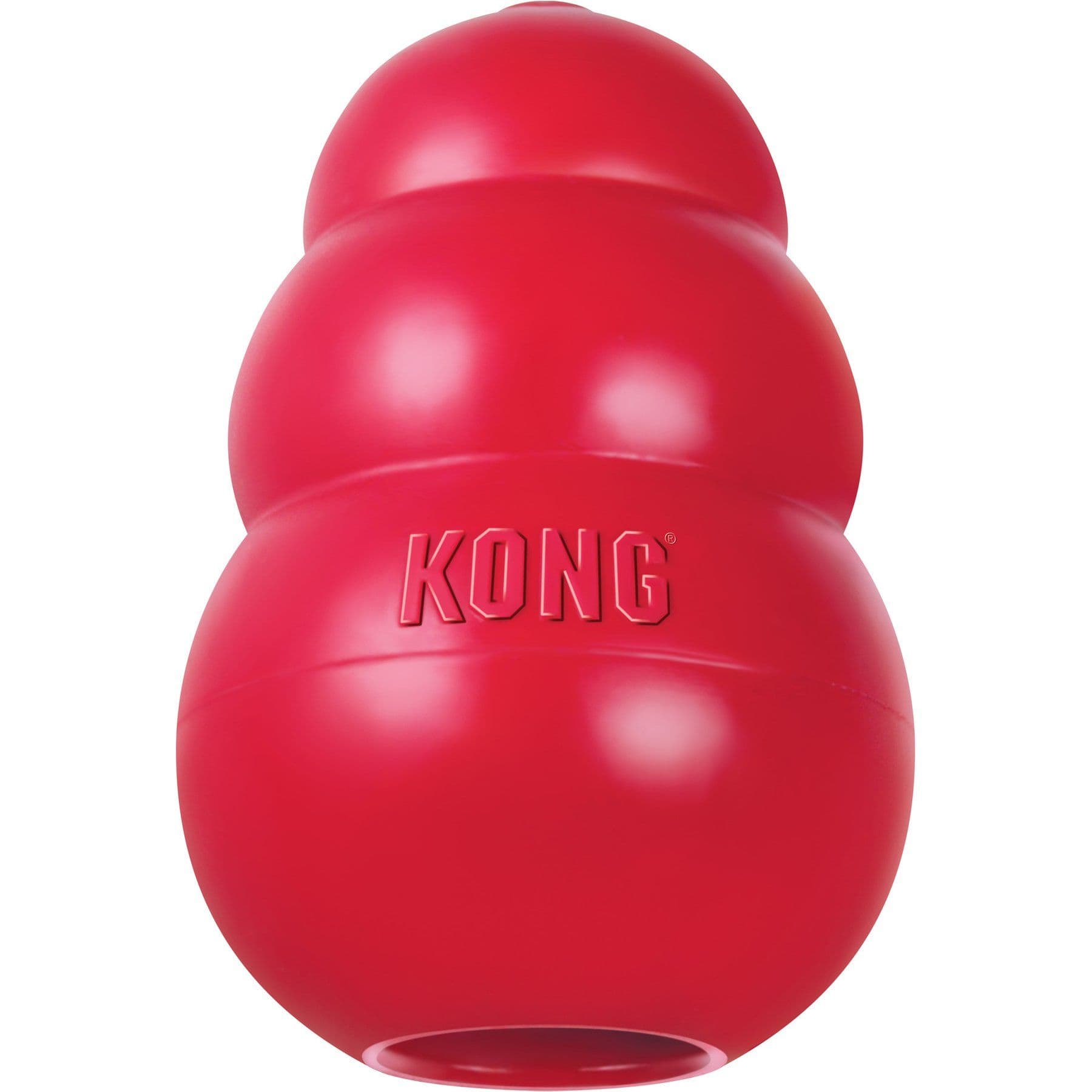
The red natural rubber cone that passes the thumbnail test and turns a five-minute toy into an hour of work once it is stuffed and frozen. Buy the largest size your dog can carry.
Webvet may earn a commission when you click through to Chewy, at no extra cost to you.
Why a hard toy cracks a tooth
The mechanism is simple. When a dog bites down on something that will not deform, the object absorbs none of the load, so the tooth absorbs all of it. The tooth that usually loses is the upper fourth premolar, the big shearing tooth vets call the carnassial.
Dogs instinctively work a hard object back to that tooth and crush down with the strongest part of the jaw. Tooth enamel is thin on a dog compared with a human, and it is never replaced once it is gone.
A crack that reaches dentin opens thousands of microscopic tubules running toward the dental pulp, which is why a fractured tooth hurts and can become infected even when nothing looks dramatic from the outside. These objects fail both checks almost every time:
- Real bones, raw or cooked, including the shelf-stable bone treats sold in pet stores
- Antlers, whole or split
- Hooves
- Hard nylon power chew toys
- Hard plastic toys and thick plastic bottle caps
- Ice cubes big enough that a dog has to crunch them
- Rocks, sticks, and anything picked up on a walk
Every item on that list is sold somewhere under a photo of a happy dog. Popularity is not a safety signal, and neither is a package that says "for aggressive chewers," which describes the dog rather than the toy.
If your dog already has a cracked or discolored tooth, deal with that first: our guide to damaged and rotting dog teeth explains what treatment involves.
What do vets actually recommend dogs chew on
Vets recommend dogs chew on objects that flex. In practice that means solid natural rubber toys, thermoplastic elastomer toys, and the flexible rather than hard nylon lines, each sized so the dog cannot swallow it and each used while somebody is in the room.
Those three classes are what most dogs can chew on safely, whatever their chewing style, and they are the safe toys for dogs that chew hard as well as the ones that nibble.
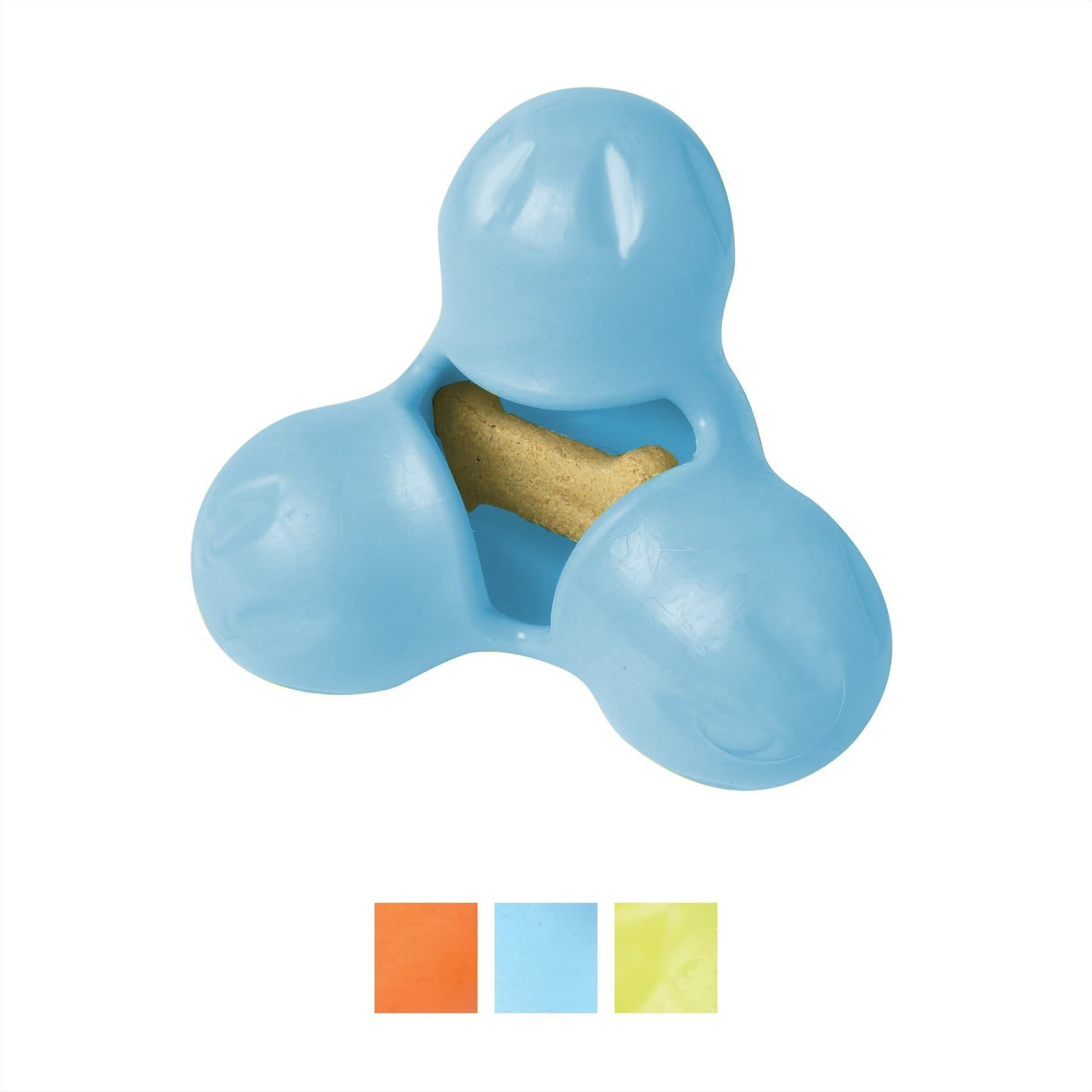
West Paw's stuffable tough toy in Zogoflex: real give under a thumbnail, a hollow centre for food, floats, dishwasher safe, and backed by a one-time replacement guarantee.
Webvet may earn a commission when you click through to Chewy, at no extra cost to you.
- Solid natural rubber. The class vets name first. It dents under a thumbnail, bounces unpredictably enough to be interesting, and the hollow versions can be stuffed and frozen to stretch a short session into a long one.
- Thermoplastic elastomer. A pliable synthetic used by several toy makers, usually dishwasher safe and often floatable. It passes the hardness check comfortably and holds its shape better than soft rubber.
- Flexible nylon. The softer lines, sold for puppies and gentle chewers, yield under a thumbnail. The hard power chew lines from the same brands do not, which is why a brand name by itself never answers this question.
Two things vets add that product pages rarely do. First, a chew toy is a supervised object, not furniture: it comes out for a session and goes back in a drawer. Second, chewing is a need rather than a vice. A dog with nothing appropriate to chew finds the table leg or the baseboard.
On materials, look for toys labeled free of BPA, phthalates, and lead, and buy from makers who state plainly where the product is manufactured and what it is made from.
Dog toys are not regulated the way children's toys are in the United States, so a manufacturer's own BPA and materials disclosure is most of the information you are ever going to get.
KONG Classic, for average and gentle chewers
The red KONG Classic is the natural rubber toy most vets reach for first. It dents under a thumbnail, it is hollow, and it takes canned food or soaked kibble that you can freeze into a session lasting far longer than the toy alone would.
For a family dog who chews but does not destroy, this is close to the whole answer. Our healthy dog treats guide covers what belongs inside one. Our KONG dog toys guide covers sizes, formulas, and what to stuff.
KONG Extreme, for stronger chewers
The black KONG Extreme is the same shape in the brand's toughest rubber formula. It still gives under a firm thumbnail press, which is exactly the point: it buys durability without crossing into the hardness that fractures teeth.
If your dog has already destroyed a red Classic, this is the next step rather than a jump to hard nylon.
Chew toy materials, rated

The healthiest dog chew toy is the one whose material dents under a thumbnail and cannot be torn into swallowable pieces. Judged against that single standard, solid natural rubber rates highest of any common material, thermoplastic elastomer sits just behind it, and hard nylon, wood, bamboo, hard plastic, antler, and real bone all fail outright.
The table below rates every material you are likely to meet against the same three questions. Does it pass the thumbnail press test, what is its typical failure mode once a dog gets to work on it, and what happens if your dog swallows the piece that eventually comes off?
| Material | Thumbnail press test | Typical failure mode | Swallow risk |
|---|---|---|---|
| Solid natural rubber | Passes: dents clearly | Surface gouges, then chunks torn out by a powerful chewer | Low while intact; torn chunks are swallowable |
| Thermoplastic elastomer | Passes: flexes and dents | Punctures and stretched tears at thin points | Low while intact; check torn edges |
| Flexible nylon | Usually passes | Bristled, frayed ends after heavy chewing | Small shredded slivers can be swallowed |
| Hard nylon (power chew) | Fails: no mark at all | Tooth damage before toy damage; sharp shards | Shards can lacerate or lodge |
| Braided rope and fabric | Passes hardness, fails swallow | Fraying into long loose strands | High: strands cause linear foreign body |
| Wood and bamboo | Fails: no give | Splitting along the grain | Splinters can pierce mouth, throat, or gut |
| Wood-polymer chew sticks | Fails or borderline | Chipping into hard fragments | Fragments swallowed whole |
| Leather and rawhide | Softens with saliva | Peels into slick sheets | High: sheets swell and obstruct |
| Hard plastic | Fails: cracks, never dents | Cracking into sharp-edged pieces | Sharp fragments |
| Antler, hoof, real bone | Fails badly | Tooth fractures before the object marks | Splinters and obstruction |
| Tennis ball felt | Passes hardness, fails abrasion | Abrasive felt grinds enamel; ball compresses | High if crushed into the throat |
Read as verdicts rather than rows, it comes out like this.
- Natural rubber: pass. The best all-round choice and the only common material that stands up to a determined chewer without crossing the hardness line. Retire it when a chunk is missing.
- Thermoplastic elastomer: pass. Pliable, easy to clean, often guaranteed by the maker. Watch for punctures and stretched thin spots rather than cracks.
- Nylon: split verdict. Flexible lines pass. Hard power chew lines fail the thumbnail press test outright and shed sharp slivers as they wear. Judge the line, never the brand.
- Rope: pass on hardness, fail on swallowing. Loose strands are the most dangerous thing on this list for a dog who eats what he chews.
- Wood and bamboo: fail. Both split along the grain into splinters that can pierce the mouth, throat, or gut, and neither gives under a thumbnail. Wood-polymer chew sticks are firmer than the packaging suggests.
- Leather and rawhide: fail on ingestion. Saliva turns them slick and peelable, and a swallowed sheet can swell in the gut.
- Hard plastic: fail. It cracks rather than dents, and the edges it leaves are sharp.
- Tennis ball felt: fail on abrasion. The felt is impregnated with grit and works like fine sandpaper on tooth enamel over months of fetch and chewing.
That standard also makes the shopping carousel at the top of the search readable. It puts two opposite product classes side by side and the photographs do not tell them apart.
Hard nylon power chews and stick-style wood-composite chews sit in the fail column. Pliable rubber and stuffable toys sit in the pass column. Read the row against the hardness rule rather than the star ratings.
One caveat: soft is not the same as safe. A plush toy passes the thumbnail press test easily and is still the wrong object for a destructive chewer, because squeakers, plastic eyes, and polyester stuffing are exactly the pieces that end up somewhere they should not be.
Chew toys to avoid, and why

Avoid every dog chew your thumbnail cannot mark: real bones of any kind, antlers, hooves, hard nylon power chews, hard plastic, and wood or stick-style toys. Then avoid anything small enough to swallow whole, plush toys with squeakers and stuffing for a destructive chewer, and rope toys left down without supervision.
Bones deserve a line of their own. Cooked bones splinter, raw bones still fracture teeth, and the shelf-stable bone treats sold in stores have drawn federal safety warnings. Our guide to the dangers of bones for dogs carries the full case.
Failing the hardness tests raises the risk of a slab fracture rather than guaranteeing one. It is a probability, not a prophecy, and there is no honest fracture rate anyone can quote you.
If your dog has chewed a hard toy for years with no visible damage, that does not disprove the standard and it does not make the next one safe. It means the fracture has not happened yet, or has not been found yet, because a slab fracture is often invisible without a dental radiograph.
The one narrow exception for extreme chewers
There is one honest exception, and it is narrow. For a dog who destroys and swallows every pliable toy you buy, an obstruction is a bigger and more immediate danger than a fracture, so a harder toy can genuinely be the lesser risk.
Senior dogs and dogs with worn teeth get no version of that exception. They stay on the pliable standard with nothing traded away, because their teeth already fail at loads a young dog's would shrug off.
Sizing a chew toy so your dog cannot swallow it

Size a chew toy to your dog, not to the weight range printed on the package.
The toy has to be too wide to sit fully behind the molars and too large to pass the back of the throat, and both of those are checked against your own dog rather than assumed from a label on a shelf.
The ten-second size check
The check takes about ten seconds. Hold the toy up beside your dog's relaxed muzzle and confirm it is wider than the muzzle at its widest point. If the whole toy would fit inside the mouth with room to close, it is too small.
If your dog could work it behind the molars and hold it there, it is too small. Between two sizes, take the larger one every time.
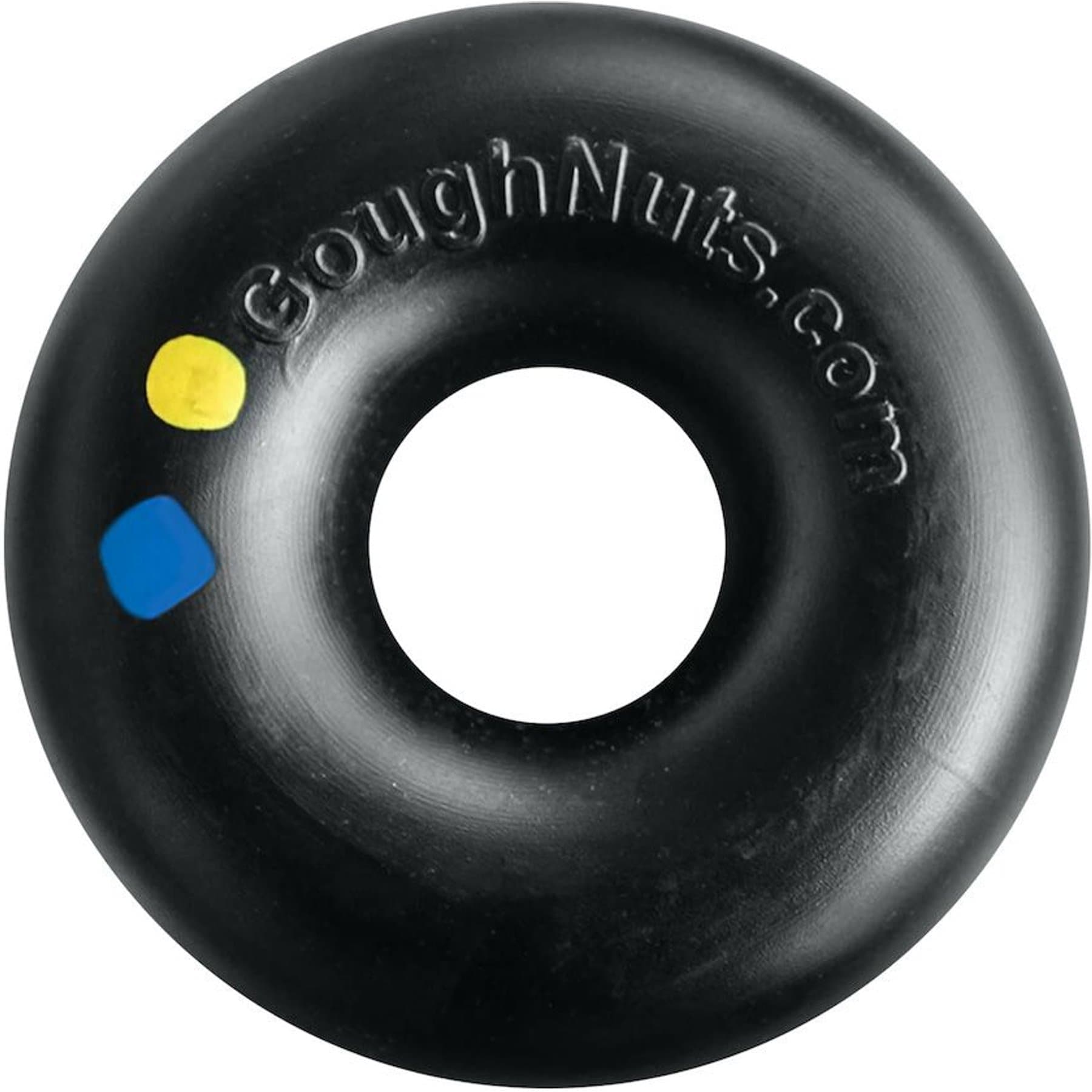
Solid natural rubber ring with a red inner layer: when red shows, the toy has failed its inspection and comes out that day. Heavy, awkward to pin on the back teeth, and built for power chewers.
Webvet may earn a commission when you click through to Chewy, at no extra cost to you.
| Dog size | Starting toy size | The check against the dog that overrides the chart |
|---|---|---|
| Small dogs, under 20 lb | Small, roughly the width of your palm | Must not fit fully behind the molars |
| Medium dogs, 20 to 50 lb | Medium, wider than the muzzle at its widest point | Must not pass the back of the throat |
| Large dogs, 50 to 90 lb | Large | Size up if the dog can carry it entirely inside the mouth |
| Giant dogs, over 90 lb | Extra large or giant | Size up again for a known destructive chewer |
| Multi-dog home | Size to the largest dog in the house | Every toy on the floor is available to every dog |
| Flat-faced breeds | Size up, and choose a flatter shape over a ball | A round toy can seal a short airway |
Four things the chart cannot say for you.
- Small dogs are not exempt. Safe chew toys for small dogs are still the ones a terrier or a Chihuahua cannot fit whole behind the teeth.
- Safe chew toys for large dogs need the size up more often than owners expect, because a German Shepherd jaw can compress a toy that looks far too large to swallow.
- Balls are the highest-risk shape on the shelf. A ball that clears the back of the molars can lodge in the throat, and a dog cannot dislodge it alone.
- Re-check size as the toy wears. A large rubber toy chewed down by a third is a medium toy, and eventually a swallowable one.
Nothing on that chart overrides what you can see on your own dog. A lean 45-pound greyhound, a broad-headed 45-pound bulldog, and a short-muzzled French Bulldog do not have the same mouth, and no package can know which one is standing in your kitchen.
When in doubt, treat any toy that could disappear into the mouth as a choking hazard and size up.
Chew toys that hold up to a long chewing session
No chew toy is safe for a dog to chew on for hours, and that is the honest answer.
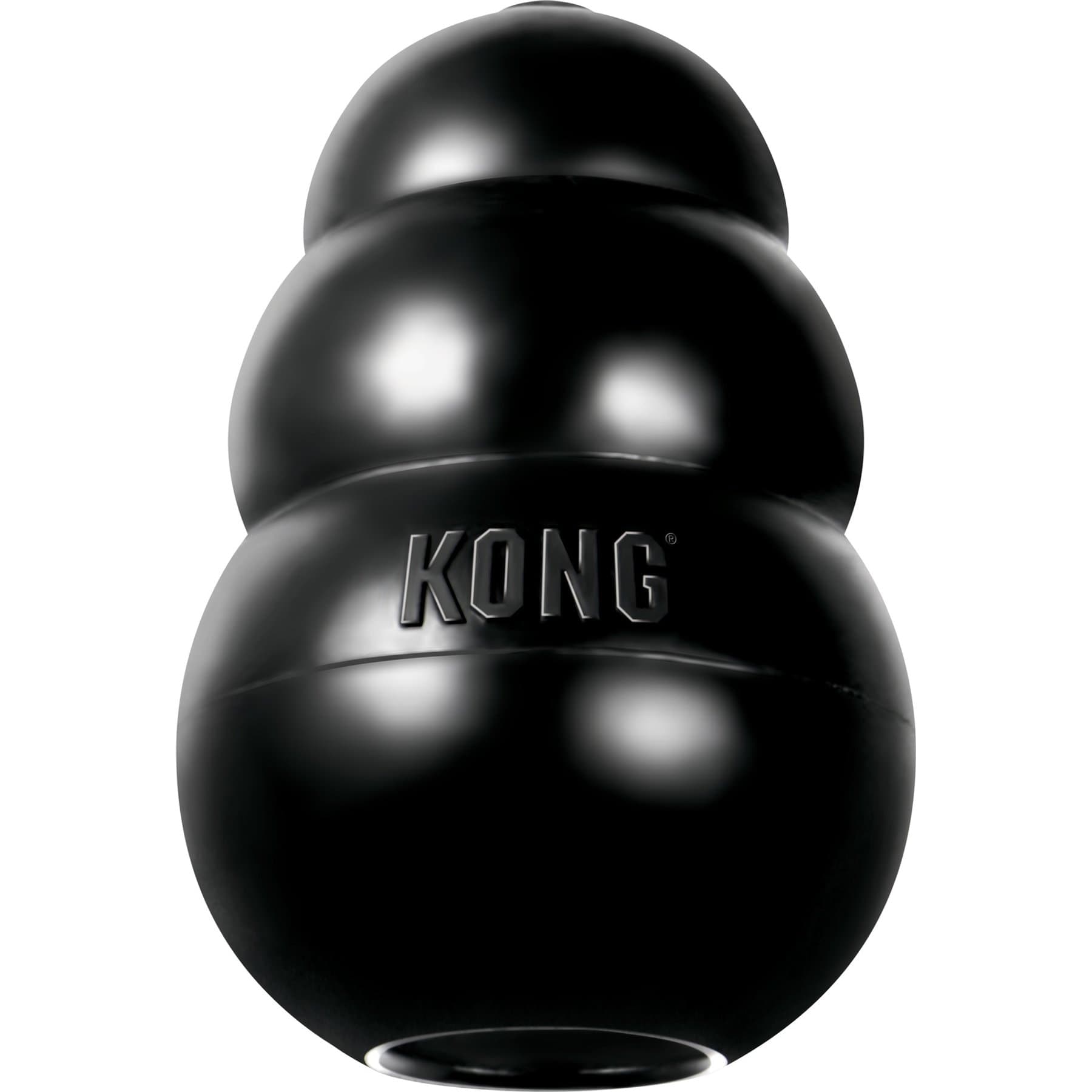
KONG's firmest rubber in the same hollow shape: denser rather than tooth-hard, so a destroyer who has opened a Classic gets more sessions without crossing the hardness line.
Webvet may earn a commission when you click through to Chewy, at no extra cost to you.
What people usually want is a way to occupy a bored dog, and the safe version of that is a short supervised chewing session plus separate enrichment that does not involve grinding teeth against a hard object all afternoon.
- 1Aim for a supervised chewing session of roughly 10 to 30 minutes, then end the session yourself and put the toy away.
- 2End it on your schedule rather than waiting for the toy to fail, and inspect the toy every time you pick it up.
- 3If your dog needs hours of occupation, the answer is enrichment (stuffed and frozen toys, puzzle feeders, sniffing games), not a harder chew.
A toy marketed as lasting for hours is making a durability promise, not a safety promise.
The realistic goal is a supervised chewing time budget instead of a toy that lasts all afternoon, because long unbroken chewing is where enamel abrasion happens, where a determined dog finally opens a seam, and where an unsupervised swallow gets missed entirely.
Durable without crossing the hardness line
Durability still matters, because a toy that survives ten hard minutes is a toy that is not shedding pieces into your dog.
The best safe chew toys for dogs who work hard at them are the durable pliable ones, not the hard ones, and the healthy version of durable is a toy that outlasts the session without outlasting the enamel. Three are worth naming, and the toughest KONG sits with them.
West Paw Zogoflex Tux
Zogoflex is a pliable thermoplastic elastomer that dents under a thumbnail, is dishwasher safe, and is backed by the maker against a dog destroying it. The Tux shape is hollow and stuffable, so it doubles as the enrichment toy instead of being only something to gnaw on.
It is a sensible pick for a dog who is hard on toys but not yet a destructive chewer.
GoughNuts Original Ring
The Goughnuts ring is the one widely sold toy that solves the retirement problem for you. It is built with a red inner layer beneath the outer rubber: when red shows, the toy has been chewed past its safe depth and is finished.
That turns the judgment call at the heart of this guide into something you can simply see.
Enrichment instead of a longer chew
For the hours part, separate enrichment from chewing. A rubber toy stuffed with wet food and frozen solid takes far longer to empty than the same toy takes to chew, and it works the tongue rather than the molars.
Scatter feeding, a snuffle mat, and a puzzle feeder do the same job with no dental load at all, and a frozen stuffed toy is also a practical fix for a dog who inhales his meals.
Keep the filling sensible. A chew toy is not a second dinner, the training treats you use as rewards are a different tool, and anything you put inside a toy counts against your dog's daily calories.
Supervision, crate rules, and when to throw a toy away

There is no chew toy that is genuinely safe to leave a dog alone with. The realistic standard is that chewing happens while you are in the room, and that anything left down with an unattended dog is chosen on the assumption that nobody will notice the moment it starts coming apart.
That is stricter than most households run, so here is the workable version. A toy that will be down while you are out of the room, or in a crate, has to clear a higher bar than a supervised toy does. For the enclosure decision itself, compare dog crate designs separately from the toy-safety checks below.
It is a higher bar again for older dogs, whose teeth have less margin, and the same bar applies to any toy sold on a dental claim.
- Single piece. No seams, no squeaker, no stuffing, no removable parts, no attached rope.
- Pliable material that passes the thumbnail press test, so it cannot fracture a tooth if the dog goes at it hard out of boredom.
- Sized up. Too large to swallow even after weeks of wear, not merely too large today.
- Already proven with this dog across multiple supervised sessions, with no pieces ever coming off.
- No rope, no plush, no rawhide, and no edible chew or bully stick in a crate. Nothing that can be swallowed whole or fray into strands.
- Inspected before it goes in and again when it comes out.
Two hard rules sit on top of those. Nothing stays in a crate overnight, and a dog crated with a chew toy should not be wearing a collar with tags that can hook on it.
Of all the supervision rules and crate rules here, removing every chew toy when nobody is home is the easiest one to actually keep, and it costs you nothing.
Signs of obstruction are covered in the Merck Veterinary Manual pet owner section, which is a better place to check at midnight than a forum.
Keep routine dental care going alongside it: chew toys prevent nothing on their own, and the American Animal Hospital Association dental care guidelines put a regular oral exam at the center of prevention, because a quiet fracture is found by a veterinarian and almost never by an owner.
Our dog dental health guide covers what that care looks like. And because the same instinct that shreds a toy goes after shoes, cords, and baseboards, dog-proofing the house removes the objects you were never going to be able to supervise.
Dogs who destroy everything
Some dogs go through a pliable toy in an afternoon.
Safe chew toys for aggressive chewers and heavy chewers are a different buying decision, because for those dogs the swallowing risk outranks the fracture risk, and the trade-offs have to be made deliberately rather than by reaching for the hardest thing on the shelf. Two things are worth saying before the shopping starts.
Toys sold as indestructible dog toys are rarely indestructible, whatever the lifetime guarantee on the package promises, and the safe dog chew toys for aggressive chewers are still the pliable ones, chosen in their toughest formula and their largest size rather than swapped out for hard nylon the moment a rubber toy fails.
- Stay on natural rubber and thermoplastic elastomer. Switching to hard nylon trades an obstruction risk for a fracture risk rather than removing a risk.
- Buy the toughest formula within those materials, and size up beyond what any chart suggests.
- Supervise every session and end it yourself, on a timer if that is what it takes.
- Treat any toy that has produced a swallowed piece as permanently retired, not washed and handed back.
- Pay the premium for a built-in wear indicator. A destructive chewer reaches the retirement threshold in weeks rather than years, and a visible signal beats a judgment call.
If none of that holds and your dog is still swallowing pieces, work inside the conditions listed earlier for a harder-than-standard toy, with every one of them met rather than only the convenient ones. And talk to your veterinarian: a dog who compulsively eats what he chews is worth a conversation on its own.
Puppies and teething
Puppies are the one group where this standard shifts, and it shifts in both directions at once. Deciduous puppy teeth are smaller and more fragile than adult teeth, so anything hard is worse for a puppy than for a grown dog.
At the same time a teething puppy has a real need to chew, and denying it produces a puppy who chews the furniture.
- Softer than the adult standard: puppy-specific flexible lines, soft rubber, and chilled (not frozen rock solid) textured toys.
- No hard nylon, no antler, no bone, no ice, and no hand-me-down toy from an adult dog in the house.
- Size for the mouth the puppy has right now, and re-check every few weeks while the head is still growing.
- Supervise everything. Puppies swallow first and consider afterwards.
Teething discomfort peaks while the adult teeth erupt, generally somewhere between three and six months, and then it passes. The chewing habit you build during that window does not, which is why the best chew toys for puppies to keep them busy matter more than anything you hand a settled adult.
Chew bones for puppies and dental chews for puppies are a separate, edible decision with its own rules.
Edible chews are a different decision
Everything above is about toys, meaning objects your dog is not supposed to eat. Edible chews, dental chews, bully sticks, pig ears, and real bones are a separate decision with separate rules, handled elsewhere rather than here, because with those the entire point is that the item gets consumed.
How to judge an edible chew
For an edible chew the question is not hardness alone. It is calories, digestibility, contamination risk, and whether the product has any evidence at all behind its dental claims.
The Veterinary Oral Health Council maintains a list of accepted products that have shown measurable plaque or tartar control in trials, which is the standard vets actually use instead of the wording on the front of the bag.
Where to go next on edible chews
Our guide to vet recommended dog dental chews resolves that decision in full, including which seals mean something, which of the best natural dental chews for dogs hold up to scrutiny, and which chews are still too hard for the standard on this page.
It is also the right place to start on long lasting dog chews for aggressive chewers and on chew bones for small dogs, both of which get judged on ingestion rather than on hardness alone. One rule carries across the boundary: no bone is a safe chew object, edible or not.
The bottom line
Judge the chew toy, not the brand. Press your thumbnail into it. Rap it on your kneecap. Hold it beside your dog's muzzle. If it dents, does not hurt, and is too large to swallow, it is a candidate. If it fails any one of the three, put it back, whatever the label promises.
Then keep judging it. The toy that passed in March is a different object by June. Inspect it weekly, retire it at the first missing piece, and keep chewing to supervised sessions rather than an all-day habit. Our dog chew toys guide applies this standard to specific picks by chewing style.
That routine, not any single purchase, is what keeps a dog's teeth and gut out of trouble. And if you are ever unsure whether a fragment went down or whether a tooth looks wrong, call your veterinarian.
Dog chew toy questions
Frequently Asked Questions
Are Nylabones safe for dogs?
Whether Nylabones are safe for dogs depends entirely on the line, so the brand name alone is not a verdict. Nylabone sells flexible puppy and soft-chew products that give under a thumbnail, and those meet the hardness standard here.
It also sells hard nylon power chew products that fail the thumbnail press test outright, leave no mark under a nail, and can fracture a carnassial tooth.
The Nylabone hardness verdict, then, is line by line: flexible line yes, power chew line only as the conditional case, with direct in-room supervision, a mouth with no existing dental disease, short owner-ended sessions, and retirement at the first sharp or shredded edge.
Can a rope toy cause an intestinal blockage?
Yes. A rope toy can cause an intestinal blockage, and rope is the one material that passes the thumbnail press test but fails the swallow test. It dents under a thumbnail and would not hurt a kneecap, so it looks safe by every hardness check in this guide.
The danger is the strands. When frayed strands bunch the intestine, the dog has a linear foreign body: one end anchors, often at the base of the tongue or in the stomach, while the gut gathers along the rest of the strand.
That is a surgical emergency and a different mechanism from a swallowed chunk. Use rope for supervised tug only, retire it the moment it frays, and never leave one down.
Are tennis balls safe for dogs to chew on?
Tennis balls are safe for dogs to fetch and not safe for dogs to chew. The abrasive felt covering works like fine sandpaper against tooth enamel, so a dog who carries and grinds a tennis ball for months ends up with crowns worn flat over time rather than fractured.
The wear is gradual, which is why owners almost never notice until a veterinarian points it out, and enamel does not grow back. There is a second risk stacked on top: a standard tennis ball can be compressed by a large dog and lodge in the throat.
Throw the ball, take it back when the game ends, and give your dog a pliable rubber toy for the actual chewing.
What chew toys are safe for a senior dog?
The chew toys that are safe for a senior dog are softer than the adult standard.
This guide sets its hardness bar for a healthy adult mouth, and a senior dog often has already worn or cracked teeth, plus some degree of periodontal disease, so those teeth fail at loads a young dog would survive.
Choose soft natural rubber over the toughest formulas, hollow stuffable toys that reward licking rather than grinding, and anything you can dent easily rather than only just. Skip nylon of any hardness, antlers, and bones entirely.
If your senior dog has stopped chewing something he used to enjoy, that is a reason for a dental exam rather than a new toy.

Editor
The Webvet Editorial Team is the in-house group of pet-care editors and writers behind Webvet, operated by Smart Pet Collective. The team researches, writes, and maintains Webvet's pet health, behavior, and medication content. Every article follows a defined editorial process: research from reputable veterinary and scientific sources, careful drafting, mandatory review of medical content by a credentialed veterinarian, and dated publication. Health and medication articles are medically reviewed by a licensed veterinary professional before they go live and are kept current over time.
Veterinarian · BVMS MRCVS
Dr. Pippa Elliott, BVMS, MRCVS, is a veterinarian with nearly 30 years of experience in companion animal practice. Dr. Elliott earned her Bachelor of Veterinary Medicine and Surgery from the University of Glasgow. She was also designated a Member of the Royal College of Veterinary Surgeons. Married with 2 grown-up kids, Dr. Elliott has a naughty Puggle named Poggle, 3 cats and a bearded dragon.
Related reading

Cat Proof Christmas Tree: Vet-Reviewed Safety Steps, Deterrents, and Cat-Safe Tree Options

Dog Ate Grapes or Raisins? Signs of Poisoning and What to Do

Onion Toxicity in Dogs: Garlic, Chives, Leeks, and What to Do
