Crash Tested Dog Car Seat and Harness Guide: What the Testing Means and Which Products Passed
Vet-reviewed guide to crash-tested dog car seats, harnesses, carriers, and crates: what independent certification means and how it differs from a maker-run test. How to check a claim before you buy.

BVMS MRCVS
Medically reviewed by Dr. Pippa Elliott, BVMS MRCVS · Last reviewed

This article contains affiliate links. Webvet may earn a commission when you buy through them, at no extra cost to you.
A crash tested dog car seat or harness label can mean two very different things: an independent certification from the Center for Pet Safety, or a crash test the maker ran or commissioned itself. The short answer is that crash-tested is not a regulated rating, and the CPS certified list is the one check you can verify yourself.
Before you pay for a crash tested dog car seat, harness, carrier, or crate, know that pet restraints have no government or industry standard behind them, as AVMA News reported in 2023. Retail listings rarely say who ran the test, and that difference decides how much the words are worth.
We did not crash-test any product ourselves. Every result here comes from an independent tester such as the Center for Pet Safety or from a maker's own published test, and the safety guidance comes from the AVMA and VCA Animal Hospitals.
What crash-tested means for a dog car seat or harness
The short answer: crash-tested is a marketing phrase, not a regulated rating. It can describe an independent certification, a maker-run crash test, a strength rating on the hardware, or nothing beyond the word itself. To tell which one a listing claims, look for who ran the test, which standard they used, and the dog weight tested.

- 1Crash-tested is not a regulated term, so check who ran the test before you trust it.
- 2To read what crash-tested means on a listing, look for the tester's name, the standard used, and the dog weight tested.
- 3Center for Pet Safety certification is the independent check, and it covers harnesses, carriers, and crates.
- 4A maker-run test or a strength rating is weaker evidence than an independent certification.
- 5Restrain your dog in the back seat or a secured crate, never loose and never in front of an airbag.
No rule requires a listing to back the words with evidence. AVMA News notes that kennels, carriers, harnesses, and seatbelts for pets have no standards or industry tests, unlike restraints for people. Even EzyDog, a maker of a crash-tested harness, states that there are no official standards or test requirements for car canine safety products.
Many makers borrow a human benchmark instead. The standard most often cited, FMVSS 213, is a child restraint rule. Its stated purpose, per the federal text at Cornell's Legal Information Institute, is to reduce the number of children killed or injured in crashes, so a pet product can only use it as a borrowed yardstick.
On a retail page, a crash-tested claim usually falls into one of these kinds:
- Independently certified: the product and size appear on the CPS certified list.
- Maker-run crash test: the maker names a lab and a borrowed standard, usually FMVSS 213, and publishes its own pass result.
- Strength rating: the webbing, buckles, or straps were load-tested, which says nothing about how the dog moves in a crash.
- The word alone: "crash-tested" with no lab, standard, or weight named.
Independent testing covers three kinds of gear. The Center for Pet Safety (CPS) certified list we checked in October 2026 is sorted into:
- Safety harnesses.
- Pet travel carriers.
- Travel crates.
Booster-style seats are not one of those groups. CPS defines a pet travel seat as one that holds or elevates the pet but does not offer full containment.
The strongest version of the claim names CPS and the exact product. Sleepypod's page for the Clickit Sport Plus, for example, says the harness was crash-tested at U.S., Canadian, and E.U. child safety standards, then independently certified with a 5 Star rating by CPS. The CPS list itself names the Clickit Sport and the Clickit Range.
The AVMA states there is limited scientific information to judge the safety of individual pet transport products, and it encourages evidence-based crash testing of enclosures and safety harnesses. CPS ran its 2015 crate study on crates whose makers claimed "testing," "crash testing," or "crash protection," which shows those words can be checked.
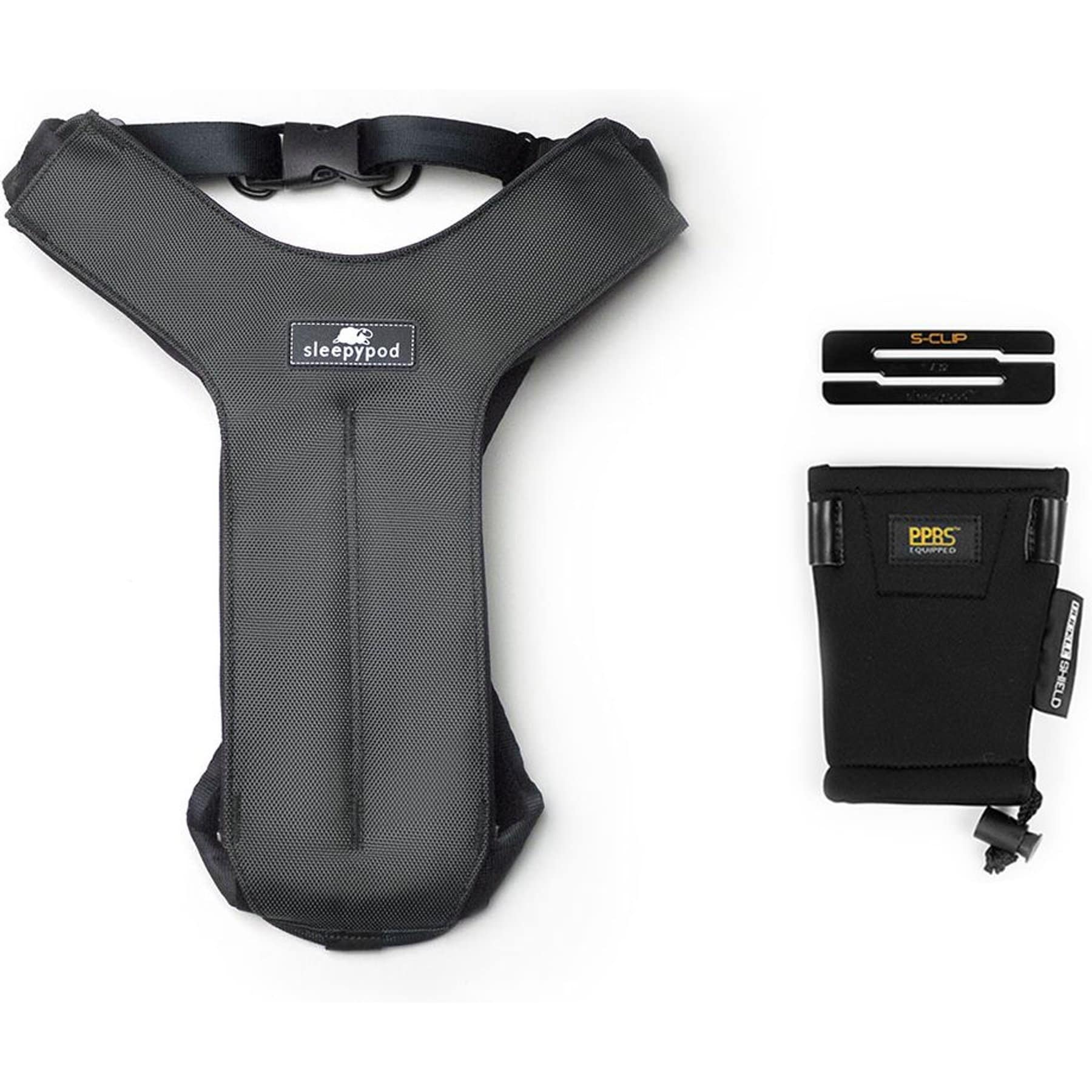
Seat belt harness that Sleepypod says holds a CPS 5 Star certification; also usable as a walking harness.
Webvet may earn a commission when you click through to Chewy, at no extra cost to you.
Why the model year matters
A crash test result belongs to the tested model, not the brand. A test result or review from a few years ago may describe a product that has since been redesigned: CPS tested the 2013 Kurgo Tru-Fit Enhanced Strength harness and has not retested the redesigned version.
Restraint itself is the step owners skip most, and the numbers behind the risk are softer than the marketing suggests:
- A 2010 American Automobile Association survey, reported by AVMA News, found that more than 80% of drivers recognize the danger of driving with an unrestrained pet, but only 16% use pet restraints.
- No reliable count of pet crash injuries exists, since AVMA News says federal crash data do not capture it.
- The figure owners see most, that a 60-pound dog at 35 mph can become a 2,700-pound projectile, is an estimate from the advocacy group BarkBuckleUp, not a measured crash result.
The injuries are real, though. Dr. Elisa Mazzaferro, a Cornell criticalist quoted by AVMA News, says typical injuries range from minor abrasions to fractured limbs, a broken spine, or internal bleeding. The AVMA's pet travel guidance adds that unrestrained pets may be crushed by deployed airbags or thrown through windows.
Who tests pet travel gear: the Center for Pet Safety and maker-run tests
Most crash tests on pet travel gear come from two kinds of organization: the makers themselves, at labs they choose, and the Center for Pet Safety, which tests independently. Knowing which one produced a result tells you how far to trust it.
According to AVMA News in 2023, CPS is the only nonprofit organization with testing and performance requirements for pet vehicle restraints, and its results are published online. That makes CPS certification the one form of evidence an owner can check without relying on the maker's word.
Maker-run tests
A maker-run test is not worthless, but the maker picks the lab, the standard, and the pass line. Kurgo describes a static strength test plus a dynamic test on a crash test sled using FMVSS 213, and states its harnesses were sled-tested at Calspan in June 2018.
Kurgo says its harnesses passed two criteria. One was an excursion limit set by dog weight:
- 32 inches for dogs up to 50 lb.
- 36 inches for dogs from 51 to 75 lb.
That result is the maker's own: CPS tested the 2013 Tru-Fit Enhanced Strength and has not retested the redesign, so the current harness has a maker-run pass but no CPS result.
EzyDog took a similar route for its Drive harness. It says testing was done at Automotive Safety Engineering in Australia, a facility it describes as recognized under FMVSS 213 for certifying child safety seats. EzyDog tested its small, medium, and large harnesses with 28 lb, 50 lb, and 75 lb dogs.
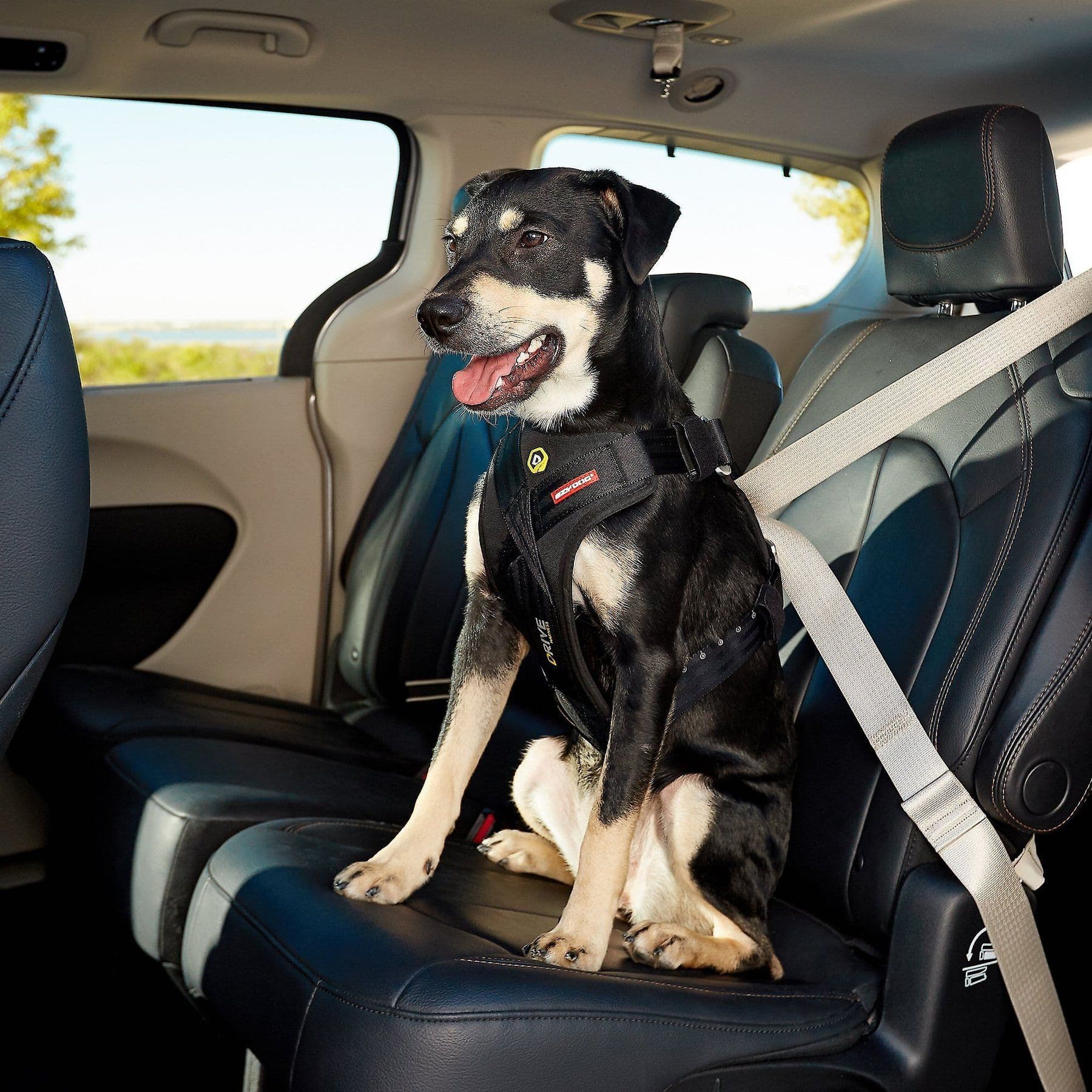
Step-in car harness EzyDog had crash-tested in Australia at 28, 50, and 75 lb; the seat belt threads through the top handles.
Webvet may earn a commission when you click through to Chewy, at no extra cost to you.
That is a commissioned test at an outside lab, which is more than many listings offer. It is still the maker's test, and the Drive is not on the CPS certified harness list. The useful detail is the weight per size: you can match your dog to the test dog used for that size.
The Center for Pet Safety
The Center for Pet Safety is a registered 501(c)(3) nonprofit founded in 2011. It does not use live animals in testing, is not affiliated with the pet products industry, and does not endorse products. It accepts no funding from pet product manufacturers, which is the basis for calling its testing independent.
CPS crash tests use "crash test dogs": specially designed, weighted, and instrumented simulants. Its harness criteria look at the hardware, the webbing, the connection point, and excursion, meaning how far the test dog's head travels forward against the FMVSS 213 head excursion limits.
The CPS 2013 harness study is why many owners now distrust the label:
- Apart from the Sleepypod Clickit Utility, every harness tested was judged insufficient in design, materials, and overall performance.
- CPS stated it did not agree with the crash protection claims made by those other manufacturers.
- Of the brands that qualified for crash testing, only one offered crash protection.
- In July 2014, CPS published its harness test protocol, CPS-001-014.01, as an output of that study.
Independent testing outside the U.S. points the same way. In 2014, the NRMA Insurance Research Centre tested six car harnesses, as reported by Australia's CHOICE. Only two restrained the test dummy, and the failures came from weak plastic buckles similar to those on many backpacks.
That data is older and Australian, but the failure point is worth checking on any harness you consider.
Maker and independent results do not always agree. In the CPS 2015 carrier study, Sleepypod disputed a result on its Mobile Pet Bed. CPS reviewed the maker's evidence and noted that the manufacturer's testing did not return the same result as its own.
How to read a crash-test claim: certified, tested, and strength-rated are not the same
CPS Certified is a voluntary program. By joining, a manufacturer commits to three things:
- Meet independently developed safety standards.
- Monitor product quality control.
- Commit to truth in marketing.

When we checked the CPS certified list on October 22, 2026, the safety harness filter showed three entries: the Saker Bomber Harness, the Sleepypod Clickit Range, and the Sleepypod Clickit Sport. The EzyDog Drive, Thule Cappy, Chai's Choice, and CarSafe harnesses were not on it.
The carrier filter showed 11 entries, including the Sleepypod Mobile Pet Bed, Mobile Pet Bed Mini, Atom, and Air, several PawsInCar carriers, the Away Pet Carrier, and the Gunner G1 Kennel Small. The travel crate filter showed nine entries.
The word "certified" on a retail page does not always mean CPS. EzyDog's Chewy listing calls the Drive "crash tested, passed and certified." EzyDog's own page says its designs conform to a combination of child safety and vehicle interior standards, used as a guide. Conformance the maker tested for is not certification by an outside body.
| Claim on the listing | Who ran the test | What was measured | What it tells you | What to ask the maker |
|---|---|---|---|---|
| CPS certified | Center for Pet Safety, a nonprofit that takes no maker funding | Crash performance against the published CPS protocol, using weighted, instrumented test dogs | The strongest evidence available, for the listed model and size only | Is this exact model and size on the CPS certified list, and what weight is it rated to? |
| Maker-run crash test | The maker, at a lab it chose | A sled test against a borrowed child seat standard such as FMVSS 213, with pass lines the maker sets | The product passed the maker's chosen test | Which lab, which standard, what pass criteria, and what test dog weight for my size? |
| Strength rating | The maker or a parts supplier | Static load on webbing, buckles, clips, or straps | The parts held a set load, not how the dog moved in a crash | Was there also a dynamic crash test, and can I see the result? |
| Crash-tested with no details | Not stated | Not stated | Nothing you can check | Please send the test report for this model. |
| No test claim (tether or walking harness) | No one | Nothing | Distraction prevention at most | Not applicable: choose a tested harness, carrier, or crate instead. |
A strength rating is a different measurement again. Kurgo separates its static strength test from its dynamic sled test, and the Chewy listing for the Clickit Sport Plus says "strength- and crash-tested." In the CPS 2015 crate study, a wire crate held down with CPS-supplied, strength-rated straps still failed, so strong straps alone do not prove crash protection.
Weight ratings need a second look too. Sleepypod's Clickit Sport Plus page says the size shown is "rated to 25 lbs. (11 kg) by Center for Pet Safety." Company of Animals says its CarSafe is "crash test certified up to 32kg" at a lab registered with the Office of Vehicle Safety Compliance: the maker's own commissioned test.
Before you buy, put these questions to the maker or check them yourself:
- Is this exact model and size on the CPS certified list, under the same name?
- If the maker ran the test, which lab, which standard, and what pass criteria?
- What test dog weight was used for the size you are buying?
- Which connection was tested: seat belt, LATCH anchor, or a strap?
- Can the maker send the test evidence for this model?
- Was the current version tested, or an older model with the same name?
Some claims rest on the word alone. CPS asked Snoozer for the evidence behind its crash-test claim for the Roll Around carrier and received none. The Thule Cappy page says "crash-tested and TÜV approved" but states no test standard or lab report.
The Chai's Choice maker page lists a "crash-tested design" on its vehicle harness without naming a lab, a standard, or a weight rating. None of that means those products failed. It means the listing gives you nothing to verify, so the questions fall to you.
At the bottom of the ladder are products with no test claim at all. CPS ran one harness its maker never claimed was tested or protective, to show what a distracted-driving tether offers in a crash. Such products may keep a dog from wandering the cabin, but they make no crash promise.
Crash-tested harnesses and seat belt tethers: how each connects to the car
The AVMA tells owners to look for crash-tested harnesses that work with the vehicle's seat belt and keep the dog sitting upright rather than lying down. It also notes that a vehicle harness, usually made for dogs only, is different from the harness you use for walks.
Dr. Mazzaferro, quoted by AVMA News, names safety harnesses that can be incorporated into a safety belt as one of the safest ways to travel with a pet. VCA Animal Hospitals names a seatbelt harness, the SleepyPod ClickIt Sport, as an alternative to a crate.
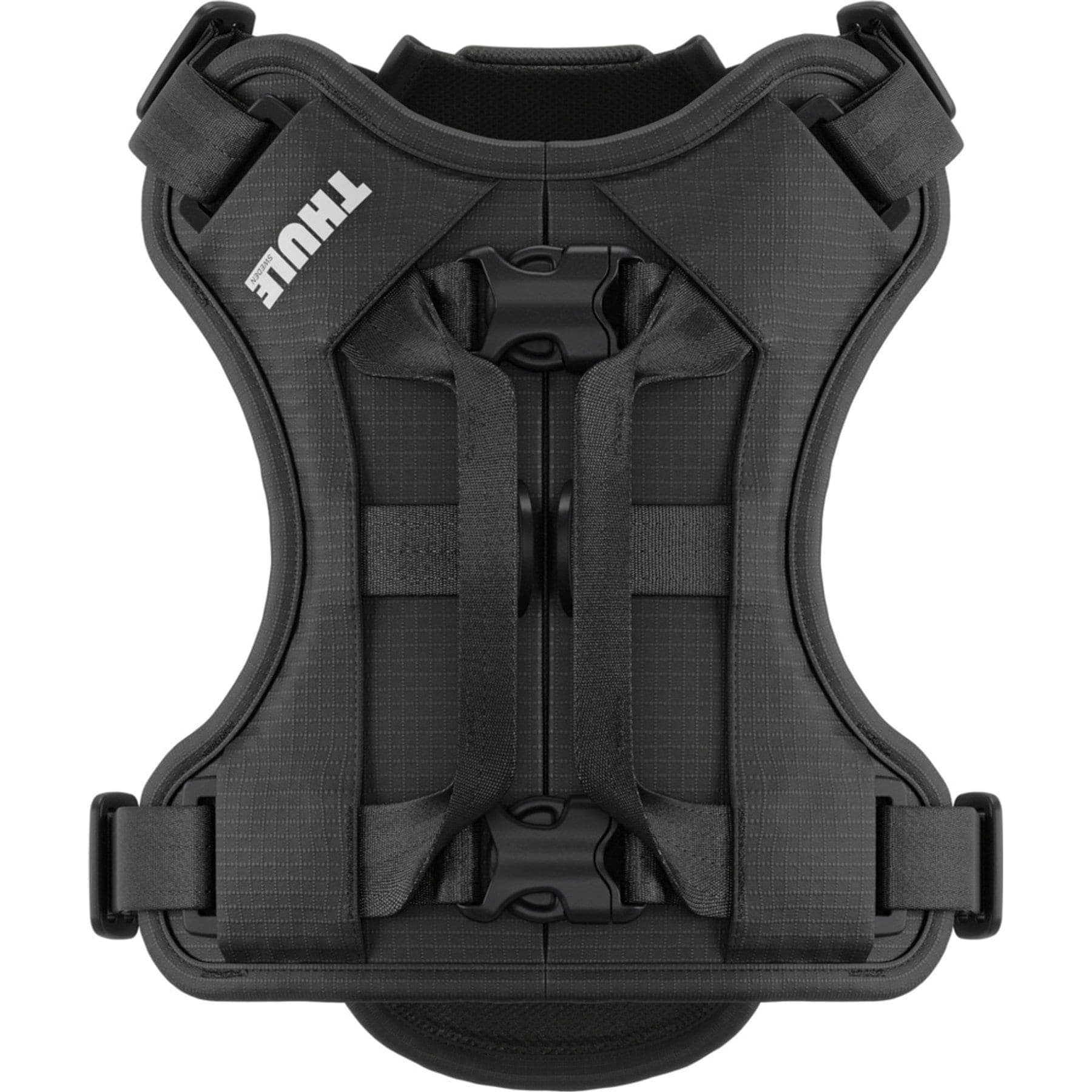
Step-in car harness that uses the car's own seat belt and keeps the dog close to it; Thule states crash-tested and TÜV approved.
Webvet may earn a commission when you click through to Chewy, at no extra cost to you.
A car harness connects to the vehicle in one of three ways:
- A harness tether or extender sits between the harness and the buckle. CPS warns that extension tethers and zipline-style products increase the risk of injury.
- The seat belt threads through the harness. EzyDog says you feed the seatbelt through the handles on top of the Drive; Chai's Choice says its handle lets the seat belt pass through.
- The harness clips onto the seat belt itself. Sleepypod says the Clickit connects to the existing seatbelt, and Company of Animals says the CarSafe connects directly to the car seat belt system.
Two lower-priced harnesses connect straight to the seat belt. The Chai's Choice Crash Tested Vehicle Safety Basic Dog Harness, Brown, Medium: 20.1 to 24-in chest was listed at $59.95 on Chewy when we checked in October 2026. Its seat belt runs through the nylon handle, and the listing says it doubles as a cooling vest.
The CarSafe Crash Tested Back Clip Dog Harness, Blue, Medium was listed at $55.99 on Chewy when we checked in October 2026. Company of Animals states a crash test certification up to 32 kg at a registered lab, a maker-run result with a stated weight ceiling. Neither harness is on the CPS certified list.
For the two higher-priced seat belt harnesses, the evidence differs:
- The Sleepypod Clickit Sport Plus Car Safety Dog Harness, Charcoal Grey, Medium was listed at $109.24 on Chewy when we checked in October 2026. Sleepypod states a CPS 5 Star certification and a CPS rating to 25 lb for the size shown on its page, not necessarily the Medium linked here; the CPS list names the Clickit Sport and Clickit Range.
- The EzyDog Drive Dog Car Harness, Medium was listed at $125.00 on Chewy when we checked in October 2026. EzyDog's size chart runs small 15–35 lb, medium 35–65 lb, and large 65+ lb, each size tested by the maker at 28, 50, or 75 lb.
The Thule Cappy sits between those pairs in price and is built around the seat belt connection. The Thule Cappy Dog Car Harness, Small: 18.5 to 25-in chest was listed at $99.95 on Chewy when we checked in October 2026. The listing describes a step-in design with padded mesh panels that uses the vehicle's own seatbelt system.
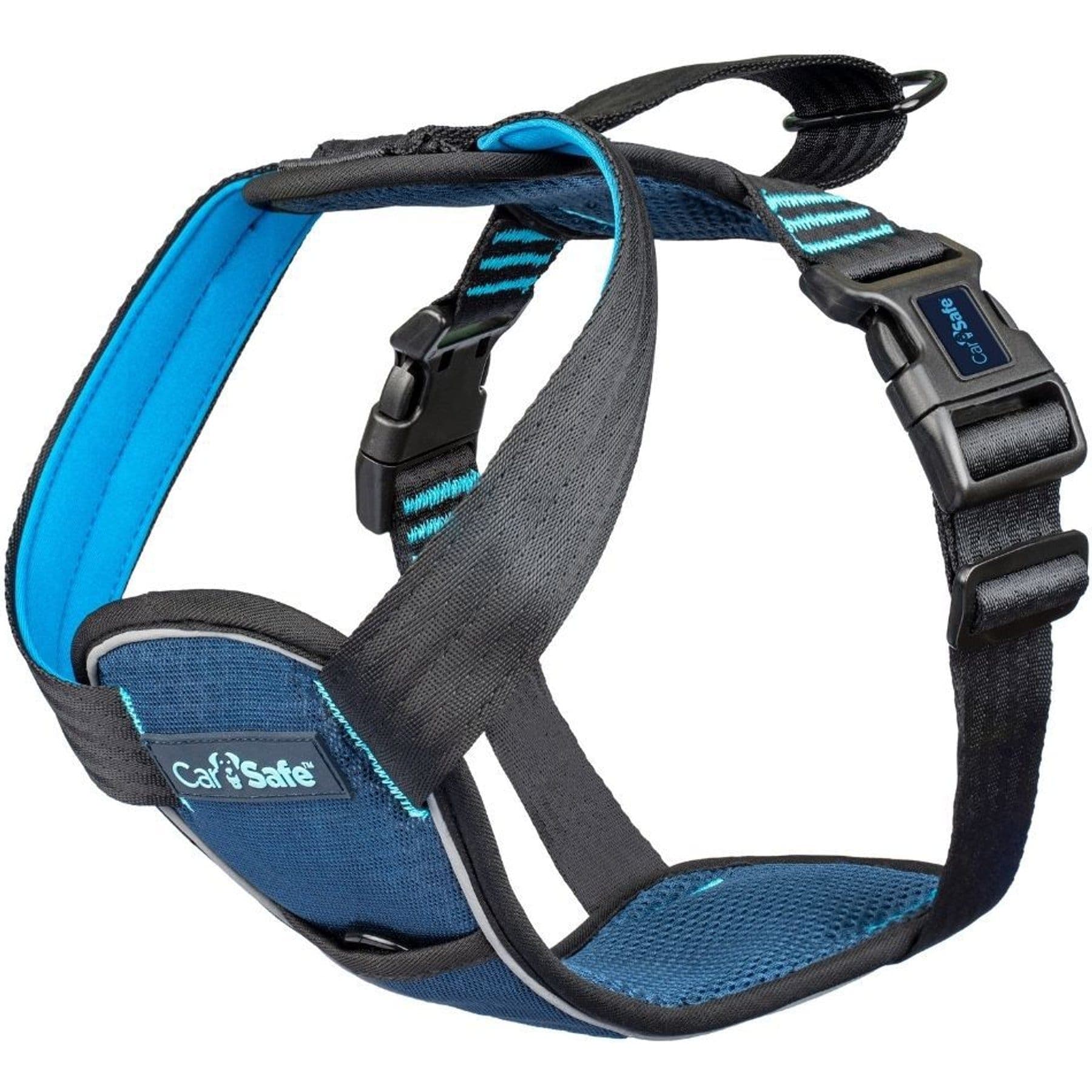
Back-clip car harness that clips to the seat belt; Company of Animals states crash test certification up to 32 kg.
Webvet may earn a commission when you click through to Chewy, at no extra cost to you.
Thule says the Cappy keeps the dog close to the seatbelt to prevent forward movement, unlike tethers or extenders. It states crash-tested and TÜV approved but names no test standard or lab, and the harness is not on the CPS list. Ask Thule for its test summary before relying on it as crash protection.

Large dogs and the tested weight
Size is where harness evidence gets thin. VCA says larger dogs have several well-designed "doggy seat belts" for restraint in the back seat. In the CPS 2013 study, the Sleepypod Clickit Utility kept the test dog on the seat in every test, but head excursion exceeded the limit for its large size.
Makers state their own upper limits for large dogs:
- Sleepypod: lists a Clickit Range tier of 18–110 lb.
- EzyDog: sizes its large Drive for dogs of 65+ lb and tested it with a 75 lb dog.
- Kurgo: says its large Enhanced Strength Tru-Fit was tested with a 75 lb dog.
- CarSafe: Company of Animals states its crash test certification up to 32 kg.
If your dog is heavier than the test weight for a size, the test did not cover your dog. Before buying the largest size, ask the maker what the test dog weighed.
The connection point can decide the result. In the 2013 study, the Klein Allsafe let the test dog launch off the seat, risking a secondary impact. A tether clipped to a collar loads gear CPS says is not built for crash protection; our guide on preventing dog collar accidents covers collar risks.
For belts and buckles judged on more than crash evidence, see our roundup of the best dog seat belts. Whichever harness you choose, replace it after any impact; Sleepypod, for one, runs a Crash Replacement Program for any restraint that has absorbed an impact.
Crash-tested car seats and carriers by dog size
For small dogs, carriers hold most of the independent evidence. Sleepypod says dogs under 18 lb and most cats ride safest in a strapped-in carrier such as its Mobile Pet Bed, Atom, or Air. In the CPS 2015 study, both Sleepypod Mobile Pet Beds met CPS criteria for successful performance.
Sleepypod's page says the Mobile Pet Bed is rated to 15 lb by CPS and tested to U.S., Canadian, and E.U. child car seat standards with integrated PPRS technology. The Sleepypod Mobile Cat & Dog Car Seat Pet Bed & Carrier, One Size, Robin Egg Blue was listed at $224.99 on Chewy when we checked in October 2026.
The Chewy listing describes it as:
- A carrier, pet bed, and crash-tested car seat in one.
- A removable mesh dome that opens on top.
- A removable, machine-washable bed.
A small dog that already sleeps in it at home can travel in the same bed.
CPS notes that carriers can prevent distraction, which matters for avoiding accidents, but that crash protection depends on proper restraint and on how strongly the carrier connects to the car. Its 2015 carrier study showed how much the connection matters:
- Sleepypod Mobile Pet Bed: CPS first saw a connection failure when the Velcro released, then a passing retest; CPS still recommends using the PPRS Handilock with it.
- Pet Ego Jet Set Forma Frame: the original connections failed and released the carrier from the test bench; a retest using the ISOFIX-Latch connection passed.
- PetMate Vari Kennel: this plastic carrier, not marketed as crash tested, stayed on the seat but released the 15 lb simulant through its opening.
- Snoozer Roll Around: marketed as crash tested, it let the simulant launch out on impact, and the maker sent CPS no test evidence.
How to choose a carrier for a small dog, based on those results:
- Pick a carrier that appears on the CPS certified list under the same name you are buying.
- Keep your dog within the stated weight rating, such as the 15 lb CPS rating Sleepypod lists for the Mobile Pet Bed.
- Use the exact connection CPS tested, such as the PPRS Handilock CPS recommends for the Sleepypod Mobile Pet Bed.
- Secure the carrier in the back seat, as near the center of the vehicle as possible, so it cannot move.
- Never clip a carrier tether to a collar or walking harness.
Booster seats and the word "seat"
Many products sold as dog car seats are boosters. CPS defines a pet travel seat as a portable seat that holds or elevates the pet but does not offer full containment. In its 2015 pet seat pilot study, the Kurgo Skybox Booster Seat's connections failed with a 30 lb test dog.
That seat became a fully unrestrained projectile. CPS also points out that booster-seat tethers usually clip to a collar or walking harness. When the dog moves off-axis in a crash, that collar or walking harness takes the load, and neither is designed for crash protection.
Read the wording closely, too. The PetSafe Happy Ride Quilted Dog Safety Seat, for pets up to 30 lb, comes with a seat belt tether that attaches to a crash-tested Happy Ride Safety Harness sold separately. On that page, the crash-tested wording belongs to the harness, not the seat.
Large dogs and the safest choice
No source names a crash-tested car seat built for large dogs. VCA points larger dogs to well-designed seat belt harnesses in the back seat, and Sleepypod sends medium to large dogs to its Clickit harness rather than a carrier. For a large dog that needs containment, the sources point to a crate.
No primary source names one safest seat for every dog either. For a small dog, the closest answer is a carrier on the CPS certified list, used with the connection CPS tested and within its rated weight. For comfort-focused picks, see our best dog car seats roundup.
Crash-tested crates and kennels for the cargo area
Crates are the other restraint the AVMA prefers. Dr. Mazzaferro, quoted by AVMA News, counts crates affixed to a safety belt in a sedan, or placed in the far back of an SUV, among the safest ways to travel with a pet. VCA adds that sturdy crates provide some degree of protection in an accident.
The CPS 2015 crate study only included crates priced under $1,000 that made testing or crash protection claims, plus some cheaper value crates as investigative tests. The results split sharply:
- Gunner Kennel G1 Intermediate (75 lb test dog): the first test result was so strong that CPS deemed a second test not necessary.
- MIM Variocage: the dog was retained, but the front cargo strap tore through the crate's metal connection point.
- Ruff Tuff: the tie-down brackets failed on three of four corners in the first test.
- 4Pets Proline Milan: the cargo connection anchor straps ruptured completely and released the crate.
- Wire crate with CPS-supplied strength-rated straps (110 lb dog): it still failed, and CPS concluded wire crates are distraction prevention tools only.
- Wire crate with rubber anchor straps: the straps gave no protection, and the crate slid into the seatback.

A crash-tested cargo crate is not a crash-proof dog crate. Even the best CPS results describe one crate, in one size, held down by tested connections. In the 2015 results above, failures came from straps, brackets, and connection points as well as from the crate itself.
When we checked in October 2026, the CPS certified travel crate list had nine entries:
- Cabela's GunDog Kennel: Intermediate and Large.
- Gunner G1 Kennel: Intermediate, Medium, and Small.
- Lucky Duck Lucky Kennel: Intermediate, Large, and Medium.
- Rock Creek Crates Aluminum Kennel: Medium.
The Gunner G1 is the one crate that appears both in the 2015 study results and on the current certified list, where it is listed in three crate sizes and as a small carrier. For the other certified kennels, the CPS list is the evidence to check against the exact size you buy.
Sources differ in tone on crash-tested kennels. VCA names Sleepypod, Variocage, Gunnar, and RuffLand as examples of crash-tested crates, while the CPS 2015 result for the Variocage was mixed. VCA also lists collapsible wire crates as not sturdy enough to protect a dog during car travel, which matches the CPS wire crate findings.
Crate size is a second point where sources pull in different directions:
- VCA: smaller crates are better for travel, because there is less risk of the dog being thrown around inside during hard braking.
- AVMA: the crate or carrier should be big enough for the pet to stand up, turn around, and lie down comfortably.
- AVMA: place the crate as near the center of the vehicle as possible and secure it to prevent movement.
Our dog crate size chart helps you find the size that passes the AVMA's stand, turn, and lie-down test without extra room. For general picks, see the best dog crates, and for strong-walled options, our heavy duty dog crates guide.
A travel crate is a different tool from a home pen, which is covered in our guide to the best dog playpens.
Before you load a crate into the cargo area, check these points:
- The model and size are on the CPS certified crate list, or the maker can show test evidence for that size.
- The tie-down straps and connection points are the ones the crate was tested with, since that is where the 2015 failures happened.
- The crate is not a collapsible wire crate, which CPS and VCA both rule out for crash protection.
- The crate sits in the far back of an SUV or is secured in a sedan, as near the vehicle's center as possible.
Where a restrained dog should ride: back seat, cargo area, and the front airbag risk
AVMA policy is direct: it is unsafe for pets to be loose inside motor vehicles. The veterinary sources agree on what restraint means:
- AVMA policy: the preferred options are a properly sized, species-appropriate enclosure or a properly designed safety harness.
- VCA: a dog in a car should be secured by a crate or a seat belt and harness, for your safety as well as the dog's.
- AVMA: just as people should always wear seatbelts in case of a crash, pets should always be properly restrained with an appropriate safety harness, crate, or carrier.
VCA's road trip safety tips note that airbags and seatbelts were not designed with pet safety in mind. CPS made the same point about the PupSaver seat, whose instructions recommend the front seat: CPS said that position exposes the pet to airbag deployment and to cabin intrusion in frontal crashes.
Open cargo areas are a different case from the enclosed cargo area of an SUV. AVMA policy says pets carried loose or tethered in open cargo areas, such as a pickup bed, are not safe. The AVMA adds that even an appropriate-length tether in a truck bed could tangle, injure, or choke the dog.

The back seat does two jobs. AVMA News notes that restraining the pet in the back seat protects it in a crash and also helps keep the driver from becoming distracted. Where each restraint type belongs:
- Seat belt harness: back seat, using the car's own seat belt and the connection the maker tested.
- Carrier for a small dog: back seat, secured with the tested connection and within the rated weight.
- Crate: secured in the back seat of a sedan or the far back of an SUV, near the vehicle's center.
- Nowhere: the front seat, a lap, or an open truck bed.
If your dog struggles with nausea on drives, our guide to dog car sickness covers what helps.
Crash-tested dog car seat questions
Frequently Asked Questions
Is a crash-tested dog harness worth it?
A crash-tested harness is worth paying more for when its crash test can be checked. In the CPS 2013 study, only one brand that qualified for crash testing actually offered crash protection.
Check that the harness is on the CPS list, or that the maker names its lab, standard, and test dog weight. The AVMA also advises choosing a crash-tested harness that works with your vehicle's seat belt.
Is a crash-tested crate safer than a harness?
No source ranks one over the other. AVMA policy lists a properly sized enclosure and a properly designed safety harness as the preferred options, and the AVMA says too little science exists to compare individual products.
A crate secured in the cargo area of an SUV suits a dog that needs containment. A seat belt harness suits a dog that rides calmly sitting upright in the back seat, which is how the AVMA says a vehicle harness should hold a dog.
What is the safest crash-tested dog car seat?
No primary source names a single safest seat. For a small dog, the strongest evidence belongs to carriers certified by CPS, such as the Sleepypod Mobile Pet Bed, which met CPS criteria and which Sleepypod says is rated to 15 lb. CPS says booster-style seats do not offer full containment.
Are crash-tested harnesses made for large dogs?
Yes, but check the tested weight for the size you buy. Sleepypod lists a Clickit Range tier of 18–110 lb, while EzyDog and Kurgo say their large sizes were tested with a 75 lb dog. A large dog heavier than the test weight is outside what the test covered.
Large sizes can be the hardest to restrain: in CPS's 2013 testing, the one harness that passed overall still exceeded the head excursion limit in size Large.
Is a crash-tested seat belt tether enough on its own?
No. CPS warns that extension tethers and zipline-style products increase the risk of injury. A tether clipped to a collar or walking harness also loads gear that CPS says is not designed for crash protection. Use a vehicle harness that connects directly to the seat belt.
Outside the cabin, the AVMA warns that even an appropriate-length tether in a truck bed can tangle, injure, or choke a dog.

Editor
The Webvet Editorial Team is the in-house group of pet-care editors and writers behind Webvet, operated by Smart Pet Collective. The team researches, writes, and maintains Webvet's pet health, behavior, and medication content. Every article follows a defined editorial process: research from reputable veterinary and scientific sources, careful drafting, mandatory review of medical content by a credentialed veterinarian, and dated publication. Health and medication articles are medically reviewed by a licensed veterinary professional before they go live and are kept current over time.
Veterinarian · BVMS MRCVS
Dr. Pippa Elliott, BVMS, MRCVS, is a veterinarian with nearly 30 years of experience in companion animal practice. Dr. Elliott earned her Bachelor of Veterinary Medicine and Surgery from the University of Glasgow. She was also designated a Member of the Royal College of Veterinary Surgeons. Married with 2 grown-up kids, Dr. Elliott has a naughty Puggle named Poggle, 3 cats and a bearded dragon.
Related reading

Best Dog Car Seat Cover: Waterproof Bench, Cargo, and Hammock Picks

Best Dog Car Hammock: Back-Seat Covers That Stop Falls, Fur, and Mud

Best Dog Seat Belt: Tethers and Harness Restraints That Keep a Dog in the Back Seat
