Best Dog Car Seat: Vet-Reviewed Booster and Bucket Picks by Dog Size
Vet-reviewed guide to the best dog car seat for each size of dog: boosters, console seats, and bucket beds compared by weight limit. How to clip the tether to a harness, and why every seat belongs in the back.

BVMS MRCVS
Medically reviewed by Dr. Pippa Elliott, BVMS MRCVS · Last reviewed

This article contains affiliate links. Webvet may earn a commission when you buy through them, at no extra cost to you.
A dog car seat is a booster or bed that keeps a small dog in one spot and in view of the window. It restrains the dog only when its tether is clipped to a harness, and it belongs in the back seat, away from the front airbag.
Choose a dog car seat by your dog's weight first. The weight ratings makers publish for our six picks run from 7 pounds for Snoozer's smallest console seat to 45 pounds for Petsfit's medium booster, and K&H claims no limit for its bucket seat. Heavier dogs ride more safely in a harness attached to the seat belt.
| Seat | Best fit | Format | Maker weight rating | Main tradeoff |
|---|---|---|---|---|
| Kurgo Skybox Rear Dog Booster Seat | Small dogs riding in the back seat | Padded booster that installs with the seatbelts | Up to 30 lb | Failed a 2015 Center for Pet Safety crash test |
| Petsfit Medium Dog Car Booster Seat, Khaki | Medium dogs or two small pets | Elevated booster with buckles and a detachable leash | Up to 45 lb or 2 small pets on the Petsfit page | Chewy listing does not publish the weight rating |
| K&H Pet Products Buckle n' Go Dog & Cat Car Seat, Gray, Large | Bigger dogs that want a defined spot | Bucket seat on headrest straps with a buckle-in lead | No limit claimed by K&H; one retailer lists 60 lb | May not fit proprietary belt locks in some Honda models |
| FidoRido Dog Booster Car Seat, Beige, Medium | Dogs that like to stand and lie down | Three-in-one booster, bed, and bath with two straps | Up to 30 lb | Highest listed price of the six |
| Snoozer Pet Products Console Lookout Dog Car Seat, Black Diamond, Small | Toy dogs, if you accept front-seat risk | Console seat that sits beside the driver | Up to 12 lb on Chewy; Snoozer rates the Small at 7 lb | Rides in the front airbag zone |
| Etna Dog & Cat Car Booster Seat, Tan | Tight budgets | Strap-on fleece booster with a zippered pocket | Not published on the listing | No tether described on the listing |
Do dogs need a car seat? What a booster or bucket seat does and does not do
Every dog in a car needs a restraint, and a seat is one way to give a small dog a place to ride. The AVMA says that just as people should always wear seatbelts, pets should always be properly restrained. A seat answers where the dog rides. The harness and tether answer whether it stays there.
The Center for Pet Safety defines a pet travel seat as a portable seat that holds or elevates a pet, and it states that such a seat does not offer full containment. That is what a dog car seat does for a small dog: a padded spot, a view, and a fixed point to clip a harness tether.

- 1What a dog car seat does for a small dog: it holds the dog in one padded spot with a view, and it restrains the dog only when the tether is clipped to a harness.
- 2Match the seat to your dog's weight: a console seat or small booster for toy dogs, a booster rated to 30 or 45 pounds for small and medium dogs, and a harness attached to the seat belt for anything heavier.
- 3Every seat belongs in the back seat, away from the front airbag. A console seat cannot ride there, which makes it the higher-risk type.
- 4Dogs heavier than the seat's rating ride more safely in a harness attached to the seat belt, as the AVMA advises.
What a booster or bucket seat does for a dog:
- Lifts a small dog high enough to see out. The Kurgo, Petsfit, and Snoozer listings all describe this.
- Gives the dog a defined, padded spot. The Kurgo listing says its tether keeps the dog put so you can keep your eyes on the road.
- Provides an anchor: a built-in tether, lead, or strap that clips to the dog's harness.
What it does not do:
- Meet a safety standard. The AVMA news desk reports that, unlike restraints for people, there are no standards or industry tests for pet car restraints.
- Offer full containment, by the Center for Pet Safety's own definition of a travel seat.
- Protect a dog clipped by the collar. The Center for Pet Safety notes that collars and walking harnesses are not designed for crash protection.
Restraint use is low even among drivers who know the risk. A 2010 AAA survey cited by the AVMA found that more than 80% of drivers recognize the danger of driving with an unrestrained pet, yet only 16% use a pet restraint. A seat helps only when the tether is clipped on every trip.
The Center for Pet Safety's 2015 pilot study crash-tested four small-dog seats with simulant test dogs, not real dogs: the PupSaver, the Snoozer Lookout I (Medium), a PetSmart Top Paw booster, and the Kurgo Skybox. The Skybox's seat connections failed, making it an unrestrained projectile. The Lookout I's anchor strap failed, leaving its 25 lb test dog fully unrestrained.
The Center for Pet Safety's Certified list, read in October 2026, names safety harnesses, pet travel carriers, and travel crates, and no booster or travel seat. So every weight limit quoted here is a maker rating, not a crash rating, and the seat type should follow your dog's weight and the back seat.
| Dog weight | Seat type that fits | Weight limit (maker rating) | Mounting method | Back seat placement |
|---|---|---|---|---|
| Toy dog, up to 7 to 12 lb | Console seat or small booster | Snoozer console: 7 lb Small, 12 lb Large | Straps to the center console lid | A console seat rides in front by design; a small back seat booster keeps the dog away from the front airbag |
| Small dog, up to 15 to 20 lb | Small booster | Petsfit small: 15 lb; Etna: not published | Adjustable straps around the vehicle seat | Back seat, with the dog's harness attached to the seat belt |
| Small to medium dog, up to 30 lb | Seatbelt-installed booster or two-strap booster | Kurgo Skybox: 30 lb; FidoRido: 30 lb | Vehicle seatbelts or the seat's own straps | Back seat, tether clipped to a harness |
| Medium dog, or two small dogs, up to 45 lb | Large booster | Petsfit medium: 45 lb or 2 small pets | Buckles plus an adjustable lanyard | Back seat, tether clipped to a harness |
| Large dog, over 45 lb | Bucket seat as a nest, or a harness alone | K&H Buckle n' Go: no limit claimed by the maker | Headrest straps and a seat belt buckle | Back seat; the AVMA advises a harness attached to the seat belt |
What is the best car seat for dogs?
The best car seat for a dog is one rated above its weight that installs in the back seat and clips to a harness. For a small dog up to 30 pounds, our top pick is the Kurgo Skybox, a seatbelt-installed booster with an integrated harness tether, though its seat connections failed a 2015 Center for Pet Safety crash test. For heavier dogs, the AVMA points to a harness attached to the seat belts instead.
Our picks: the best dog car seats
We chose these six seats from maker specifications, each seat's Chewy listing, and the placement guidance of the AVMA, ASPCA, and Center for Pet Safety. WebVet did not obtain or test them.
No standards or industry tests exist for pet car restraints, so no dog car seat carries a safety rating. Our picks are the seats best matched to a dog's weight, your car, and the back seat.
What we weighed for each pick:
- A published weight limit, so you can size the seat to your dog before it arrives.
- A back seat install, by seatbelt, headrest straps, or seat straps.
- A harness attachment, whether a built-in tether, a buckle-in lead, or a strap, or a clear note where the listing describes none.
- The honest limits, including crash-test results, front-seat marketing, and anything the listing leaves out.
Whichever seat you choose, the ASPCA rule applies: keep the dog in the backseat in a harness attached to the seat buckle. To keep hair and claws off the upholstery, see our guide to the best dog car seat covers.
| Pick | Dimensions (maker) | Weight limit | Mounting |
|---|---|---|---|
| Kurgo Skybox Rear Dog Booster Seat | Interior 15.5 in W x 8.5 in H x 12.5 in D | Up to 30 lb | Vehicle seatbelts plus an integrated harness tether |
| Petsfit Medium Dog Car Booster Seat | 23 in L x 16.5 in W x 13.5 in H | Up to 45 lb or 2 small pets on the Petsfit page; not stated on the Chewy listing | Patent buckles, a safety clip, and an adjustable lanyard |
| K&H Buckle n' Go, Large | 21 in x 19 in x 19 in | No limit claimed by K&H; one retailer lists 60 lb | Headrest straps, a seat belt buckle, and a lead to the harness |
| FidoRido Dog Booster Car Seat, Medium | The listing does not publish dimensions | Up to 30 lb | Two-strap restraint system |
| Snoozer Console Lookout, Small | Outside 7 in H x 9 in W x 15 in L; inside 5 in H x 7 in W x 13 in L | Up to 12 lb on Chewy; 7 lb for the Small on Snoozer's page | Secures to the console lid with a safety strap |
| Etna Dog & Cat Car Booster Seat | The listing does not publish dimensions | The listing does not publish a weight limit | Adjustable straps around the vehicle seat |
Kurgo Skybox Rear Dog Booster Seat: best back-seat booster that installs with the seatbelts
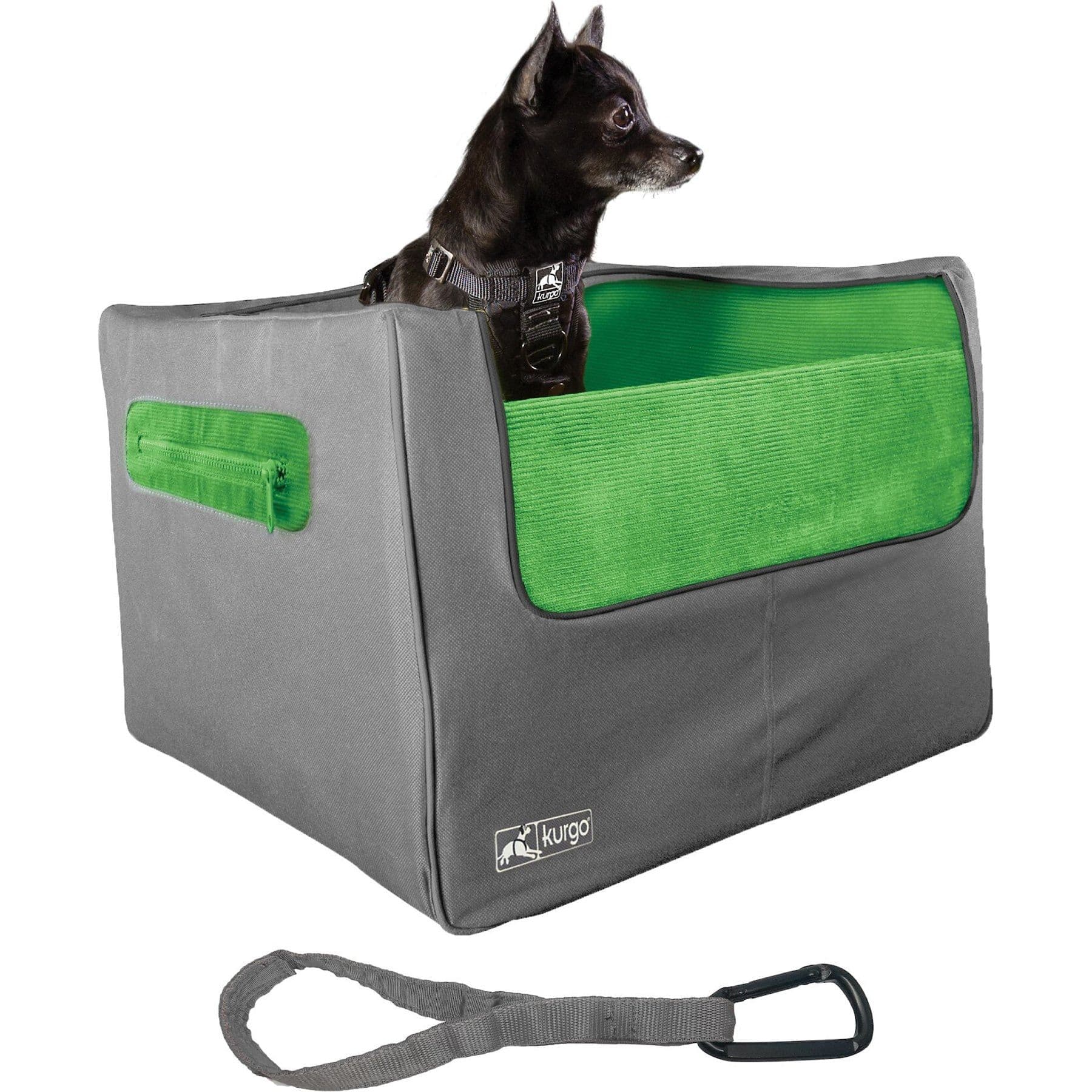
A padded back-seat booster for dogs up to 30 pounds that installs with your seatbelts and clips to a harness.
Webvet may earn a commission when you click through to Chewy, at no extra cost to you.
The Skybox is a low-walled, padded booster built for the back seat. Kurgo rates the Skybox for dogs up to 30 lbs, says it is compatible with the vehicle's seatbelt system, and builds in a tether that attaches to the dog's harness. It was listed at $57.17 on Chewy when we checked in October 2026.
Chewy's listing says it installs in seconds with your existing seatbelts, lifts the dog just high enough to peek out the window, and doubles as a travel bed, with storage pockets for treats. Kurgo gives the interior as 15 1/2 in wide, 8 1/2 in high, and 12 1/2 in deep.
The tradeoff is the crash record. In the Center for Pet Safety's 2015 pilot study, the Skybox's seat connections failed on impact. That result describes the Skybox as sold in 2015, not necessarily today's unit, but it is why we treat this seat as a positioning tool and rely on the harness for restraint.
- Who it suits: small dogs up to 30 pounds that ride in the back seat and already wear a harness.
- What to pair it with: Kurgo recommends a crash-tested travel harness, such as its Enhanced Strength Tru-Fit Smart Harness.
- After an accident: Kurgo says to replace the booster, as with child car seats and bike helmets.
Petsfit Medium Dog Car Booster Seat: best booster for medium dogs
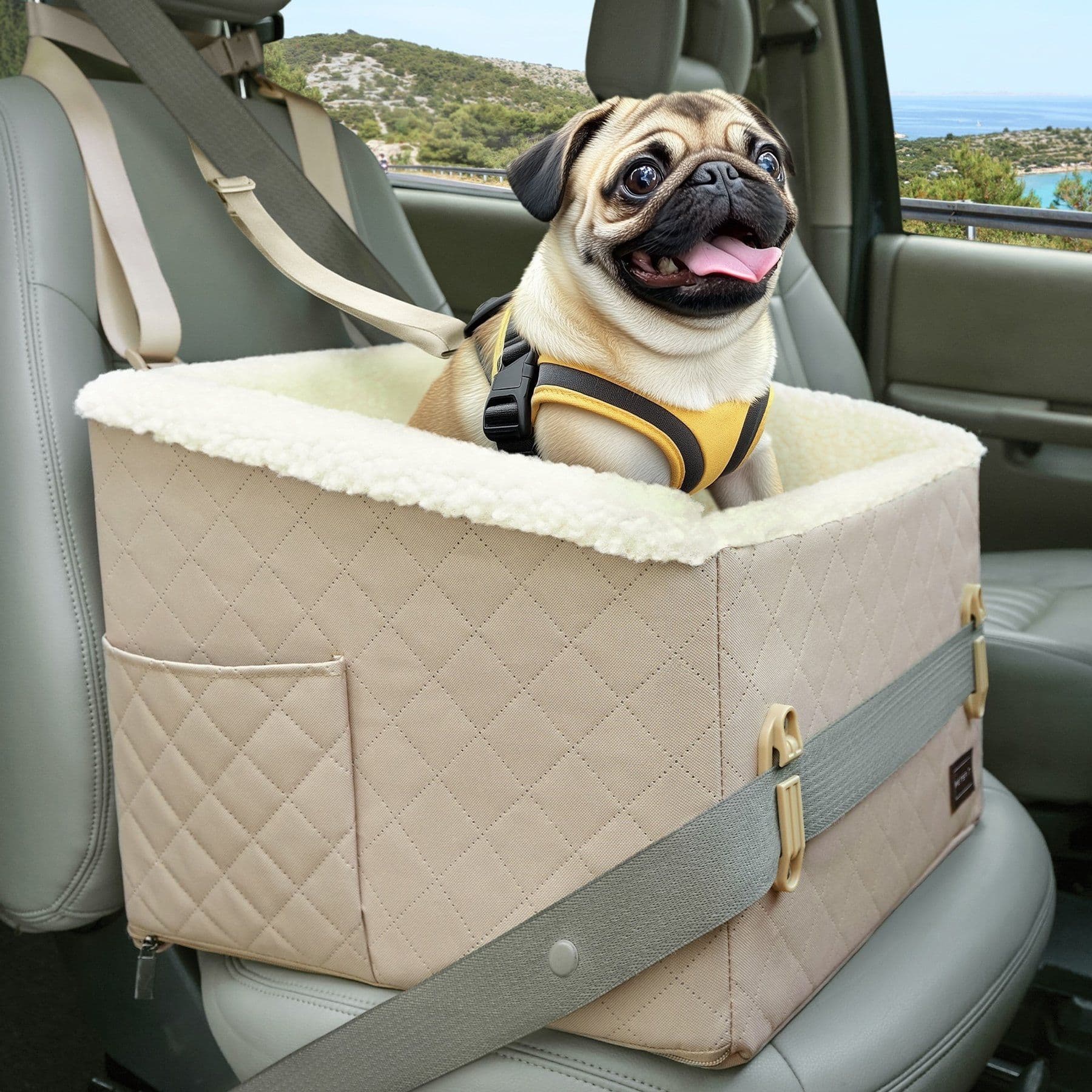
An elevated medium booster with patented safety buckles, a detachable leash, and a washable cushion cover.
Webvet may earn a commission when you click through to Chewy, at no extra cost to you.
The Petsfit carries the highest published weight rating among the boosters here. Petsfit rates its medium booster for a dog up to 45 pounds or 2 small pets and lists it at 23 in long, 16.5 in wide, and 13.5 in high. The Chewy listing does not publish a weight rating, so confirm the size before ordering.
It was listed at $61.99 on Chewy when we checked in October 2026. The listing describes sturdy Oxford fabric, soft Berber fleece, and sponge filling, with patented safety buckles and a detachable leash. Petsfit's own page describes the restraint as an adjustable lanyard, a safety clip, and 2 patent buckles.
- Who it suits: medium dogs, or two small dogs sharing one seat, per Petsfit's rating.
- Easy care: a washable cushion cover and storage pockets, per the listing.
- Placement: the listing says it installs in the front or rear seat. Use the rear, as the AVMA and ASPCA advise.
The listing also says the elevated design reduces anxiety. That is Petsfit's claim rather than veterinary advice, so treat the raised view as a comfort feature, not a treatment for car stress.
K&H Pet Products Buckle n' Go Dog & Cat Car Seat: best fold-flat seat with a buckle-in lead
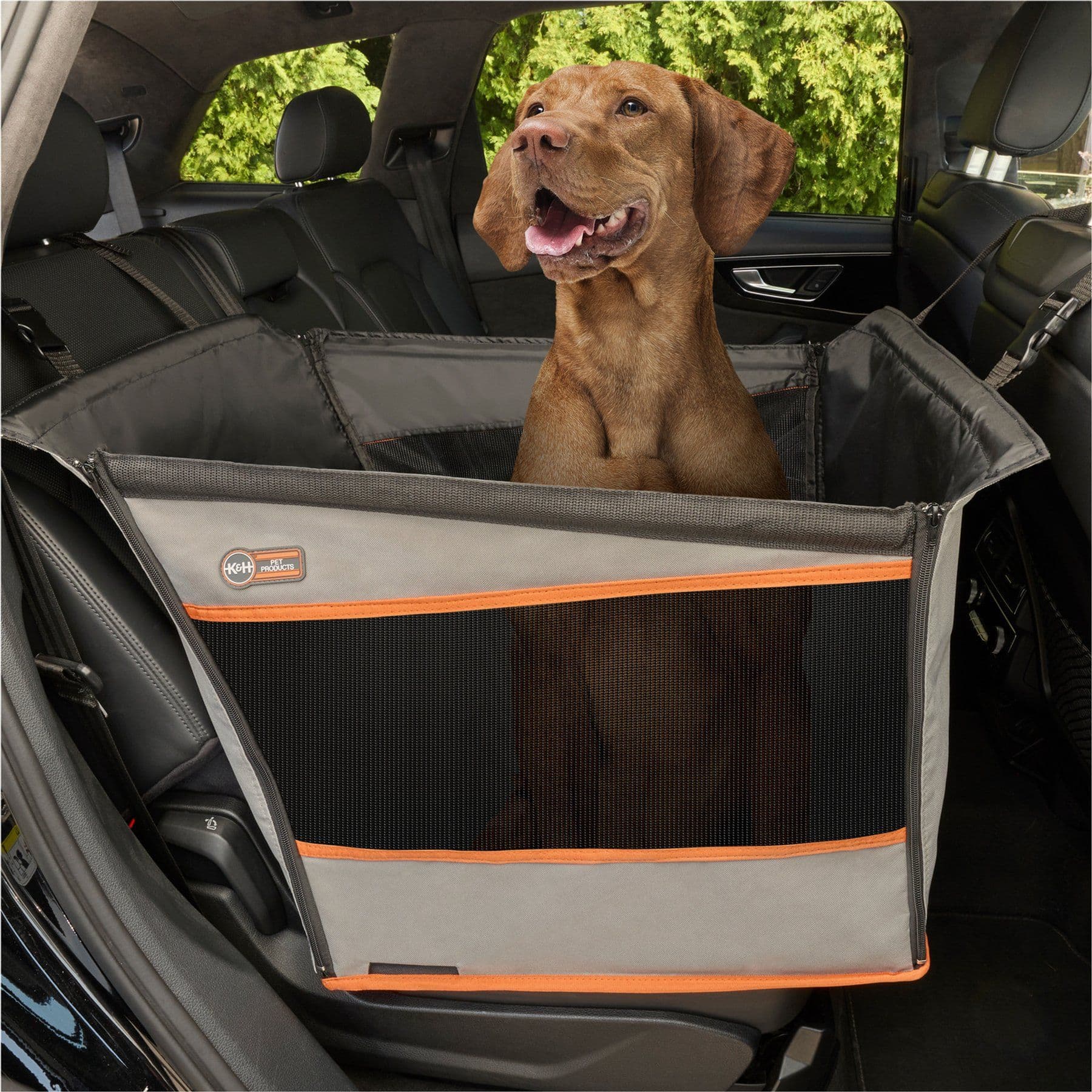
A back-seat bucket seat with a mesh window and a lead that snaps into any seatbelt buckle, then folds flat for storage.
Webvet may earn a commission when you click through to Chewy, at no extra cost to you.
The Buckle n' Go is a bucket seat rather than a booster. K&H says front and back straps loop around the headrests, a buckle installs into the seat belt receiver, and the included lead attaches to the dog's harness and any car seat belt. It was listed at $63.12 on Chewy when we checked in October 2026.
Chewy's listing says it is designed for the backseat, works on the left or right side, has a mesh window for a view and a little added airflow, and folds flat for storage. K&H gives the Large as 21 in x 19 in x 19 in.
- Weight: K&H says the seat has no pet weight limit and suits small, medium, and large dogs. That is a maker claim, not a tested rating, and one third-party retailer spec lists 60 lb.
- Fit check: K&H warns it may not work in vehicles with non-standard proprietary belt locks and cites some Honda models.
- Placement: the back seat, left or right side, by design.
Its strength is that it is built around the back seat. The catch is that "no weight limit" describes the fabric bucket, so a bigger dog still depends on its harness and the buckle-in lead to stay put.
FidoRido Dog Booster Car Seat: best two-strap seat for dogs up to 30 pounds
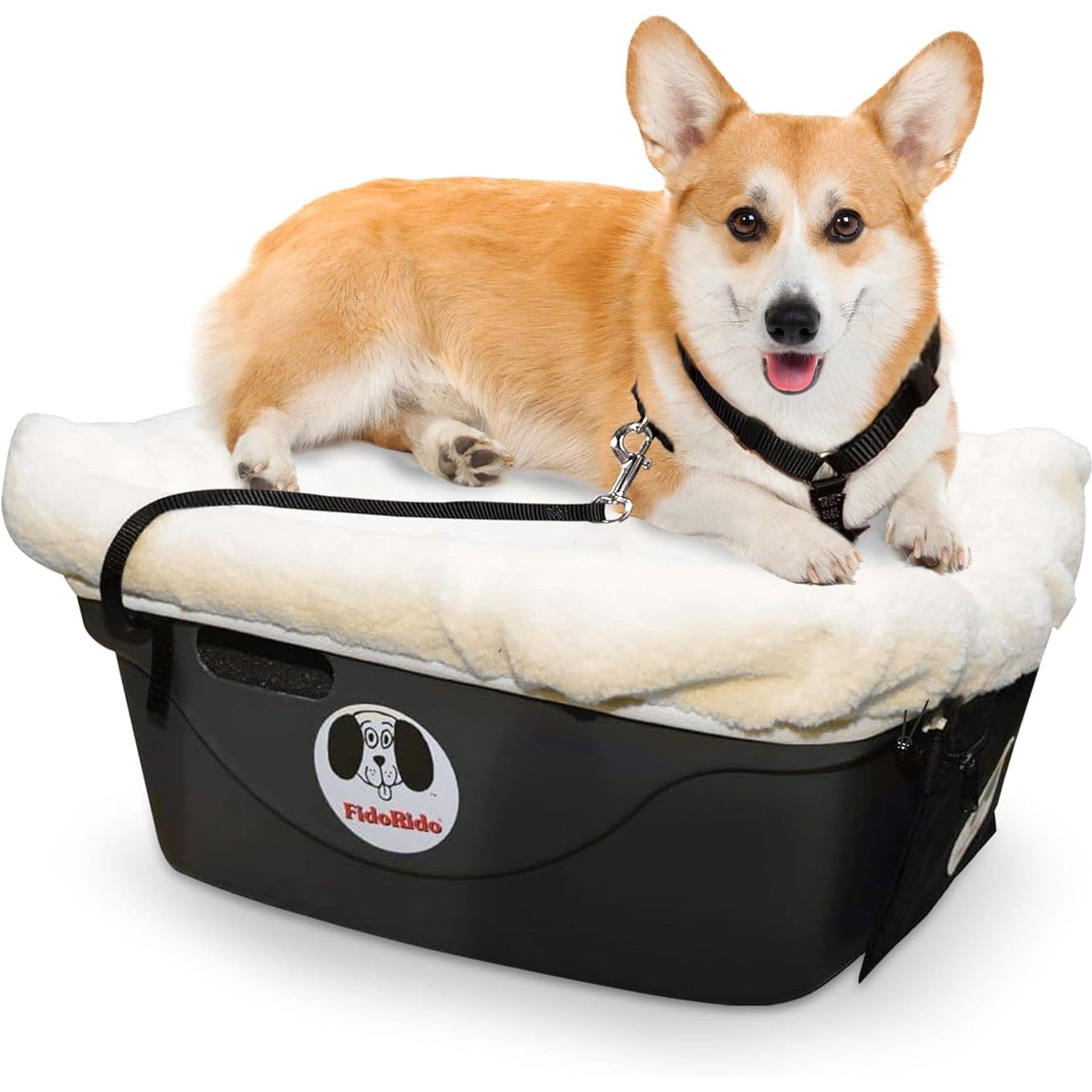
A three-in-one booster and restraint system for dogs up to 30 pounds that lets the dog stand, sit, or lie down.
Webvet may earn a commission when you click through to Chewy, at no extra cost to you.
The FidoRido is a three-in-one booster seat and restraint system for dogs up to 30 pounds. Its two-strap system lets the dog stand, sit, lie down, and look out the window while restrained, and the tub doubles as a bed or bathtub. It was listed at $159.99 on Chewy when we checked in October 2026.
Freedom to move is the tradeoff. The Center for Pet Safety notes that in positions where a dog moves more, the collar or walking harness takes the load, and those are not designed for crash protection, so pair this seat with a travel harness rather than a walking one.
- Who it suits: dogs up to 30 pounds that settle better when they can change position.
- Crash claims: Fido Pet Products links an independent review on its page and does not claim crash testing.
- Price: the highest listed price of the six. The maker's page showed $109.99 but read as sold out when checked.
- Size: the listing does not publish dimensions, so the 30-pound rating is the only sizing guide.
Snoozer Pet Products Console Lookout Dog Car Seat: best console seat for dogs up to 12 pounds
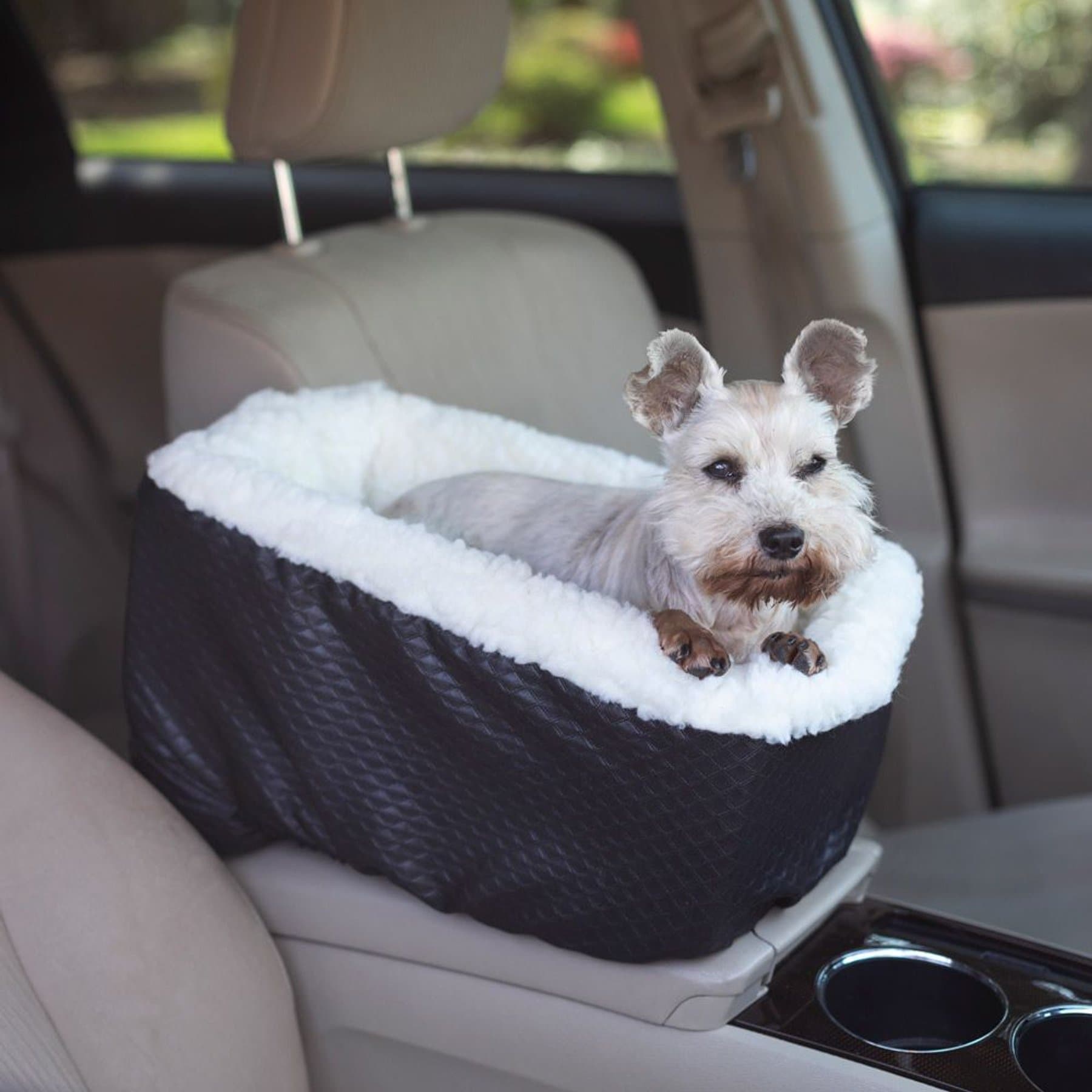
A Made in USA console seat with a plush sherpa interior and a safety strap; Snoozer rates the Small to 7 pounds.
Webvet may earn a commission when you click through to Chewy, at no extra cost to you.
The Snoozer is the only console seat on our list. It secures to the lid of the center console and gives a toy dog a boost so it can look out the window. It was listed at $55.99 on Chewy when we checked in October 2026.
Chewy's listing says it is made in the USA, with mildew, water, fade, and UV resistant solarium fabric, a plush sherpa interior, and a safety strap, for smaller dogs up to twelve pounds. Snoozer sizes it more tightly, rating the Small for pets up to 7 lbs and the Large for pets up to 12 lbs.
The tradeoff is placement. Snoozer headlines the console seat as a safer way to ride up front, but the AVMA, ASPCA, and Center for Pet Safety point dogs to the back seat, away from airbags. A console seat sits beside the driver in that front zone, so we rank it as the higher-risk choice.
- Dimensions (Small, Snoozer's Luxury Console page): outside 7 in H x 9 in W x 15 in L; inside 5 in H x 7 in W x 13 in L.
- Measure first: Snoozer advises comparing your console with the seat's exterior dimensions and your dog with the interior dimensions, because consoles vary by vehicle.
- Maker claim: Snoozer suggests the view suits dogs that get carsick or anxious. That is the maker's claim, not veterinary advice.
Etna Dog & Cat Car Booster Seat: best budget booster
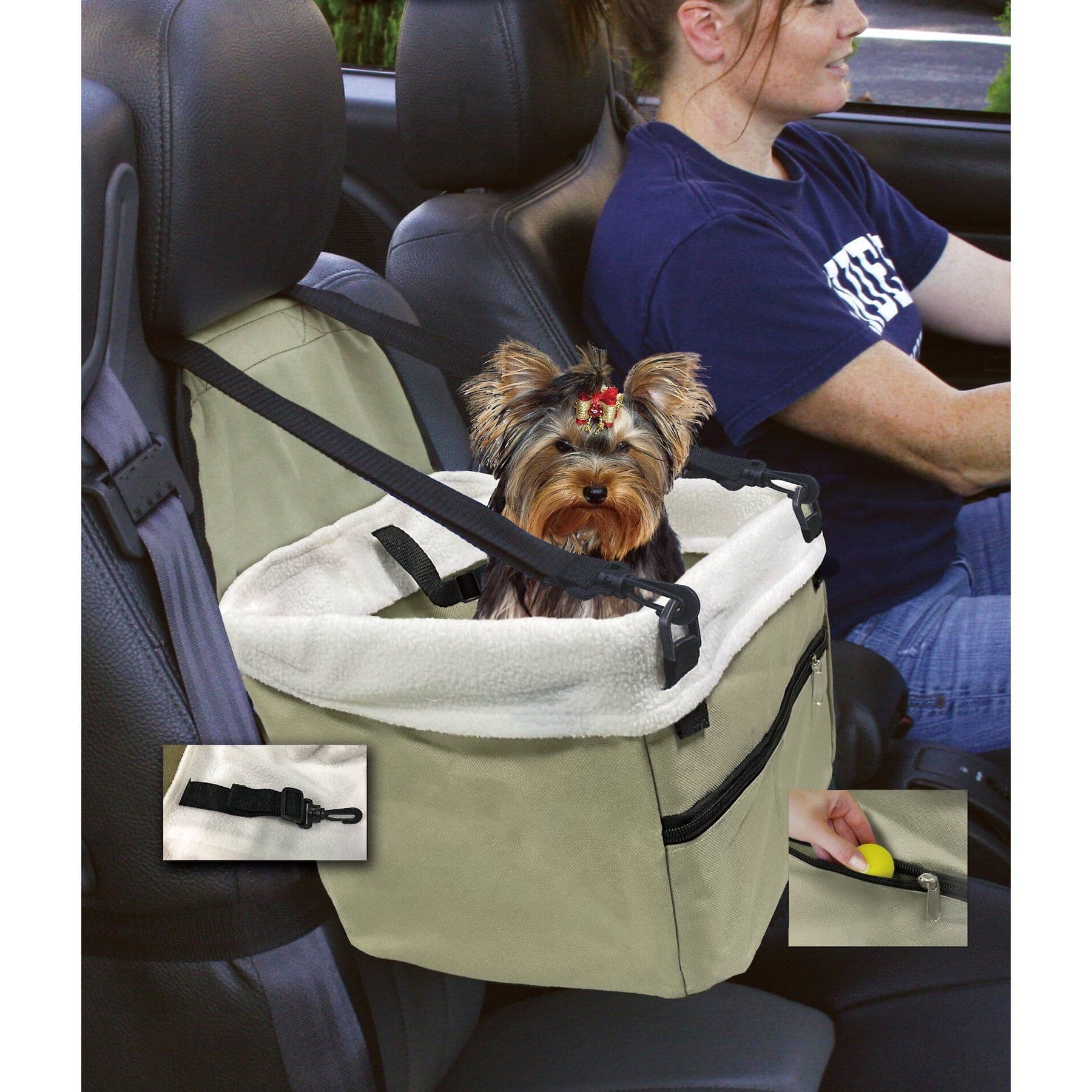
A low-cost fleece-lined booster with adjustable straps and a zippered front compartment for treats and toys.
Webvet may earn a commission when you click through to Chewy, at no extra cost to you.
The Etna is the low-cost option, listed at $18.49 on Chewy when we checked in October 2026, about a third of the next-cheapest pick. The listing describes adjustable straps, a design that keeps the dog from sliding or falling out of the seat, a soft fleece lining, and a zippered front compartment for treats and toys.
The listing does not publish a weight rating or dimensions. A reseller listing for an Etna 4460 booster gives 20 pounds, but that model is not confirmed as this Chewy seat. The listing also does not describe a tether, so attach the dog's harness to the seat belt itself, as the ASPCA advises.
- Who it suits: small dogs on a tight budget whose owners already use a car harness.
- Placement: the listing shows it strapped to the passenger seat. Strap it to a rear seat instead.
- At the destination: the fleece lining doubles as a small bed, per the listing.
Booster, console, bucket, or bed: which type of dog car seat fits your dog
The Center for Pet Safety lists booster seats, console booster seats, and seats marketed as crash tested among the styles of pet travel seat, and it framed its seat study around the small dog. Choosing between these types is really choosing where the dog rides and how the seat is anchored.

- Booster seat: a raised, padded box that straps to or around a vehicle seat and lifts a small dog to window height. The Kurgo Skybox Rear Dog Booster Seat installs with the seatbelts; the Petsfit uses buckles and a lanyard.
- Console seat: a smaller booster that straps to the center console lid between the front seats. Snoozer rates its console seats for pets up to 12 pounds, and the dog rides in the front airbag zone.
- Bucket seat: a deeper fabric seat hung from the headrests, such as the K&H Pet Products Buckle n' Go Dog & Cat Car Seat, Gray, Large, with a lead that snaps into the seat belt buckle.
- Bed-style seat: a padded bed on the back seat. Kurgo's listing says the Skybox doubles as a travel bed, the FidoRido doubles as a bed or bath, and the Etna's fleece lining makes a bed at the destination.
- Carrier or crate: not a seat, but the option the ASPCA ranks highest for an accident.
For a small dog riding in the back, look for a booster that installs with the seatbelts and has a harness tether, because that matches the ASPCA's harness-to-seat-buckle rule. A console seat suits only toy dogs, and only owners who accept the front-seat risk.
Snoozer's Lookout line includes both the console seat on our list and the Lookout I booster. The Snoozer Lookout I (Medium) was one of the four seats in the 2015 Center for Pet Safety pilot study, and its anchor strap failed on impact.
Carriers and crates instead of a seat
A carrier is the alternative the welfare groups rate highest. The ASPCA says hard-sided carriers with ventilation holes that are secured to the vehicle are the safest option, and its travel safety tips call a crate the safest option in an accident. Our guide to the best dog crates compares models.
- Avoid wire and collapsible crates in the car. The ASPCA says they can collapse or break open, causing serious injuries or death in an accident.
- Secure it near the center. The AVMA says to position the crate or carrier as near the center of the vehicle as possible and secure it against movement.
- Be wary of the cargo area. The Center for Pet Safety warns cargo-area anchors are not always weight-rated for crash forces, and the cargo platform may not be as solid as it looks.
The AVMA traveling FAQ puts the size split simply: small pets should be confined in crates or travel-safe dog beds, and larger pets restrained with harnesses attached to the car's seat belts. A carrier and a seat serve a small dog in different ways: the carrier contains it, the seat positions it.
Cooling, elevated, and luxury seats
None of the six listings describes a cooling feature. The closest is airflow and fabric: the K&H listing mentions a mesh window, and the Snoozer listing describes mildew, water, fade, and UV resistant fabric. Heat risk sits with the parked car: the AVMA says never to leave a pet alone in a parked vehicle, no matter the outdoor temperature.
Elevated and luxury labels describe comfort, not restraint. Petsfit's listing calls its design elevated for a better view, and Snoozer's maker page names its console line Luxury Console. Neither label changes where the seat should ride, which is the back seat for every type that can go there.
Car seats for small dogs: sizing by weight and how high the seat sits
Sizing a seat by dog weight is the first filter, and weight is the one figure makers publish consistently. The maker ratings for the small-dog seats on our list:
- Snoozer console seat: Small up to 7 lbs and Large up to 12 lbs on Snoozer's page; the Chewy listing says up to twelve pounds.
- Petsfit small booster: a small pet up to 15 pounds, at 15 in L x 16 in W x 14 in H, per Petsfit's small booster page.
- Etna booster: the listing does not publish a rating; a reseller lists 20 pounds for an Etna 4460, unconfirmed for this seat.
- Kurgo Skybox: up to 30 lbs.
- FidoRido: up to 30 pounds.
These are maker ratings, not crash-test ratings; the Center for Pet Safety's seat tests used 25 lb and 30 lb simulant dogs on seats sold for small dogs. No veterinary or safety source sets a seat height or weight cutoff for small dogs, so pick one whose maker rating sits above your dog's weight.

Weight alone can mislead, especially for a very small or long-bodied dog. Snoozer's advice works for any seat: compare your dog's measurements with the seat's interior dimensions, and compare your car's console or seat with the exterior dimensions.
How high the seat sits is about the view. Kurgo's listing describes the Skybox as just high enough to let a dog peek out the window, with low walls; Kurgo gives its interior height as 8 1/2 in. Snoozer's Small console is 5 in high inside, and Petsfit's small booster stands 14 in high overall.
Matching the seat to your dog's weight
- Under about 12 pounds: a small booster in the back seat, or the Snoozer Pet Products Console Lookout Dog Car Seat, Black Diamond, Small if you accept the front-seat placement and size it by Snoozer's chart.
- Up to 15 or 20 pounds: a small booster such as Petsfit's small model, or the Etna Dog & Cat Car Booster Seat, Tan on a budget, with your own harness attachment, since its weight rating is not published.
- Up to 30 pounds: the Kurgo Skybox Rear Dog Booster Seat for a seatbelt install, or the FidoRido Dog Booster Car Seat, Beige, Medium for a dog that likes to lie down.
- Two small dogs: the Petsfit Medium Dog Car Booster Seat, Khaki, the only pick its maker describes as suitable for 2 small pets.
No primary source evaluates seats built for two small dogs, so the Petsfit rating is the only figure to work from. Each dog should still wear its own harness, clipped to its own attachment point.
Before you order any small dog seat, check:
- The maker's weight limit sits above your dog's current weight.
- The interior dimensions fit your dog's measured length and height, as Snoozer advises.
- The exterior dimensions fit your back seat, or your console if you accept that placement.
- The seat has a tether, lead, or strap for the harness, or you have a separate seat belt attachment.
- The listing's install instructions work for a rear seat.
Medium dogs, large dogs, and two-dog seats: when to switch to a harness
Booster ratings on our list stop at 45 pounds, the Petsfit medium's figure, and K&H is the only maker claiming no limit. Past that point, a large dog needs a harness instead of a seat. The AVMA's traveling FAQ says it plainly: larger pets should be appropriately restrained with harnesses attached to the car's seat belts.
Signs it is time to move from a seat to a harness:
- Your dog weighs more than the seat's published weight limit.
- Your dog leans across the driver. The AVMA says a large pet leaning across your lap can interfere with your view of the road.
- Your dog ends up on your lap or near your feet, which the AVMA says pets should not be allowed to do.
- Your dog has outgrown the seat's interior dimensions, even if it is still under the weight rating.
For a medium dog, the choice is narrower than for a small one. Only the Petsfit medium booster is rated by its maker to 45 pounds; the Kurgo Skybox and FidoRido stop at 30 pounds, which covers only the lighter end of medium dogs.
For a big dog that wants a defined spot, a bucket seat such as the K&H Buckle n' Go Large can serve as a nest in the back seat, but the restraint is still the harness and the buckle-in lead. A bigger seat adds room and comfort, not crash protection.
Choosing the harness
Not every car harness performs. The Center for Pet Safety's 2013 harness study found that, with the exception of the Sleepypod Clickit Utility, the harnesses tested were insufficient in design, materials, and overall performance. The AVMA advises looking for crash-tested harnesses that work with your seat belt and keep the dog sitting upright.
- Certified options: the Center for Pet Safety Certified list includes the Sleepypod Clickit Range, Sleepypod Clickit Sport, and Saker Bomber Harness.
- No extension tethers or ziplines: the Center for Pet Safety says they increase the risk of injury. In a sudden stop the dog is thrown forward and snapped back, a clothes-line effect that places extreme force on the spine.
- Compare models: our guide to the best dog seat belts covers harness-and-belt systems for dogs of every size.
Two dogs, bigger cars, and getting in
For two medium or large dogs, no seat on our list is rated for the pair, so the AVMA's harness-to-seat-belt advice applies to each dog on its own belt. To keep hair and mud off the upholstery under two big dogs, see our guide to the best dog car hammocks; a hammock does not replace the harness.
Some large dogs struggle to climb into the back seat, especially as they age. Our guide to the best dog ramps covers ways to help, and our overview of senior dog health covers the joint and mobility changes to discuss with your vet.
Installing the seat and settling the dog in: tethers, harnesses, and comfort
Clipping the tether to a harness is the step that turns a dog car seat into a restraint. K&H's own guidance, from a seat maker, says a car seat helps with positioning but you should use a tether to a harness to keep the dog secured. The ASPCA's rule is the same: back seat, harness, secured seatbelt.

To install the seat with a harness:
- Place the seat on the back seat. K&H says its seat works on the left or right side.
- Anchor the seat the way its maker describes: the vehicle seatbelts for the Kurgo Skybox, headrest straps plus a buckle into the seat belt receiver for the K&H, and buckles and a lanyard for the Petsfit.
- Put the harness on the dog before it gets in. VCA Animal Hospitals advises using a carrier or dog safety harness and getting the dog used to it before getting into the car.
- Clip the seat's tether or lead to the harness, never the collar. Snoozer's instructions tell users not to connect to the collar.
- Use only the seat's own tether. The Center for Pet Safety says never to attach an extension tether or zipline device.
- Check every clip and buckle before each trip, and replace the seat after any accident, as Kurgo advises.
A seat can work with the seatbelt in two ways. Some seats install with the seatbelt, like the Kurgo Skybox; others give the dog a lead that snaps into the seat belt buckle, like the K&H. K&H warns its buckle may not fit non-standard proprietary belt locks in some Honda models, so check your car first.
Buckles matter. In the Center for Pet Safety pilot test, a plastic buckle between the seat belt and the dog's harness broke. The AVMA also warns, about dogs tethered in truck beds, that a tether could tangle, injure, or even choke a dog, which is one more reason to keep to the seat's own short tether.
Choose a travel harness over a walking one. The Center for Pet Safety notes that collars and walking harnesses are not designed for crash protection, and the AVMA suggests a crash-tested harness that works with the seat belt.
How to make a dog comfortable in the back seat of a car?
Make the back seat familiar before trips get long. The AVMA says a familiar blanket or safe toy can help a pet feel more comfortable, and VCA suggests adding a t-shirt or blanket with your scent. VCA calls several short trips before a long haul the best way to ease travel anxiety, starting with sitting in the parked car.
- Stop often: the AVMA recommends breaks about every 2 to 3 hours for the bathroom and exercise.
- Keep the head inside: the AVMA says dirt and debris can enter the eyes, ears, and nose and cause injury or infection.
- Ease nausea: if it is not too stressful, VCA suggests withholding food for up to 8 hours before travel.
Some dogs need more than a seat. Our guide to dog car sickness covers nervous and nauseous travelers; call your vet before giving any medication. VCA's motion sickness guidance adds context worth knowing before that vet call:
- Nausea drugs are not calming drugs. VCA says anti-nausea drugs such as maropitant (Cerenia, a prescription medication) help motion sickness, not anxiety, and a single dose of Cerenia lasts 24 hours.
- Diphenhydramine dosing is your vet's call. VCA lists motion sickness among its uses, says it takes effect in about 1 to 2 hours, and leaves the dose to your veterinarian.
- Anxiety medication needs lead time. Some prescription anti-anxiety medications need to start several days to a couple of weeks before travel; see our guide to dog anxiety meds.
- Young dogs often improve. VCA says puppies often outgrow motion sickness by about 1 year old.
If your dog trembles from fear in the car, our article on dog shaking, scared, and anxious behavior explains what to watch for.
Where the seat goes: back seat, center console, and the front airbag risk
The safest dog car seat is the one in the back seat, away from the front airbag, and the AVMA, ASPCA, and Center for Pet Safety guidance agrees on that. The AVMA says pets, like human passengers, are at risk of death by collision or when an airbag deploys, and unrestrained pets may be crushed by deployed airbags or thrown through windows.
The front seat is the wrong place for any dog car seat:
- ASPCA: airbags are not designed with pets in mind, and serious injury could occur if your pet is secured in the passenger seat.
- Center for Pet Safety: the front seat exposes a dog to airbag deployment and occupant compartment intrusion in frontal crashes.
- K&H, a seat maker: the back seat is farther from front airbags.
Which side of the back seat matters less than being there. K&H says its Buckle n' Go works on the left or right side, so pick the side that suits your car. The AVMA's advice to place a crate or carrier as near the center of the vehicle as possible applies to crates and carriers, not seats.

A center console seat puts the dog in that same front zone. Snoozer's console seat secures to the console lid next to the driver, and Snoozer headlines it as a safer way to ride up front. Because veterinary and safety guidance points dogs to the back seat, we treat a console seat as the higher-risk choice.
Some listings show front use too. Use the rear either way:
- Etna: the listing describes fastening the booster to the passenger seat.
- Petsfit: the listing says it installs in the front or rear seat.
Distraction is the other reason the seat belongs behind you. The AVMA says restraining the pet in the back seat helps keep the driver from becoming distracted, and an emergency and critical care veterinarian quoted by the AVMA says an unrestrained animal loose in a car can be as distracting as talking on your cell phone.
What is the safest place for a dog in a car?
The back seat, restrained. The ASPCA says to keep dogs in the back seat in a harness attached to a secured seatbelt, and the Center for Pet Safety's travel guidance says to secure pets in the back seat in a CPS Certified harness, crate, or carrier. A veterinarian quoted by the AVMA calls belt-integrated harnesses and belted crates the safest methods.
A seat fits into that setup, but the harness does the restraining. If a published crash-test result matters most to you, our guide to crash-tested dog car seats covers products with test results on record.
A quick check before every drive:
- The seat is on the back seat, not the front passenger seat or the console.
- The seat is anchored the way its maker describes.
- The tether is clipped to a harness, not a collar.
- No extension tether or zipline is added.
- The dog's weight is under the seat's published weight limit.
Dog car seat questions
Frequently Asked Questions
Can a dog car seat go in the front seat?
Some listings show it there, but it should not ride there. The ASPCA says airbags are not designed with pets in mind and a pet secured in the passenger seat could be seriously injured in an accident. Strap the seat to the back seat instead and clip its tether to the dog's harness.
What size car seat does my dog need?
Weigh your dog and choose a seat whose maker rating is above that weight, then compare the dog's length with the interior dimensions. On our list the maker ratings run from 7 pounds for Snoozer's Small console seat through 30 pounds for the Kurgo Skybox and FidoRido up to 45 pounds for Petsfit's medium booster. A heavier dog is a harness candidate.
Are center console dog car seats safe?
They are the riskiest type on our list, because the console sits between the front seats. The Center for Pet Safety says the front exposes a dog to airbag deployment and occupant compartment intrusion in frontal crashes. If you use a console seat anyway, stay within the maker's weight rating and clip the strap to a harness.
Do dog car seats work for large dogs?
Only as a place to lie down. The seats on our list with published ratings stop at 45 pounds, and K&H's no-weight-limit claim for its bucket seat is not a tested rating. For a large dog, the AVMA advises a harness attached to the car's seat belts, with any seat serving as a cushion underneath.
Should my dog wear a harness in a car seat?
Yes. Kurgo builds its tether to attach to a harness, K&H's lead attaches to the harness, and Snoozer's instructions say not to connect the strap to the collar. The Center for Pet Safety notes that collars and walking harnesses are not designed for crash protection, so pair the seat's tether with a crash-tested travel harness.

Editor
The Webvet Editorial Team is the in-house group of pet-care editors and writers behind Webvet, operated by Smart Pet Collective. The team researches, writes, and maintains Webvet's pet health, behavior, and medication content. Every article follows a defined editorial process: research from reputable veterinary and scientific sources, careful drafting, mandatory review of medical content by a credentialed veterinarian, and dated publication. Health and medication articles are medically reviewed by a licensed veterinary professional before they go live and are kept current over time.
Veterinarian · BVMS MRCVS
Dr. Pippa Elliott, BVMS, MRCVS, is a veterinarian with nearly 30 years of experience in companion animal practice. Dr. Elliott earned her Bachelor of Veterinary Medicine and Surgery from the University of Glasgow. She was also designated a Member of the Royal College of Veterinary Surgeons. Married with 2 grown-up kids, Dr. Elliott has a naughty Puggle named Poggle, 3 cats and a bearded dragon.
Related reading

Best Dog Car Seat Cover: Waterproof Bench, Cargo, and Hammock Picks

Best Dog Car Hammock: Back-Seat Covers That Stop Falls, Fur, and Mud

Crash Tested Dog Car Seat and Harness Guide: What the Testing Means and Which Products Passed
