Best Dog Seat Belt: Tethers and Harness Restraints That Keep a Dog in the Back Seat
Vet-reviewed guide to the best dog seat belt for your car and dog: buckle tethers, headrest straps, LATCH anchors, and harness restraints compared. Why the tether always clips to a harness, and how long it should be.

BVMS MRCVS
Medically reviewed by Dr. Pippa Elliott, BVMS MRCVS · Last reviewed

This article contains affiliate links. Webvet may earn a commission when you buy through them, at no extra cost to you.
A dog seat belt is a short tether that connects your dog's harness to the car through the seat belt buckle, a headrest strap, or the LATCH anchors built for child seats. It never clips to a collar. Its job is to keep your dog on the back seat, away from the driver and the front airbag.
Our top pick is the EzyDog Click Adjustable Seat Belt Restraint, Black, a buckle-in tether for a back-seat rider in a car with standard buckles. Beyond that, the choice comes down to your car's anchor point, your dog's harness, and how short the tether can be set.
Length matters because the Center for Pet Safety found long tethers let a dog launch forward and snap back. We compare six Chewy restraints on those points; we did not test them.
| Restraint | Best for | Anchor point | Tether length | Main tradeoff |
|---|---|---|---|---|
| EzyDog Click Adjustable Seat Belt Restraint, Black | Back-seat riders in a car with a standard buckle | Seat belt buckle receiver | Adjustable, 17.5 to 26 in (EzyDog) | Not for Volvo vehicles; shortest setting is well above 6 in |
| KONG Ultimate Safety Tether Dog Seat Belt | Cars with LATCH or ISOFIX child-seat anchors | Two seat-base anchors plus the rear anchor | Adjustable; listing gives no length | Highest price of the six; no crash-test claim in the listing |
| Kurgo Tru-Fit Quick Release & Seatbelt Tether Smart Dog Harness, Charcoal, Small | A harness and car tether in one purchase | Seat belt, through the included tether | 10 in | Kurgo states the seat belt loop is not crash tested |
| Mighty Paw Headrest Dog Seat Belt | Switching between cars; a leash at the car door | Nylon loop around a headrest | Adjustable; listing gives no length | No crash-test claim in the listing |
| SlowTon Car Safety Dog Harness with Seat Belt, Black, Large: 27.5 to 37-in chest | A low-cost harness and belt set for a larger dog | Listing does not state the car-end attachment | Adjustable elastic belt; no length published | Listing gives no car-end attachment or belt length |
| Kurgo Seat Belt Tether | Adding a tether to a car harness you already own | Standard seat belt system | 10 in, per the Chewy listing | Harness sold separately |
Do dog seat belts work? What a tether or harness restraint does in a sudden stop
A dog seat belt works when it holds a harnessed dog on the back seat in a sudden stop, instead of letting it fly into the seat back, the footwell, or the driver. The tether clips to the harness, never the collar, and the shorter it is set, the less the dog travels before the harness catches it.

- 1In a sudden stop, a dog seat belt keeps a harnessed dog on the back seat instead of letting it launch forward.
- 2Always clip the tether to a car harness, never to a collar or a leash ring the harness maker has not designated for the car.
- 3Whether you choose a buckle tether, a headrest strap, or a LATCH anchor depends on what your car has and how short you can set the tether.
- 4Keep the dog in the back seat. Front airbags are built to protect belted adults, not dogs.
The case for any restraint starts with the forces involved. An unrestrained dog becomes a heavy object the moment the car decelerates, and the numbers published by animal-welfare groups and AAA are large:
- AAA figures reported by dvm360: an unrestrained 10-pound dog in a 30 mph crash exerts roughly 300 pounds of pressure, and an unrestrained 80-pound dog exerts roughly 2,400 pounds.
- San Diego Humane Society: an unrestrained pet in an auto accident exerts a force 20 times its body weight. That is an animal-welfare organization's figure, not a crash-test measurement.
- Center for Pet Safety: giving a pet too much freedom during travel is dangerous to the pet and to the other people in the car if a crash happens.
That last point is why the Center for Pet Safety treats keeping the test dog on the seat for the whole test as essential: a dog that leaves the seat puts everyone in the car at risk. CPS tests with weighted, instrumented simulated dogs, never live animals.
Some dog seat belts work far better than others. The 2013 CPS harness crash test study found:
- Only the Sleepypod Clickit Utility was judged a top performer; the rest were insufficient in design, materials, and overall performance.
- Of eleven brands claiming testing or crash protection, all but one performed sub-optimally, some catastrophically, as veterinarian Jennifer Coates reported for PetMD.
Cornell's veterinary college still recommends a restraint. Cornell University College of Veterinary Medicine says the safest way for a dog to travel is a crash-tested harness, seat belt, or travel crate, designed to reduce injury risk in a sudden stop or collision. For products with published crash results, see our guide to crash-tested dog car seats.
Start with the anchor point your car offers, then match the harness and the tether length to it:
| Restraint type | Anchor point in the car | Harness requirement | Tether length to aim for | What to check |
|---|---|---|---|---|
| Seat belt buckle tether | The seat belt buckle receiver (female end) | Car harness with a designated tether ring | As short as the dog can sit and lie down; CPS used 6 in or less as its 2013 benchmark | Vehicle exclusions such as Volvo |
| Headrest strap | A loop around the rear headrest posts | Car harness | Shortest comfortable setting | None of the sources cited here evaluates this type |
| LATCH or ISOFIX anchor tether | The child-seat anchors at the seat base plus the rear anchor | Car harness | Shortest comfortable setting | That your back seat has the anchors |
| Car harness with seat belt loop or pass-through | The car's own lap and shoulder belt | The harness is the restraint | Belt fed through the back of the harness gave the least travel in CPS's Allsafe case study | Fit by the maker's size chart |
Putting a seat belt on a dog follows the same steps whatever type you choose:
- Fit the car harness first, using the maker's size chart, and check it is snug before every trip.
- Seat the dog on the back seat, never the front.
- Fix the tether to the car: buckle receiver, headrest loop, or LATCH anchors.
- Clip the other end to the ring the harness maker designates for the car. Kurgo's instructions for its crash-tested car harness say to use the loop on the back of the harness and not the leash attachment.
- Shorten the tether until the dog can sit or lie down but cannot reach the footwell or the front seats.
- Inspect the strap and clip for wear or abrasion, as EzyDog instructs, and do not use anything damaged.
A homemade dog seat belt, such as a leash looped through the car's belt or clipped to a walking harness, loads exactly the parts CPS says were never designed for crash protection. It also skips the anchor, hardware, and length decisions that separate a secure setup from a risky one.
Are dog seat belts a good idea?
Yes, as part of a harness-based setup in the back seat. VCA Animal Hospitals says a dog in a car should be secured by a crate or a seat belt and harness. Yet in an AAA survey reported by dvm360, 83 percent of owners agreed an unrestrained dog can be dangerous, and only 16 percent used a restraint.
Our picks: the best dog seat belts
Each of these six picks suits a different anchor point, harness situation, or budget, and all are sold on Chewy. Their shared job is to stop a dog from becoming a projectile in a hard stop and to keep it away from the driver.
We did not test these products. Every note comes from the Chewy listing, the maker's published specifications, and the veterinary and Center for Pet Safety guidance cited here. None of the six listings claims crash testing.
| Pick | Anchor | Length published | Harness needed | Maker or listing notes |
|---|---|---|---|---|
| EzyDog Click Adjustable Seat Belt Restraint | Seat belt buckle receiver | 17.5 to 26 in (EzyDog) | Yes; clips to the harness D-ring | EzyDog says not for use in Volvo vehicles |
| KONG Ultimate Safety Tether Dog Seat Belt | LATCH, ISOFIX, or CanFix three-point anchors | Not published | Not stated in the listing; use a car harness | Works with KONG travel seat covers and hammock, sold separately |
| Kurgo Tru-Fit Quick Release & Seatbelt Tether Smart Dog Harness | Seat belt, via the included tether | 10 in tether | It is the harness | Kurgo states the seat belt loop is not crash tested |
| Mighty Paw Headrest Dog Seat Belt | Nylon loop around a headrest | Not published; adjustable | Yes | Doubles as a leash |
| SlowTon Car Safety Dog Harness with Seat Belt | Not stated in the listing | Not published; adjustable elastic | Included; Large fits a 27.5 to 37 in chest | Mesh harness also works for walks |
| Kurgo Seat Belt Tether | Standard seat belt system | 10 in (Chewy listing) | Yes; sold separately | Locking screw-gate carabiner and swivel |
Prices are what Chewy listed when we checked in October 2026 and can change. Dogs that ride every day are better served by a restraint that stays in the car, while dogs who switch vehicles need one that moves easily.
EzyDog Click Adjustable Seat Belt Restraint: best buckle-in tether for back-seat riders
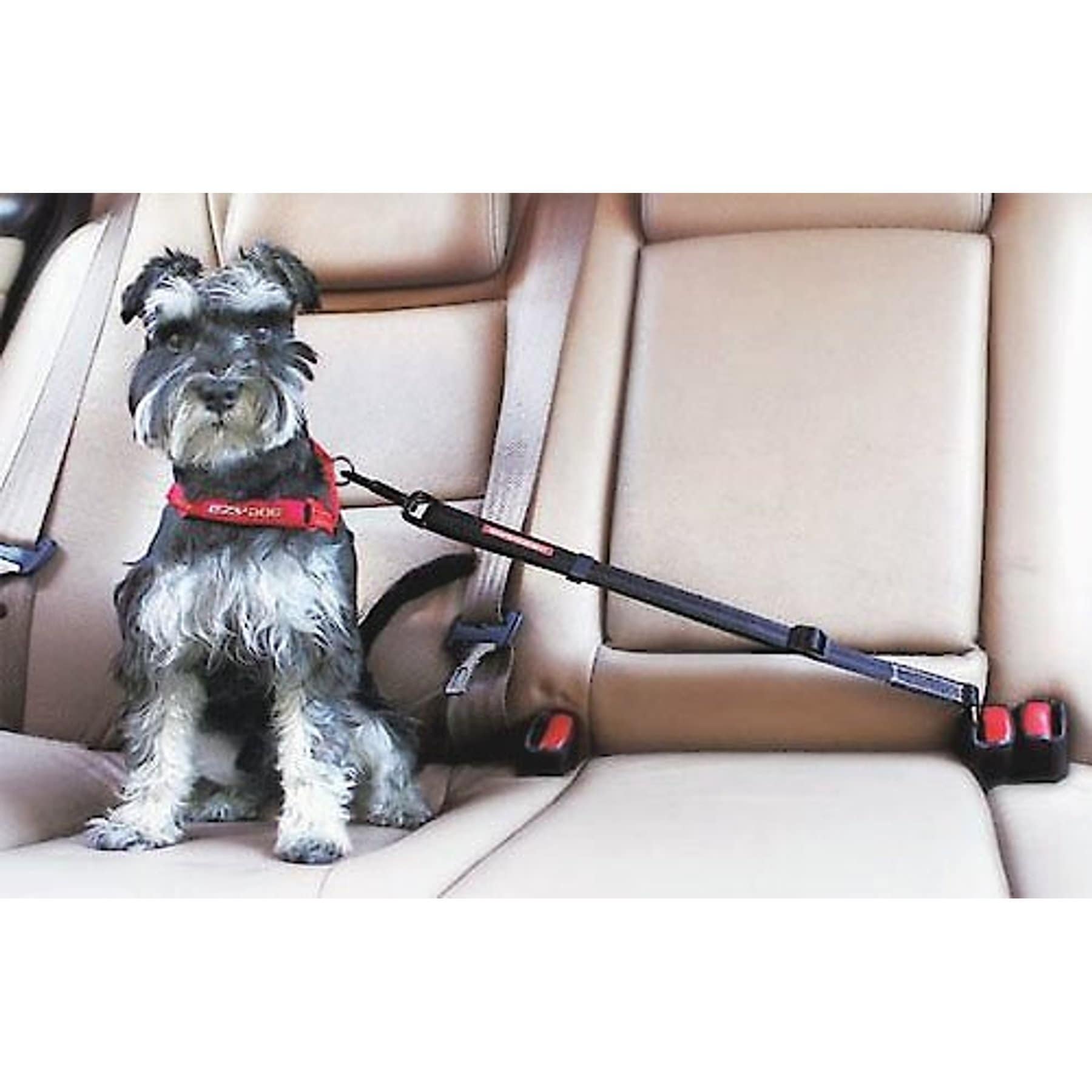
Clicks into the seat belt buckle and clips to the harness D-ring, with an adjustable strap so the dog can sit or lie down.
Webvet may earn a commission when you click through to Chewy, at no extra cost to you.
The EzyDog Click Adjustable Seat Belt Restraint, Black is a buckle tether: one end clicks into the car's seat belt buckle receiver, and the snap hook on the other end clips to the D-ring on your dog's harness. It was listed at $22.00 on Chewy when we checked in October 2026.
- Length: EzyDog says it is fully adjustable from 17.5 to 26 inches.
- Harness: EzyDog names its Quick Fit, Chest Plate, and Convert harnesses as compatible.
- Always ready: Chewy's listing says it can stay in the car so you can clip the dog in and go.
- Vehicle limit: EzyDog says it is not for use in Volvo vehicles.
The tradeoff is length: even the 17.5 inch minimum is well above the 6 inch benchmark CPS used in 2013, so use the shortest setting your dog can sit and lie down with. EzyDog describes the restraint as distraction prevention and says that in an accident it may not prevent injury to passengers or the dog.
Who it suits: an owner whose dog rides calmly in the back seat of a car with standard buckles, especially one who already uses an EzyDog harness.
KONG Ultimate Safety Tether Dog Seat Belt: best tether for LATCH anchor points
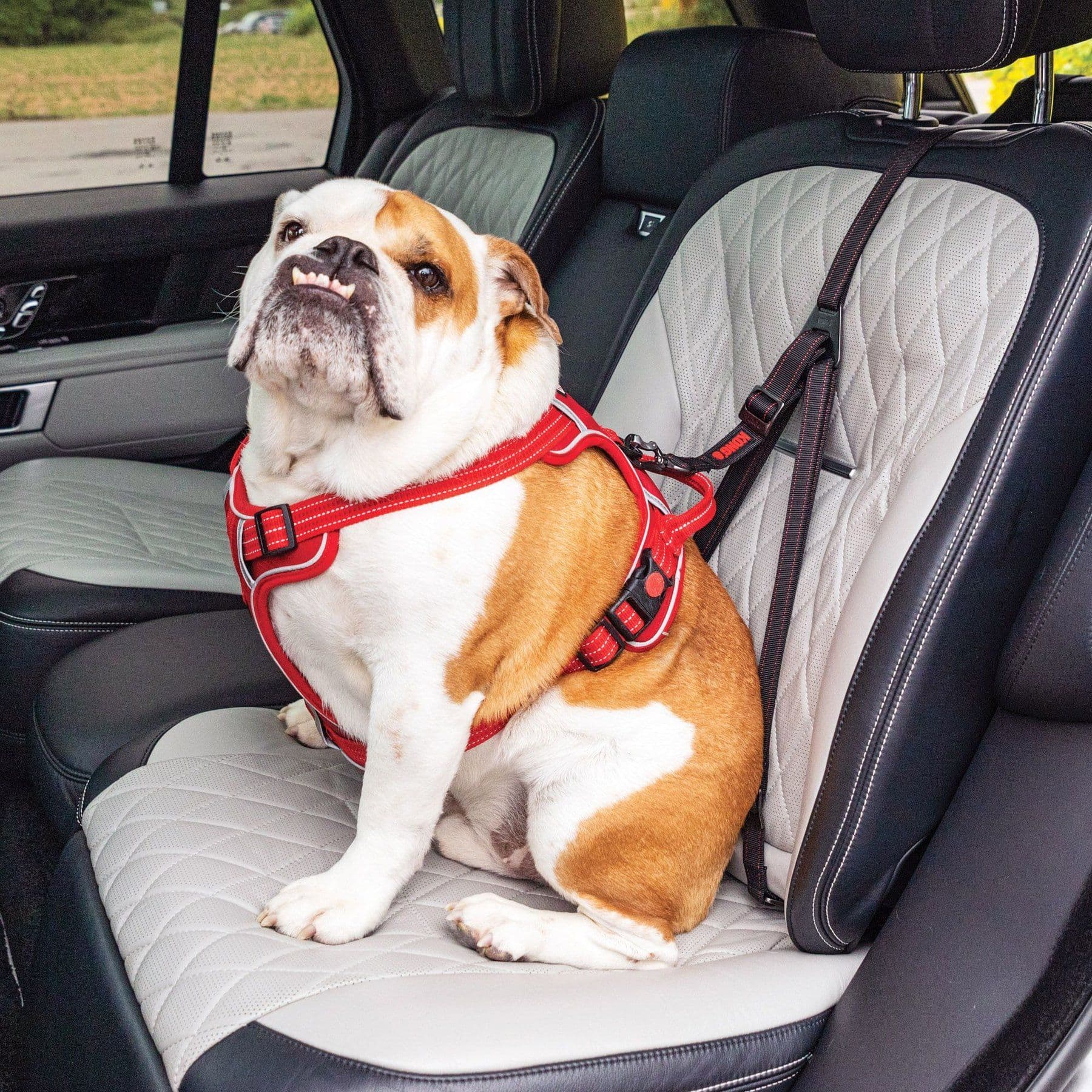
Hooks into the LATCH child-seat anchors at the seat base and rear, a three-point system designed for infant seats.
Webvet may earn a commission when you click through to Chewy, at no extra cost to you.
The KONG Ultimate Safety Tether Dog Seat Belt uses the LATCH, ISOFIX, or CanFix three-point anchor system designed for securing infant seats. It hooks into the two anchors at the base of the seat and the one at the rear. Chewy listed it at $33.13 in October 2026, the highest price of the six picks.
- Anchor: three points instead of one buckle or one headrest.
- Maker claim: KONG says the design keeps the dog in a central seat position, reduces side-to-side movement, and lowers the risk of the dog being thrown into the footwell under braking. That is KONG's marketing, not independent test data.
- Colors: KONG sells it in black or red.
- Add-ons: the listing says it also works with the KONG Travel Bench Seat Cover and Hammock and the KONG Travel Single Seat Cover, sold separately. Our guide to dog car hammocks compares hammock styles.
The tradeoff is that the listing gives no tether length, and the product only works if your back seat has the anchors. Check your vehicle manual before you buy.
Who it suits: a car with LATCH or ISOFIX anchors in the rear seat, and an owner who wants the dog held in the middle of the seat rather than tied to one side.
Kurgo Tru-Fit Quick Release & Seatbelt Tether Smart Dog Harness: best harness with a car tether included
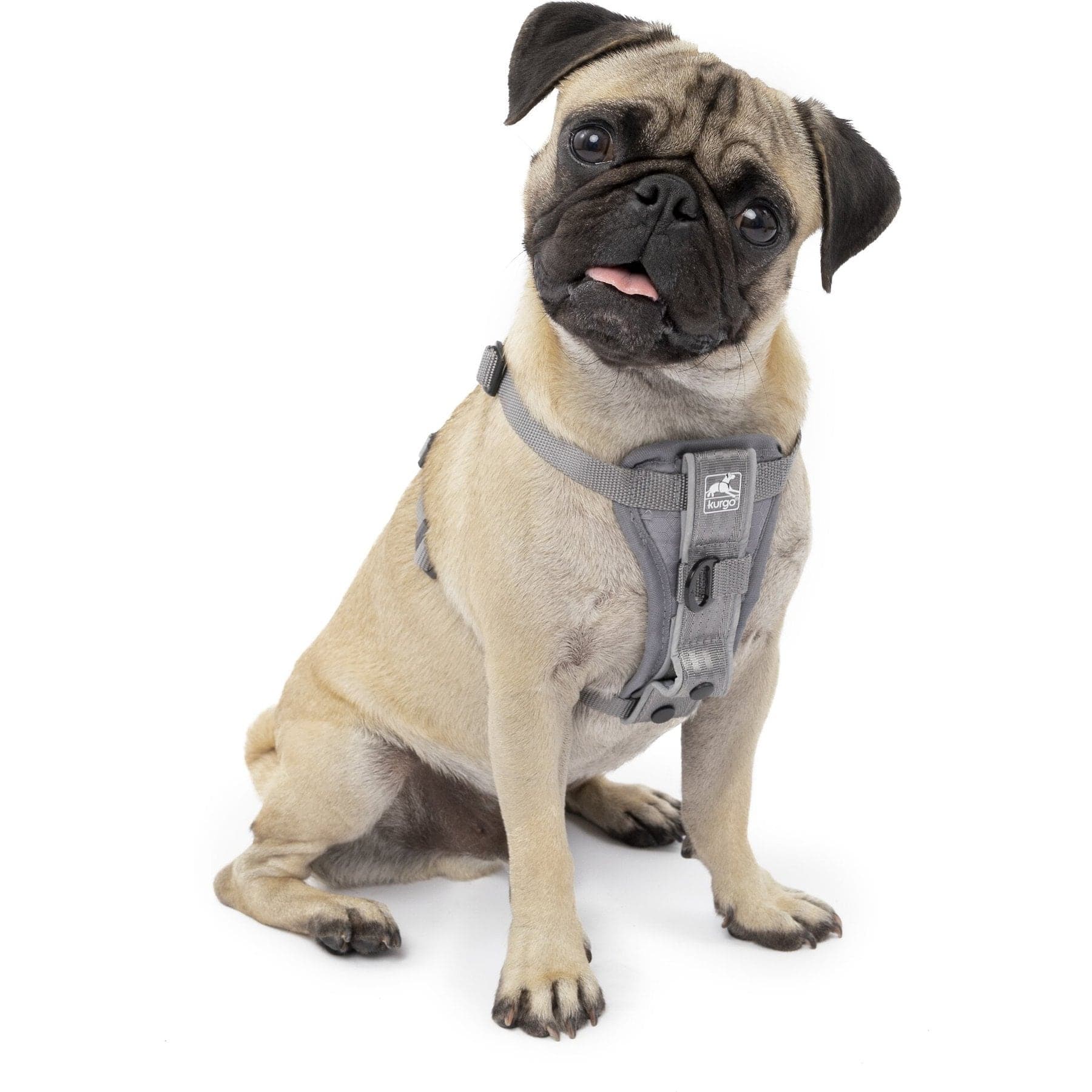
A walking harness with a 10-inch car tether included, five adjustment points, and two quick-release buckles.
Webvet may earn a commission when you click through to Chewy, at no extra cost to you.
The Kurgo Tru-Fit Quick Release & Seatbelt Tether Smart Dog Harness, Charcoal, Small slips over the dog's head and fastens with two quick-release buckles. It was listed at $26.95 on Chewy when we checked in October 2026. This listing is the Small, so check Kurgo's size chart against your dog's chest measurement before ordering.
- Tether: a 10 inch tether is included for securing the dog in the car.
- Leash rings: two attachment points, one on the chest and one on the back.
- Fit: five adjustment points, according to the listing and Kurgo.
- Build: Kurgo lists ripstop fabric and quick-release buckles.
The tradeoff is crash performance. Kurgo's page for the Tru-Fit Smart harness says its 10 inch seat belt loop prevents distracted driving and that the harness is not crash tested. Kurgo sells a separate Enhanced Strength Tru-Fit as its crash-tested model, so do not treat this one as crash-rated.
Who it suits: a small dog that needs one harness for walks and short drives, with an owner who wants the car tether in the same box.
Mighty Paw Headrest Dog Seat Belt: best headrest tether that doubles as a leash
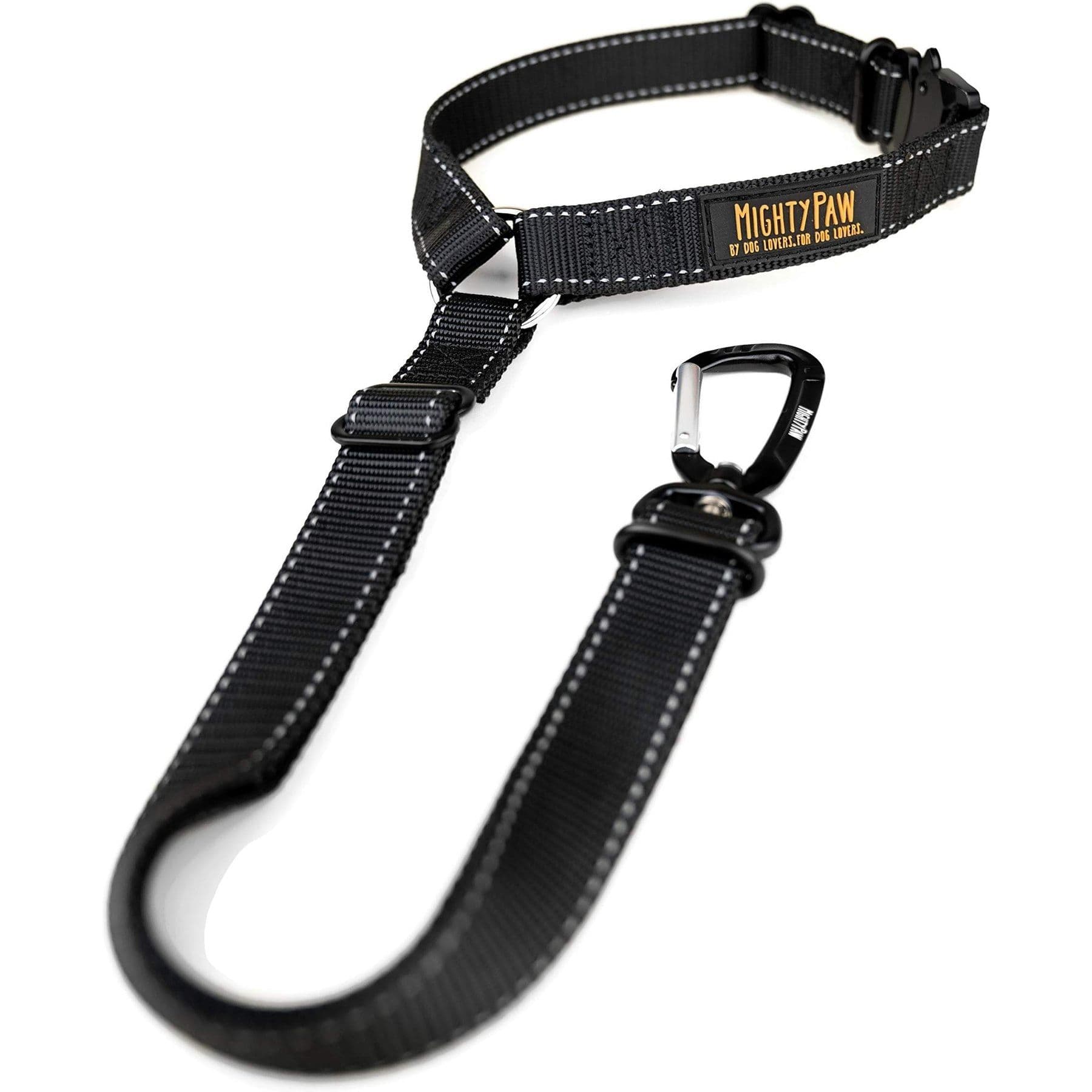
A nylon loop slips around the headrest, clips to the harness, and doubles as a leash for getting in and out of the car.
Webvet may earn a commission when you click through to Chewy, at no extra cost to you.
The Mighty Paw Headrest Dog Seat Belt fixes to the car by slipping a durable nylon loop around the headrest, then attaches to your dog's harness. It was listed at $15.99 on Chewy when we checked in October 2026.
- Anchor: a headrest loop, which the listing says fits any vehicle.
- Leash use: it can double as a leash for getting the dog in and out of the car.
- Length: adjustable to fit the dog, though the listing gives no measurement.
- Portability: the listing says it is quick to switch between cars.
The tradeoff is evidence. Neither the Center for Pet Safety nor the veterinary sources cited here evaluate headrest straps, and the listing makes no crash-test claim. Set it short enough that the dog cannot reach the front seats.
Who it suits: a family that moves the dog between cars, or an owner who wants a leash in hand the moment the door opens.
SlowTon Car Safety Dog Harness with Seat Belt: best budget harness and seat belt set
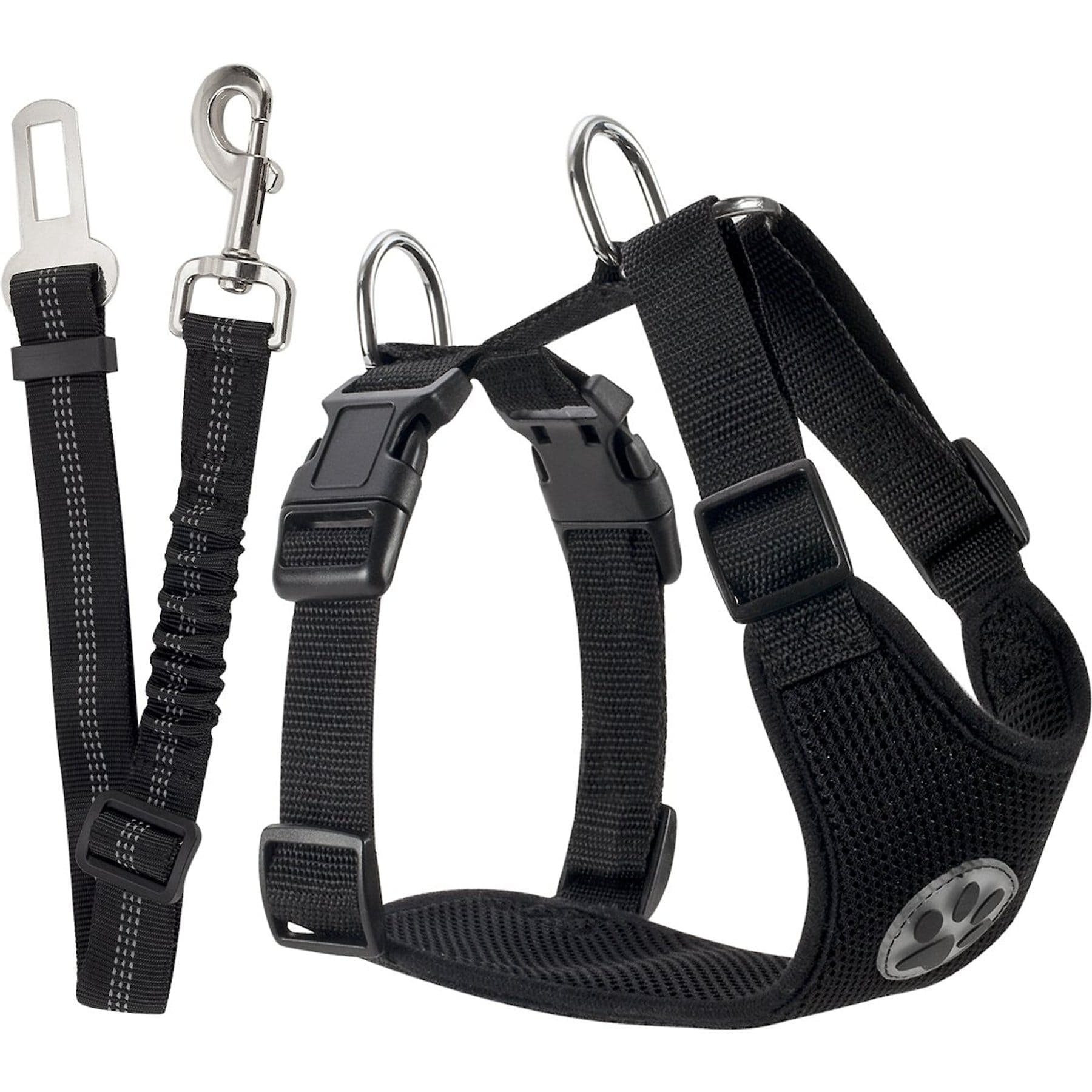
A breathable mesh harness and elastic seat belt sold together, sized Large for a 27.5 to 37-inch chest.
Webvet may earn a commission when you click through to Chewy, at no extra cost to you.
The SlowTon Car Safety Dog Harness with Seat Belt, Black, Large: 27.5 to 37-in chest pairs a mesh harness with a seat belt strap. It was listed at $19.99 on Chewy when we checked in October 2026, which makes it the lowest-priced harness-and-belt set here.
- Harness: double mesh fabric with a flannelette edge, described as breathable for warm drives.
- Belt: made of durable elastic and adjustable so the dog has room to lie down.
- Walks: the harness connects to a leash and can be the dog's everyday harness.
- Size: this listing is the Large, for a 27.5 to 37 inch chest.
The tradeoff is detail. The listing does not say how the belt end attaches to the car or how long the belt is, and it makes no crash-test claim. The belt is elastic, so set it as short as the dog can comfortably lie down.
Who it suits: an owner of a larger dog who wants a harness and car belt together at a low price, mainly for calm, everyday drives.
Kurgo Seat Belt Tether: lowest-priced tether with a locking carabiner
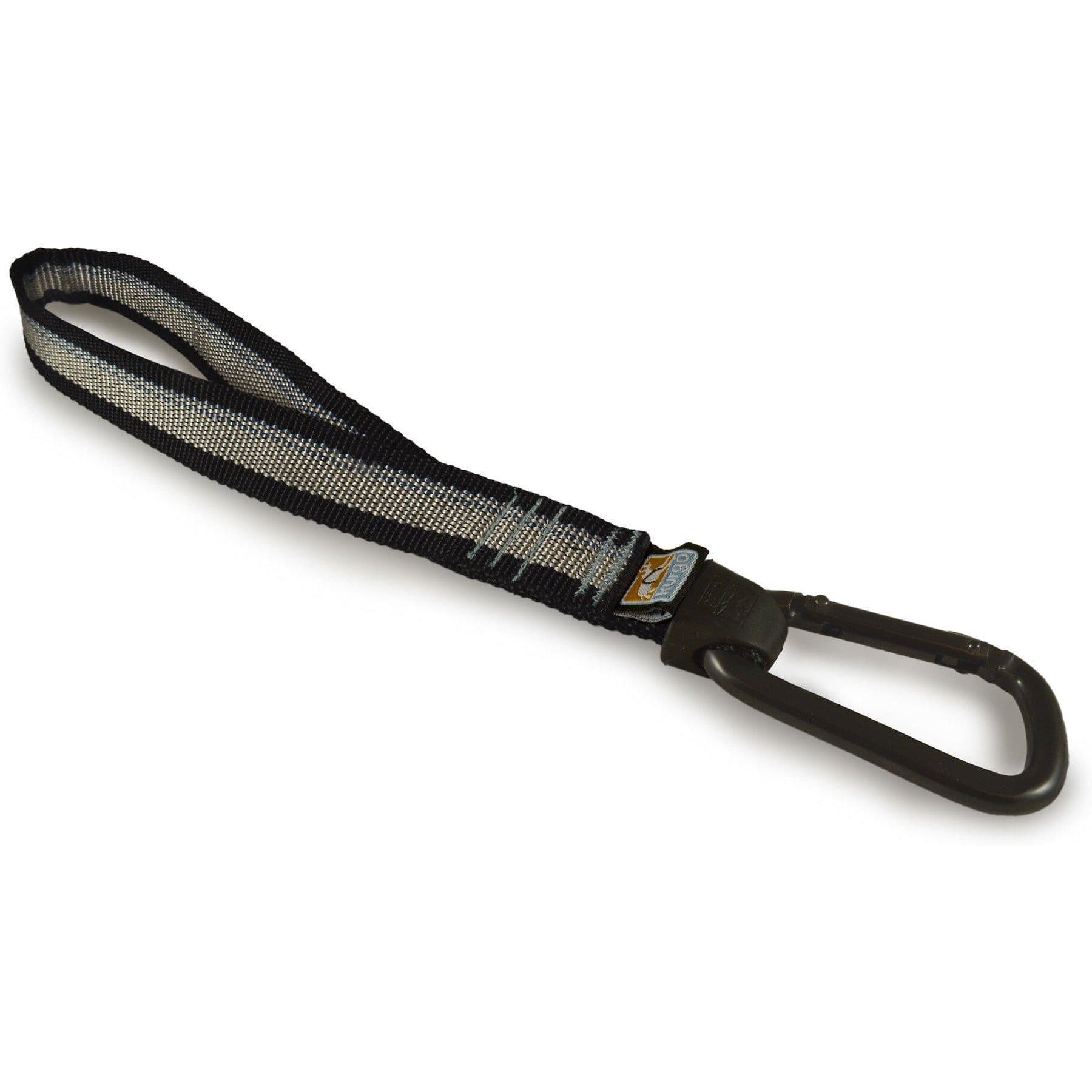
A 10-inch tether with a locking screw-gate carabiner and a swivel, for owners who already have a car harness.
Webvet may earn a commission when you click through to Chewy, at no extra cost to you.
The Kurgo Seat Belt Tether connects a harness you already own to any standard seat belt system. It was listed at $7.95 on Chewy when we checked in October 2026, the lowest price of the six.
- Length: Chewy lists a 10 inch tether. Kurgo's own page for its Direct to Seatbelt Tether, which may be a different version, gives 15 to 22 inches, so confirm the length when it arrives.
- Clip: an aluminum carabiner that the listing says supports up to 4,500 pounds of pulling force, with a locking screw gate on the harness end.
- Swivel: a built-in swivel that the listing says prevents twisting and tangling.
- Harness: sold separately.
The tradeoff is that you supply the harness, and the restraint is only as good as that harness. Kurgo's page for the Direct to Seatbelt Tether also says it is incompatible with Volvo, not recommended for Ford F-Series trucks, and not crash tested.
Who it suits: an owner who already has a car harness with a designated tether ring and wants the lowest-priced seat belt tether here.
Buckle tether, headrest strap, LATCH anchor, or car harness: the four restraint types
Every dog seat belt system has two connections: one to the car and one to the dog. The car end defines the type, and there are four:
- Seat belt buckle tether: a strap that clicks into the seat belt buckle receiver, as the EzyDog Click Adjustable Seat Belt Restraint, Black does. When a crate is not used, the ASPCA advises a back-seat harness attached to the seat buckle.
- Headrest strap: a loop that goes around the rear headrest, with a clip at the dog's end. It is the type built to move between cars.
- LATCH or ISOFIX anchor tether: a tether that hooks to the child-seat anchors built into many back seats. The KONG Ultimate Safety Tether Dog Seat Belt uses the two anchors at the seat base plus the rear anchor.
- Car harness with a seat belt loop or pass-through: the harness carries a short loop or lets the car's lap and shoulder belt run through its back. The Kurgo Tru-Fit Quick Release & Seatbelt Tether Smart Dog Harness, Charcoal, Small includes a 10 inch tether. VCA names the Sleepypod ClickIt Sport harness as the alternative to a crate.
For a buckle tether that stays in one car, the EzyDog Click is the simplest choice. With child-seat anchors in the rear, the KONG tether attaches at three points. For a dog that switches vehicles, the Mighty Paw Headrest Dog Seat Belt is built to move between cars.

The pass-through approach has the clearest published crash evidence:
- In CPS's 2013 study, the Sleepypod Clickit Utility gave a controlled launch and kept the test dog on the seat in every test.
- In CPS's Allsafe case study, the dog stayed on the seat only once the extension tether was removed and the lap and shoulder belt was fed through the harness back.
The dog's end of the restraint matters as much as the car's. EzyDog's tether ends in a snap hook that clips to a harness D-ring, while the Kurgo Seat Belt Tether uses a locking screw-gate carabiner. Whatever the clip, it attaches to the harness back clip or loop that the harness maker designates for the car.
What is the safest way for a dog to ride in a car?
Restrained in the back seat, in a crash-tested harness, seat belt, or travel crate, according to Cornell's veterinary college; VCA likewise names a crate or a seat belt and harness. For dogs that ride best enclosed, see our guide to the best dog crates; otherwise pair a short tether with a well-fitted car harness.
Harness first: why a dog seat belt clips to a harness, never a collar
A collar sits around the neck. When a dog lurches against a tether, whatever the tether is clipped to takes the load, and the Center for Pet Safety notes that collars and walking harnesses are not designed for crash protection. Our guide to preventing dog collar accidents covers other ways a collar can injure a dog.
The same CPS pilot study shows how that plays out. One booster seat maker told owners only not to connect the tether to the dog's collar, without specifying a travel harness. When the anchor strap was used with a walking harness, it failed and left the test dog fully unrestrained.
A dog seat belt harness is built for the car connection. When you choose one, look for:
- A designated car attachment. Kurgo's instructions for its crash-tested harness say to clip the carabiner to the loop on the back of the harness, not the leash attachment.
- A matched system. EzyDog names the Quick Fit, Chest Plate, and Convert as the harnesses its EzyDog Click Adjustable Seat Belt Restraint, Black is meant to clip to.
- Fit by measurement. Use the maker's chart for chest girth and weight, and refit as your dog grows or changes weight.
- A test record if crash protection matters. Kurgo says its Enhanced Strength Tru-Fit car harness was tested at a university facility under the federal child restraint standard, and CPS named the Sleepypod Clickit Utility its 2013 top performer.

No tether is safe without a car harness on the other end. For walking and car harness designs, see our guide to the best dog harness. Keep the collar for the jobs it is designed for; our guide on how to choose the right dog collar covers fit and style.
Kurgo, EzyDog, and Mighty Paw describe their tethers as clipping to a harness. The Kurgo Tru-Fit Quick Release & Seatbelt Tether Smart Dog Harness, Charcoal, Small and the SlowTon Car Safety Dog Harness with Seat Belt, Black, Large: 27.5 to 37-in chest include one.
Follow the harness instructions on which ring takes the clip; for its crash-tested harness, Kurgo says not to use the leash attachment.
Can I put a regular seatbelt on my dog?
Not on its own. VCA notes that seat belts were not designed with pet safety in mind, so the car's belt works only through a car harness. The ASPCA advises a harness attached to a secured seat belt, and in CPS's Allsafe case study, routing the belt through the harness back kept the dog on the seat.
Tether length, swivels, chew resistance, and two-dog setups
A longer tether feels kinder, and crash data says the opposite. In its 2013 criteria, reported by PetMD, CPS treated extension tethers that could not be adjusted to 6 inches or less as more dangerous than short or shortenable ones.
The Center for Pet Safety extension tether advisory explains why. With too much slack, the dog is thrown forward and then snapped back, a "clothes-line" effect that places extreme force on the spine. CPS links extension tethers to these injuries:
- Paralysis
- Blunt force trauma
- Catastrophic spinal damage
The Allsafe case study puts numbers on it. For the size Large test dog, head excursion, meaning how far the dog's head traveled, measured:
- 74.4 inches with the harness's original extension tether, classed as a failure
- 53.38 inches with a 6 inch tether, still classed as a failure
- 32.4 inches with no tether, with the car's belt routed through the back of the harness
Retail tethers run longer than that benchmark:
- EzyDog Click Adjustable Seat Belt Restraint, Black: 17.5 to 26 inches, per EzyDog.
- Kurgo Direct to Seatbelt Tether: 15 to 22 inches, per Kurgo.
- Kurgo Seat Belt Tether and the Kurgo Tru-Fit tether: 10 inches, per their Chewy listings.
None of the veterinary sources cited here publishes a tether length by dog size, so set an adjustable tether at the shortest length that lets your dog sit and lie down without reaching the footwell.
- Swivels: Kurgo says the swivel on its tether makes it harder for escape-artist dogs to twist the tether or work free, and the Chewy listing for the Kurgo Seat Belt Tether says its swivel prevents twisting and tangling.
- Chew resistance: none of the sources cited here tests how well a dog seat belt tether resists chewing, and the Mighty Paw Headrest Dog Seat Belt listing makes no chew-proof claim. EzyDog's instruction applies to every strap: inspect it for wear or abrasion and stop using it if it is damaged.
None of the six listings describes a double or split tether, so with two dogs, each one gets:
- Its own car harness, fitted to its own measurements.
- Its own anchor point: a separate buckle, headrest, or LATCH connection.
- Its own tether, set short.
Your vehicle matters too. EzyDog says its Click restraint is not for use in Volvo vehicles; Kurgo says its Direct to Seatbelt Tether is incompatible with Volvo and not recommended for Ford F-Series trucks.
In an SUV, van, or hatchback, use a seat buckle or LATCH anchor rather than a cargo tie-down. The Center for Pet Safety warns that cargo area anchors are not always weight-rated for crash forces, so check with the vehicle maker first.
Seat belts for small dogs, large dogs, and puppies
Small dogs
Size changes which restraint makes sense. San Diego Humane Society says a small dog can travel in a pet carrier or a canine seat belt harness secured to the car's seat belt. Keep a small dog's tether short too, so it cannot reach the footwell.
The Kurgo Tru-Fit Quick Release & Seatbelt Tether Smart Dog Harness, Charcoal, Small is one option for a small dog that needs a harness and a car tether together. Measure your dog's chest before choosing a size.

Booster seats for small dogs are not automatically safer. In CPS's small-dog booster seat pilot study, seat connections failed, and the Kurgo Skybox Booster Seat became a fully unrestrained projectile. If you prefer a booster or seat, our guide to the best dog car seats covers the options.
Large dogs
Large dogs have different choices. San Diego Humane Society ranks them this way:
- First choice: a crate secured in an SUV or hatchback is often best. Our guide to heavy-duty dog crates covers crates built for bigger dogs.
- If a large crate does not fit your car: a crash-tested canine seat belt harness is the next safest way for your dog to travel.
For a big dog, check the harness weight rating as well as the tether. Kurgo says its Enhanced Strength Tru-Fit was tested for dogs up to 75 pounds, though CPS has not retested it since 2013. Size also changes results: CPS found the Sleepypod Clickit Utility within head excursion limits for Small and Medium, but not Large.
Sizing goes by measurement, not breed name. Kurgo's chart, for example, lists chest girth and weight for each size, so a Greyhound and a bulldog are each fitted with a tape measure rather than by breed label.
Puppies
Puppies need a harness that fits now and refitting as they grow. None of the sources cited here sets a puppy-specific seat belt standard, minimum age, or tether length, so maker size charts are the guide.
Kurgo's Tru-Fit chart, for example, starts at X-Small, for 5 to 10 pound dogs with a 12 to 18 inch chest. Recheck the clip and the fit often as the puppy grows.
Back seat only: the front airbag risk and other restraint rules
Where your dog rides matters as much as how it is restrained. VCA's advice is direct: never let a pet ride in the front seat or on the driver's lap. Front airbags are meant to work together with seat belts to protect adults, and VCA warns they can cause serious injuries and death to pets.
The Center for Pet Safety adds that in a frontal crash, the front seat exposes a pet to airbag deployment and to intrusion into the occupant compartment. The American Kennel Club likewise says the backseat is optimal so dogs are not harmed by air bags. Belting the dog into the front seat removes neither risk.
A loose dog is also a distraction. In the AAA survey reported by dvm360, nearly 23 percent of owners had used a hand or arm to hold their dog in place while braking, and 19 percent had used one to keep the dog from climbing into the front seat.

The pros and cons, in short:
- Pro: a restraint keeps the dog on the seat, which CPS treats as essential to protecting everyone in the car.
- Pro: it cuts driver distraction, which EzyDog and Kurgo both name as a purpose of their tethers.
- Con: most harnesses CPS tested in 2013 did not perform well, so a label alone tells you little.
- Con: long tethers expose the dog to the forward-then-back motion CPS links to spinal injury.
Laws vary. GoPetFriendly reports that no federal law requires pets to be restrained inside a vehicle and names a few states with dog-specific rules. The statutes themselves are narrower than that suggests:
- Hawaii: Hawaii Revised Statutes section 291C-124(b) bars a driver from holding an animal in the lap, or allowing one in the driver's immediate area, if it interferes with control of the vehicle.
- Rhode Island: Rhode Island General Laws 31-22-28 covers animals carried on or in an open air vehicle, such as a pickup bed. The animal must be enclosed, under another person's physical control, or restrained by a harness. The fine is up to $50 for a first offense and up to $200 for each later one.
A restraint will not settle a queasy stomach or a nervous dog. If your dog struggles on drives, see our guides to dog car sickness and to a dog shaking when scared or anxious, and talk to your veterinarian about motion sickness before a long trip.
Should dogs sit in the front or back of a car?
The back. VCA, the AKC, and the Center for Pet Safety all point to the front airbag as the reason, and the ASPCA warns that serious injury could occur if a pet is secured in the passenger seat during an accident. Even the best restraint belongs in the rear seat.
Dog seat belt questions
Frequently Asked Questions
Do dog seat belts work in a crash?
Some do, and many do not. In the Center for Pet Safety's 2013 crash tests only one harness was judged a top performer, and PetMD reported that all but one of eleven brands claiming crash protection performed sub-optimally. EzyDog and Kurgo describe their tethers as distraction prevention, so look for a published crash result on the harness itself.
Can I attach a dog seat belt to a collar?
No. A collar puts the load of a sudden stop around the dog's neck, and CPS notes that collars and walking harnesses are not designed for crash protection. Clip the tether to the car loop on a harness instead.
How long should a dog seat belt tether be?
As short as your dog can sit and lie down with. CPS's 2013 benchmark was a tether that adjusts to 6 inches or less, while the retail tethers here run longer: the EzyDog Click from 17.5 to 26 inches and Kurgo's Direct to Seatbelt Tether from 15 to 22. Set an adjustable tether at its shortest comfortable length.
Is it the law for a dog to wear a seat belt?
Not under federal law, according to GoPetFriendly's summary. State rules are narrow: Hawaii's law targets animals in the driver's lap or immediate area, and Rhode Island's applies to open air vehicles such as pickup beds. Check your own state's traffic code, because distracted-driving rules can still apply to a loose dog.
Can a dog chew through a seat belt tether?
None of the sources cited here tests how well dog seat belt tethers resist chewing, so treat any strap as chewable. EzyDog tells owners to inspect the attachment for wear or abrasion and not to use it if it is damaged.

Editor
The Webvet Editorial Team is the in-house group of pet-care editors and writers behind Webvet, operated by Smart Pet Collective. The team researches, writes, and maintains Webvet's pet health, behavior, and medication content. Every article follows a defined editorial process: research from reputable veterinary and scientific sources, careful drafting, mandatory review of medical content by a credentialed veterinarian, and dated publication. Health and medication articles are medically reviewed by a licensed veterinary professional before they go live and are kept current over time.
Veterinarian · BVMS MRCVS
Dr. Pippa Elliott, BVMS, MRCVS, is a veterinarian with nearly 30 years of experience in companion animal practice. Dr. Elliott earned her Bachelor of Veterinary Medicine and Surgery from the University of Glasgow. She was also designated a Member of the Royal College of Veterinary Surgeons. Married with 2 grown-up kids, Dr. Elliott has a naughty Puggle named Poggle, 3 cats and a bearded dragon.
Related reading

Best Dog Car Seat Cover: Waterproof Bench, Cargo, and Hammock Picks

Best Dog Car Hammock: Back-Seat Covers That Stop Falls, Fur, and Mud

Crash Tested Dog Car Seat and Harness Guide: What the Testing Means and Which Products Passed
