Heavy Duty Dog Crates: Strength, Fit and Escape-Risk Tradeoffs
Compare reinforced dog crates without treating strength as an anxiety treatment. Check fit, ventilation, emergency access and the reason a dog is trying to escape.

This article contains affiliate links. Webvet may earn a commission when you buy through them, at no extra cost to you.
A heavy duty dog crate can resist wear that damages a light wire model, but stronger construction does not make confinement right for every dog. Before buying, work out whether the problem is a weak latch, unsuitable dimensions, chewing, lack of familiarity or panic when left alone. Those problems call for different decisions.
- 1No crate should be treated as an escape-proof guarantee.
- 2A dog that injures themselves trying to leave needs a safer management plan and professional help.
- 3Compare usable space, ventilation, weight and emergency access alongside material strength.
What heavy-duty and escape-proof really mean
Check how the last enclosure failed before choosing a stronger one. Latch manipulation, panel deformation and chewing damage are different problems. Panic can cause a dog to keep struggling despite an intact frame. Stop confinement that creates an injury risk and arrange a different management plan while the cause is assessed.
“Heavy-duty” describes a product category, not a universal certification. Manufacturers may use thicker metal, reinforced frames, more substantial latches or smaller openings. A claim about construction does not establish how a particular dog will behave inside it.
Use a failure-mode checklist before making a shortlist:
| What happened with the old crate? | What to investigate | What not to assume |
|---|---|---|
| Dog opened the latch | Latch operation and the actual escape sequence | Any stronger wall fixes the latch |
| Dog bent panels | Assembly, damage and force applied | The next crate can safely absorb unlimited force |
| Dog chewed bars or openings | Injury risk and the reason for chewing | Smaller openings cure anxiety |
| Dog panicked when left | Confinement and separation-related distress | A premium crate treats the underlying problem |

Photograph damage for the manufacturer and veterinarian when useful, but do not recreate an escape attempt to film it. Remove a damaged crate from service if bent metal, sharp edges or failed hardware could injure the dog. Improvised padlocks, wire ties and added panels can create new entrapment risks and complicate rescue.
Compare reinforced crate options
The following are manufacturer-described designs, not crates we have personally tested. They illustrate different construction and portability priorities. Exact sizes, accessories and warranty terms must be checked for the model you buy.
| Option | Design distinction | Main question for the buyer |
|---|---|---|
| Frisco Heavy Duty Wire Crate | Extra-large wire design with multiple latches | Is the dog comfortable with wire containment and is the interior correctly sized? |
| SMONTER Two Doors | Steel design with side access and casters | Does the floor, door layout and stationary setup suit the dog and room? |
| Impact Collapsible | Folding construction | Is frequent transport worth the folding-mechanism tradeoff? |
| K9 Kennel Boss | Collapsible aluminum format | Do its usable dimensions and assembly requirements suit the dog? |
For a calm dog with no history of damaging containment, start with the wider dog crate comparison. Heavy construction can add considerable handling burden without solving an actual problem in that household.
Reinforced crate picks
Use these four options as a shortlist of designs, then eliminate unsuitable sizes and installations. There is deliberately no universal “strongest” winner: a folding crate for a calm traveling dog and a fixed enclosure considered during a behavior consultation solve different problems.
Buying the most substantial shell does not remove the need to make that distinction.
Frisco Heavy Duty Wire Crate: for a large calm dog
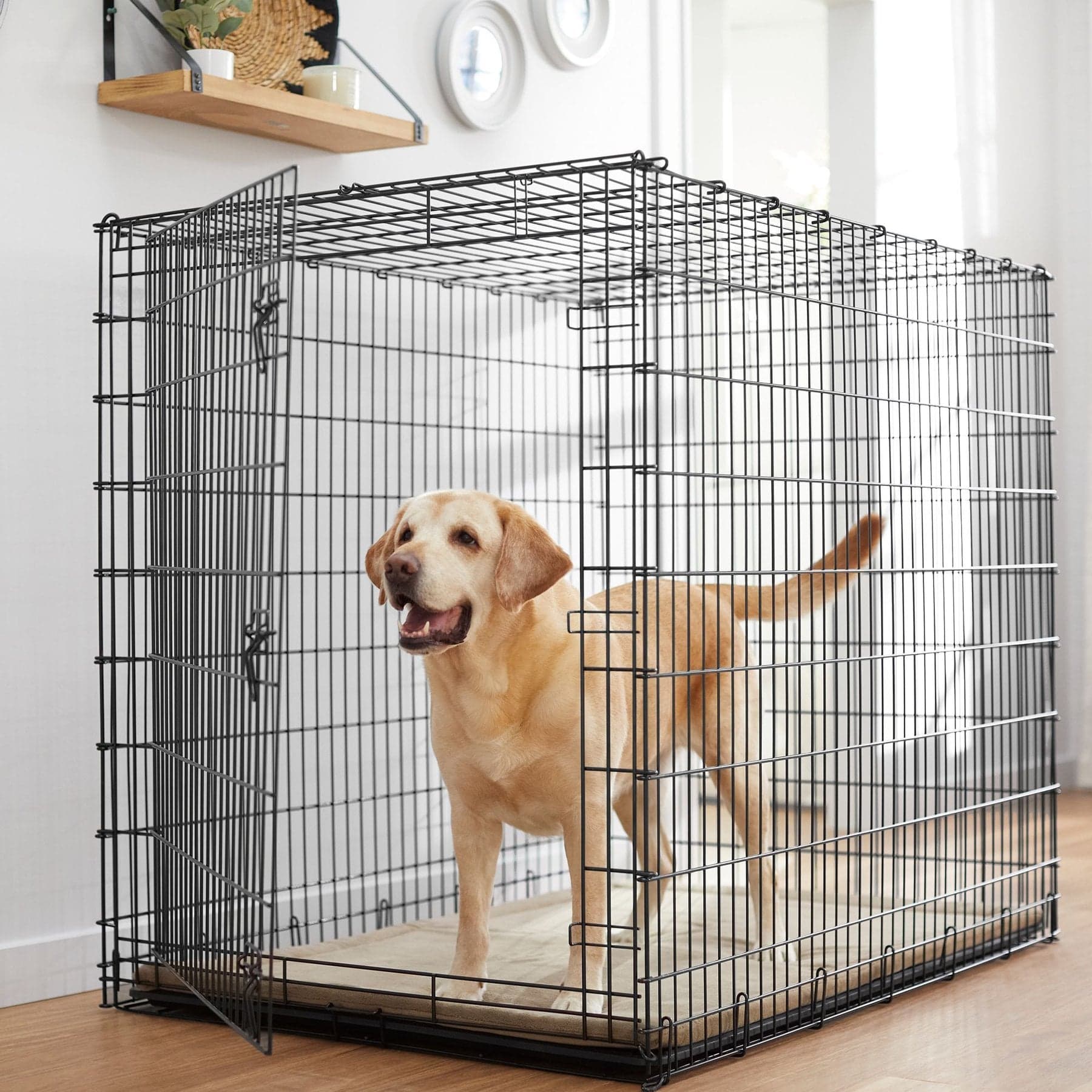
A large wire crate with three door latches and a removable pan; size and calm use still matter.
Webvet may earn a commission when you click through to Chewy, at no extra cost to you.
The Frisco Heavy Duty Single Door Wire Dog Crate is an extra-large wire option. Its Chewy catalog description specifies three door latches, drop-pin hinges and a removable plastic base pan. Those are concrete construction features to compare; they do not establish that a distressed dog can be confined without injury.

This design belongs on the shortlist when a large dog's size and ordinary use call for more substantial wire construction. It gives an open view of the room and access to the pan for cleaning. Compare usable interior dimensions and doorway clearance before choosing it; the XX-Large label is not a fit assessment.
Inspect assembly and pan access
Assembly matters with a drop-pin design. Follow the exact instructions, check that the panels and pins are seated correctly, and confirm that all three latches operate before the dog enters. An extra latch that is routinely left undone does not provide the intended closure.
Keep the instructions available for anyone who takes the crate apart or moves it.
Separate chewing from an ordinary size need
A dog that bites wire or forces their face against openings presents a different problem from a calm large dog needing an appropriately sized enclosure. Do not treat heavier wire as the answer to that behavior. Use the welfare and escape-assessment questions below before replacing a damaged crate with another wire design.
The removable pan is useful only if there is room to remove and clean it. Mark the direction in which it slides and keep that approach clear of furniture. Check the pan and surrounding frame during ordinary cleaning, and stop using damaged parts that leave a sharp edge or an unsuitable floor surface.
SMONTER Two Doors: steel construction with side access
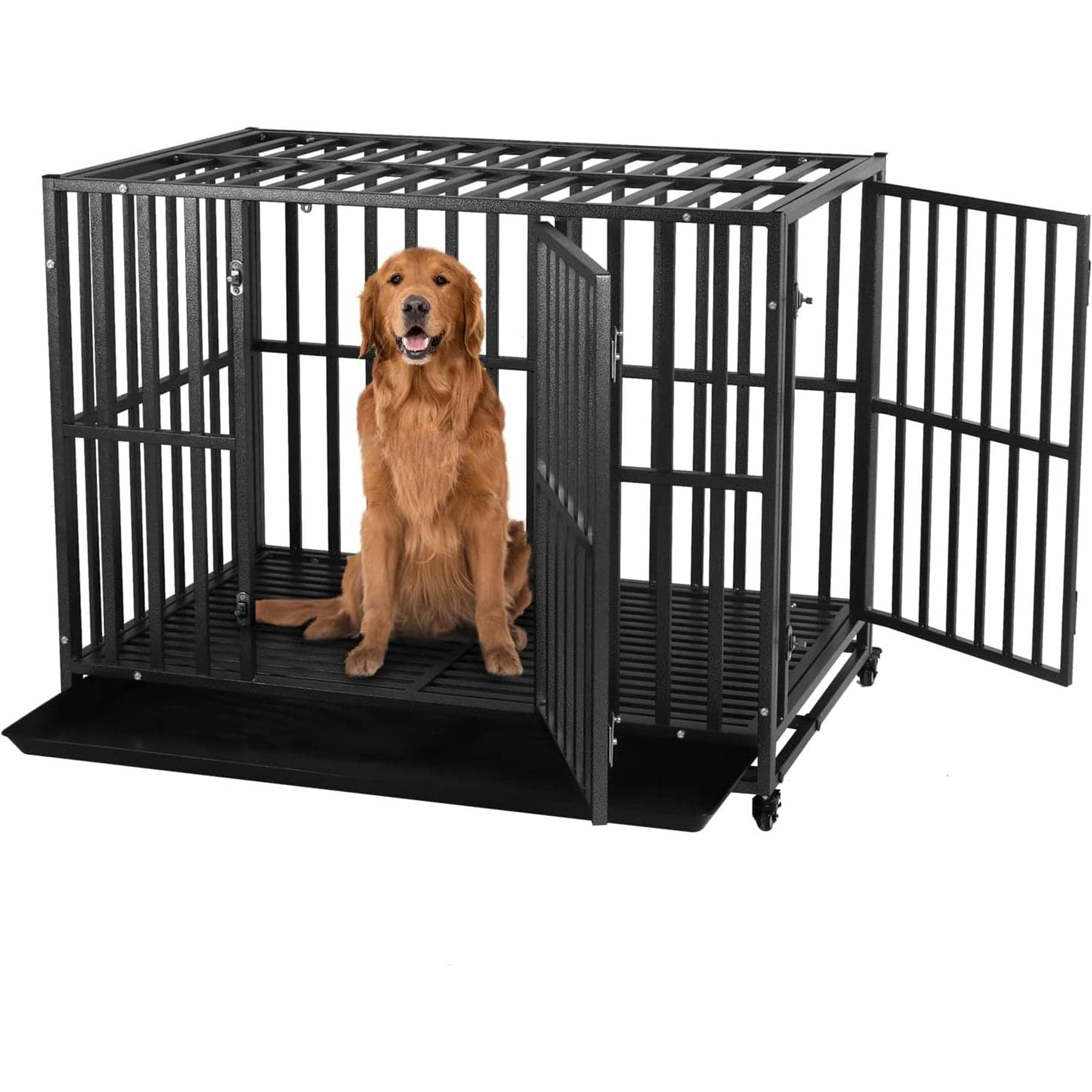
A steel crate with front and side access, a pull-out tray and locking casters; check the planned room layout.
Webvet may earn a commission when you click through to Chewy, at no extra cost to you.
The selected SMONTER is an enclosed metal kennel with a rigid frame, rather than a flexible exercise playpen. Compare its door openings and floor arrangement with the dog’s actual needs before considering the seller’s strength claims.
The SMONTER Two Doors Heavy Duty Dog Crate offers a different layout: the current 42-inch catalog model has a front door, side access, a pull-out cleaning tray and locking casters. The seller describes steel construction and side-door placement that can be configured to the left or right.
Check side-door clearance
Verify the assembly instructions for the delivered model before deciding the final orientation.
Side access can matter in a room where the short end of a crate faces another piece of furniture. It does not make a cramped location automatically suitable. Draw the footprint and both door swings, then leave sufficient space for the dog to enter and for a person to remove bedding and clean the enclosure.
Check movement and the floor
Casters help with repositioning an empty enclosure, but they add another component to check. Use the brakes as instructed and choose a level location. Do not regard wheels as permission to roll an occupied crate through the home or to place it beside an unprotected stair edge.
If moving the unit is essential, confirm the maker's procedure and whether another person is needed.
Inspect the resting surface
Compare the floor arrangement with your dog's needs. A removable tray beneath a structure is not necessarily the same as a solid pan on which the dog rests. Inspect the actual walking and lying surface and ask the seller about any unclear detail before ordering.
Bedding should not be used to conceal an unsuitable or damaged floor.
Treat strength claims cautiously
The seller's claims about strength and escape resistance remain product claims. We have not tested resistance to force, and a dog's panic should not become a test of the enclosure. Choose the design for a defined fit and management purpose, with professional advice when distress or injury is involved.
Impact Collapsible: portability changes the decision
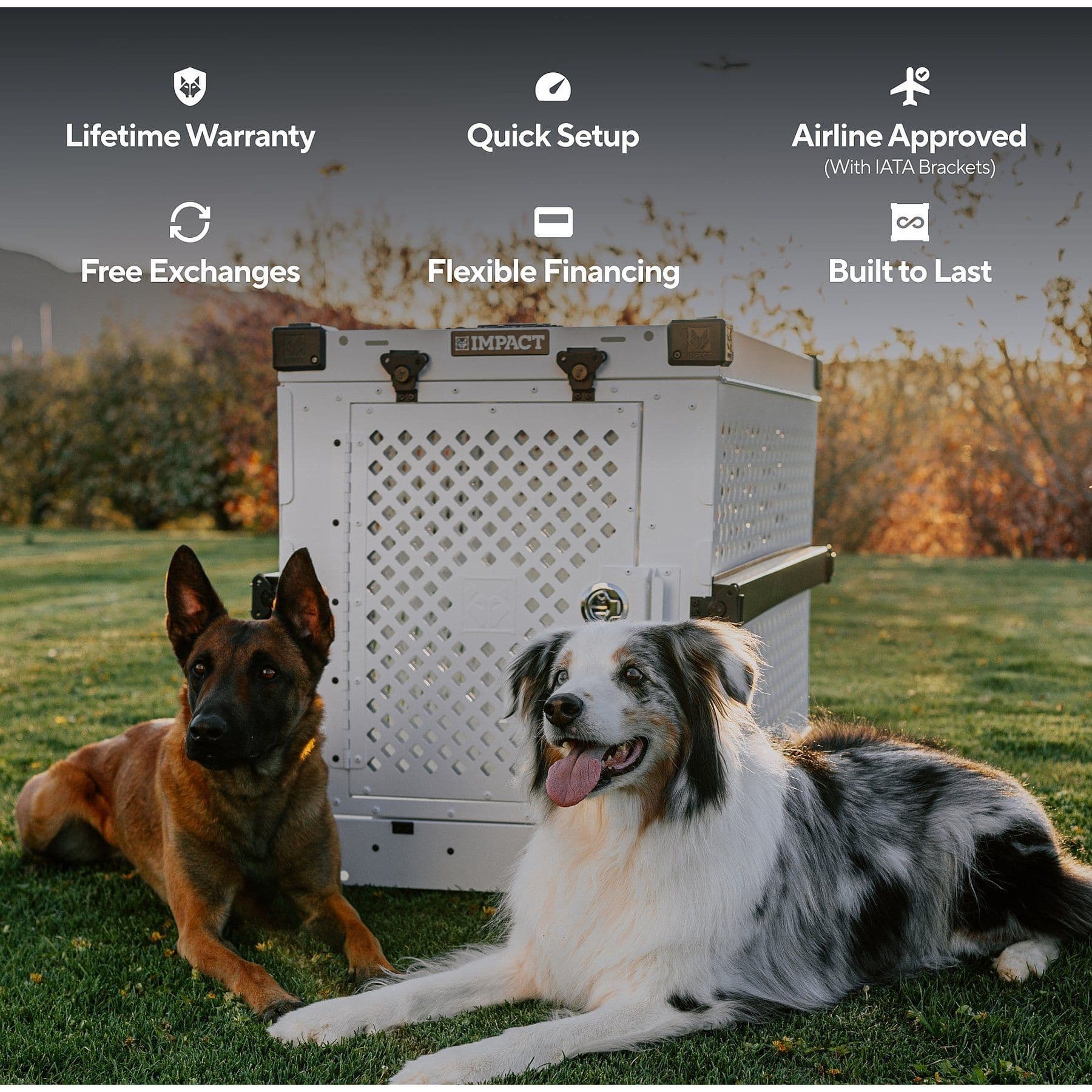
A collapsible aluminum crate for comparing handling and storage with everyday access.
Webvet may earn a commission when you click through to Chewy, at no extra cost to you.
The Impact product information separates Collapsible, Stationary and High Anxiety models. That distinction matters: the benefit of folding for storage should not be mistaken for the same design brief as a fixed reinforced model.
Compare the Impact Collapsible Crate when you need a folding aluminum crate, while treating the brand’s other designs as separate products.
Check how often you will move it
List the situations in which you would actually collapse it. If it stays beside the same wall all year, portability may be a low priority. If it travels between homes, check its folded dimensions, lifting weight and the time required for correct assembly.
After every setup, inspect:
- That every required panel and locking part is fully engaged.
- That no loose item is trapped in the mechanism.
- That the door works normally before the dog enters.
- That the crate sits securely on a level surface.
Do not assume suitability as a vehicle crash restraint from sturdy appearance. Travel containment and crash protection require evidence for the exact product and installation.
A folding model has two sizes that matter to the owner: the space occupied in use and the package that must be lifted or stored. Compare both with your actual storage location.
“Collapsible” is of limited practical value if the folded unit will not fit the cupboard or if the person traveling with the dog cannot safely handle its weight.
Plan arrival and assembly
Think through the arrival sequence at the destination. The dog needs a secure, comfortable place while the crate is carried in and opened. Keep the dog away from moving panels during setup, check the assembled enclosure, and then introduce the dog. Do not rush a partial setup simply because it is late or raining.
If the crate will ride inside a car, separately measure the cargo opening and the usable space with seats in their intended positions. A crate may fit through the hatch but leave inadequate access to its door, or fit the cargo floor while obstructing equipment the vehicle needs.
Keep crash claims separate
A home-crate comparison cannot establish crash performance, restraint attachment or suitability for every vehicle.
K9 Kennel Boss: a folding aluminum option
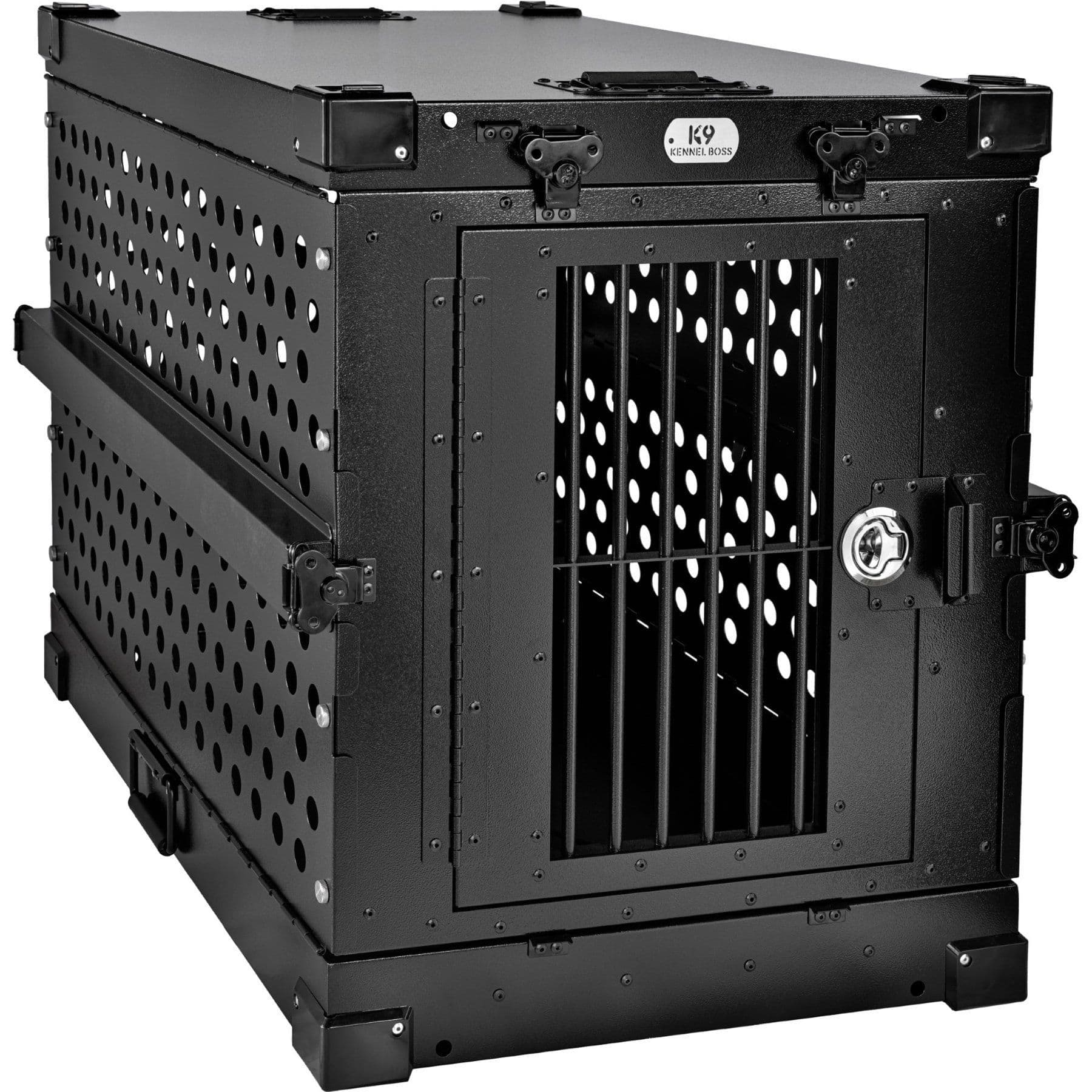
A folding aluminum crate option; inspect assembly, usable dimensions and ventilation for your dog.
Webvet may earn a commission when you click through to Chewy, at no extra cost to you.
K9 Kennel Boss’s sizing guide separates the Medium’s interior, exterior and collapsed dimensions. Those figures make its storage benefit measurable without inferring escape resistance from the aluminum construction.
| Medium measurement | Manufacturer figure | Use it for |
|---|---|---|
| Interior L × W × H | 33.8 × 22.4 × 28 inches | Dog’s standing, turning and resting fit |
| Exterior L × W × H | 34.6 × 23.2 × 28.9 inches; 25.2 inches wide with side rails | Floor footprint and route through the home |
| Collapsed L × W × H | 34.6 × 23.2 × 7.4 inches; 8.6 inches high with side rails | Storage opening after folding |
| Item weight | 36 pounds | Whether the caregiver can manage the empty unit |
For example, an 8-inch-high storage gap exceeds the 7.4-inch collapsed figure but is smaller than the 8.6-inch figure with side rails. Do not promise under-bed storage until the exact configuration clears the opening. Folding reduces height; it does not remove the 34.6-inch length or lifting weight.
Inspect the assembly and usable opening
The K9 Kennel Boss is another collapsible aluminum design to compare when folding storage is a genuine need. Evaluate its exact size and assembly method against the dog and the person who will handle it.
Compare more than the metal type:
- Door construction and usable opening.
- Panel joints and assembly requirements.
- Latch operation and access for the caregiver.
- Ventilation openings and their placement.
A lighter material can change handling without establishing the strength of the finished enclosure or its suitability for a dog in distress.
Read the current instructions before delivery so you know whether you have the necessary space and assistance. If the dog has a history of forceful escape attempts, describe that history to the manufacturer and a qualified professional rather than relying on a broad “escape-resistant” description.
Select the actual variant
The current catalog option in this comparison is the black Medium. That is a specific shopping variant, not a recommendation that medium fits your dog. Compare the manufacturer's size information across the range before using the offer.
Switching color normally changes appearance; switching size changes the living space and handling burden and deserves a fresh check.
Operate the empty crate first
A useful owner-level inspection concentrates on ordinary operation. With the dog elsewhere, open and close the door, engage each closure and check that the crate stands as the instructions require. Look for a part that does not seat correctly, a panel that remains out of line or shipping damage.
Contact the seller rather than forcing hardware into place or filing down a part to make it fit.
Share assembly instructions
Keep the assembly instructions with the crate if another household member will move it. Familiarity with a wire crate does not teach someone how this folding system locks together. A brief demonstration and a complete empty-crate setup are more useful than assuming every latch works the same way.
Fit, ventilation and emergency access
- Keep ventilation openings clear, and preserve access to the doors and latches. Think through how you would help or rescue the dog if a latch jammed or the enclosure had to be moved. A tight room arrangement should not prevent reaching the dog or operating the crate normally.
- Measure usable interior space, not the outer shell. A 70-pound dog may be tall and narrow or short and broad; weight cannot choose a crate by itself. The crate size guide explains the standing, turning and resting checks.
- Choose a location away from direct sun, heating equipment and blocked airflow. Small openings or solid panels do not remove the need for a comfortable room. Never cover the crate in a way that obstructs ventilation, and do not leave a dog in a hot vehicle because the crate looks substantial.
- Plan human access as deliberately as dog access. Everyone responsible for care should know how to release the closures and where the dog can go if the crate becomes unsafe. Keep the path to the door clear; do not wedge heavy furniture in front of it.
Compare the dog, the interior and the room separately
Start with the dog standing naturally on a level surface. Record body length and normal standing height using the sizing method the manufacturer requests, then observe the space the dog uses while turning and resting. Do not pull the head into an unusual position to make a measurement fit a chart.
If measurements fall between sizes, compare all three usable interior dimensions and the entry opening rather than choosing by weight alone.
Allow for bedding and accessories
Next, check what occupies the interior. A thick bed reduces effective headroom and may narrow usable floor space if it curls up at the sides. A bowl attachment can intrude into the turning area.
Add only items appropriate for the individual dog and permitted by the crate maker; a dog that tears and swallows bedding needs a different arrangement discussed with their care team.
Leave working space around the crate
Finally, measure the room around the shell. Leave room for the door to open normally and for a person to reach the interior without awkward lifting or twisting. A crate squeezed into a recess may fit on paper while making cleaning or emergency access unnecessarily difficult.
Do not store items against ventilation openings simply because the surrounding space looks unused.
Work through a size-label example
The selected Frisco XXL and K9 Medium illustrate why labels are poor comparisons. Frisco’s listed 54 × 36.5 × 44.75-inch size describes a much larger assembled enclosure; K9 separately provides a 33.8 × 22.4 × 28-inch interior. These are different measurement types, so do not compare them as equivalent living-space figures.
Check the doorway as well as the living space
A comfortable interior is not enough if entering requires an awkward squeeze. Look at the clear doorway width and height, the lower lip and any raised threshold. Consider whether the dog can enter calmly without hitting shoulders or repeatedly ducking into hardware.
For an older dog or one with mobility limitations, ask the veterinarian which movements should be avoided rather than guessing that a larger crate solves the access problem.
Check human access for care
The person's access also matters. You may need to remove bedding, retrieve a dropped item or clean the far corner. If reaching inside is difficult while the crate is empty, it is unlikely to become easier after an accident.
A side door or different layout may be more useful than additional overall length, but verify that feature on the exact model rather than assuming it is included.
Keep the intended structure intact
Do not remove structural parts or leave an intended latch unused to make access more convenient. If the door design does not work for your household, that is a reason to reconsider the product. A manufacturer's approved accessory is different from improvising a larger opening in a reinforced panel.
Plan cleaning before choosing a floor design

Look for the manufacturer's cleaning method and the way the floor or tray can be accessed. Some designs offer a removable tray; others require cleaning the interior in place. Confirm the actual design rather than assuming that all metal crates have a sliding pan like a familiar wire model.
Work through a realistic accident cleanup. Where will the dog wait? Can bedding come out without snagging? Can you reach corners and dry the surface before returning the dog? Is there a suitable place to clean removable parts?
These questions can reveal a poor home fit before purchase, especially in an apartment without an outdoor wash area.
Follow material-specific cleaning directions
Use cleaners compatible with the material and finish, follow their directions, and keep the dog away during cleaning. An enclosure that is easy to wipe still needs inspection for residue, retained moisture and damaged surfaces. Strong fragrance is not evidence that the interior is clean or ready for the dog.
Choose accessories by function, not by a bundle
A bundle can be convenient when every included part has a purpose, but it should not decide the crate size or add items the dog cannot safely use. Separate the necessary components for assembly from optional bedding, covers, bowls and transport accessories.
Check whether the apparent purchase price includes the selected size and any required hardware.
Check covers and airflow
A cover is not a universal way to make confinement comfortable. It changes visibility and airflow, and some dogs pull fabric through openings. Do not add a blanket over a crate to conceal signs of distress or cover ventilation.
If a quieter location helps your dog settle, start by assessing the location and routine; avoid making a heavy enclosure into a poorly ventilated box.
Keep powered accessories out of reach
Likewise, do not install a camera, corded fan or powered accessory where the dog can reach a cable. Monitoring can help you understand behavior, but equipment must be positioned appropriately and cannot replace a person who can respond.
A camera showing escalating distress is a reason to change the plan, not simply to record it for longer.
A dog trying to escape needs more than stronger bars
Repeated biting, frantic attempts to leave or injury are reasons to stop and reassess. A dog may be distressed by confinement, by separation, by pain or by several factors together. The separation anxiety guide provides context, but an individual assessment is important when behavior is severe.
A larger area, a carefully prepared room, a suitable exercise pen or help from a caregiver may be part of a temporary plan. None should be assumed safe without checking the dog's behavior and the environment. The goal is comfortable management while the underlying problem is addressed.
Avoid treating continued containment as proof of success. A dog that can no longer escape may still be highly distressed. Monitor comfort, normal rest and willingness to enter, and adjust the plan with professional guidance.
Three situations that lead to different buying decisions
A relaxed dog has learned a simple latch.
The dog enters willingly, rests normally and opens the door without damaging the crate. First confirm correct assembly and closure use, then ask the manufacturer whether a supported repair or appropriate different design addresses the observed failure. Do not add improvised fasteners that make it difficult to release the dog.
The relevant comparison is closure operation, while normal fit and comfort checks still apply.
A dog damages the enclosure during absences.
Bent panels tell you what happened to the product, but not why. Record the timing and the dog's behavior before and during the absence if you can do so without repeating an unsafe event. Seek a veterinary or behavior assessment and arrange a safe care alternative.
A sturdier purchase may form part of an eventual plan, but shopping alone does not resolve the immediate welfare question.
A calm large dog travels between two homes.
Here, folding size, lifting weight, reassembly and doorway access may be the leading factors. A fixed reinforced model could create more handling work with little benefit. Compare the folding options, establish who will assemble them, and check each destination.
If travel happens only occasionally, leaving an appropriately fitted crate at each home may also deserve a cost comparison.
Reassess when circumstances change
These examples are decision exercises, not diagnoses. The same dog may have different reactions in different places, and a previously comfortable routine can change with health or circumstances. Reassess the setup when behavior changes rather than assuming the original purchase remains the answer indefinitely.
Keep an ordinary-use record

During introduction, note whether the dog approaches voluntarily, enters, turns easily and rests. Also note the location, whether the door was open or closed, who was present and how the session ended. Those details help distinguish a space or entry problem from a reaction that appears specifically when the person leaves.
Keep observations descriptive. “Entered for a treat, came back out when the door moved” is useful information. “Needs an indestructible crate” is already a conclusion and leaves out the behavior that should guide the next step. Share the observations with the professional helping you if the dog has a history of distress.
Increase demands only when appropriate
Do not use a successful short session to justify a sudden long absence. Increase demands only within a plan the dog is coping with. Food, exercise and toilet opportunities remain part of care, but none guarantees that a particular dog will tolerate confinement.
A comfortable crate is one part of a suitable routine, not a substitute for the routine itself.
Read the ownership costs before ordering
Compare the complete delivered purchase with the cost of an appropriate alternative. Include the exact size, shipping method, optional assembly, necessary accessories and any return-shipping charge. A low advertised starting price may describe the smallest variant, while the size your dog needs can cost substantially more.
Keep returns, manufacturing warranty and dog-damage coverage as separate questions. A return policy may require clean, undamaged condition and original packaging. A defect warranty may not cover damage from an escape attempt. A dog-damage program may have its own time limit, claim evidence and replacement rules.
Read current terms from the seller that will fulfill the order before depending on any of these protections.
Check secondhand condition
For a secondhand crate, ask about the exact model, age, missing parts and prior damage. A low price is not useful if the enclosure needs an unsupported repair. Obtain the correct instructions and replacement parts from the manufacturer, inspect the empty crate and decline a purchase with unresolved structural damage.
Do not assume a warranty transfers to another owner.
Know when to retire or repair the crate
Check the empty enclosure after delivery, after moves and whenever you notice a change in operation. A latch becoming difficult to engage, an unusual gap or a panel that no longer aligns calls for inspection. Keep the dog elsewhere while investigating and contact the manufacturer about approved parts or repair procedures.
Do not hammer damaged panels back into place and immediately return the dog to the crate. Visible straightness alone does not establish that a damaged component has regained its intended function. Similarly, painting over damaged finish does not solve a sharp edge or an exposed chewing hazard.
Replace an unsuitable setup
Replacement may be appropriate when fit has changed, parts cannot be repaired as intended or the dog can no longer use the setup comfortably. The goal is not to keep the original purchase in service at any cost.
It is to maintain a management arrangement that suits the dog and the household as they are now.
Heavy-duty crate questions
Frequently Asked Questions
What is the strongest dog crate available?
There is no meaningful universal answer without a defined test and comparable evidence. Compare construction and the specific failure you need to prevent. Do not translate a marketing claim into a guarantee for your dog.
What is the best heavy-duty crate for separation anxiety?
No crate treats separation anxiety. A veterinarian or qualified reward-based behavior professional can help determine whether any closed crate is appropriate and how to manage absences while working on the problem.
What are some good heavy-duty crates?
The Frisco Heavy Duty Wire Crate, SMONTER Two Doors, Impact Collapsible and K9 Kennel Boss are the four models compared here. Choose using current instructions, usable dimensions and the dog's behavior rather than a claim that one model suits every escape-prone dog.
How big a crate does a 70-pound dog need?
Measure the dog. Confirm normal standing height, turning width and comfortable resting length inside the specific model. A weight category or “large” label alone is insufficient.
Is a 70 lb dog considered medium or large?
Many retailers call that weight large, but labels differ and do not determine crate fit. Body measurements are the useful information for this purchase.
How much does a 54-inch XXL crate cost?
As one dated example, the Frisco Heavy Duty Single Door Wire Dog Crate, XX-Large was listed at $195.79 on September 26, 2026. The listing gives approximate assembled dimensions of 54 inches long, 36.5 inches wide and 44.75 inches high.
That is the product price for this wire model, not a market-wide price range or an installed total. Check current delivery charges, taxes and accessories. Compare usable interior space separately; the 54-inch exterior length does not establish whether your dog fits.
What is the best extra-large heavy-duty crate?
The right option must fit both the dog and the home. Compare actual interior dimensions, doorway clearance, ventilation and the route needed to move the assembled enclosure into place.
What is caged dog syndrome?
People use these phrases for behavior associated with an unsuitable confinement routine, such as persistent distress or repetitive behavior. They are not a diagnosis this guide can assign. Record the actual signs, when they happen, time confined and opportunities for activity, social contact and toilet breaks.
Share that record with your veterinarian. Pain, anxiety and unmet needs require assessment; a stronger crate does not identify or treat the cause.
Can a heavy-duty crate be used every night?
Only if that arrangement suits the individual dog's needs and the dog is comfortable with it. Strength does not make a nightly routine appropriate. Toilet breaks, health, activity and social needs still matter, and a change in nighttime behavior is a reason to reassess.
At what age do you stop crating a dog at night?
There is no universal birthday for stopping. Decide by the dog's comfortable behavior, health, ability to rest in an alternative suitable space and the household's care plan. A large reinforced crate does not create a reason to continue confinement once a better arrangement is available.
What's the longest a dog should be left in a crate?
There is no single maximum that is appropriate for every dog. A puppy needing frequent toilet trips, an unwell dog and a comfortable adult have different limits. Plan departures around the individual's needs and arrange a caregiver or suitable alternative space before the dog reaches those limits.
Stop treating the crate as suitable if the dog shows distress, attempts to injure themselves escaping or cannot have necessary care. A reinforced model does not permit longer absences.
Are dogs happier sleeping in a crate?
Some dogs choose a familiar crate as a resting place; others settle better in a safe room or on an open bed. Observe relaxed sleep, voluntary entry and the ability to change position. Panting, repeated escape attempts or persistent agitation call for reassessing the arrangement, not assuming the dog prefers it.
Which brand of dog crates is considered the best?
Choose the model by the actual need. Frisco offers the large wire design compared here; SMONTER adds front and side access; Impact and K9 Kennel Boss provide collapsible aluminum options. None is a demonstrated universal strongest brand or a treatment for separation anxiety.

Editor
The Webvet Editorial Team is the in-house group of pet-care editors and writers behind Webvet, operated by Smart Pet Collective. The team researches, writes, and maintains Webvet's pet health, behavior, and medication content. Every article follows a defined editorial process: research from reputable veterinary and scientific sources, careful drafting, mandatory review of medical content by a credentialed veterinarian, and dated publication. Health and medication articles are medically reviewed by a licensed veterinary professional before they go live and are kept current over time.


