Best Dog Playpens: Indoor and Outdoor Options for Different Dogs
Compare four dog playpen designs by usable floor space, stability and daily care. Plan indoor layouts, puppy needs, supervised outdoor time and portable-pen limits.

This article contains affiliate links. Webvet may earn a commission when you buy through them, at no extra cost to you.
A dog playpen creates a defined area with more layout flexibility than a sleeping crate. It can hold a resting space and water bowl, keep a puppy nearby during household activity or provide a supervised boundary on a trip.
It works only if the dog cannot climb, push, chew or squeeze out of the chosen design.
- 1Choose usable floor area and stability, not panel count alone.
- 2A pen does not replace toilet trips, exercise, company or supervision.
- 3Indoor, outdoor and portable use create different escape and weather risks.
Compare four dog playpen options
These are researched design options, not products we have personally tested. The comparison focuses on how the construction changes daily use. Check the exact model's dimensions, approved layouts and assembly instructions before buying.
| Option | Consider it for | Check carefully |
|---|---|---|
| MidWest Exercise Pen | Configurable wire-panel containment | Panel height, connectors and floor stability |
| IRIS 24-Inch Playpen with Door | A small dog in an appropriate indoor setup | Jumping ability and movement on the floor |
| Richell Convertible Elite | A room divider that can form an approved enclosure | Required layout and space taken by the panels |
| Pet Gear Travel Lite Soft-Sided Pet Pen | Short supervised use with a calm dog | Chewing, zippers and fabric condition |
Compare the floor plan after adding a bed and water, not before. A pen that looks generous when empty may leave little movement space once its useful contents are inside. The AKC's playpen guidance distinguishes pens from other containment options; the right setup still depends on the individual dog.
Use a simple layout check: the dog can stand and turn freely, rest away from spilled water, and move without stepping continually over bowls or bedding. If a puppy needs a planned toilet area, it must be clearly separated from the resting space rather than squeezed beside the bed.
How FXW models and store listings differ
FXW Rollick, Homeplus and Instant dog playpens address different setups. FXW's comparison identifies Rollick with long stakes, Homeplus with threshold-free indoor access and Instant with a hinged setup design. Compare these construction differences with the intended floor and how often you will assemble the pen.
- FXW Rollick: the manufacturer's manual requires careful rod placement and warns about paw gaps when rods cannot be fully inserted. If a listing calls the product “FXW Rollick Unleashed,” match its exact height and model to the current instructions rather than assuming every Rollick variant has the same setup.
- FXW Homeplus: FXW's FAQ explains that its flat-bottom rods do not stake into soil. That makes outdoor stability a separate issue; an indoor design should not be treated as equivalent to a ground-staked pen.
- FXW Instant: the product description identifies hinged panels and a push-to-close latch. Those features are relevant to repeated campsite setup, but do not replace anchoring, inspection or supervision.
A Rural King dog playpen listing is a retailer choice, not one construction standard. For example, its Ultimate Exercise Pen with Door is identified by model 1235-UXP30-BK and SKU 20805405. Confirm the actual manufacturer and instructions before comparing it with another store's similarly named pen.
Dog playpen picks
MidWest Exercise Pen: configurable wire panels
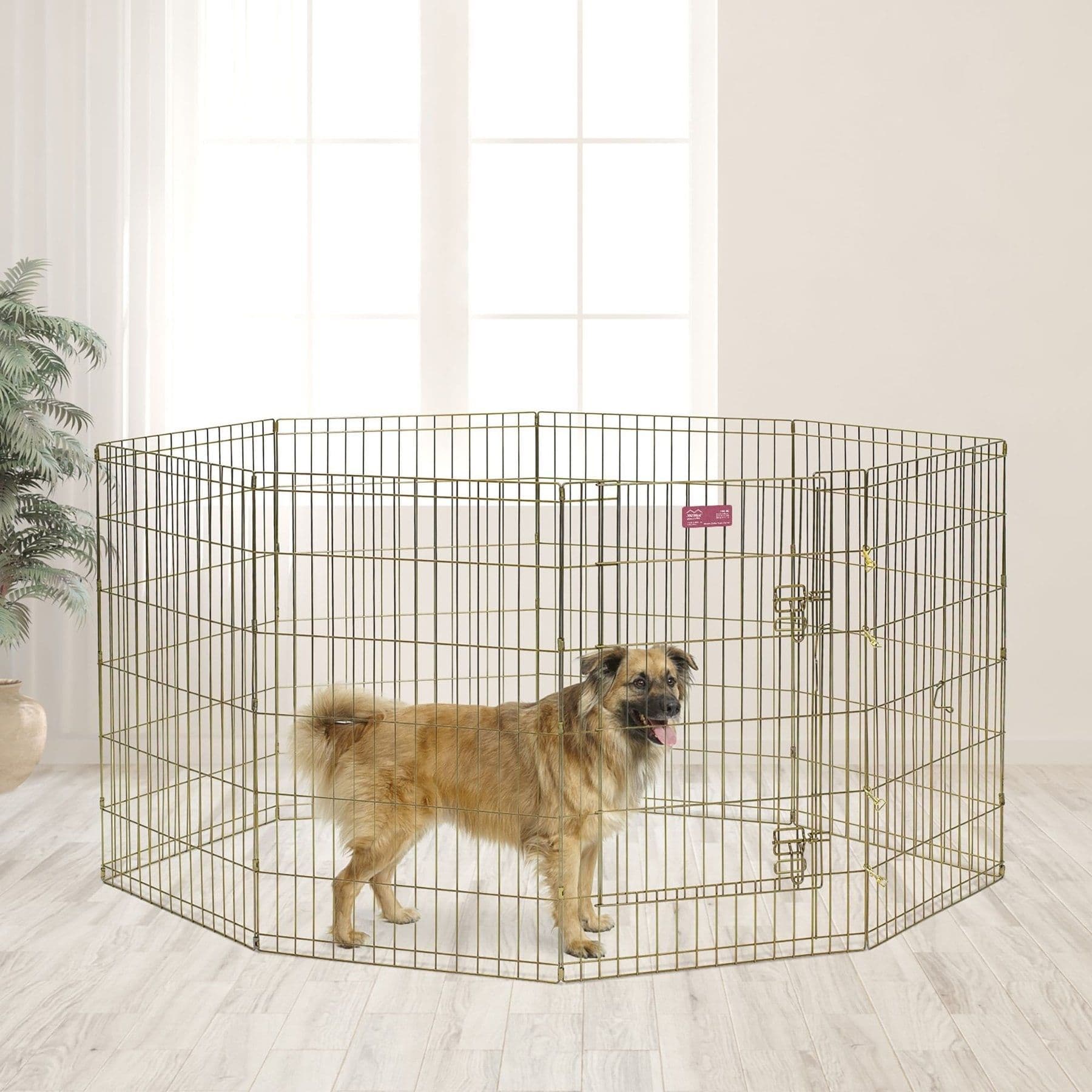
A 36-inch metal exercise pen with step-through access; use an approved layout and supervise the individual dog.
Webvet may earn a commission when you click through to Chewy, at no extra cost to you.
A MidWest exercise pen is a useful conventional option when wire panels suit the dog and setting. The ability to change the outline can help fit a room, but not every shape produces equal stability or usable area. Follow the maker's permitted arrangements and connect the ends exactly as instructed.

The selected Gold Zinc version has a 36-inch panel height and a step-through door with two latches. That identifies the variant compared here, not a recommended height for every dog. A door can make routine access easier than stepping over panels.
Match panel height to the individual dog
Choose height by the dog's behavior as well as size. A small athletic dog can defeat a low pen, while a larger calm dog may respect a boundary. A dog that climbs the panels is showing that the current setup is unsuitable, not that an improvised cover should automatically be added.
Check these details before use:
- Secure connections between every panel.
- A floor surface that does not let the pen slide.
- Safe gaps around the door and lower edge.
- No nearby furniture that creates a climbing route.
For outdoor use, follow the exact product's anchoring instructions and supervise. Stakes do not turn a lightweight exercise pen into a permanent secure fence.
IRIS 24-Inch Playpen: a small-dog indoor option
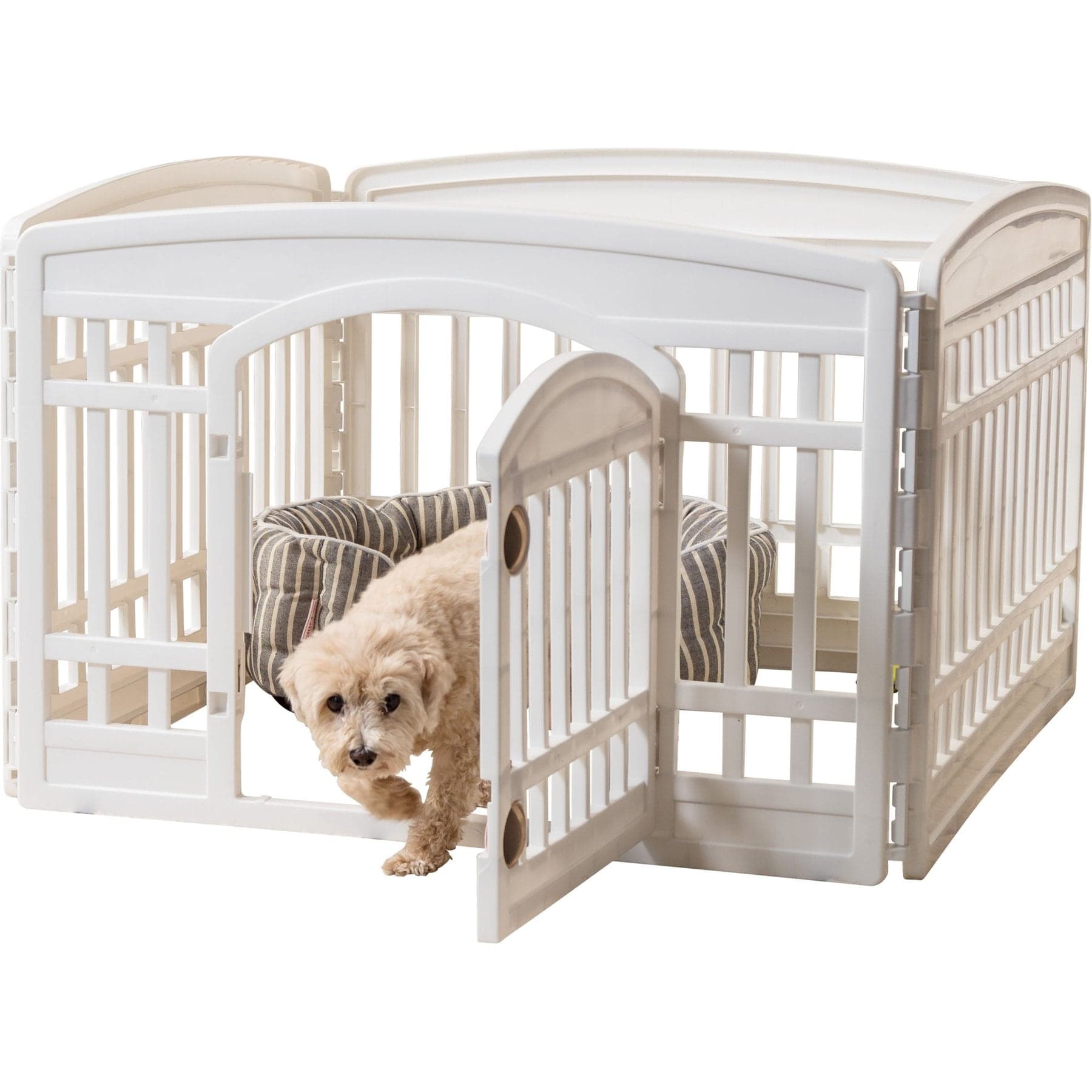
A four-panel plastic playpen with a door for an appropriate small dog or puppy; check the assembled footprint.
Webvet may earn a commission when you click through to Chewy, at no extra cost to you.
The IRIS 24-inch playpen with door offers a molded-panel design for an appropriate small dog. The low height makes suitability particularly dependent on jumping and climbing behavior.
The IRIS 24-Inch Exercise Playpen with Door suits this molded-panel comparison; its 24-inch height makes the individual dog’s ability to jump or climb a deciding factor.
The selected white IRIS set contains four plastic panels with an access door. The catalog lists matching two-panel add-ons separately. Confirm the permitted layout and final footprint before expanding it; more panels change both the space required and the setup you need to inspect.
Plan the assembled footprint
Measure the assembled footprint in the intended room. Make sure the door opens without hitting furniture and that a person can reach the dog without an awkward step over the panels. Consider floor protection, but avoid loose coverings the dog can pull into a chewing game.
This is a better candidate for a dog that rests calmly than one that repeatedly pushes the boundary. Begin with short supervised use. If the pen shifts, the dog starts climbing or a gap opens at the base, stop and choose a more suitable arrangement.
Richell Convertible Elite: a room-friendly layout
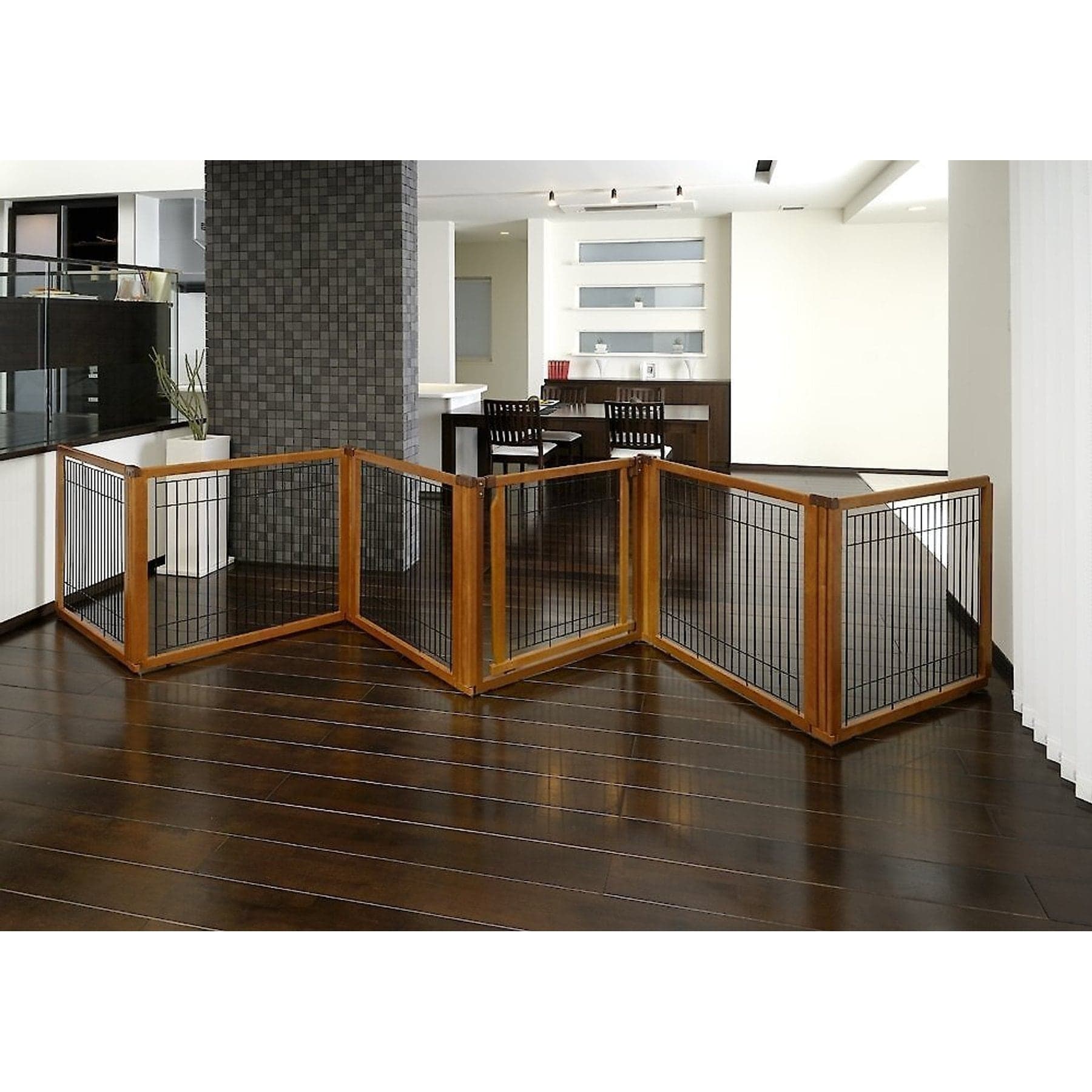
Six convertible panels with a lockable access door for an approved room-divider or pen layout.
Webvet may earn a commission when you click through to Chewy, at no extra cost to you.
The Richell Convertible Elite can serve as a pen, freestanding gate or divider in approved configurations. That makes it worth considering when the containment area needs to adapt to a room's use.
The selected brown Richell set contains six panels and a lockable access door. Its connector caps set panels at 90 or 180 degrees. Those defined positions are the useful design distinction: the panels are not intended to hold an arbitrary curve wherever furniture happens to leave space.
Work within approved configurations
The benefit is not unlimited flexibility. Follow the instructions for the exact panel set, and account for the floor area needed to keep it stable. An attractive straight line across a room may not be the approved enclosure shape.
Think about whether a pen or a gate actually solves your problem. If a safe room already exists, a properly fitted dog gate may give the dog more usable space. If you need a separate rest area within an open room, the enclosed layout may be more helpful.
Pet Gear Travel Lite: short supervised trips
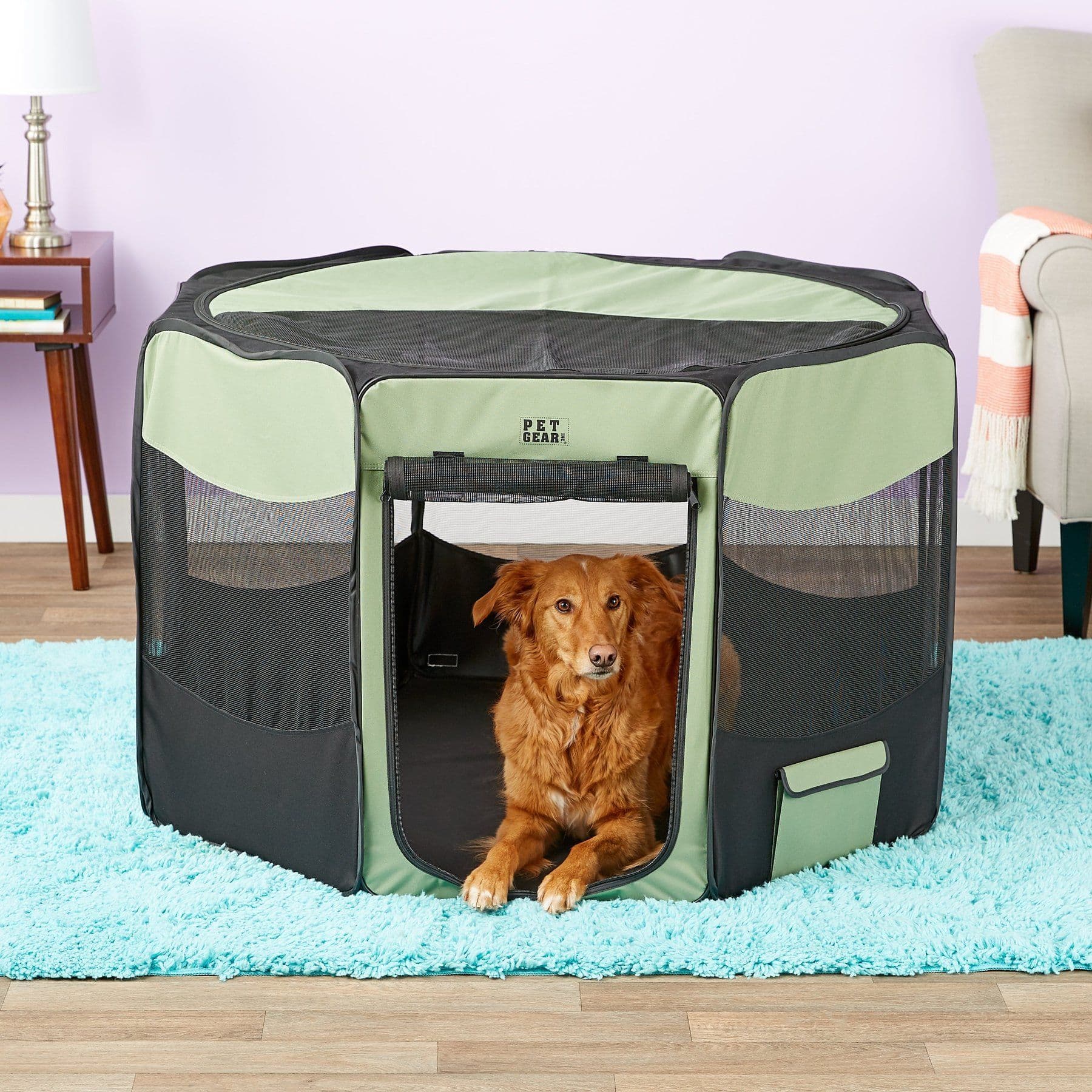
A folding soft-sided pen for short supervised use with a calm dog; inspect fabric, zippers and seams.
Webvet may earn a commission when you click through to Chewy, at no extra cost to you.
The Pet Gear Travel Lite Soft-Sided Pet Pen is a portable fabric option. The manufacturer's instructions describe setup for the specific model range. Check that the structure is fully opened and stable before the dog enters.
Soft sides and mesh are inappropriate for a dog that claws, mouths or chews them. A removable top does not make the pen an escape-proof container, and the pen should not be treated as a vehicle restraint or weatherproof outdoor kennel.
It is most useful when a calm dog needs a familiar resting boundary while a person remains nearby. Inspect seams, zippers and mesh before every trip, and have another plan if the dog does not settle in the new setting.
Choose floor area, height and placement
The dog needs room for normal movement after necessary items are added. Panel count alone cannot tell you that: long narrow layouts can offer less useful resting space than a more balanced enclosure with the same panels.
Mark the proposed footprint on the floor, then place a bed and bowl inside the outline. Imagine opening the pen, cleaning it and guiding the dog out without stepping over a barrier. Choose a location with comfortable temperature, social contact and a clear view for supervision.
Avoid these placements:
- Beside electrical cords, curtains or reachable table edges.
- In direct sun through a window.
- Against furniture the dog can climb to escape.
- In a busy route where people may trip or leave the door open.
A crate serves a more compact resting role. The crate sizing guide can help with a sleeping enclosure, but a pen requires a broader activity-and-care layout rather than simply a larger crate measurement.
Set up a puppy pen for real daily needs
Compare two layouts with the same panels
MidWest’s Gold exercise-pen instructions cover the selected 544-36 model, an eight-panel pen. Its manufacturer catalog specifies 24-inch-wide panels. That gives 16 feet of panel length, but the enclosed area changes with the shape. Use only a configuration the instructions permit.
| Illustrative layout using eight 2-foot panels | Area calculation before panel thickness and contents | Practical effect |
|---|---|---|
| Square: two panels per side | 4 × 4 = 16 square feet | More balanced space for resting and turning |
| Rectangle: three panels on each long side, one on each short side | 6 × 2 = 12 square feet | Same panel count, 4 square feet less area and only 2 feet of width |
These are planning calculations, not measured clear interior dimensions or a space allowance for every dog. A 3 × 2-foot bed occupies 6 square feet: the square has 10 square feet left arithmetically, while the rectangle has 6. Bowls, door operation and the dog’s movement reduce what remains usable.
MidWest’s catalog also limits its listed pen tops to the four-foot square configuration. A cover that fits the square is not automatically compatible with a long rectangle. Check the exact accessory, then mark the approved layout and door swing on your floor before buying.
Try the care tasks before adding the dog
Test the layout while empty. Open the access door, remove the bed and imagine cleaning a spill at the far side. If an adult must climb over panels to reach the dog, consider a model with a suitable entrance or change the room arrangement.
A convenient access door can be more valuable than an extra decorative feature.
The MidWest exercise-pen range includes different heights, and its instructions matter as much as the chosen number. A taller panel does not prevent a dog pushing the whole enclosure across a slick floor. Height and stability are separate decisions.
Compare clear panels with open wire
A clear acrylic dog playpen can preserve the view through a boundary, but transparency does not establish ventilation, stability or suitability for a dog that jumps against it. Check the actual openings, connectors, base and cleaning instructions. Follow the dog's response during supervision rather than assuming an unobstructed view will prevent frustration.
Plan the floor before adding bedding
A dog playpen with a waterproof bottom can simplify spill cleanup, but inspect seams, edges and the floor beneath it. A separate playpen mat needs the same checks. Waterproof does not mean chew-resistant, and a loose liner should be removed if the puppy can lift or shred it.
Indoor floors create their own tradeoffs. A waterproof layer may help protect the surface beneath the pen, but loose edges can become a chewing target. Choose a setup that remains flat and secure and that you can inspect. Avoid piling towels around the edge to conceal a gap the dog can exploit.
Observe whether the dog slips when turning or stepping through the entrance. A pen placed on a smooth surface may need an appropriate nonslip arrangement compatible with the product and the dog. Do not solve sliding by adding heavy objects inside the dog's space or trapping the panels beneath furniture in an unapproved way.
Leave room for water and cleaning
Keep water where the dog can reach it without repeatedly stepping into it. Check that bowls or attachments cannot tip, trap a paw or reduce the useful entrance. The final arrangement should remain easy to clean, because an area that is difficult to maintain often becomes less comfortable over time.
A pen for a large dog is a behavior decision
A heavy-duty dog playpen should be judged by its actual panel construction, connectors and approved anchoring, not the label. Metal alone does not establish stability. For a big dog, check both the usable floor area and whether the dog can move the entire pen during ordinary supervised activity.
A large dog's body size makes floor area important, but strength and behavior decide whether a lightweight pen is appropriate. A calm dog may respect a boundary during supervised rest; an excited dog may move or topple it. Do not infer suitability from a photograph of a similarly sized dog standing inside.
If the dog leans on the panels, climbs or repeatedly tests the door, change the arrangement before leaving them there. A dog-proofed room behind a correctly mounted gate may provide a more workable space.
- If the behavior reflects distress, address that with appropriate help rather than continuing to add weight or height to the same pen.
Plan a puppy’s care routine
A puppy pen can help keep a puppy nearby while you cook or work, provided you can still respond to their needs. Introduce it positively and start with short periods while you remain present. Reward settling rather than waiting until the puppy is frantic to begin training.
Plan the routine before the equipment:
- Offer an appropriate toilet opportunity before confinement.
- Provide safe rest space and access to water as appropriate.
- Supervise new toys and remove items the puppy damages.
- Arrange regular breaks, play, social contact and care.
Do not use a pen to justify leaving a young puppy alone for a duration they cannot manage. The enclosure cannot provide reassurance or notice an accident, illness or escape attempt. If an absence is unavoidable, arrange help based on the puppy's individual needs.
Outdoor pens need weather and escape checks

A large outdoor dog playpen still needs approved anchoring and supervision. More panels can create a larger footprint without making the enclosure stronger. A portable outdoor pen is useful only while the person can watch and respond; it is not a substitute for a permanent secure exercise area.
An outdoor pen needs level ground, secure assembly, shade and a supervising adult. Shade moves as the day changes, and mesh walls do not protect a dog from dangerous heat, storms or approaching animals.
Inspect the entire perimeter for gaps and digging opportunities. Keep the pen away from roads, pools and other hazards even if the dog appears calm. A dog may react differently when wildlife, another dog or a visitor approaches.
Do not treat a roof as complete protection
An outdoor dog playpen with a roof or cover still needs product-specific approval for that attachment, suitable ventilation and inspection of the entire perimeter. A fabric top is not proof against climbing, chewing or approaching animals. Remove the dog when conditions are unsuitable rather than relying on a cover to make exposure safe.
Check the ground itself. Hot paving can injure paws; the hot pavement guide explains why surface conditions matter. Bring the dog inside if the weather or their comfort changes rather than trying to solve every outdoor risk with another accessory.
Dog playpen questions
Frequently Asked Questions
Can I leave my dog in a playpen all day?
A pen is not an all-day care plan. Dogs need toilet opportunities, activity, company and checks on comfort and safety. Arrange breaks and assistance rather than assuming more floor area makes a long absence suitable.
Are playpens good for dogs?
They can be useful management tools for dogs that are comfortable in them. Suitability depends on size, behavior, setup and routine. A dog that repeatedly climbs or panics needs a different arrangement.
What is the best dog play pen?
Choose the design that fits your dog and setting: wire panels for an appropriate configurable space, molded panels for some small dogs, or a soft pen for calm supervised travel use. No one design meets every need.
Is it better to leave a puppy in a crate or playpen?
They serve different purposes. A crate is a compact resting enclosure; a pen can separate rest and other needs over a larger area. Both require positive introduction, suitable sizing and a care routine.
Can I leave my 9 week old puppy alone for 2 hours?
Do not assume that from age alone. Consider toilet needs, health, prior experience and the puppy's response to separation. Arrange help when the puppy cannot comfortably manage the planned absence, and build alone time gradually.

Editor
The Webvet Editorial Team is the in-house group of pet-care editors and writers behind Webvet, operated by Smart Pet Collective. The team researches, writes, and maintains Webvet's pet health, behavior, and medication content. Every article follows a defined editorial process: research from reputable veterinary and scientific sources, careful drafting, mandatory review of medical content by a credentialed veterinarian, and dated publication. Health and medication articles are medically reviewed by a licensed veterinary professional before they go live and are kept current over time.
Related reading

Dog Gate for Stairs: Safer Choices for Top and Bottom Landings

Best Dog Gates: Match the Barrier to Your Doorway and Dog

Dog Crate Furniture: Stylish Options and the Fit Checks That Matter
