Best Dog Gates: Match the Barrier to Your Doorway and Dog
Choose an indoor dog gate by the opening, mounting method and dog’s behavior. Compare four designs and check escape routes, stair limits and everyday access for people.

This article contains affiliate links. Webvet may earn a commission when you buy through them, at no extra cost to you.
A dog gate must fit the opening, mounting method and dog's behavior. Walk-through gates suit hallways, freestanding dividers suit some calm dogs, and stairways need location-specific installation.
Start with the location and the ways your dog could get around the barrier.
- 1Choose the mounting method before the material or color.
- 2Check gaps, climbing routes and the threshold people must cross.
- 3Use a stair-approved hardware installation at the top of stairs, following the exact product instructions.
Compare dog gate types and picks
Before narrowing the product shortlist, survey the opening with both the dog and people in mind. Wall geometry determines where brackets can attach; escape behavior determines whether the barrier is suitable; thresholds and swing space affect human trip risk. Measure the actual walking route as well as the wall-to-wall width.

These are researched design options, not products we have personally tested. Compare each model's current instructions with your home before buying. A manufacturer's maximum width, height or stair approval applies to the specified installation, not every improvised arrangement.
| Option | Best reason to consider it | Important limit |
|---|---|---|
| Cardinal Auto-Lock MG-15 | A permanent hardware-mounted barrier | Needs suitable attachment points and correct installation |
| Carlson Extra Tall Walk-Thru | Convenient access across an appropriate doorway | Pressure mounting is not top-of-stair fall protection |
| Richell Convertible Elite | Flexible room division for a suitable dog | A freestanding layout is not for a dog that pushes or jumps it |
| KidCo Retractable Safeway | A barrier that retracts when not needed | Mesh, mounting and stair requirements need careful checking |
An opening survey prevents the common mistake of choosing a gate that is technically wide enough but unsuitable for the location. Record the opening width at mounting height, available wall material, baseboard projection, floor level, dog size and any nearby furniture that could become a launch point.
For a household with children, check the requirements for child safety separately. A pet gate does not become a child safety gate simply because it blocks a dog, and a child-rated product still needs to suit the particular dog.
Dog gate picks
For a dog gate with a doggie door, check whether the small opening defeats the boundary for a puppy or another pet. Carlson's passage is useful only when the animals you intend to separate cannot both use it. Close or secure that opening according to the model's instructions when it is not needed.
Cardinal Auto-Lock: hardware-mounted containment
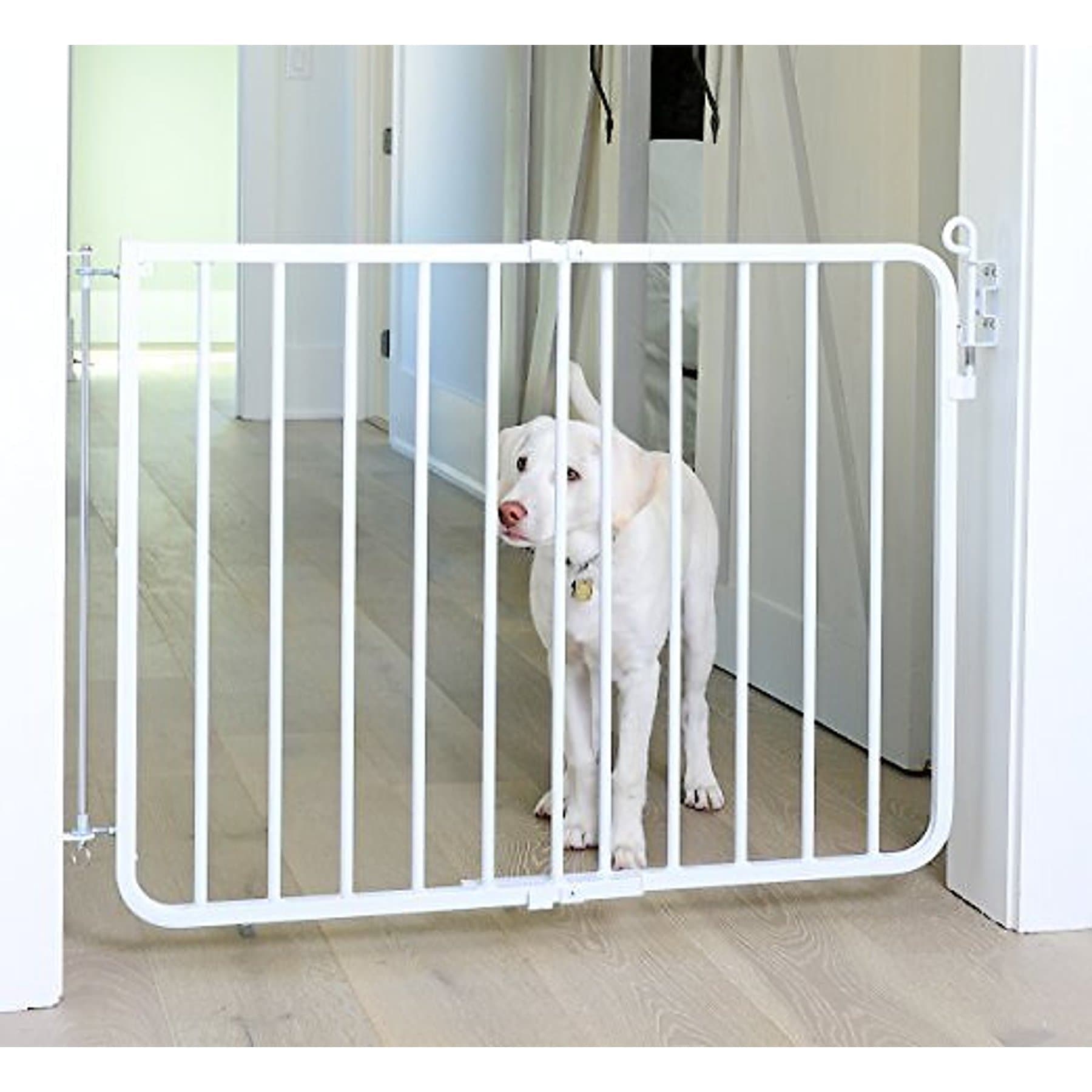
A hardware-mounted gate whose latch engages when it is swung closed; match its instructions to the opening.
Webvet may earn a commission when you click through to Chewy, at no extra cost to you.
The Cardinal Auto-Lock MG-15 is a hardware-mounted aluminum gate. Its latch engages when the gate is swung into the latch assembly; “auto-lock” should not be read as a promise that a gate left open closes itself.
Cardinal lists an adjustable opening range of 26.5 to 40.5 inches, a height of 29.5 inches and bar spacing of 2.5 inches. Those measurements help eliminate an unsuitable opening or a dog small enough to pass between bars. They do not guarantee containment of a climber or jumper.
Check the installation and daily route
Compare the mounting instructions with the wall material, trim and direction of travel. The manufacturer's own approved extensions have specified ranges, so do not assume an extension simply adds its nominal length to every usable opening. Confirm the complete configuration before purchase.
For a high-traffic doorway, practice the latch while the dog is managed elsewhere. Everyone using the gate must confirm closure, and the route should remain clear. Near stairs, use the dedicated dog stair gate guide to assess the landing and the exact instructions.
Carlson Extra Tall Walk-Thru: a doorway option
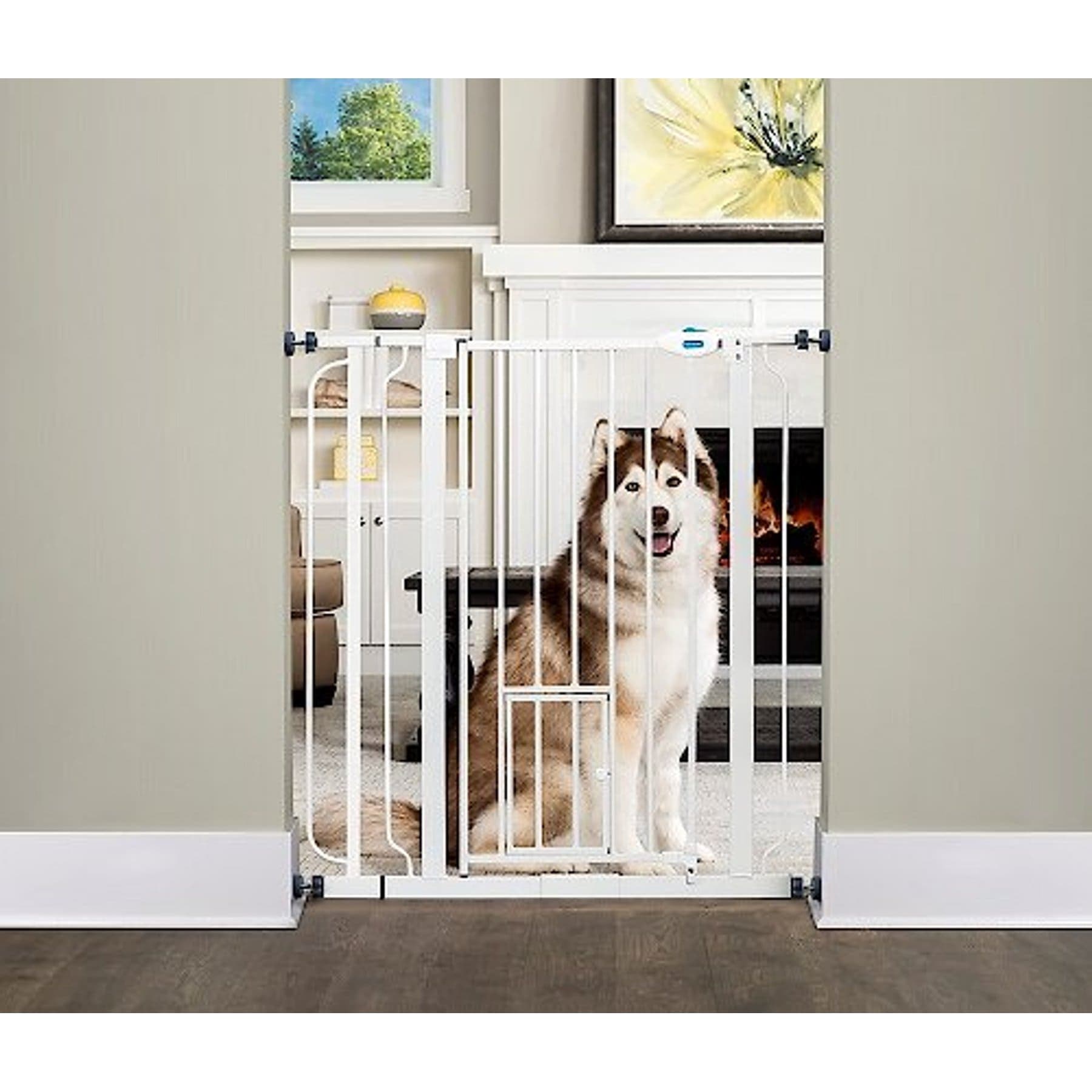
A walk-through gate with a small-pet opening for an appropriate doorway; check gaps, threshold and mounting.
Webvet may earn a commission when you click through to Chewy, at no extra cost to you.
A walk-through gate can reduce the temptation to climb over a barrier every time you enter a room. The Carlson Extra Tall Walk-Thru is an option to compare when a suitable doorway needs regular human access and the dog benefits from additional height.
“Extra tall” is not a guarantee against jumping. Assess the individual dog, furniture beside the gate and whether the dog climbs horizontal features. Also check the small-pet opening on the exact model: it may help a cat pass, but it can defeat the barrier if the dog fits through it.
Pressure-mounted designs require particular care:
- Fit only within the maker's allowed opening range.
- Use required wall cups or other supplied parts.
- Check pressure and alignment regularly.
- Treat any bottom crossbar as a trip hazard.
Do not use a pressure-only setup at the top of stairs. If you cannot make the location match the installation requirements, select a different barrier or move the containment point.
Richell Convertible Elite: a flexible room divider
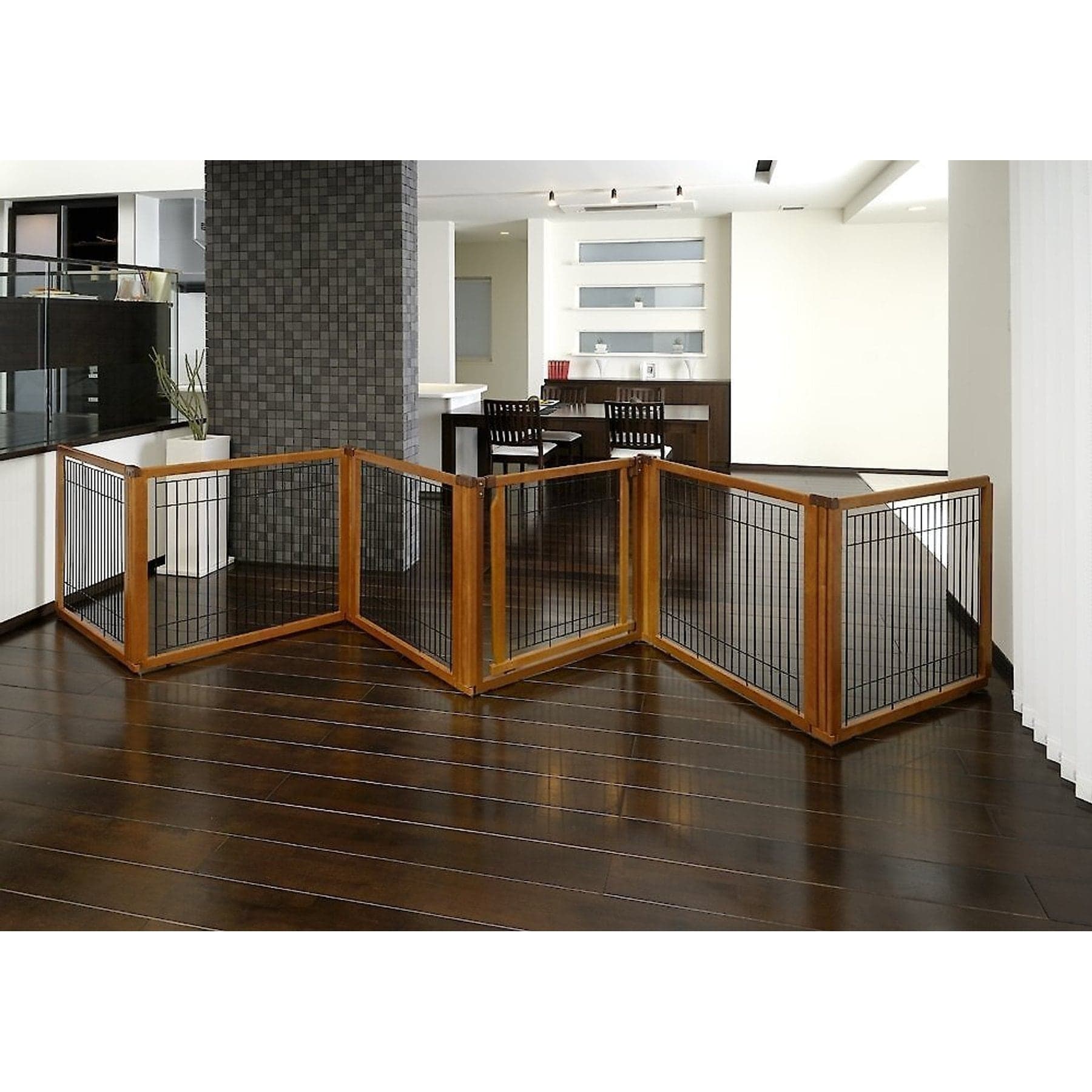
Six convertible panels with a lockable access door for an approved room-divider or pen layout.
Webvet may earn a commission when you click through to Chewy, at no extra cost to you.
The Richell Convertible Elite can be arranged as a pen, freestanding gate or room divider according to its instructions. That flexibility is useful when the goal is to define a resting area in an open-plan room rather than permanently close one doorway.

A freestanding arrangement relies on its approved geometry and a dog that respects the barrier. It is not a suitable answer for a dog that shoves panels aside, climbs them or charges toward visitors. Keep the layout within the maker's permitted configurations rather than stretching it into a nearly straight, unstable line.
Consider the full floor footprint, not just the span across the opening. Support panels take room, and an attractive divider may become an obstacle in a narrow hallway. Check that no free end leaves a gap a small dog can squeeze through.
KidCo Retractable Safeway: retractable separation
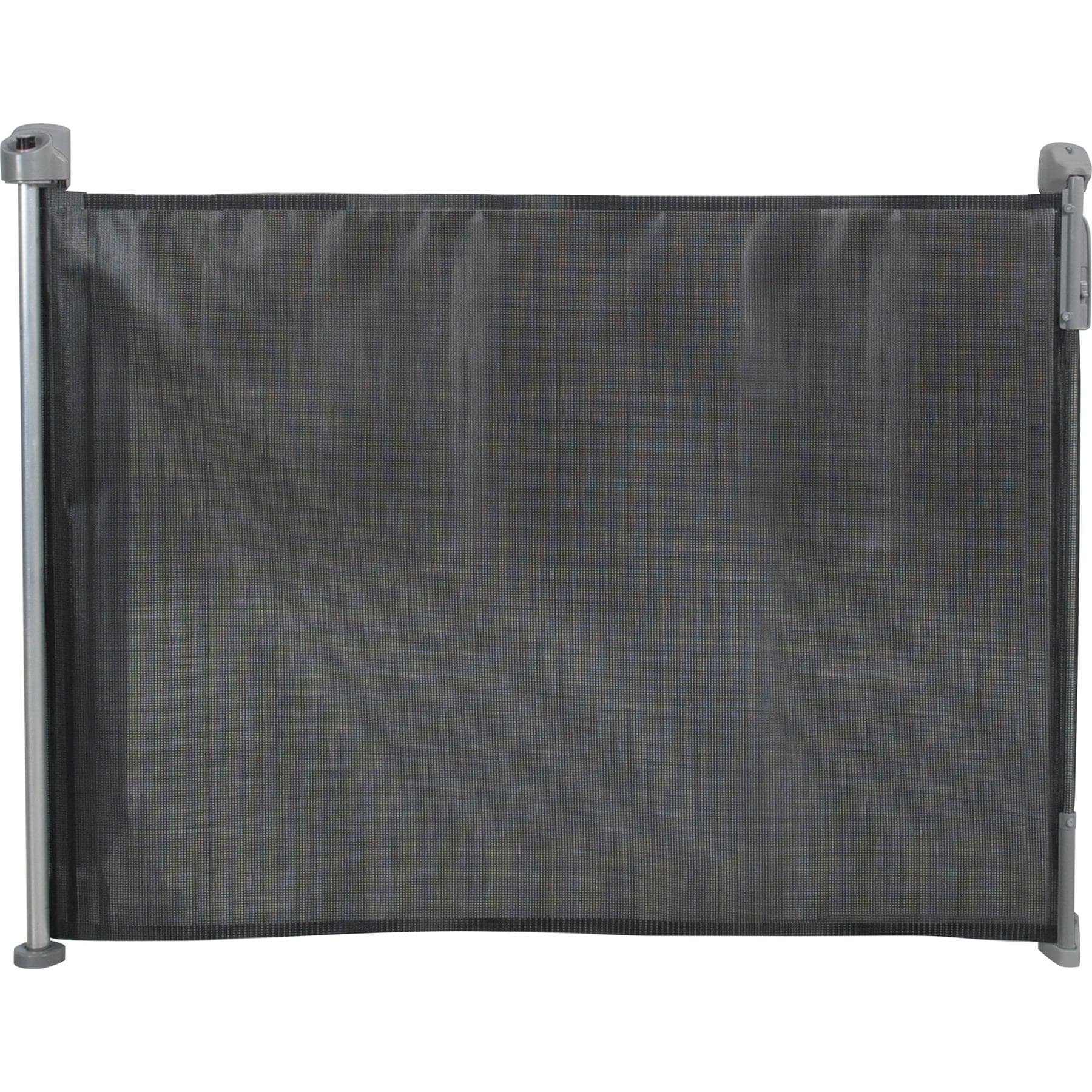
A retractable mesh barrier that clears the opening when not needed; confirm mounting and suitability for your dog.
Webvet may earn a commission when you click through to Chewy, at no extra cost to you.
The KidCo Retractable Safeway is a hardware-mounted mesh design with a width-setting mechanism and quick-release hardware. It is useful to compare when a rigid gate would occupy space while open. The maker lists a maximum opening of 55 inches and includes spacers intended for baseboard installation.
The retracting format changes storage, not the need for secure mounting. Check the actual bracket locations and supplied instructions before choosing it for an irregular wall or a stair location. Do not generalize the installation requirements of a similarly named rigid Safeway gate to this model.
Match mesh to the dog’s behavior
Mesh may be a poor choice for a dog that claws, chews or pushes persistently at the barrier. Observe initial use and choose a different arrangement if the dog tests it that way. A clean-looking doorway is not enough if the material is unsuitable for the animal using the space.
Presetting width is a convenience. Each time the barrier is used, confirm that it has engaged properly and the lower edge does not create an unsuitable gap. Keep the manufacturer's care instructions so a future move or reinstall preserves the intended setup.
Measure the opening and the escape routes
Start with the job the gate must do
Write one sentence describing the intended use. Keeping a calm dog out of a kitchen while dinner is prepared is different from preventing access to a stairway, separating pets during meals or managing an open front door. The location and consequences of failure should shape the shortlist.
Then record who will use the passage. A gate across a rarely used storage-room opening may be operated twice a day. A gate between a kitchen and living room may be opened dozens of times while people carry things.
Latch operation, opening width and a bottom threshold can matter more than decorative finish in that second location.
Example: a kitchen boundary
Suppose an adult dog calmly stays behind barriers but the kitchen doorway has projecting baseboards. A suitable pressure-mounted walk-through gate might work away from stairs, provided its approved width and attachment method fit the actual surfaces. A freestanding divider may need more floor space than the narrow doorway offers.
Before choosing either, consider where the dog will rest. A bed or mat a little back from the gate can provide a comfortable waiting place away from the cooking area. The barrier manages access; it does not teach the dog what to do with the waiting time.
Example: a dog that rushes visitors
A barrier near the entry can help manage space, but a dog that charges or climbs it needs a different assessment from the calm kitchen example. Identify a containment point farther from the opening, consider the dog's behavior and introduce the arrangement before visitors arrive.
Do not rely on a low decorative divider immediately inside an open front door for a dog likely to push past it. A closed suitable room, another caregiver or a different management arrangement may be more appropriate. If the dog's behavior is difficult to manage safely, get qualified help rather than continually buying taller barriers.
Measure where the brackets actually sit
Take the opening width near the floor and at the proposed upper mounting points. Baseboards can make the bottom narrower than the top. Decorative trim may project beyond the wall, and a tapered post may offer a different width at each bracket. Record these differences rather than averaging them into one number.

For hardware mounting, identify the actual structure supporting each attachment. A finished surface is not the same as a suitable fastening point. Follow the manufacturer's instructions for the material and approved hardware, and get installation advice when the underlying structure is uncertain.
Keep the floor in the measurement
Look for a slope, a threshold strip or a change from carpet to hard flooring. The gate needs the clearances and alignment specified by the maker. Raising it to avoid an uneven surface can leave a gap below; forcing it into a skewed position can affect the latch.
If the location cannot accommodate the required geometry, move the barrier or choose a model designed for the arrangement. Do not trim structural parts or add makeshift packing simply to make a purchased gate fit. An alternative doorway may be the more practical solution.
Read width ranges carefully
The Cardinal Auto-Lock MG-15 shows why extension names are not a simple addition exercise. Cardinal publishes the following opening ranges for this model. Measure at the actual mounting points, then match a listed configuration.
| MG-15 configuration | Published opening range | Decision |
|---|---|---|
| Base gate | 26.5–40.5 inches | No extension needed only when the actual installation meets this range and the manual |
| BX1 10.5-inch extension | 42.5–53 inches | Use the approved configuration, not base maximum plus extension length |
| BX2 21.75-inch extension | 48.75–64 inches | Check required parts and attachment geometry before ordering |
Keep the selected configuration with your notes. If one extension belongs on a specified side or a model requires particular cups or brackets, include that in the purchase. An incomplete set is not an opportunity to substitute parts from a different gate that appear similar.
Worked width decision
For a 41-inch opening, the opening exceeds the base gate’s maximum by 0.5 inch, while the BX1 configuration starts at 42.5 inches. Do not stretch adjustment hardware to fill the gap. Ask Cardinal to confirm an approved solution or choose a different model whose documented range includes 41 inches.
Width is only one filter. The same MG-15 is listed as 29.5 inches high with 2.5-inch bar spacing and is not an outdoor model. A span match cannot compensate for a dog that fits through the gaps, jumps the height or needs a weather-rated barrier.
For an extra-wide dog gate across a 60-inch opening, the MG-15 with the BX2 extension falls within Cardinal’s published 48.75–64-inch range. Compare that hardware-mounted arrangement with a freestanding divider’s full support footprint before deciding which fits the room and the dog.
Evaluate small dogs and puppies by gaps
For a big dog, body size affects both the space needed to pass and the height of nearby climbing aids. A heavy-duty gate label does not establish a strength rating: assess the exact mounting and behavior instead of assuming a larger frame will stop a dog that pushes or climbs.
Height is only one dimension of containment. A small dog may pass between bars, through a cat opening, under the bottom edge or beside an end panel. Compare the actual clear gaps with the individual dog before allowing use. Do not wait for a head or body to become trapped to discover a mismatch.
Growing puppies need repeated checks. An opening that once allowed easy passage can become an entrapment concern as the puppy grows, while climbing ability may change too. Review the whole barrier during the puppy's development rather than assuming the first installation remains suitable.
A cat opening is a separate decision
A small-pet door can preserve access for a cat in a mixed household, but it works only when the dog cannot use the same opening and the cat is comfortable approaching it. The opening is a physical passage, not a system that recognizes species.
Also consider what is beyond the gate. If the purpose is to keep a dog away from cat food or a litter box, position the boundary so the cat can approach without being crowded. A higher or separate cat route may be another option, provided it is suitable for that cat and the room.
Evaluate jumpers, climbers and pushers separately
Jumping and climbing place limits on what a household gate can achieve. If your dog clears the top, climbs the mesh or uses nearby furniture as a launch point, remove the escape route and choose a different safe arrangement. Buying a taller version of the same unsuitable design may leave the underlying problem unresolved.
A taller gate may help in some households, but there is no universal height that contains every dog. Look at nearby furniture, the dog's previous behavior and the gate's structure. A sofa beside a gate can become an intermediate step even when the barrier itself seems tall enough.
A dog that climbs uses the structure differently from a dog that jumps clear of it. A dog that pushes tests the mounting or free-standing footprint. Describe the actual behavior when asking a manufacturer or professional for advice; the label “large dog” leaves out these important differences.
When changing material does not solve the problem
Replacing wood with metal may change resistance to chewing, but it does not resolve barrier frustration or separation distress. Repeated biting, frantic scratching or attempts to force through a gap require reassessing the situation. Continued containment alone is not evidence that the dog is comfortable.
Use an appropriate alternative space while the issue is addressed. A suitable dog playpen or prepared room may serve some dogs better, but each still needs a behavior and environment check. None is automatically the answer for a dog distressed by confinement.
Then look from the dog's perspective:
- Can the head or body fit between bars or through a pet opening?
- Can the dog crawl under the lower edge?
- Is a chair, sofa or step close enough to help the dog jump?
- Can the dog push the gate out of alignment?
Do not make a small dog prove a gap is unsafe by letting them try it. If the spacing is questionable, choose a design with appropriate openings. Added mesh, boards or ties can introduce chewing and entrapment hazards, so obtain manufacturer guidance before modifications.
Choose the mounting method before the finish
| Situation | Mounting decision | Unsuitable shortcut |
|---|---|---|
| Stair drop | Follow a stair-rated model’s complete hardware instructions | Pressure alone or a freestanding divider |
| Ordinary doorway | Compare permitted pressure or hardware mounting with the dog’s behavior | Over-tightening against weak trim |
| Wide open room | Use an approved stable panel arrangement for a dog that respects it | An unsupported straight line or improvised extensions |
| Outdoor opening | Choose a model intended for exposure and inspect the entire boundary | Assuming any metal indoor gate is weatherproof |
Outdoor decks and garage openings
A gate for a front porch or outside deck must suit outdoor exposure, the attachment surfaces and any nearby drop. Check the complete railing and the route around the gate; a secure panel does not close gaps elsewhere. Use the exact stair instructions where porch steps create a fall hazard.
A garage-door opening presents a different problem from a narrow internal doorway. A household gate is not a substitute for the garage door, vehicle separation or a secure permanent boundary. Keep the dog away from cars, tools, stored chemicals and the moving door mechanism; a suitable indoor room may be more practical.
Hardware-mounted gates

A hardware-mounted gate attaches to the building using the intended brackets and fasteners. It is the relevant category for a top-of-stair installation, but hardware mounting alone does not approve every model for every stairway. The product's exact instructions and the landing geometry remain essential.
For a level doorway, this method can suit an owner who wants a fixed installation and a clear, repeatable latch position. Consider the door swing and how the gate is removed, if removal is supported. Keep the correct tools and instructions for future adjustment.
What to examine before ordering
Look at the location of the hinge and latch attachments, the mounting surface and the permitted opening width. Check whether the gate has a bottom threshold and whether a swing stop is supplied for an appropriate location. Ask about approved adapters for an unusual post or trim arrangement.
An adapter should be matched to both the gate and the surface. A no-drill banister kit can change how one side attaches, but it does not make every improvised strap arrangement acceptable. If compatibility cannot be confirmed, use another location or obtain qualified installation advice.
Pressure-mounted gates
A pressure-mounted gate uses tension between appropriate opposing surfaces. Some models also require wall cups secured as directed, so “pressure mounted” does not always mean that no screws are involved. Read the full installation method before choosing one for a rental or a surface you cannot alter.
These designs may be convenient for suitable level doorways. They should not be used as pressure-only fall protection at the top of stairs. A gate that slips in a hallway and a gate that slips beside a drop have different consequences.
Check the threshold and latch
Many pressure-mounted walk-through gates leave a low rail across the passage. Treat it as a trip consideration, especially where people carry laundry, use mobility aids or move through at night. Choose a design and location the household can use consistently without climbing over the barrier.
Follow the maker's adjustment sequence and recheck the installation as instructed. A latch that no longer aligns or a gate that moves unexpectedly needs attention with the dog managed elsewhere. Do not compensate by forcing the latch or removing a part that appears inconvenient.
Freestanding dividers
A freestanding divider uses its footprint and approved panel arrangement rather than attachment to opposing walls. It can suit a calm dog that respects a visual boundary and an owner managing an open-plan room. It is a poor match for a dog that pushes panels aside or climbs them.
Measure depth as well as span. Support panels and angled layouts occupy living space. If the only way to fit the opening is to straighten a configuration the maker expects to be angled, the product does not fit that location as intended.
Check both ends of the boundary
Stand where the dog will be and inspect the free ends. Can the dog go around a sofa, squeeze beside a panel or push into another room? A divider can appear to cover the center of an opening while leaving an easy route at the edge.
Keep movable furniture from becoming an unintended support or escape route. The divider should work in its approved arrangement, not depend on an unstable chair holding it in place. Review the layout after moving furniture or changing the room's use.
Retractable mesh gates
A retractable design rolls the barrier away when open, which can preserve space in a suitable passage. It still needs the manufacturer's intended attachments. Compare bracket placement, locking operation and lower-edge clearance rather than selecting it solely because the open doorway looks unobstructed.
Mesh behavior is also part of the decision. A dog that claws, chews or persistently pushes at the surface may require a different arrangement. Inspect for damage and stop use when the barrier no longer functions as intended; do not patch it with improvised wire or rigid pieces.
Check a specific stair approval
Some retractable products describe approved stair installations, but that does not apply to the category as a whole. Read the current manual for the exact model and installation. A product name containing “safety” or “stair” cannot substitute for the mounting requirements.
Where the landing cannot accommodate the specified placement, choose a different gate or move the containment point. The stair gate guide covers that decision in greater detail. A retracting panel is a space-saving feature, not an exception to stair precautions.
Compare everyday operation
Hardware mounting, pressure mounting and freestanding placement serve different situations. Wood versus metal is a secondary question until the mounting method is appropriate. Metal may suit a dog that chews wood, but a poorly installed metal gate is still a poor barrier.
For a renter, “no drilling” may be attractive, but it does not override a fall hazard. Ask the property owner about approved installation or choose a safer containment point away from the stairs. A playpen or dog-proofed room may offer a workable alternative.
Consider the humans too. A narrow walk-through opening, a latch that is difficult to reach or a high floor bar can make people leave the gate open. Choose a setup that can be used correctly during ordinary life, including carrying laundry or moving with limited mobility.
Introduce the gate without creating frustration
Prepare a useful space on the dog's side
Provide a suitable resting area, appropriate access to water and enough space for normal movement. Remove nearby cords, reachable food and other hazards. The gate should define a manageable area, not isolate the dog in an uncomfortable passage simply because that is where the opening happens to be.
Start with brief, supervised use and reward calm behavior appropriate to the situation. A mat away from the gate can help define a resting location. Increase demands gradually while observing the dog rather than assuming a newly installed barrier is ready for a long absence.
Watch the response, not only the latch
If the dog repeatedly jumps, bites or scratches at the boundary, identify what is triggering the behavior. Access to a person, another animal, food or the outside may be involved. Avoid turning each attempt into a confrontation at the gate.
A gate can support management while training or professional help addresses the underlying problem. It does not treat separation anxiety or aggression. When behavior puts a pet or person at risk, use an appropriate safer arrangement and qualified support rather than relying on the barrier's advertising.
Make the human routine reliable
Show every adult caregiver how the latch works and what a fully secured gate looks like. Explain any swing stop or small-pet opening. A visitor should not need to guess whether pushing the panel, lifting a handle or stepping over the whole unit is the correct way through.
Decide how deliveries, cleaning and moving furniture will be handled. If a gate must be removed temporarily, manage the dog before opening the route. Restore the intended installation and inspect it before normal use resumes.
Recheck after a change
Moving the gate to another doorway requires a fresh installation check. Width, trim, wall material and floor level may differ even within the same house. Keep the instructions with the product so the second installation follows the same care as the first.
Changes in the dog matter as well. Growth, mobility limitations or a new pattern of climbing can make an old arrangement unsuitable. Reassess actual use rather than assuming a gate that worked last year will always meet the household's needs.
Compare complete ownership costs
Include required extensions, approved adapters, installation work and replacement components in the purchase comparison. A lower-priced basic gate may cease to be the cheapest suitable setup once an unusual opening is accounted for. Conversely, a costly model may add features the location does not need.
Check the return policy before assembling or modifying anything. Keep the exact model number, hardware list and manual. For a secondhand gate, confirm all required parts are present and that the manufacturer supports the model; missing brackets or a damaged latch are material problems, not cosmetic imperfections.
Keep the purpose limited
An indoor dog gate is not an outdoor fence, a vehicle barrier or a substitute for a pool enclosure. Choose equipment designed for the actual setting. Outdoor exposure, fall hazards and different users introduce requirements that a decorative room divider does not address.
If the opening or dog does not suit the available gate, changing the management location can be more effective than repeatedly changing brands. A suitable closed room, supervised arrangement or appropriately chosen pen can sometimes solve the same household need with fewer daily compromises.

Start while you are present. Reward calm behavior near the barrier and provide a comfortable resting area on the dog's side. Increase separation gradually rather than closing the gate for a long absence immediately.
A gate can help manage greetings while training progresses. Pair it with the practical steps in stopping a dog jumping on people, and give the dog enough distance from the trigger to settle. Do not allow visitors to reach through and excite a dog that is already struggling.
If the dog repeatedly bites, claws, climbs or panics, change the setup and seek appropriate help. A taller gate is not automatically the answer. The crate guide explains another management option, but switching equipment should follow the dog's needs rather than a contest of barrier strength.
Dog gate questions
Frequently Asked Questions
What can I use instead of a dog gate?
A dog-proofed room, suitable exercise pen or supervised leash management may work. Choose according to the dog's behavior and the task. Furniture stacked across an opening is not a reliable substitute.
What is the safest dog gate?
The safest choice is one designed for the location, correctly installed and appropriate for the dog. At the top of stairs, use a specifically suitable hardware installation rather than a pressure-only or freestanding barrier.
How to make a cheap dog gate?
If you already own compatible Richell Convertible Elite panels, reconfiguring them as a level-room divider may avoid another purchase. This is assembly of a manufactured system, not a homemade stair gate. Use only genuine parts and the configuration shown in the Richell manual.
- Measure the span and the floor space needed by an approved return-panel layout. Choose a flat, solid indoor surface away from stairs and glass doors.
- Connect the panels with the supplied coupling rods, insert the hole pins, and seat the caps at the permitted 90- or 180-degree angles shown in the manual.
- Turn the bottom adjuster knobs until they contact the floor. Check that the complete arrangement stands evenly and that both door locks engage.
- Inspect the end gaps, lower edge and openings for your dog. Supervise first use; stop if the dog squeezes through, pushes, climbs or destabilizes the divider.
If you do not already own the panels, compare the complete kit price with a suitable basic gate or use a secure existing door. Reconfiguration is not automatically the cheapest purchase.
Is there a dog gate that does not require drilling?
Pressure-mounted and freestanding options exist for appropriate locations. They are not interchangeable with hardware-mounted stair barriers. Read the exact installation instructions and do not omit required wall cups or fasteners.
What is the best freestanding pet gate?
Choose a stable, approved configuration for a dog that does not push, climb or jump it. A convertible divider can be useful in a room, but a dog testing the barrier may need a different management arrangement.
What is a good small-dog gate for a doorway?
Look for suitable bar spacing, a low enough bottom gap and a mounting range that fits the opening. Overall height alone does not prevent a small dog squeezing through or underneath.
Is wood or metal better?
Material matters less than fit and mounting. A dog that chews wood may need another material, but chewing at a barrier also warrants attention to the underlying behavior. Inspect any material for damage.
Can a retractable dog gate avoid drilling?
Some products advertise alternative mounting, but do not assume adhesive fittings or improvised straps are approved. Follow the exact maker's instructions, especially around stairs.
How tall should an indoor dog gate be?
Tall enough for the particular dog without nearby climbing aids, within a suitable product design. There is no universal height that stops every dog. Persistent jumping or climbing requires a different setup.
What is the best weatherproof outdoor dog gate?
Choose an outdoor-rated model whose mounting and opening requirements match the actual boundary. An indoor pressure gate or freestanding divider is not an outdoor fence. The Cardinal SS-30OD is one manufacturer-described outdoor option to investigate; assess the entire surrounding barrier and follow its maintenance instructions.
What is the most durable dog gate?
Durability depends on the frame, latch, attachments and how the dog treats them. A rigid metal hardware-mounted gate can suit a dog that respects the barrier, while fabric mesh can be damaged by chewing. No comparative strength test in the sources establishes one universal winner.
Inspect the actual failure point: a loose wall fixing, bent panel and worn latch need different remedies. Replace damaged components using approved parts, and change the management plan if the dog persistently attacks the barrier.
What kind of gate can prevent my dog from running out the front door?
Create a second secure boundary inside the home before opening the front door, using a properly installed gate suited to the dog's size and escape behavior. Keep enough room between the barriers to enter and close one before opening the other. Supervise arrivals and combine management with calm greeting training.
Where can I find a retractable dog gate that doesn't require drilling?
Do not assume a no-drill retractable gate is interchangeable with a hardware-mounted stair design. The KidCo retractable model discussed here uses mounting hardware. For a suitable level doorway, a compatible pressure gate may avoid screws, but it still needs a sound opening and a dog that respects the barrier.
What is the safest type of puppy gate?
Choose a puppy gate with suitable spacing, a small enough bottom gap and secure mounting for the location. Observe the puppy for squeezing, climbing and chewing. Avoid a low pet opening that lets the puppy through, and use the stair-specific instructions wherever a drop is involved.
What is the best retractable dog gate according to reviews?
We have not hands-on tested these gates or aggregated comparable owner-review data, so we cannot name a review-based retractable winner. The KidCo Retractable Safeway is the mesh model compared here because its documented retracting design addresses a specific space-saving need.
Compare its mounting requirements and your dog's chewing or pushing behavior before buying. A high star rating cannot establish that the exact installation fits your doorway, and retractable does not mean no-drill.

Editor
The Webvet Editorial Team is the in-house group of pet-care editors and writers behind Webvet, operated by Smart Pet Collective. The team researches, writes, and maintains Webvet's pet health, behavior, and medication content. Every article follows a defined editorial process: research from reputable veterinary and scientific sources, careful drafting, mandatory review of medical content by a credentialed veterinarian, and dated publication. Health and medication articles are medically reviewed by a licensed veterinary professional before they go live and are kept current over time.
Related reading

Dog Crate Furniture: Stylish Options and the Fit Checks That Matter

Heavy Duty Dog Crates: Strength, Fit and Escape-Risk Tradeoffs

Dog Crate Sizes: Measurement Guide and Size Chart
