Best Dog Crates: Choose the Right Crate for Your Dog and Home
Choose a dog crate by usable space, behavior and daily care. Compare wire, plastic and soft options, plus the ownership details that determine whether a crate fits your home.

This article contains affiliate links. Webvet may earn a commission when you buy through them, at no extra cost to you.
The best dog crate is one your dog fits comfortably and can use calmly. A folding wire model may suit everyday life, while a plastic kennel offers a more enclosed resting place. A soft crate solves a portability problem only for a dog who will not chew or push through its fabric.
Start with the job the crate needs to do, then compare materials and features.
- 1Measure the dog and the usable interior before choosing a size.
- 2Match the crate to the dog's behavior, not just your room's appearance.
- 3A dog panicking in confinement needs a different management plan, not simply stronger bars.
Compare four dog crate options
Make the first crate shortlist around behavior, separating chewing, panic and travel-certification needs from price or convenience. A dog chewing an enclosure, panicking when confined or needing a certified travel restraint presents three separate decisions.
Chewing calls for inspecting the damage and changing management; panic needs an appropriate behavior plan; travel requires evidence specific to the journey and restraint.
These are researched options for different home-use needs, not products we have personally tested. The distinctions below come from the manufacturers' current designs and the practical implications of those designs. No crate here is a universal winner, and ordinary home crates should not be treated as crash-tested vehicle restraints.
| Option | Consider it for | Check before buying |
|---|---|---|
| MidWest iCrate | Everyday wire containment and an adjustable puppy space | Exact size, door arrangement and divider compatibility |
| MidWest LifeStages | A folding wire crate with an included puppy divider | Adult fit, divider position, door layout and folded storage space |
| Petmate Vari Kennel | A more enclosed plastic kennel | Interior height, ventilation and the specific travel rules if relevant |
| Pet Gear Insta-Fold Soft Crate | A calm, already crate-trained dog during supervised trips | Fabric-chewing behavior, zipper security and assembly instructions |

Use a behavior-first shortlist. A relaxed dog that sleeps while you work may do well in a conventional wire crate. A dog that paws and mouths fabric should not be placed in a soft-sided model.
Repeated escape attempts, drooling or injury put the whole confinement plan under review rather than moving the dog automatically into the most expensive crate.
Before ordering, answer three questions: Can the dog rest comfortably in it? Can you safely assemble, clean and move it? Does the dog tolerate the intended kind of confinement? A “no” to any of these is a reason to pause, even if the product is attractive or heavily discounted.
Dog crate picks
MidWest iCrate: an everyday wire option
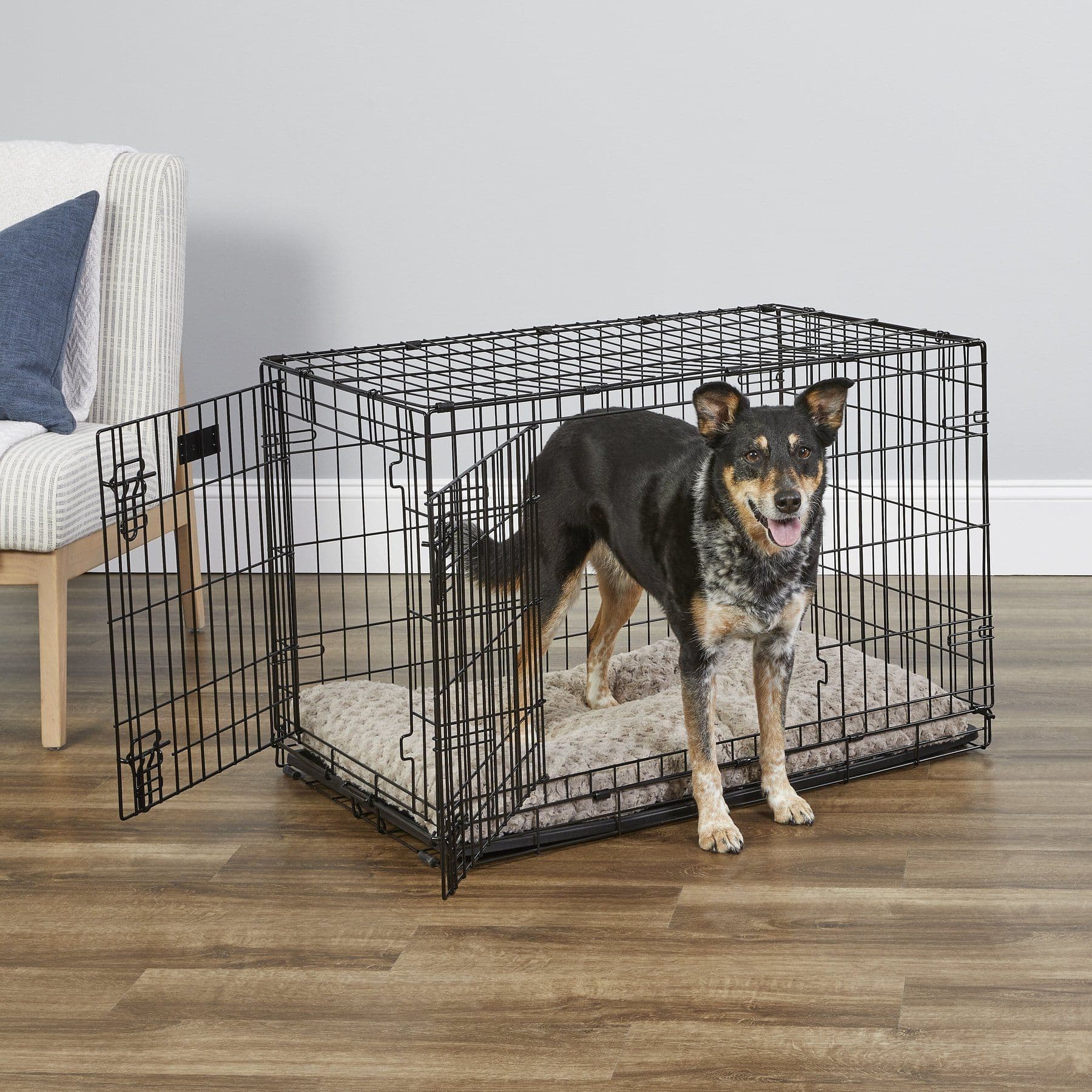
A folding wire crate with two doors; compare this variant's usable dimensions with your dog's measurements.
Webvet may earn a commission when you click through to Chewy, at no extra cost to you.
The MidWest iCrate is a useful starting point for shoppers comparing conventional folding wire crates. Its open construction makes the dog easy to observe, and a removable pan separates routine cleaning from dismantling the entire frame. Check the exact configuration because single-door and double-door versions do not give the same placement options.
The practical appeal is flexibility rather than a promise of superior behavior. A second door may let you place the crate beside a sofa while keeping the main entrance unobstructed. A compatible divider can adjust a growing puppy's living area without requiring a new crate at every stage.
Check the divider and both doors
Before selecting it:
- Confirm the interior dimensions and door opening for your dog.
- Check that the model includes the divider or accessories you need.
- Learn how the latches engage; do not assume a partly closed latch is secure.
- Inspect the assembled panels and tray for damage or sharp projections.
Wire construction is not a solution for a dog biting bars or forcefully throwing themselves against the sides. If that behavior occurs, stop using the current setup and address the distress rather than adding improvised wire ties.
MidWest LifeStages: a divider for changing puppy space
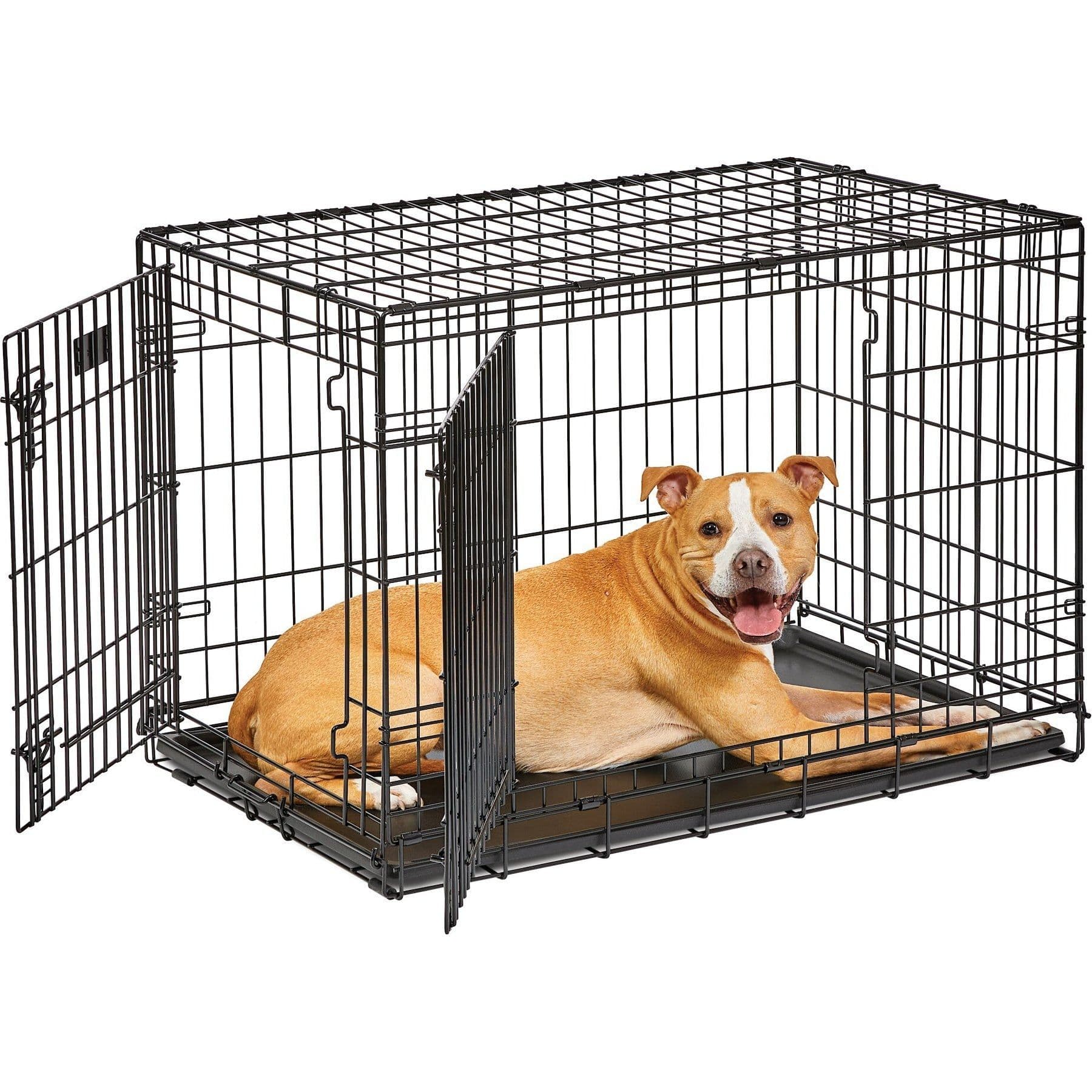
A wire crate option for comparing divider use and changing fit as a puppy grows.
Webvet may earn a commission when you click through to Chewy, at no extra cost to you.
The MidWest LifeStages Double Door Collapsible Wire Dog Crate offers another wire layout to compare with the iCrate. The selected 36-inch variant includes a divider panel and a removable plastic pan. Its value is an adjustable living area for a growing puppy, provided the adult-size crate fits the dog and room.
Compare the two MidWest models by the actual configuration, included components and usable dimensions. Both are wire crates; this comparison does not establish that LifeStages is stronger or more escape-resistant. If an iCrate already meets the same needs, a different model name alone is not a reason to change.
The LifeStages folds flat and has a carrying handle, according to its product listing. Still check the assembled footprint, folded storage space and weight before planning to move it regularly. A carrying handle does not make an occupied crate safe to lift.
Check the divider as the puppy grows
Before selecting it:
- Check the divider's attachment instructions and the space left for standing, turning and resting.
- Confirm that both doors can open in the planned room position.
- Compare the removable pan and door opening with the dog's measurements.
- Recheck divider position as the puppy grows; do not reduce comfortable movement to discourage accidents.
Petmate Vari Kennel: a more enclosed option
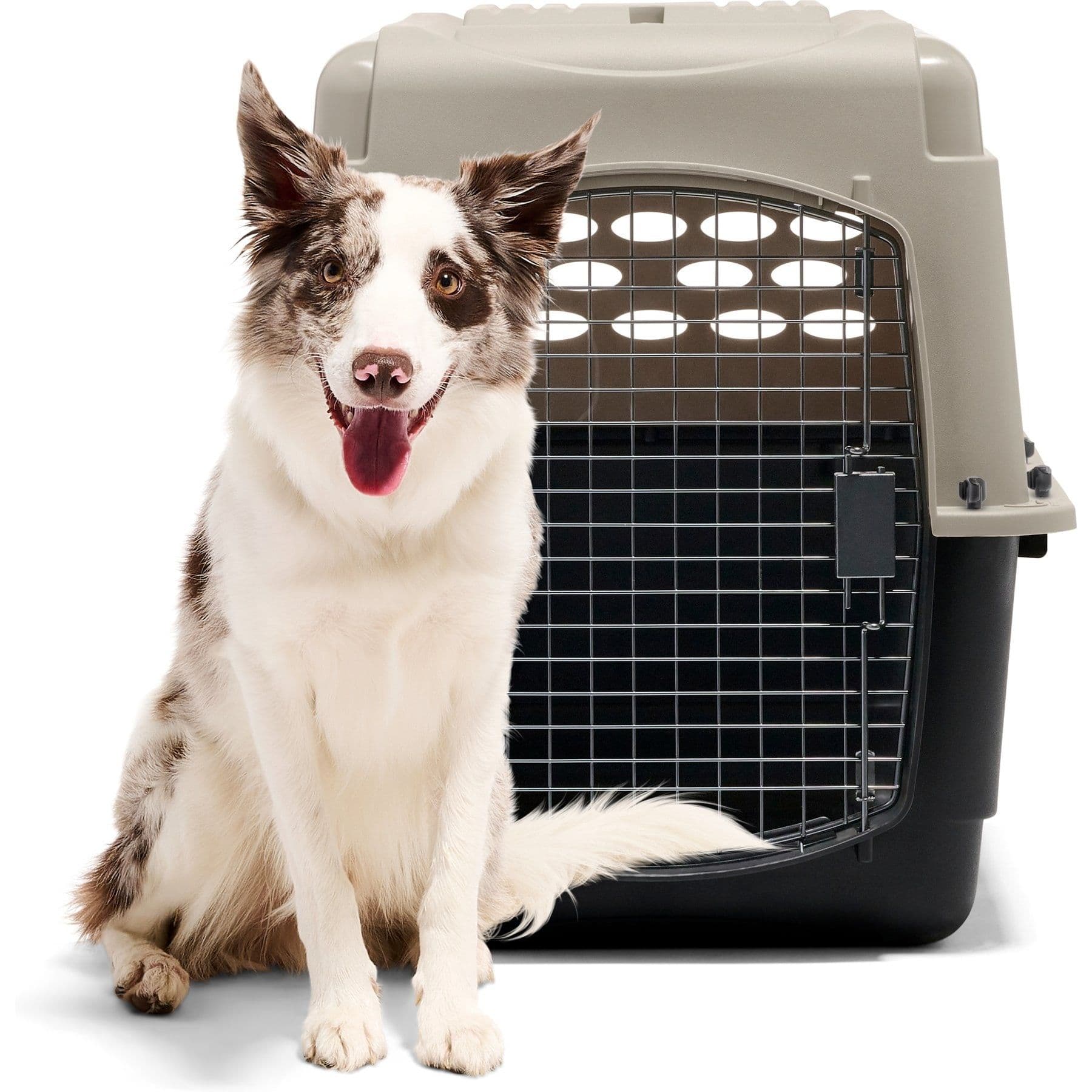
A plastic-shell kennel option; check interior headroom and the doorway rather than choosing by weight alone.
Webvet may earn a commission when you click through to Chewy, at no extra cost to you.
The Petmate Vari Kennel uses a plastic shell and a metal entrance door. Compared with an open wire crate, its walls provide less visual exposure to the room. Some owners prefer that arrangement for a quiet resting area, but an individual dog's comfort must be observed rather than predicted from material alone.
A plastic shell also changes the dimensions that matter. The interior can narrow toward the base or roof, and the entrance may be smaller than the crate's broadest exterior measurement. Check usable height and turning room with particular care for a tall or long-legged dog.
If travel is part of the plan, separate three questions:
- Is the kennel suitable for calm home use?
- Does it meet the current carrier or airline's requirements for this animal and trip?
- Has the exact product been independently evaluated for the kind of vehicle restraint you intend?
A “travel kennel” label does not answer all three. Never assume an airline-compatible design is crash-tested, or that approval by one airline applies to another journey.
Pet Gear Insta-Fold: for calm, crate-trained dogs
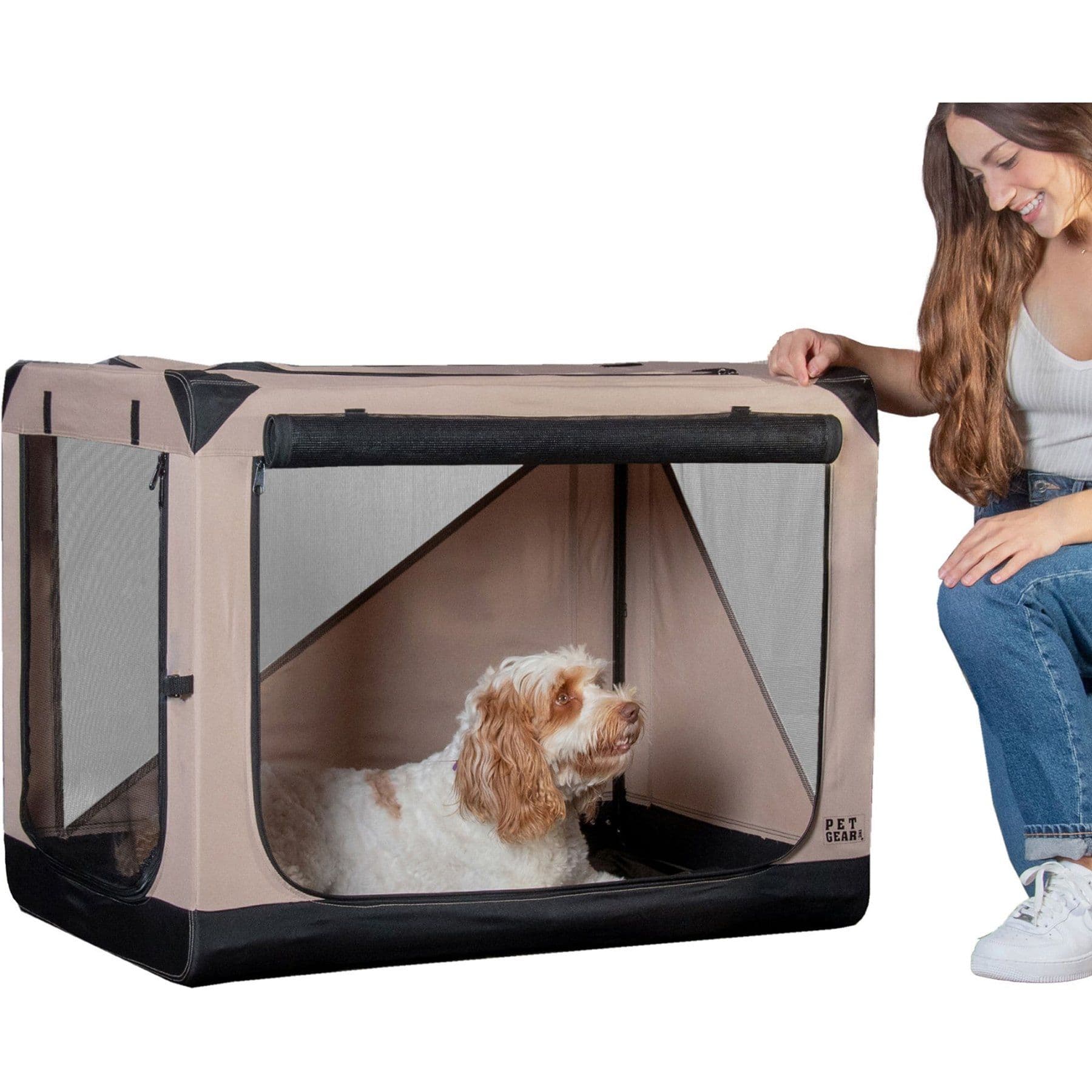
A soft-sided option for a calm, crate-trained dog during supervised use; unsuitable for chewing or escape attempts.
Webvet may earn a commission when you click through to Chewy, at no extra cost to you.
The Pet Gear Insta-Fold Soft Crate addresses a different need: a portable resting space for a dog already comfortable with confinement. Its fabric construction makes it unsuitable for a dog that chews, claws, bites zippers or pushes insistently against the walls. A first crate for an untrained puppy is a different purchase.
Follow the manufacturer's assembly instructions and check that the frame is fully locked before the dog enters. Place it on a stable, level surface, away from heat and direct sun. A mesh panel is ventilation, not climate control.
This type of crate makes the most sense when:
- The dog already settles in a crate without trying to escape.
- An adult can supervise the unfamiliar setting.
- Portability is important and the dog fits the exact model.
- You have a different plan if the dog becomes distressed.
It should not be used as a substitute for a protective vehicle restraint. Nor should it be left outdoors as a weatherproof kennel simply because it is easy to carry outside.
Choose the right size and location
Compare space and portability with actual models
| Option already in this shortlist | A concrete specification | What it changes |
|---|---|---|
| Petmate Vari 32-inch | 29.5 × 19.75 × 23.5 inches inside; 32 × 22.5 × 24 outside | Mark room space from the outside and dog space from the inside |
| Pet Gear Insta-Fold 30-inch | 29.5 × 22 × 24 inches assembled; 11 pounds | A portable fabric option occupies almost the same length when open as its label suggests |
| MidWest LifeStages 36-inch range | Manufacturer instructions specify two carrying handles for 36–48-inch crates | Plan empty-crate handling; handles do not establish safe occupied transport |
Petmate’s Vari specifications make the interior/exterior difference explicit. A dog whose normal standing height exceeds 23.5 inches is already too tall for the listed 32-inch interior, even if a retailer’s weight category appears suitable.
For repeated setup, Pet Gear lists a removable waterproof liner and three zippered doors. That offers cleaning and access flexibility for a calm fabric-crate user; it does not make mesh equivalent to wire for a dog who chews.
Use the LifeStages assembly instructions to identify both handles and the correct panel setup. Before a trip, try carrying the empty crate through the actual doorway and assembling it where it will be used.
Choose the room position
Sizing a dog crate starts with the dog’s standing and resting measurements. The largest indoor crate is not automatically the best fit: compare usable height, width and door clearance, then consider whether its footprint fits the home.
For a big dog, compare large and extra-large crates by usable inside space rather than the size label. A huge indoor crate can still have a doorway that is too narrow or a roof that is too low. Measure the dog and the route through your home before ordering.
Build a size shortlist before choosing a brand
Write the dog's body measurements on paper before opening product listings. Include natural standing height, body length using the selected manufacturer's method and the space the dog occupies when lying comfortably. If the dog is still growing, distinguish the size needed now from the expected adult size rather than averaging the two.
Next, create a short comparison with four separate numbers for each candidate: interior length, interior width, interior height and entrance size. Add a note about any divider, raised tray edge or sloping wall. This prevents a familiar “36-inch” or “large” label from substituting for the room the dog actually receives.
Compare shape, not only length
A hypothetical example shows why this matters. One model might have the right length but a low doorway that forces a tall dog to duck awkwardly. Another might provide more height but lose floor width to a thick shell. A third might fit the dog perfectly but leave its door blocked by the sofa.
Only the third problem can be solved by moving furniture; the others call for another crate shape or size.
For two dogs, plan two individual rest spaces unless a qualified professional has advised otherwise for a specific situation. A large crate does not automatically make shared confinement appropriate. Each dog needs the ability to rest without competition over the doorway, bedding or items inside.
Decide which features you will actually use
A feature list becomes useful when it connects to a daily task. A removable tray matters if you can slide it out in the final location. A second door matters if it creates a usable entrance.
Wheels matter if they operate safely as instructed on your floor and you genuinely need to move the empty crate.
Compare features in this order:
- Dog movement: Enough room and an entrance the dog can use naturally.
- Closure: A latch the caregiver can reliably operate and inspect.
- Cleaning: Access to all surfaces and replacement parts where needed.
- Placement: Ventilation, temperature and space for doors to open.
- Storage: Whether folding and carrying solve a real household need.
Decorative covers, matching cushions and accessory bundles belong later. An included bed can be poor value if the dog chews it or it takes up needed floor area. An extra panel is useful only if it belongs to the exact model and can be securely installed.
Measure first, then shop. The dog must be able to stand normally, turn and lie comfortably. Weight and breed charts narrow the search, but the actual inside dimensions determine fit. Use the dog crate size chart and measurement guide to compare exterior labels with usable space.

Choose a resting place with comfortable temperature, airflow and a predictable household routine. Avoid direct sun through glass, heaters, dangling cords and locations where a door can trap the dog or block a person. Do not cover ventilation to make the crate look tidier.
The setup also needs a practical inspection:
- Is the tray secure and the floor comfortable?
- Can the entrance open fully without striking furniture?
- Are collars, leads or loose items likely to snag? Follow the crate's specific entanglement warnings.
- Can you reach the dog quickly and clean the entire interior?
A blanket or thick bed is not automatically an improvement. Choose bedding the dog uses safely, and recheck the usable floor area after adding it. Remove damaged items or anything the dog tears and swallows.
Plan the first week, not only delivery day
Set up and inspect the crate before inviting the dog inside. Confirm every panel and fastener is correctly assembled, the door moves freely and no packaging remains where the dog can reach it. The first introduction should happen when you can stay nearby and respond, not immediately before a long absence.
Let the dog investigate with the door open. Place rewards where the dog can choose to approach and leave. Gradually build a comfortable association with resting there, following an appropriate training plan for the individual dog. This buying guide does not replace a full crate-training program, but the purchase should leave room for one.
Record comfort during introduction
Keep a simple observation record during early use: whether the dog enters willingly, which position they use to rest, whether they can turn without obstruction and what happens when the door moves. Note discomfort or distress rather than treating the absence of barking as the only success measure.
The right response to a problem depends on the observation. A dog scraping the top needs a fit reassessment. A tray that rattles may need correct assembly or a permitted adjustment. A dog that relaxes with you nearby but panics when you leave needs attention to separation, not a softer cushion.
Think through cleaning and repair
Easy cleaning is a practical welfare feature. You should be able to remove bedding, reach corners and inspect the floor without putting the dog in an unsafe temporary location. Follow the manufacturer's cleaning-product guidance and allow surfaces to dry before normal use.
Before buying, check whether the maker offers replacement trays, latches, panels or bedding in the exact size. A small damaged component should not lead to improvised hardware inside the enclosure. Photograph the model label and retain the instructions so later repairs use compatible parts.
Inspect after moves and damage
Inspect the crate after moving it, after assembly and whenever the dog damages an item inside. Look for bent wire, cracked plastic, fraying fabric, loose fasteners and doors that no longer align. A crate can remain usable for years, but appearance from across the room is not an adequate condition check.
If an accident occurs, clean the affected surfaces thoroughly with products appropriate to the materials and pet setting. Repeated accidents may reflect a schedule, training or health issue; making the crate smaller is not an automatic answer. A new change in an adult dog's routine deserves attention to the dog as well as the enclosure.
When a crate is the wrong tool
A crate-trained dog has learned to settle comfortably in that space. For a puppy, crate training requires gradual introduction and a care routine with toilet trips and company. Equipment choice does not replace that learning, and distress is a reason to reconsider the setup rather than extend confinement.
Recognize when confinement is not working
A crate can help manage a home, but it cannot supply exercise, company, toilet opportunities or treatment for fear. Some dogs rest happily in an open crate and still struggle when its door closes. Others become distressed only when left alone. Those are different patterns worth describing to a veterinarian or qualified reward-based behavior professional.
Watch for repeated attempts to break out, damaged teeth or nails, frantic movement, persistent distress vocalization or other signs that the dog is not coping. Do not leave the dog to “work it out” if injury or panic is occurring. The separation anxiety guide explains why containment alone does not resolve that problem.
Heavy-duty dog crates can change construction strength, but they do not change the underlying reason a dog is trying to escape. Furniture-style crates likewise belong with calm, appropriately introduced dogs, not as decorative replacements for a failed behavior plan.
Other ways to manage your dog's space

Compare the full ownership cost
The useful price is the cost of a suitable setup, not the lowest advertised starting size. Compare the exact dimensions your dog needs, delivery, a compatible divider if necessary and any essential replacement parts. Avoid paying for a bundle simply because it includes many items.
A lower-cost conventional crate can be a sensible choice when it meets the dog's needs and the caregiver can use it correctly. A more expensive model may justify its price through a genuinely useful access or storage feature.
Neither price level establishes that the dog will accept confinement or that the product is appropriate for a particular medical or behavior problem.
Understand returns and secondhand condition
Check the return policy before assembly and use. Understand whether size exchanges are available and whether opened or used products have different terms. This is especially valuable when a dog's proportions fall between two models and the seller's measurements are incomplete.
Secondhand equipment requires an additional condition check. Obtain the exact model identity and instructions, inspect for missing or damaged parts and check relevant current recall information. Do not assume a used crate is safe because another dog previously occupied it.
Unknown modifications or a latch repaired with improvised hardware are reasons to choose a different unit.
Keep home resting and travel protection separate
A crate that is convenient in a living room may be awkward or unsuitable in a vehicle. A fabric carrier may be easy to pack but provide little protection in a collision. A heavy home crate may become a hazard if it is not an appropriate, correctly secured vehicle system.
Before buying for car travel, look for evidence about the exact restraint and installation you intend to use. Check vehicle compatibility and follow the product's securing instructions. Do not transfer a crash-test result from a different model, size or brand to the product in your cart.
Keep airline requirements separate
Air travel is another separate purchase decision. The carrier's current rules, the animal's measurements, route and other requirements can affect suitability. A retail phrase such as “airline approved” is not a substitute for checking the airline's requirements for the actual trip before booking or travel day.
For occasional stays away from home, the priority may instead be a familiar resting space that can be safely carried and assembled. A soft crate can be useful for a calm trained dog under supervision, while a conventional folding frame may suit another household.
Match the equipment to the task each time rather than expecting one enclosure to provide every form of containment and protection.
Choose another suitable space when needed
A crate is one option in a larger home-management plan. A dog playpen can provide separate resting and water areas. A properly installed dog gate can keep a dog in a comfortable room while an owner remains nearby. Stair gates require their own location-specific mounting checks.
Independent outdoor access is another decision, not an alternative form of crating. Read the dog door guide, including sliding-glass panels and electronic access systems, only after confirming a secure outdoor destination. Invisible fences do not create a physical barrier.
For a dog with a bite risk, environmental management may also include carefully fitted muzzle training. A muzzle and crate serve different purposes; neither makes unsafe close interactions acceptable. Choose the tool that solves the actual problem while protecting the dog's comfort and the people around them.
Dog crate questions
Frequently Asked Questions
Is it okay to crate a dog every night?
It can be appropriate for a dog that is comfortable, correctly housed and has its needs met. Nighttime does not make prolonged confinement suitable for every puppy, senior or dog with medical needs. Arrange toilet access and reconsider the setup if the dog shows distress.
Where should a new dog sleep the first night?
Choose a quiet, comfortable space where you can respond to the dog. An unfamiliar dog should not be shut into an unfamiliar crate for a full night as a test. Use gradual introduction and an appropriate temporary management plan.
Is it better to crate a dog or not?
That depends on the dog and the purpose. A crate may be a useful resting space; a pen or dog-proofed room may fit another dog's needs better. The useful outcome is safe, comfortable management, not crate use for its own sake.
What are the best dog crates for dogs?
Start with fit and behavior. A conventional wire crate is versatile, a plastic kennel is more enclosed, and a soft crate suits only calm dogs that do not damage fabric. Compare the exact model's dimensions and instructions before deciding.
What should I use instead of a dog crate?
Consider a dog-proofed room, a properly installed gate or a suitable pen. Each still needs escape, chewing and supervision checks. A caregiver may be the better answer when the real problem is an absence longer than the dog can comfortably manage.
What's the longest a dog should be left in a crate?
There is no single maximum that is appropriate for all dogs. Age, health, toilet needs, comfort and activity matter. Plan regular breaks and human care rather than using a product's strength or size to justify a long absence.
Are dogs happier sleeping in a crate?
Some choose it as a resting place; others prefer an open bed. Look at voluntary entry, relaxed sleep and comfortable movement. Do not assume a curled-up or silent dog is necessarily content if the surrounding behavior suggests fear.
At what age should you stop crating a dog?
There is no fixed birthday. Reassess when the dog can safely use a larger area and when the crate remains helpful. A crate can remain available with its door open even after it is no longer needed for management.
What if my dog cries in the crate at night?
Check immediate needs, discomfort and the dog's familiarity with the setup. Avoid automatically ignoring persistent distress. New, severe or unexplained behavior warrants veterinary advice; ongoing separation-related distress needs a structured plan.
Do dogs prefer open or enclosed crates?
Individual dogs differ. Compare comfortable use of the actual space rather than assuming a den-like appearance creates a preference. Visibility, airflow, entrance size and the dog's past experience can all affect the choice. Let the dog investigate and reassess if confinement causes distress.
Do veterinarians recommend dog crates?
A veterinarian may recommend a particular management arrangement for an individual dog, but that is not a blanket endorsement of every crate or confinement routine. Ask about your dog's health, behavior and intended use. A product being sold as a dog crate does not establish veterinary approval.
Is two hours in a crate too long?
It depends on the dog's age, health, toilet needs and comfort with confinement. Two hours is not automatically suitable because it sounds brief. Start from the individual dog's care plan and demonstrated comfort, provide necessary breaks and avoid leaving a distressed dog confined to meet an arbitrary time target.
Which brand of dog crates is considered the best?
There is no single best brand for every dog. In this comparison, MidWest provides two wire layouts to compare, Petmate a more enclosed plastic kennel and Pet Gear a soft-sided option for calm, crate-trained dogs. Fit, behavior and the exact model's instructions decide among them.

Editor
The Webvet Editorial Team is the in-house group of pet-care editors and writers behind Webvet, operated by Smart Pet Collective. The team researches, writes, and maintains Webvet's pet health, behavior, and medication content. Every article follows a defined editorial process: research from reputable veterinary and scientific sources, careful drafting, mandatory review of medical content by a credentialed veterinarian, and dated publication. Health and medication articles are medically reviewed by a licensed veterinary professional before they go live and are kept current over time.


