Dog Crate Furniture: Stylish Options and the Fit Checks That Matter
Furniture-style dog crates can suit calm, crate-trained dogs. Compare four designs and check the actual living space, airflow, cleaning access and room layout before buying.

This article contains affiliate links. Webvet may earn a commission when you buy through them, at no extra cost to you.
Dog crate furniture combines a resting enclosure with a table or cabinet. It can make a calm dog's familiar space fit more naturally into a living room, but the furniture part should never decide the dog's available space. Measure the actual compartment, check ventilation and consider how the dog behaves before choosing the finish.
- 1Furniture crates suit dogs already comfortable with the intended confinement.
- 2Interior dimensions, cleanability and ventilation matter more than tabletop size.
- 3Chewing, escape attempts or confinement distress are reasons to choose a different plan.
Is dog crate furniture right for your dog?
Furniture styling is most suitable for a calm, crate-trained dog that already rests comfortably in a closed enclosure. It does not turn chewing, repeated escape attempts or confinement distress into a furniture-selection problem. If those behaviors are present, work on the management plan before choosing a tabletop finish.
A good candidate is an adult dog who settles calmly in a crate and does not chew the structure. A puppy still learning where to toilet, a dog that paws frantically at barriers or a strong wood chewer creates a different problem.
Decorative panels can be damaged, and a dog may swallow fragments or encounter exposed hardware.
| Furniture question | Separate dog question |
|---|---|
| Does the tabletop fit beside the sofa? | Is the inside long, wide and tall enough? |
| Does the finish suit the room? | Can damaged surfaces be inspected and cleaned? |
| Can it support a lamp? | Are cords and objects out of reach? |
| Does it have two compartments? | Does each dog have suitable individual space? |

The furniture purchase should follow successful crate use, not replace the introduction process. If the dog sleeps comfortably with an open door but becomes distressed when closed in, an attractive enclosure will not resolve that difference. Read the broader dog crate guide before choosing a specialized style.
Compare furniture-style crate options
These are design-based options to investigate, not products we have personally tested. Check the exact model and size because changes within a range can affect door placement, interior space and cleaning access.
| Option | Useful design feature to examine | Tradeoff to check |
|---|---|---|
| Unipaws Wooden Double Doors Dog Crate | Alternative entrance positions | Clearance for both doors and actual compartment size |
| New Age Pet ECOFLEX Horizon | Composite furniture-style enclosure | Suitability for the dog's chewing behavior |
| Richell Wooden End Table Crate | Removable tray and open-door arrangement | Tray access and furniture placement |
| Casual Home Wooden Pet Crate | Conventional wooden end-table format | Exact model instructions and cleaning limitations |
For every option, obtain the assembled outside dimensions, interior living dimensions, door opening and tabletop load limit. Treat an absent measurement as a question for the seller, not permission to estimate it from the photograph.
Furniture crate picks
Unipaws Wooden Double Doors Dog Crate
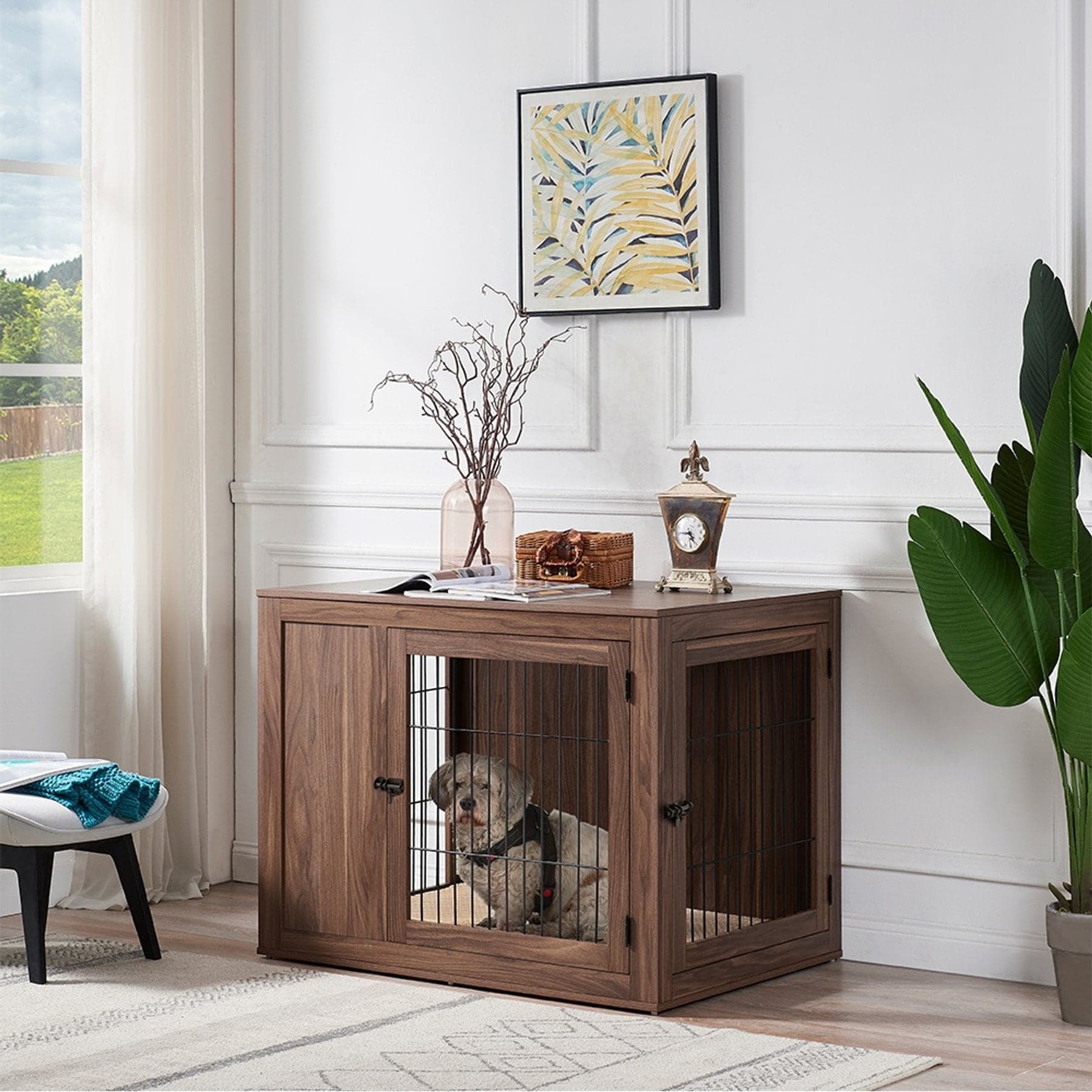
A furniture-style crate for a calm, crate-trained dog; check inside space, door access and cleaning.
Webvet may earn a commission when you click through to Chewy, at no extra cost to you.
The Unipaws Wooden Double Doors Dog Crate illustrates the value of entrance choice. Two access positions can help fit a crate beside furniture without placing the dog's entrance against a wall.
That flexibility only matters if the doors can open fully in your room. Mark out the complete footprint with removable tape, then include the door swing and your own access for cleaning. A crate tucked neatly between a sofa and cabinet can become awkward if bedding cannot be removed without moving the entire unit.
Check the exact size rather than assuming all double-door models have the same interior. Door count does not add floor space, and decorative trim may reduce usable width. Ask how the manufacturer expects the surfaces and any included cushion to be cleaned.
New Age Pet ECOFLEX Horizon
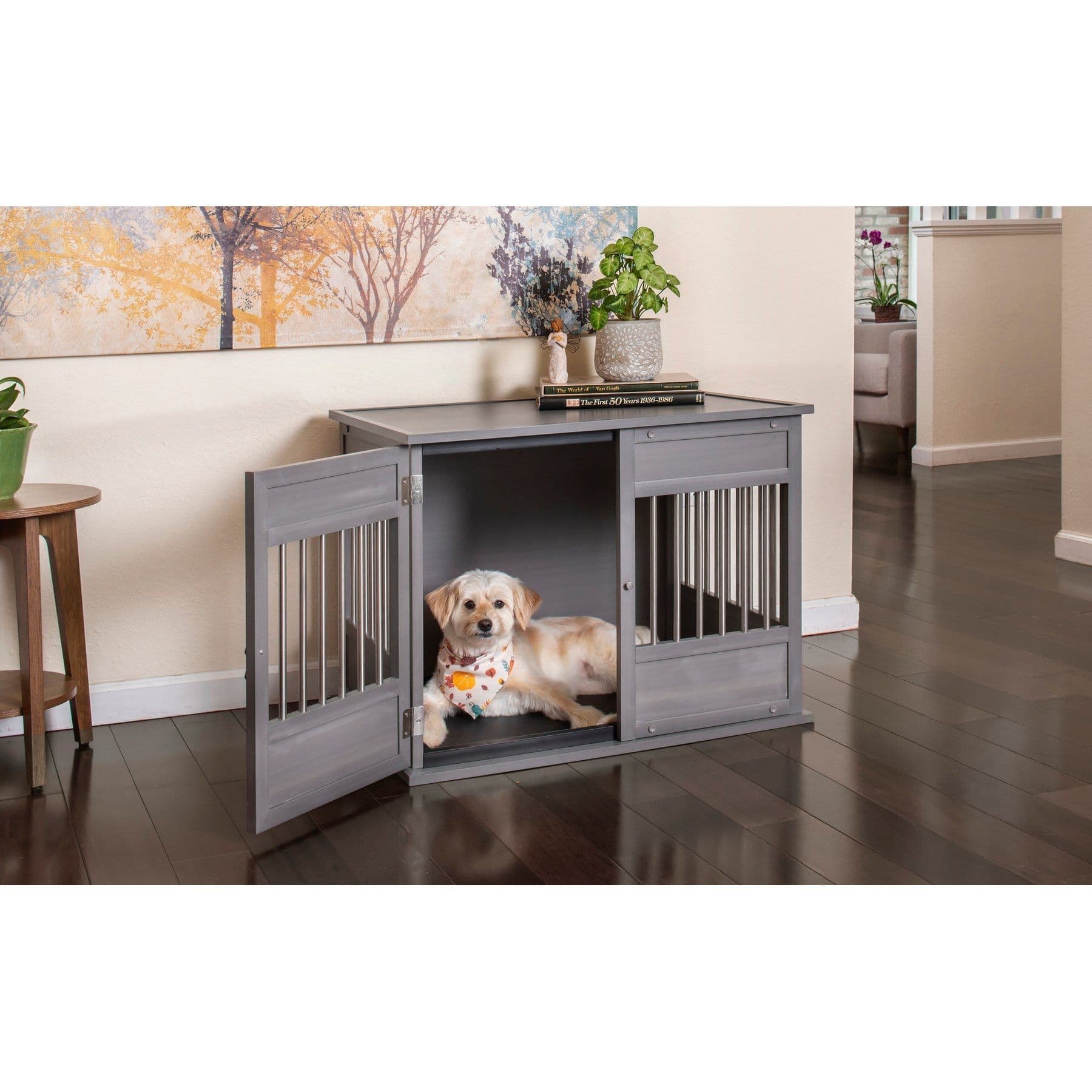
An ECOFLEX furniture crate with a long-side door; check fit and treat its top as furniture, not extra dog space.
Webvet may earn a commission when you click through to Chewy, at no extra cost to you.
The New Age Pet Horizon uses ECOFLEX, a wood-plastic composite, with a door on the long side. That entrance position is the practical distinction to examine when the unit sits beside a sofa. The maker explicitly says the crate is not chew-proof and may be unsuitable for dogs prone to chewing or anxiety.
The New Age Pet ECOFLEX Horizon is the side-entry model to compare with your sofa position and the dog’s usable resting space.
The manufacturer publishes both outside and inside measurements. For the displayed Medium, the listed exterior is about 32 by 23 by 24.7 inches, while the interior is 29 by 20.1 by 23.6 inches.
Allow for the thickness of furniture panels
This is a useful example of how furniture thickness reduces living space; recheck the selected variant rather than applying those measurements to every size.
ECOFLEX's moisture resistance can help with cleaning, but joints and the dog's bedding still need attention. Follow the current cleaning directions and check the floor after spills. A material description does not make a dog that frequently chews furniture a suitable candidate for this enclosure.
Richell Wooden End Table Crate
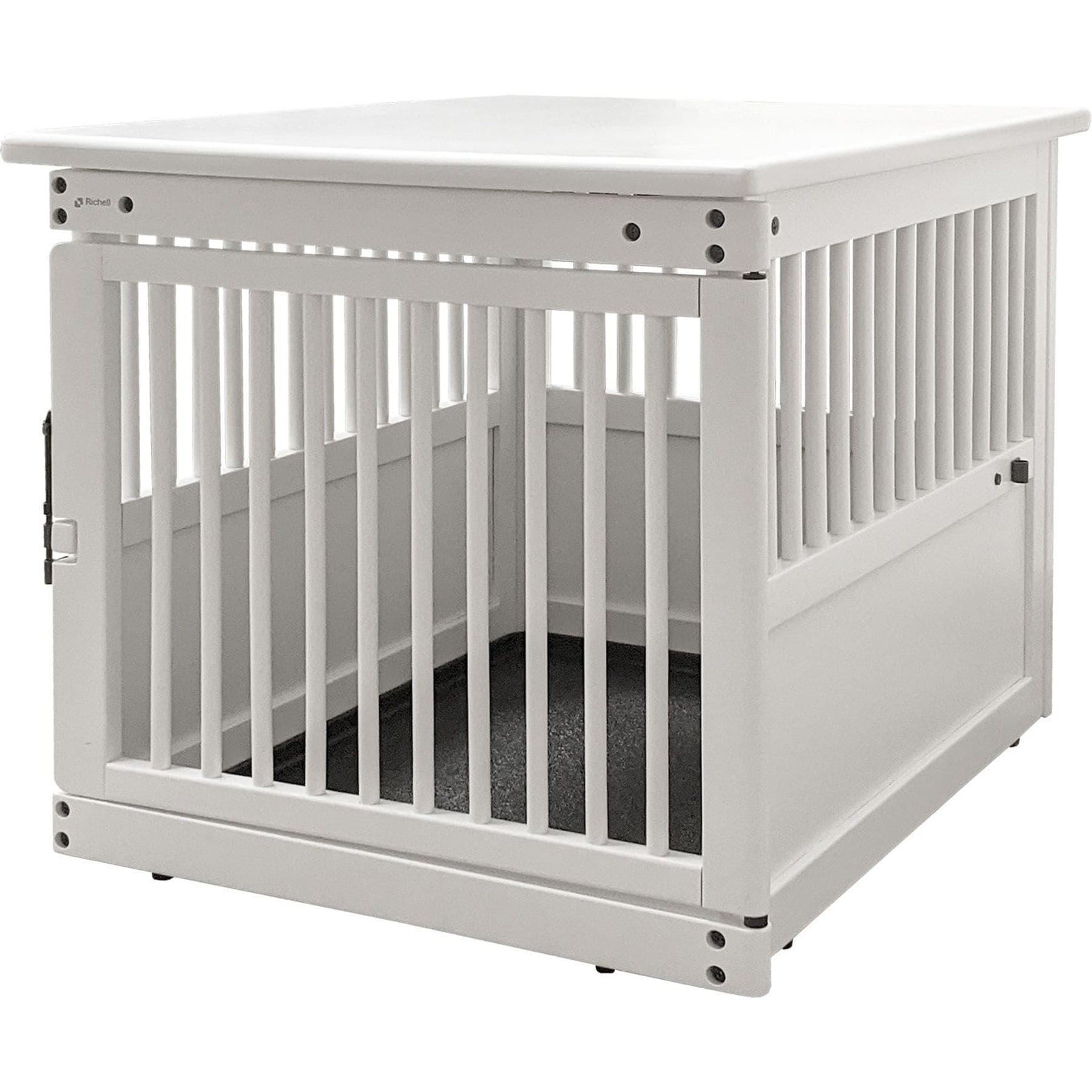
A wooden end-table crate for comparing resting space, room placement and cleaning access.
Webvet may earn a commission when you click through to Chewy, at no extra cost to you.
The Richell Wooden End Table Crate includes a removable sliding tray and a door arrangement that can remain open. These details may be useful for owners who want a resting space available throughout the day and occasional closed-door management.
Think through tray removal before positioning it. A product can have convenient cleaning access in a photograph but lose that benefit when wedged into a corner. Keep the needed side or front clearance free, and check that the dog cannot pull or damage loose bedding around the tray.
Richell offers more than one size. Match the dog's measurements to the specific interior, and avoid using a retailer's broad weight range as the sole decision. A tall dog and a compact dog of equal weight may not fit the same enclosure comfortably.
Casual Home Wooden Pet Crate
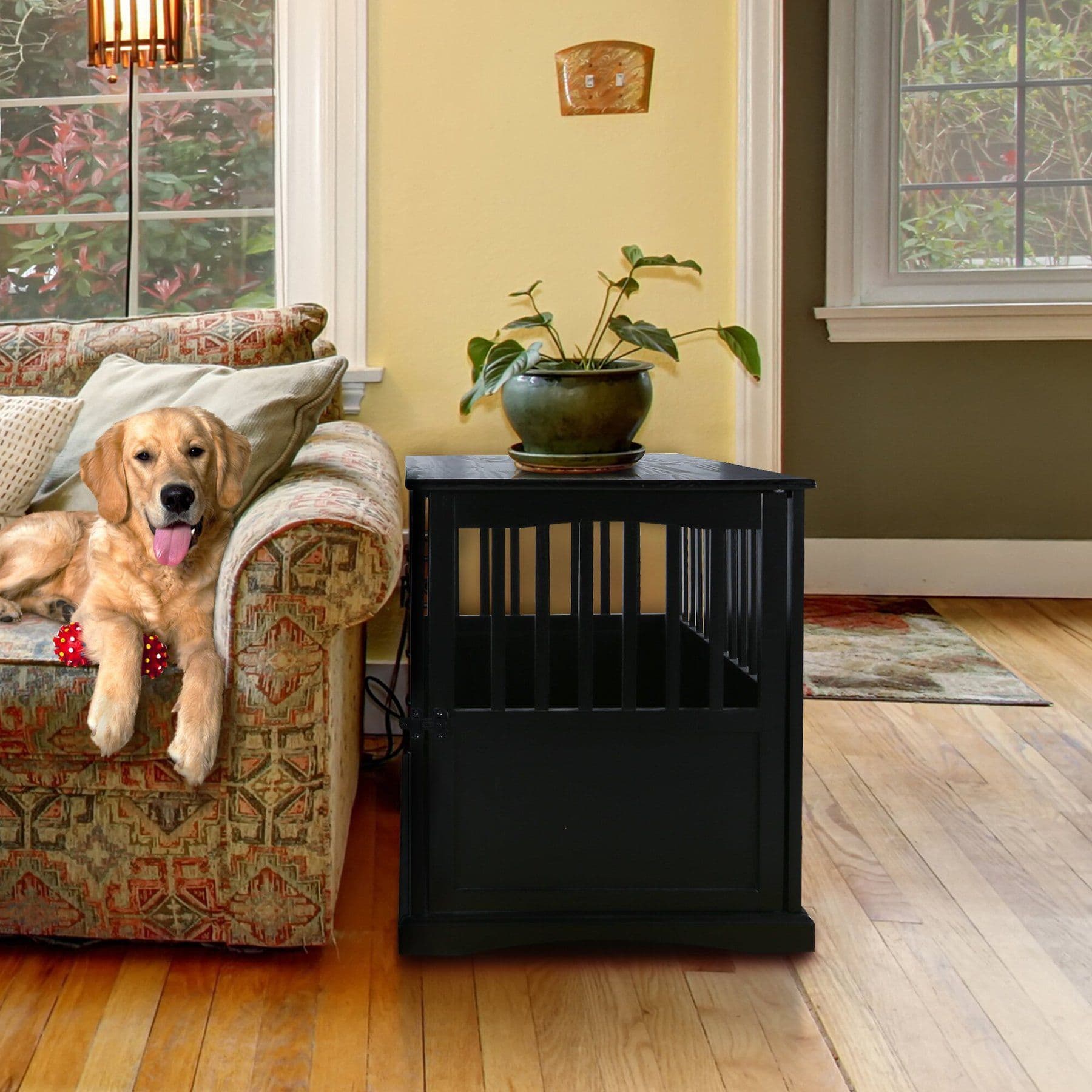
A wooden end-table crate for a dog comfortable with confinement; inspect airflow and usable dimensions.
Webvet may earn a commission when you click through to Chewy, at no extra cost to you.
Casual Home's wooden pet-crate format is another option when an owner wants a simple end-table appearance. Treat the exact current product listing and assembly instructions as essential purchase information; similarly named listings may show different dimensions or finishes.
Compare the Casual Home End Table Dog Crate by its interior room and cleaning access before choosing it to match a tabletop finish.
Inspect cleaning access and hardware
Before choosing a wooden model, ask how spills and accidents are handled. Removable bedding is easy to wash, but joints, slats and inaccessible corners can retain debris. If the dog frequently has accidents, a more easily cleaned conventional crate or a different management setup may be the better choice.
Also check access to replacement hardware and the manufacturer's intended use. Do not add improvised extra latches or screw shelves into the enclosure without guidance. Modifying a decorative structure can create projections inside the dog's space.
Check interior space and room layout
Make two sets of measurements: one for the furniture and one for the dog. Record the exterior tabletop dimensions and its stated load rating separately from the interior compartment. The space a lamp occupies on top cannot compensate for living space the dog lacks underneath.
| Furniture check | Dog-space check |
|---|---|
| Exterior tabletop length and width | Clear interior length and width |
| Manufacturer's surface load rating | Comfortable standing and resting room |
| Space for nearby furniture and people | Doorway clearance and unobstructed ventilation |
Use the dog crate size guide to compare normal standing height, turning room and resting length. The dog should not need to stay tightly curled because the crate doubles as a narrow side table.

For double dog-crate furniture, measure each compartment separately. Two dogs should not be shut into one small area because the outside cabinet is described as “extra large.” Consider their relationship, individual rest needs and the ability to manage them separately.
Before final placement:
- Leave ventilation openings clear of curtains, upholstery and stored items.
- Keep the unit out of direct sun and away from heaters.
- Keep lamp cords, plants, drinks and small objects beyond the dog's reach.
- Follow the tabletop load limit and do not use the unit as seating unless explicitly designed for it.
An open resting space should remain welcoming. Do not make it the household's punishment area or a place where children reach in to disturb a resting dog. If nighttime confinement is difficult, look at the routine and nighttime anxiety context rather than changing furniture alone.
Cleaning, chewing and daily use
DIY furniture around an existing crate
If the goal is a coordinated room rather than a custom containment structure, consider a separate furniture surround around an appropriate existing crate. The crate must keep its own intended assembly and operation. A decorative cover should not become a structural part, block airflow or prevent the dog and person from reaching the door.
Start with the correctly fitted crate, then plan the surrounding furniture. Keep these decisions separate:
- Measure the crate's outside footprint and full door swing.
- Preserve the manufacturer's required clearances, ventilation and access to the tray or floor.
- Design any independent furniture so it cannot tip, fall or put unsupported weight on the enclosure.
- Keep fixings, unfinished edges and cords outside the dog's reach.
- Confirm the final arrangement still allows ordinary inspection and cleaning.
Do not take a decorative cabinet plan as a tested dog-containment design. Building the actual enclosure involves door hardware, spacing, material and load questions that a generic DIY photograph does not answer. Ask a competent maker to assess the furniture structure and the crate manufacturer to confirm any proposed modification to its product.
A separate table that leaves a suitable crate accessible may solve the visual problem with fewer changes. If the dog chews wood or reacts badly to confinement, making a more attractive surround does not resolve that behavior.
Plan the room with the doors open
Mark the proposed footprint on the floor, then mark the space occupied by an open door. Walk the route from the sofa to the hallway, from the dog's bed to water and from the room entrance to the crate.
A cabinet can look neatly fitted when closed yet obstruct the route everyone actually uses once the dog is resting with the door open.
Check the entrance direction
Consider the direction from which the dog naturally approaches. A side entrance may work well beside a sofa, while a short-end entrance may suit a different corner. Door count is a convenience, not a substitute for clear space.
If a table leg or armchair blocks one of two entrances, judge the arrangement by the entrance the dog can actually use.
Leave space for cleaning
Next, think through cleaning rather than only appearance. Can you reach the far inside corner without moving a heavy unit? Can the tray or bed come out through the available opening? If moving the crate is necessary, what must be cleared from the tabletop first?
These everyday tasks explain why two similarly attractive units can have very different ownership costs.
A worked furniture-fit comparison
Richell’s exact White Medium (80013) gives a concrete furniture-fit example. Its crate dimensions, tray dimensions and entrance are three separate measurements; none should be silently relabeled as the complete usable interior.
| White Medium 80013 specification | Published measurement | Buying implication |
|---|---|---|
| Crate L × W × H | 31.1 × 25 × 24 inches | Check the furniture footprint before allowing for door and cleaning access |
| Tray dimensions | 20.9 × 26.6 × 1 inches | Check bedding against the tray; this is not an interior-height measurement |
| Door opening | 21 × 18.6 inches | Check voluntary entrance separately from the overall crate size |
| Item weight | 35.7 pounds | Plan moving and assembly with the room cleared |
Suppose you already own a rectangular 28 × 20-inch bed. Its 28-inch side exceeds the tray’s longer 26.6-inch dimension by 1.4 inches. Rotating it will not make that side fit the shorter tray dimension. Choose suitable flatter bedding or another correctly sized crate; do not fold a bolster into the dog’s space.
Eliminate an unsuitable interior
Likewise, a 32 × 26-inch furniture recess exceeds the listed crate footprint, but leaves only 0.9 inch in one direction and 1 inch in the other. That arithmetic says nothing about door swing, ventilation or pulling out the tray. Mark those additional paths before treating the recess as a workable location.
Separate a two-door crate from a two-dog cabinet
“Double door” often refers to two ways into one compartment. “Double dog” can refer to a large cabinet divided into two spaces. Those descriptions are not interchangeable. Check the floor plan, whether the divider is fixed and whether each compartment has its own entrance and suitable dimensions.
For two dogs, also plan individual access and care. One may need to leave while the other continues resting. Food, toys or close proximity may create tension even between dogs that usually get along. Do not use a shared furniture enclosure as a shortcut around assessing those needs.
Choose separate spaces when needed
If the dogs cannot rest comfortably in the proposed arrangement, choose separate spaces.
A removable divider does not automatically make every configuration suitable. Follow the manufacturer's intended assembly and evaluate the resulting space with the particular dogs in mind. A long outside cabinet measurement can conceal two small interiors, and photographs of multiple dogs are not proof that the setup suits yours.
Decide what the tabletop will hold
Check the stated load limit for the exact size and use the top only as intended. A surface suitable for light objects is not necessarily suitable for a person to sit on, a large aquarium or stacked storage. Consider the total weight and the way objects could shift if the crate is bumped.
A lamp creates a cord-routing problem as well as a decorating choice. Keep cords and plugs beyond the dog's reach and out of the doorway. Avoid loose small objects, reachable plants and drinks near the edges. Nothing should hang through slats or cover the ventilation openings.
If the furniture becomes a convenient place to pile bags or laundry, the intended clearances may disappear. Choose a location and routine that keep the dog's space usable. A less prominent spot with unobstructed airflow can be more suitable than a display arrangement that continually attracts clutter.
Know what maintenance your purchase permits

Read the assembly and care instructions before treating a finish as washable. Wood, composite panels, metal spindles, cushions and tray liners may have different cleaning requirements. Remove debris, use compatible cleaning products as directed and allow surfaces to dry before returning bedding and the dog.
Check fasteners and hinges during ordinary cleaning. A door that starts rubbing, a latch that no longer aligns or a rough damaged edge deserves attention while the dog is elsewhere. Ask about appropriate replacement parts. Do not hide a defect with fabric or improvise a projecting screw inside the enclosure.
For a secondhand purchase, confirm the model, instructions and complete hardware. Inspect panels for swelling, chewing, cracks and damaged joints. If you cannot establish how the enclosure should assemble or whether a missing part can be replaced correctly, choose another option. The low purchase price does not resolve an uncertain structure.
Introduce the new furniture as a new space
A dog comfortable in a wire crate may still notice a different entrance, floor, smell or view in a furniture model. Allow the dog to investigate without pressure and build familiarity through calm, rewarding experiences. Do not close the door for a long period simply because the old crate was familiar.
Watch ordinary movement. The dog should be able to enter, turn and settle without striking the frame or repeatedly adjusting around an awkward bed. If the dog avoids a particular feature, look at what has changed.
Respond to discomfort
A slippery floor or difficult doorway may require a different suitable arrangement, while signs of distress call for reassessing confinement itself.
Keep the resting area protected from unwanted attention. A dog asleep inside should not have people reaching through slats or another pet crowding the entrance. Furniture placement should support the dog's rest as well as the room's appearance.
Inspect the enclosure during cleaning
Inspect slats, joints, hinges and latches regularly. Stop using the enclosure if chewing exposes sharp edges, a panel loosens or a door no longer closes correctly. Damage on the inside matters even when the outside still looks presentable.
Choose bedding the dog uses safely and remove it for cleaning according to its instructions. Avoid leaving water damage hidden beneath a cushion. If accidents suddenly start in a previously comfortable adult dog, discuss the change with a veterinarian instead of assuming it is a furniture-training problem.
A heavy-duty crate is a separate construction choice, not the next automatic step after furniture damage. Determine whether chewing reflects normal exploration, inadequate introduction or distress. The right answer may be a larger safe area and a different care plan.
Dog crate furniture questions
Frequently Asked Questions
Are furniture dog crates worth it?
They can be worthwhile when the dog already rests calmly in a crate and the design offers suitable space and cleaning access. They are a poor investment when appearance requires compromising fit or when the dog chews the structure.
Who makes the best dog crate furniture?
There is no single best maker for every room and dog. Compare the exact product's interior dimensions, entrance layout, cleaning access and use restrictions. The four options above illustrate different design choices rather than a universal ranking.
At what age should you stop crating a dog?
There is no fixed age. Reassess the dog's ability to use a larger safe area and whether confinement remains useful and comfortable. A furniture crate can remain an open resting place when closed-door management is no longer needed.
Where can I buy dog crate furniture?
Buy from a source that identifies the exact model, supplies complete dimensions and instructions, and explains returns and replacement parts. Product identity matters more than a marketplace's generic “large dog crate” label.
How many hours a day should a dog stay in one?
Furniture styling does not extend suitable confinement. Age, health, toilet needs, activity and comfort determine the routine. Arrange regular breaks and care rather than planning a full day around an attractive enclosure.
Can I build DIY dog crate furniture?
A decorative surround should not obstruct a suitable crate's ventilation or exits. Building an actual load-bearing enclosure requires appropriate design and materials; avoid improvised structures with sharp hardware, entrapment gaps or no way to clean inside.
Can a dog stay in a crate for 12 hours at night?
Do not assume that is suitable. Puppies, seniors and dogs with health needs may need much more frequent attention, and comfort varies. Plan the night around the dog's needs rather than a fixed stretch of confinement.
What is crate syndrome?
The phrase is used loosely and is not a diagnosis to apply from a search result. Describe actual distress, repetitive behavior or injury to a veterinarian and review the dog's confinement and daily routine.
What should you put in the bottom of a dog crate?
Use a secure, intact floor or tray and bedding the dog can use safely. The surface should be comfortable, cleanable and compatible with the manufacturer's instructions. Remove items the dog shreds or swallows.
Does putting a blanket over a dog crate help?
Do not cover ventilation openings or place fabric where the dog can pull it inside. A furniture crate already changes visibility compared with an open wire design. Follow the model's instructions and assess the dog's comfort rather than assuming extra covering makes the space better.
Are dogs happier in an open or enclosed crate?
There is no universal preference. Choose by the dog's comfortable behavior, suitable space and the intended routine. Furniture styling is an owner preference; it does not establish that the dog prefers a more enclosed space or will settle when the door is closed.
Are dogs happier sleeping in a crate?
Some dogs sleep comfortably in a familiar crate, while others prefer a suitable open bed or room. Observe voluntary entry, relaxed resting and easy changes of position. Furniture styling cannot establish happiness or make persistent distress acceptable; select the arrangement that actually suits the dog's sleep and care needs.

Editor
The Webvet Editorial Team is the in-house group of pet-care editors and writers behind Webvet, operated by Smart Pet Collective. The team researches, writes, and maintains Webvet's pet health, behavior, and medication content. Every article follows a defined editorial process: research from reputable veterinary and scientific sources, careful drafting, mandatory review of medical content by a credentialed veterinarian, and dated publication. Health and medication articles are medically reviewed by a licensed veterinary professional before they go live and are kept current over time.


