Electronic Dog Doors: Microchips, Collar Keys and App Controls
Understand what an electronic dog door actually controls. Compare microchips, collar keys, powered opening and app features, then plan permissions and backup access.

This article contains affiliate links. Webvet may earn a commission when you buy through them, at no extra cost to you.
An electronic dog door may recognize a pet, unlock a flap, move a panel or let you change access settings from an app. Those are different functions. Before buying, decide who needs to enter, who needs to stay inside and whether your dog can comfortably push a flap.
- 1Identification, locking and powered opening are separate features.
- 2Selective entry does not necessarily mean selective exit.
- 3Confirm fit, power-failure behavior and manual access before relying on the door.
Electronic does not always mean motorized
A microchip-reading door can unlock for a recognized pet while still requiring the animal to push the flap. A powered door moves its panel out of the way. An app may control a schedule without changing either of those physical actions.

Use this feature checklist instead of treating “smart” as a complete description:
| Function | What it answers | What it does not establish |
|---|---|---|
| Microchip recognition | Can this reader identify the pet's compatible implant? | Whether it reads identity in both directions |
| Collar key | Can an authorized tag activate the system? | Whether another pet can follow through |
| Motorized opening | Does the panel move for the pet? | Suitability for every dog or safe yard access |
| App control | Can settings be changed remotely? | Guaranteed operation without internet or power |
Write down the real requirement. “Let the dog into the garden but keep the cat indoors” is more specific than “buy a microchip door.” If the model only restricts entry from outside, it does not solve that mixed-pet problem.
Compare electronic dog door systems
These are researched system types, not products we have personally tested. Check the current exact model because similar names can describe different generations, sizes and connectivity options.
| System | Identification approach to examine | Practical buying question |
|---|---|---|
| PetSafe SmartDoor Connected | Model-specific microchip or collar-key support | Which pets and directions can receive individual permissions? |
| High Tech Pet Power Pet | Compatible ultrasonic collar system | Does the chosen version provide the opening and power arrangement needed? |
| SureFlap Microchip Pet Door | Microchip or compatible RFID tag | Will the small-dog opening and selective-entry behavior suit the household? |
| PetSafe Electronic SmartDoor | Compatible SmartKey collar tag | Will this older model’s controls suffice without Connected app features? |
A simple flap may be sufficient when every pet can use the same secure area. The broader dog door guide helps separate the need for electronics from basic fit and installation.
Electronic dog door picks
The best automatic dog door is the one whose opening mechanism and access controls solve the actual problem. Choose powered movement when pushing a flap is the obstacle, and selective permissions when different pets need different access. Confirm both requirements separately if your household needs both.
PetSafe SmartDoor Connected
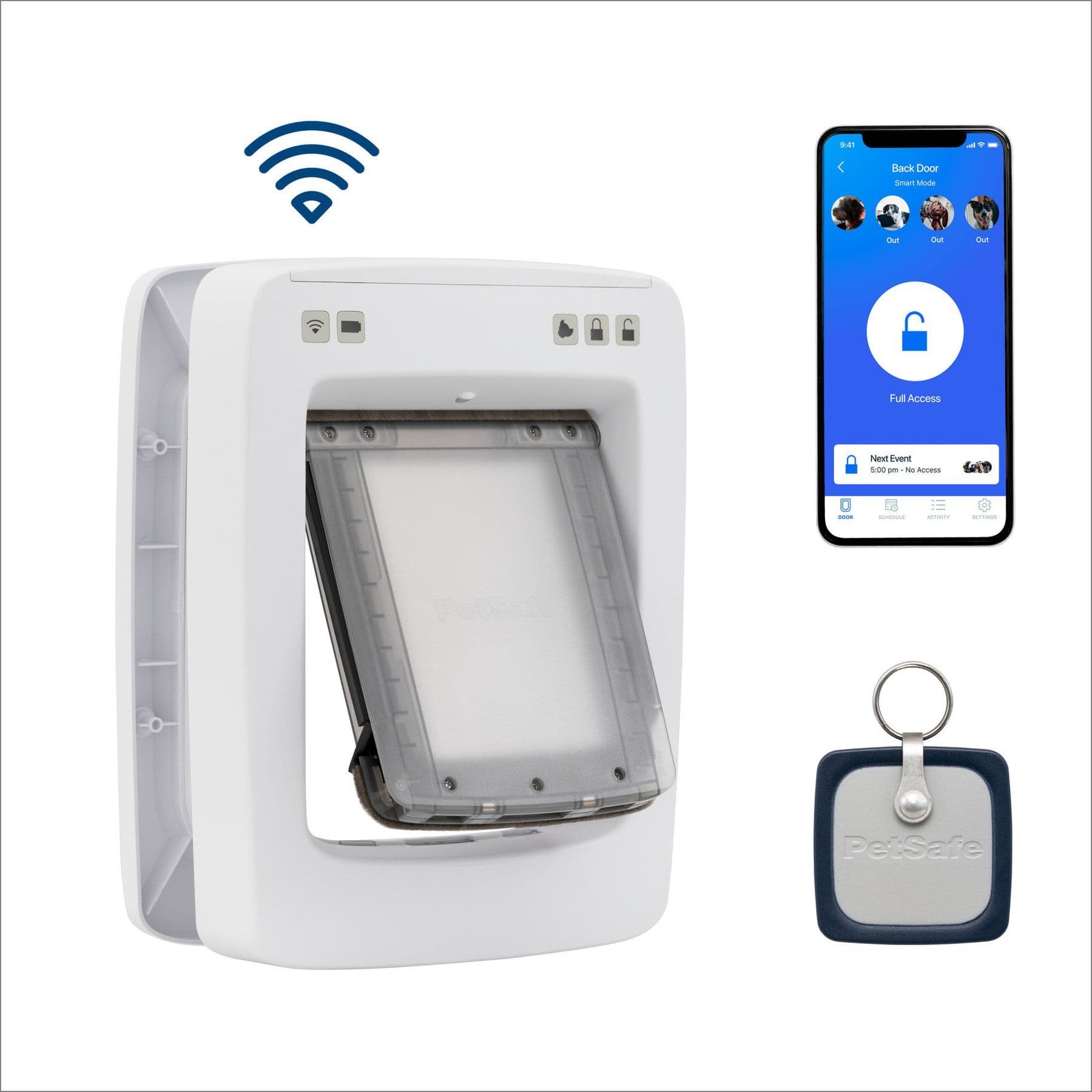
A connected pet door for model-specific access permissions and schedules; plan power, network and backup access.
Webvet may earn a commission when you click through to Chewy, at no extra cost to you.
The PetSafe SmartDoor Connected supports selective entry and exit, individual pet schedules and remote locking through the My PetSafe app. The maker specifies a 2.4 GHz Wi-Fi connection and battery power or an optional wall adaptor. A collar key is included; extra pets may require additional keys.
Size changes more than the opening. PetSafe specifies microchip compatibility for the Medium and describes it for cats; do not extend that claim to the Large or assume your dog's chip will work. The listed clear openings are 7.1 by 7.8 inches for Medium and 11.9 by 16.1 inches for Large.
Measure the pet and verify the identification method before choosing either variant.
Match permissions to each pet
For a multipet home, list each animal and the desired access in both directions. Ask whether permissions can be assigned individually, how many pets can be stored and how the door behaves if one authorized pet approaches beside another. A schedule is useful only when it controls the direction and animal you intended.
Also confirm installation compatibility, power needs and what remains available when the network is down. Remote control is a convenience; a person still needs a way to check the pet and manage access locally.
High Tech Pet Power Pet Door
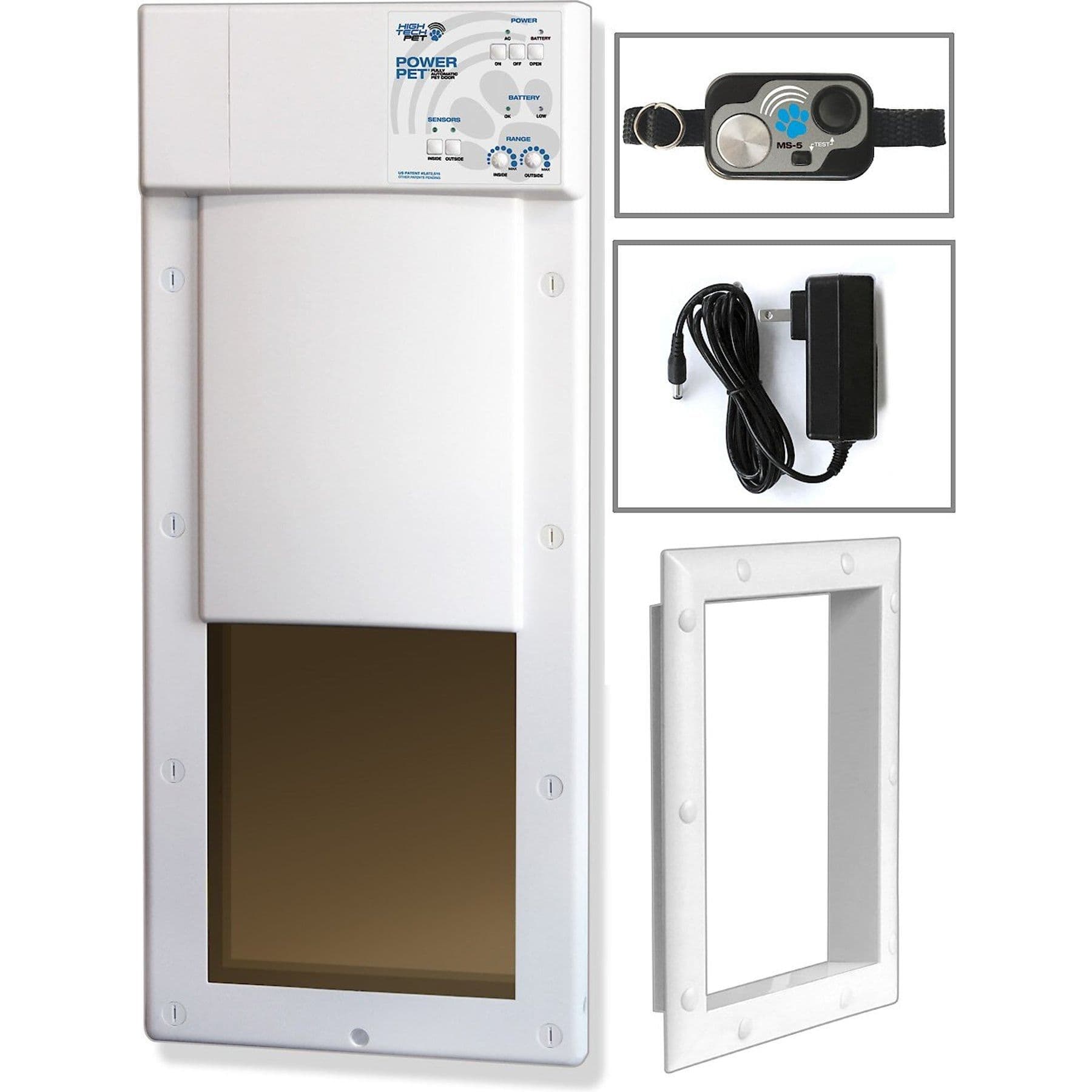
A powered-opening pet door using its compatible collar sensor; check opening size, permissions and backup access.
Webvet may earn a commission when you click through to Chewy, at no extra cost to you.
High Tech Pet's Power Pet range uses compatible ultrasonic collar technology and includes powered door designs. Some versions have additional connectivity or different mounting arrangements, so use the precise model's instructions when comparing features.
The High Tech Pet PX-2 Power Pet is the PX-2 model selected here. Compare its powered opening and collar requirements without assuming it includes features from another Power Pet version.
Check the dog and collar together
A powered opening may suit a dog that struggles with a flap, but fit and comfortable movement still need to be checked. Observe whether the dog approaches naturally and can pause or retreat without being pressured to pass through.
The collar is part of the system. Check its size, battery requirements and suitability for your dog, and keep a maintenance routine for it. Do not assume the dog's implanted microchip activates a system designed for a specific collar transmitter.
SureFlap Microchip Pet Door
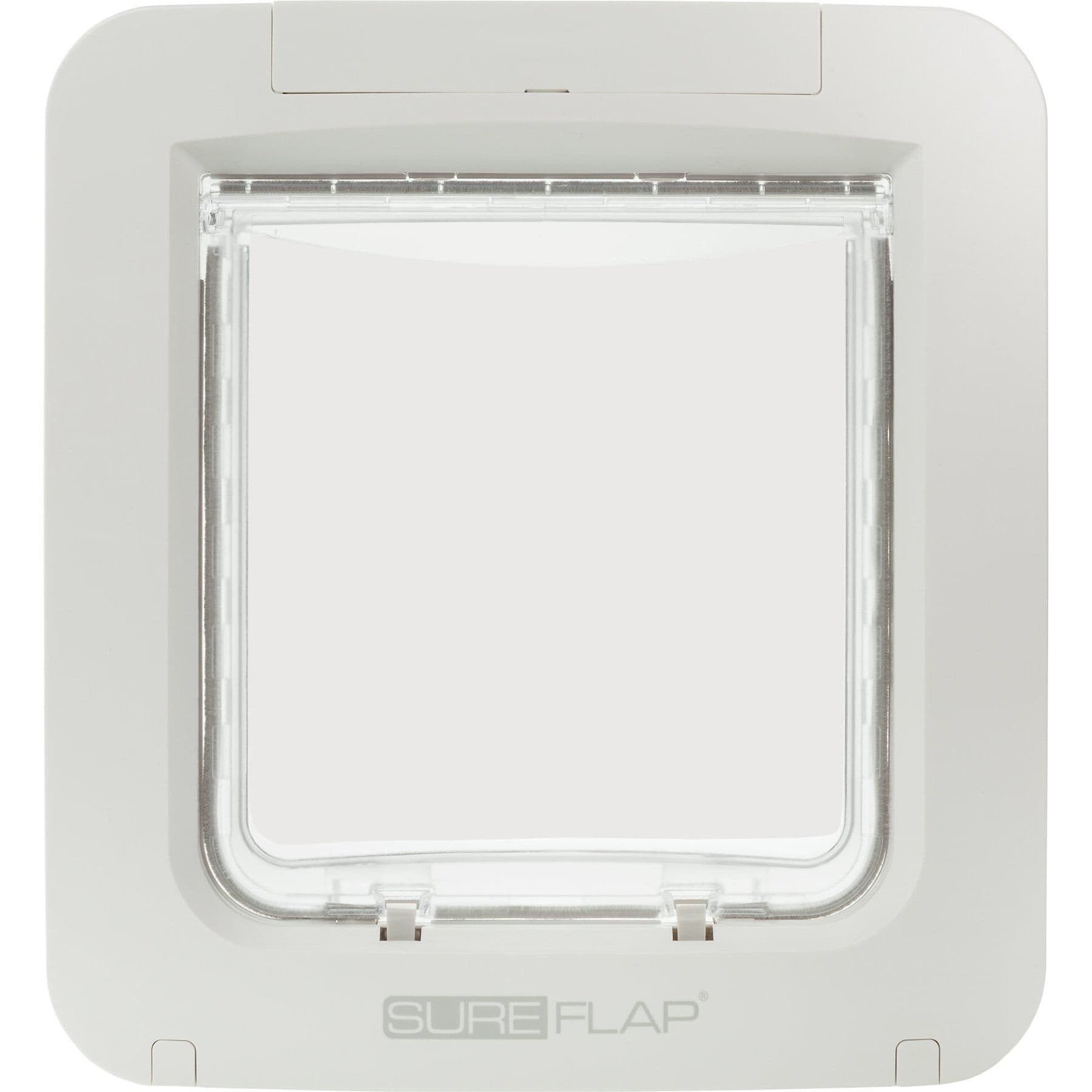
A microchip-reading door for a suitably sized small dog or cat; verify fit and the exact direction of access control.
Webvet may earn a commission when you click through to Chewy, at no extra cost to you.
The SureFlap Microchip Pet Door is designed for large cats and small dogs. Its opening size is a crucial limit: microchip recognition does not make it suitable for a larger dog that cannot pass comfortably.
Check the manufacturer's current compatibility guidance and whether your pet's chip can be read in the intended position. Where a compatible collar tag is used instead, assess the collar arrangement and tag maintenance as part of the purchase.
Pay particular attention to direction. The standard product's selective-entry role should not be assumed to keep an indoor cat from leaving. If preventing escape is the central requirement, verify the exact exit-control behavior before installation. The cat escape guide explains why this distinction matters in a mixed household.
PetSafe Electronic SmartDoor
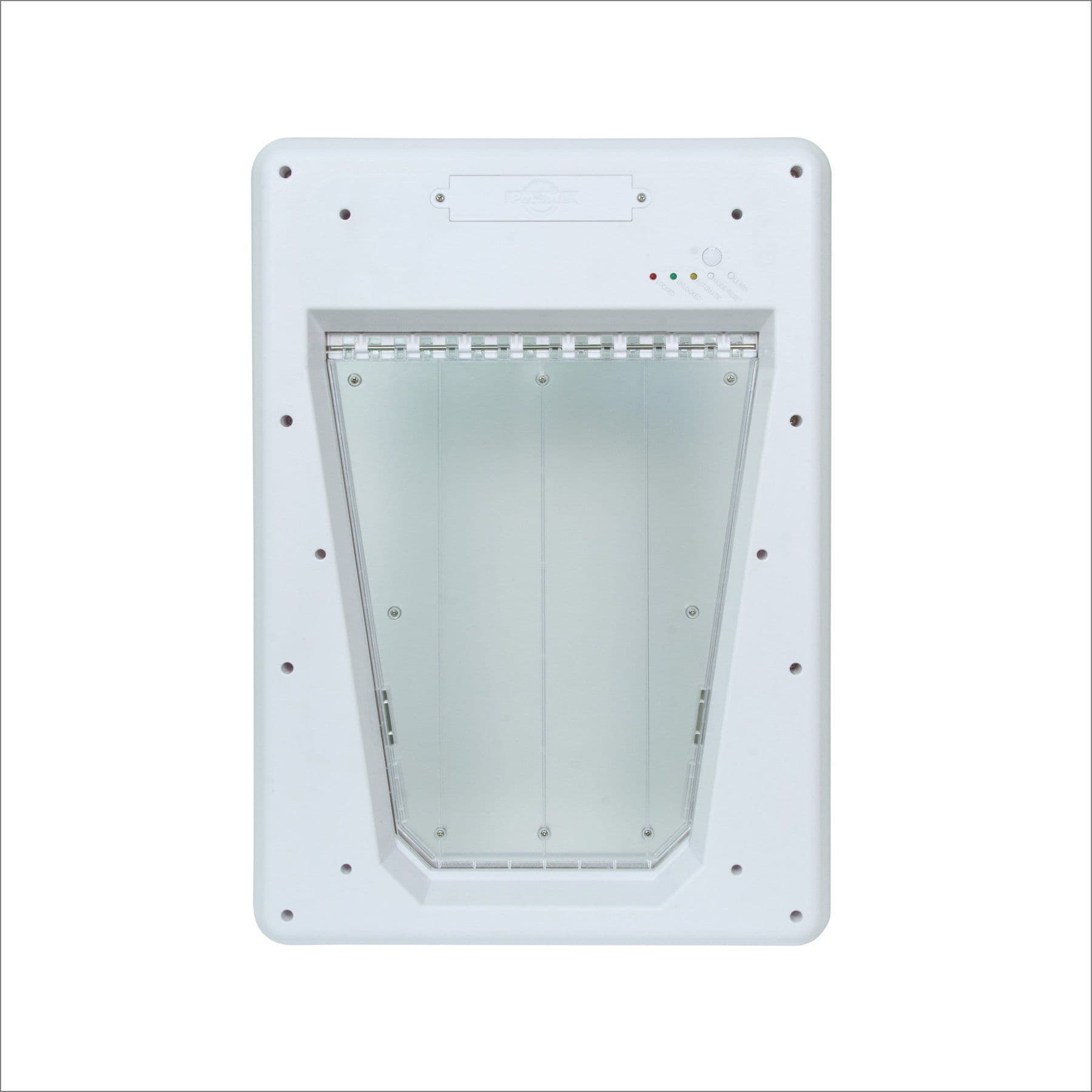
A collar-key electronic door; distinguish this older SmartDoor model from the connected app-controlled range.
Webvet may earn a commission when you click through to Chewy, at no extra cost to you.
The older PetSafe Electronic SmartDoor uses a compatible SmartKey worn on the pet's collar. It is a separate product from SmartDoor Connected. Do not assume that buying the older electronic model includes the Connected model's app functions or identification options.
This is a useful comparison for a household that wants key-controlled access without selecting a product for its app. Start with the exact model's operating modes, key compatibility and clear opening, then determine whether those controls solve the actual household problem.
A collar-key product should not be purchased on the assumption that an implanted microchip will activate it.
Check the selected size and upkeep
The Large catalog variant is a shopping option, not a recommendation for every large dog. Compare the clear flap opening and installation measurements with your dog and the building. If your goal is to keep one pet inside while another goes out, verify individual exit behavior rather than inferring it from the word electronic.
Plan battery checks for both the door and any powered key. Keep instructions for relearning or replacing a key, changing modes and managing the door if the normal access method fails. The most useful system is one the people caring for the pets can operate reliably.
Check access permissions and failure behavior
Build a permission matrix before purchase. Give each pet a row, then write “allowed” or “not allowed” under entry and exit. Add any time restrictions. Compare that simple table with what the exact model can actually do.

Next, plan for ordinary failures:
- What happens when the door loses mains power?
- What happens when a collar battery or door battery is depleted?
- Does a lost internet connection stop access or only remote settings?
- Can a person open or secure the door locally?
- Can a pet become stranded outside during a lockout?
Check the manual rather than assuming every device fails open or fails closed. Test the permitted backup and manual procedures while a person is present and the dog has another route. Do not discover a limitation for the first time during a storm or a long absence.
Watch early use with every pet in the household. One authorized dog may hold an opening long enough for another animal to follow. Identification reduces a particular access problem; it does not erase all behavior and supervision questions.
Choose fit, installation and maintenance
Apply the permission test to two actual products
Sure Petcare explicitly describes the Microchip Pet Door as selective-entry only: its reader is outside and any animal can exit when outward access is open. Curfew or an in-only lock changes the shared door state; it does not give an indoor cat a separate exit restriction.
| Household requirement | SureFlap Microchip Pet Door | PetSafe SmartDoor Connected |
|---|---|---|
| Keep an indoor cat in while a dog goes out | Does not meet this requirement through selective identification; any animal can exit | Manufacturer specifies selective entry and exit with individual pet schedules; confirm paired identities and settings |
| Use an implanted chip instead of a collar key | Check the pet’s chip with the manufacturer’s compatibility tool | Microchip compatibility is limited to Medium; do not transfer it to Large |
| Compare physical opening | Use the exact pet-door dimensions, not the smaller cat-flap chart | Medium: 7.1 × 7.8 inches; Large: 11.9 × 16.1 inches |
PetSafe’s SmartDoor chart makes the size tradeoff concrete: the Medium supports specified microchip formats, but a dog that cannot pass its 7.1 × 7.8-inch opening needs another solution. Moving to Large changes both the opening and the identification choices.
Write down each pet’s allowed movements
Consider a household with one dog allowed into a secure yard during the day and one cat that must remain indoors. The dog needs authorized exit and entry. The cat needs exit blocked, even though the cat is already inside the house.
A door that only recognizes animals arriving from outside does not meet that requirement. This is why selective entry and selective exit must be separate questions.
Account for different permissions
Now add a second dog recovering from a procedure who must go outdoors only with a person. A shared schedule for every key may be insufficient if the other dog still needs independent access. Look for the exact ability to assign different permissions, and confirm how the person changes them locally and remotely.
If the product cannot do it, use another management arrangement rather than treating a shared lock mode as an individual restriction.
Write the table in ordinary language before studying product terminology:
| Pet | May leave alone? | May come back in? | When does that change? |
|---|---|---|---|
| Dog with daytime yard access | Yes, when the yard and conditions are suitable | Yes | Close independent access overnight or during unsuitable weather |
| Indoor-only cat | No | Provide a separate recovery plan if accidentally outside | Restriction remains in place |
| Dog needing supervised recovery trips | No | A person manages both directions | Follow the individual care plan |
This is an illustrative household, not a promise that any listed door implements every row. Compare the desired behavior with the exact model's instructions. If you cannot find a clear answer to an essential permission, get confirmation before cutting an opening in the building.
Understand recognition and physical passage
Recognition happens at a particular location and range. A collar key may trigger a door while a dog waits nearby; a microchip reader may require a different approach position. Read the setup instructions so you know what normal activation looks like and how to adjust only the settings the manufacturer permits.
After recognition, the dog still has to pass through. A lock releasing on a flap does not mean a motor moves that flap. A dog familiar with one design may hesitate at another because the sound, resistance or movement differs. Choose the mechanism for the dog's abilities and introduce it without pressure.
Watch for following pets
Also consider another pet standing close behind. An authorized opening can create an opportunity for a second animal to follow, even when that second animal has no recognized key. Observe the household's actual behavior during supervised use.
When separation is essential, treat a pet door as one part of the management plan rather than assuming identification makes following physically impossible.
Distinguish keys, microchips and connectivity
A compatible implanted microchip is an identification method. A manufacturer-specific collar key is another. Neither term automatically means the door has Wi-Fi or can be controlled from a phone. Conversely, an app-enabled door may still require a collar accessory. List each requirement separately so a feature-rich listing does not obscure a missing essential function.
For a collar-key system, check the accessory's size, attachment, water-resistance guidance and power requirements. Confirm the correct replacement model and how it is paired. A tag with a similar brand name may belong to another generation.
Keep the product number with the door's instructions so a lost key does not lead to ordering the wrong replacement.
Check the chip-learning procedure
For a microchip-reading model, use the maker's compatibility check and learning procedure. Do not assume that every implant format, implantation position or pet size gives the same result. If recognition is unreliable, obtain product support and check the pet's identification record rather than repeatedly forcing the animal against the reader.
Separate a network outage from a power outage
Internet connectivity and electrical power are different dependencies. A door might retain some local settings when its internet connection is lost, while remote changes or notifications become unavailable. That behavior is model-specific. Write down what remains operational for the exact product instead of summarizing it as simply working or not working without Wi-Fi.
PetSafe’s SmartDoor Connected settings let the owner choose Locked or Unlocked behavior for power loss. With Unlocked selected and no power, any animal can pass in either direction: the key and microchip system no longer identifies pets.
PetSafe also permits batteries to remain installed as backup when using its power adaptor. Choose the outage setting before relying on the door: Locked can prevent a pet outside from returning, while Unlocked removes selective access. Maintain the backup and arrange a person who can bring pets inside.
Practice the backup procedure
During setup, practice the permitted manual procedure while a person is present and the pet has another route. Learn how to secure the opening and how to let the pet return if normal activation fails. Keep those instructions accessible to caregivers.
Do not wait until the dog is outdoors in bad weather to discover that the only person familiar with the controls is away.
Decide what you need from an app
Useful app functions might include changing a schedule, locking access or checking whether a door event was recorded. Decide which action solves your problem. A long feature list adds little if the basic opening does not fit the dog or the controls do not manage the correct direction.
Notifications are information, not physical intervention. A message that a pet used the door does not confirm the yard is suitable at that moment, that the dog has returned or that someone can respond to a problem. Keep an appropriate care arrangement for the times you are away.
Check how another caregiver gains authorized control and what they can do without your phone. Avoid making one person's device the only practical way to secure the doorway. When pets or caregivers change, review permissions and stored keys so the settings still reflect the current household.
Choose the location before the opening is cut
Match the exact installation type to the building. A product intended for a door may need separate components for a wall, and a panel intended for a patio track is not a substitute for either. Frame thickness, nearby obstructions and the path to the outdoor area all matter.
The clear pet passage, frame size and cutout size are different measurements. The passage determines whether the pet can move comfortably. The frame must fit the available surface. The cutout is the opening created in the building according to the template.
Confusing those measurements can leave an unusable or oversized hole even when the selected pet size seemed correct.
Match installation to the structure
Glass and electrical work deserve qualified help when required by the installation. Do not try to cut an existing tempered-glass pane. For wall work, confirm what is inside the proposed location and how weatherproofing and finishing will be handled. A product advertised as convenient does not make every wall suitable for an owner installation.
Introduce the complete route gradually
Let the dog investigate the opening and the sound of the mechanism while access is managed. Follow the manufacturer's training procedure and keep early experiences short and rewarding. The dog should be able to approach and retreat voluntarily. Pulling a dog through by the collar does not establish comfortable independent use.
Practice both directions. The interior and exterior approaches may have different lighting, surfaces and step-over heights. A dog that exits readily may hesitate to re-enter from a lower patio or darker garden. Observe the actual route rather than assuming one successful crossing proves that the setup is ready for unattended use.
If the dog becomes worried, stop increasing the challenge. Check physical fit, noise and movement, then adjust the introduction with appropriate help. A powered panel may reduce flap resistance, but it introduces its own motion and sound. There is no one mechanism that automatically suits every cautious or mobility-limited dog.
Compare long-term ownership, not only purchase price

Add the cost of compatible keys, required installation components, power accessories, replacement seals and professional work where needed. Check whether the chosen package includes one key or more and whether a wall installation needs a tunnel or adaptor. Product names alone do not reveal the complete bill.
Consider how straightforward the product will be to maintain. Can the moving area be cleaned as instructed? Are replacement parts and the correct keys identifiable? Is the manual available? If the unit stops operating normally, you need a way to secure the opening while arranging repair, especially because the building now has a permanent cutout.
Save the model number, installation date and instructions. Record the settings that matter to the household, including schedules and manual lockout steps. This short handover can prevent a pet sitter from changing the wrong control or assuming that a low-battery notification concerns the door when it concerns a collar accessory.
Work through the selection before ordering
Consider three households with different requirements. These examples apply the documented distinctions above; they are not claims that we tested the products or guarantees about a particular dog's behavior.
One small dog and no indoor-only pets
First determine whether electronics solve a real problem. If the outdoor area is suitable and the dog can push a conventional flap, identification may be useful primarily to limit unwanted entry. A SureFlap Microchip Pet Door is a candidate only when its clear opening fits and its selective-entry behavior matches that goal.
The owner should still check the compatible identification method, the animal's approach to the reader and the permitted installation route. Choosing a reader does not remove the need to inspect seals or close access when outdoor conditions change. If the system is unnecessary, a conventional flap or supervised trips may be simpler.
A larger dog and an indoor-only cat

Start with the dog's clear-passage requirement, then record the cat's blocked-exit requirement. The Large SmartDoor Connected is described with an 11.9-by-16.1-inch clear opening, but that number alone does not establish the dog's fit. Compare body clearance and the step-over with the installation instructions before selecting the size.
Its individual schedules and selective entry and exit are relevant to this household's access problem. However, the owner must still observe whether pets approach together and confirm the actual settings. A permitted dog opening the route can create an opportunity for a following cat, so electronic permission is not a guarantee against every escape.
The Medium model's microchip description should not be transferred to the Large. Plan the appropriate compatible key for each animal whose access is being managed, and make sure caregivers can identify which key belongs to which pet. Keep the identification decision separate from the choice of opening size.
A dog that hesitates to push a flap
Find out whether resistance, fit, sound or the outside landing is causing hesitation. A powered High Tech Pet model may remove the need to push the panel, but the moving mechanism introduces a different experience. Follow the exact model's introduction procedure and let the dog approach and retreat voluntarily.
Before selecting it, check the compatible ultrasonic collar, the chosen door's clear opening and the power arrangement. A collar that activates one manufacturer's system is not automatically interchangeable with another key. The intended pet must be able to wear and use the required accessory appropriately for that system.
Practice the manual and backup procedures before relying on the installation. Someone should know how to secure the opening and bring the dog indoors when normal activation is unavailable. If the dog still finds the route uncomfortable, return to supervised access and resolve the cause rather than increasing pressure to use the device.
Turn the preferred option into an order checklist
Record the exact model and size, required keys, installation type, included accessories and any components sold separately. Compare the selected basket or order variant with that record before payment. Similar product names and shared listing photographs can hide meaningful differences in size, connectivity and package contents.
Keep the manual and product identifier after installation. A replacement key, flap or power accessory should be matched to that model, and anyone taking over the dog's care needs the current permission and backup instructions. The result is a usable access plan, rather than a collection of features nobody is certain how to operate.
Reassess after a household change
A system chosen for one small dog may no longer suit a new large dog, an indoor-only cat or a pet recovering from illness. Recheck fit and permissions rather than extending the original arrangement by habit. An existing opening in the door is not a reason to accept unsuitable access.
Changes outside matter too. Building work, an open yard gate, damaged fencing or severe weather may mean independent access should be paused. The pet door controls an opening in the house; it does not inspect the entire destination. Keep the physical outdoor boundary and the access routine under regular review.
If electronic access no longer solves the actual problem, supervised trips can be the simpler choice. That is a practical decision about the household, not a failure to use the product's available features. The best system is the one that reliably supports the care the pets currently need.
Confirm the final installation
Measure the actual clear passage and threshold, not just the frame. For a large dog, check shoulders and natural standing posture; for a short-legged dog, pay attention to the step-over. A door that is technically wide enough can still require awkward movement.
Installation should match the structure. Use a qualified professional where wall construction, glazing or electrical work requires it. If the intended location is a patio door, compare the dedicated sliding-glass options rather than trying to adapt an incompatible unit.
Make maintenance part of the routine:
- Keep moving areas clean as the manufacturer directs.
- Inspect seals and weatherproofing.
- Check batteries and replace damaged tags.
- Confirm settings after updates, resets or a change in household pets.
The yard still needs a physical boundary and suitable conditions. Electronics should not give a dog unattended access to an unsafe area. If independent access does not fit your household, supervised trips and an appropriate indoor arrangement from the crate guide may be simpler.
Electronic dog door questions
Frequently Asked Questions
Are electronic dog doors worth it?
They may be when their actual access controls solve a specific household need. They add cost, power and maintenance requirements, so a conventional door may be enough if every pet can use the same secure area.
Which brand of smart dog door is the best?
Compare the actual system, not the brand alone. PetSafe SmartDoor Connected provides individual schedules and app controls; High Tech Pet Power Pet provides powered models using compatible ultrasonic collars; SureFlap's Microchip Pet Door targets large cats and small dogs. Select the system whose opening and directional permissions meet the household's requirements.
What is the best automatic door opener for dogs?
Choose a powered pet-door panel if the dog needs an opening that moves out of the way and the selected model fits the building. An opener that moves an existing sliding door is a different installation: assess the door layout, track and manual release using the sliding-glass guide. Neither approach is universally best.
What is the best quality dog door?
Look for a well-fitting opening, a documented installation method, a dependable way to secure access and identifiable replacement parts. Quality includes support and maintenance after the opening is cut. An expensive connected unit is a poor choice when its clear passage or permissions do not suit the pets.
What is the best dog door for home?
Start with a secure outdoor destination and the pets that need access. A simple flap may suffice when all pets share the same permissions. Choose an electronic system when its exact identification and entry-or-exit controls solve a requirement that the simple flap cannot meet.
What is the best electronic dog door?
Choose by fit, identification technology, direction-specific permissions and failure behavior. A system that works for one small dog may not meet the needs of a large dog or a household with an indoor-only cat.
Can an electronic dog door be controlled by an app?
Some models offer app settings, schedules or remote locking. Confirm the exact model's functions and what works without internet. App control does not necessarily mean the panel opens automatically for the dog.
What dog door can I control remotely?
Look for a model that explicitly supports the remote action you need, such as locking or changing a schedule. Confirm network requirements and local backup controls before relying on it while away.
What can I use instead of a doggie door?
Supervised trips through the main door or assistance from a caregiver may meet the same need without construction. This may be preferable when the outdoor area is unsafe or other pets must remain indoors.
Can snakes come in through a doggie door?
Electronic recognition may reduce some unwanted entry, but it is not a wildlife-proof guarantee. An open panel or another animal following through can still create access. Manage the surroundings and close access when needed.
What is the disadvantage of a doggie door?
It adds an opening that requires fit, weather and security management. Electronic versions also need power, compatible identification and maintenance. The largest disadvantage may be unsuitable independent outdoor access rather than the device itself.
Is it better to put an electronic dog door in a wall or a door?
Choose the route that provides a suitable approach on both sides and supports the exact model. Door installation avoids a wall tunnel but may require replacing an expensive door later. Wall installation can preserve the door, but thickness, wiring, pipes and weather sealing need professional assessment.
Check whether the electronic model permits wall installation and which tunnel or adapter it requires. A reader fitted to the wrong opening is not a workable access system.

Editor
The Webvet Editorial Team is the in-house group of pet-care editors and writers behind Webvet, operated by Smart Pet Collective. The team researches, writes, and maintains Webvet's pet health, behavior, and medication content. Every article follows a defined editorial process: research from reputable veterinary and scientific sources, careful drafting, mandatory review of medical content by a credentialed veterinarian, and dated publication. Health and medication articles are medically reviewed by a licensed veterinary professional before they go live and are kept current over time.
Related reading

Dog Door for Sliding Glass Door: Panel Fit, Locks and Screens

Dog Doors: Types, Sizing and Home Safety Before You Install

Best Dog Playpens: Indoor and Outdoor Options for Different Dogs
