Dog Gate for Stairs: Safer Choices for Top and Bottom Landings
Stair gates need secure attachment and the right landing position. Compare four options, understand no-drill limits and measure walls, banisters and the route people use.

This article contains affiliate links. Webvet may earn a commission when you buy through them, at no extra cost to you.
A dog gate for stairs needs to do more than fit the opening. Its attachments must suit the wall or banister, its position must keep the dog away from the drop, and its operation must not create a trip hazard for people.
Choose the stair location first, then a product whose instructions explicitly support that installation.
- 1Do not use a pressure-only or freestanding gate as protection at the top of stairs.
- 2Follow the exact model's mounting, setback and swing-direction instructions.
- 3If the landing cannot support a suitable installation, move the containment point to a safer doorway.
Choose the stair location before the gate
Start with the top-versus-bottom decision in the table below, then check the proposed attachment. An advertised width only tells you the range the gate can span; it does not establish that your wall, railing or banister can support the mounting. Reject an unsupported installation even when the gate fits the opening.
Top and bottom landings are different problems. At the top, a failed or displaced gate can expose the dog or a person to a fall. At the bottom, the aim may be to stop access to the staircase before the dog starts climbing. Neither location is solved by measuring width alone.
| Location | First decision | Reason to stop |
|---|---|---|
| Top landing | Can approved hardware attach to suitable structure with the required setback? | No secure attachment or insufficient landing space |
| Bottom landing | Can the gate block access without leaving climbable steps on the dog's side? | Dog can climb around it or reach a hazardous gap |
| Angled opening | Does the exact model permit that mounting angle? | Improvised angled brackets or a twisted frame |
| Banister-to-wall opening | Is a compatible, approved adapter available? | Loose straps, cable ties or an unstable post |

If you rent, obtain the necessary permission for a suitable installation. A no-drill preference is understandable, but it does not make a pressure barrier appropriate at a drop. Blocking a hallway farther from the stairs may be the safer reversible option.
Compare stair-gate options
The following are researched options with different installation approaches. They are not personally tested recommendations for your particular staircase. Read the current manual before ordering; model-specific clearances and accessories determine whether the product fits.
| Option | Installation question | Useful distinction |
|---|---|---|
| Cardinal Auto-Lock MG-15 | Can hardware and swing stop suit the landing? | Latch engages when the gate is swung closed |
| Cardinal Outdoor Gate SS-30OD | Do the outdoor mounting and stair instructions fit? | Outdoor model for a suitable porch or deck opening |
| KidCo Safeway | Does the exact Safeway model suit the opening and angle? | A stair-focused range rather than generic pressure mounting |
| KidCo Bamboo Angle Mount Safeway | Are mounting points offset within the permitted geometry? | A specific model for nonaligned attachments |
For ordinary doorways away from a drop, the general dog gate comparison covers additional options. Avoid paying for a stair-specific design without first confirming that it is actually usable in your home.
Dog gate picks
Cardinal Auto-Lock MG-15
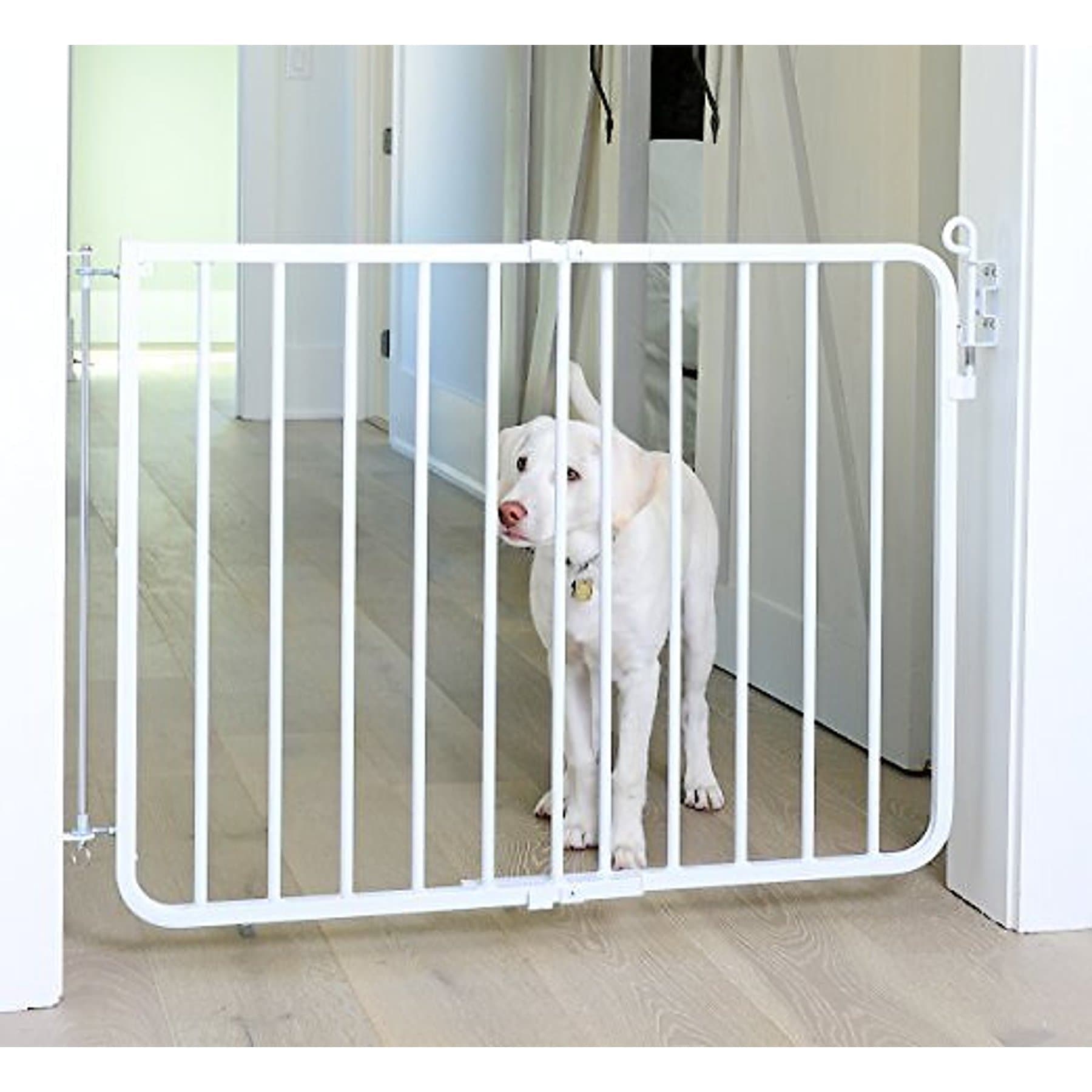
A hardware-mounted gate whose latch engages when it is swung closed; match its instructions to the opening.
Webvet may earn a commission when you click through to Chewy, at no extra cost to you.
The Cardinal Auto-Lock MG-15 is a hardware-mounted aluminum option listed by its manufacturer for stair locations. Its locking action engages when the user swings the gate into the latch. This is different from assuming a gate left open will close itself.
The manufacturer lists a basic width range of 26.5 to 40.5 inches. Check the complete installation, including the swing stop, attachment material and any extension needed for your opening. Do not put the gate where it opens over the drop or where operating it requires standing on a step.
The MG-15 instructions show how the hinge, latch and one-way stop are assembled. Use the instructions supplied with the exact current model and ask the manufacturer about any mismatch between a listing and your installation. The photographs in a retailer listing cannot establish that your particular banister will support the gate.
Cardinal Outdoor Gate SS-30OD
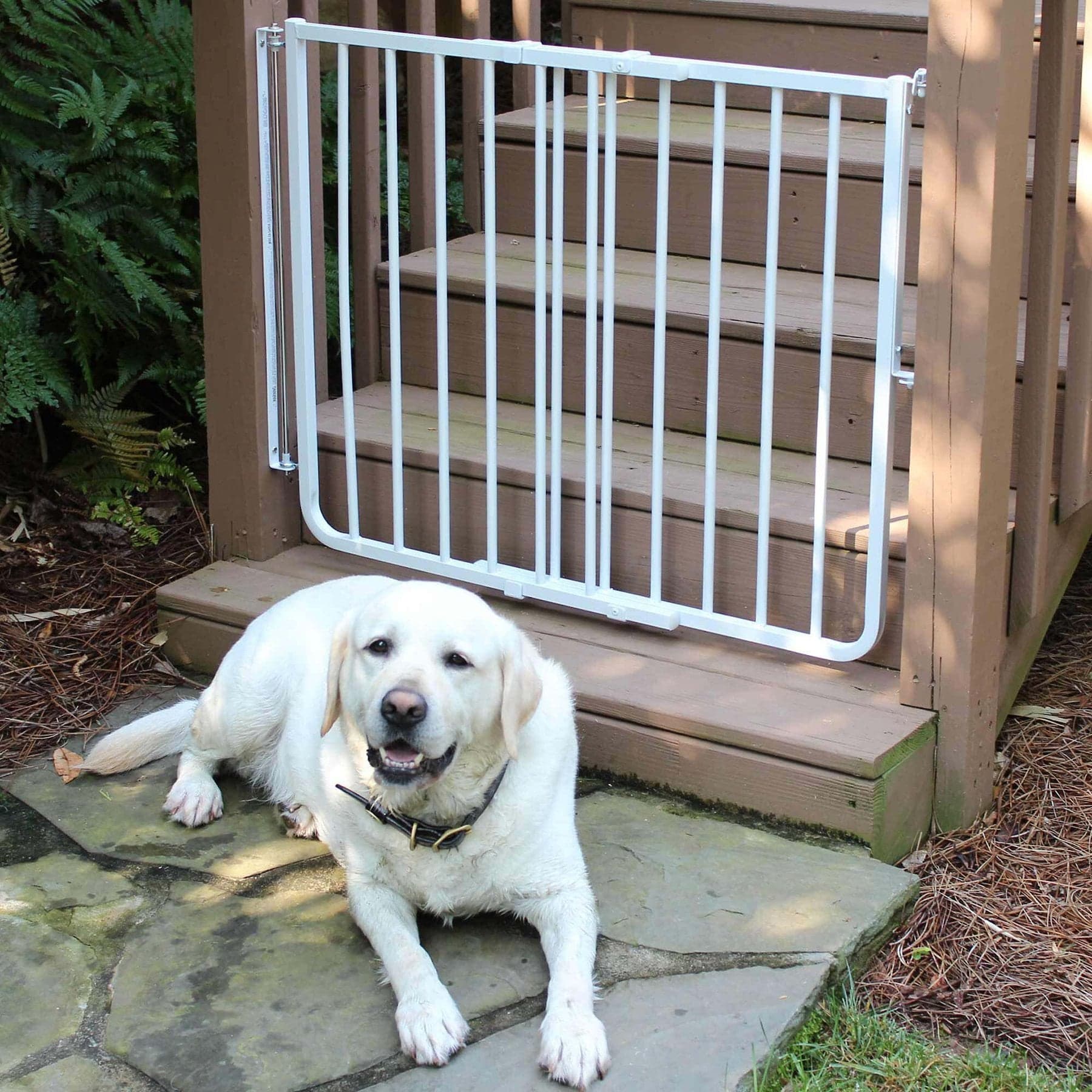
An outdoor gate option; follow its exact mounting instructions and inspect the whole surrounding boundary.
Webvet may earn a commission when you click through to Chewy, at no extra cost to you.
A stair barrier on a porch or deck needs an outdoor model as well as an appropriate stair installation. The Cardinal Outdoor Gate SS-30OD is a separate product from the indoor SS-30 and the Auto-Lock. Follow the SS-30OD instructions for its own hardware and maintenance requirements.
Outdoor suitability is useful only if the surrounding boundary is secure. Check the railing, spaces under and beside the gate and any route around the end of the stairs. A pet gate closes one opening; it does not turn a partly open deck into a complete containment area.
Maintain the outdoor installation
Inspect exposed components after weather and during ordinary use. Dirt, corrosion, loose fasteners or a changing wood mounting surface can affect operation. Follow the manufacturer's care instructions rather than treating an outdoor label as a promise of maintenance-free installation.
Keep the route free of wet leaves and objects that make the landing slippery or difficult to use.
KidCo Safeway pet gate
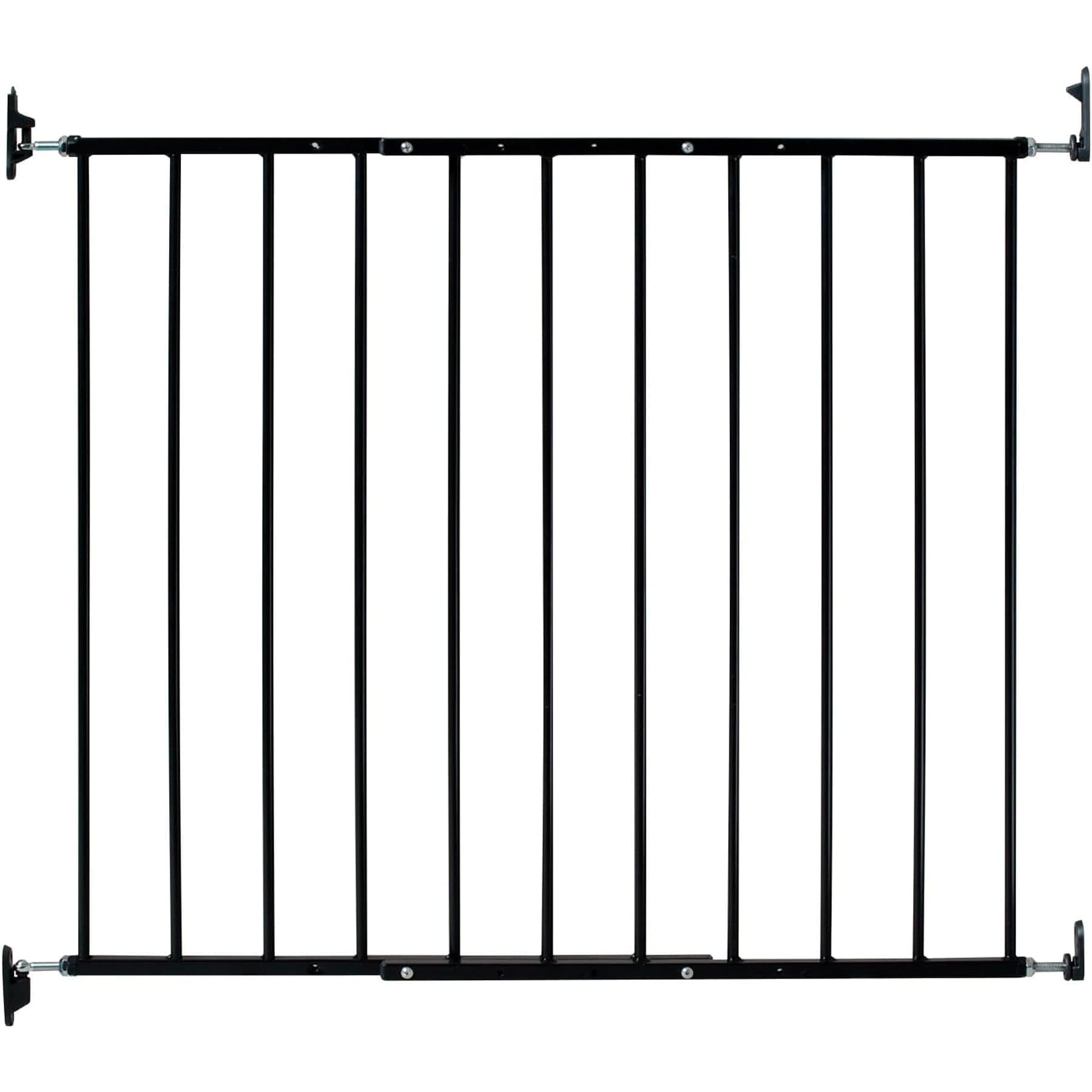
A hardware-mounted Safeway gate for a compatible stair installation; verify attachment points and swing direction.
Webvet may earn a commission when you click through to Chewy, at no extra cost to you.
The KidCo Safeway range includes stair-focused gates, and an Angle Mount Safeway addresses some nonaligned mounting points. Choose the exact version that supports your opening rather than buying first and improvising later.
The KidCo Safeway is the hardware-mounted model in this comparison; verify its own stop-pin and installation instructions for the landing.
Assess dog fit and daily latch use
A child-safety use case does not remove the need to assess your dog. Check bar spacing for a small dog, height for a jumper and whether nearby furniture offers a route over the barrier. For a household with children, satisfy the product's child-safety requirements as well.
Confirm the latch can be operated by the adults who will use it and that it consistently engages. A difficult gate that is routinely left open will not provide the intended protection.
KidCo Bamboo Angle Mount Safeway
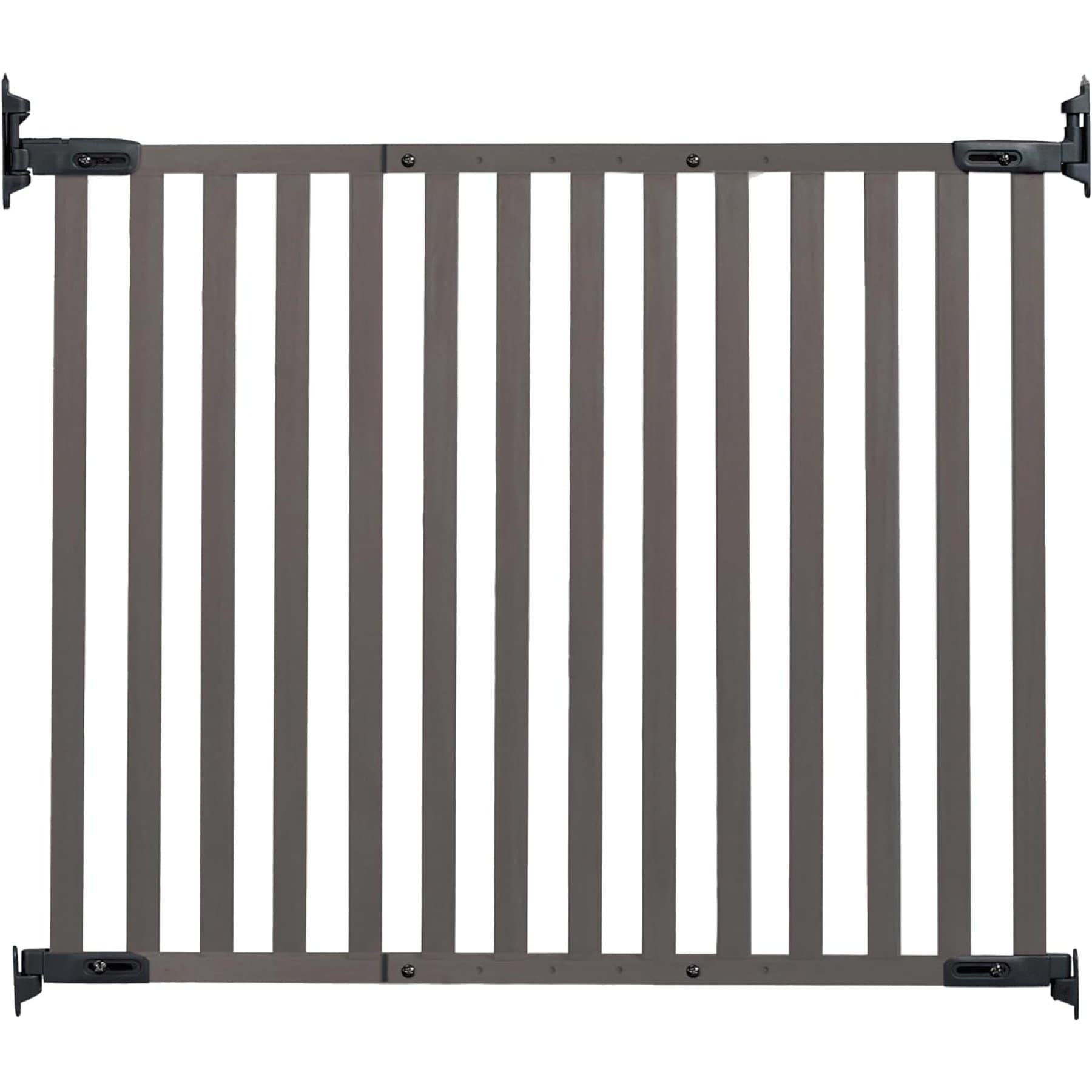
A hardware-mounted bamboo option for comparing offset stair attachments with the exact installation instructions.
Webvet may earn a commission when you click through to Chewy, at no extra cost to you.
The KidCo Bamboo Angle Mount Safeway is a hardware-mounted bamboo model designed for situations in which mounting points are not directly opposite each other, including a wall-to-banister stair opening. It is a separate model from the standard Safeway, so compare its own permitted geometry and hardware.
An angled design can resolve a specific alignment problem, but it does not turn a loose post or unsuitable attachment surface into a sound mounting point. Photograph both sides at bracket height and compare the manufacturer’s diagram before ordering. Ask about any adapter needed for the exact post shape.
Check passage and current availability
The maker describes a hardware-mounted design without the bottom threshold common to pressure gates. That can simplify the walking route, while appropriate setback, swing direction and latch operation still need checking.
The selected gray bamboo variant is distinct from the steel Angle Mount gate. Read its own instructions before ordering: do not assume that an extension or mounting part for the steel version fits the bamboo model.
Measure banisters, trim and landing space
Measure the opening at each proposed attachment height. Baseboards, tapered posts and decorative moldings can make the two sides unequal. Record the distance from the proposed barrier to the stair edge and the clear standing area needed to operate it.
Your survey should include:
- The material behind each mounting point.
- The shape and stability of the banister or post.
- The intended swing direction and any limiting stop.
- Nearby furniture, rails or steps the dog could climb.
- The route people use while carrying items.
Use only adapters approved for the exact installation. A strap that protects a wooden banister from scratches is not automatically a suitable load-bearing attachment. If the manufacturer cannot confirm the arrangement, move the barrier or obtain qualified installation advice.
Work through a wall-to-banister example

Suppose the latch side meets a wall and the hinge side meets a tapered wooden post. Measure where the actual brackets would sit, rather than using the widest distance between the two surfaces. A taper can change the span between upper and lower fixings.
Record both measurements and photograph the post from the front and side. Compare those with the exact manufacturer's mounting diagram. If an approved adapter is needed, include its thickness in the final span. Do not order an extension from the opening's widest measurement alone.
The attachment also needs support behind it. Decorative trim is not evidence of a suitable fixing point. Follow the manufacturer's instructions for the surface, and get qualified help when you cannot establish what is behind it. A gate that fits the width can still be impossible to mount correctly.
Compare straight and offset attachments

For directly opposing mounting points, start with the standard model's instructions. The KidCo Safeway and its Angle Mount version serve related purposes, but the angled version addresses a particular alignment problem. An offset wall is a reason to inspect the Angle Mount diagram, not to twist a standard gate into place.
Likewise, an outdoor porch calls for the SS-30OD's own instructions rather than assuming an indoor aluminum gate has identical weather suitability. Choose between these products by mounting and exposure first. Latch convenience comes after confirming a secure, permitted installation.
Check the route with the gate open
Mark the proposed swing on the landing while the dog remains elsewhere. An adult should be able to approach, operate the latch and pass through without balancing on a step. Include the space taken by handrails, doors and any objects routinely carried along that route.
If the permitted swing or setback leaves too little standing room, a gate in a nearby hallway may be the better location. This preserves the purpose of blocking stair access while avoiding an installation that makes everyday passage awkward.
Install and test the full barrier
Apply the selected model’s landing requirements
The Cardinal SS-30OD installation instructions specify a minimum three-inch setback from the end of the first step when installed at the top of stairs. This is an SS-30OD requirement, not a universal measurement to transfer to the other gates.
| SS-30OD check | What to record before installation |
|---|---|
| Opening span | 27–42.5 inches for the standard gate; verify the exact bracket positions |
| Top-of-stairs setback | At least 3 inches from the end of the first step, as the manual states |
| Swing control | Follow the manual’s one-way stop-bracket arrangement where needed to prevent opening over the drop |
| Mounting surface | Follow the specified attachment to wood or wall; do not rely on a decorative rail or unsupported trim |
For example, a proposed mounting line only two inches back fails this model’s stated setback even if the opening is 36 inches wide. Move to a compliant mounting location with proper support and usable landing space, or choose another approved arrangement. Do not solve it by building a homemade barrier.
Complete the manufacturer’s installation checks
- Install without the dog crowding the work area. Use all required hardware and follow the sequence in the manual. Do not omit a component because the gate appears firm before use.
- Check closure, mounting and movement before introducing the dog. The latch should engage every time, the frame should remain aligned and the gate should operate only as intended. Recheck after household maintenance, accidental impacts or any movement in the attachments.
Introduce the barrier while you are present and reward calm behavior on the safe side. If stairs are being restricted because of pain, surgery or weakness, follow your veterinarian's movement plan. A gate can support that plan but does not determine when stair use is medically appropriate.
A playpen or a safe room may help when stair mounting is impractical. The crate guide covers another option for dogs comfortable with confinement. For visitor management, combine barriers with calm greeting training.
Dog stair gate questions
Frequently Asked Questions
What is the best dog gate for a stairwell?
The best choice is a model explicitly suitable for the location and securely installed according to its instructions. Mounting structure, landing space and dog behavior matter more than a universal product ranking.
How do I block off stairs for dogs?
Use a correctly installed barrier at an appropriate landing or block a safer doorway before the dog reaches the stairs. Remove nearby climbing aids and introduce the boundary calmly while supervised.
Are stair gates good for dogs?
They can help manage access and prevent unwanted stair use when the setup is appropriate. They are not a solution for severe barrier frustration, and a dog that persistently climbs or attacks one needs a different plan.
What is the best dog barrier gate for stairs?
Choose by the actual attachment points, allowed mounting angle and required setback. A hardware-mounted stair design is the starting point at the top; the exact model must fit the site.
What can I use instead of a dog gate?
A dog-proofed room or suitable pen away from the staircase may work. Do not substitute stacked furniture, loose boards or a freestanding screen at a stair drop.
What is the best dog gate for stairs that doesn't require drilling?
Some systems use approved banister adapters, but “no drill” is not a safety category. Never replace required hardware with pressure alone at the top of stairs. Confirm the complete installation with the manufacturer.
What can replace a stair gate?
Move the containment point to a secure doorway or separate area if the landing cannot support a suitable barrier. Choose a solution that prevents access to the hazard rather than placing an unreliable obstacle beside it.
Do freestanding gates work on stairs?
Do not use them as fall protection at the top of stairs. They can shift or tip. A freestanding divider may work in another room for an appropriate dog, within its instructions.
What is the most durable dog gate?
Durability depends on the frame, latch, attachments and how the dog treats them. A rigid metal hardware-mounted gate can suit a dog that respects the barrier, while fabric mesh can be damaged by chewing. No comparative strength test in the sources establishes one universal winner.
Inspect the actual failure point: a loose wall fixing, bent panel and worn latch need different remedies. Replace damaged components using approved parts, and change the management plan if the dog persistently attacks the barrier.
Is a wooden or metal dog gate better?
Metal can avoid exposed wooden surfaces that a dog may chew, but material alone does not decide stair suitability. Compare the exact model's hardware, latch, spacing and installation instructions. An appropriately installed wooden stair design can be more suitable than an incorrectly installed metal pressure gate.
What is the best retractable dog gate according to reviews?
The available sources do not establish a tested retractable winner for every stairway. The general gate comparison discusses the KidCo Retractable Safeway for retractable separation. Before considering it at stairs, confirm the exact model's stair instructions, mounting surfaces and setback with the manufacturer.
Star ratings cannot establish that a gate fits your landing. For the stair options compared here, choose the hardware-mounted model whose actual mounting diagram matches the site; do not substitute a retractable gate simply because it is easier to tuck away.
What is the best type of stair gate for pets?
A hardware-mounted gate whose instructions explicitly permit the stair location is the starting point for a pet at the top landing. Then check dog fit, attachment surfaces, permitted swing and setback. A freestanding divider or pressure-only gate cannot provide equivalent protection at that drop.

Editor
The Webvet Editorial Team is the in-house group of pet-care editors and writers behind Webvet, operated by Smart Pet Collective. The team researches, writes, and maintains Webvet's pet health, behavior, and medication content. Every article follows a defined editorial process: research from reputable veterinary and scientific sources, careful drafting, mandatory review of medical content by a credentialed veterinarian, and dated publication. Health and medication articles are medically reviewed by a licensed veterinary professional before they go live and are kept current over time.
Related reading

Best Dog Gates: Match the Barrier to Your Doorway and Dog

Dog Crate Furniture: Stylish Options and the Fit Checks That Matter

Heavy Duty Dog Crates: Strength, Fit and Escape-Risk Tradeoffs
